ISSN(Online): 2320-9801
ISSN (Print): 2320-9798
International Journal of Innovative Research in Computer
and Communication Engineering
(An ISO 3297: 2007 Certified Organization)
Vol. 3, Issue 8, August 2015
Hole Detection and Healing Using Heal
Algorithm
Divya K Suku, Phini Ann Philip
Pursuing M.Tech, Department of ECE, CAARMEL Engineering College, Pathanamthitta, Kerala, India
Assistant Professor, Department of ECE, CAARMEL Engineering College, Pathanamthitta, Kerala, India
ABSTRACT: Wireless Sensor Networks is one of the fast growing technologies in the present scenario. Here we
monitor a specified region of interest (RoI). The hole in the region of interest is due to random deployment, environmental factors and external attack. Several anomalies are present in WSNs, one such problem is hole. The formation of hole in a WSN is unavoidable due to the inner nature of the networks. HEAL deals with holes of various forms and sizes and provides a cost-effective and an accurate solution for hole detection and healing. This paper deals with detecting and healing such holes in an on demand basis.
KEYWORDS: Wireless sensor network, hole detection, hole healing, coverage
I. INTRODUCTION
The Wireless Sensor Networks(WSN) is created with tiny nodes and these tiny sensor nodes is capable of sensing some limited data processing and communicating with each other. These tiny sensor nodes are deployed in the target
field in large numbers and they collaborate to form an adhoc network capable of reporting the phenomenon to a data
collection point called sink or base station. Several anomalies can occur in WSNs that damages the desired functionalities resulting in the formation of different kinds of holes such as; coverage holes, routing holes, jamming holes and worm holes.
In this work we are interested in large bounded holes and they are circumscribed by sensor nodes. One of the fundamental services provided by a WSN is the monitoring of a specified region of interest (RoI), where the main duty
is sensing the environment and communicating the information to the sink. Assuring that the RoI is completely covered at all time is very important [2]. However, the emergence of holes in the RoI is unavoidable due to the inner nature of WSNs, random deployment, environmental factors, and external attacks. Thus, an event occurring within these holes is neither detected nor reported and therefore, the main task of the network will not be completed. Thus, we provide a self-organizing mechanism to detect and recover holes.
Some of the major reason for node destruction and hole creation are:
Power depletion
Physical destruction
Existence of obstacles
Lower density regions
Unlike existing algorithms, our algorithm relocates only the adequate nodes within the shortest times with the lowest cost. WSN are deployed in hostile environment and the hole formation is due to, a group of sensor nodes fails to carry out the network operations. This paper seeks the problem of hole detection and healing in an on demand basis.
II. RELATED WORK
ISSN(Online): 2320-9801
ISSN (Print): 2320-9798
International Journal of Innovative Research in Computer
and Communication Engineering
(An ISO 3297: 2007 Certified Organization)
Vol. 3, Issue 8, August 2015
equipped with location awareness devices. The algorithms [10, 26, 27, 28, 29, 30, 35] under this category, use the connectivity information of sensor nodes to detect the boundary of the sensor networks and detect holes inside the wireless sensor network. The algorithms [31, 32, 33] proposed under this category identify the nodes, as either inner or boundary nodes, by assuming that the node distribution in the network follows some statistical functions. Ghrist and Muhammad [4] employed a central control algorithm that requires connectivity information for all nodes in the RoI. In [5], the complexity does not depend on the overall size of the network, whereas the homology algorithm encounters severe difficulties with dense networks. Additionally, the message forwarding overhead can be impractically large, since the algorithm is centralized. Funke in [6] presented a heuristic for detecting holes based on the topology of the communication graph. The heuristic computation is not localized as it requires the computation of distance field over
the whole network.
In a more recent paper [7], Funke and Klein described a linear-time algorithm for hole detection. They require that the communication graph follows the unit disk graph model. Compared to the heuristic approach presented in [6], the algorithm does slightly worse. Furthermore, when decreasing the node density, the algorithm breaks down more and more.Wang et al. [16] proposed three different deployment protocols that relocate mobile sensors once coverage holes are detected using Voronoi diagrams. In [14], the authors proposed a scheme called Co-Fi that relocates mobile nodes to replace low energy nodes. Authors in [15] developed three hole-movement strategies for moving an existing big hole in a way that either the total energy consumption is minimized or the power consumption of sensors is balanced. The incompleteness of previous work motivates our research presented here. Our proposed hole and border detection algorithm is distributed and lightweight, and thus more suited to the energy constrained WSNs. It does not require
flooding for gathering the topology information, as is the case in [10] or synchronization among nodes.
III.PROPOSED SYSTEM
In our algorithm we propose a mechanism to detect and heal holes. Our hole detection mechanism deals with holes of various forms and sizes. We try to alert a limited number of nodes surrounding the hole, only those nodes have the task of moving and repairing the hole. When designing a hole healing algorithm, the following issues need to be addressed:
1) How to detect a hole and how to estimate its size?
2) Where are the best target locations to relocate mobile nodes to repair coverage holes?
3) How to dispatch mobile nodes to the target locations while minimizing the moving and messaging cost?
Fig1: holes in a sensor network
ISSN(Online): 2320-9801
ISSN (Print): 2320-9798
International Journal of Innovative Research in Computer
and Communication Engineering
(An ISO 3297: 2007 Certified Organization)
Vol. 3, Issue 8, August 2015
where k is the required degree of coverage for a particular application (see Fig. 1). It is pertinent to mention that the coverage hole problem defined is dependent on application requirements. Some applications may require a higher degree of coverage of a given target area for fault tolerance using triangulation-based positioning protocols [7] or trilateration based localization [8].
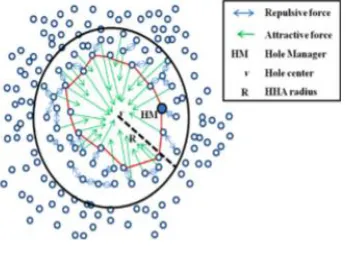
Fig 2: healing process
We defined an attractive force that acts from the hole center and attracts the nodes towards the hole center. At the
same time, a repulsive force is defined among nodes to minimize the overlapping among them (see fig2). These forces
will be effective in a limited area, which we call the HHA. The proposed algorithms consist of hole detection and hole healing steps. The identification of holes in a wireless sensor network is of primary interest since the breakdown of sensor nodes in a larger area often indicates one of the special events to be monitored by the network in the first place (e.g. outbreak of a fire, destruction by an earthquakes etc.). This task of identifying holes is especially challenging since typical wireless sensor networks consist of lightweight, low capability nodes that are unaware of their geographic location. But there is also a secondary interest in detecting holes in a network recently routing schemes have been proposed that do not assume knowledge of the geographic location of the network nodes. Our hole detection algorithm is based purely on the topology of the communication graph, i.e. the only information available is which nodes can communicate with each other.
First we have to access the existence of a hole, which is done by identifying stuck nodes All the nodes that are marked as stuck nodes. From this module we can identify the hole characteristics such as hole position and radius. DHD is the algorithm used for the detection of the holes, it can detect multiple number of holes in WSN. DHD is a distributed and localized hole detection algorithm that operates over the Gabriel graph of the network.
Algorithm:
Hole detection & Healing :
1) Initialize the Htimer and Neigh_timer 2) If timer expire
– generate the hello message
• Attach
– node id
– Position info
– Broadcast Hello message
– Set new schedule for next hello 3) If hello received
– Check in neigh_table
• If sender info already found
– Increase the expire time
• Else
ISSN(Online): 2320-9801
ISSN (Print): 2320-9798
International Journal of Innovative Research in Computer
and Communication Engineering
(An ISO 3297: 2007 Certified Organization)
Vol. 3, Issue 8, August 2015
4) If neigh_timer expires
– If neigh_info expire
• Delete
• Set as failed neighbor
• Share the info to next neighbors
– Set new schedule for next verification 5) If failure sharing receive
– If Hole id is same but not generated by own
• Make confirmation of node failure
• Cal max dist from orignator
• Send to next node with own info
– Else if own pkt recv
• Set as HM
• Calc hole dist
• Calc hole center point
– Else
• If hop count < Th_hop
– Forward to next node 6) If the node is HM
– Send healing message
• Update hole point
• Update Distance to hole 7) If Healing message is received
– Checks the hole point & dist
– If own dist less then HM dis
• Start move to center point to the hole point
In our proposed system we have developed actor node for healing the hole in the network. Hole will be occurred due to the inner nature of WSNs, random deployment, environmental factors, and external attacks. During normal operation of the network, a great loss of nodes occurs, due to an external attack for example, causing the creation of one or several large holes within the network making it ineffective.
IV.SIMULATION RESULTS
For evaluating the performance of the proposed system, the Hole Healing Algorithm has been taken. This is implemented on NS2. The figure above shows the Hole Healing result. Here we can see 15 nodes and one actor node. Actor node is a mobile sensor node. It moves at where the hole is detected and temporarily healing process is preceded. By this we can avoid the packet loss. Mean while we detect the node that is to be acted as bridge for healing the hole. We compare some performance characteristics of existing and the proposed systems. The no. of nodes moves and delay characteristics of of the proposed system with the existing technique is compared here. The results are showed in Xgraph.
No. of nodes moved: The movement of nodes in the existing and proposed system is compared and examined. The
X-graph figure shown below represents this comparison
ISSN(Online): 2320-9801
ISSN (Print): 2320-9798
International Journal of Innovative Research in Computer
and Communication Engineering
(An ISO 3297: 2007 Certified Organization)
Vol. 3, Issue 8, August 2015
Fig3: No. of nodes moved
Delay analysis: The figure below shows the delay comparison of the existing and the proposed system. The delay of
the proposed system is much less than that of existing system.
Fig4: Delay Analysis
PDF (Packet delivery fraction) Comparison: The PDF is higher in the recovery schemes and lower in the failure
ISSN(Online): 2320-9801
ISSN (Print): 2320-9798
International Journal of Innovative Research in Computer
and Communication Engineering
(An ISO 3297: 2007 Certified Organization)
Vol. 3, Issue 8, August 2015
Fig5: PDF Comparison
V. CONCLUSION AND FUTURE WORK
This paper has proposed and implemented a lightweight and comprehensive two-phase protocol, HEAL, for ensuring area coverage employing a mobile WSN. The protocol uses a distributed DHD to detect holes in the network.. Compared to the existing schemes, DHD has a very low complexity and deals with holes of various forms and sizes despite the nodes distribution and density. By exploiting the virtual forces concept, our approach relocates only the adequate nodes within the shortest time and at the lowest cost.
Through the performance evaluation, we validated HEAL, using different criteria and showed that it detects and heals the holes despite their number or size with less mobility in various situations. The evaluation results demonstrate that HEAL provides a cost-effective and an accurate solution for hole detection and healing in mobile WSNs. In the future, we plan to investigate the interaction between HEAL and the network layer for hole detection and healing.
REFERENCES.
1. N. Ahmed, S.S. Kanhere, and S. Jha, “The Holes Problem in Wireless Sensor Networks: A Survey,” SIGMOBILE Mobile Computing Comm. Rev., vol. 9, no. 2, pp. 4-18, 2005.
2. B. Wang, Coverage Control in Sensor Networks. Springer, 2010.
3. B. Kun, T. Kun, G. Naijie, L.D. Wan, and L. Xiaohu, “Topological Hole Detection in Sensor Networks with Cooperative Neighbors,” Proc. Int’l Conf. Systems and Networks Comm. (ICSN ’06), p. 31, 2006.
4. R. Ghrist and A. Muhammad, “Coverage and Hole-Detection in Sensor Networks via Homology,” Proc. Fourth Int’l Symp. Information Processing in Sensor Networks (IPSN ’05), pp. 254-260, Apr. 2005.
5. V. De Silva, R. Ghrist, and A. Muhammad, “Blind Swarms for Coverage in 2-D,” Proc. Robotics: Science and Systems, pp. 335-342, June 2005.
6. Spector, A. Z. 1989. Achieving application requirements. In Distributed Systems, S. Mullende.
7. Patcha; A. Mishra; Collaborative security architecture for black hole attack prevention in mobile ad hoc networks[C]; Radio and Wireless Conference, 2003, 75-78.
8. F. Stefan, “Topological Hole Detection in Wireless Sensor Networks and its Applications,” Proc. Joint Workshop on Foundations of Mobile Computing, p. 44-53, 2005.
9. D. Boneh; C. Gentry; B. Lynn; H. Shacham. “Aggregate and Verifiably Encrypted Signatures from Bilinear Maps”. Advances in Cryptology- EUROCRYPT’03: LNCS 2656. Berlin: SpringerVeralg, 2003. 416-432.
10. J.W. Cai; P. Yi, Y. Tian, Y.K. Zhou, N. Liu, The Simulation and Comparison of Routing Attacks on DSR Protocol[C], WiCOM 2009, in press.
11. .M. Shila; T. Anjali; Defending selective forwarding attacks in WMNs, IEEE International Conference on Electro/Information Technology, 2008, 96-101.
12. ] I.F. Akyildiz; X. Wang (2005). A Survey on Wireless Mesh Networks [J]. IEEE Communications Magazine, 43 (9), 23-30
ISSN(Online): 2320-9801
ISSN (Print): 2320-9798
International Journal of Innovative Research in Computer
and Communication Engineering
(An ISO 3297: 2007 Certified Organization)
Vol. 3, Issue 8, August 2015
14. S. Ganeriwal, A. Kansal, and M.B. Srivastava, “Self Aware Actuation for Fault Repair in Sensor Networks,” Proc. IEEE Int’l Conf. Robotics and Automation (ICRA ’04), pp. 5244-5249, May 2004.
15. C.Y. Chang, L.L. Hung, S.W. Chang, and Y.C. Chen, “Decentralized and Energy-Balanced Algorithms for Main- taining Temporal Full-Coverage in Mobile WSNs,” J. Wire- less Comm. and Mobile Computing , vol. 12, no. 5, pp. 445- 462, 2012.
G. Wang, G. Cao, and T.F.L. La Porta, “Movement-Assisted Sensor Deployment,” IEEE Trans. Mobile Computing, vol. 5, no. 6, pp. 640-652, June 2006.
BIOGRAPHY
Divya K Suku received her Bachelor of Engineering in Electronics and Communication Engineering from Anna
University, Chennai, 2013. At present, she is pursuing M.Tech in Communication Engineering at Caarmel Engineering College, Kerala, Affiliated to MG University. Her research interests include Digital Image Processing and Computer Networks.