ISSN(Online): 2320-9801
ISSN (Print): 2320-9798
International Journal of Innovative Research in Computer
and Communication Engineering
(An ISO 3297: 2007 Certified Organization)
Vol. 3, Issue 8, August 2015
Development of an Adaptive Hybrid
Algorithm for Congestion Control and
Bandwidth Utilization in a Mobile Network
G. K. Azever, S. M. Sani, A. M. S. Tekanyi
Department of Electrical and Computer Engineering, Ahmadu Bello University, Zaria, Nigeria
ABSTRACT: This research work developed an adaptive algorithm that hybridizes call admission control, bandwidth
degradation and load balancing congestion control techniques to improve bandwidth utilization and minimize congestion in mobile network. The developed hybrid algorithm is implemented using NetBeans IDE 6.9.1 platform to obtain performance metrics of blocking probability of new calls and dropping probability of handover calls. The simulation results obtained from the model recorded the New Call Blocking Probability (NCBP) of 0.003 and Handover Call Droppping Probability (HCDP) of 0.001. The developed model’s NCBP was better than the ITU-T benchmark standard of 0.01 and matched that of the HCDP of 0.001. Also, real life results from measured data of Etisalat mobile network and simulated data results of the developed model were validated using statistical Welch’s T-Test. The probability levels (p-values) of 0.034 for NCBP and 0.001 for HCDP obtained from T-Test, which are less than 0.05 imply that NCBP and HCDP reject the null hypothesis. Hence, there is significant difference between the developed hybrid model and existing model from Etisalat mobile network at 95% confidence level, which also indicates that the developed model has better performance.
KEYWORDS: Adaptive Algorithm; Call Admission Control; Bandwidth degradation; Load Balancing; Bandwidth
Optimization; Blocking Probability; Dropping Probability
I. INTRODUCTION
Congestion occurs when the demand for resources exceeds the available capacity, resulting in queuing in the network [1]. In GSM networks, congestion is caused by inadequate radio channels and infrastructure, traffic build up during peak periods and at hot spots on the network, inadequate dimensioning of the network, particularly the switching system, End-to-End System connections, as well as marketing strategies and pricing schemes [1], [2], [3], [4]. These factors overload the channel with packets (calls) thereby leading to a high number of loss calls due to block and drop calls. In order to address this problem, control mechanisms have been developed to reduce congestion related loss calls by minimizing the spread and duration of congestion [5]. In order to address congestion issue in a GSM network, most researchers have proposed and worked on several congestion control schemes, some of which are reviewed in this work.
II. RELATED WORKS
ISSN(Online): 2320-9801
ISSN (Print): 2320-9798
International Journal of Innovative Research in Computer
and Communication Engineering
(An ISO 3297: 2007 Certified Organization)
Vol. 3, Issue 8, August 2015
of [8]’s work was that it lacked the analytical model to back the design of the algorithm used. These reviewed works considered the congestion control mechanisms based on call admission control, bandwidth degradation, load balancing or any combination of the two techniques. They had high values of NCBP and HCDP congestion parameters and were unable to achieve the NCBP and HCDP minimum values of 0.01 and 0.001 recommended by ITU-T. However, this proposed hybrid model considers all the three control performance metrics to reduce loss calls and improve the quality of service of a GSM network.
III. KEY PERFORMANCE INDICATORS (KPIs)
The most valuable KPIs in this paper which serve as tools in achieving the implementation of the hybrid algorithm measure for congestion control in a GSM network are itemized hereunder.
3.1 Drop-Call Probability
This can be defined as the probability that an accepted call is first terminated before it completes the service. Drop-call probability is given by [9] as:
P(Y= )=( )
! , ≥0 (1)
where,
t = call duration
Y = random variable that counts the number of drops
n = the confirmed calls dropped
= drop-call rate and can be expressed as [10]:
= (2)
where,
= Number of Dropped Calls = Number of Call Attempts
This is a Poisson probability function with a discrete variable which accounts for the number of dropped calls.
3.2 New Call Blocking Probability (NCBP)
The NCBP is the probability that a new call will be blocked or rejected [11], [12].This probability can be expressed mathematically as:
= ×100% (3)
where,
= Number of blocked Calls = Total Number of Call Attempts
3.3 Handover Call Dropping Probability (HCDP)
The HCDP is the probability that a handover call is dropped or rejected. It measures service continuity during handover [11], [12].The HCDP can be expressed as:
HCDP
= ×100% (4)where,
= Number of Dropped Calls
=Total Number of Handover Calls attempts
IV. MODEL DEVELOPMENT METHODOLOGY
The hybrid scheme is the joint scheme which consists of call admission, bandwidth degradation, and load balancing control mechanisms jointly designed to improve bandwidth utilization and quality of service of the network. The designed methodology was carried out using the combined algorithms in Figure 1 and activities of the flowchart of the hybrid model represented in Figure 2. Simulation was used to obtain the results and the results of the developed model were validated against raw data from Etisalat mobile network, Abuja using Welch’s T-Test.
ISSN(Online): 2320-9801
ISSN (Print): 2320-9798
International Journal of Innovative Research in Computer
and Communication Engineering
(An ISO 3297: 2007 Certified Organization)
Vol. 3, Issue 8, August 2015
of 2.00GB, of 32bits, window 7) was used. The simulation of the developed hybrid model was carried out for an average of twenty four hours.
Figure 2: Flow Chart of Developed Hybrid Scheme [12]
V. RESULTS AND DISCUSSIONS
Here, discussions are centered on simulation and raw data results obtained, which were evaluated to establish the authenticity and improvement made by the developed model.
5.1 Simulation Results
The simulation results obtained from the developed algorithm on performance metrics of NCBP and HCDP were computed as presented in Table 1.
5.2 Results of Measured Data
ISSN(Online): 2320-9801
ISSN (Print): 2320-9798
International Journal of Innovative Research in Computer
and Communication Engineering
(An ISO 3297: 2007 Certified Organization)
Vol. 3, Issue 8, August 2015
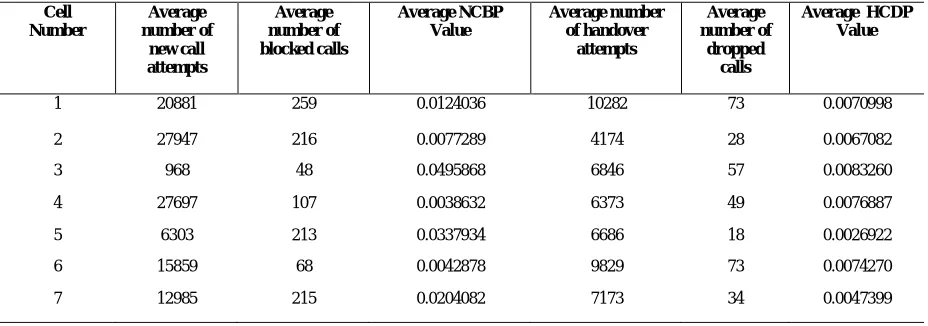
KAD2433, KAD2466_2, KAD2466_1 and KAD2466_3, which were represented as Cells 1, 2, 3, 4, 5, 6 and 7 to correspond with the simulated joint scheme cells. The average call parameters of measured data were computed for each traffic cell to obtain the NCBP and HCDP values as shown in Table 2. These results were used to test the validity of developed model by using statistical Welch’s T-Test and the standard ITU benchmark.
Table 1: Simulation Results
Cell Number Average number of new call attempts Average number of blocked calls Average NCBP Value Average number of handover attempts Average number of dropped calls
Average HCDP Value
1 4316 11 0.002548 2927 2 0.0006828
2 3052 18 0.005877 2608 3 0.0011503
3 3484 6 0.001722 2296 4 0.0017422
4 4656 23 0.004940 3276 9 0.0027473
5 3208 8 0.002494 2212 2 0.0009042
6 2981 12 0.004025 2875 0 0.0000000
7 4288 4 0.000932 2432 3 0.0012335
Table 2: Measured Data Results
Cell Number Average number of new call attempts Average number of blocked calls Average NCBP Value Average number of handover attempts Average number of dropped calls
Average HCDP Value
1 20881 259 0.0124036 10282 73 0.0070998
2 27947 216 0.0077289 4174 28 0.0067082
3 968 48 0.0495868 6846 57 0.0083260
4 27697 107 0.0038632 6373 49 0.0076887
5 6303 213 0.0337934 6686 18 0.0026922
6 15859 68 0.0042878 9829 73 0.0074270
7 12985 215 0.0204082 7173 34 0.0047399
5.3 Validation of Results
Validation was carried out by comparing the developed model results with Nigerian Communication Commission (NCC) and ITU-T standards, as well as comparing them with measured data obtained from Etisalat mobile network using Welch’s t-test.
5.4 Model Validation Using NCC and ITU-T Standards
ISSN(Online): 2320-9801
ISSN (Print): 2320-9798
International Journal of Innovative Research in Computer
and Communication Engineering
(An ISO 3297: 2007 Certified Organization)
Vol. 3, Issue 8, August 2015
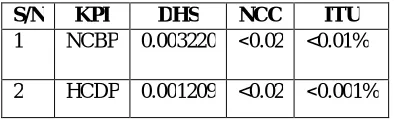
Table 3: Developed Model versus NCC and ITU-T
S/N KPI DHS NCC ITU
1 NCBP 0.003220 <0.02 <0.01%
2 HCDP 0.001209 <0.02 <0.001%
From the results in Table 3, the NCBP value of 0.003 and HCDP of 0.001 for the developed hybrid model met the NCC benchmark of less than 0.02. Also, the developed model results met ITU-T benchmark of 0.01 for NCBP and 0.001 for HCDP. Hence, the developed hybrid scheme algorithm for call admission, bandwidth degradation and load balancing control mechanisms showed better performance in terms of both blocking and dropping probabilities.
5.5 Model Validation using Welch’s T-Test
The results of the Measured Data (MD) and Simulated Data (SD) performance metrics of NCBP and HCDP were inserted and run using IBM SPSS statistics 20 software tools. The t-test results of the NCBP and HCDP metrics obtained were extracted as shown in Table 4 and Table 5, respectively.
5.5.1 NCBP T-Test Results
The results of the independent-sample t-test for NCBP between MD and SD are shown in Table 4.
Table 4: Results of T-Test on NCBP
NCBP N Mean SD t-value P
MD 7 0.01887 0.01719 2.396 0.034
SD 7 0.00322 0.00178
From the result of Table 4, t-value (k=12) = 2.396, P = 0.034.Since P is less than α (0.05), therefore, the null hypothesis is rejected, which means that there is significant difference between the developed model and existing model [13].This indicates that the developed hybrid model is of better performance when compared with the existing model used by Etisalat mobile network.
5.5.2 HCDP T-Test Results
Similarly, the results of the independent-sample t-test for HCDP between MD and SD are shown in Table 5.
Table 5: Results of T-Test on HCDP
HCDP N Mean SD t-value P
MD 7 0.00638 0.00198 6.338 0.001
SR 7 0.00121 0.00865
ISSN(Online): 2320-9801
ISSN (Print): 2320-9798
International Journal of Innovative Research in Computer
and Communication Engineering
(An ISO 3297: 2007 Certified Organization)
Vol. 3, Issue 8, August 2015
VI. CONCLUSION AND FURTHER WORK
The algorithm was developed and implemented on a NetBeans IDE 6.9.1. Based on the simulation results of 0.003 for NCBP and 0.001 for HCDP, the developed hybrid model achieved better performance and good quality of service for a GSM mobile network. This work can be improved by using a heterogeneous network to ascertain the metrics values of NCBP and HCDP.
REFERNECES
[1] E. K. Akut and S. M. Sani, ‘Identification and modelling of dominant causes of congestion in a fixed-line network’, International Refereed Journal of Engineering and Science (IRJES), vol.2, pp 09-17, 2013.
[2]B. M. Kuboye, B. K. Alese, and O. Fajuyigbe.Congestion Analysis on the Nigerian Global System for Mobile Communications (GSM) Network .Pacific Journal of Science and Technology, 10(1):262-271, 2009.
[3]A.S. Adegoke and I.T. Babalola,’Qualityof service analysis of GSM telephone system in Nigeria’. American journal of scientific and industrial science 2(5):707-712, 2011.
[4]K. Ofomaja,E.Osunkwor, and S.O. Azi ‘Analysis of trafffic congestion in a well established cellular network in Asaba, Delta State Nigeria’. International Journal of Scientific and Engineering Research 4(6):1040-1045. 2013.
[5]H. Johansson, and J Steensland,. ‘A Performance Characteristic of Load Balancing Algorithms for Parallel SAMR Applications. Retrieved on June10, 2012from www.it.uu.se/research/publications/lic/2006-010/paperC.pdf.
[6] N. Nasser and H. Hussanein, ‘Combined Admission Control Algorithm and Bandwidth Adaptation Algorithm in Multimedia Cellular Networks for QOS Provisioning’. IEEE, pp 1183-1186, 2004.
[7] M. Sanabani, S. Shamala, M. Othman and J. Desa, ‘Adaptive Call Admission Control for Prioritized Adaptive Services in Wireless/Mobile Multimedia Cellular Networks’. IJCSNS, International Journal of Computer Science and Network Security, vol.6, pp 114-124, 2006.
[8]M. A. Alarape, A. T Akinwale, and O. Folorunso, ‘ A Combined Scheme for Controlling GSM Network Calls Congestion’’, International Journal of Computer Applications, vol.14, pp 0975 – 8887, 2011.
[9]G Boggia, P. Camarda and A. D’Alconzo, Modeling of Call Dropping in Well-Established Cellular Networks .EURASIP Journal on Wireless Communications and Networking, Vol. 2007, Article ID17826pp 1-10, 2007.
[10]O. Shoewu and F. O. Edeko, ‘Outgoing Call Quality Evaluation of GSM Network Services in EPe, Lagos State’. American Journal of Scientific and Industrial Research, 10(2): 409-417, 2011.
[11] S.S. Rappaport, ‘The multiple-call hand-off problem in high-capacity cellular communications systems’,IEEE Transactions on Vehicular Technology, 40(3):546-557, 1991.
[12] G. K, Azever, S. M. Sani, and A. M. S Tekanyi, ‘Development of an Adaptive Algorithm for Bandwidth Optimization and Congestion Control in a GSM Network: A Case Study of Etisalat’, M.Sc Disertation, Department of Electrical Engineering, Ahmadu Bello University, Zaria, 2015 [13]B. A. Samah, ‘Introduction to T-Test Statistics Test Statistics’. Department of Professional Development andContinuing Education Faculty of Educational Studies University Putra Malaysia 43400 Serdang Selangor, pp 22-52, 2008.
BIOGRAPHY