Copyright to IJIRSET www.ijirset.com
253
ENTERPRISES
Mr.T.Varun Kumar
1, Dr.B.Ganesh Babu
2,
Dr.M.Saravanan
3and
Dr.M.Murugan
41
Research Scholar(PT), Dept. of Mechanical Engg., Roever College of Engg&Technology,Perambalur, INDIA
2
Principal, Roever College of Engg & Technology, Perambalur, INDIA
3
Principal, C.R College of Engineering, Madurai, INDIA
4
Principal, RathinamInstitue of Technology, Coimbatore, INDIA
ABSTRACT:-Agile manufacturing is a term applied to an organization that has created the processes, tools, and training to enable it to respond quickly to customer needs and market changes while still controlling costs and quality. An enabling factor in becoming an agile manufacturer has been the development of manufacturing support technology that allows the marketers, the designers and the production personnel to share a common database of parts and products, to share data on production capacities and problems particularly where small initial problems may have larger downstream effects. Understand the roles and responsibilities of Six Sigma practitioners. Identify the benefits of Six Sigma as a business improvement methodology. The various process times for manufacturing a mono block pump were obtained from a pump manufacturing industry. A flow diagram showing the process is drawn to reflect the current state of the operation. This makes the redesigned process more effective and efficient. By reducing wastefulness the proportion of value adding time in the whole process rises and speed is increased. This project addresses the application of agile manufacturing concepts to the small scale pump manufacturing industry for increasing the production time and profit level.
Keywords:Agile Manufacturing (AM), Small Medium Enterprise (SME), Value Stream Mapping, Agilty.
1.0INTRODUCTON
India is one of the fast developing countries in the world. Indian economy is mainly driven by small and medium scaleenterprises. Because most of the SMEs are owned by Indian citizens. They face a huge challenge due to open economy. Higher productivity, good quality & flexibility to changing market needs are “The need of the hour” for SMEs. But usage of agile/lean manufacturing technique is not focused in SMEs.
Implementation of concepts like Agile/Lean Manufacturing in SMEs lack popularity due to the following reasons.
Lack of training Lack of resources
Huge cost involvement as experts needs to be hired Time consuming activity
Sri Krishna College of Engineering & Technology, Kuniamuthur, Coimbatore-641008, Tamilnadu, India
Copyright to IJIRSET www.ijirset.com 254 Our project mainly focuses on making the implementation of Agile/Lean Manufacturing easy in SMEs. This will play a major role in increasing the quality of the products and productivity of those enterprises.
During the past three decades, majority of the countries have witnessed the globalisation of their markets. As a result of globalisation, the companies restricting their operations within the national markets have been forced to compete with the products and services offered by multinational companies. The other development is that, numerous companies operating in different countries have begun to enter into the markets operating in various countries.
These developments have resulted in the removal of trade barriers which were existing earlier along the borders of the countries. This phenomenon has been forcing the organisations to orient their strategies towards reaching world class manufacturing goals. However, this task is found to be challenging as world class manufacturing requirements demand high degree of quality of products and services at low prices. In order to face these challenges, the manufacturing frontiers have been advocating the adoption of lean manufacturing paradigm.
2.0AGILITY FROM LEAN
Manufacturing organisations are facing challenges from two directions. In one direction, newer manufacturing technologies emerge to make the existing ones outmoded. In the other direction, today’s customers are demanding more and more new products and services within a short period of time. In order to meet these two challenges, today’s manufacturing organisations are required to act quickly in accordance with the changing situations. On realising this trend, during the recent years, the manufacturing arena has been inclining towards the new type of paradigm. The researchers have named this paradigm as “Agile Manufacturing”. Number of academicians and manufacturers view AM as a new approach. As a matter of fact, agility in manufacturing arena has been occurring as the spontaneous responsiveness to high degree of competition.
As evidence to this statement, the performance of today’s mobile phones manufacturing companies can be mentioned. It is a common observation that these companies have been introducing several models very frequently. During the recent years, many automobile manufacturing companies have also been evolving new models at a quicker speed.Researchers had been examining AM issues clearly for more than a decade.
The study of literature in this direction reveals that the birth of AM principles is marked by the constitution of ‘Agility Forum’ by a group of researchers. Thereafter aa few researchers have contributed very valuable AM principles. Some of the meanings and definitions enlisted by them are presented below: Agility means a manufacturing system with
Agile Manufacturing = Flexible
Copyright to IJIRSET www.ijirset.com
255 manufacturing that is a development from the concept of lean manufacturing. The requirement to become more flexible and responsive to customers led to the concept of agile manufacturing as a variation from the lean concept. This situation persists because majority of the manufacturers are lacking knowledge on AM criteria. Rather they progress towards agility by attempting to implement various criteria using unfocussed and crude methods. This approach results in retarded growth of agility in organisations.
3.0 DESIGNING AN USER FRIENDLY TOOL FOR FLOW ANALYSIS
Selection of pilot company Study of the process Video shoot of the process
Extract information from video by using Subtitle Edit Software Design template for calculation using a statistical software Analysis using statistical software
Presentation to management Training to their employees
3. 1SELECTION OF PILOT COMPANY
The first step involves the selection of pilot company to implement the new tool designed for flow analysis. Another important process before this is to select the field in which the flow analysis has to be done. So we decided to choose pump manufacturing sector. As this project’s main aim is to implement the flow analysis tool in small and medium scale industries, we selected pump assembly in SME.
3.2 STUDY OF THE PROCESS
To know about the flow analysis, the assembly process of pump has to be studied. So we have to take a keen look on theassembly process undergone in the company. This will give us a brief idea about the flow of process in the selected company.
3.3 VIDEO SHOOT OF THE PROCESS:
Sri Krishna College of Engineering & Technology, Kuniamuthur, Coimbatore-641008, Tamilnadu, India
Copyright to IJIRSET www.ijirset.com 256 Fig. 1Video Shoot During Process
3.4 EXTRACT INFORMATION FROM VIDEO BY USING SUBTITLE EDIT SOFTWARE
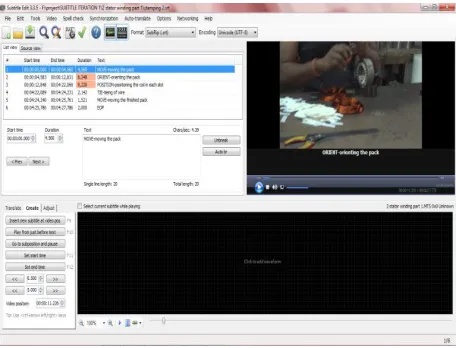
After shooting the flow process, it should be arranged according to process flow. To calculate the process time, software called “subtitle edit” is used. By using the process flow as input to the software, videos are sub-titled according to the flow process. After the sub-title process, exporting of the subtitle text with time to notepad. Then this should be transferred to an excel sheet. By using the basic formulas, the process time of the process can be found in the excel sheet. This will help us to find the time taken for any process that is video shot.
Copyright to IJIRSET www.ijirset.com
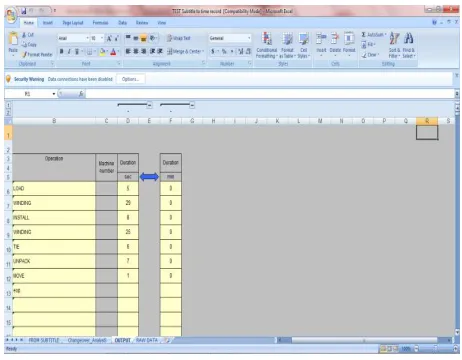
257 A template is created to calculate the value or non-value added processes. This sheet is created by using the statistical software namely Microsoft Excel. After creating the template, the subtitle text is imported into it. From this the cycle time can be found. Then another template is created to find non-value and value added processes. This can be done by importing the cycle time from the first template.
Fig. 3 Creating the Templ
3.6 PROCESS AND CYCLE TIME
Here we have listed the process cycle time for the production of parts and they are:
Process (Sec)
Coil forming part 1 81
Stator winding part 1 265
Coil forming part 2 81
Stator winding part 2 213
Starting and running winding
Insulation lead out and binding 312
Sri Krishna College of Engineering & Technology, Kuniamuthur, Coimbatore-641008, Tamilnadu, India
Copyright to IJIRSET www.ijirset.com 258 Stator core pressing in to body 64
Stator final assembly 257
Pump pre assembly with stator and
Rotor 284
Pump final inspection 99
Pump final assembly 250
Labeling 21
Name plate fixing 47
Plastic wrapping 30
Final packing 119
Copyright to IJIRSET www.ijirset.com
259 Fig.5Value and Non -Value added time is Identified
Fig.6Final Value and Non -Value added time
3.7 PRESENTATION TO MANAGEMENT
After finding the solution to the problem, all the non-value added process is reduced. Then it should be presented to the management of that company to get their approval. This includes the explanation of all the procedures done by us to reduce the non-value added time.
3.8 TRAINING TO THEIR EMPLOYEES
Sri Krishna College of Engineering & Technology, Kuniamuthur, Coimbatore-641008, Tamilnadu, India
Copyright to IJIRSET www.ijirset.com 260 4. 0 IMPLEMENTATON OF AGILE IN SME
In small medium enterprise level many of the workers are lack about agility and following agile manufacturing is costlier and no owners come forward to practice the system. SME is one of the backbone to our nation and most of Indian owners have practicing the SME. If we providing a simple tool in an easier way, many of SME will come forward and follow the system which leads to the drastic change in the quality and production environment. Thus considering this factor we have created a effective and dynamic tool for the lead time reduction in the pump industry.
5.0 CONCLUSION AND FUTURE WORK
This project can be extended by trying to formulate a Value Stream Mapping (VSM) for each sections present in a particular SME. Through the so far done process the NVA (Non Value Added) process are identified and are eliminated to decrease the cycle time. The cycle time can be immediately reduced, by removing the bottlenecks in the system. All the data needed for VSM has been gathered. A future state map should be developed along with a current state map. The future and current state maps are compared and the bottlenecks are identified and focus will be on to eliminate those and implement the future state map in the SME and reduce the lead time. This project will bring a great improvement in the SME economy which ultimately helps the country’s economy grow. This also helps in popularizing the field of Lean techniques which brings a major increase in productivity. A company’s sustainability mainly depends upon the QCDM (Quality, Cost, Delivery and Morale) factor. This also has been improved to a considerable extent.
REFERENCES
1.Anderson, R., Eriksson, H. and Torstensson, H. (2006), “Similarities and deifferences between TQM ,Six Sigma and Lean”, The TQM Magazine, Vol.18, No.3, pp.282-296.
2.Ashley,S., (1997), “Rapid – response design”, Mechanical Engineering- CIME, Vol .119, No.12,p. 72(3).
3.Assen,M.F., Hans,E.W and Velde,S.L., (2000), “An agile planning and control framework for customer-order driven discrete parts manufacturing environments”, International Journal of Agile Management Systems, Vol.2, No.1, pp. 16-23.
4.Christopher,M and Towill.D.R., (2000), “Supply chain migration from lean and functional to agile and customised”, Supply Chain Management: An International Journal, Vol.5, No.4, pp. 206-213.
5.Malek,L.A, Das,S.K and Wolf,C., (2000), “Design and implementation of flexible manufacturing solutions in agile enterprises”, International Journal of Agile Management Systems, Vol.2, No.3, pp187-195.
6.Onuh,S.O and Hon, K.K.B., (2001),” Integration of rapid prototyping technology into FMS for agile manufacturing” Integrated Manufacturing Systems, Vol 12, No3 , pp. 179 – 186.
7.Owusu,Y.A, (1999), “Importance of employee involvement in world class agile management systems”, International Journal of Agile Management Systems, Vol.1, No.2, pp.107-115.
8.Paixao,A.C and Marlow,P.B., (2003) “ Fourth generation ports – a question of agility”, International Journal of Physical Distribution and Logistics Management,.33, No.4, pp 355-376.
9.Parkinson,S., (1999), “Agile Manufacturing”, Work Study, Vol.48, No.4, pp.134-137.
10.Process Benchmarking through Lean Six Sigma for ERP Sustainability in Small & Medium Enterprises ,Rashmi Jha1 and A. K. Saini2,Submitted in May 2011; Accepted in July 2011.
11.Lixia Chen &BoMeng, “The Application of Value Stream Mapping Based Lean Production System”,InternationalJornal of Business and Management (2010) Vol.5 pp203-208.