ABSTRACT
KILIC, ALI. Improving Electret Filter Efficiency by Modifying Fibrous Webs with Melt Additives. (Under the direction of Dr. Behnam Pourdeyhimi and Dr. Eunkyoung Shim).
Improving Electret Filter Efficiency by Modifying Fibrous Webs with Melt Additives
by Ali Kilic
A dissertation submitted to the Graduate Faculty of North Carolina State University
in partial fulfillment of the requirements for the Degree of
Doctor of Philosophy
Fiber and Polymer Science
Raleigh, North Carolina 2012
APPROVED BY:
____________________ _____________________ _________________ Dr. Richard Spontak Dr. Saad A. Khan Dr. Bong Yeol Yeom Committee member Committee member Committee member
BIOGRAPHY
ACKNOWLEDGMENTS
This dissertation work would have never been accomplished without the valuable guidance and support of Dr. Behnam Pourdeyhimi, Dr. Eunkyoung Shim, and Dr. Bong Yeol Yeom. This is almost 4 year with them which was extremely enlightening to draw my future. I have learned tremendously from them to improve my writing, presentation, and technical skills as well as methodologies for solving problems. I am extremely thankful to Dr. Richard Spontak and Dr Saad Khan for valuable discussions and agreeing to be on my graduate committee.
I wish to acknowledge the financial support of this research by the Nonwoven Research Cooperative Center (NCRC). Special thanks to Dr. Benoît Mazé, Dr. Nagendra Anantharamaiah, Dr. Yogeshwar Velu (DuPont), Y. van der Zijpp (Colbond), Steve Cox and Dave Healey (H&V) for their help and fruitful discussions during the research. I would also like to thank Amy Minton, Birgit Andersen, Roberto Garcia, Chuck Mooney for their patience during analyzing my samples. I would also like to thank my friends especially “NCRC student members” who have made my graduate school years bearable even sometimes enjoyable. I would like to extend my appreciation to our Turkish community in the Triangle area.
TABLE OF CONTENTS
LIST OF TABLES ... viii
LIST OF FIGURES ... ix
1 Introduction ... 1
1.1 References ... 6
2 Literature Review ... 7
2.1 Electrets ... 7
2.2 Electret Filters ... 9
2.3 Basic Electret Characteristics ... 18
2.3.1 Charging and Polarization Phenomena ... 19
2.3.2 Charge Motions within Electrets ... 27
2.4 Methods for Producing Electret Filters ... 31
2.4.1 Corona Discharge... 31
2.4.2 Triboelectrification ... 36
2.4.3 Liquid Contact ... 43
2.4.4 Electrospinning ... 45
2.5 Additives for Improving Electret Properties of PP ... 46
2.5.1 High Dielectric Constant Inorganic Additives ... 47
2.5.2 Nucleating Agents ... 55
2.5.3 Antioxidants ... 70
2.5.4 Oily Mist Resisting Agents ... 94
2.6 References ... 97
3 Optimizing Charging Properties of BaTiO3/Polypropylene Composite Filaments ... 117
3.1 Introduction ... 118
3.2 Materials & Methods ... 120
3.3 Results and Discussion ... 125
3.3.1 Microstructure ... 125
3.3.2 Surface Potential Decay Tests ... 131
3.4 Conclusion ... 136
3.5 References ... 136
4 Improving Electret Properties of PP Filaments with Barium Titanate ... 142
4.1 Introduction ... 142
4.2 Materials & Methods ... 146
4.2.1 Material and Filament Preparation... 146
4.2.2 Charging and Characterization of Charging Property ... 147
4.3.1 Fiber Structure ... 151
4.3.2 Electret Properties of Barium Titanate Containing PP Filaments ... 158
4.4 Discussions ... 162
4.5 Conclusion ... 165
4.6 References ... 165
5 Filtration Properties of BaTiO3 Containing Meltblown Electret Filters... 170
5.1 Introduction ... 171
5.2 Materials & Methods ... 174
5.2.1 Materials ... 174
5.2.2 Methods... 174
5.3 Results and Discussions ... 179
5.3.1 Basic Web Properties ... 179
5.3.2 Surface Potential and Filtration Properties ... 181
5.3.3 Filtration Properties after Isothermal Potential Decay ... 188
5.3.4 Microstructural Properties of BaTiO3/PP Webs ... 190
5.4 Conclusion ... 192
5.5 References ... 192
6 Effect of Nucleating Agents on Electret Properties of Polypropylene Filaments ... 198
6.1 Introduction ... 199
6.2 Experimental ... 202
6.2.1 Sample preparation ... 202
6.2.2 Charging and Characterization of Charging Property ... 204
6.2.3 Fiber microstructure ... 205
6.3 Results ... 207
6.3.1 Fiber microstructure ... 207
6.3.2 Charging Properties ... 212
6.4 Discussion ... 219
6.5 Conclusion ... 220
6.6 References ... 221
7 Effects of Stabilizers on Charging of PP Filaments ... 225
7.1 Introduction ... 226
7.2 Materials & Methods ... 231
7.2.1 Material and Filament Preparation... 231
7.2.2 Fiber microstructure ... 232
7.2.3 Charging and Characterization of Charging Property ... 232
7.3 Results ... 234
7.3.1 Fiber Microstructure ... 234
7.3.2 Charging Properties ... 237
7.4 Conclusion ... 241
8 Effect of Heat Treatment on Charging Properties of Electret Fibers ... 247
8.1 Introduction ... 247
8.2 Experimental ... 254
8.2.1 Materials and Filament Preparation ... 254
8.2.2 Charging and Characterization of Charging Property ... 255
8.2.3 Surface Crystallinity Analysis ... 257
8.3 Results and Discussions ... 258
8.4 Conclusion ... 264
8.5 References ... 264
9 Aerosol Filtration Properties of Nucleating Agent Containing Electret Filters ... 269
9.1 Introduction ... 269
9.2 Experimental ... 272
9.3 Results and Discussions ... 277
9.3.1 Analysis of DMDBS/PP Meltblown Webs ... 277
9.3.2 Analysis of NA11/PP Meltblown Webs ... 282
9.4 Conclusion ... 291
9.5 References ... 291
10 Effect of Stabilizers on Corona Discharged PP Electret Filters ... 295
10.1 Introduction ... 296
10.2 Experimental ... 297
10.3 Results and Discussions ... 303
10.3.1 Analysis of Irgafos/PP Meltblown Webs ... 303
10.3.2 Analysis of Tinuvin/PP Meltblown Webs ... 310
10.4 Conclusion ... 317
10.5 References ... 317
11 Effect of Surface Morphology on NA11 containing PP Electret Filters ... 323
11.1 Introduction ... 323
11.2 Experimental ... 326
11.3 Results and Discussions ... 330
11.4 Conclusions ... 336
11.5 References ... 336
12 Overall Conclusions ... 343
13 Suggested Future Works ... 345
13.1 References ... 347
14 Measuring Electrostatic Properties of Fibrous Materials: A Review and a Modified Surface Potential Decay Technique ... 348
14.1 Introduction ... 348
14.2 Literature Review ... 349
14.3 Experimental ... 357
14.3.1 Material ... 357
14.3.2 Corona Discharge... 358
14.3.3 Electrostatic Voltmeter ... 359
14.3.4 Sample Preparation for ISPD Test ... 359
14.4 Results and Discussion ... 360
14.4.1 Results ... 360
14.4.2 Discussion ... 366
14.5 Conclusion ... 368
LIST OF TABLES
Table 2.1 Capture mechanisms in submicron range ... 12
Table 2.2 Defective structures, their origins and effects [adapted from17,32]... 22
Table 2.3 Liquids for contact electrification83 ... 45
Table 2.4 Dielectric properties of ABO3 perovskite structures 41 ... 49
Table 2.5 Electret properties of trisamide based nucleating agents containing PP films117 ... 68
Table 2.6 Change in O/C ratio on surface and contact angle upon corona discharge142 ... 78
Table 2.7 Antioxidants, general classification ... 82
Table 3.1 DSC analysis of reference and modified samples ... 127
Table 4.1 Detailed crystal analyses for various BaTiO3 concentrations. (Since BaTiO3 peaks for 0.01%, 0.1% concentrations were not clear, they were not included) ... 155
Table 5.1 Temperature profile of MB process ... 175
Table 6.1 Detailed WAXD analysis for various nucleating agent concentrations ... 211
Table 9.1 Temperature profile of MB process ... 274
Table 10.1 Temperature profile during meltblowing process ... 299
LIST OF FIGURES
Figure 1.1 Effect of electrostatic charging on total filtration efficiency 4 ... 2
Figure 2.1 Mechanical capture mechanisms [adapted from 5] ... 11
Figure 2.2 Aerosol capture mechanisms [adapted from 10] ... 12
Figure 2.3 Comparison between mechanical and electrostatic filtration 9 ... 13
Figure 2.4 Efficiency for mechanical capture mechanisms12 ... 14
Figure 2.5 Schematic representation of state density within a dielectric [adapted from17] .... 20
Figure 2.6 TSD curve for pure PP obtained by Kravtsov et al 33... 24
Figure 2.7 Frequency dependence of polarization mechanisms in dielectrics [adapted from 41,43 ] ... 27
Figure 2.8 Hopping and tunneling mechanisms [adapted from 31] ... 29
Figure 2.9 Current distribution on corona region and sample ... 33
Figure 2.10 Triboelectric series of common materials [Adapted from 74] ... 38
Figure 2.11 Hydroxide adsorption model for nonionic polymers [adapted from 71] ... 41
Figure 2.12 Electret charge technique from 82 ... 44
Figure 2.13 Atomic structure of BaTiO3 crystal and crystal structures under various temperatures ... 51
Figure 2.14 Dielectric constant of barium titanate depending on grain size and temperature 52 Figure 2.15 Crystal forms within 43-48° diffraction angles 105 ... 55
Figure 2.16 Crystal structure before and after nucleating agent ... 56
Figure 2.17 Changes in crystallization temperature, clarity and crystallization half-time [adapted from 108,111] ... 59
Figure 2.18 Elongated cavities formed upon modification with NA11 [adapted from89] ... 66
Figure 2.19 Schematics for percolation concentration ... 67
Figure 2.20 Loss of tertiary H and crosslinkage in PP ... 72
Figure 2.21 Initiation of oxidation reaction for PP130 ... 73
Figure 2.22 Possible propagation mechanisms during the oxidation of PP130 ... 74
Figure 2.23 Termination processes upon oxidation130 ... 75
Figure 2.24 TSC and SPD test performed by 133 ... 79
Figure 2.25 Primary antioxidants and H donoring mechanism ... 83
Figure 2.26 Functional groups that have chromophoric effects. ... 86
Figure 2.28 Chemical structure and acting mechanism of Irgafos168 ... 88
Figure 2.29 Chemical structure and acting mechanism of HALS149 ... 90
Figure 2.30 Fluorochemical oxazolidinones used in 157 ... 96
Figure 3.1 Specimen for ISPD test and surface potential detection points ... 122
Figure 3.2 Optical micrographs of the samples ... 125
Figure 3.3 DSC melting thermograms for samples. ... 126
Figure 3.4 WAXD spectra for reference and modified PP filaments. The spectra were recorded at angles covering three major characteristic diffraction peaks of the PP. ... 128
Figure 3.5 Crystal sizes calculated according to Schrerrer equation ... 129
Figure 3.6 Birefringence value for BaTiO3 containing filaments ... 131
Figure 3.7 Surface potential decay after charging for 1min ... 132
Figure 3.8 Initial surface potentials after charging for various times ... 133
Figure 3.9 Relaxation times for various charging times ... 134
Figure 3.10 log dV/dt vs log t curves ... 135
Figure 4.1 Arrangement of titanium, barium, and oxygen ions within BaTiO3 crystal ... 145
Figure 4.2 Specimen for SPD test and surface potential detection points ... 148
Figure 4.3 Optical micrographs of the samples with the indicated BaTiO3 content... 151
Figure 4.4 SEM images from the cross-section of 10% BaTiO3/PP filament ... 152
Figure 4.5 EDS mapping micrographs and elemental analysis of same specimen ... 153
Figure 4.6 X-ray diffraction diagram BaTiO3 containing filaments (detailed peak analysis was given in Table 4.1) ... 154
Figure 4.7 WAXD graphs after thermal charging. (T) indicates 1min thermal treatment at 130°C ... 156
Figure 4.8 Crystallinity of BaTiO3/PP filaments ... 157
Figure 4.9 SPD curves for BaTiO3/PP filaments. ... 159
Figure 4.10 Comparison of initial potential values of cold and thermally charged samples (after 1min charging) ... 160
Figure 4.11 Remaining potential percentages after keeping at 80°C for 24h ... 161
Figure 4.12 Comparison of calculated relaxation times of cold and thermally charged samples (after keeping 24h at 80°C) ... 163
Figure 5.1 Particle capture efficiency for conventional filters 3 ... 172
Figure 5.2 Surface potential measurement of MB webs ... 177
Figure 5.4 Fiber diameter and solidity of selected MB webs (box boundaries indicate upper and lower hinges, whereas dashed line stands for average fiber diameter, solid line for
median) ... 181 Figure 5.5 The effects of charging time and temperature on filtration efficiency (Efficiency for ~25 gsm, 1 layer 1% BaTiO3 containing sample) ... 182 Figure 5.6 Potential map for cold charged and thermal charged webs (charging distance:3cm, charging time 10min) ... 184 Figure 5.7 Penetration vs resistance curves of samples (dp: 0.3μm, u:5.3cm/sec) LR indicates linear regression on semilog plot, whereas As rec stands for as received and, CC for cold charged, TC for thermal charged ... 185 Figure 5.8 Quality factors calculated for 0.3µm DOP filtration at a face velocity of 5.3cm/sec ... 186 Figure 5.9 DOP penetration through 10% BaTiO3/PP web for various particle diameter ... 187 Figure 5.10 Filtration properties of thermally charged samples before and after accelerated decay test ... 189 Figure 5.11 X-ray diffraction patterns of samples (a)PP Control, as received, (b)PP Control, after thermal charging, (c)10%BaTiO3/PP, as received, (d)10%BaTiO3/PP, after thermal charging (The samples for WAXD analysis were taken from ones used in filtration) ... 191 Figure 6.1 Filtration test on commercial filter media. 0.3μm NaCl particles at u=5.3cm/sec ... 200 Figure 6.2 Chemistry of DMDBS (left) and NA11 (right) ... 203 Figure 6.3 Specimen for SPD test and surface potential detection points ... 204 Figure 6.4 Optical micrographs for samples containing 1% NA11 (left), 5% NA11 (right) Arrows indicate elongated cavities ... 207 Figure 6.5 Cross-sectional image of 5% NA11 containing fibers obtained via SEM ... 208 Figure 6.6 Difference between melting and crystallization temperatures, Δ(Tm-Tc) of
nucleating agent containing filaments ... 209 Figure 6.7 Crystal size in (110) planes of nucleating agent/PP filaments ... 210 Figure 6.8 Crystallinity values of nucleating agent/PP filaments calculated from DSC
Figure 6.12 Isothermal surface potential decay test on thermally charged DMDBS/PP
filaments and NA11/filaments ... 217
Figure 6.13 Initial potentials and relaxation times of thermally charged samples. (C) indicates cold charged, whereas (T) indicates thermally charged ... 218
Figure 7.1 Chemical structure and acting mechanism of Irgafos168 ... 229
Figure 7.2 Chemical structure and acting mechanism of HALS 21 ... 230
Figure 7.3 Specimen for SPD test and surface potential detection points ... 233
Figure 7.4 XRD spectra for reference and additive containing PP filaments. The spectra were recorded at angles covering three major characteristic diffraction peaks of the PP. (110), (040), (130) planes were indicated... 235
Figure 7.5 Changes in crystallization temperature upon addition of stabilizers ... 236
Figure 7.6 Crystallinity of the samples calculated from endothermic DSC curve ... 237
Figure 7.7 Isothermal surface potential decay curve at elevated temperatures [Real data from charged PP filaments] ... 238
Figure 7.8 Initial surface potential vs additive concentrations after 1min charging at 23°C. Filaments were arranged as shown in Figure 7.3. Shadowed region corresponds to deviation for PP Control sample. ... 239
Figure 7.9 Relaxation times after accelerated potential decay at 80°C. Shadowed region corresponds to deviation for PP Control sample... 240
Figure 8.1 Chemistry of NA11 ... 235
Figure 8.2 Specimen for SPD test and surface potential detection points ... 256
Figure 8.3 Isothermal surface potential decay at 80°C of heat treated PP filaments containing different concentrations NA11 ... 259
Figure 8.4 ATR analysis for PP filament and NA11 in powder form ... 260
Figure 8.5 Measured FTIR-surface crystallinity values for heat treated NA11 containing filaments ... 261
Figure 8.6 Surface crystallinity values compared to electret properties: Initial potential and relaxation time (Lines were given for ease of tracking) ... 262
Figure 8.7 Change in carbonyl index upon heat treatment at 70 and 110°C ... 263
Figure 9.1 Chemistry of DMDBS and NA11 ... 273
Figure 9.3 Fiber diameter, solidity and air permeability values for DMDBS containing webs (box boundaries indicate upper and lower hinges, whereas dashed line stands for average fiber diameter, solid line for median) ... 278 Figure 9.4 Filtration properties of cold and thermally charged DMDBS containing webs. Regression lines corresponds to PP Control sample for comparison ... 279 Figure 9.5 Quality factor vs concentration for DMDBS/PP webs (calculated from initial filtration and pressure drop values)... 280 Figure 9.6 Filtration properties of thermally charged DMDBS containing webs after 24h charge decay at 80°C Regression lines corresponds to PP Control sample for comparison 281 Figure 9.7 Quality factor vs concentration for thermally charged DMDBS/PP webs after annealing at 80°C for 24h ... 282 Figure 9.8. Fiber diameter, solidity and air permeability values for NA11 containing webs (box boundaries indicate upper and lower hinges, whereas dashed line stands for average fiber diameter, solid line for median) ... 283 Figure 9.9 Filtration properties of cold and thermally charged DMDBS containing webs. Regression lines corresponds to PP Control sample for comparison ... 284 Figure 9.10 Quality factor vs concentration for NA11/PP webs (calculated from initial
filtration and pressure drop values)... 285 Figure 9.11 Filtration stability of thermally charged NA11 containing webs. Regression lines corresponds to PP Control sample for comparison ... 286 Figure 9.12 Quality factor vs concentration for thermally charged NA11/PP webs after
Figure 10.3 Fiber diameter, solidity and air permeability values for Irgafos containing webs (box boundaries indicate upper and lower hinges, whereas dashed line stands for average fiber diameter, solid line for median) ... 304 Figure 10.4 Filtration efficiency of as received and cold charged Irgafos containing webs. Measured at a face velocity of 5.3cm/s using 0.3μm DOP particles ... 305 Figure 10.5 Comparison of filtration efficiency after cold and thermal charging. Measured at a face velocity of 5.3cm/s using 0.3μm DOP particles. Samples were charged for 10min and temperature was kept 130°C for thermal charging solid and dashed regression lines
Figure 11.4 Filtration properties of as received, cold charged, heat treated+cold charged
samples. Linear regression lines corresponds PP control sample for ease of tracking. ... 333
Figure 11.5 Drop in quality factors and change in surface crystallinty of heat treated NA11 containing samples ... 334
Figure 11.6 Surface crystallinity vs drop in quality factor. Error bars for measurement of 3 points. ... 335
Figure 14.1 Measurement of TSDC for charged fibrous samples (open circuit condition) [adapted from 11] ... 350
Figure 14.2 Simple schematic drawing of electrostatic voltmeter (adapted from 23) ... 354
Figure 14.3 Isothermal surface potential decay curve at elevated temperatures [Real data from charged PP filaments] ... 355
Figure 14.4 Specimen for ISPD test and surface potential detection points ... 360
Figure 14.5 Surface potential measurements after various fiber alignments ... 361
Figure 14.6 Surface potential decay of all 9 samples at 80°C ... 362
Figure 14.7 Average surface potentials of the samples that were charged on the same day 363 Figure 14.8 Initial potentials and calculated relaxation times of the samples ... 364
Figure 14.9 Surface potential decay test at various annealing temperatures ... 365
CHAPTER 1
1 Introduction
Aerosol filter media is a highly engineered nonwoven product designed to remove various suspended particles such as microorganisms, fine dusts, and pollens from the air stream. Production of air with the lowest concentration of suspended particles such as microorganisms, fine dusts, and pollens in indoor is still a challenging issue in both academic and industrial world. Increase in the number of pandemic cases, environmental pollution and strict clean room and operation room requirements forces high growth rates in filtration industry.
There are two main approaches to improve filter efficiency. One approach is the use of finer fibers, thus increasing the efficiencies of capture mechanisms such as diffusion and interception. However, this will also result in high pressure drop, which is unfavorable for filtration. A second approach -which is in the scope of this dissertation-, is imparting electrostatic charge on filtration medium without changing web structure. Those are called as “electret filters” or “electrostatic filters” 1
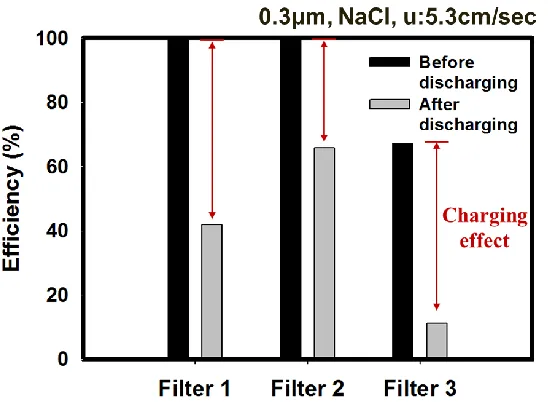
low resistance (3-6 mmH2O) compared to glass filter media. Electrostatic capture contribution on the efficiency of some commercial filter media is shown in Figure 1.14. In all three filters, discharging causes large drops in filtration efficiency since it removes contribution of electrostatic capture mechanism. It indicates electrostatic charge is essential part of such high efficiency filter products.
Figure 1.1 Effect of electrostatic charging on total filtration efficiency 4
filtration facilities of a medium size hospital may cause the death of tens in a couple of hours, which is irrecoverable. In semiconductor labs a minimal change in aerosol concentration will stop production for days, which means loss of millions of dollars. Although it may not be as important as previous scenarios, this will give irrecoverable damage to the fame of the hospitals and companies. Another important use of the electrets filters is facemasks. Again without electrostatics lower efficiency of facemasks against microorganisms at particular diameter range will allow penetration through respiratory system3. This will be fatal, since those portable devices are still a largely accepted solution for protecting individuals during pandemics. Moreover without electrostatic charging, facemask will be composed of densely packed fine fibers, which will give rise to the pressure drop. That will come up with enormous difficulty in breathing comfort. Employers will be in need of replacing such facemask too often, which will increase the operational expenses. Due to all those scenarios significant investments have been done on electret filters by many companies. It is still a question under debate that under harsh filtration conditions, ie with high humidity, high temperature, or high ionic concentration, decay of imparted charges accelerates abruptly. An unstable electret filter is nothing more than a conventional filter that has efficiency below 50-60% as shown in Figure 1.1. Therefore, use of additives and improving electrostatic charge density and its stability are critical for high efficiency electret filter media.
there is not an extensive study that explains effect of those additives on efficiency and stability of electret filters. This study addresses the effect of various polymer additives on electret and electrostatic filtration properties of high efficiency nonwoven electret filters. Undoubtedly incorporation of such additives will result in changes in chemical structure and morphology of fibers which are also planned to be investigated with various techniques. At the end of the study modified nonwoven webs will be analyzed by means of not only bulk chemistry and morphology, but also surface chemistry and morphology. Relation between those structural data and both their electret and electrostatic filtration properties will be compared. Specific objectives also include interaction of additives with host polymer and effect of this interaction on electrostatic properties. The project is not limited to selection of additives, since the electrostatic filtration efficiency strongly depends on charging method. Due to chemistry and electronic structure, additives may require specific charging conditions. It will be one of the targets of the study, to investigate influences of charging procedure via negative corona charger and a probable triboelectrification method separately for selected additives.
Chapter 2 includes review of literature. It gives detailed account of the theory electrostatic charging, polymer additives and electret filters. Other than conventional use of such additives, their possible interaction with host polymer is also briefly explained.
Chapter 3 explains the electrostatic properties of barium titanate and maleic anhydride containing polypropylene (PP) filaments.
In Chapter 4 it was shown that there is no compatibility issue with PP and BaTiO3. So fibers produced free from compatibilizer. Also regarding with ferroelectric properties of BaTiO3 charging procedure was modified.
Chapter 5 deals with incorporation of BaTiO3 as an electret additive into PP meltblown webs, which was resulted with high efficiency stable filters.
Chapter 6 includes effect of nucleating agents to enhance charging properties of PP filaments.
Chapter 7 is about the effect of stabilizers on electrostatic properties.
In Chapter 8 effects of surface crystallinity on charging properties of PP fibers were discussed.
Chapter 10 is about the effects of stabilizers on electrostatic filtration properties. It was shown that exclusion of stabilizers resulted with unstable filtration characteristics.
In Chapter 11 effects of surface crystallinity on electrostatic filtration properties of PP webs were discussed.
Conclusions and suggested future works were covered in Chapters 12 and 13.
Appendix 1 is related with measurement of electrostatic properties of fibrous samples. Current methods were reviewed and the proposed isothermal surface potential decay technique was discussed.
1.1 References
1. Klaase, P. T. . & Van Turnhout, J. Method for manufacturing an electret filter medium. (Google Patents: 1986).
2. Barrett, L. W. & Rousseau, A. D. Aerosol loading performance of electret filter media.
American Industrial Hygiene Association 59, 532–539 (1998).
3. Kowalski, W. J., Bahnfleth, W. P. & Whittam, T. S. Filtration of airborne microorganisms: modeling and prediction. ASHRAE TRANS 105, 4–17 (1999).
CHAPTER 2 2 Literature Review
2.1 Electrets
Dielectrics may be classified in two groups; either active or passive. Passive dielectrics are used for insulation purposes. Active dielectrics have an electrical property that may be manipulated and used for various applications. Piezoelectricity, pyroelectricity are examples for such applications. Electrets are also classified under the group of active dielectrics, since the electric field resulting from its quasipermanent charge property is used somehow1. Although it sounds all concepts are very similar to dielectrics used in capacitors; dielectrics in capacitors possess an induced polarization that is only transient, dependent on the potential applied on the dielectric, while electrets may exhibit quasi-permanent charge storage or dipole polarization in addition 2.
with another commercial application on film electrets 4. This was the electret condenser microphone which is used in many areas of life such as tape recorders, stereos, telephones, cordless and cellular phones and hearing aids.
Microphones are transducers that convert sound as mechanical energy into electric signals. Unlike other capacitor microphones electret microphones do not require polarizing voltage in use. A thin Mylar film which was exposed to high DC field under elevated temperatures was used for very first applications by Sessler and West. A strong polarization of the foil results in a surface potential of 200 V6. Detected sound signals will vibrate the film and which will produce an electrical image of the sound as a potential value which is proportional to the sound signal.
Another commercial application is radiation sensors, which is based on measuring change in potential of electret periodically in suspected areas that has a high radioactive matter concentration. The potential decay rate will be high in emergency conditions 7.
In general to exhibit electret characteristics polymer should have sufficiently deep trapping levels for electrons and deep potential wells for ions and dipole molecules. Besides conductivity should not exceed 10-8-10-10 Ωcm-17 Basic electret characteristics will be discussed in detail in section 2.3.
contact/friction based (triboelectrification) methods, whereas dipolar species within polar dielectrics should be polarized at high temperatures and frozen instantly7. Methods for charging electrets are summarized in section 2.4.
2.2 Electret Filters
The efficiency of conventional filter media is based on four mechanisms, which are Brownian diffusion, interception, inertial impact and gravitational settling. If combined action of airflow and Brownian motion brings a particle into contact with a fiber, this is diffusional deposition. Smaller particles will particle will rapidly came into thermal energy equilibrum with the gas and this sharing will result in Brownian motion. The coefficient of diffusion of particles is related to their mobility, μ by Einstein equation:
. .B
D k T
Equation 1.1
where
B Cn/ 3 dp Equation 1.2
1 2.52 /
Cn
d
Equation 1.3where λ is the mean free path .
Diffusional capture depends on relative magnitude of convective versus diffusional motion of air. This is explained with well know Peclet number [Equation 2.4]. Diffusional capture efficiency will increase as Pe increases.
2uR Pe
D
Equation 1.4
where u is velocity and R is the particle radius.
Direct interception is for particles that are following a streamline and being captured by coming into contact with fiber. Particles behave in a passive way with respect to the airflow. Since larger particles may change direction, particles should be smaller than fiber diameter. Capture is velocity independent during direct interception. If capture is affected by deviation of a particle from a streamline because of its own inertia, this is inertial impaction. Inertia causes perturbation in particle’s trajectory Particle ignores the flow field and experiences Stokes drag with the formula:
3 p
du
m d u
dt Equation 1.5
increases, since particle will tend to follow streamlines. It is easy to measure due to dependency to the direction of airflow.58. Those mechanisms were illustrated in Figure 1.2.
Figure 1.2 Mechanical capture mechanisms [adapted from5]
were illustrated in Figure 1.3 and summarized in Table 2.1.
Figure 1.3 Aerosol capture mechanisms [adapted from 10]
Table 1.1 Capture mechanisms in submicron range
Web Particle (submicron range) Mechanisms
Discharged Neutral Diffusion, interception (mostly)
Charged Neutral Diffusion, interception, induced capture
Charged Charged Diffusion, interception, induced and
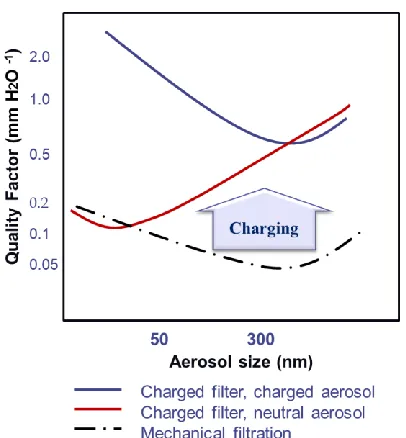
The contribution of mechanical interactions will lessen according to strength of electric field that is created within web. Presence of electrostatic forces will allow us to design a web with a more open structure which will result in drop in resistance against flow. Resistance of a filter media, which is generally called as pressure drop, will determine process expenses. It is also a direct indication for breath comfort in portable filter media, ie facemasks. The performance of air filter is mostly described according to quality factor which is the ratio of negative natural log of penetration to pressure drop. (QF=-lnP/Δp). Thus both factors will be involved. In Figure 1.4 the quality factor values obtained from tests on mechanical and electrostatic filters are compared.
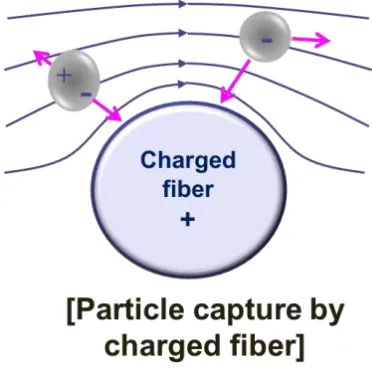
The charged electret fibers not only attract charged particles, but also uncharged ones. If particles are charged inherently, they are pulled towards the fibers by a strong Coulombic force, giving the highest quality factor. When they are not charged, they are polarized by the strong field around the electret fiber. So they are converted into macroscopic dipoles and attracted by the fibers. The efficiency on neutral particles is not as high as charged particles due to lower Coulombic forces11.
On the other hand as shown in Figure 1.5 in a particle diameter range, mechanical filters are insufficient for particle capturing by means of either Brownian diffusion or interception. The lower most level in this well is defined as “most penetrating particle size”. Unfortunately diameter of many microorganisms and significant amount of aerosol particles take place in this region8’12. To improve the efficiency at this region electrostatic capture mechanism seems to be must.
Due to scope of this study we will focus on the changes on electrostatic filtration efficiency upon additive incorporation. Electrostatic filtration efficiency can be measured by subtracting the mechanical filtration efficiency from total filtration efficiency.
Total Electrostatic Mechanical
Equation 1.6Mechanical filtration efficiency of the webs can be tested by subjecting neutral aerosols on discharged webs using TSI instrument. Similarly after charging the webs total filtration efficiency can be measured. Here what we thought is if we can have fixed mechanical filtration efficiency for all webs, the effect of electrostatic filtration can be obtained and compared easily. As a result electrostatic charging characteristic upon any modification can be obtained thereof.
As mentioned mechanical filtration at this particle range will occur due to Brownian diffusion and interception. There are various models that explain those mechanisms. Referring to model developed by Liu and Rubow, the capture efficiencies due to diffusion and interception will be as follows 13:
1 3 2 3
1
1.6
.
d Ka
Pe
F
Equation 1.72
1 1
1
r r K rN
a
F
N
where ζ stands for filtration efficiency, a for packing density, FK for Kuwabara hydrodynamic factor, Pe for Peclet number, ε for web correction factor, Nr for diameter ratio 13.
If the samples are completely free from charges only mechanical capture mechanism will be effective. This situation can be provided soaking samples, either charged/uncharged, into isopropyl alcohol which is described in EN 779 test procedure. However one needs to be careful on this treatment since instead of discharging, sample can be charged significantly upon contact with this kind of polar liquids14.
As a result it can be understood both of these capture mechanisms are highly dependent on fiber diameter, web packing density, and web uniformity. Those parameters will also have influence on electrostatic filtration., since both induced and Coulombic capture depends on them. Brown introduced induced and Coulombic force factors 15 depending on the value of Kuwabara correction factor. Single fiber efficiencies for both mechanisms could be calculated using these two values.
2
0.5ln
0.25
0.75
k
h
a
a
a
Equation 1.9and
0.93
1.48
in
K
in0.35 0.73
0.51
in hk Kin
; 10-2 < Kin <100 Equation 1.11
0.60 0.40
0.54
in
h
kK
in
; 100 < Kin <102 Equation 1.12
where
2 2 2
2 0
( 1)
6 2 (1 )
p c f p
in
p f f
C Q d
K d u
Equation 1.13
and
0.78
C KC
; 10-3 < KC <101 Equation 1.14
0.17 0.83
0.59
C hk KC
10-1 < KC <10 Equation 1.15
where
06 1
c p f C
f p
C n eQ K
d u
Equation 1.16
According to our approach if samples have similar fiber diameters and solidities, it may be said that similar mechanical capture efficiencies are effective. The difference between measured mechanical capture (using discharged webs and particles) and total efficiency (using charged web) will be resultant electrostatic capture efficiency. Obtained electrostatic capture efficiency will indicate if the selected additive is useful as an electret additive.
Another option to understand the change in electrostatic filtration would be to check the change in efficiency by changing surface velocity, since only diffusion and electrostatic capture mechanisms are dependent on efficiency; however this will also cover diffusion and would not be indicative. Interception mechanism depends on particle and fiber diameter and solidity of web, but not surface velocity.
2.3 Basic Electret Characteristics
explained in details. The observations in the experimental parts will be tried to be explained under the light of this knowledge.
2.3.1 Charging and Polarization Phenomena
Charge density may be a combination of inherent and injected charges, and also polarization, whereas stability will depend on charge transport and combination processes. For a nonpolar polymer, such as PP, electrostatic property is generally based on inherent and injected charges. However impurities and inevitably used additives such as antioxidants and stabilizers can cause polarization.
To elucidate the electrical behaviors of insulating materials, concept derived from semiconductor physics is used. However structure of insulating materials is too complicated when compared to semiconductors. On the other hand it is very weak intermolecular interactions in polymers that cause contentions on the application of band theory. However intramolecular forces are large that band scheme might hold for chain 17,23. Despite those of the challenges, band gap theory still enlightens many specific findings within insulators.
to tertiary hydrogen, contains antioxidants and oxidation products at a level 25,26. Such molecular level defects act as deep traps within PP. However should be engineered carefully to reach long term charge stability. For instance carbonyl containing groups are found to be acting as deepest traps in a recent study27. Deep traps are important since the formation of space charges is related with their concentration. However those of the groups coming from oxidation are known to be catalyzing the decay process due to resulting increase in hydrophilicity 28. On the other hand various studies concerned on space charge formation since they are thought to be reasons behind the electrical breakdown of the dielectric29.
Besides chemical defects imparting deep traps, there are physical defects originating from conformational and morphological structure. Looking at most common crystal structure in PP, α-crystal, it is composed of monoclinic unit cells consisting of four 31 helical chains which are composed of three propylene [CH2CH(CH3)]– units forming the ‘‘pitch’’ of the helix27. This helical structure is originated from conformational interactions between neighboring methyl groups30. Conformational properties are important on electret stability since some of the arrangements other than all-trans can act as shallow traps. Charging properties of PP having different conformational properties and stereo structures were investigated. It was shown that mmrm and rrrm sequences can provide more stable traps, whereas mmrr and short heterotactic sequencies fail. It was asserted that structural breaks in tacticity may result in increase in molecular mobility of polymer20. Those of the localized states resulting from conformational disorders may have a density of 1022cm-317.
layers whenever ε1σ1 ≠ε2σ2. Wagner brought mathematical explanation for sparsely distributed impurities of small spheres inside dielectric matrix. Sillars demonstrated the importance of the shape of conductive inclusions. Amorphous sections will have higher free volume which result in different dielectric constant. Also it was shown that conductivity of amorphous structures is lower than that of crystal parts31. Effect of crystallinity will be explained in chapter 2.5.2. Defective structures were summarized in Table 1.2.
Table 1.2 Defective structures, their origins and effects [adapted from17,32]
Size Origin Effect
Molecular Oxidation products, antioxidant and catalyst residues, by-products, electret additives
Deep traps, dipoles
Conformational Chain orientation and interaction, molecular weight distribution, free volume
Shallow traps
Morphological Amorphous-crystalline boundaries Interfacial polarization
current depending on exponential function of square root of field is generated. Interestingly barrier height tested experimentally is found to be lower than theoretical values, which makes this kind of injection more effective17. Ionic conduction will occur at a level, however carrier ions can move through the amorphous region of the polymer only. Therefore an increase in crystallinity may give rise to reduction of the mean free path of the ionic carriers22. Those of the ions are thought to be originating from antioxidants, oxidation products and water34.Ionic conduction dominates in polymers such as PVC and nylon.23
In summary typical physical trap energy ranges below 1.0eV, whereas chemical defects are deeper but lower in concentration17,18 Particularly chemical defects containing carbonyl or conjugated double bonds produce the deepest traps, whereas non-conjugated double bonds and hydroxyl groups are found to be shallower19 Shallow traps are located within specific conformational regions and amorphous-crystalline boundaries, while charges with higher release energy are trapped in molecular defects within crystal structures35–37
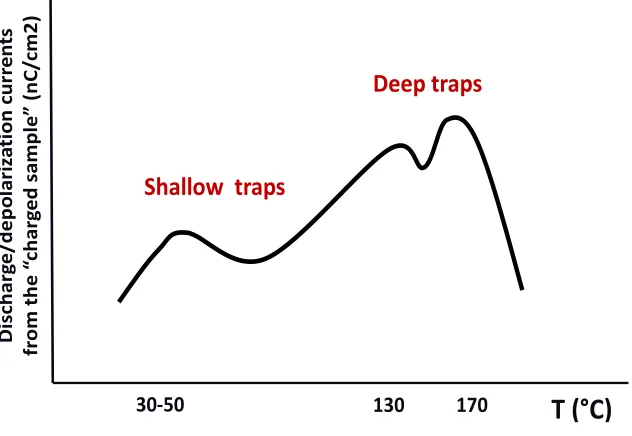
sites due to the difference in electrical conductivity of the microstructures. The medium-temperature peak between 100 and 130 °C is attributed by the release of both inherent and injected charge carriers. And, at high temperature fiber treatment, the release of both inherent and injected charges is obtained in the appearance of highest-temperature TSC peaks, which is very close to the melting temperature. This peak is thought to be a combination of two components. The first component (at Tmax 165 °C) is due to decay of inherent charges and is lower in magnitude than the second one (at Tmax 170 °C), which is thought to be related with injected charge relaxation33.
Figure 1.7 TSD curve for pure PP obtained by Kravtsov et al33
Same group claims38,39 six possible charge trapping mechanism in polypropylene electrets:
- Trapping by structural defects of polymer
- Trapping at interfaces of crystalline/amorphous structures - Self-trapped electrons in the polymer bulk40
- Polar groups and charged molecular fragments by thermal degradation of polymer
- Macromolecules oxidation and polar group formation by ozone, atomic oxygen, nitrogen oxides
- Dipole polarization from the heterolytic breakage of chemical bonds in polymer.
Besides charging polarization is an effective method to produce electrets. There are four polarization mechanisms which are electronic (Pe), ionic (Pa), dipole (Pd) and interfacial polarization (Pd)41,42.
iii. In the subinfrared range of frequencies dipole (orientational) polarization occurs largely as a result of motion of charged ionic or molecular dipoles, producing a net dipolar orientation in the direction of applied electric field. This type of polarization is observed in two cases:
- An asymmetrical dipole moment will produce oscillations at very high frequencies, such as 1011 Hz. Si-O-Si bond in an equilibrium position under a sinusoidal ac field, or OH group bonded to Si will provide that kind of dipole polarization. In linear dielectrics dipole polarization is largely due to motion of charged ions between the interstitial positions.
- Second case is generally observed in nonlinear dielectrics, which involves the rotation of dipoles between two equivalent equilibrium positions. For instance Ti atom in a BaTiO3 crystal will cause that kind of polarization. This will also provide ferroelectric manner of dielectric and very high dielectric constants, 104 or more.
As explained in Figure 2.7, polarization of a dielectric depends on frequency of the applied field. 41,43. All types of polarization mechanisms will be effective when DC electric field is used, which is generally preferred in electret studies.
Figure 1.8 Frequency dependence of polarization mechanisms in dielectrics 41,43
2.3.2 Charge Motions within Electrets
configurational disorders and intentionally incorporated additives that causes not only charge trapping, but also charge motions35,48–50. For instance PE has a band gap width of 8.8eV, which correspond to an intrinsic conductivity of 10-45S/m17, however impurities and defective structures will increase this value upto 10-16S/m51.
For the case of shallow traps the residence time of the carriers ranges from 10-13s for a level at 0.1eV to about 500s for a level at 1eV. Charges can move trap to trap either each time transition to extended state which is called hoping or without undergoing to extended state, which is called tunneling (phonon-assisted tunneling) mechanism. The energy separating extended states from localized states is called mobility edge. The carrier mobility will be zero below mobility edge, whereas above this limit mobility will be infinite. Deep traps are produced by chemical disorders. Those are a lower concentration when compared to shallow traps. Space charge formation is thought to be controlled by deep traps17. So electret properties would be enhanced via processing deep traps, since compared to shallow traps they contribute less to conduction.
must be small for tunneling. Hopping conduction is trapped electron movement can be between states of same energy level. Tunneling mostly occurs under high electric field.31
Figure 1.9 Hopping and tunneling mechanisms [adapted from 31]
Higher electrostatic resistivity is desirable for polymers used in charged filter media. However, absorption of the moisture from the atmosphere will reduce resistivity of filter media since water is highly conductive compare to most commercial polymers, and the presence of water absorbed by polymer will promote of discharge of electrostatic charge. This is actually one of the strategies used in antistatic additive design52. Therefore, when one select polymer used for charged filter media, not only resistivity of polymer but also its moisture regain should be considered. In this aspect, polypropylene (PP) is a good candidate due to its good electrical resistivity (> 1016 Ω cm) and low moisture regain (0% at 65% RH).53
Other than natural phenomena acting on charge decay of electret, some other factors will be effective in the discharge of electret filters. Brown conducted loss of electrostatic capture efficiency to the following9,10:
• Neutralization due to sharing charges with captured particles
• Chemical disruption of fiber by aerosol
2.4 Methods for Producing Electret Filters
For high filtration efficiency there should be high electric field within webs that will give rise to electrostatic forces on particles. After the invention of Hansen filter in 1930s, various systems were developed to produce more efficient electret filters. Electret filters can be classified according to charging mechanism: Corona discharge, triboelectrification via carding or hydroentanglement and liquid contact. Electrospinning may also be added54–57, even though it has been investigated in very recent studies. According to charging mechanism web composition will change, ie triboelectrification generally needs more than one component. On the other hand they were also classified as space charge electrets that possess an injected or imbedded charge as in corona treated PP webs or dipolar electrets that are formed by the orientation of dipoles58.
2.4.1 Corona Discharge
Negative and positive air ions are different from each other. In a positive corona the electron avalanche accelerates toward the electrode so that fully formed primary positive ions are repelled into atmosphere. Mostly hydronium ion H+(H2O)n is produced. In a negative corona the electrons are generated at the electrode by the photoelectric action of photons striking its surface. Produced electrons will strike the neutral gas molecules to form primary negative ions which have a structure based on O2- . (6 ref) Those can be hydrates such as O2 -(H2O)n in a humidified environment and secondary chemical species such as CO4-(H2O)n, NO-(H2O)n and NO2-(H2O)n. Primary ions are able to grow in size as they collide with neutral molecules and aerosol particles60.
Rader et al 61 investigated the effect of electronegative gases in corona medium. Such gases like those containing oxygen deenhance the resulting corona. But when low corona current is desired with high electric field, this medium could be useful. Electronegative gases in the medium will drop the ionization efficiency and system will require higher voltage to produce corona. Authors mentioned that the corona in a nonelectronegative medium will be more intense by a factor of at least 10 and uniform. So most of the energy spent for corona will be used for ionization and polarization of these species in the medium. That is why in most of the industrial applications inert gases such as He, Ne, Ar or propane is used
5 2
cos
( )
(0)
2
I x
I
d
Equation 1.17
In Figure 1.10 charging current and charge distribution according to Warburg law were illustrated.
Figure 1.10 Current distribution on corona region and sample
carriers depends on surface morphology and carrier type and energy, which is generally only a few nanometers. Surface charges can move into the bulk and be retrapped at depths of several microns, which will be dependent on bulk properties58. After a certain charging time, the reason behind charge saturation may be explained with the formation of carrier sheath layer and its interaction with polymer 63. So for the corona discharged webs an optimization will be obligatory.
Corona discharge process is space charge limited, because ions of one polarity will be accumulated in the interelectrode space. Increases in current will need higher electric field to drive onto other electrode. It involves either ions produced or energetic electrons that produces plasma. Ionic identity depends on polarity if discharge. Ionic corona occupies a small fraction of medium, whereas electronic plasma covers a large area. Volumetric filling factor for ionic plasma is lower. Negative corona generally propagates by impact ionization of gas molecules, whereas positive corona depends more on photoionization 64. Wang et al observed longer stability for positively charged porous PP films, compared to negatively charged films 65. On the other hand XPS studies revealed that the oxygen content on negative-corona-charged samples is approximately 2.4 times higher than that in positive corona- charged samples66.
corona doesnot allow polarization in polar electrets or polar additive containing electrets. This will be discussed in detail in part 2.5.3 with effect of oxidation and antioxidants on electret properties.
To improve the efficiency, charging temperature is increased during corona. Even for some cases charging is done in molten state. The electric field is switched off after solidification of molten electret. Those are called thermoelectrets. They mostly have better charge density and stability compared to ones that are prepared at lower temperatures67.
Van Turnhout found a drawback for direct corona discharge on fibrous webs. At high voltages he observed arcing through open pores; thus suggested covering the charging electrodes with poorly conductive sheet68. In another patent he proposed “charged film fibrillation method” which produced even better electret properties69
. Both corona discharge and triboelectrification would be seen in split fiber webs. The initially corona discharged film is split and stretched to form filaments with a ribbon-like structure. The ribbon-like filaments are then carded into a filter web58.
charges on the face and screen showed the largest filtration efficiency, close to ULPA filters70.
Another interesting improvement is found with simultaneous application of radiation and electric field. Electret is exposed to penetrating high energy radiations such as gama, beta, or x-ray to a dose about 106 rads in the presence of an external polarization field. The charging is produced in the dielectric due to the electron-hole pairs created by the ionizing radiation, which drift in the applied electric field towards the electrodes and trapped inside the material67.
2.4.2 Triboelectrification
High energy electron injection is the main reason for producing functional, unsaturated groups and broken chains. Those of the groups may increase the charge mobility on the surface layer, thus giving rise to decay rate. So instead of injection methods, such as corona discharge or electron beam; triboelectrification is advantageous for charging stable electret filters71–74.
charge on the surface can be formed. Even contact and separation is enough for charging of materials. Tribolectrification involves both contact of two solids and their motion under friction. Details of contact, such as contact area, sliding, rolling, normal forces will be effective in triboelectrification75.
Figure 1.11 Triboelectric series of common materials [Adapted from 78]
To produce largest electric field within webs, triboelelectrification is applied on more than one component webs, ie one from most negative, one from most positive side.
understanding on triboelectrification would be achieved if chemical composition of surface is investigated. A good correlation was found between electron pair acceptor/ donor parameters, (α and β) and measured surface charge. Surface polarity was found to be effective on the rate of charging79.
Previous explanation is based on electron transfer between polymer surfaces. This would be more possible for metal-polymer interaction since the work function required for electron transfer between polymers is too large. Taking nylon/PE surface as an example, triboelectrification will result in positive charging of nylon and negative charging of PE. Electron transfer between these materials will require removal of an electron from nylon (cost of several eV), separation of charge across the interface (cost of below 1 eV, depending on the distance) and addition of electron to polyethylene (again endothermic process) So it was calculated electron transfer would be possible with and endothermic process of 5-10eV, which is significantly larger than the thermal energy (kT=0.026eV at room temperature). This explanation on the impossibility of electron transfer satisfies for polymer in perfect structure. However all polymers have shallow traps, resulting from conformational disorders. Those of the defects have depths below 1eV, which is still larger than thermal energy but at least closer18.
at interfaces will be facilitated by adsorbed water. However surfaces will share the aqueous ion (H+, OH-) unequally, which is experimentaly shown in triboelectric series.
In this regard water has important properties that are effective on triboelectrification. Its high bulk dielectric constant (ε=78 at 298 K) will reduce the strength of all electrostatic interactions by that factor. Secondly mobile ions (H+, OH-, and other electrolyte ions) within aqueous solutions will screen electrostatic charges on any surface. This is particularly important since some of the additives will act on hydrophilicity, which is undesirable for electrets. A thin film of water is deposited on nearly all surfaces from the atmospheric air. It was reported that even hydrophobic surfaces such as PTFE adsorb water from the air on PTFE (around 2 monolayers of water at 80% RH)80 However water on those surface will form islands instead forming layers that cause conducitivity.
One other proof for ion exchange during triboelectrification is the observations of Diaz et al. Very less electrification was observed at 0%RH, maximum around 30%RH, and a decrease in contact electrification above 40%RH 81. The decrease in contact electrification at high humidity was condected to increased surface conductivity, whereas decrease in contact electrification at 0%RH was concluded as necessity of water for the transfer of ions during contact electrification75.
These are important concepts to understand the triboelectrification. Incorporation of additives would probably change the surface composition and properties of PP, and therefore hydroxide affinity. There are various studies concentrated on triboelectrified webs. Resin-wool filters are first examples of triboelectrified filter media. Upon carding resin particles will be negatively charged, whereas relatively conductive wool will be positively. The low conductivity of the resin will stabilise the charge on the filter and wool will develop image charges to reduce the electrostatic energy of the system to a minimum10.
Brown et al studied on PP filter media mixed with various fibers including nylon, modacrylic, cellulose diacetate, stainless steel. Significant improvement was obtained in filtration efficiency particularly with modacrylic and steel fibers77.
Various patents were issued on electret filters that were charged via hydroentanglement82,83 Fluorinated webs will be more available for triboelectrically charging via hydroentanglement, since nonfluorinated PP webs will be more hydrophilic comparatively. Those of the webs could be charged by water jets or stream of water droplets, since a subsequent drying process in not necessary. In the literature hydroentanglement at a water pressure of 10-500 psi was utilized for charging samples. Charge density and stability was not mentioned, instead filtration properties were discussed84.
strong if all fibers are charged at same sign; however this will not contribute to total filtration efficiency. Due to that reason bipolarly charged carded will be advantageous. This means both positively and negatively charged fibers are present77. However frictional charging is difficult to predict and cannot be controlled easily, so when charging in a controlled manner is desired, corona discharge may be preferred85.
2.4.3 Liquid Contact
Figure 1.13 Electret charge technique from 86
Table 1.3 Liquids for contact electrification87
Liquid Dipole moment (D) Dielectric constant (-)
Acetone 2.88 20.7
Acetonitrile 3.92 37.5
DMF 3.82 36.71
Dimethyl Sulfoxide 3.96 46.6
Ethylene glycol 2.28 37
IPA 1.66 18.3
Methanol 1.7 32.6
In summary we can say that main mechanisms for all methods are explained so far. However due to its ease of application, corona discharge was preferred in this study as charging method. On the other hand other methods are not capable of polarizing dipolar species which is desired for some of the additives.
2.4.4 Electrospinning
electrospun and corona treated webs were found to be longer than that of PET mat. However measured surface potential was normalized according to mass which is irrelevant and inaccurate. As a result of normalization lower weight nanofiber webs was found to exhibit high initial potential88.
Yeom et al investigated boehmite nanoparticles incorporated into Nylon-6 (PA6) nanofiber webs as an electrostatic charging agent. Processed and corona charged PA6 nanofiber web showed significant improvement in aerosol capture efficiency compared to the discharged nanofiber web. Boehmite addition was found to be strongly effective on the electret performance of the web which was shown with bot potential measurement and filtration tests89.
2.5 Additives for Improving Electret Properties of PP
according to requirement for electret purposes, one or more additive would be selected from several additive classes. In the literature electret additives were very much selected from inorganic ceramic ferroelectrics 91,92, nucleating agents 35,93–96, antioxidants including light stabilizers 90,97,98 and fluorochemicals 99–101. In this study additives that can be processed via reactive extrusion were selected. Fluorochemicals were not preferred due to environmental issues.
2.5.1 High Dielectric Constant Inorganic Additives
Inorganic additives may be divided into two groups: Linear and nonlinear dielectrics. For the case of linear dielectrics dependency of polarization to applied field is linear. It means polarization continues until all dipoles are aligned. For nonlinear dielectrics, also called “ferroelectrics” there is not a similar linear relation between polarization and electric field102.
2.5.1.1Linear Dielectrics
Those webs had a filtration efficiency of above 99% upon charging. Effect of SiO2, TiO2, Al powders addition at concentrations of 0.1, 0.5, 1.0%wt were investigated. At lower concentrations SiO2 and TiO2 gave slight increase to surface charge. However surface charge density dropped upon mixing at a ratio of 5% and 10%. The effect of aluminum mixing on the surface charge density was found fluctuating 103.
2.5.1.2Nonlinear Dielectrics
It is not as easy to explain the dielectric properties of nonlinear dielectrics. Second mechanism of dipolar polarization is predominant: Rotation of dipoles between two equivalent equilibrium positions. The spontaneous alignment of dipoles is so strong that it can cause crystallographic phase transformations at a critical temperature, which is called Curie temperature. The Curie temperature in piezoelectric materials is used to describe the temperature above which the material loses its spontaneous polarization and piezoelectric characteristics. In lead zirconate titanate (PZT), the material is tetragonal below Tc and the unit cell contains a displaced central cation and hence a net dipole moment. Above Tc, the material is cubic and the central cation is no longer displaced from the centre of the unit cell. Hence, there is no net dipole moment and no spontaneous polarization41
spontaneous alignment to opposite. This is the reason of very large changes in polarization and dielectric constants (ε >1000). Those of the materials are widely used in pressure transducers, ultrasonic cleaner, loudspeakers where electro-mechanical coupling is needed 41.
Polymer dielectrics have the advantage of flexibility, whereas its ceramic counterparts superior due to absence from creep, absence from deformation under stress at room temperature, resistance to environmental changes, high temperature and oxidation 41. Also it should be noted processability of plastic materials is easier when compared to ceramics. Both advantages would be gained since polymer/inorganic ceramic dielectric composites will be prepared in this study. Table 1.4 summarizes dielectric properties of some nonlinear dielectrics.
Table 1.4 Dielectric properties of ABO3 perovskite structures 41
Curie Temperature (°C)
Spontaneous polarization (µC/cm2)
κ at Tc
BaTiO3 120, 5,90 26 at 23 C 1600
PbTiO3 490 750[23] -
As nonlinear dielectric (also called ferroelectric ceramic) barium titanate was selected. High dielectric constant of barium titanate is probably what makes it one of the most used materials for capacitor and electromechanical coupling applications.
Barium titanate has a ABO3 type mixed oxide structure. Crystal structure consists of a regular array of corner sharing oxygen octahedra with smaller Ti (IV) cations occupying the central octahedral B site and barium (II) cations filling the interstices between octahedral [Figure 2.13]. The high polarizability is a result of more space for small Ti ions within the oxygen octahedra. The Ti atoms of BaTiO3 are surrounded by 6 O ions. All crystals having the TiO6 configuration exhibit high dielectric constant. A net permanent moment of the octahedron can result only by a unilateral displacement of the positively charged Ti+4 ion against its negatively charged O-2 surrounding. Ferroelectricity requires the coupling of such displacements and dipole moments associated with displacements 41,42.
![Figure 1.2 Mechanical capture mechanisms [adapted from5]](https://thumb-us.123doks.com/thumbv2/123dok_us/1506266.1184434/27.612.218.421.165.405/figure-mechanical-capture-mechanisms-adapted-from.webp)
![Figure 1.6 Schematic representation of state density within a dielectric [adapted from17]](https://thumb-us.123doks.com/thumbv2/123dok_us/1506266.1184434/36.612.205.423.328.531/figure-schematic-representation-state-density-dielectric-adapted-from.webp)
![Figure 1.11 Triboelectric series of common materials [Adapted from 78]](https://thumb-us.123doks.com/thumbv2/123dok_us/1506266.1184434/54.612.228.375.77.377/figure-triboelectric-series-common-materials-adapted.webp)
![Figure 1.12 Hydroxide adsorption model for nonionic polymers [adapted from 75]](https://thumb-us.123doks.com/thumbv2/123dok_us/1506266.1184434/57.612.233.406.363.595/figure-hydroxide-adsorption-model-nonionic-polymers-adapted.webp)