ISSN(Online): 2320-9801 ISSN (Print): 2320-9798
I
nternational
J
ournal of
I
nnovative
R
esearch in
C
omputer
and
C
ommunication
E
ngineering
(A High Impact Factor, Monthly, Peer Reviewed Journal)
Vol. 4, Issue 1, January 2016
Enhancing Target Coverage and Network
Connectivity of Mobile Sensor Networks
D.Prasad
Professor, Department of ECE, Ramanandatirtha Engineering College, Nalgonda, India
ABSTRACT: Scope of interest focuses and network connectivity are two principle testing and for all intents and purposes vital issues of wireless Sensor Systems (WSNs). Albeit numerous studies have abused the portability of sensors to enhance the nature of scope and availability, little consideration has been paid to the mobility of sensors development, which frequently devours most of the constrained vitality of sensors and along these lines abbreviates the network lifetime essentially.Target coverage and Network connectivity are two main challenging issues of mobile sensor networks. Targetcoverage covers a set of specified points of interest in the randomly deployed MSNs. Target coverage is usually interpreted as how well asensor network will cover an area of interest. Network Connectivity is defined as the ability of the sensor nodes to collect data and reportdata to the sink node. Target Coverage and Network Connectivity may also affect the quality of network. In this paper, for targetcoverage, two algorithms i.e. basic algorithm based on clique partitions and TV Greedy algorithm based on voronoi diagrams of targetare proposed.
KEYWORDS: Mobility, Mobile sensor networks, Target Coverage, Network connectivity, Voronoi diagrams.
I. INTRODUCTION
Progresses in remote correspondence and Smaller scale Electro Mechanical Frameworks (MEMS) have empowered the advancement of minimal effort, low-control, multi-utilitarian, modest sensor nodes which can sense the earth, perform information preparing and speak with each other over short separations. Because of an extensive variety of potential applications including environment observing, object following, logical watching and activity control also, and so forth., Remote Sensor System (WSN) have pulled in a plenty of exploration endeavors. A commonplace extensive scale WSN for the most part comprises of one or more sinks (or base stations) also, tens or a great many sensor nodes that composed themselves into a multi-bounce remote system and sent either arbitrarily or as per a few redefined measurable dispersion over a topographical district of hobby. A sensor node without anyone else has serious asset requirements, for example, constrained memory, battery power, and flag handling, calculation and correspondence abilities; subsequently it can sense just a shopping centre segment of nature. Notwithstanding, a gathering of sensors teaming up with one another can finish a much greater undertaking productively. With mix of detecting, calculation, and remote correspondence, the sensor nodes can sense physical data, process rough data, and report them to the sink or base stations that can settle on application particular choices and connection to the outside world by means of the Web or satellites [1, 2].
ISSN(Online): 2320-9801 ISSN (Print): 2320-9798
I
nternational
J
ournal of
I
nnovative
R
esearch in
C
omputer
and
C
ommunication
E
ngineering
(A High Impact Factor, Monthly, Peer Reviewed Journal)
Vol. 4, Issue 1, January 2016
II. RELATED WORK
Coverage problems have been formulated in otherfields. These problems greatly relating to the coverage inWSN include Art Gallery Problem, Circle CoveringProblem, and Robotic systems coverage.
Art Gallery Problem (AGP): Envision that the administrator needs to place cameras in the display such that the entire display is cheat confirmation. In particular, one tries to decide the base number of cameras that can be set in a polygonal situation, such that each point in the earth is checked by no less than one camera. There are two inquiries emerging: what numbers of cameras are required, and where these cameras ought to be sent. This issue is normally displayed as a basic polygon on a 2D plane. A basic arrangement is to isolate the polygon into non-covering triangles and spot on camera in each of these triangles. In spite of the fact that this issue can be explained in polynomial time ideally in a 2D plane, yet it is appeared to be NP-hard while being stretched out to a 3D space.
Circle Covering Problem (CCP): Given a fixednumber of identical circles, the goal of CCP is tominimize the radius of circles that can fully cover a givenplane. Namely, How to arrange identical circles on aplane that can fully cover the plane? Some approachesgiven number of circles are discussed, however, auniversal method has not been found.
Robotic systems coverage: There is mainly threetype’s coverage in many-robot systems. The first is theblanket coverage, where the goal is to achieve a staticarrangement of sensors that maximizes the total detectionarea. The second type is the barrier coverage, where thegoal is to achieve a static arrangement of nodes thatminimizes the probability of undetected penetrationthrough the barrier. The third is the sweep coverage ismore or less equivalent to a moving barrier.
The above problems are similar to the nature ofcoverage problems in WSN: need to know whether anarea is sufficiently covered and monitored. These resultsalso provide some theoretical backgrounds to thecoverage issue. However, solutions of these problems arenot directly applicable to WSN because of differentcriterions (for example, a camera in AGP can see infinitedistance unless there is an obstacle, whereas a sensor hasthe maximal sensing ranges.).
III.PROPOSED ALGORITHM
For Target coverage problem, two algorithms are used:basic algorithm based on clique partition and TV-greedyalgorithm based on Voronoi diagrams.
3.1 Basic algorithm based on Clique Partitions
Initially after deployment of sensors some targets may havebeen already covered. There is need to cover the uncovered targets. Firstly, basic algorithm constructs the graph ofuncovered targets. After the graph is constructed, minimumnumber of clique partitions is determined. Every cliquepartition represents the set of targets that can be covered bysame sensor node. Thus, for the targets from same clique,only one mobile sensor is dispatched to cover those targets.Hence, the basic algorithm minimizes the number ofsensors that need to be moved.
3.2 TV-Greedy algorithm based on Voronoi Diagrams
TV-Greedy algorithm minimizes the aggregate development of sensors. It decides the Voronoi outlines as per static targets. The Sensor node which is situated in a voronoi polygon of target is called server of that objective and the
objective is considered as customer of that sensor. The arrangement of target‟s all servers is called own server
gathering of that objective. The closest server in target‟s own server gathering is called chief server of that objective.
ISSN(Online): 2320-9801 ISSN (Print): 2320-9798
I
nternational
J
ournal of
I
nnovative
R
esearch in
C
omputer
and
C
ommunication
E
ngineering
(A High Impact Factor, Monthly, Peer Reviewed Journal)
Vol. 4, Issue 1, January 2016
resolved from their own particular server bunches. At that point the applicant server gathering of target is resolved. The nearest sensor to the crossing point of two focuses from the hopeful server gathering of those objectives is chosen to move and to cover both targets. Along these lines, TV-Greedy algorithmdiminishes the aggregate development of sensors and target scope is accomplished.
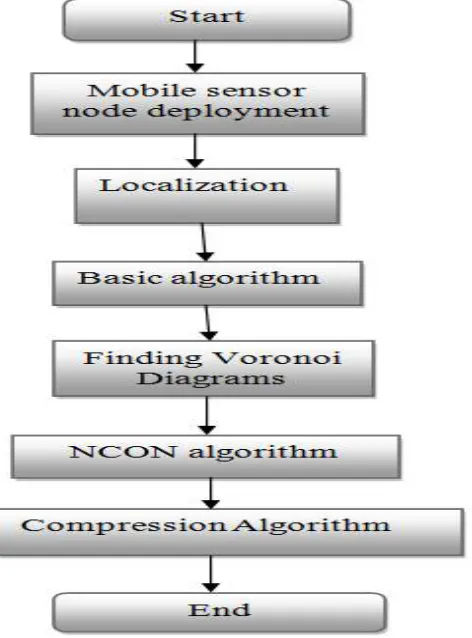
Figure.1 demonstrates the stream outline of venture. To cover revealed targets, essential calculation builds the diagram of targets. After the diagram is developed, least clique, segment of the built chart are resolved. Therefore, for the objectives from same clique, stand out versatile sensor is dispatched to cover those objectives. Thus, the fundamental calculation minimizes the quantity of sensors that should be moved, however it might expand the aggregate development of sensors. TV-greedyalgorithm minimizes the aggregate development by gathering the sensors as indicated by closeness to targets. TV-greedyalgorithm decides the Voronoi outlines as indicated by static targets. Since targets are statics, re-calculation after each operation is not required. Voronoi diagrams bunch sensors as indicated by closeness of sensors to the objectives. After that the sensor which is near sensor is chosen to cover that objective. Target scope points that no less than one sensor can cover the one or numerous objectives. TV-greedyalgorithm finds the sensor which is on the convergence of two targets and near both focus than other sensor nodes. The fundamental thought behind system network is to utilize rest of portable sensors to look after availability. The fundamental thought behind system availability is to utilize rest of versatile sensors to look after network. System availability is important for sensor node to gather information and send it to the sink node.
System availability expects to locate the ideal course for sensor node to correspond with sink node or base station. Here Steiner tree idea is utilized to keep up system availability, where Sink node or base station is root and every one of the sensors are leaf nodes. Here Initial, an edge length compelled Steiner tree spreading over all the scope sensors and the
sink is built, such that every tree edge length is not more noteworthy than the correspondence span rc. At that point the
rest versatile sensors are migrated to the created Steiner focuses to associate the sensors and the sink node. Sensor node gathers the information from targets and send that information to the sink node. This requires the greatest vitality and time. Here LZW pressure calculation is utilized to pack information and subsequently to minimize vitality utilization and expand the computation speed of transmission.
A calculation for proposed framework is depicted as takes after:
1. Begin
2. Instate the mobile sensors in the focused on area
3. Find the objectives in the locale
4. Develop the charts of revealed targets.
5. Decide the voronoi graphs of targets.
6. Decides the chief servers and help servers of every objective.
7. Decide the applicant server gathering of target.
8. Decide the sensor from CSG which is on the crossing point of two targets.
9. Select that sensor to accomplish both targets.
10. Move the rest mobile sensors to accomplish system availability.
ISSN(Online): 2320-9801 ISSN (Print): 2320-9798
I
nternational
J
ournal of
I
nnovative
R
esearch in
C
omputer
and
C
ommunication
E
ngineering
(A High Impact Factor, Monthly, Peer Reviewed Journal)
Vol. 4, Issue 1, January 2016
12. End.
Figure 1: Flow Diagram
IV.SIMULATION RESULTS
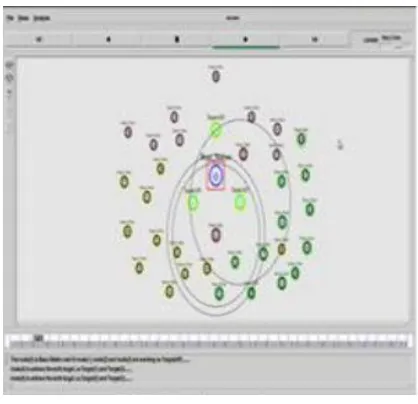
Figure 2 shows the simulation results obtained from proposedsystem. Figure 2 (a) shows the initial position of targets andsensors. After randomly deploying the sensors, some targetsare already covered.TV-greedy algorithms find the Voronoidiagrams of static targets, due to which there is no need of recomputation after each round of sensor movement. Figure 2(b) shows the Voronoi diagrams of targets. According toproximity to target, sensors are grouped. TV-greedyalgorithm selects the sensor which is very close to target, tocover that target; hence the movement of sensor isminimized. Figure 2 (c) shows the illustration of algorithmsand shows final result. Here, Sensor node 4 is on theintersection of target 1 and target 2 and hence sensor node 4achieves both the target 1 and target 2. On the same way,sensor node 5 covers target 2 and target 3. Algorithm selectsthe sensor which is very close to target; due to this sensorsmovement is minimized. And one sensor can achieve morethan one target; due to this minimum number of sensors are
ISSN(Online): 2320-9801 ISSN (Print): 2320-9798
I
nternational
J
ournal of
I
nnovative
R
esearch in
C
omputer
and
C
ommunication
E
ngineering
(A High Impact Factor, Monthly, Peer Reviewed Journal)
Vol. 4, Issue 1, January 2016
(a) Initial positions of Targets and sensors (b) Voronio diagrams of targets
(c) Final result
Figure 2: Simulation results obtained from proposed algorithms
V. CONCLUSION
ISSN(Online): 2320-9801 ISSN (Print): 2320-9798
I
nternational
J
ournal of
I
nnovative
R
esearch in
C
omputer
and
C
ommunication
E
ngineering
(A High Impact Factor, Monthly, Peer Reviewed Journal)
Vol. 4, Issue 1, January 2016
schemesuccessfully overcomes the issues of Target coverage andNetwork Connectivity in Mobile Sensor Networks andincreases the network lifetime.
REFERENCES
[1] I.F. Akyildiz, W. Su, Y. Sankarasubramaniam, and E. Cayirci.,“A Survey on Sensor Networks,” IEEE CommunicationMagazine, Aug. 2002, pp. 102-114.
[2] Y. Jennifer, M. Biswanath, and G. Dipak, “Wireless sensornetwork survey”, Computer Networks, 2008, vol. 52, pp.2292–2330. [3] Zhuofan Liao, Shigeng Zhang, Jiannong Cao, WeipingWang, Jianxin Wang, “Minimizing Movement for TargetCoverage in Mobile Sensor Networks,” 32ndInternational Conference on Distributed ComputingSystems Workshops, 2012.
[4] You-Chiun Wang and Yu-Chee Tseng, “DistributedDeployment Schemes for Mobile Wireless SensorNetworks to Ensure Multilevel Coverage,” IEEETransactions on Parallel and Distributed Systems, VOL.19, NO. 9, SEPTEMBER 2008.
[5] Wei Shen and Qishi Wu, “Exploring Redundancy inSensor Deployment to Maximize Network BarjeshKochar and Rajender Chhillar, ”An Effective DataWarehousing System for RFID Using Novel DataCleaning, Data Transformation and LoadingTechniques”, The International Arab Journal ofInformation Technology, Vol. 9, No. 3, May 2012.
[6] Wei Shen and Qishi Wu, “Exploring Redundancy inSensor Deployment to Maximize Network Lifetime andCoverage,” 8th Annual IEEE Communications SocietyConference on Sensor, Mesh and Adhoc Communicationand Networks, 2011.
[7] Arnab Raha, Shovan Maity, Mrinal Kanti Naskar, OmarAlfandi and Dieter Hogrefe, “An Optimal SensorDeployment Scheme to Ensure Multi Level Coverageand Connectivity in Wireless Sensor Networks,” 2012IEEE.
[8] A. Mateska, L. Gavrilovska and S. Nikoletseas,“Mobility aspects in wireless sensor networks,”Application and Multidisciplinary Aspects of WirelessSensor Networks: Concepts, Integration and CaseStudies, L. Gavrilovska; S. Krco; V. Milutinovic; I.Stojmenovic; R. Trobec (Eds.), Springer, ISBN: 978-1-4996-509-5, October 2010.
BIOGRAPHY