TRANSLOCATIONS I N MAIZE INVOLVING CHROMOSOME 9
E. G. ANDERSON
California Institute of Technology, Pasadena, California
Received February 4, 1938
INTRODUCTION
HE C wx linkage group associated with chromosome 9 was one of
T
the first to be established in maize. This was largely due to the excellence of the two genes C and wx as working tools. EMERSON, BEADLE and FRASER (1935) list 28 genes in this group. Nearly all of these are tothe left of wx or within IO or 15 units to the right. MCCLINTOCK (1930,
1931), CREIGHTON and MCCLINTOCK (1931)~ CREIGHTON (1934) and BURN-
HAM (1930, 1934a, b) have shown that the gene ygz is near the end of the short arm of chromosome 9 and wx nearer the spindle attachment but still on the short arm. Virescentl (vl) is probably on the long arm not far from the spindle attachment (BEADLE 1932, BURNHAM 1934b). The greater portion of the long arm is conspicuous by its lack of definitely known genes. This lack of known genes may be largely due to the difficulty of detecting genes in the distal part of the long arm by means of ordinary linkage tests with such genes as C, sh and wx. Or it may be that such regions are redundant sections of chromosome materials which are also represented elsewhere in the chromosome complement.
Chromosomal interchanges or reciprocal translocations are excellent tools for the exploration of portions of chromosomes where no known genes are available. For most cases it is only necessary to cross any new or unplaced gene with the appropriate translocation stock, backcross with the new gene if recessive or with a normal stock if dominant. Classification of the gene character under consideration and semisterility will give a direct linkage test with a known point on the chromosome.
The chromosome 9 translocations studied by the writer have all been on the long arm, mostly in the region beyond the present known genes. They do not add appreciably to our knowledge of the region covered by the present linkage maps, but do furnish excellent means for the place- ment and mapping of genes in the extensive region of the long arm where no genes are as yet available.
PREVIOUS DATA ON TRANSLOCATIONS INVOLVING CHROMOSOME 9
T8-9a (BURNHAM 1930, 1934b; MCCLINTOCK 1930, 1931; CREIGHTON and MCCLINTOCK 193 I ; BEADLE 193 2 ) . The interchange on chromosome
9 on the long arm .4 of distance out from spindle attachment. Link- age order C-wx-T with 13.7 percent of crossing over with waxy.
Tj-9a (BURNHAM 1934a). Interchange in proximal part of the short arm of chromosome 9. Linkage order sh-wx-T with about two percent of crossing over with waxy. Much non-homologous pairing and much suppression of crossing over.
T6-9a (ANDERSON 1934, MCCLTNTOCK 1934). Interchange about one-third the way out on the long arm of chromosome 9. Linkage order C-wx-T with I I .6 percent of crossing over with waxy.
TRANSLOCATIONS INCLUDED I N THE PRESENT STUDY
I n the present paper, data are presented on the following translocations which are included in the writer's published list (ANDERSON, 193 j) ; T
1-9a, b, c, 2-9a, b, 3-9a, b, 4-9a, b, 6-9a, b, and 8-9b. I n addition two others are included which will be designated T3-9c and T9-10b. Both were from the writer's X-rayed material (ANDERSON 1935, Lot I , sixty minute treat- ment, and Lot 2, fifty minute treatment, respectively). The chromosomes involved were determined by diakinesis observations of intercrosses with known translocations. T3-9c gave two rings of four in crosses with T 1-2a,
T 1-7a, T4-8a1 T 5-7a and T 4-5a, and a ring of six with T 8-9a and T
2-3". T 9-10b gave two rings of four with T 1-7a, T 4-8a, T 4-5a, and T
2-3a, and a ring of six with T3-9a and T3-10a. These determinations of chromosomes involved have been checked by cytological observation a t mid-prophase and by linkage tests.
No data are presented on T 9-10a as this translocation involves problems connected with the survival of unbalanced gametes and will be reported
as a separate paper.
LINKAGE DATA
Since most of the linkage tests with genes from chromosome 9 were made involving the same genes in the same linkage order, the summarized data have been combined in a few tables. The individual cultures have been fairly consistent with the exception of T 4-9a and T 6-9a which are presented in more detail. Except for T 6-9a, backcrosses using the F, as male or female have given similar results and are combined in the tables. The arrangement of data in the tables is like that in the linkage summary of EMERSON, BEADLE and FRASER (193 5).
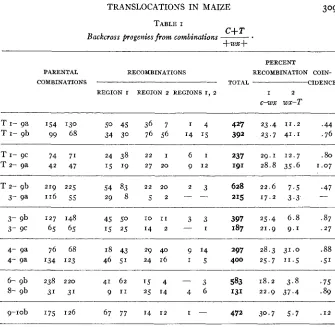
Backcross data involving various translocations with the two genes C
and wx are presented in table I . Data similarly involving the three genes
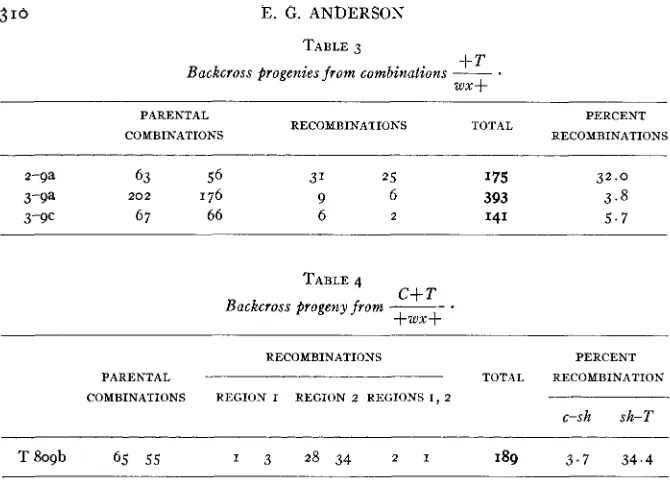
C, sh and wx are presented in table 2. Additional data involving only wx
I N MAIZE
TABLE I
Backcross progenies from combinations - C+T * +WX+
309
PERCENT
PARENTAL RECOMBINATIONS RECOMBINATION COIN-
COMBINATIONS TOTAL CIDENCE
REGION I REGION 2 REGIOXS I, 2 1 2
C - W X WX-T
T I - 9a 154 130 50 45 36 7 I 4 427 23.4 11.2 .44
T I - 9b 99 68 34 30 76 56 14 '5 392 23.7 41.1 .76
T I - 9C 74 71 24 38 2 2 I 6 I 237 29.1 12.7 .80
T2- 9a 42 47 15 19 2 7 2 0 9 1 2 191 28.8 35.6 1.07
T2- 9b 219 225 54 83 2 2 2 0 2 3 628 22.6 7.5 .47
3- 9a 116 55 2 9 8 5 2 - - 215 17.2 3 . 3 -
____
_-__
3- 9b 1 2 7 148 45 50 1 0 1 1 3 3 397 25.4 6 . 8 .87
3- 9c 65 65 15 25 14 2 - I 187 21.9 9 . 1 .27
4- 9a 76 68 18 43 29 40 9 14 297 28.3 31.0 .88
4- 9a 134 123 46 51 24 16 I 5 400 25.7 1 1 . 5 . S I
6- 9b 238 2 2 0 41 62 15 4 - 3 583 18.2 3 . 8 .75
8- 9b 31 31 9 11 25 14 4 6 131 22.9 37.4 .89
9-1ob 175 126 67 77 14 1 2 I - 472 30.7 5 . 7 .12
chlorophyll gene in some of the c wx stocks used. Under somewhat un- favorable weather conditions these proved practically lethal. While theo- retically a lethal gene should not alter the linkage percentages, datain-
TABLE 2
Backcross fiogenies from combinations ~- C+ +T * +sh wx+
PARENTAL RECOMBINATIONS
COMBINA-
TIONS REGION I REGION 2 REGION 3 I AND 2 I AND 3 2 AND 3 I , 2 TOTAL
AND 3
TI-9b 132 69 2 7 25 25 66 49 2 2 9 8 1 397
I 3 C 145 41 3 3 28 29 24 5 I 1 3 283
2-9a 42 34 3 I 13 15 19 6 3 3 - 139
4-9a 57 2 1 1 2 1 7 1 5 8 2 I 2 3 129
4-9b 68 78 6 I 19 14 I 4 I I I93
TABLE 3
+T W X f Backcross Progenies f r o m combinations __
.
PARENTAL PERCENT
COMBINATIONS RECOMBINATIONS TOTAL RECOMBINATIONS
2-9a 63 56 31 2 5 I75 3 2 . 0
3-9a 2 0 2 176 9 6 393 3 . 8
3-9c 67 66 6 2 141 5 . 7
TABLE 4
Backcross progeny f r o m -- C+ T *
+ W +
RECOMBINATIONS PERCENT
PARENTAL TOT.\L RECOMBINATION
COMBINATIONS REGION I REGION 2 REGIONS I , 2
c-sh sh-T
T h 9 b 65 55 1 3 2 8 3 4 2 1 189 3 . 7 3 4 . 4
volving a lethal gene are not entirely trustworthy for accurate determina- tions. But for the approximations required in the present work, the data are probably accurate enough.
The T 4-9a progenies fall into two sharply different groups. Three cul- tures from a single plant, 11-315-2, gave 10.2, 12.2, and 11.6 percent cross- ing over for the wx-T interval. Two cultures from sibs of this plant gave 27.1 and 34.9 percent for the same region. A closely related plant gave 27.6 percent. The two groups of data have been summarized separately. Cytological observations of one plant at mid-prophase of meiosis has shown the interchange of chromosomes about four fifths the way out on the long arm of 9 and very near the spindle attachment on 4. This position would give an expectation of loose linkage corresponding to the higher crossover value. The low value obtained in cultures from 11-315-2 might be due to the presence of some other chromosomal alteration such as the short inversion about the spindle attachment of chromosome 4 which is known to be present in some stocks (MCCLINTOCK 1933).
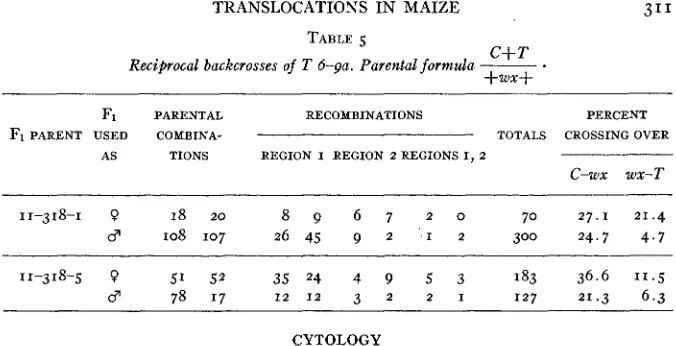
Some further data have been obtained on T 6-9a. Two sister F, plants were backcrossed reciprocally with a c wx stock. The data are given in table 5 . With such small numbers of plants involved, not much reliance can be placed on these data. There is a marked difference in the crossover values when the plants are used as female or male, but the difference is opposite to that previously found for the T
-Y
-PI
region of chromosome 6(ANDERSON 1934). Obviously the crossing-over behavior of T 6-9a needs
TRANSLOCATIONS 311
TABLE 5
C S T Reciprocal backcrosses of T 6-ga. Parental formula ___
+WX+
Fi PARENTAL RECOMBINATIONS PERCENT
F1 PARENT U S E D COMBINA- TOTALS CROSSING OVER
AS TIONS REGION I REGION 2 REGIONS I, 2
C-wx WX-T
11-318-1 0 18 20 8 9 6 7 2 0 70 27.1 21.4
3 108 107 26 45 9 2 I 2 300 24.7 4.7
11-318-5 0 51 5 2 35 24 4 9 5 3 183 36.6 11.5
3 78 17 I 2 1 2 3 2 2 1 127 21.3 6.3
CYTOLOGY
Cytological examinations have been made of aceto-carmine preparations a t mid-prophase of meiosis. Measurements and estimates of position of the interchange of chromosomes have been made from camera lucida tracings of the clearest figures. The position of the interchange is recorded in tenths of the distance from the spindle attachment to the end of the arm. Thus 9 L.4 indicates chromosome 9 long arm four-tenths of distance from the spindle attachment. In general these placements are probably reliable to about . I or . 2 of the length of the arm. Those near the end of the chromosome are somewhat less reliable. In some cases, notably T 5-9a (BURNHAM 1934a) and T 6-9b, there is much non-homologous pairing (MCCLINTOCK 1933) which makes it difficult to determine the normal position of the interchange.
The three translocations T 8-ga, T6-9a, and T 5-9" have been described. The following have been examined cytologically:
T I-9b I L .6 9 L - 5
T 2-9a
2s
.7 9 L .6+T 2-9b 2
s
. I 9 L . 29 L . I + T 3-9a
T 3-9c 3 L .I 9 L . 2
T 4-9b 4FL .6 9rL .2
T I-9c I S .6 9 L .2+
-
T 4-9a 4 L .I 9 L .8
T 8-9b 8:s . 2 9lL .8
T 9-rob 9 L .3 I O near sa.
T I-9a and T 3-9b have not been studied. T 6-9b shows much non-homolo- gous pairing, but seems to have the interchange in the proximal part of the long arm of 9.
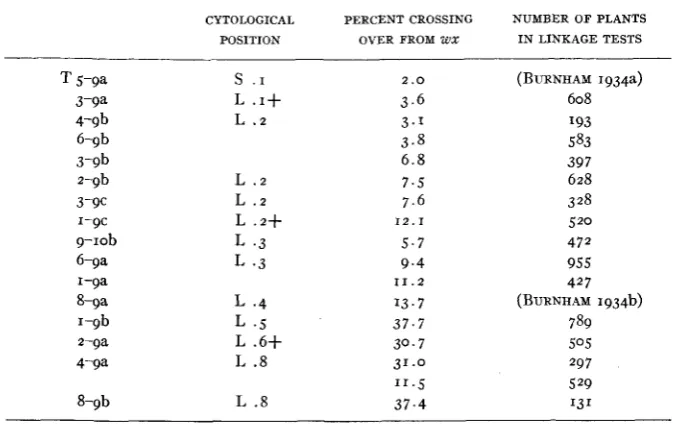
RELATION OF POSITION OF INTERCHANGE TO LINKAGE WITH WAXY
TABLE 6
Comparison of position of interchange with map distence from waxy.
CYTOLOGICAL PERCENT CROSSING NUMBER OF PLANTS
POSITION OVER PROM W X I N LINKAGE TESTS
T 5-9a 3-9a 4-9b 6-9b 3-9b 2-9b 3-c I-9c 9-1ob 6-ga I-9a 8-9a I-9b 2-9a 4-9a 8-9b
s
. IL . I +
L . 2
L . 2
L .2
L .2+
L . 3
L . 3
L . 4
L 4
L .6+
L .8
L .8
2 .o
3 . 6 3 . 1 3 . 8 6 . 8 7 . 5 7.6
5.7 9 . 4
13.7 3 7 . 7 30.7 31.0
1 1 . 5
37.4
12.1
11.2
(BURNHAM 1934a) 608 I93 583 397 628 3 28 520 472 955 427
(BURNHAM 1934b) 789 505 297 529 13 1
Table 6 gives a list of the interchanges involving chromosome 9 arranged in approximate order of their position in the chromosome and of their crossover distance from waxy. The first column gives the observed position in chromosome 9. The second column gives the percent of crossing over from waxy. The third column gives the total number of backcross plants on which the crossover percentages are based, summarized from the pre- ceding tables. The correlation between the cytological observations and the percentages of crossing over is very close, considering the probable amount of error in the cytological placements. The loose linkages shown by T 1-9b, Tz-ga, T 4-9a, and T 8-9b probably represent longer map dis- tances, which can be studied more effectively when one or more helpful genes ark found in the distal part of chromosome 9.
SUMMARY
Data are presented on linkage relations with waxy for fourteen trans- The amount of crossing over with waxy is closely correlated with the locations involving the long arm of chromosome 9.
cytological position of the interchange (table 6). LITERATURE CITED
ANDERSON, E. G., 1934 A chromosomal interchange in maize involving the attachment to the nucleolus. Amer. Nat. 68: 345-350.
3 = 3
BEADLE, G. W., I932 The relation of crossing over to chromosome association in Zea-Euchlaena hybrids. Genetics 17: 481-501.
BURNHAM, C. R., 1930 Genetical and cytological studies of semisterility and related phenomena in maize. Proc. Nat. Acad. Sci. 16: 269-277.
1934a Chromosomal interchanges in maize : Reduction of crossing over and the association of non-homologous parts (abstract). Amer. Nat. 68: 81-82.
1934b Cytogenetic studies of an interchange between chromosomes 8 and 9 in maize. Gene- tics 19: 430-447.
CREIGHTON, HARRIET B., 1934 Three cases of deficiency in chromosome 9 of Zea mays. Proc. Nat. Acad. Sci. 2 0 : 111-115.
CREIGHTON, H. B. AND MCCLINTOCK, B., 1931 A correlation of cytological and genetical crossing over in Zea mays. Proc. Nat. Acad. Sci. 17: 492-497.
EMERSON, R. A., BEADLE, G. W., AND FRASER,A. C., 1935 A summaryoflinkage studies in maize. Cornel1 Univ. Agri. Exp. Sta. Memoir 180: 1-83.
MCCLINTOCK, BARBARA, 1930 A cytological demonstration of the location of an interchange be- tween two non-homologous chromosomes of Zea mays. Proc. Nat. Acad. Sci. 16: 791-796. 1931 The order of the genes c, sh and wx in Zea mays with reference to a cytologically known point in the chromosome. Proc. Nat. Acad. Sci. 17: 485-491.
1933 The association of non-homologous parts of chromosomes in the mid-prophase of meiosis in Zea mays. Z. Zellf. mikr. Anat. 19: 191-237.