Design and Efficient of Discrete Cosine
Transform using Modified CORDIC
Algorithm
Sambit Patnaik1, Janmejaya Samal2, K.Pitambar Patra3, Sumit Kumar Choudhary4
Asst. Professor, Department of ECE, Einstein Academy of Technology & Management, Bhubaneswar, India1
Asst. Professor, Department of ECE, Einstein Academy of Technology & Management, Bhubaneswar, India2
Asst. Professor, Department of ECE, Einstein Academy of Technology & Management, Bhubaneswar, India3
Asst. Professor, Department of ECE, Einstein Academy of Technology & Management, Bhubaneswar, India3
ABSTRACT: Low-power layout is one of the most vital challenges to maximize battery life in portable devices and to save the energy during simulation operation. Image and video compressor is widely used in Discrete Cosine Transform (DCT). Many types of techniques are used in design discrete cosine transform (DCT). Multiplier and adder are two main components in design to DCT, Loeffer (1989) have developed a new architecture DCT, it consists of 11 multiplications and 29 additions. By now a day we required low chip area and fast speed algorithm, but the multiplier consumed large area compared to adder. We are designed to multiplier less CORDIC (Coordinate Rotation Digital Computer) algorithm based on DCT. CORDIC is a main component of shift and add for rotation vector and plan which is usually used for calculation of trigonometric functions. CORDIC algorithm is efficient area and delay compared to existing algorithms. All design are implementation Xilinx 14.1i and verified the result.
KEYWORDS: Discrete Cosine Transform, Discrete Fourier Transform, Coordinate Rotation Digital Computer
I.INTRODUCTION
a simple microprocessor. The number one benefit that FPGA gives is On-web site 2 programmability. therefore, it bureaucracy the suitable platform to put into effect and check the capability of a committed processor designed using CORDIC algorithm [5]. The advances in IC generation have outstanding pastimes in developing special reason, parallel processor arrays such systolic arrays had been extensively used. The basic arithmetic computation of those parallel arrays has often been implemented with a MAC ,due to the fact those operations arise in DSP programs. The reduction in hardware cost also motivated the development of sophisticated signal processing algorithms which want the assessment of capabilities together with trigonometric and logarithmic capabilities, which can not be evaluated effectively with MAC based totally arithmetic gadgets. So whilst sign processing algorithms contain those fundamental functions, it's far sure to observe significant overall performance failure. So an arithmetic computing set of rules called CORDIC (Coordinate Rotation virtual pc) has acquired tremendous interest, because it gives an iterative system to correctly calculate each of these standard capabilities. specially, all the evaluation duties in CORDIC are formulated as a rotation of vectors in various Coordinate systems. by means of varying a few parameters, the equal CORDIC processor is capable of iteratively calculates those standard features the use of the identical hardware inside the identical quantity of implementation of pipelined VLSI array processors.
II.LITERATURE REVIEW
CORDIC or Coordinate Rotation virtual laptop is a easy and hardware-green algorithm for the implementation of diverse simple, especially trigonometric, functions. instead of using Calculus based totally methods such as polynomial or rational useful approximation, it makes use of easy shift, upload, subtract and table look-up operations to reap this goal. The CORDIC algorithm become first proposed through Jack E Volder in 1959. it's also applied in both Rotation mode or Vectoring mode. In either mode, the algorithm is rotation of an perspective vector by way of a exact perspective but in variable guidelines. This constant rotation in variable direction is carried out thru an iterative series of addition/subtraction followed through bit-shift operation. The final result is acquired via as it should be scaling the end result obtained after successive iterations. attributable to its simplicity the CORDIC set of rules can be without difficulty implemented on a VLSI gadget.
III.DISCRETECOSINETRANSFORM
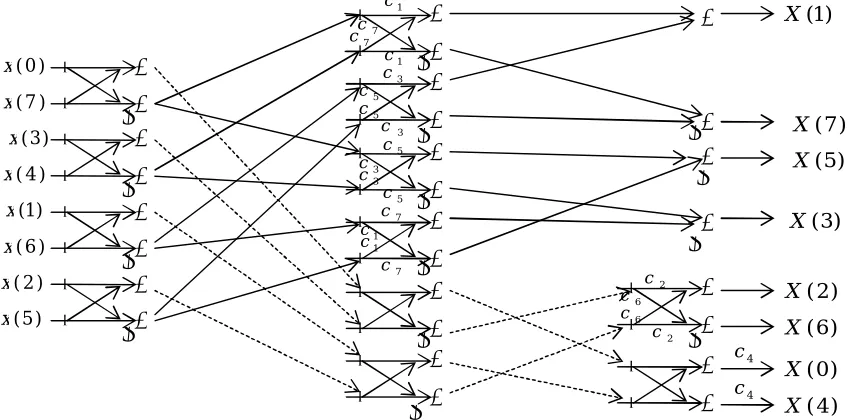
Discrete Cosine Transformation (DCT) is the most widely used transformation algorithm. DCT, first proposed by way of Ahmed [9] et al, 1974, has got greater importance in current years, in particular in the fields of photograph Compression and Video Compression. This chapter makes a speciality of green hardware implementation of DCT by way of reducing the variety of computations, enhancing the accuracy of reconstruction of the unique information, and lowering chip place. due to which the electricity consumption additionally decreases. DCT also improves velocity, compared to different trendy picture compression algorithms like JPEG.
DCT output 4 cos )) 7 ( ) 6 ( ) 5 ( ) 4 ( ) 3 ( ) 2 ( ) 1 ( ) 0 ( ( 5 . 0 ) 0
( f f f f f f f f
F
] 16 7 cos )} 4 ( ) 3 ( { 16 5 cos )} 5 ( ) 2 ( { 16 3 cos )} 6 ( ) 1 ( { 16 cos )} 7 ( ) 0 ( [{( 5 . 0 ) 1 ( f f f f f f f f F ] 16 6 cos )} 6 ( ) 5 ( ) 2 ( ) 1 ( { 16 2 cos )} 7 ( ) 4 ( ) 3 ( ) 0 ( [{( 5 . 0 ) 2 ( f f f f f f f f F ] 16 5 cos )} 3 ( ) 4 ( { 16 cos )} 2 ( ) 5 ( { 16 7 cos )} 1 ( ) 6 ( { 16 3 cos )} 7 ( ) 0 ( [{( 5 . 0 ) 3 ( f f f f f f f f F ] 4 cos )) 6 ( ) 5 ( ) 2 ( ) 1 ( ) 7 ( ) 4 ( ) 3 ( ) 0 ( [( 5 . 0 ) 4 ( f f f f f f f f
F
] 16 3 cos )} 4 ( ) 3 ( { 16 7 cos )} 5 ( ) 2 ( { 16 cos )} 1 ( ) 6 ( { 16 5 cos )} 7 ( ) 0 ( [{( 5 . 0 ) 5 ( f f f f f f f f F ] 16 2 cos )} 6 ( ) 5 ( ) 2 ( ) 1 ( { 16 6 cos )} 7 ( ) 4 ( ) 3 ( ) 0 ( [{( 5 . 0 ) 6 ( f f f f f f f f
F
IV.CORDICALGORITHM
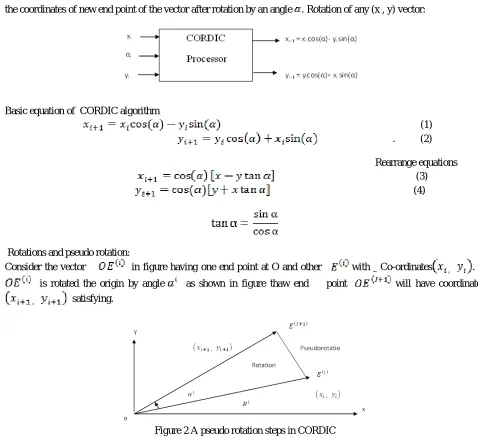
The simple form of CORDIC is based on observation that if a unit length vector with at (x,y)=(1,0) is rotated by an angle degrees, its new end point will be at
(
x
,
y
)
(sin
,
cos
)
thus coordinates can be computed by findingthe coordinates of new end point of the vector after rotation by an angle . Rotation of any (x , y) vector:
Basic equation of CORDIC algorithm
(1)
. (2)
Rearrange equations (3) (4)
Rotations and pseudo rotation:
Consider the vector in figure having one end point at O and other with Co-ordinates . If
is rotated the origin by angle as shown in figure thaw end point will have coordinates satisfying.
Figure 2 A pseudo rotation steps in CORDIC
V.SIMULATIONRESULT
together technology with higher utilization in their computing hardware gives faster timing closure and higher fine of results for a better time to designing answer.
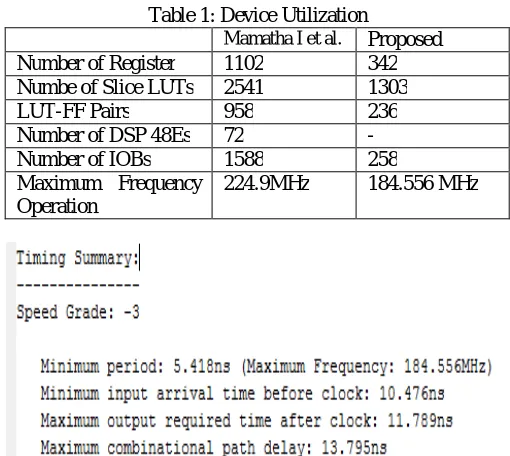
Table 1: Device Utilization
Mamatha I et al. Proposed Number of Register 1102 342 Numbe of Slice LUTs 2541 1303
LUT-FF Pairs 958 236
Number of DSP 48Es 72 - Number of IOBs 1588 258 Maximum Frequency
Operation
224.9MHz 184.556 MHz Figure 3: Resister transfer Level (RTL) View of 8-point
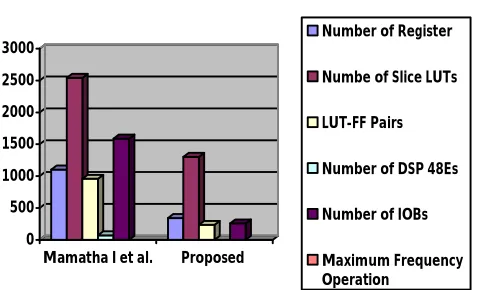
0 500 1000 1500 2000 2500 3000
Mamatha I et al. Proposed
Number of Register
Numbe of Slice LUTs
LUT-FF Pairs
Number of DSP 48Es
Number of IOBs
Maximum Frequency Operation
VI.CONCLUSION
We found that CORDIC based DCT algorithm is the best algorithm in the existing algorithm. So we are implementation to CORDIC based DCT algorithm in this paper. The performance evaluation of the various sub modules are carried out using Xilinx 14.1 ISE Simulator and it was found that the circuits designed using DCT logic showed a reduced delay and power. As a future work more arithmetic and logical function can be used.
REFERENCES
[1] Mamatha I, Nikhita Raj J, Shikha Tripathi, Sudarshan TSB, “Systolic Architecture Implementation of 1D DFT and 1D DCT”, 978-1-4799-1823-2/15/$31.00 ©2015 IEEE.
[2] Liyi Xiao Member, IEEE and Hai Huang, “Novel CORDIC Based Unified Architecture for DCT and IDCT”, 2012 International Conference on Optoelectronics and Microelectronics (ICOM) 978-1-4673-2639-1/12/$31.00 ©2012 IEEE.
[3] Shymna Nizar N.S,Abhila and R Krishna, “An Efficient Folded Pipelined Architecture For Fast Fourier Transform Using Cordie Algorithm”, 2014 IEEE International Conference on Advanced Communication Control and Computing Technologies (lCACCCT) IEEE.
[4] E. Jebamalar Leavline, S.Megala2 and D.Asir Antony Gnana Singh, “CORDIC Iterations Based Architecture for Low Power and High Quality DCT”, 2014 International Conference on Recent Trends in Information Technology 978-1-4799-4989-2/14/$31.00 © 2014 IEEE.
[5] Satyasen Panda, “Performance Analysis and Design of a Discreet Cosine Transform processor Using CORDIC algorithm”, 2008-2010. [6] Keshab K. Parhi, “VLSI Digital Signal Processing Systems, design and implementation”, Wiley.
[7] Deepika Ghai, “COMPAATIVE ANALYSIS OF VARIOUS CORDIC TECHNIQUES”, June, 2011.
[8] Yuan-Ho Chen et al, “A High Performance Video Transform Engine by Using Space- Time Scheduling Strategy”, IEEE TRANSACTIONS ON VERY LARGE SCALE INTEGRATION (VLSI) SYSTEMS, VOL. 20, NO. 4, APRIL 2012.
[9] Xue Liu, Feng Yu, Ze-ke Wang, " A Pipelined Architecture for Normal I/O Order FFT", Journal of Zhejiang University-SCIENCE C (Comput & Electron) , vol.12, no.1, 2011 , pp::76-82.
[10] Weihua Zheng, Kenli Li, Keqin Li, "A Fast Algorithm Based on SRFFT for Length N=qx2m DFTs", IEEE Trans. Circuits and Systems-II: Express Briefs, vol. 61, no.2, 2014, pp: 110-114.
[11] Weihua Zheng, Kenli Li, and Keqin Li," A Fast Algorithm Based on SRFFT for Length N = q × 2m DFTs , IEEE Trans. Circuits Syst.II, Exp. Briefs, vol. 61, no. 2, pp.110-114, Feb. 2014