ISSN(Online): 2320-9801
ISSN (Print): 2320-9798
I
nternational
J
ournal of
I
nnovative
R
esearch in
C
omputer
and
C
ommunication
E
ngineering
(An ISO 3297: 2007 Certified Organization)
Vol. 3, Issue 6, June 2015
Video Based Face Recognition Using Artificial
Neural Network
Santhy Mol T, Neethu Susan Jacob
Pursuing M.Tech, Dept. of CSE, Caarmel Engineering College, MG University, Kerala, India Assistant Professor, Dept of CSE, Caarmel Engineering College, MG University, Kerala, India
ABSTRACT: Face recognition is one of the main applications of image processing. It is a biometric approach that gives a method to recognize the identity of person based on his/her physiological characteristics. Recently face recognition from videos has become more popular due to more abundant information than still images. This paper presents a video based face recognition algorithm. And it generates a video signature by combining large information available from frames of a video. It accept this information as a rank list of face images from a dictionary. The algorithm is generated using the ranked list of frames in the video using level-1 features. Multiple ranked list over the frames are then improve using artificial neural network classifiers and finally fused together to create signature of video. The effectiveness of the proposed algorithm is shown on YouTube database that make different types of video based face recognition summons. Performance comparison with the benchmark results on different databases.
KEYWORDS: Face recognition, video, fusion.
I. INTRODUCTION
Recently, the use of camera technology is increased and numerous amount of video is captured every day. In face recognition, the no of data collected from cameras is greater than the size of all public data base face images. The objective of collecting data from cameras is to predict the unnecessary activity and person associated with that activity. Therefore the use of video camera for security application has an increasing interest in video based face recognition.
Face recognition is an easily studied problem because many algorithm of the face recognition are proposed [11] earlier, many of the algorithms are focus on the comparison of still images and face recognition from videos is less discussed. At certain conditions like low lighting, sun glass, long hair, face recognition is fail to perform. Due to extensive applications availability of enormous intra-personal variations in video and limited information in still images, video-based face recognition has acquired significant attention. Unlike still face images, videos provide large information that can be influenced to address variations in pose, illumination, and expression as well as enhance the face recognition performance.
Video based face recognition contains comparison of video to still face images and comparison of two videos. In video to still face recognition, the input is a video and the output is the collection of still face images whereas in still to video face matching, the input and output are changed. In video to video face recognition, both input and output are videos to be matched.
ISSN(Online): 2320-9801
ISSN (Print): 2320-9798
I
nternational
J
ournal of
I
nnovative
R
esearch in
C
omputer
and
C
ommunication
E
ngineering
(An ISO 3297: 2007 Certified Organization)
Vol. 3, Issue 6, June 2015
II. RELATED WORK
The survey on video based face recognition approaches mainly classified in to three categories. Set based approaches [7] use collection of observations in a video. The approaches that model image sets as distributions use the between-distribution similarity to match two image sets. However, the performance of such approaches depends on the parameter estimation of the manifolds is also proposed [6] where matching between two image sets is performed by measuring similarity between the input and reference subspaces/manifolds [3]. Sequence based approaches use the temporal information for improved face recognition. To utilize the temporal information, Zhou [12] had proposed to use a joint posterior probability distribution of motion vector and identity variable estimated using sequence importance sampling. Some of the approaches that model the temporal information with Hidden Markov Models (HMM) [8] are also proposed.
Dictionary based approaches use large dictionary for matching faces. Chen [10] proposed a multi variate sparse representation that simultaneously takes correlation as well as coupling information between frames. Recently, Bhatt [13] proposed to compute a video signature as an ordered list of still face images from large dictionary.
III. OVERVIEW OF THE SYSTEM
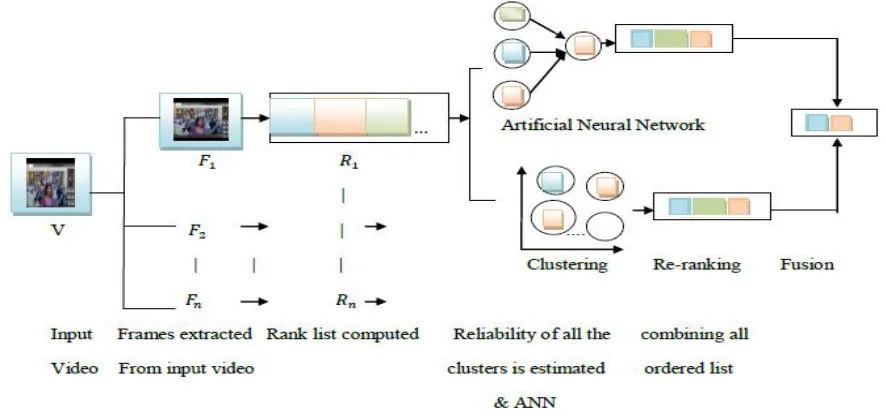
This paper proposes an algorithm for video based face recognition. It generates the signature of a video as an ordered list of face images from a dictionary. Fig. 1 shows the outline of proposed algorithm. It starts by computing a rank list of every frame in the video. Level-1 features are used to generate a rank list using LDA. To identify the person in a video, rank list from multiple frames are combined using artificial neural network classifier and clustering based re ranking and fused the list. It produces the final composite ranked list for a video which represents the discriminative video signature. Finally, to match two videos, their video signatures are compared using DCG (Discounted cumulative gain) measure.
The major contributions of this paper can be summarized as follows:
It uses the facial features for efficient video based face recognition. Level-1 features are used for computing multiple ranked lists
In this paper, a new paradigm is introduced using artificial neural network for generating video signatures as an ordered list of still face images from the dictionary.
ISSN(Online): 2320-9801
ISSN (Print): 2320-9798
I
nternational
J
ournal of
I
nnovative
R
esearch in
C
omputer
and
C
ommunication
E
ngineering
(An ISO 3297: 2007 Certified Organization)
Vol. 3, Issue 6, June 2015
Fig.1.Outline of proposed algorithm for matching two videos
IV.DESCRIPTION ON PROPOSED METHOD
Recent face recognition survey shown that the generation of image signature from dictionary is more efficient than the comparison of two images. In this paper, video based face recognition is addressed by computing a composite rank list using a dictionary of still face images. This algorithm use large data from the video frames for the generation of composite rank list.
In this paper, dictionary is a large collection of still face images where every person has number of images. Each image has different variations like pose, illumination, and expression.
A. Rank list generation
ISSN(Online): 2320-9801
ISSN (Print): 2320-9798
I
nternational
J
ournal of
I
nnovative
R
esearch in
C
omputer
and
C
ommunication
E
ngineering
(An ISO 3297: 2007 Certified Organization)
Vol. 3, Issue 6, June 2015
The linear discriminant function learns these variations and retrieves images from the dictionary that are similar to the input video frame i.e. images with similar illumination, pose & expression.
B. Artificial Neural Network
Artificial Neural Network is a very well known classification technique that has been used to approximate real valued functions. We employ an artificial neural network of two layers that uses the back propagation algorithm for learning.
Consider . , … . , are input frames and , , … . . , are the output frames with corresponding ranks of each frames. The image with similar appearance is placed on one classifier (neurons). Each classifier (neurons) contains different features like pose, illumination, expression.
C. K- means clustering
Multiple rank list of a video are combined to generate a single composite rank list, denoted as R. As shown in Fig. 2, the proposed algorithm generates a composite rank list. First, each rank list corresponding to a video is partitioned in to different clusters and reliability of each cluster is calculated. And the similarity scores of images within a cluster are adjusted based on the reliability of that cluster.
Fig 2. Illustrates ANN and Clustering based re-ranking and fusion to perform video signature
Images in the ranked list are partitioned into different clusters such that if an image in a cluster has high similarity to the input frame. The idea behind clustering is to congregate images in a ranked list into different clusters where each cluster represents a particular viewing condition. Here k means clustering is used for clustering purpose because it is computationally efficient and faster than other hierarchical clustering techniques.
1) Rechecking of rank
ISSN(Online): 2320-9801
ISSN (Print): 2320-9798
I
nternational
J
ournal of
I
nnovative
R
esearch in
C
omputer
and
C
ommunication
E
ngineering
(An ISO 3297: 2007 Certified Organization)
Vol. 3, Issue 6, June 2015
2) Joining of rank list
Multiple rank list from clustering based re ranking and artificial network are fused based on the similarity scores of the image to generate a composite rank list as the video signature.
D. Matching video signature
The Discounted cumulative gain measure is used to compare two rank lists. DCG measure is widely used in information retrieval domain to compare the lists of documents. Each document in the ranked list is arranged based on its similarity to the input query also has a relevance score provided by a domain expert.
Algorithm 1 summarizes the proposed algorithm for matching two videos.
Algorithm 1 Summarization of the Proposed System
Step-1: For a given video pair, frames from each video are extracted and
pre-processed. Face region from each frame is detected.
Step-2: for each frame in the video, a rank list of still face images from the
dictionary is computed using LDA. The retrieved dictionary images are arranged in
a rank list such that the image with the maximum similarity score is positioned at
the top of the list.
Step-3: Rank list across multiple frames of a video are combined to form a video
signature using artificial neural network, clustering based re ranking and fusion.
Step-4: the videos are matched using DCG measure as comparing video signatures.
The proposed algorithm efficiently computes the signature of video and changes the problem of video based face recognition into matching two rank lists.
V. EXPERIMENTAL RESULT
The performances of proposed algorithm on different databases are compared. Table I shows the comparison of algorithms on different data bases such as You Tube Data base, MBGC.
TABLE I
COMPARISON OF ALGORITHMS ON DIFFERENT DTABASE
Algorithm You Tube DB MBGC
Recognition Rate
Time Recognition Rate
Time Clustering Based Re
ranking
ISSN(Online): 2320-9801
ISSN (Print): 2320-9798
I
nternational
J
ournal of
I
nnovative
R
esearch in
C
omputer
and
C
ommunication
E
ngineering
(An ISO 3297: 2007 Certified Organization)
Vol. 3, Issue 6, June 2015
According to the results, In You Tube Database, recognition rate of clustering based re ranking is 78% and the time to take the creation of composite rank list is 15.3 seconds. The proposed algorithm recognition rate is 80% and time to take the creation of Video signature is 15 seconds.
In MBGC, recognition rate of clustering based re ranking is 78.1% and the time is 15.9 seconds. The proposed algorithm recognition rate is 80.5% and the time to take the creation of video signature is 15.1 seconds. This result shows that the recognition rate and time of creation of composite rank list is most efficient in proposed algorithm using different databases.
VI. CONCLUSION AND FUTURE WORK
The proposed video based face recognition algorithm is based on the observation that video signature can be created by combining the large information available within multiple frames of a video. The algorithm starts with creating a ranked list for every frame in the video using computationally efficient features. Multiple ranked lists across the frames are then optimized using artificial neural network, clustering based re-ranking and finally fused together to create the signature of video. The video signatures are compared using DCG measure. In future work the neural network can be modified by Fuzzy C- means clustering algorithm and other classifiers.
ACKNOWLEDGEMENT
We would like to thank reviewers for their helpful and constructive comments. We would also like to thank the faculties, the resource providers and the system administrator for the useful feedback and constant support.
REFERENCES
[1] P. J. Phillips et al., Overview of the multiple biometrics grand challenge, in Proc. Int. Conf. Advances Biometrics, 2009, pp. 705714.
[2] L. Wolf, T. Hassner, and I. Maoz, Face recognition in unconstrained videos with matched background similarity, in Proc. IEEE Int. Conf.CVPR, Jun.2011, pp. 529534
[3] G. Aggarwal, A. K. R. Chowdhury, and R. Chellappa, A system identification approach for video-based face recognition, in Proc. 17th ICPR, 2004, pp. 175178.
[4] J. R. Barr, K. W. Bowyer, P. J. Flynn, and S. Biswas, Face recognition from video: A review, Int. J. Pattern Recognit. Artif. Intell.,vol. 26, no. 5, p.1266002, 2012.
[5] H. S. Bhatt, R. Singh, and M. Vatsa, On rank aggregation for face recognition from videos, in Proc. 20th IEEE ICIP, Sep. 2013, pp. 15.
[6] A. Hadid and M. Pietikinen, Manifold learning for video-to-video face recognition, in Proc. Int. Conf. Biometric ID Manag. and Multimodal Communication, 2009, pp. 916
[7] J. Stallkamp, H. K. Ekenel, and R. Stiefelhagen, Video-based face recognition on real-world data, in Proc. 11th ICCV, Oct. 2007, pp. 18. [8] M. Kim, S. Kumar, V. Pavlovic, and H. Rowley, Face tracking and recognition With visual constraints in real-world videos, in Proc. IEEE Int.
Conf. CVPR, Jun. 2008, pp. 18.
[9] A. Hadid and M. Pietikinen, Manifold learning for video-to-video face recognition, in Proc. Int. Conf. Biometric ID Manag. and Multimodal Communication, 2009, pp. 916.
[10] Y. C. Chen, V. M. Patel, S. Shekhar, R. Chellappa, and P. J. Phillips, “Video-based face recognition via joint sparse representation,” in Proc. 10th IEEE Int. Conf. Workshops Automatic Face and Gesture Recognition, Apr. 2013, pp. 1–8.
[11] W. Zhao, R. Chellappa, P. J. Phillips, and A. Rosenfeld, “Face recognition: A literature survey,” ACM Comput. Surv., vol. 35, no. 4, pp. 399– 458, 2003.
[12] S. Zhou, V. Krueger, and R. Chellappa, “Probabilistic recognition of human faces from video,” Comput. Vis. Image Understand., vol. 91, nos. 1–2, pp. 214–245, 2003.
ISSN(Online): 2320-9801
ISSN (Print): 2320-9798
I
nternational
J
ournal of
I
nnovative
R
esearch in
C
omputer
and
C
ommunication
E
ngineering
(An ISO 3297: 2007 Certified Organization)
Vol. 3, Issue 6, June 2015
BIOGRAPHY
Santhy Mol T received her Bachelor of Engineering in Computer Science and Engineering from Anna University, in 2012. At present, he is pursuing M.Tech in Computer Science and Engineering at Caarmel Engineering College, Kerala Affiliated to MG University. His research interests include Image Processing, Data Mining.