Volume 3, No. 7, Nov-Dec 2012
International Journal of Advanced Research in Computer Science
RESEARCH PAPER
Available Online at www.ijarcs.info
A New Solution for Dynamic Travelling Salesman Problem with Hybrid Ant Colony
Optimization Algorithm and Chaos Theory
Isa Maleki*
Computer Engineering Department
Science and Research Branch, Islamic Azad University, West Azerbaijan, Iran
Seyyed Reza Khaze Computer Engineering Department
Science and Research Branch, Islamic Azad University, West Azerbaijan, Iran
Farhad Soleimanian Gharehchopogh Computer Engineering Department
Science and Research Branch, Islamic Azad University West Azerbaijan, Iran
[email protected] [email protected]
Abstract: In this paper, a new method of optimization is proposed based on the combination of Ant Colony Optimization (ACO) and Chaos Theory to solve Dynamic Travelling Salesman Problem (DTSP). ACO algorithm has been modified in a way by using chaos theory to obtain an optimal solution to solve DTSP. By combination of both chaos theory and ACO algorithm, a hybrid algorithm is created which provided a better net to solve DTSP. In hybrid algorithm, pheromone updating rule is performed by using Logistic Map function and is non-linear which can prevent premature convergence. Features such as high precision and good convergence rate to reach best results indicate our proposed hybrid algorithm is better.
Keywords: Dynamic Travelling Salesman Problem (DTSP); ACO; chaos theory; logistic map function; hybrid algorithm
I. INTRODUCTION
DTSP is one of the most well-known problems in hybrid optimization. Researchers have been proposed several discovery algorithms to solve DTSP such as hybrid algorithm [1], ACO [2, 3, and 4], GAs [5, 6], refrigerating algorithm [7] and Artificial Neural Networks [8, 9]. In the DTSP, a salesman starts his trip from a city and after a complete trip comes back to his own city again and pass each city for once and of course he should pass all cities [10].It is firstly introduced by Psaraftis in 1998 [11 and 12]. The most important thing in this feature is finding the shortest route. Among these methods, ACO is particularly considered more important in finding close solutions to optimal ones for hybrid optimization problems.
Solving DTSP based on ACO was primarily introduced by Middendorf & Guntsch [13]. Also, Huang et al have used revolutionary algorithms to solve DTSP [14]. As one of the nature-derived optimization method, ACO was inspired from real ant’s behaviors in finding the shortest route between nest and food source. Ants are social and almost blind insects that are capable of finding the shortest route between the nest and the food source and vice versa. They can also adapt to the environmental changes. The media which is used to address the information among ants is a chemical (effect) called pheromone [15]. It provides the possibility of finding the shortest route. The ants choose the shortest route are created stronger pheromone trail than those choose the longer one. Since the stronger pheromones attracts more ants so all of them choose the shortest route and move through it.
In the recent years, Chaos theory is considered in several researches in physics, chemistry, biology and engineering. Basically, chaos theory is used by Lorenz in 1963 [16]. Chaos theory initially was developed for the analysis of air currents and weather forecast but can also be analyzed most mechanical, dynamical, laser and optical systems. Numerous researches have been done about chaos theory. Then, it gradually was applied in control science [17 and 18], synchronization [19] and optimization [20]. Chaos theory with unique features such as sensitivity to initial value, a completely different approach for solving the combination optimization problems presented.
F.S.Gharehchopogh et al. [1] proposed a hybrid algorithm to solve DTSP which the initial results of the ACO algorithm from gained data of routes were selected to mutate genetic algorithm results. Genetic algorithm results are used to enlarge ants searching domain. In each generation of genetic algorithm, it is created better results to achieve an optimal one. Consequently, by using efficient routes of ACO algorithm, it looks for finding most optimal routes. In hybrid method of optimal routes, ACO algorithm is presented as the initial population to the genetic algorithm. In genetic algorithm, chromosomes are shown as the series of natural numbers. Each number is related to the cities of DTSP. It is used PMX merge operator [21] which has the ability to guarantee the optimal route. In this paper by using logistic mapping function and ACO, DTSP is done. It is provided strategies which can be used particular dynamic function to the pheromone value on manes.
proposed algorithm is described; in the section five we explain the results and evaluation of the proposed method; and finally in the sixth section, we will conclude.
II. CHAOTICFUNCTION
The most popular and simplest chaotic function is known as logistic mapping function [22, 23] which involves a differential equation of non-linear first order single – variable. The dynamic equation of this function was initially introduced by Robert May. It is defined as follow [22]:
Xn+1=λXn(1−Xn) (1)
In Equation (1), x value in interval [0, 1] and r value in interval 0<r≤4 are accepted. This function shows three chaotic behaviors in which the Equation (1) behavior is considered as follow if X0=0.3
Pseudo code algorithm of non- linear logistic function is as follow:
[image:2.595.360.527.52.232.2]
Figure 1. Quasi Code of One Dimensional Logistic Function
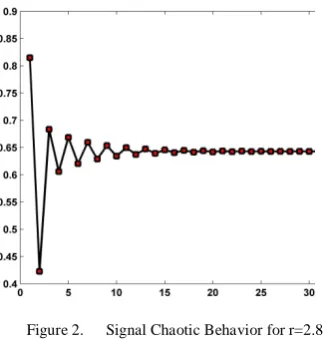
[image:2.595.365.525.297.470.2]Fig. 2 shows the output in the first 30 iterations for r=2.8 which is almost chaotic. But as passing through transient state, the final response reaches to the non-zero value.
Figure 2. Signal Chaotic Behavior for r=2.8
As Fig. 3 shows the final answer between two constant numbers will change as r=3.2
Figure 3. Signal Chaotic Behavior for r=3.2
As it is indicated in Fig. 4, for r=3.8, after a long time, the output had irregular fluctuations and it doesn’t converge due to periodic behavior. This non-periodic behavior is called chaotic signal or simply chaos.
Figure 4. Signal Chaotic Behavior for r=3.8
The logistic function is a simple chaotic function which probably is the simplest sample of discrete chaotic dynamic system which shows chaotic behavior. If it ends up to a periodic behavior so it is an alternative attract. In an area in which the system has chaotic behavior and ends up to a non-periodic absorber, it is said that the system has a strange or chaotic absorber.
Chaotic functions in their states of equations of state are usually paths with unpredictable fluctuations but limited around the neighborhood [24, 25]. Such behaviors are usually difficult to control and may be incomplete. Of course, it must be noted that chaos system isn't always negative and in some cases produce or increase of controlled chaos behavior is needed.
III. ANTSCOLONYOPTIMIZATION
ACO algorithm is one of the most well-known revolutionary optimization algorithms. It is initially introduced by Dorigo in 1996 [26, 27]. In DTSP, the goal is to find a route with the shortest distance for the salesman.
A. The Rule of Transition Probability
The possibility of transfer from city (i) to the city (j) for the ant (k) in the time (t) is stated based on Equation (2). In this equation, ɳi,j is field of vision which is equal to 1/di,j
1. Initialization
X (n) = Fixed Point r= Chaotic Point
2. Loop
X (n+1) =r*X (n)*(1-X (n))
[image:2.595.106.242.309.383.2] [image:2.595.86.248.470.641.2](the nearer cities are more probable to choose) and τi,j is the amount of pheromone on mane in the time of t.
Allowed k is the series of cities that the ant k doesn't visit
yet and probably can do this in the next step. α and β are the
effective parameters of spilt pheromone amount on the mane and the field of vision of it.
( )
[
[
] [ ]
] [ ]
∈
⋅
⋅
=
∑
∈otherwise
allowed
k
i
t
t
t
p
k allowed j ij ij ij ij k ij k0
f
)
(
)
(
β α β αη
τ
η
τ
(2)The amount of pheromone on the edge (i, j) in the time of t is shown by τi,j.
B. Rules of Pheromone Update
The pheromone updating rule on manes is done according to Equation (3).
τij
(
t+n) (
=1−ρ)
×τij( )
t +∆τij (3)In Equation (3), 1-ρ determines the rate of pheromone evaporation from t to t+n. In order to prevent pheromone increase on mane, it is determined 0< ρ <1 limit for ρ. As the amount of ρ is increased, pheromone evaporation rate will increase, too.
k ij m k ij τ τ
∑
= ∆ = ∆1 (4)
k ij
τ
∆ Is amount of pheromone in which the ant k leave on
the route (i, j) and in the time interval of t to t+n.
+ = ∆ otherwise L Q k k ij 0 n) t (t, at time j) (i, edge uses ant k if τ (5)
In Equation (5), Q is a constant number as Lk is the route length which is travelled by ant K.
IV. PROPOSEDSOLUTION
Chaos includes a series of repeated activities for algorithms optimization to improve and speed up its performance. Ant s chaotic behavior make pheromone remains consistent on all manes so that ant can find the nearer routes in the shorter time. So, we can find a route of repeated points, it can be used to optimize route.
Optimization is trying to change a primary idea to an optimal response. Practically, optimization issues are so complicated and classic algorithms can't solve them satisfactorily. These algorithms have two limitations falling in local minimum and time consuming to search. At one hand, due to dynamic and accidental features of chaos variables, chaos systems are capable of escaping from local optimum. So, chaos searching can be used practically to optimize collective intelligence algorithms.
In the proposed algorithm, by using the combination of logistic map is one dimensional and ACO about DTSP, it is studied the optimization of the found routes by ants through
the possibility of selecting routes and updating pheromone to decide about which routes will be better to choose.
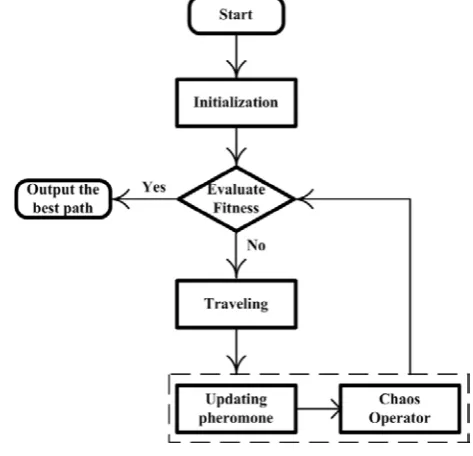
[image:3.595.323.560.163.391.2]Like other processes of search, chaotic process is followed by a series of experimental answers which lead to the optimal answer. In each repetition, by a chaotic search, it will be found more optimal answer. Then, each of the experimental solution obtained, a new solution is considered to be closer to the optimal solution. The general view of hybrid algorithm is shown in Fig .5.
Figure 5. Proposed Solution (Hybrid Algorithm)
Pseudo-code of the proposed algorithm based on ACO algorithm and chaotic function include as below:
Figure 6. Quasi Code of Proposed Algorithm
A. pheromone updating method
As the ants move into chaotic, they will probably choose the route which were chosen by the other ants and strengthen by pheromone odor. In Equation (6), logistic map is one dimensional chaotic function is merged with pheromone updating to choose the best route.
τij
(
t+n) (
= 1−ρ)
×τij( )
t +∆τij+Xn (6)Xn Is used to repeat logistic function. As the precision and speed in reaching to the result depends on the growth rate of chaotic function in chaotic function so to select
1. Begin
2. Initialization Parameters 3. Loop
Each ant is positioned on a starting City
4. Loop
Transition probability rule Pheromone updating Logistic Function
5. Until All ants have built a complete solution
6. Until End condition
optimal routes and algorithm more efficiency, it is used logistic function in pheromone updating rule to speed up pheromone growth rate. Fig .7 shows how pheromone effects on routes.
Figure 7. Pheromone Chaotic Updating
The above process is described by a positive feedback loop as Equation (7). It means that the possibility that an ant choose a route will increase as the others choose it before. In each stage of repetition, the current value of X is returned (feedback) to the input to obtain the next value. The feedback feature of controlled logistic function is used to select cities neighboring.
(7)
The interesting thing is that it changes very little chaotic behavior is a function of the amount of chaos in each direction, when separate and distinct causes. Chaotic functions at some stage of their long routes may cause very sudden and optimization. Chaos shows a pseudo-random deterministic behavior which there lacks repeats and doesn't have early convergence.
B. The Possibility of Choosing Route
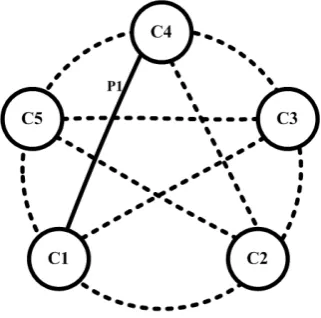
In order to prevent a problem reach to an early convergent, ants choose all the routes chaotically to reach the shortest ones. As you can see in Fig. 8, the way of routes formation is shown. If we suppose that the starting point is city 1, ants will visit all the routes which connect to the city 1 chaotically. As the route length is shorter, the chaos will be more in that route. As all the ants convergent to a route, pheromone will be strengthening in it. Thus, the first solution is obtained.
Figure 8. Finding the Optimal Route as Chaotic
As you can see in Fig. 8, choosing a city isn't definite and all the neighbor cities are considered as optimal route chaotically.
C. Choosing the Cities
Firstly, based on the distance between two points, it is determined a series of optimal route and the shortest one choose as the optimal. For example, in Fig. 9, if the starting point (city) is C1, the P1 will choose as the optimal route and the routes which connect to the C1 are the chaotic routes which don't choose as the starting cities and are chaotic options for optimal cities. The rate of achieving to the solution in this method has more speed and accuracy in compared with other optimization methods.
Figure 9. Cities Chaotic Selection
V. RESULTSAND DISCUSSION
[image:4.595.357.518.227.386.2]In this section, we review the obtained results from proposed algorithm to solve DTSP. In order to indicate the efficiency of proposed algorithm, we consider 30 cities and maximum 100 iterations for two algorithms. By considering the possibility of route selecting changes and updating method as chaotic, we can review the tour length. In Fig.10, the cities are drawn as dots on the coordinates.
Figure 10. Cities Coordinate
[image:4.595.340.551.541.677.2]The parameters values for implementation of proposed algorithm in Table 1 are shown.
Table I. Value of Parameters in the Proposed Algorithm
r rho Parameter Name
1.0 5
[image:4.595.38.280.613.735.2]The given results in Table 2 show that the possibility to reach the optimal solution will increase in the proposed algorithm. As in none of the proposed algorithm, the obtained answers don't worse than route length. In other words, the obtained route length is remained consistent or decreased. Comparison of the obtained results in our proposed method of ACO shows that it creates more optimal solution
.
Table II. Comparing the Results of Proposed Algorithm and the Another Algorithm
Worst Solution Best
Solution Average
Solution Algorithms
ACO [1] GA [1] Hybrid Algorithm [1]
Proposed Algorithm
As you can see in Table (2), Ant Colony algorithm went through longer routes to achieve the goal.
A. The Effect of Logistic Function Parameters
Four different values are shown for controlling parameter of r in Table 3. Determining the optimal controlling parameter of r will increase the proposed algorithm efficiency. These values are considered to reach the close solution to optimal due to 10 times repetition of the program. As it is appeared in results, due to the increase of r controlling parameter, the hybrid algorithm acts worst in obtaining the route length average. Consequently, determining a proper value for r parameter in combining pheromone updating rule and local search to find optimal tour is really effective.
Table III. Impact of Parameter r
Worst Solution Best
Solution Average
Solution Parameter Value
367 340
410 r 1.4
351 340
424 r 2.8
348 340
437 r 3.2
357 340
420 r 3.8
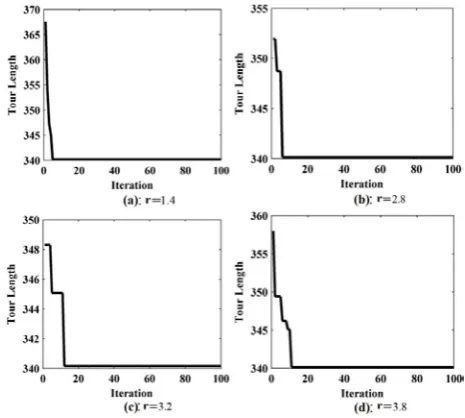
[image:5.595.328.561.58.267.2]In proposed algorithm, the shorter routes are travelled to achieve the goal and contained more capability to adapt to DTSP. The initial parameters as well as ant's colony optimization algorithm had great importance to reach the close solution to optimal as by manipulating these parameters, it can be reached to the different results. In Table 3, it can be seen how the solution optimization changed in 10 times repetition by manipulating (r) chaotic parameter. In Fig. 11, by using the graphs, we review the production process of different solutions in logistic function. This claim is easily approved by reviewing Fig. 11.
Figure 11. Graphical Representation of the Path Cost Improvement
In Fig. 11, it is shown the improving process of solution optimization to solve DTSP graphically in which the vertical and horizontal axis showed route cost and the process repetition, respectively. Fig. a-11, b-11, c-11 and d-11 indicate the output as r=1.4, r=2.8, r=3.2 and r=3.8, respectively.
VI. CONCLUSION
In this paper, we introduce a new method based on ACO and chaos theory to find optimal route. The obtained results in this method indicate the optimal solution and proper efficiency of the algorithm in solving DTSP. It also improved considerably the convergence rate and solution quality in compared with optimization approach based on ants behaviors. Although ACO provides acceptable and proper solutions to solve DTSP, but the proposed algorithm can improve the problem solutions if we use chaos theory and replace a non-linear logistic function.
VII. REFRENCES
[1] F.S. Gharehchopogh, I. Maleki, M. Farahmandian, "New Approach for Solving Dynamic Traveling Salesman Problem with Hybrid Genetic Algorithms and Ant Colony Optimization", International Journal of Computer Applications (IJCA), Vol. 53, No.1, pp 39-44, September 2012.
[2] M.Dorigo, L. M.Gambardella, “Ant colony system: a cooperative learning approach to the traveling salesman problem”, IEEE Transactions on Evolutionary Computation, Vol. 1, No. 1, pp.53–66, 1997.
[3] M.Guntsch, M.Middendorf. “Pheromone Modification Strategies for Ant Algorithms Applied to Dynamic TSP”. In Applications of Evolutionary Computing, Lecture Notes in Computer Science, Vol.2037, pp. 213-220, 2001.
[4] M.Guntsch, M.Middendorf, and H.Schemck. “An Ant Colony Optimization Approach to Dynamic TSP”. Proceedings of the GECCO 2001. San Francisco, USA, 7-11 July, 2001, Morgan Kaufmannp, pp. 860-867, 2001.
[image:5.595.52.266.446.510.2]problems”, Engineering Optimization, Vol. 35, No.3, pp. 297–311, 2003.
[6] M.Albayrak, N.Allahverdi, “Development a new mutation operator to solve the Traveling Salesman Problem by aid of Genetic Algorithms”, Expert Systems with Applications, vol. 38, no.3, pp. 1313–1320, 2011.
[7] J. Pepper, B. Golden, E. Wasil, "Solving the traveling salesman problem with annealing-based heuristics": a computational study. IEEE Transactions on Systems, Man, and Cybernetics, Part A, Vol. 32, pp. 72 – 77, 2002.
[8] K. S.Leung, H.D. Jin, Z. B. Xu, ”An expanding self-organizing neural network for the traveling salesman problem”, Neurocomputing, Vol. 62, pp. 267–292, 2004.
[9] T. A. S.Masutti, L.N. de Castro, “A self-organizing neural network using ideas from the immune system to solve the traveling salesman problem”, Information Sciences, Vol. 179, No. 10, pp. 1454–1468, 2009.
[10] M. Guntsch, M. Middendorf, and H. Schmeck. ”An ant colony optimization approach to dynamic TSP. In Lee Spector et al., editor, Proceedings of the Genetic and Evolutionary Computation”, Conference (GECCO-2001), Morgan Kaufmann,San Francisco, California, USA, pp. 860–867, 7-11 July 2001.
[11] H.N Psaraftis,”Dynamic vehicle routing problems”. In: Golden, B.L., Assad, A.A. (eds.) Vehicle Routing: Methods and Studies, Elsevier, Amsterdam, pp.223–248, 1988.
[12] C. Li, M. Yang, L. Kang: “A New Approach to Solving Dynamic Traveling Salesman Problems“. In: Wang, T.-D., Li, X., Chen, S.-H., Wang, X., Abbass, H., Iba, H., Chen, G., Yao, X. (eds.) SEAL 2006. LNCS, Springer, Heidelberg,vol. 4247, pp. 236–243,2006.
[13] M.Guntsch, M.Middendorf,”A population based approach for ACO”. In: Cagnoni, S., Gottlieb, J., Hart, E., Middendorf, M., Raidl, G.R. (eds.) EvoWorkshops 2002. LNCS, Springer, Heidelberg, Vol. 2279, pp. 72–81, 2002.
[14] Z.Huang, X.Hu, S. Chen, ”Dynamic traveling salesman problem based on evolutionay compution”. In: Proc. of the 2001 IEEE Congr. on Evol. Comput, pp. 1283–1288, 2001.
[15] M.Dorigo, G. Di Caro, and L. M. Gambardella.” Ant algorithms for discrete optimization". Artificial Life, Vol. 5, No. 2, pp.137–172, 1999.
[16] L. N. Edward: “Deterministic non-periodic flows”, Journal of Atmospheric Science, Vol. 20, pp. 130-141, 1963.
[17] Ott E, Grebogi C, Yorke JA. “Controlling chaos”, Phys Rev Lett, Vol. 64, pp.1196-9, 1990.
[18] T.Kapitaniak, “Continuous control and synchronization in chaotic system”. Chaos, Solitons & Fractals, Vol. 6, pp.237-244, 1995.
[19] L.Pecora, T. Carroll, “synchronization in chaotic system”. Phys Rev Lett, Vol. 64, pp.821-4, 1990.
[20] K.Aihara, T. Takabe, M. Toyoda, “Chaotic neural network”. Phys Lett A, Vol. 144, pp.333-40, 1990.
[21] D.E.Goldberg, “Alleles Loci and the TSP”, Proceedings of the First International Conference on Genetic Algorithms and Their Application, Lawrence Erolaum, New Jersy, pp.154-159, 1985.
[22] R.May, “Simple mathematical models with very complicated dynamics”. Nature, Vol. 261, pp. 459–467, 1976.
[23] M.J.Feigenbaum, “Quantitative universality for a class of nonlinear transformations,” Journal of Statistical Physics, Vol. 19, pp. 25-52, 1978.
[24] B.Li, W.S.Jiang, “Optimizing complex functions by chaos search,” Cybernetics and Systems: An International Journal, Vol. 29, pp. 409-419, 1998.
[25] M.Ohya, “Complexities and their applications to characterization of chaos,” International Journal of Theoretical Physics, Vol. 37, No. 1, pp. 495-505 , 1998.
[26] M. Dorigo, V. Maniezzo, and A. Colorni, “The ant system: Optimization by a colony of cooperating agents”, IEEE Transactions on System, Man, and Cybernetics, Part B, Vol. 26, pp. 29-41, 1996.