DOI: http://dx.doi.org/10.26483/ijarcs.v9i6.6328
Volume 9, No. 6, November-December 2018
International Journal of Advanced Research in Computer Science
RESEARCH PAPER
Available Online at www.ijarcs.info
ISSN No. 0976-5697
ISSN No. 0976-5697
SIMITS2: SIMULATION FRAMEWORK FOR VEHICULAR CLOUD
COMPUTING
Nayana Hegde
Dept.of Electronics and Communication Sri Krishna Institute of Technology Bengaluru,
India
Sunilkumar S. Manvi
Dept. of CIT REVA University Bengaluru,
India
Abstract:Vehicular Cloud is a hybrid technology comprising of VANET, cloud computing and wireless communication. VCC facilitates convenient, on demand access to network, storage area, applications and services on pay as you use basis. VCC is formed by pooling the resources from moving vehicles. Due to the prohibitive cost of deploying and implementing such as system in a real world, most research work in VCC rely on simulations for evaluation purpose. The key concept for VCC simulations is a real world vehicular mobility model. In this paper we present a tool SIMITS2 that allows users to easily generate real world mobility models for VCC simulations. The simulation results are obtained when vehicles are moving according to a real world scenario.
Keywords: VCC, Simulator, Cloud computing, VANET.
1. INTRODUTION
Recently VCC has drawn noteworthy attention from researchers and academicians. VCC is a network of smart vehicles, where vehicles communicate with vehicles (V2V) and infrastructures (V2I) in real time, to realize the vision of intelligent Transportation Systems (ITS) [1]. A smart vehicle consists of sensing, computing, storing and communicating resources. The smart vehicle in VCC communicates with internet to get required information while travelling. It is costly to communicate with infrastructure for every vehicle. Moreover, many vehicles may need information of their local vicinity only. So neighboring vehicles can pool their unutilized resources and cloud is formed [2][5].
The ability to collect sensor information which is of local relevance is biggest advantage of vehicular cloud. VCC is gaining popularity due to wide range of applications. Applications are mainly safety related, entertainment and military related [3][4].
It is very important to test and assess protocol implementations in a real world environment. Simulations are commonly used as a first step in the protocol development for research [6]. Several communicationsnetwork simulator already exist to provide a platform for testing and evaluating network protocols. We highlight the simulators that support the new IEEE 802.11p standard for data exchange in high speed V2V and V2I scenarios. Next section we list the simulators with their unique features.
Objectives of proposed paper are as follows
1. List the network simulators and discuss their unique features
2. Explain SIMITS2 with its features
3. Evaluate performance of VCC using SIMITS2.
The paper has been divided into five sections. The first section introduces the readers to the basic of VCC and our contribution. The second section gives list of network
simulator. Third section explains SIMITS2 simulator. Forth section is evaluation of VCC. Last is conclusion.
2. NETWORK SIMULATORS
The basic function of a network simulator is to analyze the performance of network protocols under different network topologies and settings. Although there are many network simulators available, we are particularly interested in network simulators that are suitable to use with the vehicular network simulations. We highlight the simulators that support the new IEEE 802.11p standard for data exchange in high speed V2V and V2I scenarios without involving association and authentication mechanism of vanilla 802.11 standards. Following is the list of vehicular network simulators with their important features.
NS-2 (Network Simulator 2)
Network Simulator (Version 2), widely known as NS2, is simply an event driven simulation tool that has proved useful in studying the dynamic nature of communication networks [7].
(Network Simulator 3)
NS-3 is a discrete-event network simulator for Internet systems, targeted primarily for research and educational use. NS-3 is free software, licensed under the GNU GPLV2 license, and is publicly available for research, development.
OPNET
OPNET stood for Optimized Network Engineering Tools. It is a software tool for computer network modelling and simulation. It is good for application and network performance management capabilities.
Nayana Hegde et al, International Journal of Advanced Research in Computer Science, 9 (6), Nov-Dec 2018,23-27
© 2015-19, IJARCS All Rights Reserved 24
Mininet is a network emulator which creates a network of virtual hosts, switches, controllers, and links. IT hosts run standard Linux network software, and its switches support open flow for highly flexible custom routing and Software-Defined Networking.
OMNet+
It is a modular, component-based C++ simulation library and framework, primarily for building network simulators. OMNeT++ can be used for free for non-commercial simulations like at academic institutions and for teaching.
JiST
JiST is a high-performance discrete event simulation engine that runs over a standard Java virtual machine. It is a prototype of a new general-purpose approach to building discrete event simulators, called virtual machine-based simulation that unifies the traditional systems and language-based simulator designs. The resulting simulation platform is surprisingly efficient. It out-performs existing highly optimized simulation runtimes both in time and memory consumption [8].
MobiReal
MobiREAL is a novel network simulator for ubiquitous society with mobile devices. It can simulate realistic mobility of humans and automobiles, and enables to change their behaviour depending on a given application context. Therefore, we can get more detailed performance evaluation of network applications, routing protocols, infrastructure and so on which existing simulators cannot evaluate well.
MobiSim
MobiSim is a mobility management application, composed of many modules, using a pluggable architecture and a form generator in order to help researchers in the field of MANET (Mobile Ad-hoc NETworks) to deal with mobility in these networks. User can create “scenarios”, simulate them in graphical or batch modes, simulate the traces, evaluate measures on the traces, create Excel diagrams by means of the evaluations, and finally test mobility model recognition algorithms on the traces. It supports plain text, NS format, and xml files for traces and contains many mobility models, which can be mixed together and configured graphically. All of these can be extended with an XML configuration file without any need to create additional GUI and recompiling thanks to the form generator and Parameter framework.
NetSim
NetSim is a discrete event simulator covering a broad range of wired, wireless, mobile and sensor networks. It comes with a simple and user friendly GUI which features drag and drop functionality for devices, links, application etc.
3. SIMITS2
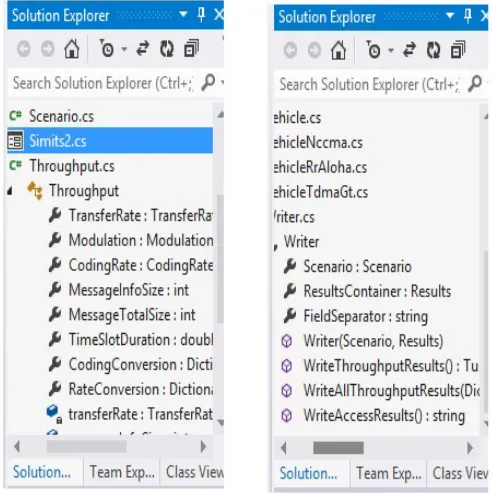
[image:2.612.321.568.273.520.2]SIMITS2 is communication simulator in the field of ITS. It is able to simulate and to measure the performance of different medium access control mechanisms (MAC). The simulation experiments can be performed considering a convoy of autonomous vehicles which follow a trajectory on a limited area. To guarantee the convoy stability, certain messages must be interchanged among the vehicles members of the convoy. The software allows modifying several parameters as the number of vehicles, trajectory, environment, etc It also presents the evolution and the results of the experiment in screen and in *.csv files. This software has been written in C#. Source files are .cs files in the simulator software. Compiled files are .exe files or .dll files. The complete project source files are bundled to .sln file. It is called solution file. Figure 1 depicts details of configuration of simulator files.
Figure 1. Configuration of Simulator source files
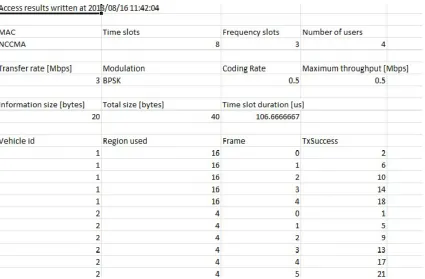
are named with timestamp of the simulation. Format of the simulation file is shown in figure 5.
Figure 2.
Figure3. GUI of
GUI
Simulation
User
Interface
Controller
Event Handler
Timer setting
simulator
are named with timestamp of the simulation. Format of the
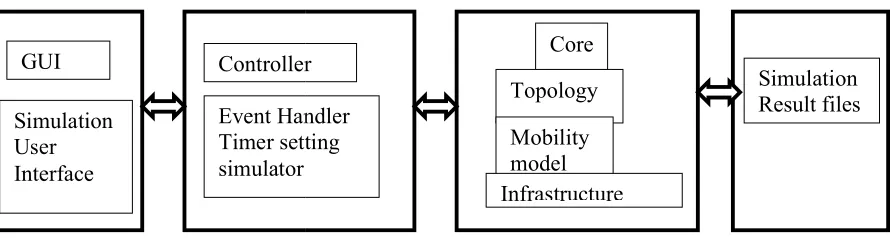
Figure 2.Architecture of the SimITS2 platform
Figure3. GUI of SimITS2simulator for input scenario
Controller
Event Handler
Timer setting
Topology
Mobility
model
Infrastructure
Core
Nayana Hegde et al, International Journal of Advanced Research in Computer Science, 9 (6), Nov-Dec 2018,23-27
© 2015-19, IJARCS All Rights Reserved 26
[image:4.612.95.520.101.380.2]Figure 4. Results of SimITS2simulator
Figure 5. Output file format
4.EVALUATION
[image:4.612.336.564.439.625.2]This section depicts the results which are obtained by running the SIMITS2, an open-source simulator for dynamic vehicular cloud. It performs vehicle to infrastructure communication using IEEE 802.11p standard. The simulation includes urban and highway scenario and vehicles moving in single lane one way road. Distance between each vehicle is less than 30 meters. Simulation parameters are as follows: time slot duration 160 Micro second, number of vehicles 10/ 20, information size 20/30 bytes and data rate of 6 Mbps. Figure 6 shows the graph obtained throughput per channel for 20 users in urban scenario. Simulation is carried for 65secs of time slot. Figure 7 shows the number of transaction with time for 20 vehicle users.
Figure 6.Throughput per channel for 20 users
Figure 7.No transmissions for 20 users
5 .CONCLUSION
In this paper, we describe the simulation of vehicular cloud network using SIMITS2 tool on windowsoperating system. It is based on an open source .net framework. SIMITS2 allows user to quickly and easily generate real world
0 0.51 1.52 2.5
1 9 1725 33414957 65
Th
ro
ug
hp
ut
time slot in sec
Throughput per channel
Throughput per channel
0 10 20 30 40 50 60 70
1 10 19 28 37 46 55 64
N
o
of
tr
an
sm
is
si
on
Time slot in sec
No trasmissions
No
[image:4.612.75.305.600.732.2]mobility models for vehicular cloud simulations. Next step is to use this tool to understand the effect of level of details in context of VCC simulation. The movements of vehicles are based on static configurations and it can be of various patterns in urban, rural or highway environment. The mobility model is decided depending on the requirement. Simulation results can documented easily with the helpof output file generated by the simulator.
REFERENCES
[1]Sunilkumar S. Manvi, Nayana Hegde,”Key Management Authentication and Non Repudiation for Information Transaction in Vehicular Cloud Environment “, IEEE International Conference on Cloud Computing in Emerging Markets (CCEM), 2016
[2] K. Z. Ghafoor, K. A. Bakar, M. A. Mohammed, and J. Lloret, “Vehicular cloud computing: Trends and challenges,” Igi global chapter, pp. 1–7, 2013. [3]Sunilkumar S. Manvi, Nayana Hegde, “Emerging
Applications in Vehicular Cloud Computing”, International Conference on Computer Communication and Informatics, Coimbatore, Tamil Nadu, 2017
[4] M. Whaiduzzaman, M. Sookhak, A. Gani, and B. Rajkumar, “A survey on vehicular cloud computing,” Journal of Network and Computer Applications, vol. 40, no. 1, pp. 325–344, 2014.
[5]M. Eltoweissy, S. Olariu, and M. Younis, “Towards autonomous vehicular clouds,” International Conference on Ad Hoc Networks, pp. 1–16, 2010.ad hoc networks, IEEE Transactions on Vehicular Technology 66 (7) (2017) 6336–6348.
[6]Vaishali D. Khairnar, S.N.Pradhan, "Mobility Models for Vehicular Ad-hoc Network Simulation",International Journal of Computer Applications,Volume 11– No.4, December 2010, 8-12
[7] Nayana Hegde,Sunilkumar.S.Manvi,"Simulation of Wireless Sensor Network Security Model Using NS2", International Journal of Latest Trends in Engineering and Technology ,Vol. 4 Issue 1 May 2014 pp.113-119.
[8]R. Barr, Z. J. Haas, R. van Renesse, Jist/swans, Wireless Networks Laboratory, Cornell University. http://jist. ece. ornell. du