Integrating compositional semantics into a verb lexicon
Hoa Trang Dang, Karin Kipper and Martha Palmer
Department of Computer and Information Sciences
University of Pennsylvania
200 South 33rd Street
Philadelphia, PA 19104, USA
f
htd,kipper,mpalmer
g@linc.cis.upenn.edu
Abstract
We present a class-based approach to building a verb lexicon that makes explicit the close asso-ciation between syntax and semantics for Levin classes. We have used Lexicalized Tree Adjoin-ing Grammars to capture the syntax associated with each verb class and have augmented the trees to in-clude selectional restrictions. In addition, semantic predicates are associated with each tree, which al-low for a compositional interpretation.
1
Introduction
The difficulty of achieving adequate hand-crafted semantic representations has limited the field of natural language processing to applications that can be contained within well-defined sub-domains. Despite many different lexicon development ap-proaches (Mel’cuk, 1988; Copestake and Sanfil-ippo, 1993; Lowe et al., 1997), the field has yet to develop a clear consensus on guidelines for a computational lexicon. One of the most controver-sial areas in building such a lexicon is polysemy: how senses can be computationally distinguished and characterized. We address this problem by em-ploying compositional semantics and the adjunction of syntactic phrases to support regular verb sense extensions. This differs from the Lexical Concep-tual Structure (LCS) approach exemplified by Voss (1996), which requires a separate LCS representa-tion for each possible sense extension. In this pa-per we describe the construction of VerbNet, a verb lexicon with explicitly stated syntactic and seman-tic information for individual lexical items, using Levin verb classes (Levin, 1993) to systematically construct lexical entries. We use Lexicalized Tree Adjoining Grammar (LTAG) (Joshi, 1987; Schabes, 1990) to capture the syntax for each verb class, and associate semantic predicates with each tree.
Although similar ideas have been explored for verb sense extension (Pustejovsky, 1995; Goldberg,
1995), our approach of applying LTAG to the prob-lem of composing and extending verb senses is novel. LTAGs have an extended domain of local-ity that captures the arguments of a verb in a local manner. The association of semantic predicates to a tree yields a complete semantics for the verb. More-over, the operation of adjunction in LTAGs provides a mechanism for extending verb senses.
2
Levin classes
Levin verb classes are based on the ability of a verb to occur in diathesis alternations, which are pairs of syntactic frames that are in some sense meaning preserving. The fundamental assumption is that the syntactic frames are a direct reflection of the under-lying semantics. However, Levin classes exhibit in-consistencies that have hampered researchers’ abil-ity to reference them directly in applications. Many verbs are listed in multiple classes, some of which have conflicting sets of syntactic frames. Dang et al. (1998) showed that multiple listings could in some cases be interpreted as regular sense extensions, and defined intersective Levin classes, which are a more fine-grained, syntactically and semantically coher-ent refinemcoher-ent of basic Levin classes. We represcoher-ent these verb classes and their regular sense extensions in the LTAG formalism.
3
Lexicalized Tree Adjoining Grammars
3.1 Overview of formalism
Elementary trees are combined by the operations of substitution and adjunction. Substitution is a sim-ple operation that replaces a leaf of a tree with a new tree. Adjunction is a splicing operation that replaces an internal node of an elementary tree with an aux-iliary tree. Every tree is associated with a lexical item of the language, called the anchor of the tree. The tree represents the domain over which the lex-ical item can directly specify syntactic constraints, such as subject-verb number agreement, or seman-tic constraints, such as selectional restrictions, all of which are implemented as features.
LTAGs are more powerful than context free gram-mars (CFG), allowing localization of so-called un-bounded dependencies that cannot be handled by CFGs. There are critical benefits to lexical seman-tics that are provided by the extended domain of locality of the lexicalized trees. Each lexical en-try corresponds to a tree. If the lexical item is a verb, the corresponding tree is a skeleton for an en-tire sentence with the verb already present, anchor-ing the tree as a terminal symbol. The other parts of the sentence will be substituted or adjoined in at appropriate places in the skeleton tree in the course of the derivation. The composition of trees during parsing is recorded in a derivation tree. The deriva-tion tree nodes correspond to lexically anchored el-ementary trees, and the arcs are labeled with infor-mation about how these trees were combined to pro-duce the parse. Since each lexically anchored initial tree corresponds to a semantic unit, the derivation tree closely resembles a semantic-dependency rep-resentation.
3.2 Semantics for TAGs
There is a range of previous work in incorporating semantics into TAG trees. Stone and Doran (1997) describe a system used for generation that simul-taneously constructs the semantics and syntax of a sentence using LTAGs. Joshi and Vijay-Shanker (1999), and Kallmeyer and Joshi (1999), describe the semantics of a derivation tree as a set of attach-ments of trees. The semantics of these attachattach-ments is given as a conjunction of formulae in a flat seman-tic representation. They provide a specific method-ology for composing semantic representations much like Candito and Kahane (1998), where the direc-tionality of dominance in the derivation tree should be interpreted according to the operations used to build it. Kallmeyer and Joshi also use a flat semantic representation to handle scope phenomena involv-ing quantifiers.
4
Description of the verb lexicon
VerbNet can be viewed in both a static and a dy-namic way. The static aspect refers to the verb and class entries and how they are organized, providing the characteristic descriptions of a verb sense or a verb class (Kipper et al., 2000). The dynamic as-pect of the lexicon constrains the entries to allow a compositional interpretation in LTAG derivation trees, representing extended verb meanings by in-corporating adjuncts.
Verb classes allow us to capture generalizations about verb behavior. Each verb class lists the the-matic roles that the predicate-argument structure of its members allows, and provides descriptions of the syntactic frames corresponding to licensed con-structions, with selectional restrictions defined for each argument in each frame.1 Each frame also includes semantic predicates describing the partic-ipants at various stages of the event described by the frame.
Verb classes are hierarchically organized, ensur-ing that each class is coherent – that is, all its mem-bers have common semantic elements and share a common set of thematic roles and basic syntactic frames. This requires some manual restructuring of the original Levin classes, which is facilitated by us-ing intersective Levin classes.
5
Compositional Semantics
We use TAG elementary trees for the description of allowable frames and associate semantic predi-cates with each tree, as was done by Stone and Do-ran. The semantic predicates are primitive enough so that many may be reused in different trees. By using TAGs we get the additional benefit of an ex-isting parser that yields derivations and derived trees from which we can construct the compositional se-mantics of a given sentence.
We decompose each event
E
into a tripar-tite structure in a manner similar to Moens and Steedman (1988), introducing a time function for each predicate to specify whether the predicate is true in the preparatory (during
(E
)), culmination(
end
(E
)), or consequent (result
(E
)) stage of anevent.
Initial trees capture the semantics of the basic senses of verbs in each class. For example, many
1These restrictions are more like preferences that generate a
S[event=E]
NParg1# [+animate]
VP[event=E]
V
run
S[event=E2]
NParg0 # [+animate]
VP[event=E1]
V
run
NParg1 # [+animate]
motion
(during
(E
);X
arg1)
cause
(during
(E
2);X
arg0;E
1)^
motion
(during
(E
1);X
arg1)
Figure 1: Induced action alternation for the Run verbs
verbs in the Run class can occur in the induced ac-tion alternaac-tion, in which the subject of the intransi-tive sentence has the same thematic role as the direct object in the transitive sentence. Figure 1 shows the initial trees for the transitive and intransitive vari-ants for the Run class, along with their semantic predicates. The entity in motion is given by
arg
1,associated with the syntactic subject of the intransi-tive tree and the direct object of the transiintransi-tive tree. The event denoted by the transitive variant is a com-position of two subevents:
E
1refers to the event ofarg
1running, andE
2refers to the event of an entity(
arg
0) causing eventE
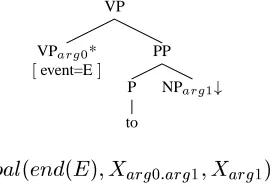
1.Predicates are associated with not only the verb trees, but also the auxiliary trees. We use a flat semantic representation like that of Kallmeyer and Joshi, and the semantics of a sentence is the con-junction of the semantic predicates of the trees used to derive the sentence. Figure 2 shows an auxiliary tree for a path prepositional phrase headed by “to”, along with its associated semantic predicate.
When the PP tree for “to the park” is adjoined into the intransitive tree for “John ran”, the semantic in-terpretation is the conjunction of the two predicates
motion(during(E),john) ^ goal(end(E),john,park);
adjunction into the transitive tree for “Bill ran the horse” yields cause(during(E2),bill,E1) ^ mo-tion(during(E1),horse)^goal(end(E1),horse,park).
In both cases, the argument Xarg0:arg1 (john or
horse) for the auxiliary tree is nonlocal and comes from the adjunction site.2 The arguments are re-covered from the derivation tree, following Candito and Kahane. When an initial tree is substituted into another tree, the dependency mirrors the derivation structure, so the variables associated with the
sub-2
Xarg0:arg1is the variable associated with the entity in
mo-tion (arg1) in the tree to which the PP adjoins (arg0).
stituting tree can be referenced as arguments in the host tree’s predicates. When an auxiliary tree is adjoined, the dependency for the adjunction is re-versed, so that variables associated with the host tree can be referenced as arguments in the adjoin-ing tree’s predicates.
VP
VParg0*
[event=E]
PP
P
to
NParg1 #
goal
(end
(E
);X
arg0:arg1
;X
arg1 )Figure 2: Auxiliary path PP tree
The tripartite event structure allows us to express the semantics of classes of verbs like change of state verbs whose description requires reference to a complex event structure. In the case of a verb such as “break”, it is important to make a distinc-tion between the state of the object before the end of the action and the new state that results after-wards. This event structure also handles the cona-tive construction, in which there is an intention of a goal during the event, that is not achieved at the end of the event. The example of the cona-tive construction shown in Figure 3 expresses the intention of hitting something. Because the tention is not satisfied the semantics do not in-clude the predicates manner(end(E),forceful,Xarg0) ^ contact(end(E),X
arg0,Xarg1), that express the
S[event=E]
NParg0# VP[event=E]
V
hit
NParg1 #
S[event=E]
NParg0
# VP
V
hit
VP
V
PP
P
at
NParg1 #
manner
(during
(E
);directedmotion;X
arg0)^
contact
(end
(E
);X
arg0
;X
arg1 )^manner
(end
(E
);forceful;X
arg0)
manner
(during
(E
);directedmotion;X
arg0)
Figure 3: Syntax and semantics of transitive and conative construction for Hit verbs
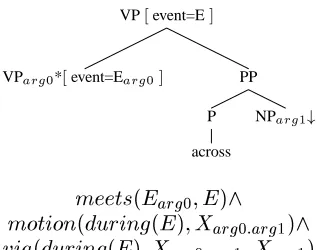
natural way by the TAG operation of adjunction and our conjunction of semantic predicates. The orig-inal Hit verb class does not include movement of the direct object as part of the meaning of hit; only sudden contact has to be established. By adjoining a path PP such as “across NP”, we get an extended meaning, and a change in Levin class membership to the Throw class. Figure 4 shows the class-specific auxiliary tree anchored by the preposition “across” together with its semantic predicates, introducing a motion event that immediately follows (meets) the contact event.
VP[event=E]
VParg0* [event=E
arg0
] PP
P
across
NParg1 #
meets
(E
arg0;E
)^
motion
(during
(E
);X
arg0:arg1 )^
via
(during
(E
);X
arg0:arg1
;X
arg1 )Figure 4: Auxiliary tree for “across”
6
Conclusion
We have presented a class-based approach to build-ing a verb lexicon that makes explicit and imple-ments the close association between syntax and se-mantics, as postulated by Levin. The power of the lexicon comes from its dynamic aspect that is based
on the LTAG formalism, for which we already have a large English grammar. Palmer et al. (1998) de-fined compositional semantics for classes of verbs implemented in LTAG, representing general seman-tic components (e.g., motion, manner) as features on the nodes of the trees. Our use of separate log-ical forms gives a more detailed semantics for the sentence, so that for an event involving motion, it is possible to know not only that the event has a motion semantic component, but also which entity is actu-ally in motion. This level of detail is necessary for applications such as animation of natural language instructions (Bindiganavale et al., 2000). Another important contribution of this work is that by divid-ing each event into a tripartite structure, we permit a more precise definition of the associated semantics. Finally, the operation of adjunction in TAGs pro-vides a principled approach to representing the type of regular polysemy that has been a major obstacle in building verb lexicons.
Researching whether a TAG grammar for Verb-Net can be automatically constructed by using de-velopment tools such as Xia et al. (1999) or Candito (1996) is part of our next step. We also expect to be able to factor out some class-specific auxiliary trees to be used across several verb classes.
7
Acknowledgments
References
Rama Bindiganavale, William Schuler, Jan M. All-beck, Norman I. Badler, Aravind K. Joshi, and Martha Palmer. 2000. Dynamically Altering Agent Behaviors Using Natural Language In-structions. Fourth International Conference on
Autonomous Agents, June.
Marie-H´el`ene Candito and Sylvain Kahane. 1998. Can the TAG derivation tree represent a seman-tic graph? An answer in the light of Meaning-Text Theory. In Proceedings of the Fourth TAG+
Workshop, pages 21–24, Philadelphia, PA,
Au-gust.
Marie-H´el`ene Candito. 1996. A Principle-Based Hierarchical Representation of LTAGs. In
Pro-ceedings of COLING-96, Copenhagen, Denmark.
Ann Copestake and Antonio Sanfilippo. 1993. Multilingual lexical representation. In
Proceed-ings of the AAAI Spring Symposium: Building Lexicons for Machine Translation, Stanford,
Cal-ifornia.
Hoa Trang Dang, Karin Kipper, Martha Palmer, and Joseph Rosenzweig. 1998. Investigating regu-lar sense extensions based on intersective Levin classes . In Proceedings of COLING-ACL98, Montreal, Canada, August.
Adele E. Goldberg. 1995. Constructions. A
Con-struction Grammar Approach to Argument Struc-ture. University of Chicago Press, Chicago, Ill.
Aravind K. Joshi and K. Vijay-Shanker. 1999. Compositional semantics with Lexicalized Tree-adjoining Grammar: How much under-specification is necessary? . In Proceedings of
the Third International Workshop on Compu-tational Semantics (IWCS-3), pages 131–145,
Tilburg, The Netherlands, January.
Aravind K. Joshi. 1987. An introduction to tree ad-joining grammars. In A. Manaster-Ramer, editor,
Mathematics of Language. John Benjamins,
Am-sterdam.
Laura Kallmeyer and Aravind Joshi. 1999. Under-specified semantics with LTAG . In Proceedings
of Amsterdam Colloquium on Semantics.
Karin Kipper, Hoa Trang Dang, and Martha Palmer. 2000. Class-based construction of a verb lexi-con. In Proceedings of the Seventh National
Con-ference on Artificial Intelligence (AAAI-2000),
Austin, TX, July-August.
Beth Levin. 1993. English Verb Classes and
Alter-nation, A Preliminary Investigation. The
Univer-sity of Chicago Press.
J.B. Lowe, C.F. Baker, and C.J. Fillmore. 1997. A frame-semantic approach to semantic annotation. In Proceedings 1997 Siglex Workshop/ANLP97, Washington, D.C.
I. A. Mel’cuk. 1988. Semantic description of lex-ical units in an explanatory combinatorial dic-tionary: Basic principles and heuristic criteria.
International Journal of Lexicography, I:3:165–
188.
M. Moens and M. Steedman. 1988. Temporal on-tology and temporal reference. Computational
Linguistics, 14:15–38.
Martha Palmer, Joseph Rosenzweig, and William Schuler. 1998. Capturing Motion Verb General-izations in Synchronous TAG. In Patrick Saint-Dizier, editor, Predicative Forms in Natural
Lan-guage and in Lexical Knowledge Bases. Kluwer
Press.
James Pustejovsky. 1995. The Generative Lexicon. MIT Press, Cambridge, Massachusetts, USA. Yves Schabes. 1990. Mathematical and
Computa-tional Aspects of Lexicalized Grammars. Ph.D.
thesis, Computer Science Department, University of Pennsylvania.
Matthew Stone and Christine Doran. 1997. Sen-tence Planning as Description using Tree Adjoin-ing Grammar. In ProceedAdjoin-ings of ACL-EACL ’97, Madrid, Spain.
Clare Voss. 1996. Interlingua-based Machine Translation of Spatial Expressions. Ph.D.
the-sis, University of Maryland, Department of Com-puter Science.