190
A NEW APPROACH OF STEGANOGRAPHY USING RADIAL
BASIS FUNCTION NEURAL NETWORK
Debashish Rout
,Bijaya Kumar Khamari,Tusharkanta Samal and Ashok Kumar Bhoi
Department of Computer Science and Engineering ,VSSUT, Burla, India134
Department of Mechanical Engineering ,VSSUT, Burla, India2
[email protected],[email protected],[email protected],[email protected]
Abstract - Steganographic tools and techniques are becoming more potential and widespread. Illegal use of steganography poses serious challenges to the law enforcement agencies. Limited work has been carried out on supervised steganalysis using neural network as a classifier. We present a combined method of identifying the presence of covert information in a carrier image using fisher’s linear discriminant (FLD) function followed by the radial basis function (RBF). Experiments show promising results when compared to the existing supervised steganalysis methods, but arranging the retrieved information is still a challenging problem.
Keywords - Steganography, carrier image, covert image.
I. INTRODUCTION
Steganography is a type of hidden communication that literally means “covered writing”. The message is out in the open, often for all to see, but goes undetected because the very existence of the message is secret [12, 20, 21]. Steganalysis could be described as a method to prevent steganography. There are other attacks on steganography. Attacking the end hosts of the steganography algorithm by searching for security credentials is not steganalysis. Digital forensics encompasses more methods than solely steganalysis to attack steganography. The target for digital forensics is detection of steganography. The objective of steganalysis is “detecting messages hidden using steganography”. Steganalysis is about separating covermessages from stego-messages. In this work, passive steganalysis is focused.
Most of the present literature on steganalysis follows either a parametric model [28, 24, 26] or a blind model [32, 27, 22, 23, 35, 33]. A general steganalysis method that can attack steganography blindly, detect hidden data without knowing embedding methods, will be more useful in practical applications. A framework for steganalysis based on supervised learning has been done in [34]. The framework was further developed and tested. Limited work has been carried out on supervised steganalysis, using neural networks as a classifier [29, 30]. Fishers’ linear discriminant function (FLD) as a classifier show impressive results in [31]. The present neural network based steganalytic work is implemented by combining the radial basis function neural network with fishers’ linear discriminant function.
II. METHODOLOGY
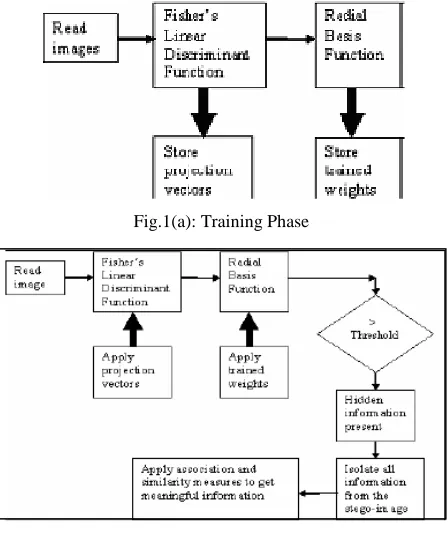
Fig.1(a): Training Phase
Fig. 1(b): Testing phase
2.1 Fisher’s Linear Discriminant Function
The process of changing the dimensions of a vector is called transformation. The transformation of a set of n-dimensional real vectors onto a plane is called a mapping operation. The result of this operation is a planar display. The main advantage of the planar display is that the distribution of the original patterns of higher dimensions (more than two dimensions) can be seen on a two dimensional graph. The mapping operation can be linear or non-linear. R.A. Fisher developed a linear classification algorithm [1] and a method for constructing a classifier on the optimal discriminant plane, with minimum distance criterion for multi-class classification with small number of patterns [16]. The method of considering the number of patterns and feature size [4], and the relations between discriminant analysis and multilayer perceptrons [17] has been addressed earlier. A linear mapping is used to map an n-dimensional vector space onto a two dimensional space. Some of the linear mapping algorithms are principal component mapping [5], generalized declustering mapping [2, 3, 8, 9], least squared error mapping [11] and projection pursuit mapping [6]. In this work, the generalized declustering optimal discriminant plane is used. The mapping of the original pattern ‘X’ onto a new vector ‘Y’ on a plane is done by a matrix transformation, which is given by
Y=AX (1)
where
(2)
and φ1 and φ 2 are the discriminant vectors (also called projection vectors).
An overview of different mapping techniques [14, 15] is addressed earlier. The vectors φ1 and φ2 are obtained by optimizing a given criterion. The plane formed by the discriminant vectors is the optimal vectors which are the optimal discriminant planes. This plane gives the highest possible classification for the new patterns.
The steps involved in the linear mappings are:
[image:2.595.187.411.117.385.2]The criterion to evaluate the classification performance is given by:
(3)
Where
Sb the between class matrix, and
Sw the within class matrix which is non-singular.
(4)
(5)
where
P(ωi) a priori the probability of the ith pattern, generally, p ((ωi) = 1/m
mi the mean of each feature of the ith class patterns, (i=1.2…,m),
mo the global mean of a feature of all the patterns in all the classes,
X {xi, I=1, 2,…L} the n-dimensional patterns of each class,
L the total number of patterns.
Eq.(3) states that the distance between the class centers should be maximum. The discriminant vector j1 that maximizes ‘J’ in Eq. (3) is found as a solution of the eigenvalue problem given by:
(6)
where
λml the greatest non-zero eigenvalue of(Sb Sw–1)
φ1 eigenvalue corresponding to λml
The reason for choosing the eigenvector with maximum eigenvalue is that the Euclidean distance of this vector will be the maximum, when compared with that of the other eigenvectors of Eq.(6). Another discriminant vector j2 is obtained, by using the same criterion of Eq.(3). The discriminant vector j2 should also satisfy the condition given by:
(7)
Eq.(7) indicates that the solution obtained is geometrically independent and the vectors φ1 and φ2 are perpendicular to each other. Whenever the patterns are perpendicular to each other, it means, that there is absolutely no redundancy, or repetition of a pattern. The discriminant vector φ2 is found as a solution of the eigenvalue problem, which is given by:
(8)
where
(9)
where
I an identity matrix
The eigenvector corresponding to the maximum eigenvalue of Eq. (8) is the discriminant vector φ2. In Eq.(6) and Eq. (8), SW should be non-singular. The SW matrix should be non-singular, even for a more general discriminating analysis and multi-orthonormal vectors [7, 18, 19]. If the determinant of SW is zero, then singular value decomposition (SVD) on SW has to be done. On using SVD [10, 13], SW is decomposed into three matrices U, W and V. The matrices U and W are unitary matrices, and V is a diagonal matrix with non-negative diagonal elements arranged in the decreasing order. A small value of 10-5 to 10-8 is to be added to the diagonal elements of V matrix, whose value is zero. This process is called perturbation. After perturbing the V matrix, the matrix Sw1 is calculated by:
(10)
where
SW1 the non-singular matrix which has to be considered in the place of Sw.
Minimum perturbed value should be considered, which is just sufficient to make Sw1 nonsingular. As per Eq.(7), when the values of φ1 and φ2 are innerproducted, the resultant value should be zero. In reality, the innerproducted value will not be zero. This is due to floating point operations.
2) Computation of two-dimensional vector from the original n-dimensional input patterns
The two-dimensional vector set yi is obtained by:
(11)
The vector set yi is obtained by projecting the original pattern ‘X’ onto the space, spanned by φ1 and φ2 by using Eq.(11). The values of ui and vi can be plotted in a two-dimensional graph, to know the distribution of the original patterns.
2.2 Radial Basis Function
A radial basis function (RBF) is a real-valued function whose value depends only on the distance from the origin. If a function ‘h’ satisfies the property h(x)=h(||x||), then it is a radial function. Their characteristic feature is that their response decreases (or increases) monotonically with distance from a central point. The centre, the distance scale, and the precise shape of the radial function are parameters of the model, all fixed if it is linear [25].
A typical radial function is the Gaussian which, in the case of a scalar input, is
h(x)=exp((-(x-c)2)/(r2)) (12)
Its parameters are its centre c and its radius r.
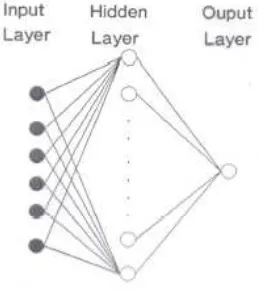
Fig. 2: Radial Basis Function Network
III. IMPLEMENTATION
a) Training
1. Decide number of cover images.
2. Read each Image.
3. Calculate the principal component vector by
Z=Z * Z T
where
Z denotes the intensities of image
4. Find eigenvector of the Z matrix by applying eigen process.
5. Calculate the φ1 and φ2 vectors.
φ1 = eigenvector ( Sb * Sw -1
)
Sb = Σ( PCVi – M0 ) ( PCVi – M0 )T / N
where:
PCVi ( i = 1,2,3 )
PCV1, Principal component vector1
PCV2, Principal component vector2
PCV3, Principal component vector3
M0 = Average of (PCV1 + PCV2 + PCV3)
Sw = (Σ( PCVi – Mi ) ( PCVi – Mi )T ) / N
where:
Mi ( i = 1, 2, 3)
M1, average of PCV1
M2, average of PCV2
M3, average of PCV3
6. Calculate φ2 vector.
φ2 = eigenvector (Q Sb Sw -1
)
Q = I – ((φ1* φ1-1 * Sw -1
) / (φ1t * Sw -1
* Phi_ φ1) )
7. Transfer for N dimensional vector into 2 dimensional vector.
V = φ2* PCVi ( 1 , 2 , 3 ) 8. Apply RBF.
No. of Input = 2
No. of Patterns = 15
No. of Centre = 2
Calculate RBF as
RBF = exp (-X)
Calculate Matrix as
G = RBF
A = GT * G
Calculate
B = A-1
Calculate
E = B * GT
9. Calculate the final weight.
F = E * D
10. Store the final weights in a File.
b) Testing
1. Read steganographed image.
2. Calculate the principal component vector.
Z=Z * Z T
3. Find eigenvector of the Z matrix by applying eigen process.
4. Calculate RBF as.
RBF = exp ( -X )
G = RBF
A = GT * G
B = A-1
E = B * GT
5. Calculate.
F = E * D
6. Classify the pixel as containing information or not.
IV. RESULTS AND DISCUSSION
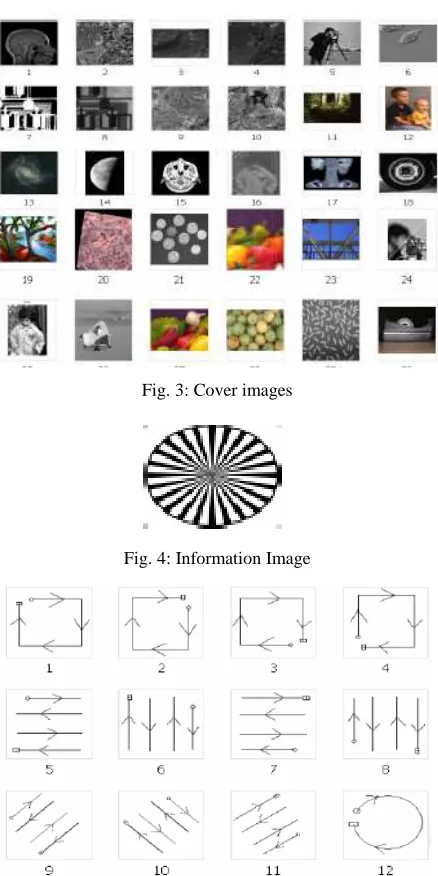
Fig. 3: Cover images
Fig. 4: Information Image
Fig. 5: Distribution of information image in cover image
In this simulation, the information is embedded using least significant bit (LSB), discrete cosine transformation (DCT) separately. In certain cases, 50% of the information image is embedded using LSB and remaining 50% of the information is embedded using DCT. In the entire simulation, the size of the information image is considered to 1/8 size of the original image (Table
Table I: SIMULATION ENVIRONMENT USED
Table II: PROJECTION VECTORS
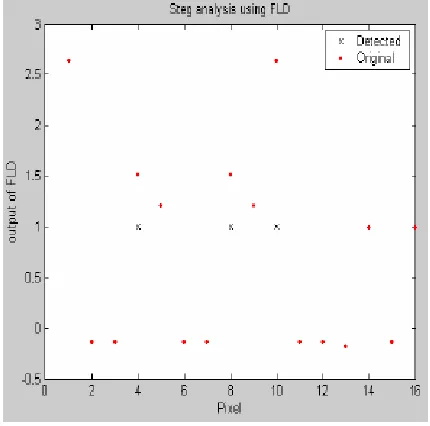
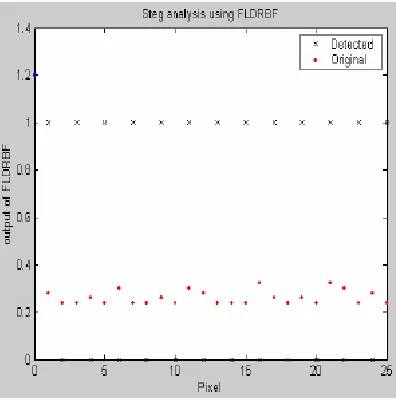
These vectors obtained after finding out the Sw and Sb matrices considering 30 steganographed images using the images given in Figure 3 and Figure 4. Figure 7 and figure 8 are obtained by setting a detection threshold value of 2. Any output greater than a threshold is considered as the pixel containing the information. The threshold value is different for different method.
[image:8.595.195.401.290.686.2]Fig. 6: Steganalysis using FLD
Fig. 7: Steganalysis using RBF
V. CONCLUSION
[image:8.595.199.395.482.693.2]but arranging the retrieved information is still a challenging problem. The information can be well arranged in a meaningful way by using a set of association rules.
Fig. 8: Steganalysis using FLDRBF
VI. ACKNOWLEDGEMENT
We express our sincere thanks to Mr. Ch Gandhi, GEQD, Hyderabad for his valuable support in improving the quality of the paper. We also express our heartful thanks to Mr. P. Krishna Sastry and Mr. M. Krishna for their technical support in doing experiments at computer forensic division, Hyderabad. Appreciation also goes to Ms. S. Rajeswari, Ms. G. Sarada, Ms. Uma Devi, and Ms. Chennamma and for their help in literature survey
REFERENCES
[1] R.A.Fisher, “The Use of Multiple Measurements in Taxonomic Problems,” Ann. of Eugenics, vol. 7, pp. 178 – 188, 1936.
[2] J.W.Sammon, “An Optimal Discriminant Plane,” IEEE Trans. On Comp, vol. 19, no. 9, pp.826 – 829, 1970.
[3] J.W Sammon., “Interactive Pattern Analysis and Classification”, IEEE Trans. on Comp., vol. 19, no. 7, pp. 594–616, 1970.
[4] D.H.Foley, “Consideration of Sample and Feature Size,” IEEE Trans., on Info. Theory, vol.18, no. 5, pp. 626 – 681, September 1972.
[5] J.Kittler, P.C.Young P.C, “Approach to Feature Selection Based on the Karhunen-Loeve Expansion,” Pattern Recognition, Vol. 5, No 5, pp. 335 – 352, 1973.
[6] H.Friedman, J.W Turkey, “A Projection Pursuit Algorithm for Exploratory Data Analysis,” IEEE Trans. on Comp., vol. 23, no. 9, pp. 881–890, 1974.
[7] D.H Foley, J.E.Sammon, “An Optimal Set of Discriminant Vectors,” IEEE Trans. on Comp., vol. 24, no. 3, pp. 281 – 289, 1975.
[8] J. Fehlauer., B.A Eisenstein., “A Declustering Criterion for Feature Extraction in Pattern Recognition, IEEE Trans. on Comp., vol. 27, no. 3, pp. 261 – 266, 1978.
[9] E.Gelsema, R.Eden, “Mapping Algorithms in ISPAHAN,” pattern Recognition, vol. 12, no. 3, pp.127 – 136, 1980. [10] V.C.Klema, A.J.Laub, “The Singular Value Decomposition: Its Computation and Some Applications,” IEEE Trans.
on Automatic Control, vol. 25, no.2, pp. 164 – 176, 1980.
[11] D.F.Mix, R.A.Jones, “A Dimensionality Reduction Techniques Based on a Least Squared Error Criterion, IEEE Trans. on Pattern Analysis and Machine Intelligence, vol. 4, no. 1, pp. 537 – 544, 1982.
[12] Simmons, G. J., “The Prisoners’ Problem and the Subliminal Channel,” CRYPTO83, Advances in Cryptology, August 22-24, pp. 51 – 67, 1984.
[14] W.Siedlecki, K.Siedlecka, J. Skalansky, “An Overview of Mapping Techniques for Exploratory Data Analysis,” Pattern Recognition, vol. 21, no. 5, pp. 411 – 429, 1988.
[15] W.Siedlecki, K.Siedlecka., J.Skalancky, “Experiments on Mapping Techniques for Exploratory Pattern Analysis,” Pattern Recognition, vol. 21, no.5, pp. 431 – 438, 1988.
[16] Z.Q.Hong, Y.J.Yang, “Optimal Discriminate Plane for a Small Number of Samples and Design Method of Classifier on the Plane,” pattern recognition, vol. 24, pp. 317 – 324, 1991.
[17] P.Gallinari, S. Thiria., F.Badran., F Fogelman-Soulie F., “On The Relations Between Discriminant Analysis and Multilayer Perceptrons,” Neural Networks, vol. 4, no.3, pp.349 –360, 1991.
[18] K.Liu, Y.Q.Cheng, J.Y.Yang J.Y., “A Generalized Optimal Set of Discriminant Vectors,” Pattern Recognition, vol. 25, no. 7, pp. 731 – 739, 1992.
[19] Y.Q.Cheng, Y.M.Zhuang, J.Y.Yang, “Optimal Fisher Discriminant Analysis Using the Rank Decomposition,” Pattern Recognition, vol. 25, no. 1, pp. 101 – 111, 1992.
[20] R. J. Anderson and F.A.P Petitcolas, “On the limits of steganography,” IEEE Journal on Selected Areas in Communications, vol. 16 no. 4, pp. 474 -484, 1998.
[21] N.Johnson and J. Sklansky, “Exploring steganography: seeing the unseen,” IEEE Computer, pp. 26 – 34, 1998. [22] N. Provos and P. Honeyman, “Detecting steganographic content on the internet,” CITI Technical Report 01-11,
August, 2001.
[23] A. Westfeld and A. Pfitzmann, “Attacks on steganographic systems,” Third Information Hiding Workshop, September. 1999.
[24] J. Fridrich, R. Du, and M. Long, “Steganalysis of lsb encoding in color images,” IEEE ICME, vol. 3, pp. 1279 – 1282, March 2000.
[25] Meng Joo Er,.Shiqian Wu, Juwei Lu and Hock Lye Toh, “Face Recognition with Radial BasisFunction(RBF) Neural Networks,” IEEE Trans. on Neural Networks, vol. 13, no.3, pp. 697 – 910, May 2002.
[26] R. Chandramouli, “A mathematical framework for active steganalysis,” ACM Multimedia Systems, vol, 9, no.3, pp.303 – 311, September 2003.
[27] J. Harmsen and W. Pearlman, “Steganalysis of additive noise modelable information hiding,” Proc. SPIE Electronic Imaging, 2003.
[28] S. Lyu and H. Farid, “Steganalysis Using Color Wavelet Statistics and One-Class Support Vector Machines,” SPIE Symposium on Electronic Imaging, San Jose, CA, 2004.
[29] Shi, Y.Q, Guorong Xuan, Zou, D, Jianjiong Gao, Chengyun Yang, Zhenping Zhang, Peiqi Chai, Chen, W, Chen C, “Image steganalysis based on moments of characteristic functions using wavelet decomposition, prediction-error image, and neural network,” IEEE International Conference on Multimedia and Expo, ICME , July 2005.
[30] Ryan Benton and Henry Chu, “Soft Computing Approach to Steganalysis of LSB Embedding in Digital Images,” Third International Conference on Information Technology: Research and Education, ITRE, pp. 105 – 109, June 2005.
[31] Ming Jiang, Wong, E.K. Memon, N. Xiaolin Wu, “Steganalysis of halftone images,” Proceedings of IEEE International Conference on Acoustics, Speech, and Signal Processing, ICASSP, vol. 2, pp. 793 – 796, March 2005. [32] Shalin Trivedi and R. Chandramouli, “Secret Key Estimation in Sequential Steganography,” IEEE Trans. on Signal
Proc., vol. 53, no. 2, pp. 746 - 757, February 2005.
[33] Liang Sun, Chong-Zhao Han, Ning Dai, Jian-Jing Shen, “Feature Selection Based on Bhattacharyya Distance: A Generalized Rough Set Method,” Sixth World Congress on Intelligent Control and Automation, WCICA, vol. 2, pp. 101-105, June, 2006.
[34] H. Farid, “Detecting hidden messages using higher-order statistical models,” Proc. IEEE Int. Conf. Image Processing, New York, pp.905- 908, Sep. 2002.