Structural Ambiguity and Lexical Relations
Donald Hindle and Mats Rooth
AT&T Bell Labs 600 Mountain Ave. Murray Hill, NJ 07974
Introduction
From a certain (admittedly narrow) perspective, one of the annoying features of natural language is the ubiq- uitous syntactic ambiguity. For a computational model intended t o assign syntactic descriptions t o natural lan- guage text, this seem like a design defect. In general, when context and lexical content are taken into account, such syntactic ambiguity can be resolved: sentences used in context show, for the most part, little ambiguity. But the grammar provides many alternative analyses, and gives little guidance about resolving the ambiguity.
Prepositional phrase attachment is the canonical case of structural ambiguity, as in the time worn example,
(1) I saw the man with the telescope
The problem arises because the grammar provides sev- eral sources for prepositional phrases. The prepositional phrase with the telescope has two central attachment pos- sibilities (the seeing is by means of a telescope or the man has a telescope), licensed by two different phrase structure rules, namely
V P - . N P P P and
N P + N' P P
(The prepositional phrase might also attach to the subject noun phrase I; in this paper we will concentrate on the most important binary choice between attach- ment t o the adjacent Noun Phrase, and attachment to the preceding Verb.)
The existence of such ambiguity raises problems for understanding and for language models. It looks like it might require extremely complex computation to deter- mine what attaches to what. Indeed, one recent pro- posal suggests that resolving attachment ambiguity re- quires the construction of a discourse model in which the entities referred t o in a text must be reasoned about (Altmann and Steedman 1988).
Of course, if attachment ambiguity demands reference to semantics and discourse models, there is little hope in the near term of building computational models for unrestricted text to resolve the ambiguity.
Structure based ambiguity resolution
There have been several structure-based proposals about ambiguity resolution in the literature; they are particu- larly attractive because they are simple and don't de- mand calculations in the semantic or discourse domains. The two main ones are:
Right Association
-
a constituent tends to attach to another constituent immediately to its right (Kim- ball 1973).Minimal Attachment
-
a constituent tends to attach so as to involve the fewest additional syntactic nodes (Frazier 1978).For the particular case we are concerned with, attach- ment of a prepositional phrase in a verb
+
object con- text as in sentence (I), these two principles - at least in the version of syntax that Frazier assumes - make opposite predictions: Right Association predicts noun attachment, while Minimal Attachment predicts verb at- tachment.Unfortunately, these structure-based disambiguation proposals seem not t o account for attachment prefer- ences very well. A recent study of attachment of prepo- sitional phrases in a sample of written responses to a "Wizard of Oz" travel information experiment shows that niether Right Association nor Minimal Attachment account for more than 55% of the cases (Whittemore et al. 1990). And experiments by Taraban and McClelland (1988) show that the structural models are not in fact good predictors of people's behavior in resolving ambi- guity.
Resolving ambiguity through lexical asso-
ciations
study, the j u d g e m e n t of a t t a c h m e n t preferences had to be m a d e by h a n d for exactly the cases t h a t their study covered; no precompiled list of lexical preferences was available. Thus, we are posed with the problem: how can we get a good list of lexical preferences.
Our proposal is to use cooccurrence of with preposi- tions in text as an indicator of lexical preference. Thus, for example, the preposition to occurs frequently in the context send NP --, i.e., after the object of the verb
send, and this is evidence of a lexical association of the verb send with to. Similarly, from occurs frequently in the context withdrawal --, and this is evidence of a lex- ical association of the noun withdrawal with the prepo- sition from. O f course, this kind of association is, unlike lexical preference, a s y m m e t r i c notion. Cooccurrence provides no indication of whether the verb is selecting the preposition or vice versa. We will treat the associa- tion as a p r o p e r t y of the pair of words. It is a separate m a t t e r , which we u n f o r t u n a t e l y cannot pursue here, to assign the association to a particular linguistic licens- ing relation. T h e suggestion which we want to explore is t h a t the association revealed by t e x t u a l distribution - whether its source is a c o m p l e m e n t a t i o n relation, a modification relation, or s o m e t h i n g else - gives us infor- m a t i o n needed to resolve the prepositional a t t a c h m e n t .
D i s c o v e r i n g L e x i c a l A s s o c i a t i o n in
T e x t
A 13 million word s a m p l e of Associated Press new sto- ries f r o m 1989 were a u t o m a t i c a l l y parsed by the Fidditch parser (Hindle 1983), using C h u r c h ' s p a r t of speech an- alyzer as a preprocessor (Church 1988). From the syn- tactic analysis provided by the parser for each sentence, we extracted a table containiffg all the heads of all noun phrases. For each noun phrase head, we recorded the following preposition if any occurred (ignoring whether or not the parser a t t a c h e d the preposition to the noun phrase), and the preceding verb if the noun phrase was the object of t h a t verb. Thus, we generated a table with entries including those shown in Table 1.
V E R B
b l a m e
control
enrage
grant
H E A D N O U N P R E P
P A S S I V E for m o n e y for development government m i l i t a r y accord radical W H P l ~ O it
concession to
Table h A s a m p l e of the Verb-Noun-Preposition table.
In this Table 1, the first line represents a passivized
instance of the verb blame followed by the preposition
for. T h e second line is an instance of a noun phrase whose head is money; this noun phrase is not an object of any verb, b u t is followed by the preposition for. T h e third line represents an instance of a noun phrase with head noun development which neither has a following preposition nor is the object of a verb. T h e fourth line is an instance of a noun phrase with head government,
which is the object of the verb control b u t is followed by no preposition. T h e last line represents an instance of the a m b i g u i t y we are concerned with resolving: a noun phrase (head is concession), which is the object of a verb
(grant), followed by a preposition (to).
F r o m the 13 million word sample, 2,661,872 noun phrases were identified. O f these, 467,920 were recog- nized as the object of a verb, and 753,843 were followed by a preposition. O f the noun phrase objects identified, 223,666 were a m b i g u o u s verb-noun-preposition triples.
E s t i m a t i n g
a t t a c h m e n t
prefer-
e n c e s
Of course, the table of verbs, nouns and prepositions does not directly tell us w h a t the lexical associations are. This is because when a preposition follows a noun phrase, it m a y or m a y not be structurally related to t h a t noun phrase (in our terms, it m a y a t t a c h to t h a t noun phrase or it m a y a t t a c h somewhere else). W h a t we want to do is use the verb-noun-preposition table to derive a table of bigrams, where the first t e r m is a noun or verb, and the second t e r m is an associated preposition (or no preposition). To do this we need to t r y to assign each preposition t h a t occurs either to the noun or to the verb t h a t it occurs with. In some cases it is fairly certain t h a t the preposition attaches to the noun or the verb; in other cases, it is far less certain. Our approach is to assign the clear cases first, then to use these to decide the unclear cases t h a t can be decided, and finally to arbitrarily assign the r e m a i n i n g cases. T h e procedure for assigning prepositions in our s a m p l e to noun or verb is as follows:
1. No Preposition - if there is no preposition, the noun or verb is simply counted with the null preposition.
2. Sure Verb Attach 1 - preposition is attached to the verb if the noun phrase head is a pronoun.
3. Sure Verb Attach 2 - preposition is attached to the verb if the verb is passivized (unless the preposition is by. T h e instances of by following a passive verb were left unassigned.)
4. Sure Noun Attach - preposition is attached to the noun, if the noun phrase occurs in a context where no verb could license the prepositional phrase (i.e., the noun phrase is in subject or pre-verbal position.)
5. A m b i g u o u s Attach 1 - Using the table of a t t a c h m e n t so far, if a t-score for the a m b i g u i t y (see below) is
[image:2.612.99.260.556.691.2]greater than 2.1 or less than -2.1, then assign the preposition according to the t-score. Iterate through the ambiguous triples until all such attachments are done.
Ambiguous Attach 2 - for the remaining ambiguous triples, split the attachment between the noun and the verb, assigning .5 to the noun and .5 to the verb.
Unsure Attach
-
for the remaining pairs (all of which are either attached t o the preceding noun or to some unknown element), assign them t o the noun.This procedure gives us a table of bigrams representing our guess about what prepositions associate with what nouns or verbs, made on the basis of the distribution of verbs nouns and prepositions in our corpus.
The procedure for guessing attachment
Given the table of bigrams, derived as described above, we can define a simple procedure for determining the at- tachment for an instance of verb-noun-preposition am- biguity. Consider the example of sentence (2), where we have to choose the attachment given verb send, noun soldier, and preposition into.
(2) Moscow sent more than 100,000 soldiers into Afganistan
.
. .
The idea is to contrast the probability with which into occurs with the noun soldier with the probability with which into occurs with the verb send. A t-score is an appropriate way t o make this contrast (see Church et al. to appear). In general, we want to calculate the contrast between the conditional probability of seeing a particular preposition given a noun with the conditional probability of seeing that preposition given a verb.
P(prep
I
noun)-
P(prepI
verb) t EJ u 2 ( ~ ( ~ r e ~ ( noun))
+
a2(P(prepI
verb))We use the "Expected Likelihood Estimate" (Church et al., to appear) to estimate the probabilities, in or- der to adjust for small frequencies; that is, we simply add 112 to all frequency counts (and adjust the denom- inator appropriately). This method leaves the order of t-scores nearly intact, though their magnitude is inflated by about 30%. To compensate for this, the 1.65 thresh- old for significance a t the 95% level should be adjusted up to about 2.15.
Consider how we determine attachment for sentence (4). We use a t-score derived from the adjusted frequen- cies in our corpus to decide whether the prepositional phrase into Afganistan is attached to the verb (root) send/V or to the noun (root) soldier/N. In our cor- pus, soldier/N has an adjusted frequency of 1488.5, and send/V has an adjusted frequency of 1706.5; soldier/N occurred in 32 distinct preposition contexts, and send/V in 60 distinct preposition contexts; f(send/V into) = 84, f(soldier/N into) = 1.5.
From this we calculate the t-score as fo1lows:l
P(wlsoldier/N)
-
P(w)send/ V) t rd u 2 ( ~ ( w l s o l d i e r / N ) )
+
u2(P(wlsend/ V))j(soldier/N into)+l/2
-
j(soldier/N)+V/2
M
f soldier N into +I 2 send V into +1 2
J
~ ( s r l d i b / i i ) + ? / ~ ~+
This figure of -8.81 represents a significant association of the preposition into with the verb send, and on this basis, the procedure would (correctly) decide that into should attach to send rather than to soldier.
Testing Attachment Preference
We have outlined a simple procedure for determining prepositional phrase attachment in a verb-object con- text. To evaluate the performance of this procedure, we need a graded set of attachment ambiguities. First, the two authors graded a set of verb-noun-preposition triples as follows. From the AP new stories, we randomly st+ lected 1000 test sentences in which the parser identified an ambiguous verb-noun-preposition triple. (These sen- tences were selected from stories included in the 13 mil- lion word sample, but the particular sentences were ex- cluded from the calculation of lexical associations.) For every such triple,
each author made a judgement of the correct attachment on the basis of the three words alone (forced choice-
preposition attaches t o noun or verb). This task is in essence the one that we will give the com- puter - i.e., to judge the attachment without any more information than the preposition and the head of the two possible attachment sites, the noun and the verb. This gave us two sets ofjudgements to compare the algorithms performance to.Judging correct attachment
We also wanted a standard of correctness for these test sentences. To derive this standard, each author inde- pendently judged the attachment for the 1000 triples a second time, this time using the full sentence context.
It turned out to be a surprisingly difficult task to assign attachment preferences for the test sample. Of course, many decisions were straightforward, but more than 10% of the sentences seemed problematic to a t least one author. There are two main sources of such difficulty. First, it is unclear where the preposition is attached in idiomatic phrases such as :
'V is the number of distinct prepositioncontexts for either sol-
(3) But over time , misery has given way to
m e n d i n g .
(4) The meeting will take place in Quantico
E v a l u a t i n g p e r f o r m a n c e
A second m a j o r source of difficulty arose from cases where the a t t a c h m e n t either seemed to make no differ- ence semantically or it was impossible to decide which a t t a c h m e n t was correct, as
(5) We don't have preventive detention in the United States.
(6) Inaugural officials reportedly were trying to
arrange a reunion for Bush and his old subma- rine buddies . . .
It seems to us t h a t this difficulty in assigning attach- ment decisions is an i m p o r t a n t fact t h a t deserves further exploration. If it is difficult to decide what licenses a prepositional phrase a significant proportion of the time, then we need to develop language models t h a t appropri- ately capture this vagueness. For our present purpose, we decided to force an a t t a c h m e n t choice in all cases, in some cases making this choice arbitrarily.
In addition to the problematic cases, a significant number (111) of the 1000 triples identified automatically as instances of the verb-object-preposition configuration turned out in fact to be other constructions. These misidentifications were mostly due to parsing errors, and in part due to our underspecifying for the parser ex- actly what configuration to identify. Examples of these misidentifications include: identifying the subject of the complement clause of say as its object, as in (7), which was identified as (say ministers from); misparsing two constituents as a single object noun phrase, as in (8), which was identified as (make subject to); and counting non-object noun phrases as the object as in (9), identi- fied as (get hell out_o]).
(7) Ortega also said deputy foreign ministers from the five governments would meet Tuesday in Managua, . . .
(8) Congress m a d e a deliberate choice to make this commission subject to the open meeting re- quirements . . .
(9) Student Union, get the hell out of China!
First, consider how the simple structural a t t a c h m e n t preference schemas do at predicting the outcome in our test set. Right Association, which predicts noun attach- ment does better, since there are more noun attach- ments, but it still has an error rate of 36%. Minimal Attachment, interpreted to mean verb a t t a c h m e n t has the complementary error rate of 64%. Obviously, neither of these procedures is particularly impressive. For our sample, the simple strategy of attaching a prepositional phrase to the nearest constituent is the more successful strategy.
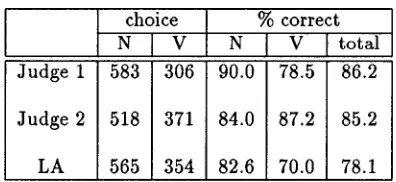
Now consider the performance of our a t t a c h m e n t pro- cedure for the 889 standard test sentences. Table 2 shows the results on the test sentences for the two h u m a n judges and for the a t t a c h m e n t procedure.
] choice [ % correct [
N V N V total
Judge 1 ~
Judge 2
LA
Table 2: Performance on the test sentences for 2 h u m a n judges and the lexical association procedure (LA).
Of course these errors are folded into the calculation of associations. No doubt our bigram model would be better if we could eliminate these items, but m a n y of them represent parsing errors t h a t obviously cannot be identified by the parser, so we proceed with these errors included in the bigrams.
After agreeing on the "correct" a t t a c h m e n t for the sample of 1000 triples, we are left with 889 verb-noun- preposition triples (having discarded the 111 parsing er- rors). Of these, 568 are noun attachments and 321 verb attachments.
First, we note that the task of judging a t t a c h m e n t on the basis of verb, noun and preposition alone is not easy. Both h u m a n judges had overall error rates of nearly 15%. (Of course this is considerably better than always choos- ing the nearest a t t a c h m e n t site.) T h e lexical association procedure based on t-scores is somewhat worse than the h u m a n judges, with an error rate of 22%, again an im- provement over simply choosing the nearest attachment site.
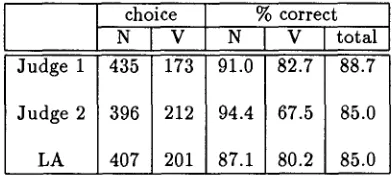
[image:4.612.345.543.416.507.2]If we restrict the lexical association procedure to choose attachment only in cases where its confidence is greater than about 95% (i.e., where t is greater than 2.1), we get attachment judgements on 608 of the 889 test sentences, with an overall error rate of 15% (Ta- ble 3). On these same sentences, one human judge also showed slight improvement.
choice
I
% correct NI
VI
NI
V1
totalTable 3: Performance on the test sentences for 2 human judges and the lexical association procedure (LA) for test
triples where t
>
2.1Comparison
with
a
Dictionary
The idea that lexical preference is a key factor in re- solving structural ambiguity leads us naturally to ask whether existing dictionaries can provide useful informa- tion for disambiguation. To investigate this question, we turn to the Collins Cobuild English Language Dictionary (Sinclair et al. 1987). This dictionary is appropriate for comparing with the AP sample for several reasons: it was compiled on the basis of a large text corpus, and thus may be less subject to idiosyncrasy than more arbi- trarily constructed works; and it provides, in a separate field, a direct indication of prepositions typically associ- ated with many nouns and verbs.
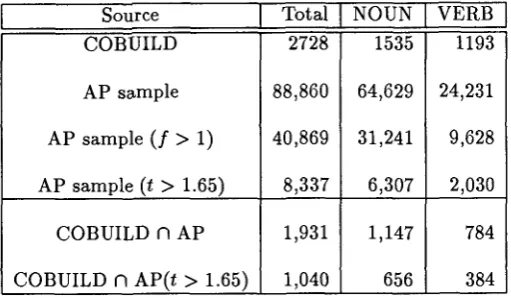
From a machine-readable version of the dictionary, we extracted a list of 1535 nouns associated with a particu- lar preposition, and of 1193 verbs associated with a par- ticular preposition after an object noun phrase. These 2728 associations are many fewer than the number of associations found in the AP sample. (see Table 4.)
Of course, most of the preposition association pairs from the AP sample end up being non-significant; of the 88,860 pairs, fewer than half (40,869) occur with a frequency greater than 1, and only 8337 have a t- score greater than 1.65. So our sample gives about three times as many significant preposition associations as the COBUILD dictionary. Note however, as Table 4 shows, the overlap is remarkably good, considering the large space of possible bigrams. (In our bigram table there are over 20,000 nouns, over 5000 verbs, and over 90 prepo- sitions.) On the other hand, the lack of overlap for so many cases - assuming that the dictionary and the sig- nificant bigrams actually record important preposition associations - indicates that 1) our sample is too small, and 2) the dictionary coverage is widely scattered.
First, we note that the dictionary chooses attachments in 182 cases of the 889 test sentences. Seven of these are
cases where the dictionary finds an association between the preposition and both the noun and the verb. In these cases, of course, the dictionary provides no information to help in choosing the correct attachment.
Looking at the 175 cases where the dictionary finds one and only one association for the preposition, we can ask how well it does in predicting the correct attachment. Here the results are no better than our human judges or than our bigram procedure. Of the 175 cases, in 25 cases the dictionary finds a verb association when the correct association is with the noun. In 3 cases, the dictionary finds a noun association when the correct association is with the verb. Thus, overall, the dictionary is 86% correct.
It may be unfair to use a dictionary as a source of disambiguation information. There is no reason to ex- pect that the dictionary aims to provide information on all significant associations; it may record only associa- tions that are interesting for some reason (perhaps be- cause they are semantically unpredictable.) But from the standpoint of a language model, the fact that the dictionary provides no help in disambiguation for about 80% of the ambiguous triples considerably diminishes its usefulness.
Conclusion
Our attempt to use lexical associations derived from dis- tribution of lexical items in text shows promising results. Despite the errors in parsing introduced by automati- cally analyzing text, we are able to extract a good list of associations with preposition, overlapping significantly with an existing dictionary. This information could eas- ily be incorporated into an automatic parser, and ad- ditional sorts of lexical associations could similarly be derived from text. The particular approach to decid- ing attachment by t-score gives results nearly as good as human judges given the same information. Thus, we conclude that it may not be necessary to resort to a com- plete semantics or to discourse models to resolve many pernicious cases of attachment ambiguity.
It is clear however, that the simple model of attach- ment preference that we have proposed, based only on the verb, noun and preposition, is too weak to make correct attachments in many cases. We need to explore ways to enter more complex calculations into the proce- dure. In particular, it will be necessary to include infor- mation about the object of the preposition, which will allow us to determine for example whether the preposi- tion in is functioning as a temporal or locative modifier in (10). And information about the premodifiers of the object noun phrase will help decide disambiguation in cases like ( l l ) , where the as phrase depends in the pre- nominal modifier such.
(10) Jefferson Smurfit Inc. of Alton
,
Ill.,
bought the company in 1983. . .
[image:5.612.82.278.134.224.2]References
[I] Altmann, Gerry, and Mark Steedman. 1988. Interac- tion with context during human sentence processing.
Cognition, 30, 191-238.
[2] Church, Kenneth W. 1988. A stochastic parts pro- gram and noun phrase parser for unrestricted text, Proceedings of the Second Conference on Applied Nat- ural Language Processing, Austin, Texas.
[3] Church, Kenneth W., William A. Gale, Patrick Hanks, and Donald Hindle. (to appear). Using statis- tics in lexical analysis. in Zernik (ed.) Lexical acquisi- tion: using on-line resources to build a lezicon.
[4] Ford, Marilyn, Joan Bresnan and Ronald M. Ka- plan. 1982. A competence based theory of syntactic closure, in Bresnan, J . (ed.) The Mental Representa- tion of Grammatical Relations. MIT Press.
[5] Frazier, L. 1978. On comprehending sentences: Syn- tactic parsing strategies. PhD. dissertation, University of Connecticut.
[6] Hindle, Donald. 1983. User manual for fidditch, a de- terministic' parser. Naval Research Laboratory Tech- nical Memorandum 7590-142.
[7] Kimball, J . 1973. Seven principles of surface struc- ture parsing in natural language, Cognition, 2, 15-47.
[8] Marcus, Mitchell P. 1980. A theory of syntactic recog- nition for natural language. MIT Press.
[9] Sinclair, J., P. Hanks, G. Fox, R. Moon, P. Stock, et al. 1987. Collins Cobuild English Language Dictio- nary. Collins, London and Glasgow.
[lo] Taraban, Roman and James L. McClelland. 1988. Constituent attachment and thematic role assignment in sentence processing: influences of content-based ex- pectations, Journal of Memory and Language, 27,597- 632.
Source Tot a1
COBUILD 2728
AP sample 88,860
AP sample (f
>
1) 40,869A P sample ( t
>
1.65) 8,337NOUN
I
VERB7
Table 4: Count of noun and verb associations for COBUILD and the AP sample
[image:6.616.317.573.297.446.2]