76
Analysis of Short Columns with and Without Steel
Casing
Jyothikamol Sabu
1, Kavitha P.E.
2Department of Civil Engineering1, 2, P. G. Student1, Assoc. Professor 2
Email: [email protected]1, [email protected]2
Abstract- Steel casing around normal concrete column is known by the name concrete filled steel tubular
(CFST) columns. It has got lots of advantages such as good ductility, greater stiffness, improved fire resistance and better load carrying capacity compared to normal columns. This study investigates load carrying capacity of short columns of rectangular and T- shape cross sections with and without steel casing. For this, an experimental study was conducted for rectangular and T-shape concrete filled steel tubular short columns having a length of 375 mm keeping area of steel as same for both specimens. Numerical analysis was conducted using ANSYS 14.5 for specimens corresponding to experiment models without steel casing. In order to extend the experimental study, numerical analysis was conducted on load carrying capacity of rectangular and T- shape short columns with and without steel casing for various length such as 375mm, 500 mm and 630 mm with area of concrete and area of steel as same for both rectangular and T- shape. It was found that load carrying capacity of short columns with steel casing is more than that of short columns without steel casing for rectangular and T- shape.
Index Terms- CFST; Steel casing; Load carrying capacity.
1. INTRODUCTION
Concrete filled steel tubular (CFST) columns are very much popular in modern civil engineering field. It has so many applications in construction industry because of its variety of advantages over normal columns such as greater stiffness, good ductility, high toughness, improved fire resistance and better load carrying capacity and so on. Steel casing act as lateral as well as longitudinal reinforcement and it contributes in total load carrying capacity of column. Steel tube act as permanent formwork thus reduces construction cost and construction time.
Extensive experimental and numerical analysis were conducted in previous years on concrete filled steel tubular (CFST) columns. Han [1] investigated the behavior of short columns of concrete-filled rectangular hollow sections (RHS) subjected to axial load experimentally and found that strength index and ductility index were increases with increase of constraining factor and decrease of width ratio. Dalin Liu and Wie Min Gho [2] conducted an experimental investigation on 26 rectangular CFST short columns. The test parameters considered for the study include volumetric steel-to-concrete ratio, material strengths and cross sectional aspect ratio. They have done a comparison of test results with available design codes such as Eurocode 4(EC4), American Institute of Steel Construction (AISC) and American Concrete Institute (ACI) and found that EC4 is unsafe to predict the ultimate capacity of concrete filled steel tubular columns made from mild steel and high strength concrete, whereas AISC and ACI estimates the failure loads of specimen conservatively. After conducting an
experimental investigation on short and slender concrete filled steel tubular columns Brian et al. [3] found that performance of the concrete filled steel tubular columns was quite good and they have the potential to be used as most effective structural members in many civil engineering applications. Parameters selected for their study was slenderness D/t or B/t, filling the hollow sections with concrete or not and concrete cylinder strength. They have also conducted comparisons with various available design codes such as Australian standard AS 5100, American code AISC, Chinese code DBJ/T 13-51-2010 and Eurocode 4 (2004). They found that all the design codes are conservative in predicting load carrying capacity of short and slender concrete filled steel tubular columns. S. Seangatith and j. Thumrongvut [4] studied behaviors and modes of failure of square thin walled steel tubular columns subjected to concentric axial load. Main variables considered in their study were compressive strengths of the concrete, wall thickness of the steel tube and tie spacing. An experimental study conducted by Tu et al.[5] on short and slender multi cell T- shaped concrete filled steel tubular columns reveals that ultimate load of columns increases with increase in thickness of steel tube and also it is difficult to buckle under axial compression. In their study they found that with an increase in concrete compressive strength failure load increases whereas axial ductility decreases.
77 concrete filled steel tubular columns having a length
of 375 mm. Steel casing is provided with 1.5 mm thickness. Then numerical analysis was conducted using ANSYS 14.5 for rectangular and T- shape columns corresponding to experiment models without steel casing. In order to extend experimental study numerical analysis was conducted for rectangular and T- shape steel columns with and without steel casing for lengths of 375 mm, 500 mm and 630 mm keeping area of steel and area of concrete as same so that ultimate load carrying capacity of concrete filled steel tubular (CFST) short columns as well as short columns without steel casing were investigated numerically.
2. EXPERIMENTAL INVESTIGATION
[image:2.595.311.525.201.413.2] [image:2.595.308.524.445.663.2]Experimental study was conducted for concrete filled steel tubular short columns of rectangular and T- shape for a length of 375 mm having 1.5 mm thick steel casing with area of steel as same. M25 grade concrete was used for infill concrete and mild steel plate was used for steel casing. Details of rectangular and T- shape short columns for experimental study is given in Table 1. Cross sectional details are given in Fig. 1.
Table 1. Specimen details of experimental study
Shape Dimensions Thickness, t (mm)
Length, l (mm)
Rectangle a=115 mm b=82 mm
1.5 375
T- shape a=40 mm
b=58 mm c =58 mm
1.5 375
Fig. 1. Cross sectional details of concrete filled steel tubular columns
In order to find compressive strength of concrete, concrete cubes of size150 mm x 150 mm x150 mm were casted and tested after 28 days of curing in a compression testing machine of capacity 2000 kN. It was found that compressive strength of concrete cubes was 32.215 N/mm2. Then concrete filled steel tubes were filled with M 25 grade of concrete within Fe 250
surrounding steel. Base plate of 8 mm thick is provided at bottom and concrete mix is poured into it. After casting they are cured for 28 days. After curing was done another 8mm thick steel plate was welded at top and then testing was done on compression testing machine of 2000 kN capacity. Specimens before and after loading are given in Fig. 2 and Fig. 3 respectively.
Fig. 2. Specimens before loading
Fig. 3. Specimens after loading
3. NUMERICAL ANALYSIS
3.1. Experiment models without steel casing
[image:2.595.68.292.451.650.2]78 experiment models were done. SOLID65 element type
[image:3.595.300.527.97.262.2]was used to model concrete. In order to carry out meshing operation, 15 mm element edge length was used. Small displacement static analysis was done to get results. Numerical analysis results of rectangular and T- shape short columns without steel casing are shown in Fig. 4. and Fig. 5 respectively.
[image:3.595.77.285.183.338.2]Fig. 4. Principal stress diagram of rectangular short column without steel casing
Fig. 5. Principal stress diagram of T- shape short column without steel casing
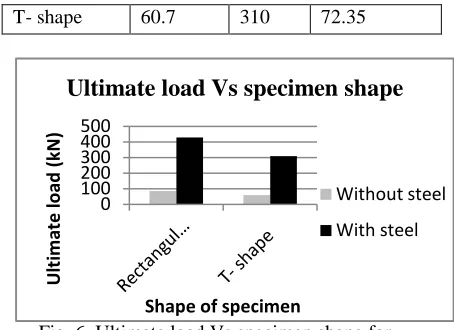
[image:3.595.75.284.378.539.2]Comparison of load carrying capacity of rectangular and T- shape short columns with steel casing as per experimental results and corresponding short columns without steel casing as per numerical analysis are given in Table 2 . Graphical representation of results is shown in Fig. 6.
Table 2. Comparison of ultimate load for specimens with and without steel casing with equal area of steel
Shape Ultimate load (kN)
Percentage increase of ultimate load
(%) Without
steel casing
With steel casing
Rectangular 85.7 430 80.07
T- shape 60.7 310 72.35
Fig. 6. Ultimate load Vs specimen shape for rectangular and T- shape specimens with and
without steel casing
From Table 2 and Fig. 6 it is clear that load carrying capacity of rectangular and T- shape short columns without steel casing is less than load carrying capacity of corresponding short columns with steel casing.
3.2. Parametric study of rectangular and T- shape short columns with and without steel casing
In order to extend experimental study numerical analysis was conducted for rectangular and T- shape steel columns with and without steel casing for lengths of 375 mm, 500 mm and 630 mm keeping area of steel and area of concrete as same. Then load carrying capacity of short columns with steel casing as well as without steel casing was evaluated numerically. SOLID65 element type was used to model concrete and SOLID180 element type was used to model steel plate. For meshing of models, 15 mm element edge length was provided. Bottom end of steel plate is provided with fixed support and top plate is kept as free support. Small displacement static analysis was used for carryout model analysis. Details of specimen geometry are given in Table 3.
Table 3. Details of specimens for parametric study using ANSYS 14.5
Shape Inner dimensions
Thickness of steel, t
(mm)
Length, l (mm)
Rectangle b=85.5 mm
a=145.5mm 1.29
375 500 630
T-shape
a=50.5 mm b= 82.5 mm c= 82.5 mm
0.75
375 500 630
Cross sectional details are to be referred with Fig. 1.
0 100 200 300 400 500
U
lt
im
a
te
l
o
a
d
(
k
N
)
Shape of specimen
Ultimate load Vs specimen shape
Without steel
[image:3.595.65.289.686.762.2]79 Meshed view of concrete filled steel tubular short
[image:4.595.77.527.141.494.2]columns of rectangular and T- shape are given in Fig. 7 and Fig. 8 respectively.
Fig. 7. Meshed view of rectangular CFST short column with top and base plates
Fig. 8. Meshed view of T- shape CFST short column with top and base plates
3.2.1. Short Columns With and Without Steel Casing of Length 375 mm
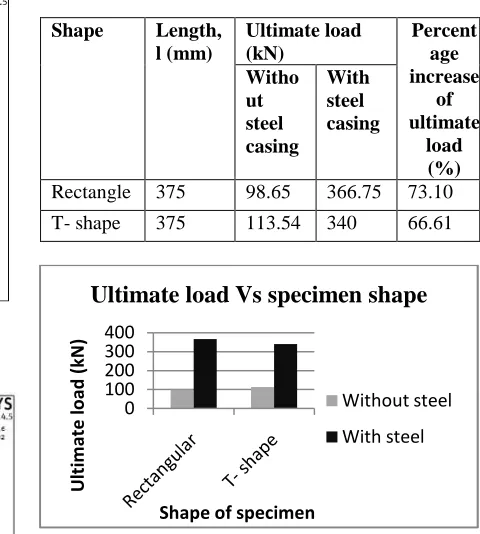
Rectangular and T- shape short columns with and without steel casing for a length of 375 mm are analyzed in ANSYS 14.5. Load carrying capacity of specimens with and without steel casing for rectangular and T- shape short columns with same area of steel and area of concrete were found out. The results thus obtained were tabulated in Table 4. Graphical representation of results is shown in Fig. 9. From Table 4 and Fig. 9 it was found that load carrying capacity of short columns of 375 mm length without steel casing is less than that of short columns of length 375 mm with steel casing.
Table 4. Comparison of ultimate load for specimens with and without steel casing for a length of 375 mm
Shape Length, l (mm)
Ultimate load (kN)
Percent age increase
of ultimate
load (%) Witho
ut steel casing
With steel casing
Rectangle 375 98.65 366.75 73.10 T- shape 375 113.54 340 66.61
Fig. 9 Ultimate load Vs specimen shape with and without steel casing for 375 mm length
3.2.2. Short Columns With and Without Steel Casing of Length 500 mm
Rectangular and T- shape short columns with and without steel casing for a length of 500 mm are analyzed in ANSYS 14.5. Load carrying capacity of specimens with and without steel casing for rectangular and T- shape short columns with same area of steel and area of concrete were found out. The results thus obtained were tabulated in Table 5. Graphical representation of results is shown in Fig. 10.
Table 5. Comparison of ultimate load for specimens with and without steel casing for a length of 500 mm
Shape Length, l (mm)
Ultimate load (kN)
Percent age increase
of ultimate
load (%) Withou
t steel casing
With steel casin g
Rectangle 500 96.53 245 60.6 T- shape 500 100.78 300 66.41
0 100 200 300 400
U
lt
im
a
te
l
o
a
d
(
k
N
)
Shape of specimen
Ultimate load Vs specimen shape
Without steel
[image:4.595.288.528.148.415.2] [image:4.595.74.297.340.516.2] [image:4.595.308.529.637.750.2]80 From Table 5 and Fig. 10 it was found that load
[image:5.595.73.297.160.286.2]carrying capacity of short columns of 500 mm length without steel casing is less than that of short columns of length 500 mm with steel casing.
Fig. 10 Ultimate load Vs specimen shape with and without steel casing for 375 mm length
3.2.3. Short Columns With and Without Steel Casing of Length 630 mm
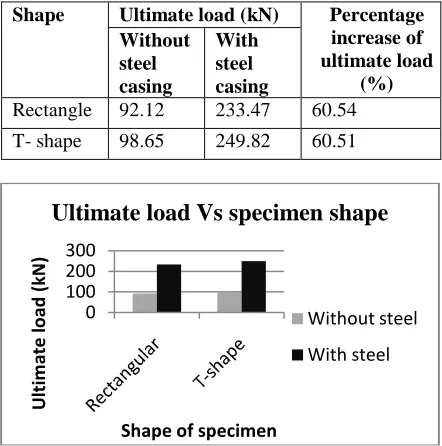
Rectangular and T- shape short columns with and without steel casing for a length of 630 mm are analyzed and Load carrying capacity of specimens with and without steel casing for rectangular and T- shape short columns with same area of steel and area of concrete were found out. The results thus obtained were tabulated in Table 6. Graphical representation of results is shown in Fig. 11.
Table 6. Comparison of ultimate load for specimens with and without steel casing for a length of 500 mm
Shape Ultimate load (kN) Percentage increase of ultimate load (%) Without steel casing With steel casing
Rectangle 92.12 233.47 60.54 T- shape 98.65 249.82 60.51
Fig. 11 Ultimate load Vs specimen shape with and without steel casing for 375 mm length
From Table 6 and Fig. 11 it was found that load carrying capacity of short columns of 630 mm length
without steel casing is less than that of short columns of length 500 mm with steel casing.
Overall results for rectangular short column with and without steel casing for various lengths such as 375 mm, 500 mm and 630 mm are tabulated in Table 7. Graphical representation of results is shown in Fig. 12. Table 7. Comparison of rectangular short column with and without steel encasement
Length (mm)
Ultimate load (kN)
Percentage increase of ultimate load (%) Without steel encasement With steel encasement
375 98.65 366.75 73.10
500 96.53 245 60.6
[image:5.595.307.530.199.442.2]630 92.12 233.47 60.54
Fig. 12. Ultimate load Vs specimen length of rectangular short column with and without steel
encasement
From Table 7 and Fig. 12 it was found that load carrying capacity of rectangular short columns without steel casing is less than that of short columns with steel casing. Load carrying capacity decreases with increase in length of specimens whereas the percentage difference between the ultimate load carrying capacity with and without steel casing decreases.
Overall results for T- shape short column with and without steel casing for various lengths such as 375 mm, 500 mm and 630 mm are tabulated in Table 8. Graphical representation of results is shown in Fig. 13.
Table 8. Comparison of T- shape short column with and without steel encasement
Length (mm)
Ultimate load (kN)
Percentage increase of ultimate load (%) Without steel encasement With steel encasement
375 113.54 340 66.61 500 100.78 300 66.41 630 98.65 249.82 60.51
0 100 200 300 400 U lt im a te l o a d ( k N )
Shape of specimen
Ultimate load Vs specimen shape
Without steel With steel 0 100 200 300 U lt im a te l o a d ( k N )
Shape of specimen
Ultimate load Vs specimen shape
Without steel
With steel
0 200 400
375 500 630
U lt im a te l o a d ( k N )
Length of specimen (mm)
Ultimate load Vs specimen
length of rectangular column
with out steel
[image:5.595.73.294.489.712.2]81 Fig. 13. Ultimate load Vs specimen length of T- shape
short column with and without steel encasement
From Table 8 and Fig. 13 it was found that load carrying capacity of T-shape short columns without steel casing is less than that of short columns with steel casing. Load carrying capacity decreases with increase in length of specimens whereas the percentage difference between the ultimate load carrying capacity with and without steel casing decreases.
5. CONCLUSION
•
Load carrying capacity of CFST short columns is found to be more than that of concrete columns.• There is at least 60% increase in load carrying capacity of CFST columns compared to concrete columns.
• Load carrying capacity of CFST columns decreases with increase in length.
• Rectangular CFST columns are found to be superior to T-shape CFST columns at low values of length to cross sectional area ratio • Percentage increase of load carrying capacity
of rectangular and T-shape CFST short columns in comparison with short columns without steel casing are found to be same high values of length to cross sectional area ratio.
REFERENCES
[1] L.-H. Han (2002): Concrete-filled circular steel tubes subjected to pure bending. Journal of Constructional Steel Research 57,pp1141–1168 . [2] DalinLiu; Wie-Min Gho. (2005): Axial load
behaviour of high-strength rectangular concrete-filled steel tubular stub columns. Thin-Walled Structures 43,pp1131–1142.
[3] Brian Uy; ZhongTao; Lin-Hai Han.(2011): Behaviour of short and slender concrete-filled
stainless steel tubular columns. Journal of Constructional Steel Research 67,pp360–378. [4] S. Seangatith; j. Thumrongvut.(2011): Behaviors
of Square Thin-Walled Steel Tubed RC Columns under Direct Axial Compression on RC Core. Procedia Engineering 14 ,pp513–520.
[5] Y.Q.Tu n; Y.F.Shen; P.Li. (2014): Behaviour of multi‐cell composite T-shaped concrete-filled steel tubular columns under axial compression. ThinWalledStructures85,pp57–70.
0 200 400
375 500 630
U
lt
im
a
te
l
o
a
d
(
k
N
)
Length of specimen (mm)
Ultimate load Vs specimen
length of T- shape
with out steel