Multi-prototype Chinese Character Embedding
Yanan Lu
1, Yue Zhang
2, Donghong Ji
1Computer School, Wuhan University, China1 Singapore University of Technology and Design2 {luyanan, dhji}@whu.edu.cn, [email protected]
Abstract
Chinese sentences are written as sequences of characters, which are elementary units of syntax and semantics. Characters are highly polysemous in forming words. We present a position-sensitive skip-gram model to learn multi-prototype Chinese character embeddings, and explore the usefulness of such character embeddings to Chinese NLP tasks. Evaluation on character similarity shows that multi-prototype embeddings are significantly better than a single-prototype baseline. In addition, used as features in the Chinese NER task, the embeddings result in a 1.74% F-score improvement over a state-of-the-art baseline.
Keywords:embedding, multi-prototype, Chinese character
1.
Introduction
Learned from large-scale unlabeled data, embeddings of-fer distributed vector representations of words and phras-es (Bengio et al., 2003; Mikolov et al., 2013). They have been applied as inputs to neural networks (Collobert and Weston, 2008; Socher et al., 2011; Kalchbrenner et al., 2014), and also used as additional features to improve lin-ear models (Turian et al., 2010; Bansal et al., 2014; Guo et al., 2014b) for NLP tasks. The advantages of embeddings are two-fold. First, they are useful for reducing sparseness compared with discrete words and n-grams. Second, they contain automatically induced features.
Written as continuous sequences of characters, Chinese sentences do not have explicit word delimitation. As a re-sult, similar to other Chinese NLP tasks, it is possible to create word embeddings based on automatically segmented Chinese sentences (Zhang et al., 2014b). Although seg-mentation errors can affect the quality, it has been shown that such word embeddings can improve Chinese NLP tasks such as parsing (Wu et al., 2013).
On the other hand, character information can also be used for NLP (Zhang et al., 2014a). Zhang et al. (2013) show that parsing can be improved by taking characters as inputs, jointly performing segmentation and syntax parsing. They show that character features can significantly improve the accuracies. Character features are also central to other Chi-nese NLP tasks such as character-based segmentation (X-ue, 2003) and named entity recognition (NER (Chen et al., 2006)).
It is an interesting research question whether character em-beddings can be useful for Chinese NLP. However, rela-tively little work has been reported on embedding Chinese characters, and limited effect has been observed (Sun et al., 2014). One possible reason is that the number of characters is much smaller compared to the number of words (104vs 106), and the effect of character embedding on reducing s-parsity can be limited. Also due to this reason, it has been shown that unsupervised clustering of characters does not improve in-domain segmentation (Liang, 2005).
Another possible reason, however, is that previous work did not take into account the polysemy of characters. One
u-niqueness of charactes, as compared with words, is that their use is highly flexible, and each character can have multiple meanings in different words. For example, the character “‘” can take at least 4 senses, includingcolor
in “‘Ú(yellow)”,surnamein “‘¼(Huang)”,failurein “ù¯ ‘ (The thing failed)” andpornographyin “×
‘ (anti-pornography)”. As a result, it is difficult to ful-ly capture the character meaning by using a fixed embed-ding for each character. We address this issue by proposing a method formulti-prototypecharacter embedding, which predicts the character sense together with its embedding given an input sentence.
Experiments show that multi-prototype embeddings can give better results than a single-prototype baseline on both character similarity evaluations and Chinese NER. For the NER task, character embeddings improves the accuracy of a state-of-the-art CRF model significantly.
2.
Multi-prototype Character Embedding
Most Chinese characters have multiple senses, but take on-ly one sense in a given context. The task of multi-prototype character embedding is to find a continuous vector repre-sentation for each Chinese charactersense. We develop a multi-prototype word model by adapting an existing mod-el for word embedding in the literature, making significant changes for the character embedding task.
There has been a line of work in training multi-prototype word embeddings (Huang et al., 2012; Guo et al., 2014a; Frey and Dueck, 2007; Tian et al., 2014; Chen et al., 2014). We adapt the Multi-Sense Skip-gram (MSSG) model (Nee-lakantan et al., 2014), which is based on the Skip-gram model (Mikolov et al., 2013). The Skip-gram model works by predicting a word vector using its context. To accom-modate for multiple word senses, the MSSG model works by predicting the sense of the current word given its con-text, and then updating the current word sense vector and context vector.
In particular, each word w is associated with two types of vector representations, one being the output embedding
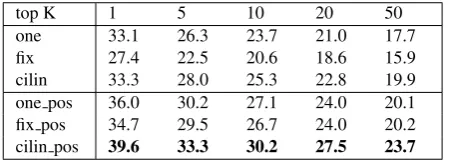
top K 1 5 10 20 50 one 33.1 26.3 23.7 21.0 17.7 fix 27.4 22.5 20.6 18.6 15.9 cilin 33.3 28.0 25.3 22.8 19.9 one pos 36.0 30.2 27.1 24.0 20.1 fix pos 34.7 29.5 26.7 24.0 20.2 cilin pos 39.6 33.3 30.2 27.5 23.7
Table 1: Character similarity accuracy results.
of cluster that is closet to its average context vector. The MSSG model uses a clustering algothrim to group word sense, which similar to thek-means algorithm, and the clus-ter cenclus-ter is the average of the vector representation of all contexts which belong to that cluster.
We make three significant changes to MSSG for the char-acter embedding task. First, we predict the sense of the current character given the context directly by using a neu-ral model (Eq.2), rather than by finding the cluster center which is closed to average context vector. This method is empirically more accurate for our task. Second, characters are highly order-sensitive in forming words, we add posi-tion into the context by combining a character cwith its position in obtaining¯vc, so each character in each position
(relative to the current character position) has a embedding. This results in a position-sensitive variation of the Skip-gram model. In addition, the number of senses per char-acter is induced from a lexicon rather than automatically. We call the Position-sensitive MSSG (PMSG).
As shown in Figure 1, given an input sentence, each char-actercis assigned to its context vectorv(c); which is then used to predict both the character senses and output vec-tors via a neural network. Denoting the current character asc0, its previous characters asc−1andc−2, respectively, and its next characters asc1andc2, respectively, the model first computes a context vectorvcontext(c0)for the current
character using predict the sense-specific vectorv(c0, i)by
s0= arg max
i=1∈[1,k(c0)]
1
e−v(c0,i)Tvcontext(c0) (2)
In the equation,k(c0)represents the number of senses (i.e. prototypes) ofc0andv(c0, i)represents the embedding of theith sense ofc0, ands0represents the sense index of cur-rent characterc0. Both the output and the context vectors are trained by predicting the context vectors using the Skip-gram model. AdaGrad (Duchi et al., 2011) is used with an initial learning rate of 0.025.
3.
Experiments
We use 46 million online news sentences1, and additional-ly the 7 million news sentences from Chinese Gigawords as the training data. All the characters occuring less than
1
Figure 1: Multi-prototype Skip-gram model.
打
/v/Kb
这以后
(Since this)
虎 打
/v/Hi
武松
(Tiger beat Wusong)
那年,畹町 打
/v/Fa
出了对外开放的口号。
(Wan Ting put forward open-up announcement)
Figure 2: Example test data.
1,000 times are removed, resulting in 5,182 characters for embedding. We setwindow= 52, anddimensionality= 200when training the MSSG and PMSG models, and eval-uate the embeddings on two tasks, by directly measuring character similarity, and application to Chinese NER.
3.1.
Chinese Character similarity
We first evaluate the embeddings using a similarity mea-sure, namely Precision@K (Qiu et al., 2011; Jin et al., 2012), which measures the precision of theKnearest neigh-bour by the cosine similarity. Because there are no pub-licly available datasets for evaluating polysemous charac-ters, we construct a dataset based on the lexicon TongYi-CiLin (cilin)3, which contains 4,738 commonly used
Chi-nese characters, and a semantically labeled ChiChi-nese corpus that consists of 10,000 sentences. There are 12 coarse-grand character categories, 97 classes, and 1200 fine-coarse-grand subclass in the cilin semantic hierarchy. We use the 97 classes as character senses, and the average sense number per character is 1.85.
We evaluate each character in its context in the labeled cor-pus incilin, which covers 85 character classes. In addition, we add all the common surnames4to the surname class of
cilin, and label all the surnames in the 10,000 sentences5. We randomly select a sentence for each sense of each char-acter, obtaining 2,236 sentences, which contain 85 out of 97 classes and 1,553 out of 4,738 characters. The average sense number per character is 2.755. An example of the character “‹” in our dataset is shown in Figure 2.
Table 1 shows the results whenKis set to1,5,10,20,50, respectively. onerepresents the single-prototype baseline,
2
here,windowis the parameter r of Eq.2 3
Available at http://www.datatang.com/data/42306/ 4Available at http://xing.911cha.com
system Characters top-5 similar characters
cilin pos
‘: sense 1 ù(red)ç(black)£(orange)Ú(colour)7(blue)
‘: sense 2 x(white;rivername)»(red)T(shore)^(bowl) (river name) ‘: sense 3 x(white)~(palladium)À(goods)À(hedge)±(circumference) ‘: sense 4 (surname)4(surname) (surname)±(surname)¤(surname) “: sense 1 ª(stem)s(flower)d(seed)è(vegetables)Þ(bud)
“: sense 2 (surname)‘(surname)Û(surname)ö(surname)4(surname)
one pos ‘“ ñ7(surname) (surname)x(white)Å(surname)±(surname) (willow)ñ(surname)v(surname) (poplar)Ú(chrysanthemum)
Table 2: 5 nearest characters of ““” and “‘” by the one pos and cilin pos systems.
Character Ci:i∈[−2,2], CiCi+1:i∈[−2,1] Sense Si:i∈[−2,2], SiSi+1:i∈[−2,1] Embedding Ei:i∈[−2,2], EiEi+1:i∈[−2,1]
Table 3: Features templates used in the CRF model.
Figure 3: NER performance on development data, where C is the size of clusters.
fixrepresents the MSSG model trained with a fixed num-ber of sensessfor each character, which is set to 56. And
cilin represents the MSSG model trained with the sense number from cilin for each character. The X pos rows show results of the PMSG models under the setting X
(X ∈ {one, f ix, cilin}). It can be seen from the table that the PMSG models perform significantly better than the MSSG models, showing the importance of position infor-mation oncharacterembedding.
If the number of senses is fixed to5for each character, the performance can be similar to the single-prototype base-line. This is because different characters have very different numbers of senses. While the most frequent character (i.e. “Z“) has over 10 senses, a large number of low frequen-cy characters have only one sense. By setting the number of senses according to thecilincorpus, the multi-prototype embeddings give the best results. However, there is not a universal standard on the number of senses for each char-acter, due to variation in semantic granularity.
Table 2 gives the nearest characters for “‘” and ““” by
one posandcilin pos. Whilecilin poscan distinguish d-ifferent senses of the characters “‘” and ““”, one pos
mixes different senses together. cilin posgives relatively more correct synonyms according to each sense. On the other hand, there is also noise. For example, for the char-acter “‘”, the second sense contains a mixture of river names and colors, while the third contains colors, metals and trading-related use of the character.
6We experiment with s=2-10 for the number of sense, and only report the best baseline (s=5) due to space limitations.
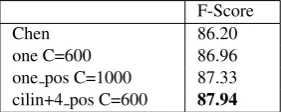
F-Score
Chen 86.20
one C=600 86.96 one pos C=1000 87.33 cilin+4 pos C=600 87.94
Table 4: NER performance on test data. where C is the size of clusters.
3.2.
Application on Chinese NER
We apply the embeddings as features for Chinese NER. The experiments are conducted on the MSRA NER data in Sighan bakeoff 2006 (Ng and Kwong, 2006), which con-tains 46,364 training sentences and 4,365 test sentences. Following Chen et al. (2006), we use the first 37,000 sen-tences of the MSRA training data for training and the last 9,364 sentences for development.
We take the character-based CRF model of Chen et al. (2006) as our baseline, which is the best CRF model in the closed test. Chen et al. (2006) show that character-based CRF is better than word-based CRF. We use their feature set as the base set, also apply sense and embedding cluster features as shown in Table 3. Ciis theithcharacter in the
sentence, Si is theithcharacter sense, Ei is theith
em-bedding. The subscript0denotes the current position,−1 denotes the previous position and1denotes the next posi-tion. We use as embedding features character embedding clusters by the K-means algorithm.
As a first development test, we study how the number of senses and size of clusters affect NER performance. The dimensionality of embeddings is set to 200, and all the em-beddings are trained using the PMSG model. Theone pos
system utilizes the baseline and embedding cluster feature templates in Table 3. The other systems use the baseline, sense and character embedding cluster feature templates.
cilin,one pos,fix posandcilin poshave the same mean-ings as Table 1. To test the influence of sense counts,
cilin+Nrepresents the number of senses per charactercilin
plusNif it is greater than 1.
The results are shown in Figure 3, from which we obtain the best parameters for each system. In the figure, the sense count has a significant influence on the development accu-racies, and multi-prototype embeddings are generally better than single-prototype embeddings.
em-beddings by0.98%F-score (significance atp <0.01). Er-ror analysis shows that the improvement are achieved by significantly better recall. This directly benefits from char-acter similarity using embeddings. For example, the recall on person names are largely higher when multi-prototype embeddings are used.
4.
Conclusion
We studied embeddings of Chinese characters, compar-ing a novel multi-prototype embeddcompar-ing method with a single-prototype embeddings baseline on direct similari-ty measures and an application to Chinese NER. Experi-ments show that multi-prototype embeddings can induce significantly better character synsets compared to single-prototype, while position information of context characters and the number of senses for each character are crucial to the training of embeddings. Positive results are obtained on both similarity and NER, showing that character embed-ding can be useful to Chinese NLP.
5.
Acknowledgements
We thank the anonymous reviewers for their construc-tive comments, which helped to improve the paper. This work is supported the State Key Program of National Nat-ural Science Foundation of China (Grant No.61133012), the National Natural Science Foundation of China (Grant No.61373108), the Singapore Ministry of Education (MOE) AcRF Tier 2 grant T2MOE201301, SRG ISTD 2012 038 from Singapore University of Technology and Design.
6.
Bibliographical References
Bansal, M., Gimpel, K., and Livescu, K. (2014). Tailoring continuous word representations for dependency parsing. InProceedings of the Annual Meeting of the Association for Computational Linguistics.
Bengio, Y., Ducharme, R., Vincent, P., and Jauvin, C. (2003). A neural probabilistic language model. Journal of Machine Learning Research, 3:1137–1155.
Chen, A., Peng, F., Shan, R., and Sun, G. (2006). Chinese named entity recognition with conditional probabilistic models. InProc. Fifth SIGHAN Workshop Chinese Lan-guage Processing, pages 173–176.
Chen, X., Liu, Z., and Sun, M. (2014). A unified model for word sense representation and disambiguation. In Pro-ceedings of the 2014 Conference on Empirical Methods in Natural Language Processing (EMNLP), pages 1025– 1035.
Collobert, R. and Weston, J. (2008). A unified architecture for natural language processing: Deep neural networks with multitask learning. InProceedings of the 25th in-ternational conference on Machine learning, pages 160– 167. ACM.
Duchi, J., Hazan, E., and Singer, Y. (2011). Adaptive sub-gradient methods for online learning and stochastic op-timization. The Journal of Machine Learning Research, 12:2121–2159.
Frey, B. J. and Dueck, D. (2007). Clustering by passing messages between data points. science, 315(5814):972– 976.
Guo, J., Che, W., Wang, H., and Liu, T. (2014a). Learning sense-specific word embeddings by exploiting bilingual resources. InProceedings of COLING, pages 497–507. Guo, J., Che, W., Wang, H., and Liu, T. (2014b). Revisiting
embedding features for simple semi-supervised learn-ing. InProceedings of the 2014 Conference on Empiri-cal Methods in Natural Language Processing (EMNLP), pages 110–120.
Huang, E. H., Socher, R., Manning, C. D., and Ng, A. Y. (2012). Improving word representations via global con-text and multiple word prototypes. InProceedings of the 50th Annual Meeting of the Association for Computa-tional Linguistics: Long Papers-Volume 1, pages 873– 882. Association for Computational Linguistics.
Jin, P., Carroll, J., Wu, Y., and McCarthy, D. (2012). Dis-tributional similarity for chinese: Exploiting character-s and radicalcharacter-s. Mathematical Problems in Engineering, 2012.
Kalchbrenner, N., Grefenstette, E., and Blunsom, P. (2014). A convolutional neural network for modelling sentences. Proceedings of the 52nd Annual Meeting of the Association for Computational Linguistics, June. Liang, P. (2005). Semi-supervised learning for natural
lan-guage. Master’s thesis, Massachusetts Institute of Tech-nology.
Mikolov, T., Sutskever, I., Chen, K., Corrado, G. S., and Dean, J. (2013). Distributed representations of word-s and phraword-seword-s and their compoword-sitionality. In Advances in Neural Information Processing Systems, pages 3111– 3119.
Neelakantan, A., Shankar, J., Passos, A., and McCallum, A. (2014). Efficient non-parametric estimation of multiple embeddings per word in vector space. InProceedings of EMNLP.
Hwee Tou Ng et al., editors. (2006). Proceedings of the Fifth SIGHAN Workshop on Chinese Language Process-ing. Association for Computational Linguistics, Sydney, Australia, July.
Qiu, L., Wu, Y., and Shao, Y. (2011). Combining contex-tual and structural information for supersense tagging of chinese unknown words. In Computational Linguistics and Intelligent Text Processing, pages 15–28. Springer. Socher, R., Lin, C. C., Manning, C., and Ng, A. Y. (2011).
Parsing natural scenes and natural language with recur-sive neural networks. InProceedings of the 28th Inter-national Conference on Machine Learning (ICML-11), pages 129–136.
Sun, Y., Lin, L., Tang, D., Yang, N., Ji, Z., and Wang, X. (2014). Radical-enhanced chinese character embedding.
arXiv preprint arXiv:1404.4714.
Tian, F., Dai, H., Bian, J., Gao, B., Zhang, R., Chen, E., and Liu, T.-Y. (2014). A probabilistic model for learn-ing multi-prototype word embeddlearn-ings. In Proceedings of COLING, pages 151–160.
Linguis-tics, pages 384–394. Association for Computational Lin-guistics.
Wu, X., Zhou, J., Sun, Y., Liu, Z., Yu, D., Wu, H., and Wang, H. (2013). Generalization of words for chinese dependency parsing.IWPT-2013.
Xue, N. (2003). Chinese word segmentation as character tagging. Computational Linguistics and Chinese Lan-guage Processing, 8(1):29–48.
Zhang, M., Zhang, Y., Che, W., and Liu, T. (2013). Chi-nese parsing exploiting characters. In ACL (1), pages 125–134.
Zhang, M., Zhang, Y., Che, W., and Liu, T. (2014a). Character-level chinese dependency parsing. In Pro-ceedings of the 52nd Annual Meeting of the Association for Computational Linguistics (Volume 1: Long Papers), pages 1326–1336, Baltimore, Maryland, June. Associa-tion for ComputaAssocia-tional Linguistics.