Extraction of Multi-word Expressions from Small Parallel Corpora
Yulia Tsvetkov
Department of Computer Science University of Haifa
Shuly Wintner
Department of Computer Science University of Haifa
Abstract
We present a general methodology for ex-tracting multi-word expressions (of vari-ous types), along with their translations, from small parallel corpora. We auto-matically align the parallel corpus and fo-cus onmisalignments; these typically in-dicate expressions in the source language that are translated to the target in a non-compositional way. We then use a large monolingual corpus to rank and filter the results. Evaluation of the quality of the ex-traction algorithm reveals significant im-provements over na¨ıve alignment-based methods. External evaluation shows an improvement in the performance of ma-chine translation that uses the extracted dictionary.
1 Introduction
Multi-word Expressions (MWEs) are lexical items that consist of multiple orthographic words (e.g., ad hoc, by and large, New York, kick the bucket). MWEs are numerous and constitute a significant portion of the lexicon of any natural language. They are a heterogeneous class of con-structions with diverse sets of characteristics, dis-tinguished by their idiosyncratic behavior. Mor-phologically, some MWEs allow some of their constituents to freely inflect while restricting (or preventing) the inflection of other constituents. In some cases MWEs may allow constituents to un-dergo non-standard morphological inflections that they would not undergo in isolation. Syntactically, some MWEs behave like words while other are phrases; some occur in one rigid pattern (and a fixed order), while others permit various syntactic transformations. Semantically, the compositional-ity of MWEs is gradual, ranging from fully com-positional to idiomatic (Bannard et al., 2003).
Because of their prevalence and irregularity, MWEs must be stored in lexicons of natural lan-guage processing applications. Handling MWEs correctly is beneficial for a variety of applications, including information retrieval, building ontolo-gies, text alignment, and machine translation.
Identifying MWEs and extracting them from corpora is therefore both important and difficult. In Hebrew (which is the subject of our research), this is even more challenging due to two reasons: the rich and complex morphology of the language; and the dearth of existing language resources, in particular parallel corpora, semantic dictionaries and syntactic parsers.
We propose a novel algorithm for identifying MWEs in bilingual corpora, using automatic word alignment as our main source of information. In contrast to existing approaches, we do not limit the search to one-to-many alignments, and pro-pose an error-mining strategy to detect misalign-ments in the parallel corpus. We also consult a large monolingual corpus to rank and filter out the expressions. The result is fully automatic ex-traction of MWEs of various types, lengths and syntactic patterns, along with their translations. We demonstrate the utility of the methodology on Hebrew-English MWEs by incorporating the ex-tracted dictionary into an existing machine trans-lation system.
2 Related Work
Early approaches to identifying MWEs concen-trated on their collocational behavior (Church and Hanks, 1989). Pecina (2008) compares 55 dif-ferent association measures in ranking German Adj-N and PP-Verb collocation candidates. This work shows that combining different collocation measures using standard statistical classification methods improves over using a single collocation measure. Other results (Chang et al., 2002; Villav-icencio et al., 2007) suggest that some collocation measures (especially PMI and Log-likelihood) are superior to others for identifying MWEs. Soon, however, it became clear that mere co-occurrence measurements are not enough to identify MWEs, and their linguistic properties should be exploited as well (Piao et al., 2005). Hybrid methods that combine word statistics with linguistic informa-tion exploit morphological, syntactic and seman-tic idiosyncrasies to extract idiomaseman-tic MWEs.
Semantic properties of MWEs can be used to distinguish between compositional and non-compositional (idiomatic) expressions. Katz and Giesbrecht (2006) and Baldwin et al. (2003) use Latent Semantic Analysis for this purpose. They show that compositional MWEs appear in con-texts more similar to their constituents than non-compositional MWEs. Van de Cruys and Vil-lada Moir´on (2007) use unsupervised learning methods to identify non-compositional MWEs by measuring to what extent their constituents can be substituted by semantically related terms. Such techniques typically require lexical semantic re-sources that are unavailable for Hebrew.
An alternative approach to using semantics cap-italizes on the observation that an expression whose meaning is non-compositional tends to be translated into a foreign language in a way that does not result from a combination of the literal translations of its component words. Alignment-based techniques explore to what extent word alignment in parallel corpora can be used to dis-tinguish between idiomatic expressions and more transparent ones. A significant added value of such works is that MWEs can thus be both iden-tified in the source language and associated with their translations in the target language.
Villada Moir´on and Tiedemann (2006) focus on Dutch expressions and their English, Spanish and German translations in the Europarl corpus (Koehn, 2005). To extract the candidates, they use syntactic properties (based on full parsing of the Dutch text) and statistical association measures. This approach requires syntactic resources that are unavailable for Hebrew.
Some recent works concentrate on exploit-ing translational correspondences of MWEs from (small) parallel corpora. MWE candidates and their translations are extracted as a by-product of automatic word alignment of parallel texts. Un-like Villada Moir´on and Tiedemann (2006), who use aligned parallel texts to rank MWE candi-dates, Caseli et al. (2009) actually use them to extract the candidates. After the texts are word-aligned, Caseli et al. (2009) extract sequences of length 2 or more in the source language that are aligned with sequences of length 1 or more in the target. Candidates are then filtered out of this set if they comply with pre-defined part-of-speech pat-terns, or if they are not sufficiently frequent in the parallel corpus. Even with the most aggressive fil-tering, precision is below 40% and recall is ex-tremely low (F-score is below 10 for all experi-ments). Our setup is similar, but we extract MWE candidates from the aligned corpus in a very dif-ferent way; and we use statistics collected from a monolingualcorpus to filter and rank the results.
Zarrieß and Kuhn (2009) also use aligned par-allel corpora but only focus on one-to-many word alignments. To restrict the set of candidates, they focus on specific syntactic patterns as determined by parsing both sides of the corpus (again, us-ing resources unavailable to us). The results show high precision but very low recall.
3 Methodology
3.1 Motivation
Parallel texts are an obvious resource from which to extract MWEs. By definition, idiomatic ex-pressions have a non-compositional meaning, and hence may be translated to a single word (or to an expression with a different meaning) in a for-eign language. The underlying assumption of alignment-based approaches to MWE extraction is that MWEs are aligned across languages in a way that differs from compositional expressions; we share this assumption. However, existing ap-proaches focus on the results of word alignment in their quest for MWEs, and in particular con-sider 1:n andn:m alignments as potential areas
in which to look for MWEs. This is problematic for two reasons: first, word alignment algorithms have difficulties aligning MWEs, and hence 1:n
andn:m alignments are often noisy; while these environments provide cues for identifying MWEs, they also include much noise. Second, our exper-imental scenario is such that our parallel corpus is particularly small, and we cannot fully rely on the quality of word alignments, but we have a bilin-gual dictionary that compensates for this limita-tion. In contrast to existing approaches, then, we focus on misalignments: we trust the quality of 1:1 alignments, which we verify with the dictio-nary; and we search for MWEs exactly in the ar-eas that word alignmentfailed to properly align, not relying on the alignment in these cases.
Moreover, in contrast to existing alignment-based approaches, we also make use of a large monolingual corpus from which statistics on the distribution of word sequences in Hebrew are drawn. This has several benefits: of course, mono-lingual corpora are easier to obtain than parallel ones, and hence tend to be larger and provide more accurate statistics. Furthermore, this provides val-idation of the MWE candidates that are extracted from the parallel corpus: rare expressions that are erroneously produced by the alignment-based technique can thus be eliminated on account of their low frequency in the monolingual corpus.
Specifically, we use pointwise mutual informa-tion (PMI) as our associainforma-tion measure. While PMI has been proposed as a good measure for identi-fying MWEs, it is also known not to discriminate accurately between MWEs and other frequent
col-locations. This is because it promotes collocations whose constituents rarely occur in isolation (e.g., typos and grammar errors), and expressions con-sisting of some word that is very frequently fol-lowed by another (e.g.,say that). However, such cases do not have idiomatic meanings, and hence at least one of their constituents is likely to have a 1:1 alignment in the parallel corpus; we only use PMIaftersuch alignments have been removed.
An added value of our methodology is the au-tomatic production of an MWE translation dictio-nary. Since we start with a parallel corpus, we can go back to that corpus after MWEs have been identified, and extract their translations from the parallel sentences in which they occur.
Finally, alignment-based approaches can be symmetric, and ours indeed is. While our main motivation is to extract MWEs in Hebrew, a by-product of our system is the extraction ofEnglish MWEs, along with their translations to Hebrew. This, again, contributes to the task of enriching our existing bilingual dictionary.
3.2 Resources
Our methodology is in principle language-independent and appropriate for medium-density languages (Varga et al., 2005). We assume the following resources: a small bilingual, sentence-aligned parallel corpus; large monolingual cor-pora in both languages; morphological processors (analyzers and disambiguation modules) for the two languages; and a bilingual dictionary. Our experimental setup is Hebrew-English. We use a small parallel corpus (Tsvetkov and Wintner, 2010) consisting of 19,626 sentences, mostly from newspapers. The corpus consists of 271,787 En-glish tokens (14,142 types) and 280,508 Hebrew tokens (12,555 types), and is similar in size to that used by Caseli et al. (2009).
We also use data extracted from two mono-lingual corpora. For Hebrew, we use the morphologically-analyzed MILA corpus (Itai and Wintner, 2008) with part-of-speech tags produced by Bar-Haim et al. (2005). This corpus is much larger, consisting of 46,239,285 tokens (188,572 types). For English we use Google’s Web 1T cor-pus (Brants and Franz, 2006).
consist-ing of 78,313 translation pairs. Some of the en-tries were collected manually, while others are produced automatically (Itai and Wintner, 2008; Kirschenbaum and Wintner, 2010).
3.3 Preprocessing the corpora
Automatic word alignment algorithms are noisy, and given a small parallel corpus such as ours, data sparsity is a serious problem. To minimize the parameter space for the alignment algorithm, we attempt to reduce language specific differences by pre-processing the parallel corpus. The impor-tance of this phase should not be underestimated, especially for alignment of two radically different languages such as English and Hebrew (Dejean et al., 2003).
Hebrew,1 like other Semitic languages, has a rich, complex and highly productive morphology. Information pertaining to gender, number, defi-niteness, person, and tense is reflected morpho-logically on base forms of words. In addition, prepositions, conjunctions, articles, possessives, etc., may be concatenated to word forms as pre-fixes or sufpre-fixes. This results in a very large num-ber of possible forms per lexeme. We therefore to-kenize the parallel corpus and then remove punc-tuation. We analyze the Hebrew corpus morpho-logically and select the most appropriate analysis in context. Adopting this selection, the surface form of each word is reduced to its base form, and bound morphemes (prefixes and suffixes) are split to generate stand-alone “words”. We also to-kenize and lemmatize the English side of the cor-pus, using the Natural Language Toolkit package (Bird et al., 2009).
Then, we remove some language-specific dif-ferences automatically. We remove frequent func-tion words: in English, the articlesa,an andthe, the infinitivaltoand the copulasam,isandare; in Hebrew, the accusative markerat. These forms do not have direct counterparts in the other language. For consistency, we pre-process the monolin-gual corpora in the same way. We then compute the frequencies of all word bi-grams occurring in each of the monolingual corpora.
1To facilitate readability we use a transliteration of He-brew using Roman characters; the letters used, in HeHe-brew lexicographic order, areabgdhwzxTiklmns‘pcqrˇst.
3.4 Identifying MWE candidates
The motivation for our MWE identification algo-rithm is the assumption that there may be three sources to misalignments (anything that is not a 1:1 word alignment) in parallel texts: either MWEs (which trigger 1:n or n:m alignments);
or language-specific differences (e.g., the source language lexically realizes notions that are re-alized morphologically, syntactically or in some other way in the target language); or noise (e.g., poor translations, low-quality sentence alignment, and inherent limitations of word alignment algo-rithms).
This motivation induces the following algo-rithm. Given a parallel, sentence-aligned corpus, it is first pprocessed as described above, to re-duce the effect of language-specific differences. We then use Giza++ (Och and Ney, 2003) to word-align the text, employingunionto merge the ments in both directions. We look up all 1:1 align-ments in the dictionary. If the pair exists in our bilingual dictionary, we remove it from the sen-tence and replace it with a special symbol, ‘*’. Such word pairs are not parts of MWEs. If the pair is not in the dictionary, but its alignment score is very high (above 0.5) and it is sufficiently fre-quent (more than 5 occurrences), we add the pair to the dictionary but also retain it in the sentence. Such pairs are still candidates for being (parts of) MWEs.
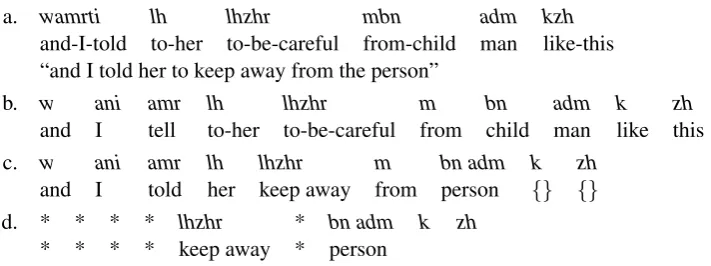
Example 1 Figure 1-a depicts a Hebrew sentence with its word-by-word gloss, and its English trans-lation in the parallel corpus. Here,bn adm “per-son” is a MWE that cannot be translated literally. After pre-processing (Section 3.3), the English is represented as “and i tell her keep away from per-son” (note thattoandthewere deleted). The He-brew, which is aggressively segmented, is repre-sented as in Figure 1-b. Note how this reduces the level of (morphological and orthographic) differ-ence between the two languages. Consequently, Giza++ finds the alignment depicted in Figure 1-c. Once 1:1 alignments are replaced by ‘*’, the alignment of Figure 1-d is obtained.
statis-a. wamrti lh lhzhr mbn adm kzh and-I-told to-her to-be-careful from-child man like-this “and I told her to keep away from the person”
b. w ani amr lh lhzhr m bn adm k zh
and I tell to-her to-be-careful from child man like this
c. w ani amr lh lhzhr m bn adm k zh
and I told her keep away from person {} {}
[image:5.595.80.436.69.202.2]d. * * * * lhzhr * bn adm k zh * * * * keep away * person
Figure 1: Example sentence pair (a); after pre-processing (b); after word alignment (c); and after 1:1 alignments are replaced by ‘*’ (d)
tics, then all remaining text (other than the spe-cial symbol) in the parallel text would be part of MWEs. In other words, all sequences of remain-ing source words, separated by ‘*’, are MWE can-didates. As our resources are far from perfect, fur-ther processing is required in order to prune these candidates. For this, we use association measures computed from the monolingual corpus.
3.5 Ranking and filtering MWE candidates
The algorithm described above produces se-quences of Hebrew word forms (free and bound morphemes produced by the pre-processing stage) that are not 1:1-aligned, separated by ‘*’s. Each such sequence is a MWE candidate. In order to rank the candidates we use statistics from a large monolingualcorpus. We donotrely on the align-ments produced by Giza++ in this stage.
We extract all word bi-grams from the remain-ing candidates. Each bi-gram is associated with its PMI-based score,2 computed from the monolin-gual corpus. Interestingly, about 20,000 candidate MWEs are removed in this stage because they do not occur at all in the monolingual corpus.
We then experimentally determine a threshold (see Section 4). A word sequence of any length is considered MWE if all the adjacent bi-grams it
2PMIk is a heuristic variant of the PMI measure, pro-posed and studied by Daille (1994), wherek, the exponent, is a frequency-related factor, used to demote collocations with low-frequency constituents. The value of the parameterkcan
be chosen freely (k >0) in order to tune the properties of the
PMI to the needs of specific applications. We conducted ex-periments with k = 0, 0.1, ... , 3 and found k = 2.7 to give the best results for our application.
contains score above the threshold. Finally, we restore the original forms of the Hebrew words in the candidates, combining together bound mor-phemes that were split during pre-processing; and we restore the function words. Many of the candidate MWEs produced in the previous stage are eliminated now, since they are not genuinely multi-word in the original form.
Example 2 Refer back to Figure 1-d. The se-quence bn adm k zh is a MWE candidate. Two bi-grams in this sequence score above the thresh-old: bn adm, which is indeed a MWE, and k zh, which is converted to the original formkzhand is hence not considered a candidate. We also con-sider adm k, whose score is low. Note that the same aligned sentence can be used to induce the English MWE keep away, which is aligned to a single Hebrew word.
3.6 Results
As an example of the results obtained with this setup, we list in Table 1 the 15 top-ranking ex-tracted MWEs. For each instance we list an indi-cation of the type of MWE: person name (PN), geographical term (GT), noun-noun compound (NNC) or noun-adjective combination (N-ADJ). Of the top 100 candidates, 99 are clearly MWEs,3 including mzg awir (temper-of air) “weather”, kmw kn(like thus) “furthermore”,bit spr( house-of book) “school”, ˇsdh t‘wph (field-of flying) “airport”, tˇswmt lb (input-of heart) “attention”, ai apˇsr (not possible) “impossible” and b‘l ph
(in-on mouth) “orally”. Longer MWEs include ba lidi biTwi (came to-the-hands-of expression) “was expressed”;xzr ‘l ‘cmw(returned on itself) “recurred”; ixd ‘m zat (together with it) “in ad-dition”; andh‘crt hkllit ˇsl haw”m (the general as-sembly of the UN) “the UN general assembly”.
Hebrew Gloss Type
xbr hknst MP NNC
tl abib Tel Aviv GT
gwˇs qTip Gush Katif NNC-GT awpir pins Ophir Pines PN hc‘t xwq Legislation NNC axmd Tibi Ahmad Tibi PN zhwh glawn Zehava Galon PN raˇs hmmˇslh Prime Minister NNC abˇslwm wiln Avshalom Vilan PN
br awn Bar On PN
[image:6.595.75.287.176.392.2]mair ˇsTrit Meir Shitrit PN limwr libnt Limor Livnat PN hiw‘c hmˇspTi Attorney General N-ADJ twdh rbh thanks a lot N-ADJ rcw‘t ‘zh Gaza Strip NNC-GT
Table 1: Results: extracted MWEs
4 Evaluation
MWEs are notoriously hard to define, and no clear-cut criteria exist to distinguish between MWEs and other frequent collocations. In order to evaluate the utility of our methodology, we con-ducted three different types of evaluations that we detail below and in Section 5.
First, we use a small annotated corpus of Hebrew noun-noun constructions that was made available to us (Al-Haj and Wintner, 2010). The corpus consists of 463 high-frequency bi-grams of the same syntactic construction; of those, 202 are tagged as MWEs (in this case, noun compounds) and 258 as non-MWEs. This corpus consolidates the annotation of three annotators: only instances on which all three agreed were included. Since it includes both positive and negative instances, this corpus facilitates a robust evaluation of precision and recall. Of the 202 positive examples, only 121 occur in our parallel corpus; of the 258 negative
examples, 91 occur in our corpus. We therefore limit the discussion to those 212 examples whose MWE status we can determine, and ignore other results produced by the algorithm we evaluate.
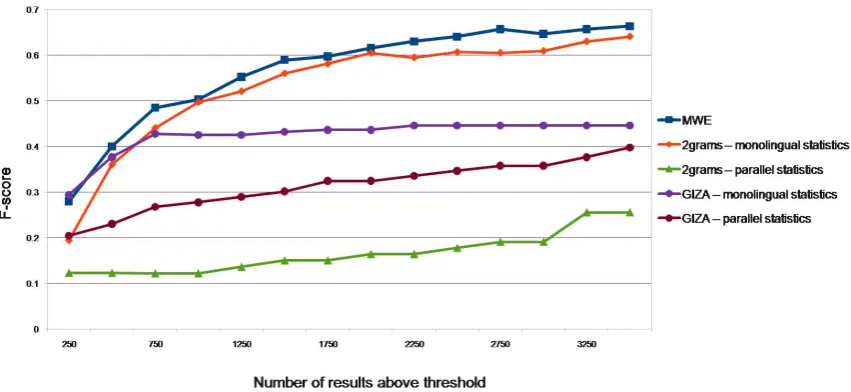
On this corpus, we compare the performance of our algorithm to four baselines: using only PMI to rank the bi-grams in the parallel cor-pus; using PMI computed from the monolingual corpus to rank the bi-grams in the parallel cor-pus; and using Giza++ 1:n alignments, ranked
by their PMI (with bi-grams statistics computed once from parallel and once from monolingual corpora). ‘MWE’ refers to our algorithm. For each of the above methods, we set the threshold at various points, and count the number of true MWEs above the threshold (true positives) and the number of non-MWEs above the threshold (false positives), as well as the number of MWEs and non-MWEs below the threshold (false positives and true negatives, respectively). From these four figures we compute precision, recall and their har-monic mean,f-score, which we plot against (the
number of results above) the threshold in Figure 2. Clearly, the performance of our algorithm is con-sistently above the baselines.
Second, we evaluate the algorithm on addi-tional datasets. We compiled three small corpora of Hebrew two-word MWEs. The first corpus,
PN, contains 785 person names (names of Knesset members and journalists), of which 157 occur in the parallel corpus. The second,Phrases, consists of 571 entries beginning with the letterx from a dictionary of Hebrew phrases (Rosenthal, 2009), and a set of 331 idioms we collected from internet resources. Of those, 154 occur in the corpus. The third set,NN, consists of the positive examples in the annotated corpus of noun-noun constructions described above.
Figure 2: Evaluation results compared with baselines: noun-noun compounds
Method PN Phrases NN
# % # % # %
UB 74 100 40 100 89 100 MWE 66 89.2 35 87.5 67 75.3 Giza 7 9.5 33 82.5 37 41.6
Table 2: Recall evaluation
5 Extraction of MWE translations
An obvious benefit of using parallel corpora for MWE extraction is that the translations of ex-tracted MWEs are available in the corpus. We use a na¨ıve approach to identify these translations. For each MWE in the source-language sentence, we consider as translation all the words in the target-language sentence (in their original order) that are aligned to the word constituents of the MWE, as long as they form a contiguous string. Since the quality of word alignment, especially in the case of MWEs, is rather low, we remove “trans-lations” that are longer than four words (these are most often wrong). We then associate each ex-tracted MWE in Hebrew with all its possible En-glish translations.
The result is a bilingual dictionary contain-ing 2,955 MWE translation pairs, and also 355 translation pairs produced by taking high-quality 1:1 word alignments (Section 3.4). We used
the extracted MWE bilingual dictionary to aug-ment the existing (78,313-entry) dictionary of a transfer-based Hebrew-to-English statistical ma-chine translation system (Lavie et al., 2004b). We report in Table 3 the results of evaluating the per-formance of the MT system with its original dic-tionary and with the augmented dicdic-tionary. The results show a statistically-significant (p < 0.1) improvement in terms of both BLEU (Papineni et al., 2002) and Meteor (Lavie et al., 2004a) scores.
Dictionary BLEU Meteor Original 13.69 33.38 Augmented 13.79 33.99
Table 3: External evaluation
6 Conclusion
We described a methodology for extracting multi-word expressions from parallel corpora. The al-gorithm we propose capitalizes on semantic cues provided by ignoring 1:1 word alignments, and viewing all other material in the parallel sentence as potential MWE. It also emphasizes the impor-tance of properly handling the morphology and orthography of the languages involved, reducing wherever possible the differences between them in order to improve the quality of the alignment. We use statistics computed from a large mono-lingual corpus to rank and filter the results. We used the algorithm to extract MWEs from a small Hebrew-English corpus, demonstrating the ability of the methodology to accurately extract MWEs of various lengths and syntactic patterns. We also demonstrated that the extracted MWE bilingual dictionary can improve the quality of MT.
This work can be extended in various ways. While several works address the choice of asso-ciation measure for MWE identification and for distinguishing between MWEs and other frequent collocations, it is not clear which measure would perform best in our unique scenario, where candi-dates are produced by word (mis)alignment. We intend to explore some of the measures discussed by Pecina (2008) in this context. The algorithm used for extracting the translations of candidate MWEs is obviously na¨ıve, and we intend to ex-plore more sophisticated algorithms for improved performance. Also, as our methodology is com-pletely language-symmetric, it can be used to pro-duce MWE candidates in English. In fact, we al-ready have such a list of candidates, whose qual-ity we will evaluate in the future. Finally, as our main motivation is high-precision, high-recall ex-traction of Hebrew MWEs, we develop other, non-alignment-based approaches to the task (Al-Haj and Wintner, 2010), and would like to explore the utility of combining different approaches to the same task under a unified framework. We are ac-tively pursuing these research directions.
Acknowledgments
This research was supported by THE ISRAEL SCIENCE FOUNDATION (grants No. 137/06,
1269/07). We are grateful to Hassan Al-Haj for providing the noun compound annotated corpus and to Gennadi Lembersky for his help with the machine translation system.
References
Al-Haj, Hassan and Shuly Wintner. 2010. Identify-ing multi-word expressions by leveragIdentify-ing morpho-logical and syntactic idiosyncrasy. InProceedings of the 23rd International Conference on Computa-tional Linguistics (COLING 2010), August.
Baldwin, Timothy, Colin Bannard, Takaaki Tanaka, and Dominic Widdows. 2003. An empirical model of multiword expression decomposability. In Pro-ceedings of the ACL 2003 workshop on Multiword expressions, pages 89–96. Association for Compu-tational Linguistics.
Bannard, Colin, Timothy Baldwin, and Alex Las-carides. 2003. A statistical approach to the seman-tics of verb-particles. In Francis Bond, Anna Ko-rhonen, Diana McCarthy and Aline Villavicencio, editors,Proceedings of the ACL 2003 Workshop on Multiword Expressions: Analysis, Acquisition and Treatment, pages 65–72.
Bar-Haim, Roy, Khalil Sima’an, and Yoad Winter. 2005. Choosing an optimal architecture for segmen-tation and POS-tagging of Modern Hebrew. In Pro-ceedings of the ACL Workshop on Computational Approaches to Semitic Languages, pages 39–46, Ann Arbor, Michigan, June. Association for Com-putational Linguistics.
Bird, Steven, Ewan Klein, and Edward Loper. 2009. Natural Language Processing with Python. O’Reilly Media, Sebastopol, CA.
Brants, Thorsten and Alex Franz. 2006. Web 1T 5-gram version 1.1. LDC Catalog No. LDC2006T13.
Caseli, Helena, Aline Villavicencio, Andr´e Machado, and Maria Jos´e Finatto. 2009. Statistically-driven alignment-based multiword expression identifica-tion for technical domains. InProceedings of the Workshop on Multiword Expressions: Identifica-tion, InterpretaIdentifica-tion, Disambiguation and Applica-tions, pages 1–8, Singapore, August. Association for Computational Linguistics.
Church, Kenneth. W. and Patrick Hanks. 1989. Word association norms, mutual information and lexicog-raphy (rev). Computational Linguistics, 19(1):22– 29.
Daille, B´eatrice. 1994. Approche mixte pour l’extraction automatique de terminologie : statis-tiques lexicales et filtres linguisstatis-tiques. Ph.D. thesis, Universit´e Paris 7.
Dejean, Herve, Eric Gaussier, Cyril Goutte, and Kenji Yamada. 2003. Reducing parameter space for word alignment. InProceedings of the HLT-NAACL 2003 Workshop on Building and using parallel texts, pages 23–26, Morristown, NJ, USA. Association for Computational Linguistics.
Itai, Alon and Shuly Wintner. 2008. Language re-sources for Hebrew. Language Resources and Eval-uation, 42:75–98, March.
Katz, Graham and Eugenie Giesbrecht. 2006. Au-tomatic identification of non-compositional multi-word expressions using latent semantic analysis. In
Proceedings of the Workshop on Multiword Expres-sions: Identifying and Exploiting Underlying Prop-erties, pages 12–19, Sydney, Australia, July. Asso-ciation for Computational Linguistics.
Kirschenbaum, Amit and Shuly Wintner. 2010. A general method for creating a bilingual translitera-tion dictranslitera-tionary. In Proceedings of The seventh in-ternational conference on Language Resources and Evaluation (LREC-2010), May.
Koehn, Philipp. 2005. Europarl: A parallel corpus for statistical machine translation. InProceedings of the MT Summit X, Phuket, Thailand.
Lavie, Alon, Kenji Sagae, and Shyamsundar Jayara-man. 2004a. The significance of recall in automatic metrics for mt evaluation. In Frederking, Robert E. and Kathryn Taylor, editors,AMTA, volume 3265 of
Lecture Notes in Computer Science, pages 134–143. Springer.
Lavie, Alon, Shuly Wintner, Yaniv Eytani, Erik Peter-son, and Katharina Probst. 2004b. Rapid prototyp-ing of a transfer-based Hebrew-to-English machine translation system. In Proceedings of TMI-2004: The 10th International Conference on Theoretical and Methodological Issues in Machine Translation, Baltimore, MD, October.
Och, Franz Josef and Hermann Ney. 2003. A sys-tematic comparison of various statistical alignment models. Computational Linguistics, 29(1):19–51.
Papineni, Kishore, Salim Roukos, Todd Ward, and Wei-Jing Zhu. 2002. BLEU: a method for auto-matic evaluation of machine translation. In ACL
’02: Proceedings of the 40th Annual Meeting on Association for Computational Linguistics, pages 311–318, Morristown, NJ, USA. Association for Computational Linguistics.
Pecina, Pavel. 2008. A machine learning approach to multiword expression extraction. InProceedings of the LREC Workshop Towards a Shared Task for Multiword Expressions.
Piao, Scott Songlin, Paul Rayson, Dawn Archer, and Tony McEnery. 2005. Comparing and combining a semantic tagger and a statistical tool for mwe extrac-tion. Computer Speech and Language, 19(4):378– 397.
Rosenthal, Ruvik. 2009. Milon HaTserufim (Dic-tionary of Hebrew Idioms and Phrases). Keter, Jerusalem. In Hebrew.
Tsvetkov, Yulia and Shuly Wintner. 2010. Automatic acquisition of parallel corpora from websites with dynamic content. InProceedings of The seventh in-ternational conference on Language Resources and Evaluation (LREC-2010), May.
Van de Cruys, Tim and Bego˜na Villada Moir´on. 2007. Semantics-based multiword expression extraction. In Proceedings of the Workshop on A Broader Perspective on Multiword Expressions, pages 25– 32, Prague, Czech Republic, June. Association for Computational Linguistics.
Varga, D´aniel, P´eter Hal´acsy, Andr´as Kornai, Viktor Nagy, L´aszl´o N´emeth, and Viktor Tr´on. 2005. Par-allel corpora for medium density languages. In Pro-ceedings of RANLP’2005, pages 590–596.
Villada Moir´on, Bego˜na and J¨org Tiedemann. 2006. Identifying idiomatic expressions using automatic word alignment. InProceedings of the EACL 2006 Workshop on Multi-word-expressions in a multilin-gual context. Association for Computational Lin-guistics.
Villavicencio, Aline, Valia Kordoni, Yi Zhang, Marco Idiart, and Carlos Ramisch. 2007. Validation and evaluation of automatically acquired multiword ex-pressions for grammar engineering. In Proceed-ings of the 2007 Joint Conference on Empirical Methods in Natural Language Processing and Com-putational Natural Language Learning (EMNLP-CoNLL), pages 1034–1043.