Exploring Fine-grained Entity Type Constraints for Distantly Supervised
Relation Extraction
Yang Liu Kang Liu Liheng Xu Jun Zhao
National Laboratory of Pattern Recognition Institute of Automation, Chinese Academy of Sciences
Zhongguancun East Road #95, Beijing 100190, China {yang.liu, kliu, lhxu, jzhao}@nlpr.ia.ac.cn
Abstract
Distantly supervised relation extraction, which can automatically generate training data by align-ing facts in the existalign-ing knowledge bases to text, has gained much attention. Previous work used conjunction features with coarse entity types consisting of only four types to train their model-s. Entity types are important indicators for a specific relation, for example, if the types of two entities are “PERSON” and “FILM” respectively, then there is more likely a “DirectorOf” rela-tion between the two entities. However, the coarse entity types are not sufficient to capture the constraints of a relation between entities. In this paper, we propose a novel method to explore fine-grained entity type constraints, and we study a series of methods to integrate the constraints with the relation extracting model. Experimental results show that our methods achieve bet-ter precision/recall curves in sentential extraction with smoother curves in aggregated extraction which mean more stable models.
1 Introduction
Relation Extraction is the task of extracting semantic relations between a pair of entities from sentences containing them. It can potentially benefit many applications, such as knowledge base construction, question answering (Ravichandran and Hovy, 2002), textual entailment (Szpektor et al., 2005), etc. Tra-ditional supervised approaches for relation extraction (Zhou et al., 2005)(Zhou et al., 2007) need to manually label training data, which is expensive and limits the ability to scale up. Due to the shortcom-ing of supervised approaches mentioned above, recently, a more promisshortcom-ing approach named distantly supervised relation extraction (or distant supervision for relation extraction) (Mintz et al., 2009) has be-come popular. Instead of manual labeling, it automatically generates training data by aligning facts in existing knowledge bases to text.
However, the paradigm of distant supervision also causes new problems of noisy training data both in positive training instances and negative training instances. To overcome the false positive problem caused by the distant supervision assumption, researches in (Riedel et al., 2010)(Hoffmann et al., 2011)(Sur-deanu et al., 2012) proposed multi-instance models to model noisy positive training data, where they assumed that at least one sentence in those containing an entity pair is truly positive. Takamatsu et al. (Takamatsu et al., 2012) claimed that the at-least-one assumption in multi-instance models would fail when there was only one sentence containing both entities. They proposed a method to learn and filter noisy pattern features from training instances to overcome the false positive problem. Researchers (Xu et al., 2013)(Zhang et al., 2013)(Ritter and Etzioni, 2013) tried to address the problem of false negative training data caused by the incomplete knowledge base. Xu el al. (Xu et al., 2013) used the pseudo-relevance feedback method trying to find out the false negative instances and add them into positive training instances. Zhang et al. (Zhang et al., 2013) employed some rules to select negative training in-stances carefully, hoping not to include the false negative inin-stances. And Ritter et al. (Ritter and Etzioni, 2013) used hidden variables to model the missing data in databases based on a graphical model. The training data generation process for all the above work is under the framework of (Mintz et al., 2009), This work is licenced under a Creative Commons Attribution 4.0 International License. Page numbers and proceedings footer are added by the organizers. License details:http://creativecommons.org/licenses/by/4.0/
one important step of which is to recognize entity mentions from text and assign them entity types which are used to compose features for training the model. The entity types they used are very coarse only con-sisting of four categories (PERSON, ORGANIZATION, LOCATION, NONE). We argue that the coarse entity types are not sufficient to indicate relations.
A specific relation constrains the entity types of its two entities. For instance, theSingerOf relation limits the entity type of its first entity as PERSON or more fine-grained ARTIST, and the entity type of its second entity as ART or more fine-grained MUSIC. Therefore, when extracting a relation instance, the entity types of its two entities are important indicators for a specific relation. Previous work used conjunction features (Details in Section 3.3) by combining the coarse entity types of entity mentions with its contextual lexical and syntactic features. However, the conjunction features may fail to dis-tinguish the relations. For example, the following two sentences contain two relation instances, one is
DirectorOf(Ang Lee, Life of Pi), and the other isAuthorOf(George R.R. Martin, A Song of Ice and Fire). 1. Ang Lee’sLife of Pisurprised many by scoring a leading four Oscars on Sunday night...
2. Westeros is the premiere fansite forGeorge R.R. Martin’sA Song of Ice and Fire.
Only using the above conjunction features, we cannot tell the difference between the two entity pairs, and are probable to incorrectly classify them as the same relation. By contrast, if we can assign each entity with fine-grained entity types, for example,Ang Leeas the entity type ARTIST andGeorge R.R. Martinas AUTHOR, we may succeed in classifying the two entity pairs correctly.
To achieve the goal mentioned above, there are mainly three challenges: (1) how to define the fine-grained type set; (2) how to assign the types to entity mentions; (3) how to integrate the fine-fine-grained entity type constraints with the relation extracting model. To address these challenges, in this paper, we propose a novel approach to explore the fine-grained entity type constraints for distantly supervised relation extraction. First, we use the types defined in (Ling and Weld, 2012) stemmed from Freebase1
as the fine-grained entity type set (introduced in Section 3.1). Second, we leverage Web knowledge to train a fine-grained entity type classifier and predict entity types for each entity mention. Third, we study several methods to integrate the type constraints with an existing systemMULTIR, a multi-instance multi-label model in (Hoffmann et al., 2011), to train the extractor.
In summary, the contribution of this paper can be concluded as follows.
(a) We explore the effect of fine-grained entity type constraints on distantly supervised relation extrac-tion. A novel method is proposed to leverage Web knowledge to automatically train a fine-grained entity type classifier, which is used to predict the fine-grained types of each entity mention.
(b) We study a series of methods for integrating the fine-grained entity type constraints with the extract-ing model and compare their performance with different parameter settextract-ings.
(c) We conduct experiments to demonstrate the effects of the newly exploited fine-grained entity type constraints. It shows that our method achieves a much better precision/recall curves over the base-line system in sentential extraction, and improves the performance with a smoother precision/recall curve in aggregated extraction, which means a more stable model.
2 Distant Supervision for Relation Extraction
We define a relation instance (or a fact), which means a binary relation, asr(e1, e2).ris the relation, and
e1ande2mean the two entities in the relation instance, for example,BornIn(Y ao Ming, Shanghai).
Distant supervision supplies a method to automatically generate training data. In this part, we will introduce the general steps in distant supervision for relation extraction. First, we define the notations we use. Σdenotes sentences comprising the corpus,E denotes entity mentions in the corpus which are consecutive words with the same named entity tags assigned by an NER system,∆denotes the facts (or relation instances) in the existing knowledge base.Rdenotes the relations in∆.
Figure 1: Fine-grained entity type set.
Figure 2: Framework of fine-grained entity type classifier.
To generate training data, we align pairs of entity mentions in the same sentence with∆. The aligned entity mentionsEtrain and their sentencesΣtrain along withRtrain are used as training data. Features are extracted from them to train the relation extracting model.
To predict the unknown data for extracting new relation instances, we input pairs of entity mentions Epredictand the sentences containing themΣpreidctinto the trained extracting model for extracting new relation instances.
3 Fine-grained Entity Type Constraints
Entity mentions in sentences are considered consecutive words with the same entity types (Section 2). The entity types are part of the lexical and syntactic features(Mintz et al., 2009), and the feature setting is followed by other related work. Their entity types are assigned by an NER system and consist of four categories (PERSON, ORGANIZATION, LOCATION, NONE). The types of entity mentions in a relation are important indicators for the very type of relation. However, the coarse (only four types) entity types may not capture sufficient constraints to distinguish a relation. In this section, we explore fine-grained entity type constraints and study different methods to integrate them with the extracting model.
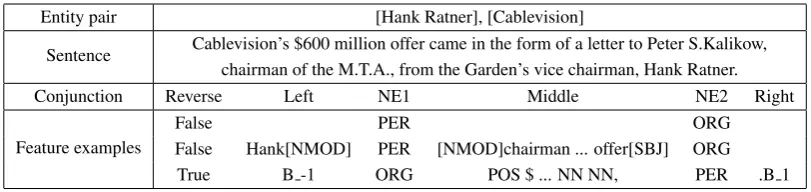
[image:3.595.121.480.301.418.2]Entity pair [Hank Ratner], [Cablevision]
Sentence Cablevision’s $600 million offer came in the form of a letter to Peter S.Kalikow, chairman of the M.T.A., from the Garden’s vice chairman, Hank Ratner.
Conjunction Reverse Left NE1 Middle NE2 Right
Feature examples
False PER ORG
False Hank[NMOD] PER [NMOD]chairman ... offer[SBJ] ORG
[image:4.595.96.502.61.157.2]True B -1 ORG POS $ ... NN NN, PER .B 1
Table 1: Examples of conjunction features.
3.1 Fine-grained Entity Types
Figure 1 is the type set we use. It was introduced in (Ling and Weld, 2012) and was derived from Freebase types. The bold types in each small box of Figure 1 are upper-class types for others in that small box. For example,/actoris a lower-class type of/personwhich is denoted as/person/actor. And/personand/person/actorcoexist in the type set.
3.2 Fine-grained Entity Type Classifier
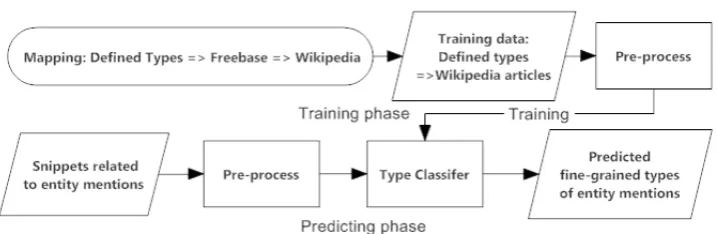
In this section, we describe our method that leverages Web knowledge to train a fine-grained entity type classifier and predict entity types of each entity mention. Its architecture is shown in Figure 2.
3.2.1 Training
The training data are obtained from Wikipedia. Because the defined fine-grained types are tailored based on Freebase types, we can find the mappings between the two type sets, for example,/person/doctor maps to two Freebase types /medicine/physician and/medicine/surgeon. And Freebase WEX2
supplies a mapping between Freebase types to Wikipedia articles. As a result, we can map Wikipedia articles to defined fine-grained types.
Based on the mappings, we obtain Wikipedia articles for each type as training data and negative training examples are sampled from articles not contained in the mappings. We preprocess the articles by: stop words filtering, stemming, and term frequency filtering and use a maxent model to train the classifier.
3.2.2 Predicting
To predict types of each entity mention, we first use search engines to expand entity mentions. Specif-ically, each entity mention is used as a query sent to the search engine3. Titles and descriptions of top
k returned snippets are selected (We keep the top 20 in the experiments). The obtained text are pre-processed with the same method as training examples. Then we use the trained fine-grained entity type classifier to predict the types of each entity mention.
After predicting, we obtain a ranked list of types for each entity mention, which are ranked by the predicting scores.
3.3 Integrating Fine-grained Entity Type Constraints into the Extracting Model
This section introduces our methods to integrate the fine-grained entity type constraints with the ex-tracting model. First of all, we briefly review the features used in previous models which derived from (Mintz et al., 2009) and (Riedel et al., 2010). Their features mainly comprise two types: lexical features (POS tags, words and entity types) and syntactic features (dependency parsing tags, words and entity types). Each feature is a conjunction with several parts: entity types of two entity mentions, the left context window of the first entity mention, the right context window of the second entity mention and the part between them (the window contains none or one or two words ). Table 1 shows an example of the conjunction features.
2http://wiki.freebase.com/wiki/WEX
To integrate the exploited fine-grained entity type constraints with the extracting model, we proposed three methods (substitution, augment and selection) to make the type constraints take effects.
3.3.1 Substitution Method
In this method, we substitute coarse entity types of the features with the entity mentions’ fine-grained types, and use the new features to train the model. Instead of substituting directly, an entity mention is first represented by its fine-grained types and the upper-class of the fine-grained type, for example, /person/politicianderives two types/personand/person/politicianitself. The reason is that the extracting model can benefit from the related types like the upper-class types. And then we use the obtained entity types to substitute the old coarse entity types as new features greedily, which mean-s that all the pomean-smean-sible combinationmean-s of typemean-s between the entity pair are conmean-sidered. For example, “Barack Obama” has the fine-grained type /person/politician and his birth place “Hawaii” has the type/location/island, then there are 4 combinations between the two entities, they are (/person, /location), (/person,/location/island), (/person/politician,/location) and (/person/politician, /location).
3.3.2 Augment Method
In this method, we generate new features by substituting the coarse entity types with predicted fine-grained types, and expand the old features with new features. Different from the substitution method, we do not add the upper-class types, for that we think the coarse types in old features have the same effect. In this method, we use the fine-grained constraints as a complementary.
3.3.3 Selection Method
The selection method is similar to the augment method. The difference is that we do not expand all old features with new features. We select some of them to expand. The reason is that some of the conjunction features are of high-precision themselves, it can clearly indicate the relations with its left, middle and right parts, even without the entity types (informative ones). If we expand these features, it may cause more noisy features. So we expect to only expand the ones that lack of the indicating abilities (non-informative ones). In this paper, we employ a simple method to distinguish between the informative ones and non-informative ones by the length of the features, which means that the longer is more informative than the shorter. In our experiments, the length threshold is set as 20.
In the predicting phase (Section 3.2), we obtain a ranked type list for each entity mention. The top list types are considered in our methods. Experiments in Section 4.3 are conducted on topk{k ∈ 1,2,3}
type/types in the obtained ranked list. And they are combined with a greedy method similar to that in the substitution method explained above.
4 Experiments
4.1 Settings
We use the same data sets as (Riedel et al., 2010) and (Hoffmann et al., 2011), where NYTimes sentences in the years 2005-2006 are used as training corpusΣtrainfor distant supervision and sentences in 2007 are used as testing corpusΣpredict. The data was first tagged with an NER system (Finkel et al., 2005) and consecutive words with the same tag are extracted as entity mentions. And then, entity mentions Etrainin training corpus are aligned to facts∆in Freebase as training examples to train the models.
We integrate our fine-grained entity type constraint with MULTIR, an existing instance multi-label extracting model in (Hoffmann et al., 2011). Following their setttings, we conduct experiments on aggregated extraction and sentential extraction to show the effect of fine-grained entity type constraints.
• Aggregated extraction: Aggregated extraction is corpus-level extraction. When given an entity
(a) PR curves of the substitution method (b) PR curves of the augment method
[image:6.595.73.530.62.351.2](c) PR curves of the selection method (d) Comparison with other methods
Figure 3: Precision-recall (PR) curves of the aggregated extraction.
• Sentential extraction: Sentential extraction predicts an entity pair only based on a specified
sen-tence containing the pair of entities. We use manually labeled data in (Hoffmann et al., 2011) as benchmark. The data consist of 1,000 sentences and are sampled from the results their system out-puts and sentences aligned with facts in Freebase. As they stated in their paper, these results provide a good approximation to the true precision but can overestimate the actual recall.
4.2 Experimental Results
In aggregated extraction, we first evaluate the three type-constraint integration methods (substitution, augment and selection) with the topk{k∈1,2,3}type/types (Section 3.3). And then, we compare the best parameter setting methods with previous work. In sentential extraction, we compare methods tuned in aggregated extraction withMULT IR.
4.2.1 Aggregated Extraction
Figure 3 shows the precision-recall (PR) curves of the aggregated extraction. In it, Sub topk {k ∈ 1,2,3} means using the substitution method (Section 3.3) with top k fine-grained entities types re-turned by the type classifier in Section 3.2. Correspondingly, Aug topk is for the augment method andSelect topkis for the selection method.
Figure 3(a) shows thatSub top3outperforms the other two settings ofkin the substitution method, it seems that more fine-grained types produce better curves. In Figure 3(b), Aug top1andAug top2
achieve similar performances. However, when adding one more type with k = 3, we obtain a lower curve, which contradicts the trend showed in the curves of the substitution method (Figure 3(a)). Fig-ure 3(c) shows the PR curves of three selection methods,Select top1has a better performance at the beginning. ThenSelect top2exceeds it a bit consistently.
Figure 4: Comparison with MULTIR
recall at the highest recall point. Comparing to other methods, the PR curve ofAug top1reaches a higher recall with 29.3% at the highest recall point thanMULTIR(24.5%). Select top2achieves 29.3% at the highest recall point, best among all methods. And by integrating the fine-grained entity type constraints, they improve the PR curve ofMULTIRwith a more smoother curve without most of the depressions seen inMULTIR. As stated in (Hoffmann et al., 2011), the smoother curve indicated a more stable model.
4.2.2 Sentential Extraction
Figure 4 shows the precision-recall (PR) curves of the sentential extraction. In the evaluation, we com-pare the three best integration methods tuned in aggregated extraction with originalMULTIR. Among our three method,Aug top1outperforms in precision and achieves a better curve in general among the three methods, however,Select top2gains a better recall at the end. Sub top3has the worst recall. In gen-eral, our methods have much better precisions thanMULTIR.Aug top1andSelect top2achieve better curves thanMULTIR. Since the evaluation of sentential extraction is a good approximation of precision, it implies that the proposed methods are effective.
4.2.3 Analysis
On one hand, among the three proposed integration methods, generally, the augment method and selec-tion method get better performance. The reason is that substituselec-tion method uses predicted fine-grained entity types to replace the old coarse features in the conjunction features completely, and the conjunction features are sensitive to entity types for different entity types indicate different conjunction features, as a result, if we can not promise a good accuracy in the type classification which is hard to achieve in classifying hundreds of fine-grained types, the performance will be badly influenced. Different from the substitution method, augment method and selection method keep the old features with coarse features, they use the features with fine-grained entity type constraints as extra information to help the extraction and achieve better results.
On the other hand, comparing to other methods, by integration the exploited fine-grained entity type constraints, our methods achieve improvements in both aggregated and sentential extraction. It proves that the fine-grained entity type constraints we exploit are effective, and our proposed integration meth-ods succeed in integrating the constraints into the extracting model. Our augment method outperforms
k=1 k=2 k=3 Recall@k 0.596 0.740 0.806
Table 2: Evaluation of the fine-grained type classifier.
extraction. In aggregated extraction, it also achieves a smoother curve and an impressive promotion at the highest recall point. Since the evaluation of aggregated extraction only considers the facts existing in Freebase which may incorrectly label the right extracting results and underestimate the true precision, and based on its better performance of precision in sentential extraction, we consider it is a more promis-ing method. This paper only employs very naive method to select the non-informative features by its length (Section 3.3.3), a more effective selecting method may lead further improvements.
4.3 Performance of Entity Type Classifier
We evaluate the performance of the fine-grained entity type classifier (Section 3.2). In section 3.2, we sample the training examples from a collection of Wikipeida articles mapped with the fine-grained types. To generate test entity mentions, we first remove the sampled training articles from the collection, and then sample the articles from it, where the titles of sampled articles are used as the test entity mentions (we sample 12,000 test entity mentions) and their mapped fine-grained types are used as benchmark. After that, the predicting method in Section 3.2.2 is used to expand mentions and predict the types of each test entity mention. After predicting, we obtain a ranked list of types for each test entity mention.
To evaluate, we define a notation of Hit@k, which equals 1 if the true type of an entity mention is hit in the top k predicted types, otherwise equals 0. And then we evaluate it by theRecall@kdefined bellow.
Recall@k= Σ12000i=1 Hit@ki
12000 (1)
In equation (1), imeans theith test entity mention. Table 2 shows the results for the top 3 predicted types.
5 Related Work
Distant supervision (also known as weak supervision or self supervision) is used to a broad class of meth-ods in information extraction which aims to automatically generate labeled data by aligning with data in knowledge bases. It is introduced by Craven and Kumlien (Craven et al., 1999) who used the Yeast Protein Database to generate labeled data and trained a naive-Bayes extractor. Bellare and McCallum (Bellare and McCallum, 2007) used BibTex records as the source of distant supervision. The KYLIN system in (Wu and Weld, 2007) used article titles and infoboxes of Wikipedia to label sentences and trained a CRF extractor aiming to generate infoboxes automatically. The Open IE systems TEXTRUN-NER (Yates et al., 2007) and WOE (Wu and Weld, 2010) trained their extractors with the automatic labeled data from Penn Treebank and Wikipedia infoboxes respectively.
Besides the problem of false positive training examples caused by distant supervision. There were a bunch of researches trying to solve the problem of false negative training examples caused by incomplete knowledge bases. Zhang (Zhang et al., 2013) made heuristic rules to filter the false negative training examples. And Xu (Xu et al., 2013) tried to overcom this problem by pseudo-relevance feedback. Min (Min et al., 2013) improved MIML in (Surdeanu et al., 2012) by adding a new layer in their 3-layer graphic model to model the incomplete knowledge base. Ritter (Ritter and Etzioni, 2013) employed similar intuition with (Xu et al., 2013) that they thought rear entities missing in the database would be often mentioned in the text. They proposed a latent-variable approach to model it and showed its improvement over aggregate and sentential extraction.
6 Conclusion
In this paper, we propose a novel approach to explore the fine-grained entity type constraints for distantly supervised relation extraction. We leverage Web knowledge to automatically train a fine-grained entity type classifier and predict entity types of each entity mention. And we study a series of methods to inte-grate the type constraints with a relation extraction model. At last, thorough experiments are conducted. The experimental results imply our methods are effective with better precision/recall curves in senten-tial extraction and smoother precision/recall curves in aggregated extraction, which indicate more stable models.
In the future we hope to explore more details of integration methods that integrates fine-grained entity type constraints with relation extraction models, especially the selection integration method. We consider that a more effective method to distinguish between the informative and non-informative features will lead more improvements.
Acknowledgements
This work was sponsored by the National Basic Research Program of China (No. 2014CB340503) and the National Natural Science Foundation of China (No. 61202329). This work was supported in part by Noahs Ark Lab of Huawei Tech. Co. Ltd.
References
Kedar Bellare and Andrew McCallum. 2007. Learning extractors from unlabeled text using relevant databases. In
Sixth International Workshop on Information Integration on the Web.
Mark Craven, Johan Kumlien, et al. 1999. Constructing biological knowledge bases by extracting information from text sources. InProceedings of the Seventh International Conference on Intelligent Systems for Molecular
Biology, pages 77–86. Heidelberg, Germany.
Jenny Rose Finkel, Trond Grenager, and Christopher Manning. 2005. Incorporating non-local information into information extraction systems by gibbs sampling. InProceedings of the 43rd Annual Meeting on Association
for Computational Linguistics, pages 363–370. Association for Computational Linguistics.
Raphael Hoffmann, Congle Zhang, Xiao Ling, Luke Zettlemoyer, and Daniel S Weld. 2011. Knowledge-based weak supervision for information extraction of overlapping relations. InProceedings of the 49th Annual
Meet-ing of the Association for Computational LMeet-inguistics: Human Language Technologies, volume 1, pages 541–
550.
Xiao Ling and DS Weld. 2012. Fine-Grained Entity Recognition. InAAAI.
Bonan Min, Ralph Grishman, Li Wan, Chang Wang, and David Gondek. 2013. Distant supervision for relation extraction with an incomplete knowledge base. InProceedings of NAACL-HLT, pages 777–782.
Mike Mintz, Steven Bills, Rion Snow, and Dan Jurafsky. 2009. Distant supervision for relation extraction without labeled data. In Proceedings of the Joint Conference of the 47th Annual Meeting of the ACL and the 4th
International Joint Conference on Natural Language Processing of the AFNLP: Volume 2-Volume 2, pages
Deepak Ravichandran and Eduard Hovy. 2002. Learning surface text patterns for a question answering system. In
Proceedings of the 40th Annual Meeting on Association for Computational Linguistics, pages 41–47.
Associa-tion for ComputaAssocia-tional Linguistics.
Sebastian Riedel, Limin Yao, and Andrew McCallum. 2010. Modeling relations and their mentions without labeled text. InMachine Learning and Knowledge Discovery in Databases, pages 148–163. Springer.
Alan Ritter and Oren Etzioni. 2013. Modeling Missing Data in Distant Supervision for Information Extraction.
Transactions of the Association for Computational Linguistics, 1:367–378.
Mihai Surdeanu, Julie Tibshirani, Ramesh Nallapati, and Christopher D Manning. 2012. Multi-instance multi-label learning for relation extraction. InProceedings of the 2012 Joint Conference on Empirical Methods in
Natural Language Processing and Computational Natural Language Learning, pages 455–465. Association for
Computational Linguistics.
Idan Szpektor, Hristo Tanev, Ido Dagan, Bonaventura Coppola, et al. 2005. Scaling Web-based aquisition of
entailment relations. Ph.D. thesis, Tel Aviv University.
Shingo Takamatsu, Issei Sato, and Hiroshi Nakagawa. 2012. Reducing wrong labels in distant supervision for relation extraction. InProceedings of the 50th Annual Meeting of the Association for Computational Linguistics:
Long Papers-Volume 1, pages 721–729. Association for Computational Linguistics.
Fei Wu and Daniel S Weld. 2007. Autonomously semantifying wikipedia. InProceedings of the sixteenth ACM
conference on Conference on information and knowledge management, pages 41–50. ACM.
Fei Wu and Daniel S Weld. 2010. Open information extraction using wikipedia. InProceedings of the 48th
An-nual Meeting of the Association for Computational Linguistics, pages 118–127. Association for Computational
Linguistics.
W Xu, RH Le Zhao, and R Grishman. 2013. Filling Knowledge Base Gaps for Distant Supervision of Relation Extraction. Proceedings of Association for Computational Linguistics.
Alexander Yates, Michael Cafarella, Michele Banko, Oren Etzioni, Matthew Broadhead, and Stephen Soderland. 2007. Textrunner: open information extraction on the web. InProceedings of Human Language Technolo-gies: The Annual Conference of the North American Chapter of the Association for Computational Linguistics:
Demonstrations, pages 25–26. Association for Computational Linguistics.
Xingxing Zhang, jianwen Zhang, Junyu Zeng, Jun Yan, Zheng Chen, and Zuifang Sui. 2013. Towards Accurate Distant Supervision for Relational Facts Extraction. InProceedings of Association for Computational
Linguis-tics.
GuoDong Zhou, Jian Su, Jie Zhang, and Min Zhang. 2005. Exploring various knowledge in relation extraction.
In Proceedings of the 43rd Annual Meeting on Association for Computational Linguistics, pages 427–434.
Association for Computational Linguistics.
GuoDong Zhou, Min Zhang, Dong Hong Ji, and Qiaoming Zhu. 2007. Tree kernel-based relation extraction with context-sensitive structured parse tree information. InProceedings of the 2007 Joint Conference on Empirical