Resource Interoperability for Sustainable Benchmarking:
The Case of Events
Chantal van Son, Oana Inel, Roser Morante, Lora Aroyo, Piek Vossen
Vrije Universiteit AmsterdamDe Boelelaan 1105, 1081 HV Amsterdam, The Netherlands {c.m.van.son, oana.inel, r.morantevallejo, lora.aroyo, piek.vossen}@vu.nl
Abstract
With the continuous growth of benchmark corpora, which often annotate the same documents, there is a range of opportunities to compare and combine similar and complementary annotations. However, these opportunities are hampered by a wide range of problems that are related to the lack of resource interoperability. In this paper, we illustrate these problems by assessing aspects of interoperability at the document-level across a set of 20 corpora annotated with (aspects of) events. The issues range from applying different document naming conventions, to mismatches in textual content and structural/conceptual differences among annotation schemes. We provide insight into the exact document intersections between the corpora by mapping their document identifiers and perform an empirical analysis of event annotations showing their compatibility and consistency in and across the corpora. This way, we aim to make the community more aware of the challenges and opportunities and to inspire working collaboratively towards interoperable resources.
Keywords:resource interoperability, annotation consistency, events
1
Introduction
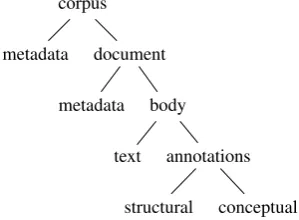
Language resources are at the core of most research in computational linguistics and natural language processing (NLP) for system development and benchmarking. There is already a wealth of resources available and the collec-tion is continuously expanding. With this growth, moni-toring their creation and making them interoperable is be-coming increasingly important for finding, accessing and reusing existing corpora. For example, different annotation layers applied to the same document provide valuable op-portunities for studying and leveraging interdependencies between different types of annotation, but these opportuni-ties are hampered when too laborious conversion steps are required to resolve structural or conceptual differences in their representations (Chiarcos, 2012a). Despite the efforts of many initiatives working towards solutions (Section 2), interoperability issues still persist today and become more and more problematic. On the one hand, this is because reaching consensus on standards and best practices is not a straightforward task and naturally takes time. On the other hand, we hypothesize that the problems that arise when in-teroperability is lacking have not been illustrated enough for the necessity of solutions to be widely recognized. Although there are various types of language resources, we limit our discussion to annotated text corpora for which we define interoperability at the levels presented in Figure 1. At the corpus-level, interoperability involves documenting and representing metadata of the data collection as a whole such as its name, language, type, genre, source, creator, year, size, etc., to enable resolving the identity of corpora in a uniform way. At the document-level, we can further distinguish between the metadata of the document (e.g. file-name, language, size) and its body, where the latter consists of a textual string and the linguistic annotations of its sub-strings (e.g. sentences, phrases, tokens). With respect to the annotations, we adopt the distinction between structural interoperability (annotations of different origin are
repre-sented using the same formalism) and conceptual interoper-ability (annotations of different origin are linked to a com-mon vocabulary) as defined by Chiarcos (2012a).
corpus
metadata document
metadata body
text annotations
[image:1.595.347.497.387.497.2]structural conceptual
Figure 1: Levels of interoperability
We present an analysis on the document-level interoperabil-ity across a set of 20 corpora that have been annotated with events, predicates or propositions. The NLP community defines these terms in various ways, often using each other in their definitions, as in: apropositionis formed by a
pred-icatewith its arguments;eventsare expressed bypredicates
describing situations that happen/occur (Saur´ı et al., 2006);
predicatescan be of “propositional” type (representing an
event, state, etc.) (Meyers, 2007). There is, however, little
agreement on the degree of meaning overlap and related-ness. For the sake of clarity, we will use in this article the
termeventto refer to all three of the overlapping and
inter-related notions. Many existing event corpora contain anno-tations of different aspects of events that are often applied to the same documents (Pustejovsky et al., 2005), providing an interesting use case for analysing interoperability. Fur-thermore, event annotations involve a wide range of prop-erties and phenomena which makes it ultimately rewarding to achieve interoperability and combine these annotations. The contributions of this paper are the following:
across event corporathat result from differences in doc-ument naming conventions, textual content and struc-tural/conceptual representations of annotations;
• a method for aligning diverse language resource cor-porato identify divergent and overlapping corpora; • an overview of document intersections across event
corporarevealing opportunities for comparing and com-bining different annotation layers;
• an empirical analysis of event annotation compatibil-ity and consistencyin and across corpora.
The remainder of this paper is structured as follows. Sec-tion 2 discusses existing initiatives for improving resource interoperability and related studies comparing annotation schemes across corpora. Section 3 provides an overview of the event corpora included in our study. Section 4 re-views metadata-level interoperability across these corpora and shows their overlap in documents, after which we focus on a subset: PropBank/NomBank (PB/NB), FactBank (FB) and TempEval-3 (TE3). We analyse their interoperability at the level of text in Section 5 and at the level of annotations in Section 6. Finally, Section 7 concludes with our lessons learned and proposes some best-practice guidelines.
2
Related Work
There is a range of initiatives collecting and indexing meta-data of language resources at the corpus-level to support researchers in finding the right one for their task or ap-plication. These include OLAC (Simons and Bird, 2003), Language Grid (Ishida, 2006), the LRE Map (Calzolari et al., 2012), the ELRA Universal Catalog,1 the LDC
Cata-log,2META-SHARE (Piperidis, 2012), CLARIN (Krauwer
and Hinrichs, 2014) and Linghub (McCrae and Cimiano, 2015). The last decades have also seen various meta-model proposals for representing annotations that facilitate structural interoperability, most of which are also translat-able to each other. These include GATE (Cunningham, 2002), UIMA (Ferrucci and Lally, 2004), LAF/GrAF (Ide and Romary, 2004; Ide and Suderman, 2007), NIF (Hell-mann et al., 2013), NAF/GAF (Fokkens et al., 2014) and PAULA/POWLA (Chiarcos and Erjavec, 2011; Chiarcos, 2012b). Repositories of linguistic annotation terminology, such as GOLD (Farrar and Langendoen, 2003), ISOcat (Windhouwer and Wright, 2012) and its successor CCR,3
make it possible to overcome the heterogeneity of annota-tion schemes by acting as an interlingua that allows map-ping annotations from one scheme to another, thus address-ing conceptual interoperability (Chiarcos, 2012a).
However, far from all corpora that we use today follow the principles mentioned above. This may be because they were created in a time where these standards simply did not yet exist. For more recently created corpora, however, there is presumably a plethora of reasons. We hypothesize that one of them is that whereas working groups such as the Open Linguistics Working Group (OWLG)4 actively
pro-mote resource interoperability, there seem to be few
exam-1http://universal.elra.info 2
https://catalog.ldc.upenn.edu
3
https://www.clarin.eu/ccr
4
https://linguistics.okfn.org
ples (that we know of) that actually clearly illustrate the ex-tent of the problems. Some studies indirectly discuss con-ceptual interoperability by comparing annotation schemes. For example, Aguilar et al. (2014) compare the Events, En-tities and Relations represented in ACE, ERE, TAC-KBP Slot-filling, and FrameNet. Werner et al. (2015) com-pare the factuality/committed belief annotations in Fact-Bank and the Language Understanding (LU) corpus. The differences between the representations of semantic propo-sitions in PropBank, VerbNet and FactBank have been ex-tensively described and even leveraged to build SemLink (Palmer et al., 2014). Close to our work is that of Puste-jovsky et al. (2005), who discuss the issues involved in creating a Unified Linguistic Annotation (ULA) by merg-ing the annotation schemes of PropBank, NomBank, Time-Bank, the Discourse Treebank and Coreference Annotation. However, their work remains on theoretical ground by lim-iting their discussion to overlapping and conflicting anno-tations in example sentences. Our approach is unique in the sense that we provide empirical evidence by discussing the overlap of the actual annotations for the complete resources when aligning them on the same texts, as well as more gen-eral distributional similarities and differences with respect to their linguistic types (part-of-speech (POS), lemma).
3
Overview of Event Corpora
For this study, we focus on 20 corpora that are connected to each other in terms of annotations and/or document bod-ies. More specifically, the corpora have been annotated with events or predicates, or they share pieces of texts and, therefore, contain at least some documents annotated with events.5 These corpora provide a range of opportunities to compare or merge annotations of events and their aspects. On the one hand, the definition of what constitutes an event varies across the corpora given the initial goal of the cor-pus. On the other hand, additional annotations capture vari-ous aspects of events, such as predicate-argument relations, semantic roles, event types, event coreference, event factu-ality, event time-stamping and event-event relations. In the following overview we present a general description of the corpora, which we group according to their annota-tion standards (these groupings, however, are not clear-cut).
3.1
PropBank, OntoNotes & Abstract Meaning
Representation (AMR)
PropBank (Palmer et al., 2004) has been one of the most influential corpora in NLP research. It provides semantic role annotations for all verbs in the 1M word Wall Street Journal (WSJ) section of thePenn Treebank
(Marcus et al., 1999). Its creation led to that of Nom-Bank (Meyers et al., 2008), which marks the sets of ar-guments that co-occur with nouns in the same set of doc-uments. Most of the annotations of Penn Treebank and PropBank are now, slightly adapted, available from their successorOntoNotes 5.0(Weischedel et al., 2013), which contains other annotation layers such as coreference and
5
named entities and also covers the Chinese and Spanish languages. Furthermore, it includes an additional 200K of broadcast news, 200K of broadcast conversation, 145K of P2.5 data and 200K of Web data taken from other sources. PropBank’s representation of semantic roles is also used in the Abstract Meaning Representation (AMR) cor-pus (Knight et al., 2014), which represents the semantics of English sentences as single rooted, directed graphs with the aim of abstracting away from syntactic idiosyncrasies. It uses a variety of sources for its data, including WSJ news.
3.2
Automatic Content Extraction (ACE) &
Entities, Relations and Events (ERE)
The key content extraction tasks of the Automatic Con-tent Extraction (ACE) program (Doddington et al., 2004; Strassel et al., 2008), which ran between 1999 and 2008, were defined as the automatic detection and characteriza-tion of real-world Entities, Relacharacteriza-tions, and Events. How-ever, the program mostly focused on entities and rela-tions between them. Event annotarela-tions are available only in theACE 2005 Multilingual Training Corpus(Walker et al., 2006), where annotators tagged the extent, trigger, polarity, tense, genericity, modality, participants and at-tributes for a constrained set of event (sub)types. This data has been reused in several other corpora, including OntoNotes andDatasets for Generic Relation Extraction (reACE) (Hachey et al., 2011) We also includedACE-2 version 1.0 (Mitchell et al., 2003), which originally does not contain event annotations, but a selection of its docu-ments was used in TimeBank, which does (Section 3.3). ACE was followed byLight ERE, which was designed as a lighter-weight version of ACE with the goal of making an-notation easier and more consistent. Modifications to ACE for Light ERE included a reduced inventory of entity and relation types, a slightly modified and reduced event ontol-ogy, and the addition of event coreference. In turn, Light ERE has transitioned to the more complexRich ERE, with the latter enabling a more comprehensive treatment of phe-nomena such as event coreference (Song et al., 2015).6
3.3
TimeML
TimeML (Pustejovsky et al., 2003a) is a specification lan-guage for events and temporal expressions, designed to cap-ture their attributes, to link them (event time-stamping) and to determine the temporal order between events. It has been applied in several corpora, including theAQUAINT TimeML Corpus(Brandeis University, 2008) and Time-Bank 1.2 (Pustejovsky et al., 2006). The documents in TimeBank come from PropBank and the ACE-2 corpus. In turn, data from TimeBank and AQUAINT TimeML was used to buildFactBank 1.0(Saur´ı and Pustejovsky, 2009), adding a representation of factuality interpretation to the event annotations, and the evaluation datasets of the Tem-pEval shared tasks, from which we selected the TempEval-3 dataset(UzZaman et al., 2013).
The TimeML specifications were followed to annotate events inEventCorefBank (ECB)(Bejan and Harabagiu,
6
At the moment, the ERE data is not yet publicly available, but the LDC kindly provided us with a list of training data filenames.
2010) which was built to encode event structures with re-lations like SUBEVENTor REASON, and intra- and
cross-document event coreference. ECB 1.0 consists of 482 doc-uments from Google News clustered into 43 topics. A first extension to ECB was released by Lee et al. (2012), who revised and completed the original annotations and added entity coreference relations following the OntoNotes anno-tation guidelines for coreference (Pradhan et al., 2007). We included a second extension called ECB+(Cybulska and Vossen, 2014), which contains another corpus consisting of 502 documents, completely (re)annotated according to new guidelines. The corpus is annotated with event classes (based on TimeML), locations and times (based on ACE and TimeML), and intra- and cross-document coreference.
3.4
Other Annotation Standards
The full-text annotations in FrameNet (ICSI Berkeley, 2017) capture the frame semantic structures as defined in its lexical database (Fillmore et al., 2003). The docu-ments come from different sources, including PropBank, the AQUAINT Program7 and theLexical Understanding
(LU) Annotation Corpus (Diab et al., 2009). The lat-ter contains annotations of dialog acts, event coreference, event relations and entity relations, but is best known for its annotations of committed belief, i.e. the strength of the author’s beliefs and the degree of commitment to their ut-terance (similar to FactBank).
The EventStatus Corpus(Huang et al., 2017) annotated approximately 3,000 English and 1,500 Spanish news arti-cles with temporal and aspectual properties of major soci-etal events, that is, whether an event has already happened, is currently happening or may happen in the future. Its English documents were sourced from English Gigaword Fifth Edition (Parker et al., 2011), which also served as a source for other resources such as the ACE corpora. Finally, in the Richer Event Description (RED) Cor-pus (O’Gorman and Palmer, 2016) a number of event-related annotation layers are integrated into a single representation of events and participants. It consists of 95 discussion fora and newswire documents annotated with entities, events, times, their coreference and partial coref-erence relations, and the temporal, causal and subevent relationships between the events. Its documentation mentions that this includes 55 documents annotated by a range of DEFT annotation formats, but it does not specify which ones.
From this overview, it is clear that the relations across the different corpora and their annotations are complex and not trivial, making it difficult to combine them. In the next sec-tions, we will discuss their interoperability in more detail.
4
Document Interoperability: Metadata
The first step towards analysing similar or merging comple-mentary annotation layers of different origin on the same pieces of text is to determine which documents are shared across the corpora of interest. Many corpora select all or a subset of their documents from existing corpora and pos-sibly add additional ones for annotation, which is usually7
described in their documentation. This way we learn, for example, that the Wall Street Journal articles first released as part of Penn Treebank have also been used in PropBank, NomBank, OntoNotes, FrameNet, the AMR corpus, Time-Bank, and more. We know that TimeBank also sourced documents from the ACE program and in turn was together with the AQUAINT TimeML Corpus the basis for creating FactBank and the TempEval-3 evaluation dataset. How-ever, when documents are taken from multiple sources, it is not always specified in the documentation exactly which documents were sourced from where. Additionally, docu-ments often go through several stages of corpus selection and extension. Lack of precise documentation makes it of-ten difficult to trace back the complete history of corpus development and document overlap.
To obtain an overview of document intersections for the corpora mentioned in Section 3 we decided to use docu-ment identifiers. However, we found that a direct com-parison of the identifiers did not reveal all intersections because documents are often renamed to match differ-ent naming convdiffer-entions. Therefore, we first mapped the filenames for each of the corpora to uniform iden-tifiers. These uniform identifiers are all fully capital-ized and do not contain file extensions. Directory names are excluded, unless they are needed for disambiguating files. For example,WSJ/00/WSJ 0006.MRG (Treebank-3) andwsj 0006.txt(FactBank) are both mapped to the uniform filenameWSJ 0006. Some corpora required some more work than capitalization and stripping extensions and prefixes. For example, all annotations of the AMR cor-pus are collected in one file per data collection containing the identifiers of the source documents as meta-information for each annotation, and OntoNotes has renamed its files to simpler filenames (e.g.,NBC20001003.1830.0755
[image:4.595.313.534.72.379.2]was renamed tonbc 0001), but we could use the mapping files specifying the original filenames that are provided in its release for each of its data collections.
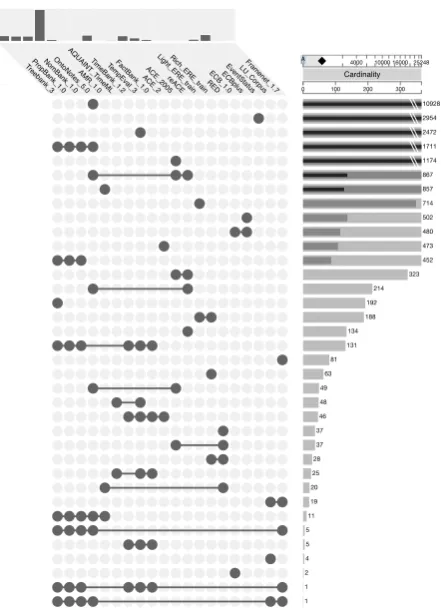
Figure 28 visualizes the document intersections that we
found, revealing the complex network resulting from more than a decade of data selection and extension.9 To begin
with, we observe the expected intersections as discussed above: 480 documents are shared between ECB 1.0 and its extension ECB+, 1,728 documents between PropBank and its successor OntoNotes, and 132 WSJ documents between Treebank, PropBank, NomBank, TimeBank, TempEval-3 and FactBank (one of which also occurs in FrameNet). It also reveals some less obvious intersections, e.g. 20 docu-ments between the RED and AMR corpora. There is only one corpus that completely stands on its own: EventSta-tus. Finally, it also reveals unexpected lack of overlap be-tween some corpora. For example, OntoNotes and Time-Bank/FactBank are partially built on top of PropBank, but they do not share any documents with each other. It ap-peared that 25% of PropBank was not carried over into OntoNotes, i.e. a set of documents that were considered too
8
Figures 2 and 3 were created using UpSet (Lex et al., 2014), see: http://caleydo.org/tools/upset
9
An interactive and more detailed version of the UpSet visualiza-tion can be viewed by following the instrucvisualiza-tions at
https://github.com/cltl/CorpusComparison.
9/28/2017 UpSet
http://vcg.github.io/upset/?dataset=12&duration=1000&orderBy=subsetSize&grouping=undefined&selection= 1/1 UpSet for R About UpSet Load Data Choose Dataset
First, aggregate by
Then, aggregate by
Sort by Degree Cardinality Deviation Aggregates Collapse All Expand All Row Height Data Min Degree: Max Degree:
Hide Empty Intersections
Dataset Information Name: CorpusComparison
# Sets: 20
# Attributes: 3
# Elements: 25248
Author: Chantal van Son
Description:
Intersections of language resources (document-level)
Source:
https://github.com/ChantalvanSon/CorpusComparison
UpSet - Visualizing Intersecting Sets
Provide a JSON file defining your data: | Learn how to create the JSON file
Query
0 4000 100001600025248
0 100 200 300
I S A U Cardinality -20% Tre eban k_ 3 Pro pBa nk_ 1.0 N omBa nk_ 1.0 O ntoN otes_ 5.0 AMR _1.0 AQ UAI N T_ Time ML Time Ba nk_ 1.2 Temp Eva l_3 Fact Ba nk_ 1.0 AC E_ 2 AC E_ 2005reAC
E Lig ht_ER E_ tra in R ich _ER E_ tra
inRED
EC B_ 1.0 EC Bp lus Eve ntSt atus LU _C orp us Frame ne t_1.7 Set Selection
0 - 0
Batch Add Sets Sort Sets 81 4 2954 502 2 37 63 714 134 857 1174 28 192 10928 2472 473 49 214 20 48 323 37 188 480 19 452 867 25 5 1711 46 11 5 1 131 1
Figure 2: Document intersections of all event corpora
domain-specific because of their strictly financial content. The documents in TimeBank/FactBank sourced from Prop-Bank were all part of this subset. The document intersec-tions reveal several opportunities for merging and compar-ing annotations across corpora.
5
Document Interoperability: Text
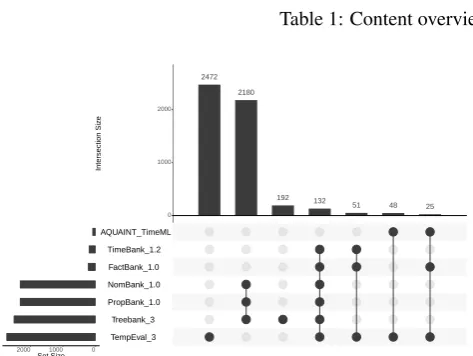
To emphasize the interoperability challenges identified at the text and annotations levels, we performed a small-scale analysis on a subset of corpora, namely PropBank/NomBank (PB/NB), FactBank 1.0 (FB) and TempEval-3 (TE3). For TE3, we only consider the TBAQ-cleaned subcorpus10 as described in (UzZaman et al.,2013). TBAQ-cleaned corresponds to the complete Time-Bank and the complete AQUAINT TimeML Corpus (A-TimeML) with revised event annotations, FB contains the complete TimeBank and part of A-TimeML with their orig-inal event annotations, and PB/NB corresponds to the ver-bal/nominal predicates annotated in the WSJ section of Treebank-3. Therefore, we indirectly analyse these corpora as well. Figure 3 summarizes the document intersections of these three corpora and related ones.
Table 1 summarizes the content of the three datasets. PB/NB is the largest corpus in terms of number of docu-ments (2,312), number of sentences (49,208), number of to-kens (1,174,165) and also number of events (227,491). FB consists of 208 documents which are split into 3,839 sen-tences and 77,231 tokens and contains 9,492 events. TE3
10
Event
Dataset #Documents
Total # Sentences
Total # Tokens
# Sentences with Events
# Sentences without Events
Total # Events
Avg. #Events / Sentence
PB/NB 2,312 49,208 1,174,165 47,394 1,814 227,491 4.79
FB 208 3,839 77,236 2,807 1,032 9,492 3.38
[image:5.595.52.289.136.314.2]TE3 256 3,955 99,384 3,604 351 11,129 3.08
Table 1: Content overview of selected event corpora
2472 2180
192 132
51 48 25 0
1000 2000
Intersection Siz
e
TempEval_3 Treebank_3 PropBank_1.0 NomBank_1.0 FactBank_1.0 TimeBank_1.2 AQUAINT_TimeML
0 1000 2000
Set Size
Figure 3: Document intersections of selected corpora
consists of 256 documents, 3,955 sentences11 and about
100k tokens of which 11,129 have been annotated as events. With respect to the text-level interoperability among these three datasets, we can mention that while PB/NB and TE3 contain only sentences from the article body, FB includes metadata such as the document id, its creation date and its title as the first sentences of the text. These sentences ac-count for the major part of the large number of sentences without annotated events in FB - 1,032 (26.88%), as op-posed to 1,814 (3.69%) in PB/NB and 351 (8.87%) in TE3. TE3 has the lowest number of events annotated per sen-tence, i.e. 3.08 compared to 3.38 in FB and 4.79 in PB/NB.
6
Document Interoperability: Annotations
Chiarcos (2012a) and Chiarcos et al. (2013) define struc-tural interoperability as annotations of different origin be-ing represented usbe-ing the same formalism, such that differ-ent resources can be processed in a uniform way and that their information can be easily merged. Following Ide and Pustejovsky (2010), they define conceptual interoperabil-ity as “the abilinteroperabil-ity to automatically interpret exchanged in-formation meaningfully and accurately in order to produce useful results” which can be achieved by linking annota-tions of different origin to a common vocabulary. In Sec-tion 6.1 we summarize the structural interoperability issues that we encountered for the three datasets. In Section 6.2 we review their conceptual interoperability by empirically comparing their annotations of events. This involves a di-rect comparison between the aligned annotations in FB and TE3 on the basis of their event identifiers, and a type-based analysis, where we abstract away from the annotations in context and provide a more general overview of the anno-tated types (i.e. POS, lemmas) in all three datasets.11We used Stanford CoreNLP (Manning et al., 2014) in order to
split the documents into sentences.
6.1
Structural Interoperability
The data in PB/NB has been released in different formats. Originally, the semantic role annotations were represented with PropBank pointers, i.e. stand-off annotations pointing to locations in the parse tree in Treebank, which in turn was represented by simple labelled brackets in a text file. PropBank pointers are only useful in combination with the corresponding tree structures, since they include empty el-ements such as traces in the token count. We loaded the data using NLTK.12 As part of OntoNotes, the data was
also released in CoNLL-format, with each line represent-ing a srepresent-ingle word with a series of tab-separated fields.13 However, as mentioned before, OntoNotes does not con-tain the complete PB/NB. FB also uses a stand-off anno-tation format and represents the data through a set of 20 tables. For example, one table contains all linguistic infor-mation relative to each token (e.g. token id, POS tag), one contains all information relative to each event (e.g. event identifier, text), and one contains the factuality degree val-ues assigned to each event. Finally, TE3 uses the TimeML XSD schema,14with XML elements for representing
meta-data (e.g.<DOCID>,<EXTRAINFO>), the main body of the annotated text (<TEXT>with in-line<EVENT> an-notations) and event instances (<MAKEINSTANCE>with tense/aspect of events as XML attributes).
Merging and comparing the annotations of the three datasets is not straightforward due to these structural dif-ferences and the textual difdif-ferences mentioned in Sec-tion 5. Both PB/NB and FB use {DOC ID, SENT ID,
TOKEN ID}to identify the position of an event in text, but
since FB includes the document id, creation date and title as part of the text and PB/NB includes empty elements in the token count, there are mismatches in the sentence and token identifiers. Although the in-line annotations of TE3 do not allow for direct comparison with other datasets, the event identifiers can be used for comparison in this matter. To analyse the conceptual interoperability of the annota-tions, we converted all three corpora to CoNLL-format with each line representing a token and information about its document id, sentence id, token id, token text, lemma and POS. If possible, we used the gold sentence splitting, tok-enization, lemmatization and POS tagging. If that was not available (e.g. TE3 only has POS tags for most but not all events, PB/NB only has lemmas for events), we used the Stanford CoreNLP pipeline to retrieve the POS tags and the lemma of all the tokens in the datasets.
12http://www.nltk.org/howto/propbank.html 13https://github.com/propbank/propbank-release 14
Verb Noun Adjective Preposition Number Adverb Particle Determiner Oth/Unknown
PB/NB 114,574 109,793 - - -
-FB 6,377 2,498 250 45 46 21 6 2 1
TE-3 5,835 2,451 202 10 - - - - 2,632
Table 2: Distribution of POS tags across annotated single-token events
6.2
Conceptual Interoperability
The event annotations in both FB and TE3 are based on the TimeML 1.2.1 Annotation Guidelines (Saur´ı et al., 2006), which define an event as a situation that happens or oc-curs. The guidelines further specify in which cases an event should or should not be annotated as a (separate) event. For example, generic events should never be tagged and causative predicates only in specific cases. Thus, TimeML defines events primarily from a semantic point of view, and allows the annotation of all linguistic realizations, includ-ing verbs, nominalizations, adjectives, predicative clauses, or prepositional phrases. Whereas the events in FB are the original ones from TimeBank and A-TimeML, those in TE3 are a result of multiple revisions. UzZaman et al. (2013) mention that TE3 borrowed the events from TempEval-2 and added missing events, but no example is given. Ver-hagen et al. (2010) mention that all event annotations for TempEval-2 were reviewed to make sure that it complied with the latest guidelines, i.e. a simplified version of the TimeML guidelines (Saur´ı et al., 2009).
In contrast, PB/NB does not take semantics as a start-ing point, but the syntactic categories of verbs and nouns. PropBank annotates the arguments and adjuncts of each verb with their semantic roles. NomBank does the same for nouns, but defines semantic restrictions with respect to which noun phrases and which constituents of noun phrases
are markable. For instance, the head noun must be of a
“propositional” type (representing an event, state, etc.) and the noun phrase must contain at least one argument and one “proposition-modifying” adjunct (Meyers, 2007).
The semantic and syntactic requirements for annotating events are thus slightly different for TimeML and PB/NB. Another difference is the extents (i.e. span of tokens) of events. In PB/NB, the single noun or verb is annotated as the event, but for phrasal verbs the particle is concate-nated with the verb to form a single predicate lemma (Bo-nial et al., 2010). TimeML implements the notion of min-imal chunk, i.e. only the head of the constituent should be annotated and not the whole phrase. As opposed to PB/NB, only the verbal part (and not its particle) of a phrasal verb is marked as event. In the early TimeML guidelines, an exception was made for exocentric elements (i.e. if it has no single head), in which case the entire expression was to be marked (e.g.on board). For TempEval-2, however, the annotators always had to annotate only the head.
6.2.1 Overlap of Annotations
As mentioned in Section 6.1, alignment of the annotations of PB/NB with the other datasets is not straightforward due to textual and structural differences. We did, however, per-form an analysis on the overlap of event annotations in FB and TE3 for their 208 shared documents by aligning them on the basis of their unique identifiers, i.e. the combination
of{DOC ID, EVENT ID}. The overlap was 8,227 events
out of a total of 9,492 in FB and 8,248 in TE3. The revised annotations of TE3 included 24 new events, while 1,265 events from FB were removed. First of all, we observe that all events annotated in TE3 indeed consist of a single to-ken. There were 4 multi-token events that were changed into single-token events: coup d’etat> coup,March for
Life > Marchand World War II >War (2 occurrences).
All other multi-token events in FB, 241 in total, were re-moved. Most of them (238) contained a cardinal number (e.g. $4.375 a share and about 12%). From the single-token events that were removed (1,265), 46 also consisted of a cardinal number. The rest of the single-token events consisted mainly of nouns (713), verbs (138) and adjec-tives (82). The 24 new events consisted of 11 nouns, 12 verbs and 1 adjective. Surprisingly, many of both the re-moved and the newly added events seemed to correspond to the ‘source-introducing predicates’ as defined in (Saur´ı and Pustejovsky, 2009), e.g.say,think,statement,plan, confi-dent, which were however also represented in the shared set of events. This may simply be a result of inconsistency (see also Section 6.3). In sum, the revisions of event anno-tations mainly seemed to concern the removal of ‘quantita-tive statements’ (Saur´ı et al., 2006) and multi-token events, but we were not able to find other clear patterns in the many events that were lost in the transition from FB to TE3.
6.2.2 Part-of-Speech Distribution of Events
In Table 2 we show the POS tag distribution for every single-token event in the three datasets. We observe that for all three datasets the majority of the single-token event mentions are either verbs or nouns. While in PB/NB only verbs and nouns are annotated as events, in TE3 and FB there are also adjectives and prepositions that stand as events, but in a smaller proportion. Furthermore, FB con-tains also event mentions of type number, adverb, particle and determiner. In the TE3 dataset, a considerable amount of event mentions do not have a POS tag assigned but are marked as ‘Other’ or ‘Unknown’ instead.
Next, we looked at the multi-token events in PB/NB and FB. We observe that there is no consistency between the two datasets. While PB/NB contains multi-token events composed of verbs in combination with particles, adverbs, prepositions, pronouns, adjectives and nouns, FB has no such event mentions. As mentioned before, the majority of the multi-token events in FB are combinations of numer-als and symbols, under various patterns. Furthermore, in PB/NB all the multi-token events have exactly two tokens, but in FB 23 out of 246 events have more than 2 tokens.
6.2.3 Overview of Event Tokens and Lemmas
Verb Noun Adjective Preposition Adverb Number Particle Determiner
PB/NB Total Tokens 153,721 355,099 83,341 122,957 39,713 45,046 2,990 100,727
Events (%)
110,291 71.74%
115,051 32.34%
2,107 2.52%
496 0.40%
302 0.76%
2 0.004%
2,320 77.59%
2 0.001%
FB Total Tokens 10,180 24,208 5,032 8,131 2,257 3,854 194 6,711
Events (%)
6,386 62.73%
2,546 10.51%
240 4.76%
50 0.61%
29 1.28%
291 7.55%
3 1.54%
9 0.13%
TE3 Total Tokens 13,643 30,290 6,246 10,706 3,469 3,652 242 8,843
Events (%)
8,536 62.56%
2,391 7.89%
173 2.76%
17 0.15%
12 0.34%
--%
--%
[image:7.595.57.546.69.192.2]--% Table 3: Overview of tokens annotated as event per POS
lemmas. For every event token and event lemma we also consider their POS tag. Because FB and TE3 do not contain information regarding the lemma of the tokens nor events and PB/NB only for the events (their rolesets), we compute these statistics based on the output of Stanford CoreNLP. While PB/NB has the lowest ratio of distinct event tokens (7.2%) and event lemmas (4.43%), FB has the highest ra-tios, around 32% for tokens and around 22% for lemmas. This high number of distinct event instances is due to the fact that many event mentions contain numerals which do not repeat throughout the dataset.
Dataset Total #Events
Distinct #Event Tokens
Distinct #Event Lemmas
PB/NB 227,491 16,398 10,089
FB 9,492 3,041 2,171
[image:7.595.54.286.374.438.2]TE3 11,129 2,883 1,871
Table 4: Overview of distinct event tokens and lemmas
6.3
Consistency of Annotations
In this section we analyse the consistency of event annota-tions. We analyse the consistency at the level of the POS tags (Section 6.3.1) and at the level of event token and event lemma (Section 6.3.2). This analysis is a work-in-progress performed in the context of the CrowdTruth15project (Inel et al., 2014), which shows that crowdsourcing is a feasi-ble method to identify and correct inconsistent annotations (Inel and Aroyo, 2017; Aroyo and Welty, 2012).
6.3.1 Evaluation of Event POS Tags
Table 3 shows the total amount of tokens for each of the following POS tags: verb, noun, adjective, adverb, prepo-sition, number, particle, determiner and symbol, as well as the total amount and percentage of tokens annotated as events for each POS tag. Overall, the tokens categorized as verbs have the highest coverage as events, as more than 62% of those have been annotated as events across the three datasets. For all three datasets, the verbs that were not marked as events were mostly the verbs be,haveanddo, which we assume to be those occurrences where they act as auxiliaries (91%, 65% and 68% of non-annotated verbs in PB/NB, FB and TE3 respectively). However, we also found some surprising cases. For example,televiseorbless 15
www.crowdtruth.org
are not annotated as events in TE3 and FB, but they are annotated as events in PB/NB, and occurrences ofsayare often not annotated in all three corpora.
The nouns annotated as events have a lower coverage (be-tween 7.89% and 32.34%) and this coverage varies a lot for each dataset. The coverage of adjectives, prepositions and adverbs is quite similar on the three datasets, as shown in Table 3. However, we know that for PB/NB these are all part of phrasal verbs (cut loose, dig up), which also ac-counts for the high coverage of particles in PB/NB. In con-trast, adjectives, prepositions and adverbs can act as inde-pendent events in FB and TE3 if they have a propositional meaning (optimistic,down,in place). As we have already discussed, only the events in FB cover numbers, but their coverage is still quite low, around 7.5%.
6.3.2 Evaluation of Event Tokens and Lemmas
In Table 5 we present the overview of inconsistencies en-countered at the level of annotated event token and event lemma. For each event token and each event lemma we count how many times it appears in the dataset and how many times it was annotated as event. Based on these oc-currences, we compute how many times a single event to-ken or event lemma was not annotated, and for how many distinct single event tokens and event lemmas there are in-stances in the corpus which are not annotated.
Dataset Event Tokens Event Lemmas
Total Distinct Total Distinct
(%) (%) (%) (%)
PB/NB 146,268 6,462 178,253 4,914
39.46% 42.97% 44.27% 53.3%
FB 11,711 1,016 12,737 921
55.88% 36.04% 57.94% 47.25%
TE3 12,580 973 13,473 837
[image:7.595.307.538.551.680.2]53.06% 33.74% 54.76% 44.73%
Table 5: Inconsistencies at the level of single-token events: event tokens and lemmas
Further-more, there are also inconsistencies at the lemma level since not all lemma instances of an event are always annotated as events. For example, in TE3disaster(noun) is annotated as event in 3 out of 7 lemma-based occurrences,war(noun) in 32 out of 52 cases, andexport(noun) in 1 out of 5. Across all three datasets, the total amount of inconsistencies at the level of event lemma is higher than the total amount of in-consistencies at the level of event token which means that only particular forms of a lemma are usually annotated as events. Further, we acknowledge the fact that TE3 shows the least amount of inconsistencies for distinct event tokens and lemmas, although they are still substantial. We believe this is due to the fact that the annotations in the dataset have been revised multiple times.
Many multi-token events in FB are composed of numbers in combination with symbols (#), currencies ($,us$,c$) and percentages (%). It is interesting to observe, however, that in cases where the sign is replaced by the word, i.e.5 per-centinstead of5%, only the number is annotated as event (we noticed 3 such cases). We also observe that only cardi-nal numbers are annotated as event, while numbers such as
millionor billionare never annotated. We further noticed
the following annotation inconsistencies: # CDwas anno-tated only 3/23 times as events, $CDwas annotated only 216/819 times andCD%was annotated only 21/304 times. Furthermore, 6 times only the cardinal was annotated as event in constructions of type c$CD. While the TimeML guidelines do specify that quantitative statements should only be annotated in case “their validity is relative to the point in time they have been asserted” (Saur´ı et al., 2006), we hypothesize that inconsistency may have been one of the reasons that they do not occur in TE3 any more. Lastly, we checked the multi-token events in PB/NB. At the token level, 527 times a phrase that was previously annotated as a multi-token event was not annotated as such. In 475 out of these 527 cases, only the head of the phrase was annotated as a single-token event; the remainder was not annotated at all. At the level of lemmas, 834 instances of multi-token events were missed, including 784 cases where only the head was annotated. It is not easy to determine which of these cases indicate actual syntactic or semantic differences, and which indicate inconsistencies. For example, the combinationback off is annotated twice as belonging to the roleset back.11,16 meaning “to retreat from” (e.g. in WSJ 1000-S4: big securities firms backed
off from program trading). However, we found 5 other
occurrences of back off that were not annotated as such, 3 of which were incorrectly assigned to another roleset. Consider the two sentences below; in both cases, the verb backwas annotated as belonging to roleset back.02, meaning “move backwards”. In Sentence 1 this is the correct interpretation, but in Sentence 2 back.11 would have been the correct roleset.
1. [...] creditors committeebackedoff a move to come up with its own alternative proposals [...] (WSJ 0475-S0) 2. Previously, he noted, gold producers tended to back
off from a rising gold market [...] (WSJ 2045-S22)
16
https://verbs.colorado.edu/propbank/framesets-english
7
Conclusion
Interoperability of resources has been discussed extensively in many standardisation initiatives and meta-model propos-als. However, the practical reality is very far from the ideal solutions that have been proposed. In this paper, we pro-vided a detailed and comprehensive analysis of the incom-patibilities that are de facto for a selection of 20 text corpora with event data. Our analysis emphasizes the need for re-source interoperability in order to facilitate merging similar or complementary event annotations in corpora that overlap in content and hence, to exploit research opportunities. We provided a comprehensive overview of the document intersections among a representative set of event-centric textual corpora, which is the stepping stone in advancing the resource interoperability process. Furthermore, we have illustrated through empirical analysis various type-level an-notation inconsistencies in and across a subset of these event corpora. Based on this study, we conclude that cor-pora should provide the means to link and align them to other corpora at different levels, for which we propose the following best-practice guidelines:
Metadata: Documents should be named with unified stan-dards (persistent identifiers) and be provided with map-pings to documents in other corpora.
Textual content: If corpora share files, their content should be aligned to facilitate the merging of annotations.
Structural: The community should agree on a data struc-ture to represent annotations that capstruc-ture their provenance, especially when they are performed on the same content.
Conceptual: Preferably, the community should agree on (the interpretation of) their labels. Alternatively, or ad-ditionally, basic statistics on the total number of tokens, words, sentences, number of annotated units per type of annotation and coverage of annotation per lemma and POS, released together with the annotated corpus, would help to properly evaluate and understand the consistency of the annotations within the corpus and their compatibil-ity with similar annotations in other corpora. Any revi-sions should be sufficiently documented.
Ultimately, the community is responsible for reaching con-sensus on how to publish and distribute resources in the future. We hope that the availability of tools for corpus and annotation analysis and aggregation will stimulate releas-ing the resources in a more consistent and transparent way. In the future, researchers should spend less time on conver-sion and mapping of data and more time on conceptually understanding the content of the annotations.
8
Acknowledgement
9
Bibliographical References
Aguilar, J., Beller, C., McNamee, P., Van Durme, B., Strassel, S., Song, Z., and Ellis, J. (2014). A comparison of the events and relations across ACE, ERE, TAC-KBP, and FrameNet annotation standards. In Proceedings of the Second Workshop on EVENTS: Definition, Detection,
Coreference, and Representation, pages 45–53.
Aroyo, L. and Welty, C. (2012). Harnessing disagreement for event semantics. Detection, Representation, and
Ex-ploitation of Events in the Semantic Web, 31.
Banarescu, L., Bonial, C., Cai, S., Georgescu, M., Griffitt, K., Hermjakob, U., Knight, K., Palmer, M., and Schnei-der, N. (2013). Abstract Meaning Representation for Sembanking. In Proceedings of the 7th Linguistic An-notation Workshop and Interoperability with Discourse
(LAW VII & ID), pages 178–186.
Bejan, C. A. and Harabagiu, S. M. (2008). A linguistic resource for discovering event structures and resolving event coreference. In Proceedings of the 6th Interna-tional Conference on Language Resources and
Evalua-tion (LREC 2008), pages 2881–2887.
Bonial, C., Babko-Malaya, O., Choi, J. D., Hwang, J., and Palmer, M., (2010). PropBank Annotation Guidelines,
version 3.0. Center for Computational Language and
Ed-ucation, Research Institute of Cognitive Science, Univer-sity of Colorad at Boulder, December.
Calzolari, N., Del Gratta, R., Francopoulo, G., Mariani, J., Rubino, F., Russo, I., and Soria, C. (2012). The LRE Map. Harmonising Community Descriptions of Re-sources. In Proceedings of the 8th International Con-ference on Language Resources and Evaluation (LREC
2012), pages 1084–1089.
Chiarcos, C. and Erjavec, T. (2011). OWL/DL formaliza-tion of the MULTEXT-East morphosyntactic specifica-tions. In Proceedings of the 5th Linguistic Annotation
Workshop, pages 11–20.
Chiarcos, C., McCrae, J., Cimiano, P., and Fellbaum, C. (2013). Towards open data for linguistics: Linguistic linked data. In New Trends of Research in Ontologies
and Lexical Resources, pages 7–25.
Chiarcos, C. (2012a). Interoperability of corpora and an-notations. InLinked Data in Linguistics, pages 161–179. Chiarcos, C. (2012b). POWLA: Modeling linguistic cor-pora in OWL/DL. In Extended Semantic Web Confer-ence, pages 225–239.
Cunningham, H. (2002). GATE, a general architecture for text engineering. Computers and the Humanities, 36(2):223–254.
Cybulska, A. and Vossen, P. (2014). Using a sledgeham-mer to crack a nut? Lexical diversity and event coref-erence resolution. In Proceedings of the 9th Interna-tional Conference on Language Resources and
Evalua-tion (LREC 2014), pages 4545–4552.
Diab, M. T., Levin, L., Mitamura, T., Rambow, O., Prab-hakaran, V., and Guo, W. (2009). Committed belief an-notation and tagging. InProceedings of the 3rd
Linguis-tic Annotation Workshop (ACL-IJCNLP 2009), pages
68–73.
Doddington, G. R., Mitchell, A., Przybocki, M. A.,
Ramshaw, L. A., Strassel, S., and Weischedel, R. M. (2004). The Automatic Content Extraction (ACE) Pro-gram - Tasks, Data, and Evaluation. In Proceedings of the 4th International Conference on Language Resources
and Evaluation (LREC 2004).
Farrar, S. and Langendoen, D. T. (2003). A linguistic ontology for the semantic web. GLOT International, 7(3):97–100.
Ferrucci, D. and Lally, A. (2004). UIMA: an architectural approach to unstructured information processing in the corporate research environment. Natural Language
En-gineering, 10(3-4):327–348.
Fillmore, C. J., Johnson, C. R., and Petruck, M. R. (2003). Background to FrameNet. International Journal of
Lex-icography, 16(3):235–250.
Fokkens, A., Soroa, A., Beloki, Z., Ockeloen, N., Rigau, G., van Hage, W. R., and Vossen, P. (2014). NAF and GAF: Linking linguistic annotations. In Proceedings 10th Joint ISO-ACL SIGSEM Workshop on
Interopera-ble Semantic Annotation, pages 9–16.
Hachey, B., Grover, C., and Tobin, R. (2012). Datasets for generic relation extraction.Natural Language Engineer-ing, 18(1):21–59.
Hellmann, S., Lehmann, J., Auer, S., and Br¨ummer, M. (2013). Integrating NLP using linked data. In
Interna-tional Semantic Web Conference, pages 98–113.
Hovy, E., Marcus, M., Palmer, M., Ramshaw, L., and Weischedel, R. (2006). OntoNotes: the 90% solu-tion. InProceedings of the Human Language Technology
Conference of the NAACL (Short Papers), pages 57–60.
Huang, R., Cases, I., Jurafsky, D., Condoravdi, C., and Riloff, E. (2016). Distinguishing Past, On-going, and Future Events: The EventStatus Corpus. InProceedings of the 2016 Conference on Empirical Methods in Natural
Language Processing (EMNLP 2016), pages 44–54.
Ide, N. and Pustejovsky, J. (2010). What does interoper-ability mean, anyway? Toward an operational definition of interoperability for language technology. In Proceed-ings of the 2nd International Conference on Global
In-teroperability for Language Resources.
Ide, N. and Romary, L. (2004). International standard for a linguistic annotation framework. Natural language
en-gineering, 10(3-4):211–225.
Ide, N. and Suderman, K. (2007). GrAF: A graph-based format for linguistic annotations. InProceedings of the
Linguistic Annotation Workshop, pages 1–8.
Inel, O. and Aroyo, L. (2017). Harnessing diversity in crowds and machines for better NER performance. In
European Semantic Web Conference, pages 289–304.
Inel, O., Khamkham, K., Cristea, T., et al. (2014). Crowdtruth: Machine-human computation framework for harnessing disagreement in gathering annotated data. InISWC, pages 486–504.
Ishida, T. (2006). Language Grid: An infrastructure for intercultural collaboration. InProceedings of the 2005
Symposium on Applications and the Internet (SAINT’06).
Interna-tional Conference on Language Resources and
Evalua-tion (LREC 2014), pages 1525–1531.
Lee, H., Recasens, M., Chang, A., Surdeanu, M., and Ju-rafsky, D. (2012). Joint entity and event coreference res-olution across documents. In Proceedings of the 2012 Joint Conference on Empirical Methods in Natural Lan-guage Processing and Computational Natural LanLan-guage
Learning, pages 489–500.
Lex, A., Gehlenborg, N., Strobelt, H., Vuillemot, R., and Pfister, H. (2014). UpSet: Visualization of intersecting sets. IEEE Transactions on Visualization and Computer
Graphics (InfoVis ’14), 20(12):1983–1992.
Manning, C. D., Surdeanu, M., Bauer, J., Finkel, J., Bethard, S. J., and McClosky, D. (2014). The Stan-ford CoreNLP natural language processing toolkit. In
Association for Computational Linguistics (ACL) System
Demonstrations, pages 55–60.
Marcus, M. P., Marcinkiewicz, M. A., and Santorini, B. (1993). Building a large annotated corpus of En-glish: The Penn Treebank. Computational linguistics, 19(2):313–330.
McCrae, J. P. and Cimiano, P. (2015). Linghub: a Linked Data Based Portal Supporting the Discovery of Lan-guage Resources. In Proceedings of the 11th
Interna-tional Conference on Semantic Systems, volume 1481,
pages 88–91.
Meyers, A., Reeves, R., Macleod, C., Szekely, R., Zielin-ska, V., Young, B., and Grishman, R. (2004). The Nom-Bank project: An interim report. InHLT-NAACL 2004
workshop: Frontiers in corpus annotation, volume 24,
page 31.
Meyers, A. (2007). Annotation Guidelines for NomBank –
Noun Argument Structure for PropBank. New York
Uni-versity.
O’Gorman, T., Wright-Bettner, K., and Palmer, M. (2016). Richer Event Description: Integrating event coreference with temporal, causal and bridging annotation. In Pro-ceedings of 2nd Workshop on Computing News
Story-lines, pages 47–56.
Palmer, M., Gildea, D., and Kingsbury, P. (2005). The proposition bank: An annotated corpus of semantic roles.
Computational linguistics, 31(1):71–106.
Palmer, M., Bonial, C., and McCarthy, D. (2014). Sem-Link+: FrameNet, VerbNet and Event Ontologies. In
Proceedings of Frame Semantics in NLP: A Workshop
in Honor of Chuck Fillmore (1929-2014), pages 13–17.
Piperidis, S. (2012). The META-SHARE Language Re-sources Sharing Infrastructure: Principles, Challenges, Solutions. InProceedings of the 8th International Con-ference on Language Resources and Evaluation (LREC
2012), pages 36–42.
Pradhan, S. S., Ramshaw, L., Weischedel, R., MacBride, J., and Micciulla, L. (2007). Unrestricted coreference: Identifying entities and events in OntoNotes. In Interna-tional Conference on Semantic Computing, 2007 (ICSC
2007), pages 446–453.
Pustejovsky, J., Castano, J. M., Ingria, R., Saur´ı, R., Gaizauskas, R. J., Setzer, A., Katz, G., and Radev, D. R. (2003a). TimeML: Robust specification of event
and temporal expressions in text. InProceedings of the 5th International Workshop on Computational Semantics
(IWCS).
Pustejovsky, J., Hanks, P., Saur´ı, R., See, A., Gaizauskas, R., Setzer, A., Radev, D., Sundheim, B., Day, D., Ferro, L., and Lazo, M. (2003b). The TIMEBANK corpus. In
Corpus linguistics, volume 2003, pages 647–656.
Pustejovsky, J., Meyers, A., Palmer, M., and Poesio, M. (2005). Merging PropBank, NomBank, TimeBank, Penn Discourse Treebank and Coreference. InProceedings of the Workshop on Frontiers in Corpus Annotations II: Pie
in the Sky, pages 5–12.
Saur´ı, R. and Pustejovsky, J. (2009). FactBank: A corpus annotated with event factuality. Language resources and
evaluation, 43(3):227–268.
Saur´ı, R., Littman, J., Gaizauskas, R., Setzer, A., and Puste-jovsky, J. (2006). TimeML annotation guidelines, ver-sion 1.2.1.
Saur´ı, R., Goldberg, L., Verhagen, M., and Pustejovsky, J. (2009). Annotating Events in English: TimeML
An-notation Guidelines (Version TempEval-2010). Brandeis
University.
Simons, G. and Bird, S. (2003). The Open Language Archives Community: An infrastructure for distributed archiving of language resources.Literary and Linguistic
Computing, 18(2):117–128.
Song, Z., Bies, A., Strassel, S., Riese, T., Mott, J., Ellis, J., Wright, J., Kulick, S., Ryant, N., and Ma, X. (2015). From Light to Rich ERE: Annotation of Entities, Rela-tions, and Events. InProceedings of the 3rd Workshop
on EVENTS at the NAACL-HLT, pages 89–98.
Strassel, S., Przybocki, M. A., Peterson, K., Song, Z., and Maeda, K. (2008). Linguistic resources and evaluation techniques for evaluation of cross-document automatic content extraction. In Proceedings of the 6th Interna-tional Conference on Language Resources and
Evalua-tion (LREC 2008).
UzZaman, N., Llorens, H., Derczynski, L., Verhagen, M., Allen, J., and Pustejovsky, J. (2013). SemEval-2013 Task 1: TempEval-3: Evaluating Time Expressions, Events, and Temporal Relations. In Proceedings of the 2nd Joint Conference on Lexical and Computational Se-mantics (*SEM), Volume 2: 7th International Workshop
on Semantic Evaluation (SemEval 2013), pages 1–9.
Verhagen, M., Saur´ı, R., Caselli, T., and Pustejovsky, J. (2010). SemEval-2010 task 13: TempEval-2. In Pro-ceedings of the 5th International Workshop on Semantic
Evaluation (SemEval 2010), pages 57–62.
Werner, G. J., Prabhakaran, V., Diab, M., and Rambow, O. (2015). Committed belief tagging on the FactBank and LU corpora: A comparative study. InProceedings of the 2nd Workshop on Extra-Propositional Aspects of
Mean-ing in Computational Semantics (ExProM 2015), pages
32–40.
Windhouwer, M. and Wright, S. E. (2012). Linking to lin-guistic data categories in ISOcat. InLinked Data in
10
Language Resource References
Bejan, C. and Harabagiu, S. (2010). EventCorefBank(ECB). Human Language Technology Research
Insti-tute.
Brandeis University. (2008). AQUAINT TimeML Corpus. TimeML corpora, ELRA-U-W0394.
Cybulska, A. and Vossen, P. (2014). The ECB+ Corpus. The NewsReader Project.
Diab, M., Dorr, B., Levin, L., Mitamura, T., Passon-neau, R., Rambow, O., and Ramshaw, L. (2009).
Lan-guage Understanding Annotation Corpus. Linguistic
Data Consortium, LDC2009T10, ISRLN 775-964-514-342-7.
Hachey, B., Grover, C., and Tobin, R. (2011). Datasets for
Generic Relation Extraction (reACE). The University of
Edinburgh, distributed via Linguistic Data Consortium, LDC2011T08, ISLRN 494-554-511-556-5.
Huang, R., Jurafsky, D., and Riloff, E. (2017). The
EventStatus Corpus. Linguistic Data Consortium,
LDC2017T09, ISLRN 173-931-115-382-5.
ICSI Berkeley. (2017). FrameNet 1.7. FrameNet Project. Knight, K., Baranescu, L., Bonial, C., Georgescu, M.,
Grif-fitt, K., Hermjakob, U., Marcu, D., Palmer, M., and Schneider, N. (2014). Abstract Meaning
Representa-tion (AMR) AnnotaRepresenta-tion 1.0. Linguistic Data Consortium,
LDC2014T12, ISLRN 637-196-362-554-6.
Marcus, M. P., Santorini, B., Marcinkiewicz, M. A., and Taylor, A. (1999). Treebank-3. The Penn Treebank (PTB) project, distributed via Linguistic Data Consor-tium, LDC99T42, ISLRN 141-282-691-413-2.
Meyers, A., Reeves, R., and Macleod, C. (2008).
Nom-Bank v 1.0. The NomBank Project, distributed via
Lin-guistic Data Consortium, LDC2008T23, ISLRN 652-357-402-514-3.
Mitchell, A., Strassel, S., Przybocki, M., Davis, J., Dod-dington, G., Grishman, R., Meyers, A., Brunstein, A., Ferro, L., and Sundheim, B. (2003). ACE-2 Version 1.0. The ACE Program, distributed via Linguistic Data Con-sortium, LDC2003T11, ACE corpora, ISLRN 498-363-793-174-9.
O’Gorman, T. and Palmer, M. (2016). Richer Event
Description 1.0. Linguistic Data Consortium,
LDC2016T23, ISLRN 722-524-976-246-2.
Palmer, M., Kingsbury, P., Babko-Malaya, O., Cotton, S., and Snyder, B. (2004). Proposition Bank I. The Prop-Bank Project, distributed via Linguistic Data Consor-tium, LDC2004T14, ISLRN 874-058-423-080-1. Parker, R., Graff, D., Kong, J., Chen, K., and Maeda, K.
(2011).English Gigaword Fifth Edition. Linguistic Data Consortium, LDC2011T07, ISLRN 911-942-430-413-0. Pustejovsky, J., Verhagen, M., Saur´ı, R., Littman, J., Gaizauskas, R., Katz, G., Mani, I., Knippen, R., and Set-zer, A. (2006). TimeBank 1.2. Brandeis University, dis-tributed via Linguistic Data Consortium, LDC2006T08, TimeML corpora, ISLRN 717-712-373-266-4.
Saur´ı, R. and Pustejovsky, J. (2009). FactBank 1.0. Lin-guistic Data Consortium, LDC2009T23, ISLRN 293-001-569-603-0.
Walker, C., Strassel, S., Medero, J., and Maeda, K. (2006).
ACE 2005 Multilingual Training Corpus. The ACE
Program, distributed via Linguistic Data Consortium, LDC2006T06, ACE corpora, ISLRN 458-031-085-383-4.