Creating Large-Scale Argumentation Structures for Dialogue Systems
Kazuki Sakai
1, Akari Inago
2, Ryuichiro Higashinaka
3,
Yuichiro Yoshikawa
1, Hiroshi Ishiguro
1, Junji Tomita
31Osaka University,2Ochanomizu University, and3NTT Media Intelligence Laboratories
Abstract
We are planning to develop argumentative dialogue systems that can discuss various topics with people by using large-scale argumenta-tion structures. In this paper, we describe the creaargumenta-tion process of these argumentaargumenta-tion structures. We created ten structures each having more than 2000 nodes of five topics in English and five topics in Japanese. We analyzed the created structures for their characteristics and investigated the differences between the two languages. We conducted an evaluation experiment to ascertain that the structures can be applied to dialogue systems. We conducted another experiment to use the created argumentation structures as training data for augmenting the current argumentation structures.
Keywords: Argumentation, Large-scale argumentation structures, Dialogue systems
1.
Introduction
[image:1.595.341.506.280.340.2]Argumentation is a process of reaching consensus through premises and rebuttals and is important for making decisions and exchanging views. Argumen-tation has long been studied in the fields of rhetoric, informal logic, and more recently artificial intelli-gence. For example, there have been studies on automatically extracting conclusions and premises from documents (Rosenthal and McKeown, 2012; Yanai et al., 2016; Lippi and Torroni, 2016). Other studies have devised argumentation models (Toulmin, 1958; Reed and Rowe, 2004; Walton, 2013) and visualizations of the models (Gordon et al., 2007; Reed and Rowe, 2004; Snaith et al., 2010). To develop dialogue systems that can support humans in argumentation, we are planning to develop argumentative dialogue systems that can discuss various topics with people by using large-scale argumentation structures; we argue that large-scale argu-mentation structures are necessary for systems to respond appropriately to various arguments raised by users. Recently, corpora containing argumentation struc-tures of discussions/meetings have been made avail-able (Janin et al., 2003; Renals et al., 2007). Other studies have extracted argumentation structures from corpora (Fern´andez et al., 2008; Bui et al., 2009). However, these structures are small; thus, insuffi-cient as knowledge for dialogue systems. One of the largest argumentation databases currently available is AIFdb (Lawrence et al., 2012), which is an open database containing argumentation structures in argument inter-change format (AIF). Although AIFdb contains many argumentation structures, each structure is small; for exam-ple, the largest contains about 250 nodes, and the average number of nodes per structure is 8.14 (See Table 1). In this paper, we describe the creation process to con-struct large-scale argumentation con-structures for dialogue sys-tems. We manually created several large-scale argumen-tation structures based on a conventional argumenargumen-tation model (Walton, 2013), and each structure has more than 2000 nodes. We created the structures in two languages; English (major language) and Japanese (author language). To verify the effectiveness of the created argumentation
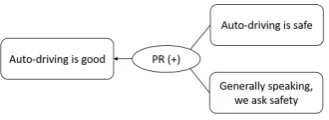
Figure 1: Argumentation model
structures, we conducted an evaluation experiment to as-certain that the structures can be applied to dialogue sys-tems. We conducted another experiment to use the created argumentation structures as training data for augmenting the current argumentation structures.
2.
Argumentation Structures
We describe the argumentation model on which our argu-mentation structures are based then discuss our process of creating them.
2.1.
Argumentation Model
As shown in Figure 1, we use a simplified version of the model described in (Walton, 2013). The model has a graph structure, and nodes represent premises and edges repre-sent relationship between nodes. Each node has a natural language statement representing the content of its premise. A node is connected to other nodes by directed arcs that represent a supportive (+) or non-supportive (−) relation-ship. If the logical connection is based on an argumentation scheme (Walton, 1996) (e.g. practical reasoning (PR), the logic is “if G is something good and action X leads to G, X should be done”), the scheme name is represented on the arcs.
Figure 2: Design of our argumentation structures for dialogue systems
Let us suppose we have a structure about “Benefits of liv-ing in the countryside vs. livliv-ing in the city”, which is repre-sented as the root node. The main issue nodes are “Living in the countryside is better” and “Living in the city is bet-ter”. The viewpoint nodes would include “Living in the countryside is healthy”. The premise nodes would include statements such as “The countryside has fewer stress fac-tors” and “People living in the city have better access to medical care”. With this design, we believe we can create dialogue systems that can discuss on a certain issue with a stance and from multiple viewpoints.
2.2.
Creation Process
Now let us describe the process of creating large-scale argumentation structures. First, we determine the main proposition and two main issue nodes representing two stances. Next, we create viewpoint nodes that represent topics. Then, under the viewpoint nodes, we create premise nodes.
We recruited more than 30 annotators for creating the ar-gumentation structures. First, we determined the proposi-tions and their stances and created the viewpoint nodes to a certain extent. The annotators iteratively created support-ing or non-supportsupport-ing premises for existsupport-ing premises under viewpoint nodes. When creating premises, they used ar-gumentation schemes whenever possible. To maintain ob-jectivity of the data, the logical relationships between two nodes were checked by other annotators. If the relationship was inappropriate, the annotators corrected or removed the corresponding nodes. This process was repeated until the relationship was appropriate. By repeating this process, we can create large-scale argumentation structures.
2.3.
Constructed Structures
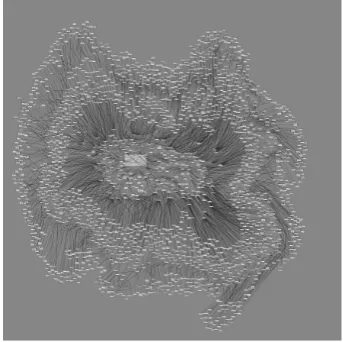
We manually created five English and five Japanese struc-tures each with five different topics. Figure 3 shows an ex-ample of visualizing the argumentation structures. Each constructed structure has more than 2000 nodes that are
Figure 3: Visualization of constructed structure. Topic is countryside vs. city (English).
supporting or not supporting other nodes. The structures are also hierarchical, as described in Section 2.1.
The five topics of the graphs written in English are as fol-lows: the pros and cons of driving automobiles (Auto driv-ing), benefits of living in the countryside vs. living in the city (Countryside), who is the greater pop icon, Lady Gaga or Taylor Swift? (Lady Gaga), which is the better Japanese meal, sushi or ramen? (Sushi), and which is the better liv-ing environment, east or west coast? (East coast).
[image:2.595.336.508.335.506.2]No. of files
No. of nodes per structure
Depth per node
No. of words per node
No. of sentences per node
Branches per node
ave. var. ave. var. ave. var. ave. var. ave. var.
AIFdb 7066 8.14 165.52 2.18 1.13 32.44 5389.81 1.95 11.39 1.50 0.78
Our argumentation
structures (English) 5 2281.60 5214.64 4.46 0.39 16.90 50.59 1.01 0.01 3.74 19.20 Our argumentation
[image:3.595.57.536.69.161.2]structures (Japanese) 5 2253.80 15885.36 4.42 0.25 19.20 56.33 1.00 0.00 3.63 8.70
Table 1: Statistics of constructed Structures. AIFdb is representative of currently available data. Note that we used nltk (English) for tokenizing words and sentences, and MeCab (Japanese) for tokenizing words.
[image:3.595.62.280.212.362.2]English Japanese scheme frequency scheme frequency 1 CE (+) 141 CE (+) 374 2 EH (+) 99 CO (+) 244 3 EO (+) 59 EX (−) 242 4 PO (+) 47 CO (−) 142 5 VC (+) 43 PO (+) 118 6 AO (−) 40 EH (+) 88 7 AD (+) 33 EO (+) 79 8 CO (+) 30 EC (+) 75 9 PR (+) 28 CE (−) 72 10 EC (+) 26 PO (−) 47
Table 2: Top 10 schemes used in each English and Japanese structures. Sign (+) or (−) with schemes means node sup-ports or refutes another node by using logic represented by scheme, respectively.
2.4.
Analysis of Constructed Structures
2.4.1. Comparison with Existing Data
Table 1 shows the statistics of the created struc-tures. We chose AIFdb as the existing data; we crawled some larger structures from the AIFdb website (http://www.aifdb.org/search). As can be seen from the table, our structures have more nodes per struc-ture than AIFdb. The number of sentences in the node is comparatively smaller than that of AIFdb, suggesting the possibility of appropriateness for dialogue system utter-ances. The average number of branches is larger than that of AIFdb and the variance is higher, which indicates the possibility of generating more various utterances for user utterances.
2.4.2. Comparison between Languages
To investigate the difference between languages, we com-pared the usage of schemes because schemes are likely to reflect the way of thinking in a language. Table 2 shows the top ten schemes used in English and Japanese. There were some differences depending on the language; for example, the scheme called argument from composition (CO), whose logic is “A is part of X, A has property Y, therefore, X has property Y”, used in Japanese is more frequent than that used in English. An example argument using CO is that a premise “emergence of automobiles leads to law ment” concludes “technical innovation leads to law amend-ment.” On the other hand, the scheme called argument from verbal classification (VC), whose logic is “P has property F,
A Life in the countryside is better. B But there is a lot more entertainment
facilities in the city than in the countryside. A But you cannot enjoy the splendor of nature or
bountiful natural resources in cities like you can in the country. The countryside offers more areas for exploring.
B But not as many places are available for adventure in the countryside because most of the land is owned by someone as part of their ranch or farm. A But adventures first started by exploring the natural
wonders of the world.
A For many cities, the concept of green space in urban development is relatively new, not to mention being a luxury.
B But cities make full use of the natural resources around them.
Figure 4: First part of dialogue text on topic of countryside vs. city. Stance A is countryside; stance B is city.
and for all x, x has property G if x has F, then P has G”, used in English is more frequent than that used in Japanese. An example argument using VC is that two premises “automo-biles require the latest electronics” and “the latest electron-ics are expensive” conclude “auto driving makes vehicles more expensive.” Although further examination is needed, if we can create a structure with a certain distribution of schemes, we may be able to develop dialogue systems ap-propriate to a certain language.
3.
Towards Development of Argumentative
Dialogue Systems
To apply the created argumentation structures to dialogue systems, we first verified whether the structures can be ap-plied to dialogue generation then developed a dialogue sys-tem prototype that used the created structures.
3.1.
Dialogue Generation
We generated dialogue text based on argumentation struc-tures. We verified that appropriate argumentative dialogue can be created by just traversing along with the structures if the structures are constructed based on logical relation-ships. Note that we used only English argumentation struc-tures for this study.
3.1.1. Generation Methods
un-Figure 5: Text chat interface of our dialogue system prototype. The prototype works either in English or Japanese. Here, the topic is “the benefits of living in the countryside vs. living in the city”.
questionnaire item ave.
[image:4.595.111.481.68.267.2]Q1 Understandability of content 3.81 Q2 Naturalness of dialogue 3.01 Q3 Understandability of stances 3.52
Table 3: Averaged questionnaire scores
der viewpoint nodes1in a depth-first search fashion. When
visiting each node, the statement associated with it was ap-pended to the dialogue text. The dialogue-generation pro-cess finished when 20 utterances were generated. Figure 4 shows a sample dialogue (on the benefits of living in the countryside versus the city). Note that when transiting to a node from stance A to stance B, or vise-versa, “But” is inserted to make the dialogue look natural.
We recruited 19 participants (12 males and 7 females; av-erage age: 28.9). They read ten dialogue texts (two sam-ples×five structures) that were randomly ordered and an-swered a questionnaire. The questionnaire included three questions: (Q1) “Was the meaning of individual utterances easy to understand?”, (Q2) “Did the dialogue look natu-ral?”, and (Q3) “Was it easy to understand how the two systems agreed or disagreed?” They answered these three questions on a five-point Likert scale, where 5 meant the highest degree of agreement.
[image:4.595.60.282.330.382.2]3.1.2. Results
Table 3 shows the questionnaire results. The score for Q1 was much higher than 3, so the dialogue texts were under-standable to all participants. The score for Q2 and Q3 was higher than 3, so the texts successfully exhibited the charac-teristics of argumentative dialogue. The evaluation results indicate that the dialogue texts generated by argumentation structures were reasonable, suggesting the effectiveness for use in dialogue systems.
1
For each structure, we selected the top two viewpoint nodes in the number of descendants.
Figure 6: Architecture of our dialogue system prototype. Prototype works either in English or Japanese.
3.2.
Dialogue System Prototype
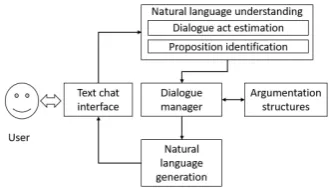
We constructed a dialogue system prototype that argues on the basis of the constructed argumentation structures used in English and Japanese (Higashinaka et al., 2017). Fig-ure 5 shows a text chat interface of our dialogue system prototype, and Figure 6 shows its architecture. When the user types, the sentence is input to two main modules: di-alogue act estimation and proposition identification. The dialogue-act-estimation module estimates four types of di-alogue acts; assertion, question, concession, and retraction. The proposition-identification module finds, on the basis of word2vec (Mikolov et al., 2013), the corresponding node that has the statement whose meaning is the closest to the input sentence. Finally, the system uses the found node to generate the response text by using the statement of the node. We confirmed that the prototype system can return reasonable responses when the user utterance is within the topic in question.
4.
Towards Automatic Creation of
Structures
[image:4.595.340.505.332.426.2]cre-Table 4: Classification results for English argumentation structures. Bold font indicates the highest score in each column. Auto driving Countryside Gaga Sushi East coast Average
baseline 0.502 0.524 0.537 0.513 0.511 0.517
[image:5.595.80.513.91.252.2]SVM (uni + bi + tri) 0.539 0.564 0.575 0.554 0.566 0.560 SVM (uni + uni pair + bi pair) 0.548 0.578 0.597 0.575 0.580 0.576 ERT (uni + bi + tri) 0.543 0.596 0.601 0.583 0.574 0.579 MNB (uni + bi + tri) 0.522 0.539 0.533 0.551 0.531 0.535 MNB (uni + uni pair + bi pair) 0.509 0.559 0.468 0.545 0.526 0.522 CBOW (no w2v) 0.532 0.580 0.575 0.587 0.563 0.567 CBOW (use w2v) 0.546 0.576 0.553 0.579 0.567 0.564 LSTM (no w2v) 0.522 0.561 0.527 0.531 0.511 0.530 LSTM (use w2v) 0.554 0.568 0.585 0.587 0.558 0.571 BLSTM (no w2v) 0.541 0.585 0.583 0.561 0.536 0.561 BLSTM (use w2v) 0.551 0.586 0.586 0.592 0.562 0.576
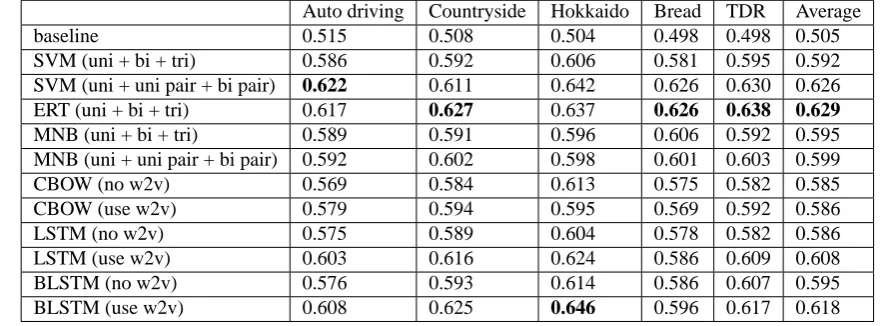
Table 5: Classification results for Japanese argumentation structures. Bold font indicates the highest score in each column. Auto driving Countryside Hokkaido Bread TDR Average
baseline 0.515 0.508 0.504 0.498 0.498 0.505
SVM (uni + bi + tri) 0.586 0.592 0.606 0.581 0.595 0.592 SVM (uni + uni pair + bi pair) 0.622 0.611 0.642 0.626 0.630 0.626 ERT (uni + bi + tri) 0.617 0.627 0.637 0.626 0.638 0.629 MNB (uni + bi + tri) 0.589 0.591 0.596 0.606 0.592 0.595 MNB (uni + uni pair + bi pair) 0.592 0.602 0.598 0.601 0.603 0.599 CBOW (no w2v) 0.569 0.584 0.613 0.575 0.582 0.585 CBOW (use w2v) 0.579 0.594 0.595 0.569 0.592 0.586 LSTM (no w2v) 0.575 0.589 0.604 0.578 0.582 0.586 LSTM (use w2v) 0.603 0.616 0.624 0.586 0.609 0.608 BLSTM (no w2v) 0.576 0.593 0.614 0.586 0.607 0.595 BLSTM (use w2v) 0.608 0.625 0.646 0.596 0.617 0.618
Figure 7: Precision-Recall curve of method that had highest average score in English
Figure 8: Precision-Recall curve of method that had highest average score in Japanese
ation process is carried out manually. As preliminary work, we are conducting research on estimating the support/non-support relationship between two statements by using ma-chine learning methods and our large-scale argumentation structures as training data.
4.1.
Classification Methods
We classified the relationship between two statements as support or non-support. The data were pairs of statements: a node that has a statement directly connected to another node that has the other statement. We examined the follow-ing machine learnfollow-ing methods:
Support Vector Machine (SVM) Two statements were
represented as a feature vector. Then, the vector was input to a linear SVM. See below for how we created the feature vectors.
Extremely Randomized Tree (ERT) Two statements were represented as a feature vector. Then, the vector was input to an ERT.
Multinomial Naive Bayes (MNB) Two statements were represented as a feature vector. Then, the vector was input to an MNB.
Continuous Bag-of-Words (CBOW) Each statement was embedded, and each vector was averaged. Then two vectors were concatenated, and their relationship was estimated using the softmax function.
Long Short-Term Memory (LSTM) Each statement was embedded, and each vector was input to LSTM. Then two vectors were concatenated, and their relationship was estimated.
Bidirectional LSTM (BLSTM) Each statement was em-bedded, and each vector was input to BLSTM. Then two vectors were concatenated, and their relationship was estimated.
[image:5.595.64.315.281.627.2] [image:5.595.72.519.282.445.2]pair + bi pair). The word uni-, bi-, and tri-grams of state-ments were used for ERT. On the other hand, a sequence of one-hot word vectors were used for CBOW, LSTM, and BLSTM. These methods used two ways to embed each statement; the pre-trained word2vec model (use w2v) and not using this model (no w2v). The Japanese word2vec was learned from the data of Wikipedia, while the English word2vec was learned from the data of Google News. The classifiers were trained using pairs of statements in four ar-gumentation structures written in the same language then were tested using pairs of statements in the other argu-mentation structure. Specifically, for training in CBOW, LSTM, and BLSTM, training data were divided into two parts; for training (90%) and development to tune the pa-rameters (10%).
4.2.
Results
Table 4 lists the accuracy of the support/non-support clas-sification for English structures, and Table 5 lists the accu-racy of the support/non-support classification for Japanese structures. In Japanese and English, an extremely random-ized tree method with uni-, bi-, tri-grams had the highest score. The score for Japanese was higher than that for En-glish. This is because in Japanese, there seems to be more linguistic constructs that denote/infer discourse or logical relationships.
In Japanese and English, we confirmed that both high-est scoring methods could classify the relationships more accurately than each baseline (McNemar’s test, Japanese:
p < .001, English:p < .001).
However, as shown in Figures. 7 and 8, the value of recall is very small in the high precision region (more than 90%). Therefore, we consider it is currently difficult to automat-ically augment argumentation structures. The progress in the field of argumentation mining would help in the fu-ture (Lippi and Torroni, 2016).
5.
Conclusion
We created large-scale argumentation structures for dia-logue systems. We compared the structures for their charac-teristics to conventional argumentation structures and usage of schemes between English and Japanese. We conducted a subjective evaluation of dialogue generation by using the argumentation structures and described the development of a dialogue system prototype. For automatic augmentation of such structures, we conducted an experiment of auto-matic support/non-support classification. For future work, we will develop a method for automatically constructing such structures. We will also evaluate a dialogue system prototype and improve the dialogue system; for example, we will develop dialogue strategies for natural argumenta-tion.
6.
Bibliographical References
Bui, T. H., Frampton, M., Dowding, J., and Peters, S. (2009). Extracting decisions from multi-party dialogue using directed graphical models and semantic similarity. In Proc. SIGDIAL, pages 235–243.
Fern´andez, R., Frampton, M., Ehlen, P., Purver, M., and Peters, S. (2008). Modelling and detecting decisions in multi-party dialogue. In Proc. SIGDIAL, pages 156–163. Gordon, T. F., Prakken, H., and Walton, D. (2007). The carneades model of argument and burden of proof.
Arti-ficial Intelligence, 171(10):875–896.
Higashinaka, R., Sakai, K., Sugiyama, H., Narimatsu, H., Arimoto, T., Fukutomi, T., Matsui, K., Ijima, Y., Ito, H., Araki, S., Yoshikawa, Y., Ishiguro, H., and Matsuo1, Y. (2017). Argumentative dialogue system based on argu-mentation structures. In Proc. SemDial, pages 154–155. Janin, A., Baron, D., Edwards, J., Ellis, D., Gelbart, D., Morgan, N., Peskin, B., Pfau, T., Shriberg, E., and Stol-cke, A. (2003). The ICSI meeting corpus. In Proc.
ICASSP, volume 1, pages 364–367.
Lawrence, J., Bex, F., Reed, C., and Snaith, M. (2012). AIFdb: Infrastructure for the argument web. In
Compu-tational Models of Argument (COMMA), pages 515–516.
Lippi, M. and Torroni, P. (2016). Argumentation mining: State of the art and emerging trends. ACM Transactions
on Internet Technology, 16(2):10:1–10:25.
Mikolov, T., Sutskever, I., Chen, K., Corrado, G., and Dean, J. (2013). Distributed representations of words and phrases and their compositionality. In Proc. NIPS, pages 3111–3119.
Reed, C. and Rowe, G. (2004). Araucaria: software for ar-gument analysis, diagramming and representation.
Inter-national Journal on Artificial Intelligence Tools, 13:961–
980.
Renals, S., Hain, T., and Bourlard, H. (2007). Recognition and understanding of meetings the AMI and AMIDA projects. In Proc. ASRU, pages 238–247.
Rosenthal, S. and McKeown, K. (2012). Detecting opin-ionated claims in online discussions. In Proc. 2012 IEEE
Sixth International Conference on Semantic Computing,
pages 30–37.
Snaith, M., Lawrence, J., and Reed, C. (2010). Mixed ini-tiative argument in public deliberation. In Proc. 4th
In-ternational Conference on Online Deliberation, pages 2–
13.
Toulmin, S. E. (1958). The uses of argument. Cambridge university press.
Walton, D. (1996). Argumentation schemes for
presump-tive reasoning. Routledge.
Walton, D. (2013). Methods of argumentation. Cambridge University Press.