Article
Semi-supervised adversarial variational autoencoder
Ryad Zemouri1,†,‡
1 Cedric-Lab, CNAM, HESAM Université, 292 rue Saint Martin 750141 Paris cedex 03 (France) ; [email protected]
Abstract: We present a method to improve the reconstruction and generation performance of
variational autoencoder (VAE) by injecting an adversarial learning. On the other hand, instead of comparing the reconstructed with the original data to calculate the reconstruction loss, we use a consistency principle for deep features. The training process of the VAE is then divided into two steps, training the encoder and then training the decoder. By using this two-step learning process, our method can be more widely used in applications other than image processing. While training the encoder, the label information is integrated to better structure the latent space in a supervised way. The adversarial constraints allow the decoder to generate data with better authenticity and more realistic than the conventional VAE. We present experimental results to show that our method gives better performance than the original VAE.
Keywords:Variational autoencoder; Adversarial learning; Deep feature consistent; Data generation
0. Introduction
Deep generative models (DGMs) are part of the deep models family and are a powerful way to learn any distribution of observed data through unsupervised learning. The DGMs are composed mainly by variational autoencoders (VAEs) [1] [2] [3], [4], and generative adversarial networks (GANs) [5]. The VAEs are mainly used to extract features from the input vector in an unsupervised way while the GANs are used to generate synthetic samples through an adversarial learning by achieving an equilibrium between a Generator and a Discriminator. The strength of VAE comes from an extra layer used for sampling the latent vectorzand an additional term in the loss function that makes the generation of a more continuous latent space than standard autoencoders.
The VAEs have met with great success in recent years in several applicative areas including anomaly detection [6] [7] [8] [9], text classification [10], sentence generation [11], speech synthesis and recognition [12] [13] [14], spatio-temporal solar irradiance forecasting [15] and in geoscience for data assimilation [2]. In other respects, the two major application areas of the VAEs are the biomedical and healthcare recommendation [16] [17] [18] [19], and industrial applications for nonlinear processes monitoring [20] [21] [22] [23] [1] [24] [25] [3] [4].
VAEs are very efficient for reconstructing input data through a continuous and an optimized latent space. Indeed, one of the terms of the VAE loss function is the reconstruction term which is suitable for reconstructing the input data, but with less realism than GANs. For example, an image reconstructed by a VAE is generally blurred and less realistic than the original one. However, the VAEs are completely inefficient for generating new synthetic data from the latent space comparing to the GANs. Upon an adversarial learning of the GANs, a discriminator is employed to evaluate the probability that a sample created by the generator is real or false. Most of the applications of GANs are focused in the field of image processing such as biomedical images [26] [27], but recently some papers in the industrial field have been published, mainly focused on data generation to solve the problem of the imbalanced training data [28] [29] [30] [31] [32] [33]. Through continuous improvement of GAN,
its performance has been increasingly enhanced and several variants have recently been developed [34] [35] [36] [37] [38] [39] [40] [41] [42] [43] [44] [45] [46] [47] [48] [49] [50] [51].
The weakness of GANs lies in their latent space which is not structured similarly to VAEs due to the lack of an encoder which can further supports the inverse mapping. With an additional encoding function, GANs can explore and use a structured latent space to discover "concept vectors" that represent high-level attributes [26]. To this purpose, some research has been recently developed such as [48] [52] [53] [54] [55].
In this paper, we propose a method to inject an adversarial learning into a VAE to improve its reconstruction and generation performance. Instead of comparing the reconstructed data with the original data to calculate the reconstruction loss, we use a consistency principle for deep features such as style reconstruction loss (Gatys [56]). To do this, the training process of the VAE is divided into two steps, training the encoder and then training the decoder. While training the encoder, we integrate the label information to structure the latent space in a supervised way, in a manner similar to [55] [53]. For the consistency principle for deep features, contrary to [56] and Hou [54] who used the pretrained deep convolutional neural network VGGNet [57], we use the features extracted from the hidden layers of the encoder. Thus, our method can be applied to areas other than image processing such as industrial nonlinear monitoring or biomedical applications. We present experimental results to show that our method gives better performance than the original VAE. In brief, our main contributions are threefold.
• Our approach perfectly combines the two models, i.e., GAN and VAE and thus improves the generation and reconstruction performance of the VAE.
• The VAE training is done in two steps, which allows to dissociate the constraints used for the construction of the latent space on the one hand, and those used for the training of the decoder. • The encoder is used for the consistency principle for deep features extracted from the hidden
layers.
The rest of the paper is organized as follows. We first briefly review the generative models in Section 2. After that, in Section 3, we describe the proposed method. Then, in Section 4, we present experimental results which show that the proposed method improves the performance of VAE. The last section of the paper summarizes the conclusions.
1. Generative networks and adversarial learning
1.1. Autoencoder and the Variational form
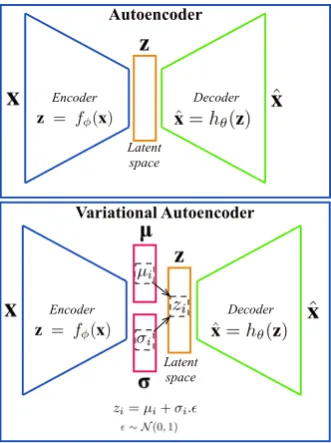
Autoencoder (AE) represents one of the first generative model trained to recreate or reproduce the input vectorx[58], [59], [60], [61]. The AE is composed by two main structures: an encoder and a decoder (Fig.1) which are multilayered neural networks (NNs) parameterized byφandθ, respectively. The first part encodes the input dataxinto a latent representationzby the encoder functionz= fφ(x), whereas the second NN decodes this latent representation onto ˆx=hθ(z)which is an approximation or a reconstruction of the original data. In an AE, an equal number of units are used in the input/output layers while less units are used in the latent space (Fig.1).
The variational form of the AE (Fig. 1) becomes a popular generative model by combining Bayesian inference and the efficiency of the NNs to obtain a nonlinear low-dimensional latent space [1], [2], [3], [4]. The Bayesian inference is obtained by an additional layer used for sampling the latent vectorzwith a prior specified distributionp(z), usually assumed to be a standard GaussianN(0,I), whereIis the identity matrix. Each elementziof the latent layer is obtained as follow:
zi =µi+σi.e (1)
Encoder Decoder
Latent space
Encoder Decoder
Latent space
Autoencoder
Variational Autoencoder
Figure 1. Schematic architecture of a standard deep autoencoder and a variational deep autoencoder.
Both architectures have two parts: an encoder and a decoder.
latent vectorz, the VAE generates vector of meansµiand standard deviationsσi. This allows to have more continuity in the latent space than the original AE. The VAE loss function given by the equation2 has two terms. The first termLrecis the reconstruction loss function (equ.3) which allow to minimize the difference between the input and output instances.
Both the negative expected log-likelihood (e.g., the cross-entropy function) or the mean squared error (MSE) can be used. When the sigmoid function is used in the output layer, the derivatives of MSE and cross-entropy can have similar forms.
The second termLkl (equ. 4) corresponds to the Kullback-Liebler (Dkl) divergence loss term that forces the generation of a latent vector with the specified Normal distribution [62], [63]. TheDkl divergence is a theoretical measure of proximity between two densitiesq(x)andp(x). It is asymmetric (Dkl(q k p) 6= Dkl(p k q)) and nonnegative. It is minimized whenq(x) = p(x)[64]. Thus, theDkl divergence term measures how close is the conditional distribution densityqφ(z|x)of the encoded latent vectors from the desired Normal distributionp(z). The value ofDklis zero when two probability distributions are the same, which forces the encoder of VAEqφ(z|x)to learn the latent variables that follow a multivariate normal distribution over a k-dimensional latent space.
L=Lrec+Lkl (2)
Lrec=−Eqφ(z|x)[log pθ(x|z)] (3)
Lkl=Dkl(qφ(z|x)k p(z)) (4)
1.2. Adversarial learning
generation comparing to the adversarial learning technics [5]. The main idea of these methods is to create an additional NN, called a discriminatorDis(x), that will learn to distinguish between the real data and the data generated by the generatorGen(z).
The learning process then consists in successively training the generator to generate new data and the discriminator to dissociate between real and generated data (Fig. 2). The learning process converges when the generator reaches the point of luring the discriminator. The discriminatorDis(x)
is optimized by maximizing the probability of distinguishing between real and generated data while the generatorGen(z)is trained simultaneously to minimizelog(1−Dis(Gen(z))). Thus, the goal of the whole adversarial training can be summarized as a two-player minmax game with the value functionV(Gen,Dis)[5]:
min
GenmaxDis V(Gen,Dis) =Ex[Φx] +Ez[Ψz] (5) whereΦx = log(Dis(x)) andΨz = log(1−Dis(Gen(z))). These techniques are much more efficient than the reconstruction loss functionLrec for generating data from a data space, .e.g. the latent space of VAE. Unlike the latent space of the VAE where the data are structured according to the Kullback-Liebler divergence loss term that forces the generation of a latent vector with the specified Normal distribution, the data space of the GAN is structured in a random way, making it less efficient in managing the data to be generated.
Generator
Discriminator
noise
real data
Real / Generated
Figure 2. Illustration of the GAN.
2. Proposed method
2.1. Method Overview
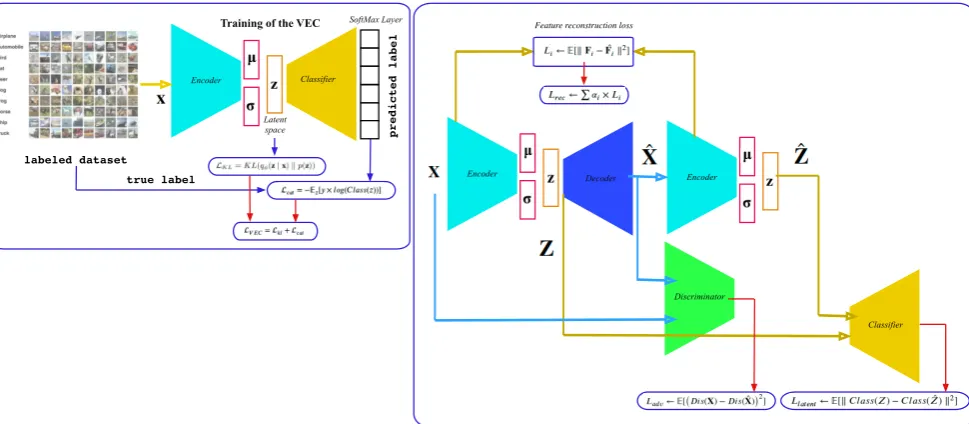
The method proposed in this paper, which is presented in Figure3, consists in separating the learning of the VAE into two successive parts: the learning of the encoderEnc(x)followed by the learning of the decoderDec(z). This decoupling between encoder and decoder during the learning phase allows a better structuration of the latent encoder space to focus in a second step on the optimization of the decoder. In order to structure the latent space taking into account the label information, a classifierClass(z)is trained at the same time as the encoderEnc(x). Two optimization functions are then used during the first phase: the Kullback-Liebler divergence loss functionLkland the categorical cross-entropyLcat.
As the convergence of the first phase, the two models thus obtained, i.e. the encoderEnc(x)and the classifierClass(z), will be used to train the decoderDec(z). Three optimization functions are then used for this second step:
• a reconstruction loss function (Lrec) • an adversarial loss function (Ladv) • a latent space loss function (Llatent)
Encoder Decoder Encoder
Classifier
Feature reconstruction loss Training of the VEC
Latent space
labeled dataset
Encoder Classifier
SoftMax Layer
true label
predicted label
Discriminator
Figure 3. The framework of the proposed method.
style reconstruction loss (Gatys [56]). A feature reconstruction loss function is then used instead of a data reconstruction loss function. To calculate these features, we use the encoder thus obtained by the first learning phase instead of using a pretrained deep convolutional neural network such as the VGGNet network [57] used by Gatys [56] and Hou [54].
In order to facilitate the convergence of the decoder, two further optimization terms are included in the whole loss function: an adversarial loss functionLadvobtained with the help of a discriminator Dis(x), trained at the same time as the decoderDec(z), and a latent space loss functionLlatent. This supplementary term will compare the original latent spaceZwith the reconstructed one ˆZthanks to the classifierClass(z)obtained during the first learning phase.
2.2. First step: training the Variational Encoder Classifier
In this first step, the encoder and classifier are stacked together in order to form the Variational Encoder Classifier (VEC). The whole structure is trained at the same time using the following loss functionLVEC:
LVEC =Lkl+Lcat (6)
whereLklcorresponds to the Kullback-Liebler (Dkl) divergence loss term given by the equation 4, while the second terme Lcat represents the categorical cross-entropy obtained by the following expression:
Lcat=−Ez[y×log(Class(z))] (7) whereyis the target label andE[.]is the statistical expectation operator. The algorithm1presents the complete procedural steps of this first learning phase.
2.3. Second step: training the Decoder
The encoder as well as the classifier obtained from the previous phase will therefore be frozen and used to train the decoder. The global optimization function is given by the following expression whereβandγare fitting parameters:
Algorithm 1Training the VEC Model
Input:Labeled dataset
Result:Trained Variational Encoder, Trained Classifier
Initialization:WVEC←Initialize parameters
repeat
X←random mini-batch images from the dataset
Z←Enc(X)
Y←One-hot encoded true label ofX
ˆ
Y←Class(Z)
Lkl←Dkl(qφ(Z|X)k p(Z)) Lcat← −EZ[Y×log(Yˆ)]
//Update the Variational Encoder Classifier parameters WVEC← −∇WVEC(Lkl+Lcat)
untilConvergence of parameters;
The first termLrecallows the decoder to enhance its input reconstruction properties, while the second termLadvallows it to increase its ability to generate artificial data from latent space. These two terms will be put in competition and it will be necessary to find the best compromise thanks to the fitting parameters. A third termLlatentwill ensure that the virtual data generation is done respecting the distribution of classes in the latent space. The whole training process of the decoder is presented by the algorithm2.
2.3.1. Feature reconstruction loss
For the reconstruction optimization function, we adopt the method proposed by Gatys [56] which consists in extracting the style of an image from the first hidden layers of a pre-trained network. It is also the same principle used by Lin [65] as Feature Pyramid Networks for Object Detection. Thus, instead of calculating the reconstruction error between the inputXand the output ˆXof the decoder, the reconstruction error is calculated from the features of the image. As an alternative to a generic pre-trained network, such as the VGGNet network [57] used by [56] and Hou [54], we will exploit the features extracted from the previously trained encoder. The advantage of our method is to adapt the extracted features to the type of application being studied, which may be outside the scope of the images learned by the VGGNet network. Thus, our approach can be applied to biomedical images such as histopathological images ([66], [27]) or vibration signals from a mechatronic system for industrial monitoring ([20]).
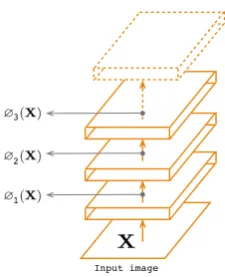
As shown in Figure4, the first three layers of the encoder will be used to extract features from the input imageX. The characteristicsFiofXwill then be compared to the characteristics ˆFiof the output
ˆ
Xgenerated by the decoder. The optimization function is then given by the following expression:
Lrec=
∑
iαi × E[k Fi−Fˆik2] (9)
whereFi =∅i(X)and ˆFi =∅i(Xˆ)are respectevely the features ofXand ˆXextracted from the layeriandαiis a fitting parameter.
2.3.2. Adversarial loss
Algorithm 2Training the Decoder Model
Input:Labeled dataset
Require:Pretrained Encoder, Classifier
Result:Trained Decoder
Initialization:WDec←Initialize parameters
repeat
//1. Train the Discriminator
fori=1tondisdo
Xreal←random mini-batch of real images
Greal=1←set the label of the real images ˆ
G←Dis(Xreal)
Ldis←E[(Greal−Gˆ)2]
//Update the parameters on real data Wdis← −∇Wdis(Ldis)
Xreal←random mini-batch of real images
Z←Enc(Xreal)
Xgen←Dec(Z) generated images
Ggen=−1←set the label of the generated images ˆ
G←Dis(Xgen)
Ldis←E[(Ggen−Gˆ)2]
//Update the parameters on fake data Wdis← −∇Wdis(Ldis)
end
//2. Train the Decoder
X←random mini-batch of real images
Z←Enc(X)
ˆ
X←Dec(Z)
ˆ
Z←Enc(Xˆ)
fori=1to3do
Fi←∅i(X) ˆ
Fi←∅i(Xˆ)
Li ←E[kFi−Fˆik2]
end
Lrec←∑αi×Li
Ladv←E[ Dis(X)−Dis(Xˆ)2] Llatent←E[kClass(Z)−Class(Zˆ)k2] //Update the Decoder parameters
WDec← −∇WDec(Lrec+βLadv+γLlatent)
untilConvergence of parameters;
to adjust this generation effect with a fitting variableβ(equation8). The update of the discriminator is done before each decoder training cycle. In order to increase this adversarial learning, we use the Wasserstein GAN method [47] which consists in increasing the number of learning cycles of the discriminator with respect to the generator. The algorithm2presents the detail of the discriminator training where the variablendisdefines the number of training cycles of the discriminator.
1 2 3
Input image
Figure 4. Deep feature consistent.
Ladv =E[ Dis(X)−Dis(Xˆ)2
] (10)
2.3.3. Latent loss
A last termLlatentprevents that the generation effect will be stronger than the reconstitution effect. The classifier obtained in the previous learning phase will make sure that the latent space ˆZobtained by the generated data has the same distribution as the original latent spaceZ. The label information of the input data is thus integrated in the reconstitution / generation process. The output of the classifier will penalize the decoder if the generated data does not belong to the same class as the original data. The expression ofLlatent is defined by:
Llatent =E[kClass(Z)−Class(Zˆ)k2] (11)
3. Experiments
3.1. Dataset description
We experimented our method on four databases: The MNIST [67], The Omniglot dataset [68], The Caltech 101 Silhouettes dataset [69] and Fashion-MNIST [70] which are briefly described below. Figure 5illustrates some of the images taken randomly from the four databases.
• The MNIST [67] is a standard database which contains 28×28 images of ten handwritten digits (0 to 9) and is split in 60,000 samples for training and 10,000 for the test.
• The Omniglot dataset [68] contains 28×28 images of handwritten characters from many world alphabets representing 50 classes which is split in 24,345 training and 8070 test image.
• The Caltech 101 Silhouettes dataset [69] is composed of 28×28 images representing object silhouettes of 101 classes and is split in 6364 samples for training and 2307 for the test.
• Fashion-MNIST [70] contains 28×28 images of fashion products from 10 categories and is split in 60,000 samples for training and 10,000 for the test.
3.2. Neural network architecture
(a) (b) (c) (d)
Figure 5. Random example images from the dataset; (a) MNIST, (b) Omniglot (c) Caltech 101
Silhouettes, (d) Fashion MNIST .
For the decoder, we almost use the inverse encoder structure. The input of the decoder is the sampling layer followed by three fully connected layers with batch normalization and a LeakyReLU activation. 7 convolutional layers with 3×3 kernel and 1×1 stride followed by batch normalization, a LeakyReLU activation and residual block and 2 upsampling layers.
For the discriminator, we use 3 convolutional layers with 3×3 kernel and 1×1 stride LeakyReLU activation, 2 maxpooling layers with 2×2 kernel and 2×2 stride and 4 fully connected layers with a LeakyReLU activation. Lastly, the output of the discriminator is formed by one linear unit.
The classifier is formed by 3 fully connected layers with batch normalization and a LeakyReLU activation. Each fully connected layer is followed by a residual block. The output of the classifier is obtained by a softmax layer.
Encoder Conv 64x3x3, stride 1, pading same, LeakyRelu
Residual Block
Maxpooling (2x2), stride 2
Conv 128x3x3, stride 1, pading same, LeakyRelu
Maxpooling (2x2), stride 2
Conv 256x3x3, stride 1, pading same, LeakyRelu
Conv 128x3x3, stride 1, pading same, LeakyRelu
Fully Connected (FC) Layer, 1024, LeakyRelu
FC, Kz, Linear FC, Kz, Linear
sampling layer Layer
Residual Block
Residual Block
Residual Block
Conv 64x3x3, stride 1, pading same, LeakyRelu
Conv 32x3x3, stride 1, pading same, LeakyRelu Residual Block
Residual Block
Fully Connected (FC) Layer, 512, LeakyRelu
Fully Connected (FC) Layer, 256, LeakyRelu
Output Size
64 x 28 x 28
64 x 28 x 28
64 x 14 x 14
128 x 14 x 14
128 x 14 x 14
128 x 7 x 7
256 x 7 x 7
256 x 7 x 7
128 x 7 x 7
128 x 7 x 7
64 x 7 x 7
64 x 7 x 7
32 x 7 x 7
32 x 7 x 7
1024
512
256
Decoder
Output Size
64 x 28 x 28
64 x 28 x 28 256 x 14 x 14
128 x 14 x 14
128 x 14 x 14
128 x 28 x 28 32 x 7 x 7
32 x 7 x 7
64 x 7 x 7
64 x 7 x 7
128 x 7 x 7
128 x 7 x 7
256 x 7 x 7
256 x 7 x 7 32 x 7 x 7
512 256 2
1 x 28 x 28 Upsampling (2x2)
Conv 32x3x3, stride 1, BN, pading same, LeakyRelu FC 256, BN, LeakyRelu
sampling layer
FC 1568, BN, LeakyRelu
Conv 128x3x3, stride 1, BN, pading same, LeakyRelu
Conv 1x3x3, stride 1, pading same, Sigmoid FC 512, BN, LeakyRelu
Residual Block
Conv 64x3x3, stride 1, BN, pading same, LeakyRelu
Residual Block
Conv 128x3x3, stride 1, BN, pading same, LeakyRelu
Residual Block
Conv 256x3x3, stride 1, BN, pading same, LeakyRelu
Residual Block
Residual Block
Upsampling (2x2)
Conv 64x3x3, stride 1, BN, pading same, LeakyRelu
Residual Block Layer
Conv 64x3x3, stride 1, pading same, LeakyRelu input image
MaxPooling(2x2), stride 2
Conv 128x3x3, stride 1, pading same, LeakyRelu
MaxPooling(2x2), stride 2
Conv 256x3x3, stride 1, pading same, LeakyRelu
FC 256, LeakyRelu
FC 512, LeakyRelu
FC 1024, LeakyRelu
FC 2048, LeakyRelu
FC 1, Linear
Discriminator FC 200, BN, LeakyRelu
sampling layer
Residual Block
FC 400, BN, LeakyRelu
FC 800, BN, LeakyRelu
Softmax
Classifier Residual Block
Residual Block
3.3. Experimental focus
3.3.1. Impact of the dimension size of the latent space
It is obvious that the dimension of the latent space plays an active influence on the quality of reconstruction and data generation. The quality of VAE decoding is highly dependent on theKzsize of the latent space. We then compared two configurations: a two-dimensional latent space (Kz =2) with a (Kz =100) dimensional space.
3.3.2. Impact of weighting parametersβandγ
We also investigated the impact of theβandγweighting parameters of the equation8. We set the parametersαiof the feature reconstruction loss (equ.3) to 1, 0.1 and 0.01 for i=1, 2 and 3 respectively. To judge the influence of each parameter of adversarial lossβand latent lossγ, we have varied theβ parameter in an increasing way according to two configurations ofγ:γ=0 andγ=0.1.
3.4. Results and discussion
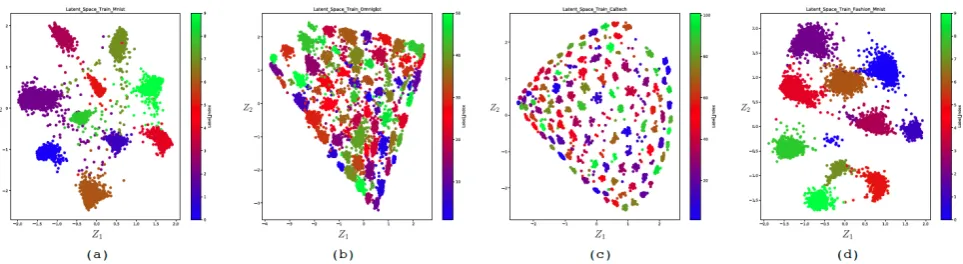
3.4.1. Supervised 2D-latent space
Figure 7. The 2D latent space obtained for the four databases.
In order to visually analyze the latent space obtained by the encoder-classifier, we set the dimension of this space to 2 (Kz =2). The interest of such a space is to be able to make a projection of the initial input data space to a space visually accessible to the human brain. We can thus visually analyze the quality of the encoder. Figure7shows the 2D latent space obtained for the four databases. We can then see the distribution of data in the latent space as well as the interaction between the different classes. We can thus analyze the overlaps between the classes. One can then choose the area of this latent space in order to generate artificial data. Figure8shows examples of images generated from the latent space for Mnist and Fashion Mnist respectively. It is interesting to note that even in a space of reduced size, the data are organized according to a logic of likelihood between classes. This is very well illustrated by the latent space of Fashion Mnist where we can see that the three classes #5, 7,and9 which represent the shoes are grouped together. The handbag cluster is also isolated from the rest of the clusters.
3.4.2. Image reconstruction and generation
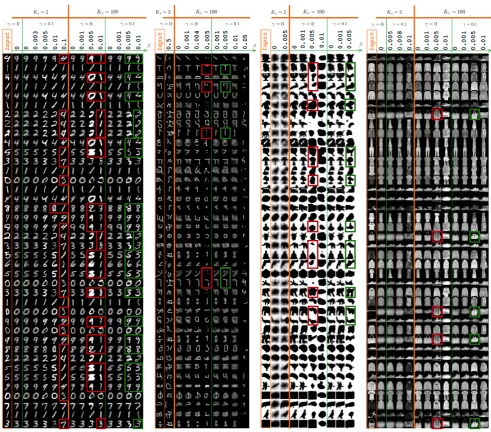
The figure9gives all the results obtained for the four databases with different values ofβand γfor each two latent spaces (Kz = 2 andKz = 100). For every database, we randomly generated 40 images as input of the VAE. The resulting output image is given according to the experimental parameters.
Figure 8. Images generated from the latent space for the Mnist and the Fashion Mnist.
two databases Mnist and Fashion-MNIST, the results achieved on the two-dimensional latent space are almost as good as forKz=100. Nevertheless the quality of the reconstruction alone, obtained by setting the adversary parameterβ=0, is better forKz=100: the images are less blurred and close to the input image than on the 2D latent space.
On the other hand, the image reconstruction performance obtained on the 2D space is less convincing for the Caltech database. Indeed, we can see that the reconstructed images are very blurred but for the most part close to the original image. Note that the reconstruction was completely impossible for the Omniglot database in 2D space. The only result in this space was obtained by forcing the weight of the adversary lossβto 0.5 which allowed to generate new world alphabets.
B. Impact of the parameterβ:
In order to measure the effect of adversarial loss termLadv on the feature reconstruction loss termLrec, we varied the adversarialβparameter during each test sequence in a progressive way. This test allows to evaluate how the data generation effect can affect the reconstruction effect. Generally speaking, we obtain three steps which are described as follows:
• β<ε1=⇒dominant reconstruction effect with blurred images
• ε1≤β≤ε2=⇒reconstruction effect with clearer and more realistic images • β>ε2=⇒generative effect is dominant
withε1andε2are two thresholds to define. This is clearly illustrated by the MNIST database. Let’s take the case ofKz=2:
• up toβ=0.003, the reconstruction effect is dominant with blurred images.
• For 0.005≤β≤0.01 the images are clearer and more realistic.
• The generative effect becomes dominant forβ=0.1 where most of the resulting images do not match the original ones. These cases are highlighted in red.
varied the βparameter in an increasing way, under two different configurations ofγ(γ = 0 and γ=0.1). This measures the effect of the latent loss termLlatent. We can see that it had the expected effect. The red-framed images have been corrected and are now compatible with the original images again. These corrected images are framed in green.
Figure 9. The results obtained for the four databases with different values ofβandγfor each of the
two latent spaces (Kz=2 andKz=100).
3.5. Test on Cifar 10
To conclude this experimental part, we did a final test on the reconstruction of images taken from the Cifar10 database [71]. The size of the latent space is fixed atKz=100, with the parametersαi=1,
β=0.001 andγ=0. Figure10shows several pairs of random images with their reconstructed output.
4. Conclusion
Figure 10. Several pairs of random images with their reconstructed output of the CIFAR10.
conventional VAE. Finally, By using a two-step learning process, our method can be more widely used in applications other than image processing.
References
1. Martin, G.S.; Droguett, E.L.; Meruane, V.; das Chagas Moura, M. Deep variational auto-encoders: A promising tool for dimensionality reduction and ball bearing elements fault diagnosis.
Structural Health Monitoring2018, 0, 1475921718788299,[https://doi.org/10.1177/1475921718788299].
doi:10.1177/1475921718788299.
2. Canchumuni, S.W.; Emerick, A.A.; Pacheco, M.A.C. Towards a robust parameterization for conditioning facies models using deep variational autoencoders and ensemble smoother.Computers & Geosciences2019,
3. Lee, S.; Kwak, M.; Tsui, K.L.; Kim, S.B. Process monitoring using variational autoencoder for high-dimensional nonlinear processes. Engineering Applications of Artificial Intelligence 2019, 83, 13 – 27. doi:https://doi.org/10.1016/j.engappai.2019.04.013.
4. Zhang, Z.; Jiang, T.; Zhan, C.; Yang, Y. Gaussian feature learning based on variational autoencoder for improving nonlinear process monitoring. Journal of Process Control 2019, 75, 136 – 155. doi:https://doi.org/10.1016/j.jprocont.2019.01.008.
5. Goodfellow, I.; Pouget-Abadie, J.; Mirza, M.; Xu, B.; Warde-Farley, D.; Ozair, S.; Courville, A.; Bengio, Y. Generative Adversarial Nets. InAdvances in Neural Information Processing Systems 27; Ghahramani, Z.; Welling, M.; Cortes, C.; Lawrence, N.D.; Weinberger, K.Q., Eds.; Curran Associates, Inc., 2014; pp. 2672–2680.
6. Yan, S.; Smith, J.S.; Lu, W.; Zhang, B. Abnormal Event Detection from Videos using a Two-stream Recurrent Variational Autoencoder.IEEE Transactions on Cognitive and Developmental Systems2018, pp. 1–1. doi:10.1109/TCDS.2018.2883368.
7. Wang, T.; Qiao, M.; Lin, Z.; Li, C.; Snoussi, H.; Liu, Z.; Choi, C. Generative Neural Networks for Anomaly Detection in Crowded Scenes. IEEE Transactions on Information Forensics and Security2019,14, 1390–1399. doi:10.1109/TIFS.2018.2878538.
8. Sun, J.; Wang, X.; Xiong, N.; Shao, J. Learning Sparse Representation With Variational Auto-Encoder for Anomaly Detection. IEEE Access2018,6, 33353–33361. doi:10.1109/ACCESS.2018.2848210.
9. He, M.; Meng, Q.; Zhang, S. Collaborative Additional Variational Autoencoder for Top-N Recommender Systems. IEEE Access2019,7, 5707–5713. doi:10.1109/ACCESS.2018.2890293.
10. Xu, W.; Tan, Y. Semisupervised Text Classification by Variational Autoencoder. IEEE Transactions on Neural
Networks and Learning Systems2019, pp. 1–14. doi:10.1109/TNNLS.2019.2900734.
11. Song, T.; Sun, J.; Chen, B.; Peng, W.; Song, J. Latent Space Expanded Variational Autoencoder for Sentence Generation. IEEE Access2019,7, 144618–144627. doi:10.1109/ACCESS.2019.2944630.
12. Wang, X.; Takaki, S.; Yamagishi, J.; King, S.; Tokuda, K. A Vector Quantized Variational Autoencoder (VQ-VAE) Autoregressive Neural F0 Model for Statistical Parametric Speech Synthesis. IEEE/ACM
Transactions on Audio, Speech, and Language Processing2019, pp. 1–1. doi:10.1109/TASLP.2019.2950099.
13. Agrawal, P.; Ganapathy, S. Modulation Filter Learning Using Deep Variational Networks for Robust Speech Recognition. IEEE Journal of Selected Topics in Signal Processing 2019, 13, 244–253. doi:10.1109/JSTSP.2019.2913965.
14. Kameoka, H.; Kaneko, T.; Tanaka, K.; Hojo, N. ACVAE-VC: Non-Parallel Voice Conversion With Auxiliary Classifier Variational Autoencoder. IEEE/ACM Transactions on Audio, Speech, and Language Processing2019,
27, 1432–1443. doi:10.1109/TASLP.2019.2917232.
15. Khodayar, M.; Mohammadi, S.; Khodayar, M.E.; Wang, J.; Liu, G. Convolutional Graph Autoencoder: A Generative Deep Neural Network for Probabilistic Spatio-temporal Solar Irradiance Forecasting. IEEE
Transactions on Sustainable Energy2019, pp. 1–1. doi:10.1109/TSTE.2019.2897688.
16. Deng, X.; Huangfu, F. Collaborative Variational Deep Learning for Healthcare Recommendation.IEEE
Access2019,7, 55679–55688. doi:10.1109/ACCESS.2019.2913468.
17. Han, K.; Wen, H.; Shi, J.; Lu, K.H.; Zhang, Y.; Fu, D.; Liu, Z. Variational autoencoder: An unsupervised model for encoding and decoding fMRI activity in visual cortex. NeuroImage 2019, 198, 125 – 136. doi:https://doi.org/10.1016/j.neuroimage.2019.05.039.
18. Bi, L.; Zhang, J.; Lian, J. EEG-Based Adaptive Driver-Vehicle Interface Using Variational Autoencoder and PI-TSVM. IEEE Transactions on Neural Systems and Rehabilitation Engineering2019,27, 2025–2033. doi:10.1109/TNSRE.2019.2940046.
19. Wang, D.; Gu, J. VASC: Dimension Reduction and Visualization of Single-cell RNA-seq Data by Deep Variational Autoencoder. Genomics, Proteomics & Bioinformatics 2018, 16, 320 – 331. Bioinformatics Commons (II), doi:https://doi.org/10.1016/j.gpb.2018.08.003.
20. Zemouri, R.; Lévesque, M.; Amyot, N.; Hudon, C.; Kokoko, O.; Tahan, S.A. Deep Convolutional Variational Autoencoder as a 2D-Visualization Tool for Partial Discharge Source Classification in Hydrogenerators.
IEEE Access2020,8, 5438–5454. doi:10.1109/ACCESS.2019.2962775.
22. Li, H.; Misra, S. Prediction of Subsurface NMR T2 Distributions in a Shale Petroleum System Using Variational Autoencoder-Based Neural Networks. IEEE Geoscience and Remote Sensing Letters2017,
14, 2395–2397. doi:10.1109/LGRS.2017.2766130.
23. Huang, Y.; Chen, C.; Huang, C. Motor Fault Detection and Feature Extraction Using RNN-Based Variational Autoencoder.IEEE Access2019,7, 139086–139096. doi:10.1109/ACCESS.2019.2940769.
24. Wang, K.; Forbes, M.G.; Gopaluni, B.; Chen, J.; Song, Z. Systematic Development of a New Variational Autoencoder Model Based on Uncertain Data for Monitoring Nonlinear Processes. IEEE Access2019,
7, 22554–22565. doi:10.1109/ACCESS.2019.2894764.
25. Cheng, F.; He, Q.P.; Zhao, J. A novel process monitoring approach based on variational recurrent autoencoder. Computers & Chemical Engineering 2019, 129, 106515. doi:https://doi.org/10.1016/j.compchemeng.2019.106515.
26. Creswell, A.; White, T.; Dumoulin, V.; Arulkumaran, K.; Sengupta, B.; Bharath, A.A. Generative Adversarial Networks: An Overview.IEEE Signal Processing Magazine2018,35, 53–65. doi:10.1109/MSP.2017.2765202. 27. Zemouri, R.; Zerhouni, N.; Racoceanu, D. Deep Learning in the Biomedical Applications: Recent and
Future Status.Applied Sciences2019,9. doi:10.3390/app9081526.
28. Wang, Z.; Wang, J.; Wang, Y. An intelligent diagnosis scheme based on generative adversarial learning deep neural networks and its application to planetary gearbox fault pattern recognition.Neurocomputing
2018,310, 213 – 222. doi:https://doi.org/10.1016/j.neucom.2018.05.024.
29. Wang, X.; Huang, H.; Hu, Y.; Yang, Y. Partial Discharge Pattern Recognition with Data Augmentation based on Generative Adversarial Networks. 2018 Condition Monitoring and Diagnosis (CMD), 2018, pp. 1–4. doi:10.1109/CMD.2018.8535718.
30. Liu, H.; Zhou, J.; Xu, Y.; Zheng, Y.; Peng, X.; Jiang, W. Unsupervised fault diagnosis of rolling bearings using a deep neural network based on generative adversarial networks. Neurocomputing2018,315, 412 – 424. doi:https://doi.org/10.1016/j.neucom.2018.07.034.
31. Mao, W.; Liu, Y.; Ding, L.; Li, Y. Imbalanced Fault Diagnosis of Rolling Bearing Based on Generative Adversarial Network: A Comparative Study. IEEE Access 2019, 7, 9515–9530. doi:10.1109/ACCESS.2018.2890693.
32. Shao, S.; Wang, P.; Yan, R. Generative adversarial networks for data augmentation in machine fault diagnosis. Computers in Industry2019,106, 85 – 93. doi:https://doi.org/10.1016/j.compind.2019.01.001. 33. Han, T.; Liu, C.; Yang, W.; Jiang, D. A novel adversarial learning framework in deep convolutional neural
network for intelligent diagnosis of mechanical faults. Knowledge-Based Systems2019,165, 474 – 487. doi:https://doi.org/10.1016/j.knosys.2018.12.019.
34. Alam, M.; Vidyaratne, L.; Iftekharuddin, K. Novel deep generative simultaneous recurrent model for efficient representation learning.Neural Networks2018,107, 12 – 22. Special issue on deep reinforcement learning, doi:https://doi.org/10.1016/j.neunet.2018.04.020.
35. Zhu, J.Y.; Park, T.; Isola, P.; Efros, A.A. Unpaired Image-to-Image Translation using Cycle-Consistent Adversarial Networks, 2017,[arXiv:cs.CV/1703.10593].
36. Yi, Z.; Zhang, H.; Tan, P.; Gong, M. DualGAN: Unsupervised Dual Learning for Image-to-Image Translation, 2017,[arXiv:cs.CV/1704.02510].
37. Pathak, D.; Krahenbuhl, P.; Donahue, J.; Darrell, T.; Efros, A.A. Context Encoders: Feature Learning by Inpainting, 2016,[arXiv:cs.CV/1604.07379].
38. Odena, A.; Olah, C.; Shlens, J. Conditional Image Synthesis With Auxiliary Classifier GANs, 2016, [arXiv:stat.ML/1610.09585].
39. Odena, A. Semi-Supervised Learning with Generative Adversarial Networks, 2016, [arXiv:stat.ML/1606.01583].
40. Mirza, M.; Osindero, S. Conditional Generative Adversarial Nets, 2014,[arXiv:cs.LG/1411.1784]. 41. Mao, X.; Li, Q.; Xie, H.; Lau, R.Y.K.; Wang, Z.; Smolley, S.P. Least Squares Generative Adversarial Networks,
2016,[arXiv:cs.CV/1611.04076].
42. Liu, M.Y.; Tuzel, O. Coupled Generative Adversarial Networks, 2016,[arXiv:cs.CV/1606.07536].
44. Kim, T.; Cha, M.; Kim, H.; Lee, J.K.; Kim, J. Learning to Discover Cross-Domain Relations with Generative Adversarial Networks, 2017,[arXiv:cs.CV/1703.05192].
45. Isola, P.; Zhu, J.Y.; Zhou, T.; Efros, A.A. Image-to-Image Translation with Conditional Adversarial Networks, 2016,[arXiv:cs.CV/1611.07004].
46. Hjelm, R.D.; Jacob, A.P.; Che, T.; Trischler, A.; Cho, K.; Bengio, Y. Boundary-Seeking Generative Adversarial Networks, 2017,[arXiv:stat.ML/1702.08431].
47. Arjovsky, M.; Chintala, S.; Bottou, L. Wasserstein GAN, 2017,[arXiv:stat.ML/1701.07875].
48. Donahue, J.; Krähenbühl, P.; Darrell, T. Adversarial Feature Learning, 2016,[arXiv:cs.LG/1605.09782]. 49. Denton, E.; Gross, S.; Fergus, R. Semi-Supervised Learning with Context-Conditional Generative
Adversarial Networks, 2016,[arXiv:cs.CV/1611.06430].
50. Chen, X.; Duan, Y.; Houthooft, R.; Schulman, J.; Sutskever, I.; Abbeel, P. InfoGAN: Interpretable Representation Learning by Information Maximizing Generative Adversarial Nets, 2016, [arXiv:cs.LG/1606.03657].
51. Bousmalis, K.; Silberman, N.; Dohan, D.; Erhan, D.; Krishnan, D. Unsupervised Pixel-Level Domain Adaptation with Generative Adversarial Networks, 2016,[arXiv:cs.CV/1612.05424].
52. Dumoulin, V.; Belghazi, I.; Poole, B.; Mastropietro, O.; Lamb, A.; Arjovsky, M.; Courville, A. Adversarially Learned Inference, 2016,[arXiv:stat.ML/1606.00704].
53. Makhzani, A.; Shlens, J.; Jaitly, N.; Goodfellow, I.; Frey, B. Adversarial Autoencoders, 2015, [arXiv:cs.LG/1511.05644].
54. Hou, X.; Sun, K.; Shen, L.; Qiu, G. Improving variational autoencoder with deep feature consistent and generative adversarial training. Neurocomputing 2019, 341, 183 – 194. doi:https://doi.org/10.1016/j.neucom.2019.03.013.
55. Hwang, U.; Park, J.; Jang, H.; Yoon, S.; Cho, N.I. PuVAE: A Variational Autoencoder to Purify Adversarial Examples. IEEE Access2019,7, 126582–126593. doi:10.1109/ACCESS.2019.2939352.
56. Gatys, L.A.; Ecker, A.S.; Bethge, M. A Neural Algorithm of Artistic Style. CoRR2015,abs/1508.06576, [1508.06576].
57. Simonyan, K.; Zisserman, A. Very Deep Convolutional Networks for Large-Scale Image Recognition.
CoRR2014,abs/1409.1556,[1409.1556].
58. Yu, S.; Príncipe, J.C. Understanding autoencoders with information theoretic concepts. Neural Networks
2019,117, 104 – 123. doi:https://doi.org/10.1016/j.neunet.2019.05.003.
59. Bengio, Y. How Auto-Encoders Could Provide Credit Assignment in Deep Networks via Target Propagation. CoRR2014,abs/1407.7906,[1407.7906].
60. Im, D.J.; Ahn, S.; Memisevic, R.; Bengio, Y. Denoising Criterion for Variational Auto-Encoding Framework.
CoRR2015,abs/1511.06406,[1511.06406].
61. Fan, Y.J. Autoencoder node saliency: Selecting relevant latent representations. Pattern Recognition2019,
88, 643 – 653. doi:https://doi.org/10.1016/j.patcog.2018.12.015.
62. Kingma, D.P.; Welling, M. Auto-Encoding Variational Bayes. arXiv e-prints2013, p. arXiv:1312.6114, [arXiv:stat.ML/1312.6114].
63. Kingma, D. Variational inference & deep learning: A new synthesis. PhD thesis, Faculty of Science (FNWI), Informatics Institute (IVI), University of Amsterdam, 2017.
64. Blei, D.M.; Kucukelbir, A.; McAuliffe, J.D. Variational Inference: A Review for Statisticians. arXiv e-prints
2016, p. arXiv:1601.00670,[arXiv:stat.CO/1601.00670].
65. Lin, T.; Dollár, P.; Girshick, R.B.; He, K.; Hariharan, B.; Belongie, S.J. Feature Pyramid Networks for Object Detection. CoRR2016,abs/1612.03144,[1612.03144].
66. Zemouri, R.; Devalland, C.; Valmary-Degano, S.; Zerhouni, N. Intelligence artificielle : quel avenir en anatomie pathologique ? Annales de Pathologie2019,39, 119 – 129. L’anatomopathologie augmentée, doi:https://doi.org/10.1016/j.annpat.2019.01.004.
67. Lecun, Y.; Bottou, L.; Bengio, Y.; Haffner, P. Gradient-based learning applied to document recognition.
Proceedings of the IEEE1998,86, 2278–2324. doi:10.1109/5.726791.
69. Marlin, B.; Swersky, K.; Chen, B.; Freitas, N. Inductive Principles for Restricted Boltzmann Machine Learning. Proceedings of the Thirteenth International Conference on Artificial Intelligence and Statistics; Teh, Y.W.; Titterington, M., Eds.; PMLR: Chia Laguna Resort, Sardinia, Italy, 2010; Vol. 9,Proceedings of
Machine Learning Research, pp. 509–516.
70. Xiao, H.; Rasul, K.; Vollgraf, R. Fashion-MNIST: a Novel Image Dataset for Benchmarking Machine Learning Algorithms.CoRR2017,abs/1708.07747,[1708.07747].