Shadow-Bitcoin: Scalable Simulation via
Direct Execution of Multi-threaded Applications
Andrew Miller
University of Maryland
[email protected]
Rob Jansen
U.S. Naval Research Laboratory
[email protected]
Abstract
We describe a new methodology that enables the di-rect execution of multi-threaded applications inside of Shadow, an existing parallel discrete-event network sim-ulation framework. Our methodology utilizes function interposition and an application-layer thread library to emulate the ordinary thread interface to the application. Using this methodology, we implement a new Shadow plug-in that directly executes the Bitcoin reference client software. We describe optimizations that enable scalable execution of thousands of Bitcoin nodes on a single ma-chine, and discuss how to model the Bitcoin network for experimental purposes. Finally, we present novel denial-of-service attacks against the Bitcoin software, which exploit low-level implementation artifacts in the Bitcoin reference client. We demonstrate these attacks using our methodology, tools, and models.
1
Introduction
Experimentation testbeds for distributed systems and peer-to-peer networks such as Bitcoin, Bittorrent, and Tor, are beneficial to the scientific community as they simplify the code debugging and testing process, reduce time to deployment of new features and protocol modi-fications, and promote the research and development of new protocols and architectural modifications. However, testbeds like PlanetLab and the Bitcoin testnet do not scale gracefully, are hard to manage and maintain, and do not offer as much control over experimental topology and node configurations as is possible under alternative experimenation techniques. As a result, developers and researchers are often unable to realize the full potential of the experimental method, and new code and design modifications are often accepted into mainline software without fully understanding their effects on the existing, often critical infrastructure.
Alternative approaches to experimentation offer a unique set of benefits over the use of a distributed testbed. In particular, emulation may provide better scal-ability and improve management of and control over the network model and node configuration, and simulation may further allow for more efficient execution and re-peatable experiments. Shadow [2,24] provides an
inter-esting and unique alternative to traditional experimenta-tion techniques. At its core, Shadow is a simulator; the operating system, network stack, internetwork topology, and communication between nodes are all simulated us-ing a discrete-event engine. However, each virtual host in Shadow runs real application software, such as the net-work’s official reference client or alternate implementa-tions. This unique simulation/emulation hybrid allows Shadow to provide the most efficient experimentation platform possible while remaining true to application-layer effects of the software executed by the virtual hosts. This unique approach is ideal for experimenting with large distributed systems and peer-to-peer networks.
Unfortunately, Shadow does not yet natively support virtual hosts thatfork processes or run multi-threaded
software due to the non-trivial layer of complexity added to Shadow’s own internal multi-threaded simula-tion core. As a result, many distributed systems, includ-ing Bitcoin, are not amenable to simulation in Shadow.
In this work, we extend the state of the art in this unique simulation/emulation space by designing and im-plementing a simulation architecture that allows the di-rect execution of multi-threaded software. As a proof of concept of the efficacy of our approach, we de-sign, implement, and test a new Shadow plug-in that di-rectly executes the multi-threaded Bitcoin software in-side the Shadow simulation framework. Our novel ap-proach utilizes GNU Portable Threads (a.k.a.,Pth) [1], an application-layer library that provides non-preemptive priority-based scheduling for multiple threads of exe-cution. Pth runs in a single operating system thread while providing the facilities to emulate thePthreads (posix threads) interface to the application. We then usefunction interpositionto redirectPthreadsfunction calls made from the virtual host toPth, while
allow-ingPthreadscalls initiated by Shadow itself to be
Using our new Bitcoin Shadow plug-in1, we show how to model the Bitcoin network and how to optimize the bootstrapping of a Bitcoin network. We then describe several novel vulnerabilities in the Bitcoin software, and use Shadow to demonstrate and measure their cost and effectiveness.
Our major contributions are as follows:
• A new approach that utilizesPthand function inter-position to allow direct execution of multi-threaded applications in the Shadow simulator.
• The design and implementation of a new Shadow plug-in that uses our techniques to directly execute the multi-threaded Bitcoin software.
• A Bitcoin model that can be used to efficiently boot-strap and instantiate a large Bitcoin test network in-side of Shadow.
• The description of several new attacks against Bit-coin, and an evaluation and measurement of these attacks using our new techniques and tools in a safe, private Shadow environment.
2
Background and Related Work
This section provides background on the Shadow simula-tion framework, while outlining related experimentasimula-tion work for and previous attacks on Bitcoin.
2.1
Shadow
Shadow [2,24] is a parallel discrete-event network sim-ulator. Shadow has a modular architecture that is broken into two major components: (1) the core simulator, and (2) software run by virtual hosts, which are dynamically loaded at run time as plug-in libraries.
2.1.1 The Core Simulator
Shadow itself is, at its core, a simulator. In addition to the parallel event engine, Shadow contains the logic required to simulate both the internetwork topology over which its virtual hosts will communicate as well as the operating system base upon which virtual hosts will run.
Event Engine. Because Shadow is a simulator, it re-places the concept of real time with its own simulation time over which it has precise control. Every action that happens in Shadow, such as starting virtual host ap-plications or sending and receiving packets, is initiated from an event that occurs at a precise time instant (with nanosecond granularity). Shadow’s event engine runs these events in the correct chronological order, while ad-hering to real-world characteristics such as network de-lay and loss. Shadow’s event engine can benefit from the use of multiple worker threads.
Topology. Shadow uses the standard GraphML format to represent the connectivity and properties of links
be-1The code for our simulator is made freely available athttps: //github.com/shadow/shadow-plugin-bitcoin
tween each virtual host running in a simulation. This topology contains both vertices and edges: vertices rep-resent Internet points-of-presence at which virtual hosts can be connected; and edges represent the path between those points-of-presence and their properties, including latency, jitter, and packet loss. Shadow models the In-ternet using real data available from public sources, like CAIDA and NetIndex. Every packet sent between two virtual hosts will be subject to the properties of the edges over which the packet travels, leading to communication characteristics that are not unlike those that would be re-alized between those locations on the Internet.
Operating System. Each virtual host in Shadow runs a simulated operating system (OS), including sockets, pipes, network protocols (TCP and UDP), timers, asyn-chronous event facilities, network interfaces, and various data buffers. These mechanisms are implemented to sup-port the Linux POSIX interface and provide the function-ality expected by virtual host software. Note that only the mechanisms that would affect the simulation, such as time or network communication, must be implemented; many system functions, such as file I/O, can be handled directly bylibcas usual. Shadow uses function inter-position to intercept calls made from virtual host soft-ware to OS functions, and redirects them to their sim-ulated counterparts as required. In this way, Shadow is emulating a Linux environment to the application, which need not be aware that it is being simulated.
2.1.2 Host Software Plug-ins
As mentioned above, each virtual host contains a simu-lated OS that emulates a POSIX API to the application. The real software applications that run in Shadow are themselves compiled as Shadow plug-ins and loaded at run-time. During the compilation process, LLVM [4,31] is used to inject a hook function that is used by Shadow to pass control into the application code in order to, e.g., call themainfunction in the application and notify the plug-in of available input/output on file descriptors.
Whenever Shadow instantiates a new virtual node that runs a particular plug-in, Shadow creates a new copy of the global structure and stores it internally. Shadow ex-pects the plug-in to provide an interface in the form of an
on event(e)fuction, which Shadow invokes when-ever an IO eventeis available. The plug-in indicates which events it is interested in by usingepolllibrary functions, which Shadow intercepts.
2.2
Bitcoin Experimentation
Bitcoin [34] is a peer-to-peer “cryptocurrency” network that functions as a decentralized digital currency. There has been a recent surge of Bitcorelated research in-cluding measurement, new applications, security mod-els, incentive analysis, and attacks (see [11] for a com-prehensive survey). We describe some of the existing ex-perimentation frameworks, and outline several areas of research which we believe could utilize our simulator.
Testbeds. Parallel to the actual bitcoin network, there exists a public dedicated “test” network2that runs a mod-ified version of the code. The modifications, such as fre-quently resetting the “mining difficulty”, are intended to make it easier for experimentation while also discourag-ing its use as an actual currency. At the time of writ-ing, we crawled Testnet and determined that it consists of approximately 250 nodes (at least an order of mag-nitude smaller than the actual network). Alternately, a “testnet-in-a-box” [20] can be run as a local instance of the test network. The main advantages of our Shadow-based simulation over Testnet is that the experimenter is afforded greater control over the network, while provid-ing an accurate simulation of the network structure.
Several other projects, such as Simbit [13], simulate various aspects of the Bitcoin network. However, these do not run the actual bitcoind application code, but rather implement simplified abstractions; these may oversim-plify or misrepresent the actual behavior. The attacks we demonstrate in Section 6, in particular, make use of implememtation-specific behavior that is not modeled elsewhere.
Another form of testbed is a platform for measuring and interacting with the live network itself, such as Coin-seer [30] and Coinscope [33].
Attacks. A very large focus of Bitcoin-related research has been on Bitcoin’s weak privacy guarantees. Al-though the reference client takes some measures to main-tain privacy, such as creating a new address to store “change,” implementation quirks often allows one Bit-coin transaction to be linked to others. [32] The tim-ing of information propagation can often be used to as-sociate transactions with ips [30]. Another vector for deanonymization involves exploiting the mechanisms by which Bitcoin nodes propagate information about their peers. [10]. Bitcoin privacy could be improved through a variety of techniques such as mixing [12,35] or by up-grading the Bitcoin protocol to support privacy preserv-ing cryptography [9,36].
A well-known class of attacks involves deviating from the default mining behavior, and can in some cases allow the deviating miner to profit disproportionately. [7,17,18]
2seehttps://en.bitcoin.it/wiki/Testnet
Another well-known class of attacks involves “double-spending” by convincing a victim that a payment trans-action is (or will be imminently) accepted by the net-work, when in reality the attacker has ensured that a conflicting transaction is actually be accepted first [8]. So-called “fast payment” attacks exploit weaknesses of Bitcoin’s information propagation mechanism [15]. We illustrate how our simulator can be used to model infor-mation propagation in Bitcoin.
Researchers have recently demonstrated that an attack that fills up a node’s address list so that it eventually only connects to the attacker’s nodes [21]. This attack and the vulnerabililies it exploits are unrelated to ours. They demonstrate and evaluate their attack against a “victim” node that they connect to the live network, and propose but do not evaluate several potential countermeasures; we believe an implementation of this attack in our sim-ulator would be a good way to evaluate potential coun-termeasures and study their interactions within the entire network.
Another recently published denial-of-service attack involves exploiting the address propagation mechanism to exhaust a node’s memory, causing it to crash [10]. The attack we demonstrate uses an entirely different mecha-nism, but has a similar effect.
3
Direct Execution of Multi-Threaded
Applications
Shadow ordinarily uses an epoll-based event loop. This works well for systems such as Tor and Bittorrent, which are implemented as a single event loop and exclusively use sockets in non-blocking mode. Essentially, a Shadow plug-in consists of an event loop that is executed by the Shadow framework; each Shadow worker thread delivers one event to a single instance at a time. Shadow uses co-operative scheduling, rather than preemptive scheduling. As such, it’s assumed that each plug-in finishes respond-ing to every event within a short time.
This does not apply to typical multi-threaded ap-plications, such as Bitcoin, that create several OS-level threads – typically through the POSIX threads
(Pthreads) API – and allow each thread toblockwhen
reading or writing to a socket.
In this section we describe an architecture for directly running such applications as a Shadow plug-in.
Pth.Pth(GNU Portable threads) [1] is an free software library that provides user-space threads. Pththreads are
on startup():
for every event e we’re waiting for: epoll add(e)
on event(e): handle event e
Figure 1: Pseudocode for an ordinary epoll Shadow plug-in
on startup():
pth create(plugin main); pth setpriority(LOWEST);
pth yield();
for each event e thread is waiting on: epoll add(e)
on event(e):
pth yield(); epoll clear()
for each event e thread is waiting on: epoll add(e)
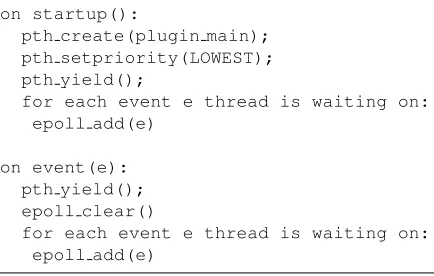
Figure 2: Pseudocode for aPth-based Shadow plug-in
the ordinary suite of POSIX I/O operations, such as read-ing and writread-ing on files and sockets. The Pth version of an I/O operation ensures that the underlying file de-scriptor is in non-blocking mode; instead of blocking, it usespth yieldto yield to the scheduler and indicates which events it can wait for.
Ordinarily, thePthscheduler will activate threads un-til every thread is blocked waiting for an I/O event, and then it will use selectin blocking mode to ac-tually wait for an event. A plug-in using Pth directly would violate Shadow’s assumption that the plug-in pro-cesses each event quickly and then returns control back to Shadow.
We take a simple approach that bypassesPth’s block-ing call toselect. Instead, we ensure that the “Shadow thread” is always available to run, but assign it the lowest-priority value so that it is only activated when ev-ery other thread is blocked. (The “main thread” of the application code is run inPththread with ordinary prior-ity). When the Shadow thread receives an event, it yields to thePthscheduler which activates any threads that can now run. When no more threads can run, the Shadow thread inspects which events the other threads are waiting for, and translates these into epoll event requests, which Shadow recognizes. Pseudocode for this plug-in archi-tecture is given in Figure 2(compare with pseudocode for a typical Shadow plugin in Figure1).
Supporting select. Pth uses select-based tools for manipulating file descriptors. These crucially assume that the file descriptor is less than 1024. However, epoll-based programs do not make this assumption. Shadow is currently unfriendly to such programs, since the virtual
mapped file descriptors may be any large number, and in fact every “instance” in Shadow has a unique number.
To fix this, we added an extra layer of mapping be-tween file descriptors. For each instance, Shadow main-tains a mapping between the local file descriptor num-ber (which is typically less than 1024) and actual file de-scriptors on the host (which will be unique among all instances, and therefore typically greater than 1024 in number).
Interposition of Pthreads. While the approach de-scribed above is suitable for writing newPth-based ap-plications, most existing application code is written to depend on thePthreads api. Our solution is to inter-cept calls intended for I/O orPthreadslibrary, and route them to the appropriatePthfunctions. Fortunately,Pth provides an emulation of thePthreadsinterface, which we were able to use mostly intact.
4
Simulating Bitcoin in Shadow
We implemented the architecture above as a reusable plug-in “template” for simulating arbitrary multi-threaded applications; the template simply calls the ap-plication’s “main” function to create a new instance. As a proof-of-concept, we used this framework to build a Shadow plug-in for bitcoind. We now describe the archi-tecture of bitcoind and several further changes we needed to make to Shadow to support it.
The Satoshi Client. While the Bitcoin network com-prises dozens of different client implementations, thede factostandard is the “reference client” (also known as,
bitcoind, mainline, or the Satoshi client). There is arguably no authority to define an “official” client; re-gardless, asbitcoindremains far and away the most widely used client,3 other alternative clients generally aim for full compliance with its behavior.
The reference client was originally written by the pseudonymous author, Satoshi Nakamoto, and published to a cryptography mailing list. Since then, it has been maintained as a free software project. The reference client is written in C++, and uses a heterogeneous multi-threaded architecture. The basic architecture of
bitcoindhas remained unchanged, despite frequent version updates with optimizations and new features. It contains dependencies on several libraries such as Lev-elDB and Boost.4
3The reference client is the most popular among “reachable”
nodes that receive incoming connections. According tohttps:// getaddr.bitnodes.io/, which performs daily crawls of the net-work, recent versions of Satoshi accounts for 83% of the reachable nodes. BitcoinJ is likely more popular among mobile clients, which are often behind a firewall and do not receive incoming connections.
4We omit BerkeleyDB by compiling bitcoind without the “wallet”
The reference client interacts with the rest of the net-work by sending and receiving messages. It uses one connection handler thread for each connected peer, but a single main thread that processes messages arriving in a queue. It maintains eight outgoing connections by de-fault, and handles up to 117 incoming connections. This multithreaded architecture makes use of both blocking and non-blocking behavior. For example, although each peer connection uses a non-blocking socket, the connec-tion thread performs a blockingsleepfor 100 millisec-onds in between polling the socket.
Supporting C++ in Shadow.Shadow supports ordinary static variables by initializing them once, then memoiz-ing the initialized state to reuse later for other instances. This is insufficient for C++, since static objects may ex-ecute arbitrary code in their constructors. We modified Shadow with an extra LLVM pass that executes all nec-essary constructors each time an instance is loaded.
Injector.In addition to thebitcoindplugin, we used our multi-threaded framework to easily build a special purpose “injector” plug-in for our experiments. The plug-in connects to a single node and performs only the minimal handshake required before sending a pay-load of messages from a file. This plug-in shares no common codebase withbitcoindwhatsoever, and in-stead uses a free library made by Bitcoin core developer Jeff Garzik called PicoCoin that provides C routines for manipulating Bitcoin protocol messages. Using this li-brary, we made a small application, the injector, that communicates with the Bitcoin network in a very lim-ited way. Effectively, it connects to a node, performs theVERSION/VERACKhandshake, delivers a payload of blocks and transactions, and then quits. It requires under 250 lines of code.
Local Sockets. We’ve taken initial steps towards sup-porting simulations of Bitcoin network measurement platforms, such as Coinscope [33], within our frame-work. Coinscope consists of multiple processes (each of which becomes a single plugin) that coordinate using local unix domain sockets (which are not currently sup-ported within Shadow). We implemented unix domain sockets as a new socket type in Shadow and are now able to directly execute Coinscope code.
5
Bitcoin Network Model
We now describe how to run thousands of simulated instances ofbitcoindto create a realistic, full-scale model of the Bitcoin network.
Bitcoin network topology. Although Shadow already supports existing datasets for the Internet topology, we must model the Bitcoin network overlay topology.
A list of the reachable IPs on the Bitcoin network can be imported from publicly available snapshots from
getaddr.bitnodes.io. We used data obtained
through our own crawls using Coinscope [33]. Our net-work model consists of 6081 nodes; roughly 40% of these are from the US, and a nearly equal amount from Europe. Our data only includes IPV4 addresses, al-though IPv6 nodes are supported by Bitcoin; according togetaddr.bitnodes.iodata, at the time of writ-ing less than 4% of nodes use IPV6.
The actual Bitcoin network forms its overlay topol-ogy through an intricate mechanism [33]. Information about potential peers propagates throughout the network through a gossip protocol. Each node maintains a list of peers it knows about, and tries to maintain exactly eight outgoing connections; when an outgoing connection is dropped, the node selects a random peer from the set it knows about and attempts to make a new connection. When a new node first joins the network, it queries sev-eral hardcoded “seed” nodes for a small starting list. Af-ter forming initial connections from this list, nodes learn about each other by relaying “ADDR” messages contain-ing the IP and port of themselves and their peers.
For simplicity, we bypassed this procedure by using existingbitcoindconfiguration options to force node connectivity. The data from our Coinscope crawls give us a set of known peer IP addresses to which each node in our model has connected. To downscale our network, we start with this 6081 node connectivity model and then re-peatedly remove the least connected node (the node with the least number of edges) as well as the edges to and from that node until reaching a network with the desired number of nodes. Finally, we configure each node with 8 connections from the remaining set of edges.
The least connected node was chosen in order to mini-mize the number of edges that get removed from the orig-inal connectivity graph. We acknowledge that this over-simplified connectivity model likely affects the accuracy of our simulated network. For example, it has been shown that the information propagation effectiveness can be influenced by even a single well-connected node [15]. Preliminary measurements of the Bitcoin network have provided evidence of many such well-connected nodes and that random graph models do not account for the ob-served network structure [33]. However, we stress that our primary goal is to demonstrate the flexibility we have in creating a topology of our choosing, and we believe that it is more important to understand how changes in a given network affect behavior than it is to precisely model the real network.
Providing initial blockchain state. Each node in the Bitcoin network typically maintains its own copy of the entire blockchain. In our model network, we begin with all the nodes “in sync” to some prior state of the blockchain.
pos-sible. Thebitcoinddata directory primarily consists of a set of block files, each of which stores up to 128 megabytes worth of blocks; and a LevelDB database that maintains an index into the block files and is used to lookup individual blocks or transactions from disk.
The block files are append-only rotated logs; once a block file reaches 128MB, it is finalized and never writ-ten to again. Therefore, each node only ever needs to write to the “newest” block file. By choosing our initial blockstate to correspond to the first block after a block file is completed, we minimize the amount of data that must be copied rather than aliased. Similarly, the Lev-elDB database consists of a number of append-only files that, once full, can also be aliased.
Overall, we are able to run a 6000 node simulation using less than 350 gigabytes of RAM and less than 300 gigabytes of storage.
Transaction Propagation ExperimentWe now explore how information propagates in Bitcoin using simulated networks at various scales.
Transactions propagate through the network using a three-round protocol. When a node receives a valid trans-action from one of its peers, it sends anINV message containing the transaction’s hash to each of its peers. When a peer receives anINVcontaining a transaction it does not know about, it requests the transaction by send-ing GETDATA. Finally, a node responds to GETDATA
with the actualTXdata.
INVmessages aren’t sent immediately; instead,INV
messages are buffered for each peer, and every tenth of a second, one peer is selected at random and the corre-sponding buffer is flushed. If a node hasNconnections, then for a given peer, it takes on average 10/Nseconds before theINVmessage is received.
We instantiated a model network at block height 120594, which corresponds to April 2011. In order to simulate spending coins mined then, we modified the client to recognize a hard-coded public key and replace it with a default public key for which we know the corre-sponding private key.
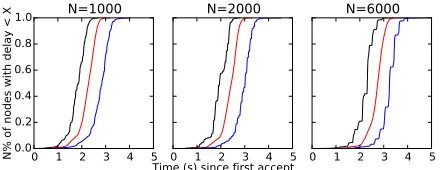
We experimented with overlay topologies containing 1000, 2000, and 6000 nodes to determine the effect of network size on transaction propagation times. For each experiment, we generated 100 transactions, and relayed them through a randomly chosen entry node. The results from these three experiments are shown in Figure3. In our model, on average, transactions take longer to prop-agate in a larger network.
In Figure4, we overlay the data for our 6000 node ex-periment on a map. There appears to be little geographic correlation with transaction propagation time, suggesting that application delays and the structure of the overlay network have a greater impact.
0 1 2 3 4 5 0.0
0.2 0.4 0.6 0.8
1.0 N=1000
0 1 2 3 4 5 N=2000
0 1 2 3 4 5 N=6000
N% of nodes with delay < X
Time (s) since first accept
Figure 3: Transaction propagation in our simulated Bitcoin net-work. (Black: minimum, red: mean, blue: maximum). Each experiment was averaged over 10, 3, and 1 runs respectively).
While these experiments demonstrate the versatility of our simulation framework, we again stress that our initial network model does not capture many salient aspects of the Bitcoin network. For example, the presence of even a small number of very well-connected nodes may have measurable impact on information propagation [15], and the presence of well-connected nodes in the Bitcoin new-tork is widely known [33]. Validating and improving our network model is ongoing work.
6
The
mapOrphans
Attack
In this section, we present novel denial-of-service attacks that exploit vulnerabilities in thebitcoind implemen-tation. We describe how we used our simulator to imple-ment and evaluate these attacks, demonstrating that our simulator framework is useful for practical research.
ThemapOrphansVulnerability. Bitcoin transactions
form a directed graph; each transaction spends some pre-viously available “input” coins, and creates several new “output” coins that can be spent by subsequent transac-tions. Consider a pair of related transactions: one trans-action (the “child”) spends a transtrans-action output created by the other (the “parent”). If a node receives these transactions out of order (i.e., first the child and then the parent), the child transaction can not be validated until the parent is received. To help with out-of-order arrivals (e.g., due to varying latency or a dropped connection), the reference client maintains a buffer called
mapOr-phans.5Transactions with unknown parents are placed
in this buffer, and are not validated until the parent is re-ceived.
This mechanism can be exploited to circumvent
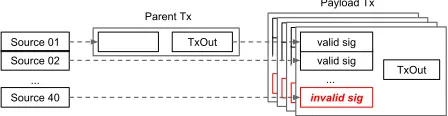
bitcoind’s defenses. The most computationally ex-pensive step in validating a transaction is checking the ECDSA signature. To prevent exhaustion attacks, signa-ture checking is deferred until all other validation steps are complete, and a node bans any peer that sends trans-actions with invalid signatures. However, when a node places transactions in mapOrphans, it forgets which peer relayed it. Thus by sending a set of (invalid) trans-actions out-of-order (as illustrated in Figure5), an at-tacker can (at low cost to itself) cause a node to perform
Figure 4: Transaction propagation in our 6000-node simulated Bitcoin network (zoomed to show Europe and North America). The large triangle (Houston) indicates the transaction origin. The color of each point indicates the time to receive a transaction (averaged over 100 trials) (blue is faster, green and yellow are longer).
ValidSig
TxOut ...
ValidSig
InvalidSig
TxOut 01 TxOut 02
... TxOut 40 valid sig
Parent Tx OrphanTx 1 through 10,000
ValidSig
TxOut ...
ValidSig
InvalidSig
ValidSig
TxOut ...
ValidSig
InvalidSig
valid sig
TxOut ...
valid sig
invalid sig
Source
Source 02
Source 40 Source 01
...
TxOut ValidSig
TxOut ...
ValidSig
InvalidSig
ValidSig
TxOut ...
ValidSig
InvalidSig
ValidSig
TxOut ...
ValidSig
InvalidSig
valid sig
TxOut ...
valid sig
invalid sig
Parent Tx
Payload Tx
Figure 5: Transactions used in themapOrphansDoS Attack.
The payload transactions are invalid and mutually conflicting. The attacker delivers these transactions to the victim out-of-order: first the payloads, and then the parent.
a large number of signature checks. Sincebitcoind
processes all transactions in a single main thread, the net result is that a victim node can be frozen until all the sig-natures have been processed.
The primary constraints on this attack are the maxi-mum size of mapOrphans(10k transactions) and the maximum size of an orphan transaction (5KB, enough to hold 40 signatures). On a test machine (Intel Core i7, 1.73Ghz), each signature verification took 1.7 millisec-onds; hence an attacker could plausibly freeze a node for over 10 minutes.
Evaluation. We implemented this attack in our sim-ulator to confirm its effectiveness. We generated a payload of transactions as described above, and used the injector plug-in to deliver it to an instance of
bitcoind(version 0.9.2).
Our simulator allowed us to make rapid itera-tions while developing and testing the implementation. In particular, the simulator’s faithfully modelling of application-level behavior helped us notice errors in our initial attempts. For example,bitcoindprocesses sig-natures in a deterministic order, which we exploit to incur the incur the greatest cost on the victim; also,
bitcoind maintains a cache of previously-validated signatures, hence the attack must consist of entirely dis-tinct valid signatures.
It is necessary to manually modify the bitcoind
code to simulate the time delay of signature validation, since Shadow models all computation as occurring in-stantaneously. Therefore we inserted asleepfunction after signature verification based on the amount of time our measurements indicate the computation should take.
We used our simulator to observe the effects of a frozen message queue on a node’s connections. What happens when it “thaws”? We experimented with this by configuring the Shadow experiment script to launch nodes and form new connections at various moments be-fore, during, and after an attack. Connections that were established prior to the attack are still serviceable after the attack subsides. Although the stalled message queue prevents the node from responding to messages from it peers, the separate connection threads prevent the socket buffers from overflowing. However, new incoming con-nection attempts are dropped, since a peer times out if the initial handshake is not completed within 60 seconds.
Memory Consumption Extension. While the victim’s main thread is busy processing invalid transactions, the connection handler threads continue to receive and buffer input from each of its peers. Each connection buffers up to 5 megabytes of messages; if this limit is reached, the connection is dropped. By using up the maximum avail-able connections (i.e., 125), and filling up these buffers to the maximum limit while amapOrphansattack is un-derway, an attacker can consume up to 500+ megabytes of RAM. This can crash nodes with a limited (but plau-sible) amount of memory.
Mitigations.We reported these vulnerabilities to the Bit-coin developers, who deployed a mitigation in version 0.9.3. The mitigation reduces the size ofmapOrphans to 500, down by a factor of 100. Also, whenever a trans-action is placed inmapOrphans, the identity of the peer who sent it is stored alongside the transaction itself. If a
mapOrphans transaction turns out to be invalid, then
that peer is disconnected. Whenever a peer disconnects, any items inmapOrphansassociated with that peer are discarded without inspection.
7
Conclusion
purposes, and describe optimizations that enable us to run thousands of Bitcoin nodes in a private test net-work. Finally, we demonstrated the efficacy of our plug-in through transaction propagation experiments, and by demonstrating novel denial of service attacks based on
themapOrphanstransaction processing queue.
Lessons Learned. Through this work, we have realized the benefit of having access to a simulation environment that runs real software. Not only does our Bitcoin simu-lator allow us to scale to the largest Bitcoin test-network known to date, but it also enables rapid prototyping of new features and fixes. In fact, when the topology size is small, our experiments run infaster than real time. We have come to appreciate this feature during our explo-ration of themapOrphansattack.
Accurate simulators, rather than simplified abstrac-tions, are ideal tools for studying the nuances of dis-tributed system software. Our work has condis-tributed to our understanding that the Bitcoin peer-to-peer protocol is flawed and highly vulnerable, and that many potential vulnerabilities and exploits lie within the low level de-tails of the Bitcoin implementation.
Future Work.Although we have demonstrated the use-fulness of our approach, and provided initial steps to-wards, it still remains for us to validate our network model by comparing it with measurements. We also hope to work with the Shadow developers to merge our work into Shadow core so that other multi-threaded ap-plications can more easily run in Shadow. Finally, we intend to continue studying the Bitcoin implementation for vulnerabilities and hope to help improve the software through mitigation techniques that we can show through simulation to be effective.
References
[1] GNU Portable Threads. http://www.gnu.org/ software/pth/.
[2] Shadow homepage and code repositories.https://shadow. github.io,https://github.com/shadow.
[3] shadow-plugin-tor code repositories. https://github. com/shadow/shadow-plugin-tor.
[4] The LLVM Compiler Infrastructure. http://www.llvm. org.
[5] The Tor Project.https://www.torproject.org/. [6] ANDRESEN, G. March 2013 Chain Fork Post-Mortem. BIP 50. [7] BAHACK, L. Theoretical Bitcoin Attacks with less than Half
of the Computational Power (draft). Tech. Rep. abs/1312.7013, CoRR, 2013.
[8] BAMERT, T., DECKER, C., ELSEN, L., WATTENHOFER, R., ANDWELTEN, S. Have a snack, pay with Bitcoins. InIEEE P2P(2013).
[9] BEN-SASSON, E., CHIESA, A., GARMAN, C., GREEN, M., MIERS, I., TROMER, E.,ANDVIRZA, M. Zerocash: Decen-tralized anonymous payments from Bitcoin. InIEEE Symposium on Security and Privacy(2014).
[10] BIRYUKOV, A., KHOVRATOVICH, D., ANDPUSTOGAROV, I. Deanonymisation of clients in bitcoin p2p network. In Proceed-ings of the 2014 ACM SIGSAC Conference on Computer and Communications Security(2014), ACM, pp. 15–29.
[11] BONNEAU, J., MILLER, A., CLARK, J., NARAYANAN, A., KROLL, J. A.,ANDFELTEN, E. W. Research Perspectives and Challenges for Bitcoin and Cryptocurrencies (Extended Version). Cryptology ePrint Archive, Report 2015/452, 2015.
[12] BONNEAU, J., NARAYANAN, A., MILLER, A., CLARK, J., KROLL, J. A., AND FELTEN, E. W. Mixcoin: Anonymity for Bitcoin with accountable mixes. InFinancial Cryptography (2014).
[13] BOWE, S. simbit - p2p network simulator. https: //bitcointalk.org/index.php?topic=603171.0, May 2014.
[14] CONRAD, B., ANDSHIRAZI, F. Analyzing the effectiveness of dos attacks on tor. InProceedings of the 7th International Conference on Security of Information and Networks(New York, NY, USA, 2014), SIN ’14, ACM, pp. 355:355–355:358. [15] DECKER, C.,ANDWATTENHOFER, R. Information propagation
in the bitcoin network. InIEEE P2P(2013).
[16] ENGELSCHALL, R. S. Portable multithreading: The signal stack trick for user-space thread creation. InProceedings of the annual conference on USENIX Annual Technical Conference (2000), USENIX Association, pp. 20–20.
[17] EYAL, I. The Miner’s Dilemma. InIEEE Symposium on Security and Privacy(2015).
[18] EYAL, I.,ANDSIRER, E. G. Majority is not enough: Bitcoin mining is vulnerable. InFinancial Cryptography(2014). [19] GEDDES, J., JANSEN, R.,ANDHOPPER, N. How low can you
go: Balancing performance with anonymity in Tor.
[20] HEARN, M. Testnet in a box. https://bitcointalk. org/index.php?topic=4483.0, March 2011.
[21] HEILMAN, E., KENDLER, A., ZOHAR, A.,ANDGOLDBERG, S. Eclipse attacks on bitcoins peer-to-peer network.
[22] JANSEN, R., BAUER, K., HOPPER, N.,ANDDINGLEDINE, R. Methodically modeling the Tor network.
[23] JANSEN, R., GEDDES, J., WACEK, C., SHERR, M., AND SYVERSON, P. Never been KIST: Tor’s congestion management blossoms with kernel-informed socket transport.
[24] JANSEN, R.,ANDHOPPER, N. Shadow: Running Tor in a box for accurate and efficient experimentation. InProceedings of the 19th Symposium on Network and Distributed System Security (NDSS)(2012).
[25] JANSEN, R., JOHNSON, A., AND SYVERSON, P. LIRA: Lightweight incentivized routing for anonymity.
[26] JANSEN, R., SYVERSON, P.,ANDHOPPER, N. Throttling Tor bandwidth parasites.
[27] JANSEN, R., TSCHORSCH, F., JOHNSON, A.,AND SCHEUER-MANN, B. The Sniper Attack: Anonymously deanonymizing and disabling the Tor network.
[28] JOHNGEDDES, R. J.,ANDHOPPER, N. Tor IMUX: Managing connections from two to infinity, and beyond. InProceedings of the 12th Workshop on Privacy in the Electronic Society (WPES) (November 2014).
[29] JOHNSON, A., WACEK, C., JANSEN, R., SHERR, M., AND SYVERSON, P. Users get routed: Traffic correlation on tor by realistic adversaries.
[30] KOSHY, P., KOSHY, D., ANDMCDANIEL, P. An analysis of anonymity in bitcoin using p2p network traffic. Springer, 2014. [31] LATTNER, C.,ANDADVE, V. LLVM: A Compilation
Frame-work for Lifelong Program Analysis & Transformation. In Pro-ceedings of the 2004 International Symposium on Code Gener-ation and OptimizGener-ation (CGO’04)(Palo Alto, California, Mar 2004).
[32] MEIKLEJOHN, S., POMAROLE, M., JORDAN, G., LEVCHENKO, K., MCCOY, D., VOELKER, G. M., AND SAVAGE, S. A Fistful of Bitcoins: Characterizing Payments Among Men with No Names. InIMC(2013).
[34] NAKAMOTO, S. Bitcoin: A Peer-to-Peer Electronic Cash Sys-tem.http://bitcoin.org/bitcoin.pdf, 2008. [35] VALENTA, L.,ANDROWAN, B. Blindcoin: Blinded,
Account-able Mixes for Bitcoin. InWorkshop on Bitcoin Research(2015). [36] VAN SABERHAGEN, N. Cryptonote v 2.0. https://