Cryptanalysis of Round-Reduced
LED
Ivica Nikoli´c, Lei Wang and Shuang Wu
Division of Mathematical Sciences, School of Physical and Mathematical Sciences, Nanyang Technological University, Singapore
{inikolic,wang.lei,wushuang}@ntu.edu.sg
Abstract. In this paper we present known-plaintext single-key and chosen-key attacks on round-reducedLED-64 andLED-128. We show that with an application of the recently proposedslidex attacks [7], one immedi-ately improves the complexity of the previous single-key 4-step attack on LED-128. Further, we explore the possibility of multicollisions and show single-key attacks on 6 steps ofLED-128. A generalization of our multicollision attack leads to the statement that no 6-round cipher with two subkeys that alternate, or 2-round cipher with linearly dependent subkeys, is secure in the single-key model. Next, we exploit the possi-bility of finding pairs of inputs that follow a certain differential rather than a differential characteristic, and obtain chosen-key differential dis-tinguishers for 5-stepLED-64, as well as 8-step and 9-stepLED-128. We provide examples of inputs that follow the 8-step differential, i.e. we are able to practically confirm our results on 2/3 of the steps ofLED-128. We introduce a new type of chosen-key differential distinguisher, called random-differencedistinguisher, and successfully penetrate 10 of the to-tal 12 steps ofLED-128. We show that this type of attack is generic in the chosen-key model, and can be applied to any 10-round cipher with two alternating subkeys.
Key words: LED, lightweight, multicollision, single-key attack, chosen-key attack
1
Introduction
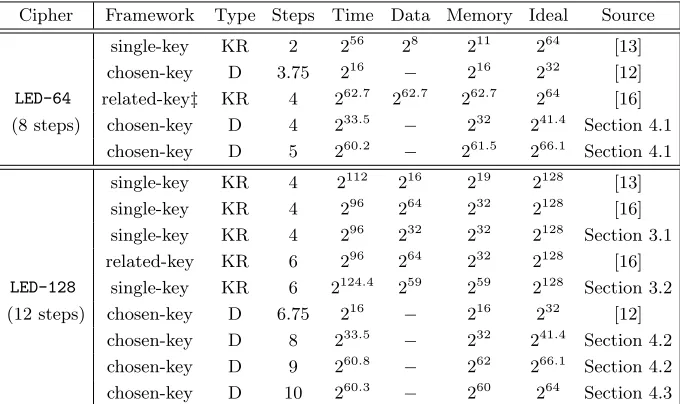
In the submission paper, the designers provide analysis ofLEDagainst various attacks – we mention the attacks in the chosen-key model: 15 rounds forLED-64 and 27 rounds for LED-128. Isobe and Shibutani [13] show single-key attacks onLED-64 reduced to 8 rounds, and LED-128reduced to 16 rounds. Mendelet al. [16] give a supplementary cryptanalysis in different single and related-key models for both versions of the cipher. They are able to penetrate 16 rounds in the related-key model forLED-64, and 24 rounds forLED-128, with an additional single-key attack on 16 rounds of LED-128. An independent work proposed by Bodganovet al.in [3, 4] also introduced similar related-key attacks on the generic structure of two-round SEM [7] with three identical keys.
Table 1.Attacks onLED. KR is key recovery and D is distinguisher.
Cipher Framework Type Steps Time Data Memory Ideal Source
LED-64
single-key KR 2 256 28 211 264 [13] chosen-key D 3.75 216 − 216 232 [12]
related-key‡ KR 4 262.7 262.7 262.7 264 [16] (8 steps) chosen-key D 4 233.5 − 232 241.4 Section 4.1
chosen-key D 5 260.2 − 261.5 266.1 Section 4.1
LED-128
single-key KR 4 2112 216 219 2128 [13] single-key KR 4 296 264 232 2128 [16]
single-key KR 4 296 232 232 2128 Section 3.1
related-key KR 6 296 264 232 2128 [16] single-key KR 6 2124.4 259 259 2128 Section 3.2 (12 steps) chosen-key D 6.75 216 − 216 232 [12]
chosen-key D 8 233.5 − 232 241.4 Section 4.2
chosen-key D 9 260.8 − 262 266.1 Section 4.2 chosen-key D 10 260.3 − 260 264 Section 4.3
‡: Complexity is based on the 6 found pairs that follow the iterative characteristic.
2
Specification and Related Works
In this section we give a brief description of theLEDand present related analysis relevant for understanding our attacks.
2.1 The Block Cipher LED [12]
LEDuses a block size of 64 bits and a key size ranging from 64 bits to 128 bits. The two primary instances,LED-64andLED-128, use a 64-bit key and an 128-bit key, respectively.
The key schedule is trivial and very efficient:LED-64 uses the 64-bit secret key in each step as a subkey, whileLED-128divides the 128-bit secret keyKinto halvesK0||K1 and usesK0andK1 alternatively as the subkeys, i.e.K0 is used in the even steps, while K1 is used in the odd steps. LEDfollows the standard iterative cipher structure, producing the ciphertext C from a plaintext P in t
iterations of a so-called step functionFi (see Fig. 1):
S0←−P
Si+1←−Fi(Si⊕Ki),0≤i≤t−1 C←−St⊕Kt
In LED-64 the number of steps t is 8, while in the other instances including LED-128,tis defined as 12. The step functionFiis a 4-round AES-like
Fig. 1.LEDand its two primary instancesLED-64andLED-128
Thus, all the step functions Fi can be seen as public permutations and differ
only in the round constants they use. Since most of our attacks can be mounted independently of the specification of the step functions, we omit their description and refer the interested reader to [12, 11] for a full specification.
2.2 Related Attacks on the Even-Mansour Scheme
The Even-Mansour scheme [8] uses two secret keys (K0, K1) and a public permu-tationF to construct a cipher EMK0,K1(P) =F(P⊕K0)⊕K1(see Fig. 2). This
scheme is very attractive due to its extremely simple design with a provable security margin. Several papers on cryptanalysis of Even-Mansour have been published. This section briefly describes the attacks relevant to our paper.
Daemen’s attack [6]. The chosen-plaintext attack of Daemen can be sketched as:
1. Choose a non-zero difference∆.
2. Choose 2d different random values as plaintexts P, query P and P⊕∆ to
the Even-Mansour scheme to receive the corresponding ciphertexts C and
C0 respectively, and compute and store∆C =C⊕C0.
3. Choose a random valueX, compute∆F(X) =F(X)⊕F(X⊕∆), and check if∆F(X) is among the stored∆C computed at step 2. If a match is found, then computeK0 = P⊕X and K1 =F(X)⊕C and confirm on another pair of plaintext-ciphertext that the values are correct.
After repeating the step 3 around 2n−d times, where n is the block size, the
secret keys are expected to be recovered. Thus the overall complexity is 2dchosen
plaintexts and 2n−d encryptions.
Slidex attack [7]. Dunkelman et al. were able to match the complexity of Daemen’s attack with only known-plaintexts, using a so-called slidex attack. Let us assume the attacker obtains 2d known plaintext-ciphertext pairs (P
i, Ci).
Then the slidex attack can be described as:
1. Choose a random non-zero difference∆.
2. For all (Pi, Ci), compute a set ofF(Pi⊕∆)⊕Ci, and search for a collision
in the set.
3. If a collision is found, e.g. F(P⊕∆)⊕C = F(P0⊕∆)⊕C0, then K0 =
P⊕P0⊕∆.
4. Otherwise, go to step 1.
After repeating the steps 1−4 around 2n−2d times, the correct value of K
0 is expected to be recovered. With the knowledge of K0, the value of K1 can be trivially recovered using a single known pair (P, C). Thus the overall complexity is 2d known plaintexts and 2n−d encryptions.
An attack on SEM [7]. Dunkelman et al. proposed a single-key variant of the Even-Mansour scheme depicted in Fig. 3, which uses the same secret key as both the pre- and the post-whitening keys, i.e. F(P⊕K)⊕K. Following the notation from [7], we refer to this single-key variant as SEM. Dunkelmanet al.
provided once more a known-plaintext attack on SEM based on the observation thatP⊕C=X⊕Y. Again, we assume the attacker obtains 2dknown
plaintext-cihertext pairs (Pi, Ci). The steps of the attack are as follows:
1. Compute a set ofPi⊕Ci for all 2d (Pi, Ci).
2. Choose a random value ofX, compute Y =F(X), and matchX⊕Y to the values ofP⊕C from the set computed at step 1.
3. If a match is found,K=P⊕X. 4. Otherwise, go to to step 2.
After repeating the steps 2−4 around 2n−d times, the correct value of K is expected to be recovered. Thus the complexity is 2d known plaintexts and 2d+ 2n−d computations.
2.3 Key-Recovery Attacks on LED
Three-subset meet-in-the-middle attacks on LED [13]. Isobe and Shibu-tani applied the attack framework formalized by Bogdanov and Rechberger [5] to LED in a very original and non-trivial manner [13] and presented chosen-plaintext attacks on 2-step LED-64 and 4-step LED-128. Their complexity on 4-stepLED-128is 216chosen plaintexts and 2112encryptions. We stress that the time complexity of their attacks cannot be reduced when more data is available.
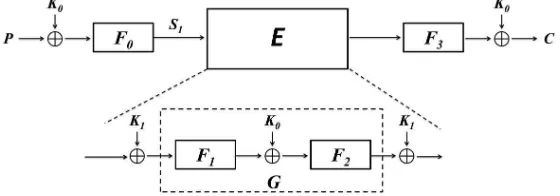
Guess-and-recover attacks on LED-128 [16]. Mendelet al. published key-recovery attacks on 4-step and 6-stepLED-128in the single-key and the related-key settings, respectively. The main strategy of their attacks is first to guess the value of K0 in order to peel off the first and the last step functions, and then to efficiently recover the value of K1 by attacking the shortened cipher. In this paper we call such attack strategy guess-and-recover. The attack on 4-stepLED-128(depicted in Fig. 4) starts by guessing the keyK0, thus the 4-step LED-128 is shortened to a cipher E, and moreover G(in Fig. 4) becomes now a public permutation. As E follows the Even-Mansour scheme, Mendel et al.
adopted Daemen’s attack [6] sketched in Section 2.2 to recover the key K1. In particular, for an inputS1 to the cipherE, in order to get the value ofE(S1), the attacker computesP =F0−1(S1)⊕K0, then queriesP toLED-128to receive the corresponding ciphertextC, and finally computes F3−1(C⊕K0) asE(S1). Note, Mendel et al.’s attack is a known/chosen-plaintext attack and since the Daemen’s attack procedure is executed for each guess ofK0 (thus repeated 264 times), the data complexity of the attack equals the entire codebook while the time complexity is 296 encryptions. The authors point out that the attacker is able to reduce the data complexity below the entire codebook, however then he has to sacrifice the time complexity, i.e. the time will increase proportionally. We stress that the attack becomes a chosen-plaintext attack if the data complexity is less than the entire codebook, otherwise it can be considered known-plaintext attack (it requires the whole codebook, hence there is no difference between chosen and known plaintext).
Mendelet al.were able to extended the above attack on 4 steps to 6 steps ofLED-128in the related key settings. A pictorial view of the guess-and-recover
strategy on 6-step LED-128 is given in Fig. 5. The attack uses a related key
K0 =K0||K10, where K10 isK1⊕∆. LetE0 be the shortened cipher under the related key K0. For a random valueS1, inside the computations of E(S1) and
E0(S1⊕∆), the difference∆G1(S1) =G1(S1⊕K1)⊕G1(S1⊕∆⊕K10) is always 0. Hence the input difference ofG2 is always ∆. Thus Daemen’s attack can be applied to recover the value ofK1in a straightforward way with the same data and time complexity.
Attacks on LED-64 exploiting differential characteristics for the step functions [16]. Mendel et al. proposed as well attacks on 3-step and 4-step LED-64 in the related-key setting, by investigating the differential properties of the step functions of LED, in particular differential characteristics with high height as well as iterative differential characteristics. For the public permutations used in the step function, the authors found differential characteristics with a probability of around 2−54, while theoretically it may go up to 2−50 (25 active Sboxes and each with 2−2). In one part of our analysis, we use the results of [16], and in order to provide conservative results, we assume the optimal differential characteristic for the step functions to hold with probability 2−54. However, as pointed out by Mendelet al., differential characteristics with a better probability may exist and if such characteristic is found, our attack complexity will be immediately improved.
2.4 Differential Multicollisions for Block Ciphers [1]
This concept was introduced by Biryukovet al.[1]. It can be defined as follows:
Definition 1. A differential q-multicollision for the block cipher EK(·) is
de-fined as a set of two differences∆P and∆K andqkey-plaintext pairs(K1, P1), (K2, P2),. . .,(Kq, Pq)that satisfy the relation:
EK1(P1)⊕EK1⊕∆K(P1⊕∆P) = EK1(P2)⊕EK2⊕∆K(P2⊕∆P) =
· · ·=
EKq(Pq)⊕EKq⊕∆K(Pq⊕∆P),
Biryukovet al. have proven that it takes at leastq·2qq−2+2n queries to produce a
differentialq-multicollision for anidealn-bit block cipher. Thus if an attacker can find a differentialq-multicollision on a dedicated block cipher with a complexity less than the lower bound q·2qq−2+2n, he can distinguish the cipher from ideal in
3
Key-Recovery Attacks on
LED-128
in the Single-Key
Setting
In this section we present key recovery attacks on 4 steps and 6 steps ofLED-128 in the single-key framework. The attacks are independent of the definition of the step function, and the data is always known-plaintext.
3.1 Attack on 4 Steps
We can improve the previous key-recovery attacks on 4-step LED-128 in a rel-atively straightforward way. Our attack follows the guess-and-recover strategy, which is depicted in Fig. 4. First, note that the shortened cipher E is the SEM scheme. Thus after guessing the value K0, to recover K1 instead of adopting Daemen’s approach [6] as in the previous attack [16], we apply Dunkelman et al.’s slidex attack or their attack approach on SEM [7] sketched in Section 2.2. This immediately gives us the first advantage: our attack is a known-plaintext attack. Moreover, based on the complexity evaluation given below, our approach has a second advantage: the complexity also gets improved. Since we will extend the below approach to attack 6-stepLED-128in Section 3.2, here we give a de-tailed description of the complete attack approach. The notations below follow the one from Fig. 4.
Attack procedure. Suppose the attacker obtains 2dknown plaintext-ciphertext
pairs (P, C).
1. Guess the value ofK0.
2. For all 2dpairs (P, C), computeS1=F0(K0⊕P) andE(S1) =F3−1(K0⊕C), then computeS1⊕E(S1), and store the pairs (S1, S1⊕E(S1)).
3. Choose 264−d different random values denoted asX. For eachX:
(a) Compute G(X)⊕X, and match it toS1⊕E(S1) stored at step 2. (b) If a match is found, compute the value S1⊕X as a candidate ofK1.
Otherwise, go to step 3(a) with the next value ofX.
(c) Verify the correctness of the candidate forK1by using another (S10, E(S10)), whereS10 is not equal to S1. In particular, compute the value for E(S10) using the current guessedK0 and the candidateK1, and check whether it is equal to the value forE(S10) computed at Step 2. If they are equal, output the currently guessed K0 and the candidate K1 as the real key, and terminate the procedure. Otherwise, go to step 3(a) with the next value ofX.
4. Change the value of K0, and repeat steps 1−3 until all possible values of
Complexity. The unit is one computation of the whole 4-stepLED-128 consist-ing of four step functions. The steps 1−3 are repeated 264times. One execution of step 2 requires 2d×2
4 = 2
d−1computations. In one execution of step 3, step 3(a) is repeated 264−dtimes, and therefore the total complexity is 264−d×2
4 = 2 63−d.
At step 3(b), on average there is one match among all the 264−d repetitions.
Hence the complexity of steps 3(b) and 3(c) is 1. Thus the overall time complex-ity is 264·(2d−1+ 263−d+ 1)≈263+d+ 2127−d, while the data complexity is 2d
known plaintext-ciphertext pairs, and 2d memory required in step 2.
Success probability. When the guessed value ofK0 is correct, if one random
X at step 3 collides withS1⊕K1 for someS1 computed at step 2, the value of
K1will be correctly recovered. The probability of a such collision is 1−1e≈0.63.
Comparison to previous attacks. The optimal time complexity of our attack is 296by settingdto 32, while the data complexity is 232. Previous attacks either cannot reach such low time complexity (e.g. [13]) or with a much higher data complexity, i.e. the entire codebook, for the same time complexity (e.g. [16]).
3.2 Attack on 6 Steps
We can extend the above attack to 6-stepLED-128 by using multicollisions. As depicted in Fig. 5, the shortened cipher E after guessing K0 can be regarded as a two-step SEM. The relationS1⊕E(S1) =X⊕S5 holds. Suppose we have a q-multicollision on E(S1)⊕S1. Namely, we find q valuesS1(1), S1(2), . . ., S1(q)
such thatE(S1(1))⊕S1(1)=E(S1(2))⊕S1(2)=· · ·=E(S1(q))⊕S1(q)holds. Denote the value ofE(S1(i))⊕S1(i), 1≤i≤q, byY. Let us select a random value asX, then setS5as X⊕Y, and compute the valueG1(X)⊕G−21(S5) as a candidate value of K1, which can be verified trivially. Note that if X is equal to any of
S1(i)⊕K1, 1≤i≤q, the computed candidate is the correct value ofK1. Thus after testing 264/q random values asX, the real value ofK1 is expected to be recovered. Recall that such attack procedure needs to be repeated for each guess ofK0, i.e. in total 264times. Hence the overall complexity is 2128/q. The details of the attack procedure are given below - for q = 8 the attack has the lowest complexity.
Attack procedure. The attacker obtains 259known plaintext-ciphertext pairs (P, C).
1. Guess the value ofK0. 2. For all 259 (P, C), compute S
1 =F0(P⊕K0) andE(S1) =F5−1(C⊕K0). Then computeS1⊕E(S1) and store (P, S1, S1⊕E(S1)).
3. Find an 8-multicollision on S1⊕E(S1), namely a set of (P(1), S (1) 1 , S
(1)
1 ⊕
E(S1(1))),. . ., (P(8), S(8) 1 ,S
(8) 1 ⊕E(S
(8)
1 )) such thatS (1) 1 ⊕E(S
(1) 1 ) =S
(2) 1 ⊕
asY. If no such 8-multicollision exists, go to step 1 with another guess value asK0.
4. Choose 261 random values asX. For each value ofX: (a) Compute X⊕Y asS5.
(b) ComputeG1(X)⊕G−21(S5) denoted asZ.
(c) Compute X ⊕Z, and match it to {S1(1), . . . , S1(8)}. If it is matched to someS1(i), thenZ is regarded as a candidate value ofK1. Otherwise, go to step 4(a) with the next value ofX.
(d) Verify the correctness ofZ asK1 by using another relation (S1, E(S1)) with S1 6= S
(i)
1 . If it is correct, set K1 = Z, then output the current guessed value of K0 and K1 as the real key, and terminate the attack procedure. Otherwise, go to step 4(a) with the next value ofX.
5. Change the value of K0, and repeat steps 1−4 until all possible values of
K0 are tested.
Complexity. The unit is one computation of the whole 6-step LED-128. The steps 1−4 are repeated 264times. One execution of step 2 has the complexity of 259×2
6 ≈2
57.4. In one execution of step 4, steps 4(a), 4(b) and 4(c) are repeated 261times, and the total complexity is 261×4
6 ≈2
60.4. On average, there is only one match at step 4(d) among 262 random values. Thus the complexity of step 4(e) is 1. Therefore the overall time complexity is 264·(259.4+ 260.4+ 1)≈2124.4, while data complexity is 259known plaintexts. The memory requirement is 259 for step 2.
Success Probability. We focus on the success probability of recovering K1, when the guessed value of K0 is correct. First we evaluate the probability of 8-multicollisions at step 2. It has been proven that a q-multicollision among
q
√
q!∗2q−1q n n-bit random values exists with a probability 0.5 [9, 18]. By setting
q = 8 and n = 64, √qq!∗2q−1q n is smaller than 258. Since we have in total 259 values, the probability of an 8-multicollision is almost 1. Then we evaluate the probability of a collision between a random value X and a S1(i)⊕K1. The probability of such a collision is 1−1
e ≈0.63. Thus the overall success probability
is 0.63.
Remark. We emphasize that our attack is not related to the specification of step functions, and thus applicable to any 6-step Even-Mansour scheme with the key schedule of alternating two keys. The advantage of our attack is related to the block size n. A shown above for the case n= 64, q is chosen as 8, and the complexity is 23.6times faster than the brute-force attack. In particular, for the common block sizen= 128,qcan be 16, and our attack becomes 24.6 times faster than the brute-force attack.
As we can see from the above analysis, the 6-step attack is actually based on a 2-step multicollision-type attack (the permutations G1, G2 with subkey additions), that is applicable to any permutations G1, G2. Thus we can derive the following interesting fact:
Observation 1 For any two-round n-bit cipher EK(P) = G2(G1(P ⊕K)⊕
L1(K))⊕L2(K), whereG1, G2are arbitrary permutations, andL1, L2are linear
bijective functions, exists a known-plaintext attack a with time complexity of less than2n encryption queries.
It is worth mentioning that Observation 1 actually answers the open problem proposed in [3, 4] that there is indeed a single-key attack on two-round SEM structure with three identical keys with computational complexity below 2n.
4
Chosen Key Differential Distinguishers for
LED-64
and
LED-128
The designers of LED pointed out in the specification document [12], that in order to gain confidence in the cipher, one should study the security of the ci-pher in the framework where the attacker knows or controls the key. Using the rebound [15] and Super-Sbox [10, 14] techniques, they were able to penetrate 15 rounds (3.75 steps) of LED-64, and 27 rounds (6.75 steps) ofLED-128. The design strategy underlying LED, in particular the trivial key schedule and fact that the best probability of a differential characteristic in an active step ofLED cannot be higher than 2−50, seem to confirm the findings of the designers. As LED-64has 128-bit input (64-bit key and 64-bit state), it leads that a differential characteristic cannot have more than 2 active steps, otherwise the probability (for 3 steps) would be at most 2−150, and the freedom of the 128-bit input is insufficient to satisfy the characteristic. Similarly, for LED-128, the best char-acteristic cannot have more than 3 active steps, as the probability of a 4-step characteristic would be at most 2−200, hence the 192-bit input (128-bit key and 64-bit plaintext) is insufficient for this characteristic.
Fig. 6.Distinguisher on 5-stepLED-64
differences. Hence if we can efficiently find a pair of inputs that follow this dif-ferential, then we would spend only 64-bits of freedom, instead of 100 bits as in the case of characteristics.
The results presented in this section give solutions for finding such pairs, and use the additional freedom to penetrate more steps ofLED.
4.1 Differential Multicollision on 5-step LED-64
Our distinguisher is based on the differential path given in Fig. 6. The path is built by fixing an optimal differential characteristic in the last step function
F4: ∆→∆∗, which determines the value of∆ and∆∗, and then the following values are set as well: ∆P = ∆, ∆K = ∆ and ∆C = ∆ ⊕∆∗. Note, the differential characteristic ∆ → ∆∗ holds with a probability of at least 2−54, following Mendel et al.’s investigation [16] described in Section 2.3. After the path is determined, we search for pairs (P, K) satisfyingLED-64K(P)⊕LED-64
K⊕∆(P⊕∆) =∆⊕∆∗. The search procedure starts with launching a
meet-in-the-middle attack between step functionsF1 andF2. Note that both the input difference ofF1and the output difference ofF2are fixed as∆. We select random values X and Y, and independently compute ∆F1(X) = F1(X)⊕F1(X ⊕∆) and∆F2−1(Y) =F2−1(Y)⊕F2−1(Y ⊕∆). Then we match between∆F1(X) and
∆F2−1(Y)⊕∆. For a match, by adaptively selecting two valuesF1(X)⊕F2−1(Y) andF1(X)⊕F2−1(Y⊕∆) as the keyKand computing the corresponding values ofP from (K, X), we obtain two pairs (K, P) which can satisfy the path on the first four step functions in Fig. 6. Finally, the differential characteristic on the last step function F4 is satisfied probabilistically.
Attack procedure.
1. Select 2s random values X, compute ∆F1(X) =F1(X)⊕F1(X⊕∆), and store (X, ∆F1(X)). The value of s will be determined in the complexity evaluation below.
2. Select 2srandom valuesY, compute∆F−1
2 (Y) =F
−1 2 (Y)⊕F
−1
2 (Y⊕∆) and match∆F2−1(Y)⊕∆ to stored∆F1at step 1. On average, there are 22s−64 matches.
3. For each matched pairX and Y,
Fig. 7.Distinguisher on 8-stepLED-128
(b) ComputeCandC0for each pair (K, Y) and (K⊕∆, Y⊕∆) respectively. (c) If ∆C is equal to ∆⊕∆∗, compute the corresponding value of P, and store the values of (P, K). On average, there are 22s−117values of (P, K) stored.
Complexity of finding differential q-multicollision. The unit is one com-putation of the whole 5-stepLED-64. The dominant complexity comes from steps 1 and 2, each of them requires 2s×1
5 units, hence the total complexity is approx-imately 2s−1.3. To produce a differentialq-multicollision, set 22s−117=q, which implies s = 58.5 + log2√q, and thus the complexity is √q·257.2. For q = 26, the overall complexity of our attack is 260.2, while the generic attack requires at least 266.1>264 encryptions.
4.2 Differential Multicollision for 8-Step and 9-step LED-128
Our distinguisher on 8-step LED-128 is based on a differential path given in Fig. 7, where ∆ can be any non-zero value. We set ∆P = ∆, ∆K = (∆K0 =
∆, ∆K1= 0) and∆C =∆. First we select a random value asK1, which makes
G1andG2to become two public permutations. Then we carry out a meet-in-the-middle attack betweenG1andG2. Note both the input differences ofG1and the output differences ofG2 are fixed as∆. We adopt the same meet-in-the-middle procedure as the one presented in Section 4.1, and adaptively choose the value of
K0. As the rest of the differential path holds with probability 1, the chosenK0 with previously fixedK1andP, which can be computed trivially fromX, is the expected solution, namely it satisfy the whole differential path. Following the complexity evaluation as in Section 4.1, our attack needsq·230.5 computations to produce a differentialq-multicollision, hence forq= 8, the overall complexity is 233.5, while the generic attack needs at least 241.4.
We would like to emphasize two aspects (freedoms) of our attack on 8 steps of LED-128: first, the difference inK0 can be any, and second, the value ofK1 can be arbitrary as well. Even with such relaxed requirements, we are still able to find a pair that follows the differential path with a complexity of around 230.5 8-step encryptions. An example of such pair, found on a computer, is given in Table 2. Note, in the example the difference inK0is 1 and the value ofK1is 0.
Table 2.An example of pair of inputs following the 8-STEP (32 rounds) differential for LED-128. The two rows of each step denote the input and output values/differences of the steps.
Input 1 Input 2 XOR difference
K0 63686a8c6ed193f6 63686a8c6ed193f7 0000000000000001
K1 0000000000000000 0000000000000000 0000000000000000
plaintext 33960e4a40a0f740 33960e4a40a0f740 0000000000000001
step 0 50fe64c62e7164b6 50fe64c62e7164b6 0000000000000000 e82c1e07da3b4304 e82c1e07da3b4304 0000000000000000 step 1 e82c1e07da3b4304 e82c1e07da3b4304 0000000000000000
3bb5fd710efb3bba 3bb5fd710efb3bba 0000000000000000 step 2 58dd97fd602aa84c 58dd97fd602aa84d 0000000000000001 50fdeb1af852210e 56c051f2c88d007a 063dbae830df2174
step 3 50fdeb1af852210e 56c051f2c88d007a 063dbae830df2174 eb82dccf19e68610 fe5507900afd76ad 15d7db5f131bf0bd
step 4 88eab643773715e6 9d3d6d1c642ce55a 15d7db5f131bf0bc c6dbdb083c8dfccb b688dc44effea528 7053074cd37359e3
step 5 c6dbdb083c8dfccb b688dc44effea528 7053074cd37359e3 ef7e6ce5ebb78007 ef7e6ce5ebb78006 0000000000000001 step 6 8c160669856613f1 8c160669856613f1 0000000000000000 5f2a1e2a6f01e9eb 5f2a1e2a6f01e9eb 0000000000000000
step 7 5f2a1e2a6f01e9eb 5f2a1e2a6f01e9eb 0000000000000000 337e6d7828ea8fec 337e6d7828ea8fec 0000000000000000
ciphertext 501607f4463b1c1a 501607f4463b1c1b 0000000000000001
characteristic for the last step function F9: ∆ → ∆∗, i.e. we use again the same characteristic that holds with 2−54. Then the differential is defined as
∆P =∆,∆K = (∆K0=∆, ∆K1= 0), and∆C=∆∗. The distinguisher uses a differential path, which is a concatenation of the path on the first 8 step functions from Fig. 7 and the characteristic ∆→∆∗ for the last step functionF9. After selecting a random value asK1, we apply exactly the same search procedure as in Section 4.1. However, this time instead of producing q pairs that follow the 8-step differential, we produce q254 such pairs. Obviously, after the last step, there would be aroundqpairs that satisfy the whole 9-step differential.
The complexity is dominated by the meet-in-the-middle attack and the gen-eration of q254 pairs for the 8-step differential. To optimize the complexity, we should create√q259differences for eachG
1andG2, hence there would beq2118 pairs in the middle and q2118−64=q254 that follow the 8-step differential or q pairs for the whole 9-step differential. Thus taking into account that theG1, G2 take 29 of the total number of rounds, the overall complexity for q = 26 is 2·23259 2
9 = 2
4.3 A Differential Distinguisher on 10-Step LED-128
In this section we introduce the concept of chosen-keyrandom-difference distin-guisher and present such distindistin-guisher for 10 steps ofLED-128.
In differential multicollisions, the attacker finds a set of two differences for the key and the plaintext, such that all the differences in the ciphertext of q
pairs of keys/plaintexts, are the same. Thus the freedom is three differences: in the key, in the plaintext, and in the ciphertext, and therefore, to prove the distinguisher is not trivial, the attacker has to find many pairs of keys/plaintexts that follow the same differential. Now assume, the freedom is only in one of the input differences, and the other two depend on (or are equal to) this single difference, i.e. the attacker wants to find a key/plaintext (K, P) such that for some given difference ∆, EK⊕∆(P ⊕∆)⊕EK(P) =∆ holds. Obviously, if the
difference ∆ is random, he cannot find the input pair with a complexity lower than 2n (see below), wherenis the block size. However, one might reasonably
argue, that if the attacker has to provide a single pair of key/plaintext, then he can use the additional freedom of the difference and come up with his own
∆ in time complexity lower than 2n, and thus achieve such distinguisher. Our
distinguisher below thwarts such approach, since it requires the attacker to be able to build the input pair forany random difference∆. This type of problem already has been analyzed in the work of Patarin [17] – he has shown that the xor of two random permutations cannot be distinguished from a pseudo-random function with less than 2n queries. In our case, the permutations are defined as
P1(X) =P1(K, P, ∆) =EK⊕∆(P ⊕∆) andP2(X) =P2(K, P, ∆) =EK(P)⊕ ∆, i.e. they are keyed with both K and ∆, and for fixed values of these two parameters they are two distinct permutations (as long as∆6= 0). In the chosen-key scenario discussed below, although the chosen-key can be chosen, the difference∆is still arbitrary and unknown, hence Patarin’s proof again applies to the pseudo-random function (PRF)P1(X)⊕P2(X), which can be translated into finding a preimage of 0 for the PRF, as fromEK⊕∆(P⊕∆)⊕EK(P) =∆is follows we
are looking at the conditionP1(X)⊕P2(X) = 0. The complexity of finding such preimage for ann-bit PRF is 2nqueries, and thus encryptions/decryptions. Now
we are ready to give a formal definition of this non-trivial distinguisher:
Definition 2. A random-difference distinguisher exists for the cipher EK(P),
if for any randomly chosen ∆, the attacker with a complexity less than 2n en-cryptions/decryptions can find a plaintext P and a key K, such that EK(P)⊕ EK⊕∆(P⊕∆) =∆.
Further, we show this type of distinguisher can be found for 10-stepLED-128, i.e. we show that for a randomly chosen∆, with less than 264queries/encryptions we can find the inputP, K0, K1such thatEK0⊕∆||K1(P⊕∆)⊕EK0||K1(P) =∆.
same MITM procedure as the one in Section 4.1, and find pairs (K1, X), where
X is the output value ofF3, satisfying the differential path on the first four step functions. Similarly, we perform MITM on the other side, between F6 andF7, and find pairs (K1, Y) whereY is the input value ofF6, satisfying the differential path on the last four step functions. Next, we match (K1, X) and (K1, Y) on the value of K1, and store (K1, X, Y) if the value ofK1 is matched. Then we search aq-multicollision among (K1, X, Y) on the value ofK1. Namely we find a set of (K1(1), X(1), Y(1)), (K1(2), X(2), Y(2)), . . ., (K1(q), X(q), Y(q)) with K1 =
K1(1)=K2(2) =· · ·=K1(q). For this fixedK1, Gbecomes a public permutation.
The last step is to find a value ofK0, which linksX(i)toY(i)for some 1≤i≤q, i.e. G(X(i)⊕K0)⊕K0 = Y(i). The search procedure is similar to the attack on SEM [7], i.e. if we haveq possible values for (X(i), Y(i)), we need only 2n/q
values for the inputs/outputs of Gin order to find one match. A single match suggests immediately the value of K0, hence we have fixed as well the second keyK0, and thus finding the input plaintext is trivial.
Attack procedure. Let∆be any non-zero value.
1. Choose 260different random valuesA. Compute and store∆F
2(A) =F2(A)⊕
F2(A⊕∆). Then choose 260different random valuesX, compute∆F3−1(X) =
F3−1(X)⊕F3−1(X⊕∆), and match it to stored∆F2(A). For each matched (∆F2(A),∆F3−1(X)), computeF2(A)⊕F3−1(X) andF2(A⊕∆)⊕F3−1(X) asK1, and store (K1, X). On average, there are 257stored (K1, X) . 2. Launch the same procedure between F6 andF7 as in step 1, and store 257
(K1, Y), where Y is the input value ofF6.
3. Match (K1, X) and (K1, Y) on the value of K1, and store (K1, X, Y) if (K1, X) and (K1, Y) are matched. On average there are 250 (K1, X, Y). 4. Find a 4-multicollision among (K1, X, Y) on the value of K1. Namely, find
(K1(1), X1(1), Y1(1)), (K1(2), X1(2), Y1(2)), (K1(3), X1(3), Y1(3)) and (K1(4), X1(4), Y1(4)) with K1(1) = K1(2) = K1(3) = K1(4). Compute X1(1) ⊕Y1(1), X1(2) ⊕Y1(2),
X1(3)⊕Y1(3) andX1(4)⊕Y1(4).
5. Choose 262 random value Z, and compute G(Z)⊕Z, where G uses K1(i), 1≤i≤4 asK1. Match the value ofG(Z)⊕Z to X1(1)⊕Y1(1),X1(2)⊕Y1(2),
X1(3)⊕Y1(3) andX1(4)⊕Y1(4). If a match to (X(i), Y(i)) for some 1≤i≤4 is found, computeX(i)⊕Z as K0, and output it with K(i)
1 as K1 and P, which can be trivially computed fromX1(i).
Complexity. The unit is one computation of the whole 10-stepLED-128. Steps 1 and 2 are both with a complexity 260× 2
10 ≈2
57.7encryptions. Step 5 requires 262× 2
10≈2
59.7encryptions. Thus the overall complexity is 257.7+ 257.7+ 259.7≈ 260.3, hence lower than 264.
Remark. As shown from the analysis above, again our attack is not related to the specification of the step functions, and can be applied to any 10-round construction with subkeys that come one after another, in a form of a chosen-key random-difference distinguisher. Thus we can conclude that:
Observation 2 For any ten-round n-bit cipher with arbitrary round functions and alternating subkeys, exists a chosen-key distinguisher with time complexity less than2n queries.
5
Conclusion
In this paper, we have presented various attacks on LED in the single-key and chosen-key models. We have improved the data complexity of the single-key attack on 16 rounds of LED-128 in terms of lower and known-plaintext data. We have also shown the first single-key attack on 24 rounds ofLED-128. In the chosen-key model, we have given practical results on 32 rounds, and have reached as far as 40 rounds, using a novel chosen-key distinguisher.
The main contribution of this work is actually the idea of multicollisions and their applications. The vast majority of our results/attacks, in particular the attacks that penetrate through the largest number of rounds, are based on creating multicollisions for some intermediate states inside the cipher, thus obtaining a small set of independent values that are used further in meet-in-the-middle attacks. As we have seen from our analysis, the primary advantage of multicollisions is that they can be applied regardless of the specification of the internal rounds/steps. Both Observations 1 and 2 are surprising to a large extend as they state that the round transformation plays no role in the security against 2-round single-key and 10-round chosen-key attacks. This result is indeed due to the multicollisions and their given before property. Another condition for applying the observations is simplicity of the key schedule. Although it seems very compelling to use a trivial key schedule, especially in lightweight primitives, its application leads to a huge reduction of the security margin at least in the chosen-key model.
chosen-key attack on LED-128, only because it uses a differential characteristic in the last step. We leave as an open research topic the problem of finding a 6-step attack onLED-64, independent of the step function.
Acknowledgement
The authors would like to thank the FSE 2013 reviewers and the LED team members Jian Guo and Thomas Peyrin for their valuable comments. Ivica Nikoli´c is supported by the Singapore National Research Foundation under Research Grant NRF-CRP2-2007-03. Lei Wang and Shuang Wu are supported by the Singapore National Research Foundation Fellowship 2012 NRF-NRFF2012-06.
References
1. Alex Biryukov, Dmitry Khovratovich, and Ivica Nikolic. Distinguisher and related-key attack on the full AES-256. In Shai Halevi, editor,CRYPTO, volume 5677 of Lecture Notes in Computer Science, pages 231–249. Springer, 2009.
2. Andrey Bogdanov, Dmitry Khovratovich, and Christian Rechberger. Biclique cryptanalysis of the full AES. In Dong Hoon Lee and Xiaoyun Wang, editors, ASIACRYPT, volume 7073 ofLecture Notes in Computer Science, pages 344–371. Springer, 2011.
3. Andrey Bogdanov, Lars R. Knudsen, Gregor Leander, Fran¸cois-Xavier Standaert, John P. Steinberger, and Elmar Tischhauser. Key-alternating ciphers in a provable setting: Encryption using a small number of public permutations.IACR Cryptology ePrint Archive, 2012:35, 2012.
4. Andrey Bogdanov, Lars R. Knudsen, Gregor Leander, Fran¸cois-Xavier Standaert, John P. Steinberger, and Elmar Tischhauser. Key-alternating ciphers in a prov-able setting: Encryption using a small number of public permutations - (extended abstract). In David Pointcheval and Thomas Johansson, editors, EUROCRYPT, volume 7237 ofLecture Notes in Computer Science, pages 45–62. Springer, 2012. 5. Andrey Bogdanov and Christian Rechberger. A 3-subset meet-in-the-middle
at-tack: Cryptanalysis of the lightweight block cipher KTANTAN. In Alex Biryukov, Guang Gong, and Douglas R. Stinson, editors,Selected Areas in Cryptography, vol-ume 6544 ofLecture Notes in Computer Science, pages 229–240. Springer, 2010. 6. Joan Daemen. Limitations of the Even-Mansour construction. In Hideki Imai,
Ronald L. Rivest, and Tsutomu Matsumoto, editors,ASIACRYPT, volume 739 of Lecture Notes in Computer Science, pages 495–498. Springer, 1991.
7. Orr Dunkelman, Nathan Keller, and Adi Shamir. Minimalism in cryptography: The Even-Mansour scheme revisited. In David Pointcheval and Thomas Johansson, editors,EUROCRYPT, volume 7237 ofLecture Notes in Computer Science, pages 336–354. Springer, 2012.
8. Shimon Even and Yishay Mansour. A construction of a cipher from a single pseu-dorandom permutation. J. Cryptology, 10(3):151–162, 1997.
9. William Feller. An Introduction to Probability Theory and Its Applications, vol-ume 1. 3 edition, 1968.
11. Jian Guo, Thomas Peyrin, Axel Poschmann, and Matt Robshaw. The LED block cipher. Cryptology ePrint Archive, Report 2012/600, 2012. http://eprint.iacr. org/2012/600.
12. Jian Guo, Thomas Peyrin, Axel Poschmann, and Matthew J. B. Robshaw. The LED block cipher. In Bart Preneel and Tsuyoshi Takagi, editors, CHES, volume 6917 ofLecture Notes in Computer Science, pages 326–341. Springer, 2011. 13. Takanori Isobe and Kyoji Shibutani. Security analysis of the lightweight block
ciphers XTEA, LED and Piccolo. In Willy Susilo, Yi Mu, and Jennifer Seberry, editors,ACISP, volume 7372 ofLecture Notes in Computer Science, pages 71–86. Springer, 2012.
14. Mario Lamberger, Florian Mendel, Christian Rechberger, Vincent Rijmen, and Martin Schl¨affer. Rebound distinguishers: Results on the full Whirlpool compres-sion function. In Mitsuru Matsui, editor, ASIACRYPT, volume 5912 ofLecture Notes in Computer Science, pages 126–143. Springer, 2009.
15. Florian Mendel, Christian Rechberger, Martin Schl¨affer, and Søren S. Thomsen. The Rebound attack: Cryptanalysis of reduced Whirlpool and Grøstl. In Orr Dunkelman, editor,FSE, volume 5665 ofLecture Notes in Computer Science, pages 260–276. Springer, 2009.
16. Florian Mendel, Vincent Rijmen, Deniz Toz, and Kerem Varici. Differential analysis of the LED block cipher. InASIACRYPT.to appear, 2012.
17. Jacques Patarin. A proof of security in O(2n) for the Xor of two random permu-tations. In Reihaneh Safavi-Naini, editor,ICITS, volume 5155 ofLecture Notes in Computer Science, pages 232–248. Springer, 2008.