ISSN 2348 – 7968
EJDHC Scheme based on Residual Codebook construction with SMVQ
and Image Inpainting
Ramya.K1 and Kathiresan.K2
1
PG Scholar/Computer Science and Engineering, Angel College of Engineering and Technology, Tirupur, Tamilnadu, India
2
Assistant Professor/Information Technology, Angel College of Engineering and Technology, Tirupur, Tamilnadu, India
Abstract
Compression techniques and information hiding techniques play a very important role in data sharing. Various techniques for data hiding and image compression has been developed, it works independent module in both sender and receiver side. This may cause low efficiency, less security and take more time for encoding. To solve these problems, the process of data hiding and compression can be combined by introducing the scheme called Enhanced Joint Data Hiding and Compression (EJDHC).Compression techniques like SMVQ or image inpainting can be chosen based on the current embedding bit. The concept of residual codebook construction is proposed with Side Match Vector Quantization (SMVQ) and image inpainting techniques for implementing EJDHC scheme. Residual codebook is constructed by considering the image blocks that are less similar to the closest match codeword in the codebook. These blocks will increase the distortion than high similarity blocks of the reconstructed image. By using the concept of residual codebook, hidden secret data and original uncompressed image are retrieved successfully.
Keywords: Side match vector quantization (SMVQ), Vector Quantization (VQ), residual codebook, inpainting, data hiding, image compression.
1. Introduction
Image processing is a method to convert an image into digital form and perform some operations in it for extracting some useful information. In image processing the input can be given in the form of image, after processing the output maybe either image or set of characteristics related to an image. Usually Image Processing system includes treating images as two dimensional signals while applying already set signal processing methods to them. Image processing involves changing the nature of an image in order to either improve its pictorial information for human interpretation, render it more suitable for autonomous machine perception.
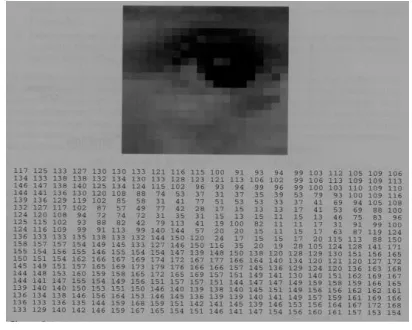
Digital image is a representation of a two dimensional image as a finite set of digital values, called picture elements or pixels. Pixel values typically represent gray levels, colors, heights etc. Digital image processing is used to change the nature of a digital image by using a computer.
Fig. 1 Image representation in a computer
In binary image each pixel is just black or white. Since there are only two possible values for each pixel, we only need one bit per pixel. Such images can therefore be very efficient in terms of storage. Images for which a binary representation may be suitable include text (printed or handwriting), fingerprints, or architectural plans.
ISSN 2348 – 7968
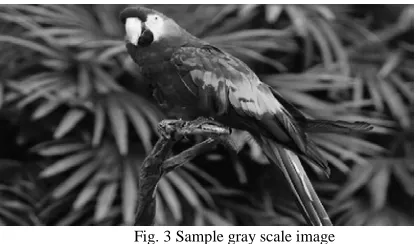
In grayscale image each pixel is a shade of grey, normally from 0 (black) to 255 (white). This range means that each pixel can be represented by eight bits, or exactly one byte. This is a very natural range for image file handling. Other grayscale ranges are used, but generally they are a power of 2. Such images arise in medicine (X-rays), images of printed works, and indeed 256 different gray levels is sufficient for the recognition of most natural objects.
Fig. 3 Sample gray scale image
2. Image Compression Overview:
Image compression is an application of data compression that encodes the original image with few bits. The objective of image compression is to reduce the redundancy of the image and to store or transmit data in an efficient form. Image compression coding is to store the image into bit-stream as compact as possible and to display the decoded image in the monitor as exact as possible. Now consider an encoder and a decoder as shown in figure. When the encoder receives the original image file, the image file will be converted into a series of binary data, which is called the bit-stream. The decoder then receives the encoded bit-stream and decodes it to form the decoded image. If the total data quantity of the bit-stream is less than the total data quantity of the original image, then this is called image compression. The full compression flow is as shown in figure.
Fig.4 The basic flow of image compression
The compression ratio is defined as follows: Cr=n1/n2
where n1 is the data rate of original image and n2 is that of the encoded bit-stream.
In order to evaluate the performance of the image compression coding, it is necessary to define a
measurement that can estimate the difference between the original image and the decoded image. Two common used measurements are the Mean Square Error (MSE) and the Peak Signal to Noise Ratio (PSNR).
The reason for image compression is that the correlation between one pixel and its neighbor pixels is very high, or we can say that the values of one pixel and its adjacent pixels are very similar. Once the correlation between the pixels is reduced, we can take advantage of the statistical characteristics and the variable length coding theory to reduce the storage quantity. This is the most important part of the image compression algorithm.
3. Data Hiding Overview:
Data hiding is the art and science of writing hidden messages in such a way that no one, apart from the sender and intended recipient, suspects the existence of the message, a form of security through obscurity. The advantage of data hiding, over cryptography alone, is that messages do not attract attention to themselves. Plainly visible encrypted messages will arouse suspicion, and may in themselves be incriminating in countries where encryption is illegal. Therefore, whereas cryptography protects the contents of a message, data hiding can be said to protect both messages and communicating parties. Data hiding includes the concealment of information within computer files. In digital data hiding, electronic communications may include hiding coding inside of a transport layer, such as a document file, image file, program or protocol. Media files are ideal for hiding transmission because of their large size. As a simple example, a sender might start with an innocuous image file and adjust the color of every 100th pixel to correspond to a letter in the alphabet, a change so subtle that someone not specifically looking for it is unlikely to notice it.
The embedded data is the message that one wishes to send secretly. It is usually hidden in an innocuous message referred to as a text, or cover-image or cover audio as appropriate, producing the stego-text or other stego-object. A stego-key is used to control the hiding process so as to restrict detection and/or recovery of the embedded data to parties who know it (or who know some derived key value).
4. Existing System
ISSN 2348 – 7968
codebooks are used to generate the index values, excluding the blocks in the leftmost column and the topmost row. Recently, many researchers have studied on embedding secret message by SMVQ. An SMVQ-based secret-hiding scheme is proposed using adaptive index. The weighted squared Euclidean distance (WSED) was utilized to increase the probability of SMVQ for a high embedding rate. In order to make the secret data imperceptible to the interceptors, hided secret data into the SMVQ compressed codes of the image by using a partially sorted codebook.
The restoration of the original SMVQ-compressed image can be achieved at the receiver side. However, in all of the above mentioned schemes, data hiding is always conducted after image compression, which means the image compression process and the data hiding process are two independent modules on the server or sender side. Under this circumstance, the attacker may have the opportunity to intercept the compressed image without the watermark information embedded, and The low bit rate scheme requires more time to encode these two independent modules may cause a lower efficiency in applications.
4.1 Disadvantages
In Previous schemes, data hiding is always conducted after image compression, which means the image compression process and the data hiding process are two independent modules on the server or sender side. It cause the attacker may have the opportunity to intercept the compressed image without the watermark information embedded, and the two independent modules may cause a lower efficiency in applications. In SMVQ sorts the code words according to their side-match distortions of all code words and then selects code words with smallest side-match distortions from the master book to form the state codebook. A best-match codeword is selected to encode an image block from code words and the corresponding index is coded. Thus, the SMVQ reduces the bit rate of VQ. Since mean square error caused by state codebook is higher than that of master codebook, SMVQ degrades the image quality and also it requires long encoding time. The low bit rate scheme SMVQ require high encoding time. To solve this problem JDHC method is proposed with residual codebooks.
5. Proposed System
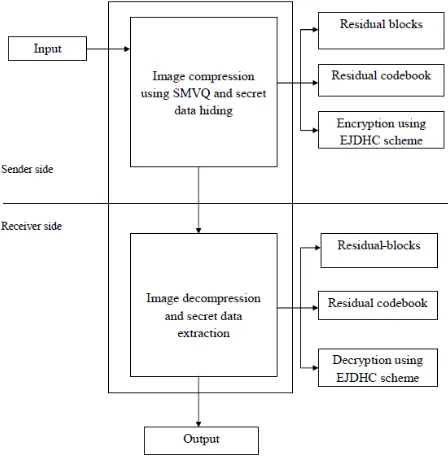
To solve these problems in this research proposed Enhanced Joint Data-Hiding and Compression (EJDHC) with residual codebooks. It combines both data hiding and image compression by using residual codebooks with side
match vector quantization (SMVQ) and image in-painting techniques. In residual codebook construction, the image blocks that are less similar to their closest match code words found in the codebook are taken into account. Less similarity blocks will increase distortion than high similarity blocks in the reconstructed image. Residual codeword for a less similarity image block is constructed by comparing it with its closest match codeword.
Fig. 5 Proposed architecture diagram.
ISSN 2348 – 7968
6. Experimental Result
VQ is widely used for digital image compression due to its simplicity and cost effectiveness in implementation. Instead of pixel values, only the index values are stored, therefore, the compression is achieved effectively. The VQ decompression process can be implemented easily and efficiently because only a simple table lookup operation is required for each received index. Side match vector quantization (SMVQ) was designed as an improved version of VQ, in which both the codebook and the sub codebooks are used to generate the index values, excluding the blocks in the leftmost column and the topmost row.
However, in all of the above mentioned schemes, data hiding is always conducted after image compression, which means the image compression process and the data hiding process are two independent modules on the server or sender side. Under this circumstance, the attacker may have the opportunity to intercept the compressed image without the watermark information embedded, and The low bit rate scheme requires more time to encode these two independent modules may cause a lower efficiency in applications. To solve this problem JDHC method is proposed with residual codebooks
.
Fig.6 Snapshot of embedded image
Enhanced Joint Data-Hiding and Compression (EJDHC) with residual codebooks combines both data hiding and image compression by using residual codebooks with side match vector quantization (SMVQ) and image in-painting techniques. In residual codebook construction, the image blocks that are less similar to their closest match code words found in the codebook are taken into account. Less similarity blocks will increase distortion than high similarity blocks in the reconstructed image.
Fig.7 Snapshot of extracted image
Residual codeword for a less similarity image block is constructed by comparing it with its closest match codeword. Similarity of an image block with its closet match codeword is determined based on minimum distortion rule between them. If the mean square error of an image block is greater than a predefined threshold value, then the block is taken as less similarity block. After receiving the compressed codes, the receiver can segment the compressed codes into a series of sections by the indicator bits. According to the index values in the segmented sections, the embedded secret bits can be extracted correctly, and the decompression for each block can be achieved successfully.
The visual quality of the decompressed images are measured by Peak signal-to-noise ratio (PSNR) .It is the ratio between maximum possible power of the signal and corrupting noise’s power. Mean square error is used for measuring the errors in digital image processing. The accuracy of an image is calculated by calculating and comparing the two mean square errors.
Fig.8 PSNR Comparison
ISSN 2348 – 7968
Fig.8 Relationship between threshold and hiding capacity
7. Conclusion
In this work combined both image compression and data hiding (EJDHC) using residual codebooks with side match vector quantization (SMVQ) and image in-painting techniques. On the sender side, except for the blocks in the leftmost and topmost of the image, each of the other residual blocks in raster-scanning order can be embedded with secret data and compressed simultaneously by SMVQ or image in-painting adaptively according to the current embedding bit. To solve visual distortion, error diffusion and low bit rate Enhanced VQ is used for some complex blocks.
References
[1] Chuan Qin, Chin-Chen Chang, Fellow, IEEE, and Yi-Ping Chiu,’A Novel Joint Data-Hiding and Compression Scheme
Based on SMVQ and Image Inpainting’, IEEE transactions on image processing,vol. 23,no. 3,2014.
[2] Cheng-Ta Huang, Wei-Jen Wang,’Employing LSB and VQ for Undetectable Secret Data Hiding’, 9th International Conference on Ubiquitous Intelligence and Computing,2012.
[3] Chia-Chen Lin, Xue-Bai Zhang ‘A High Capacity Reversible Data Hiding Scheme Based on SMVQ’, Sixth International Conference on Genetic and Evolutionary Computing,2012.
[4] Ji-Han Jiang, Shih-Chieh Shie, WeiDer Chung, and Wei-Jyun Syu ,’A Reversible Image Steganographic Scheme Based on SMVQ and Huffman Coding’, International Conference on Connected Vehicles and Expo (ICCVE),2013.
[5] Smitha.M, Dr.V.E.Jayanthi, and Ajitha Merlin,’Image Encryption Using Separable Reversible Data Hiding
Scheme’, IEEE transactions On Multimedia, 2013,Vol. 15, No. 2.