Modeling Quantum-Safe Authenticated Key
Establishment, and an Isogeny-Based Protocol
Jason LeGrow1,2,3, David Jao1,2,4, and Reza Azarderakhsh5 1
Department of Combinatorics and Optimization, University of Waterloo, Waterloo, Ontario, N2L 3G1, Canada
2 Centre for Applied Cryptographic Research,
University of Waterloo, Waterloo, Ontario, N2L 3G1, Canada
3 Institute for Quantum Computing,
University of Waterloo, Waterloo, Ontario, N2L 3G1, Canada
4 evolutionQ, Inc., Waterloo, Ontario, Canada 5
Department of Computer and Electrical Engineering and Computer Science, Florida Atlantic University, Boca Raton, Florida
Abstract. We propose a security model for authenticated key establish-ment in the quantum setting. Our model is the first for authenticated key establishment that allows for quantum superpositions of queries. The model builds on the classical Canetti-Krawczyk model but allows quan-tum interactions between the adversary and quanquan-tum oracles that emu-late classical parties. We demonstrate that this new security definition is satisfiable by giving a generic construction from simpler cryptographic primitives and a specific protocol which is secure in the quantum random oracle model, under the supersingular isogeny decisional Diffie-Hellman assumption (SIDH).
1
Introduction
Key establishment is a fundamental cryptographic primitive which allows parties communicating over an insecure but authenticated channel (that is, a channel whose messages can be eavesdropped on, but whose origin and authenticity are guaranteed) to establish a secure common cryptographic key, and hence establish a secure communication channel. Of course, modern Internet communications are not inherently authenticated, and so more sophisticated authenticated key establishment protocols are required to establish secure keys in this regime; in particular, ubiquitous Internet communication protocol suites such as SSL/TLS and IPsec include a wide array of authenticated key establishment protocols.
protocols, there has been little explicit consideration of quantum-safe security of authenticated key establishment protocols, beyond using quantum- safe com-putational assumptions. In particular—and in stark contrast with the situation of encryption [1,6,11] and signature schemes [6]—to the best of our knowledge no security model for authenticated key establishment has been proposed which allow for quantuminteractions between the adversary and key-establishing par-ties. The first major result of this work is to establish a formal framework for truly quantum-safe security of authenticated key establishment protocols. It is important that we understand how to analyze the security of our protocols in the quantum setting to face the looming threat of quantum computers.
Of course, ideally we would like to have a protocol for authenticated key es-tablishment which is secure in our quantum-safe model. To this end, we develop a generic construction which combines the simpler primitives of key establishment and digital signatures to obtain a secure authenticated key establishment proto-col. We then apply our generic construction to isogeny-based key establishment and signatures to obtain a truly quantum-safe authenticated key establishment protocol, which can in principle be used to create secure classical channels, even when faced with an adversary with significant quantum capabilities.
To reiterate, in this work we:
1. Give a novel quantum-safe security model and definition for authenticated key establishment;
2. Give a generic construction for secure protocols in this model, and;
3. Apply our generic construction to build an isogeny-based authenticated key establishment protocol.
Structure of this work. In Sections2 and 3 we detail the necessary crypto-graphic and algebrogeometric preliminaries for our security model, construction, and final protocol. Section4lists the constructions from previous works that we use to construct our protocol. Section5 contains an explanation of the security model and Section6contains our generic construction using signature schemes. Section 7 contains an explanation of our specific scheme. Finally, we conclude and consider future avenues of study in Section8.
2
Aspects of Post-Quantum Cryptography
2.1 Quantum Oracles and Post-Quantum Security Definitions
In classical cryptography, often an adversary is providedoracle access to a func-tion. For instance, in the well-known EUF-CMA security definition for signature schemes, the adversary is given oracle access to the signing function Signsk; that is, the adversary is given a “black box” which takes in messagesmand outputs a signatureσ= Signsk(m). In the quantum-safe setting, the adversary may in-stead be provided with aquantum oracle for a function. Iff:{0,1}m→ {0,1}n is a function, then a quantum oracleUf forf acts on basis states as
Uf: |xi |yi 7→ |xi |y⊕f(x)i.
In the EUF-qCMA security definition for signature schemes [6], the adversary is given quantum oracle access to the signing function:
Definition 1 (Strong EUF-qCMA Security).
A signature scheme (Sign,Ver) is strongly existentially unforgeable against a quantum adaptive chosen message attack (strongly EUF-qCMA secure)if the advantage that any polynomial-time adversary has at winning the following game is negligible:
1. The challenger C runs the key generation algorithm on input 1λ to obtain
the key pair(sk,pk), and publishespk. 2. Fori= 1,2, . . . , t:
a) The adversaryA sends|ψii=Pm,yαm,y|mi |yi toC.
b) C returns USignsk|ψii=Pm,yαm,y|mi |y+ Signsk(m)i
3. Aproduces(m∗1, σ∗1),(m∗2, σ∗2), . . . ,(m∗t+1, σ∗t+1).Awins the game if the pairs
(m∗i, σ∗i)are distinct andVerpk(m∗i, σi∗) = 1 for1≤i≤t+ 1.
2.2 The Quantum Random Oracle Model
In the quantum setting, any actual implementation of a protocol with a random oracle will use a concrete hash function. Hence the most natural approach to security analysis is to allow quantum calls to any random oracle, a construction known as the quantum random oracle model (QRO). It is easy to see how this capability might cause trouble in security proofs—it is not clear how an entity can generate new random values for queries to new inputs while at the same time maintaining consistency with previously-returned hash values (this, of course, is not a problem in the classical setting, where the entity can simply keep a table of values of all previously-requested hash values; this is infeasible in the quantum setting because the entity would have to keep a table which contains hash values for all classical input values, since the adversary could query the random oracle on a superposition of all those values). For this reason, standard proof techniques in the classical random oracle model do not necessarily translate well to the quantum setting. Some progress has been made in developing proof techniques and constructions that work in the quantum random oracle model (see, for instance, [24,29]). In Section7 we employ a construction due to Eaton and Song [10, Theorem 4] which can be used to obtain a signature scheme which is secure in the quantum random oracle model from a signature scheme which is secure in the classical random oracle model against an adversary who can run quantum computations.
Essentially all security models for quantum-safe cryptography can be framed independently of the quantum random oracle model, and so we end up with different “versions” of security definitions which differ only in whether random oracles are quantumly-accessible. If a definition allows for random oracles but doesnotallow them to be accessed quantumly, we may append -RO to the name (e.g., EUF-qCMA-RO), while if a definition allows for random oracles and allows them to be accessed quantumly then we append -QRO (e.g., EUF-qCMA-QRO). We may append no suffix if it is clear from context which is meant.
3
Mathematical Background
3.1 Elliptic Curves, Isogenies, and the j-Invariant
Definition 2 (Elliptic Curve [20, Section III.3]). An elliptic curve E is a nonsingular curve (i.e., a projective variety of dimension one) of genus one, with a distinguished pointO, called the point at infinity.
We say that an elliptic curve E isdefined over a field Kif it is defined overK
as an algebraic set andOhas coordinates inK.
It can be shown ([20, Section III.1]) that an elliptic curve defined over a field
Kwith charK6= 2,3 can be written as
We can introduce a group structure on an elliptic curveE in a natural way [20, Section III.2, Proposition 2.2], and this group structure allows us to define a class of functions, calledisogenies, which preserve some of this algebraic structure, as well as the geometric structure of the curves.
Definition 3 (Isogeny [20, Section III.4]).Let E andE0 be elliptic curves defined over a fieldK. AnisogenyfromEtoE0is an algebraic morphismφ:E→
E0 such thatφ(OE) =OE0.
We say that an isogenyφ: E→E0 isdefined over a fieldKif it is defined over Kas a rational map. Thedegree of an isogeny is its degree when considered as
a rational map. If φis a separable isogeny, then degφ=|kerφ| [8, Section 2]. For elliptic curvesE andE0, we say thatE0 isisogenous toE overKif and only if there is an isogenyφfromEtoE0defined overKsuch thatφ(E)6={OE0}. It can be shown (q.v.[20, Section III.6, Theorem 6.1]) that E0 is isogenous to
E over Kif and only if E is isogenous to E0 over K; that is, the property of “being isogenous” is an equivalence relation, and we define theisogeny class of a curveEdefined overKto be the set of all curvesE0 which are isogenous toE,
up toK-isomorphism as algebraic sets. Since any algebraic morphism of curves
is either constant or surjective [12, Chapter II, Section 6, Proposition 6.8], if
φ:E→E0 is a nontrivial isogeny, thenφ(E) =E0.
A theorem of Tate [23, Section 3, Theorem 1] says that if E and E0 are defined over a finite field K =GF(q), then E and E0 are isogenous over Kif
and only if|E(K0)|=|E0(K0)|for every finite extensionK0 of K.
LetE be defined over a field of characteristicp >0, and for each `∈Z, let
E[`] denote the set of `-torsion points ofE. Ifp-`, the map [`] :E→E
[`] :P 7→`P
is separable and has degree`2; hence, sinceE[`] = ker [`] is a finite Abelian group, it must be thatE[`]∼=Z/`Z⊕Z/`Z, since any other 2-generated Abelian group
of order `2 has elements of order strictly greater than `, by the Fundamental Theorem of Finitely Generated Abelian Groups [19, Chapter 10, Theorem 10.20]. Additionally, either E[pr] ={O} for all r∈
Z, or E[pr] =∼Z/prZ for allr ∈Z
[20, Chapter V, Section 3, Theorem 3.1]; in the first case we say that E is supersingular, while in the second case we say that E is ordinary. Any two isogenous elliptic curves are either both ordinary or both supersingular. We will be concerned only with supersingular elliptic curves for our applications.
Any supersingular elliptic curveE is defined overGF(p2) for some primep, and for each prime `6= pthere are `+ 1 isogenies of degree ` with domain E
(though not all of them are defined overGF(p2), in general) [8]. These isogenies of degree`are in one-to-one correspondence with the subgroupsΦofEof order
`; moreover, each such subgroup is the kernel of a unique isogenyφ, and we write
φ(E) =E/Φ [20, Chapter III, Section 4, Proposition 4.12]. Hence to specify an isogeny it suffices to specify its kernel, and conversely given a subgroup ΦofE
particular, ifΦis generated by a pointR∈E(GF(p2)), then we have a compact representation of φ, and we can compute φ efficiently from R [8]. We will use such isogenies in an authenticated key establishment protocol in Section 7.
Associated to every elliptic curveEdefined overKis a fieldj(E)∈K, called thej-invariant of the curve. As the name suggests, the j-invariant is invariant under K-isomorphisms of algebraic sets, and so aj-invariant uniquely identifies aK-isomorphism class of elliptic curves overK. Given an elliptic curveE, itsj
-invariant can be found in polynomial-time; moreover, given aj-invariantj∗∈K,
one can find in polynomial time the curveE with j(E) =j∗. Knowing this, we have a compact description of an elliptic curve for the purposes of communication during a key establishment protocol.
3.2 Supersingular Elliptic Curve Isogeny-based Cryptography
In the following definition, letp=`eA
A ` eB
B f±1 be a prime, where`A and`B are distinct small primes, andf is a small cofactor used to ensure thatpis prime— we will not quantify what is meant by “small.” As well, letEbe a supersingular elliptic curve defined overK=GF(p2) withE(GF(p2))∼=Z/(p∓1)Z⊕Z/(p∓
1)Z, and let{PA, QB}and{PB, QB}be bases forE[`eAA] andE[` eB
B ], respectively.
Definition 4 (Supersingular Isogeny Decisional Diffie-Hellman Prob-lem (SIDH)). Let φA:E → EA be an isogeny with kernel hmAPA+nAQAi
where mA, nA are chosen uniformly at random from Z/`eAAZ, not both
divisi-ble by `A. Let φB:E →EB be an isogeny with kernel hmBPB+nBQBi where
mB, nB are chosen uniformly at random fromZ/`eBBZ, not both divisible by `B.
Given a tuple (E, EA, EB, φA(PB), φA(QB), φB(PA), φB(QA), EC) where either
EC=EAB =E/hmAPA+nAQA, mBPB+nBQBiorECis sampled uniformly at
random from the set of all curves of the formE/hxAPA+yAQA, xBPB+yBQBi
where xA, yA and xB, yB are chosen with the same conditions as mA, nA and
mB, nB, each with probability 12, the supersingular isogeny decisional Diffie-Hellman problem (SIDH) is to determine which is the case.
The corresponding security assumption is that arbitrary instances of SIDH cannot be solved in polynomial-time on a quantum computer with non-negligible advantage. Presently the best known quantum algorithm for this problem runs in fully-exponential time O(√6p), [5] while the best known classical attack runs in time O(√4p) [8, Section 5.2].
4
Tools for Constructing a Secure AKE Protocol
In this section we briefly mention three tools we require to construct our key establishment protocol: chameleon hash functions, and two generic security-strengthening transformations for signature schemes.
4.1 Chameleon Hash Functions
Intuitively, chameleon hash functions—introduced by Krawczyk and Rabin [15]— are a type of hash function which are collision resistant for anybody who does not know an associated piece of secret information, but for which collisions can easily be found for any input given that piece of secret information. We will use them to construct signature schemes which are secure in the quantum ran-dom oracle model. A precise definition of chameleon hash function is given in Definition5.
Definition 5 (Chameleon Hash Function (Adapted from [6, Definition 3.9])).
Achameleon hash functionHis a tuple (Gen, H,Inv,Sample) of algorithms such that:
1. Gen(λ)generates a key pair(sk,pk)with security parameterλ; 2. Hpk(m, r)maps messages mto some target spaceY;
3. Sample(λ) samples rsuch that Hpk(m, r)is distributed computationally
in-distinguishably from uniform over the image of Hpk(m,·) for every pair (pk, m)6;
4. Invsk(h, m)producesr such thatHpk(m, r) =h(where(sk,pk)is generated
byGen(λ)), with distribution computationally indistinguishable from that of
Sample(λ) conditioned onHpk(m, r) =h; and,
5. For anypk,Hpk(·,·)is collision resistant.
A chameleon hash function isquantum-safe if it is collision-resistant against a quantum adversary who can query the function in superposition.
4.2 Generic Security-Strengthening Transformations
We would like to use a signature scheme for authentication in an authenticated key establishment protocol which is secure in a quantum model where the ad-versary can make quantum queries to oracles which emulate classical parties, and to random oracles. For this purpose, clearly a signature scheme which is EUF-qCMA secure in the quantum random oracle model (EUF-qCMA-QRO) is required. The strong designated verifier signature scheme that we use in Sec-tion 7 provides only EUF-CMA-RO security. To get from EUF-CMA-RO to EUF-qCMA-QRO, we apply two generic transformations:
6
Here and elsewhere, we use·as above to indicate inputs to a function which arenot
1. Eaton & Song [10, Theorem 4]: EUF-CMA-RO→EUF-CMA-QRO; 2. Boneh & Zhandry [6, Constr. 3.12]: EUF-CMA-QRO→EUF-qCMA-QRO.
The resulting protocols are described in detail in Section7.
5
The Security Model
To model different “levels” of security, security models for authenticated key establishment do not typically have fixed assumptions on thecomputational ca-pabilities of the adversary. In particular, they do not explicitly disallow adver-saries access to a quantum computer. However, to model theinteraction of the adversary and honest parties, these security models typically follow the lead of the extended Canetti-Krawczyk model [16] and its predecessors [4,7] and allow the adversary to interact only classically with the parties; that is, they can only deliver single, classical messages, rather than quantum superpositions. On the contrary, in this work we consider the case where the parties are modelled as quantum oracles (with memory) with which the adversary interacts. As noted in the introduction, such quantum-aware security models have been previously introduced in other settings [1,6,11], and the attacks which make particular use of the quantum nature of the oracles have been studied under the name “super-position attacks,” “quantum chosen message attacks” (for MAC and signature schemes), and “quantum chosen ciphertext attacks” (for encryption schemes).
Though the model may seem to give the adversary unreasonable abilities, it has a number of desirable properties that make it very natural and useful to study. For instance:
1. It is simple enough that analyzing the security of specific protocols and the effects of natural quantum attacks is sufficiently easy;
2. It encompasses all common classical and non-interactive quantum attacks on stateless key establishment protocols, and in that sense is “stronger” than previously-considered models;
3. Because it explicitly allows for quantum interactions, protocols proved secure in this model can be used without modification on a quantum computer with-out worrying abwith-out novel attacks. Though in principle this could be solved by (for instance) requiring all quantum input as part of a classical protocol be measured to collapse superpositions, this requires particular engineering of the devices; moreover, our method will work even onuntrusted devices (q.v.“device-independent” quantum cryptography [17,25]), and;
5.1 Definitions
Definition 6 (Party). A party P is an interactive classical Turing machine1
with access to a source of random bits.
Associated to each party P is a (possibly empty) private key/public key pair (sk,pk). For the purposes of the model, it is assumed that each party has a genuine copy of each other party’s public key, in order to allow for authentication. Moreover, to each party we associate a unique identifier id. It is assumed that each party has a genuine copy of each other party’s identifier.
Definition 7 (Protocol).A protocolΠ is a specification of subroutines, to be run by some number of parties, to establish a session key.
A protocol Π is said to be correct if, when Π is executed correctly and all messages are relayed faithfully (i.e., without changes to their content or ordering), all parties involved compute the same key.
Protocols are message-driven; that is, upon receiving a message, a party computes the response message and sends it to the intended recipient. The party does no further computations and sends no more messages until it is activated again by an incoming message. This assumption sacrifices no generality, since any computations can be performedbeforesending out a new message.
Definition 8 (Session). A session is an instance of a protocol at a party.
Associated to each session is a unique session identifierΨ—which we use to refer to the session—chosen by the session’s owner. If a party P has a session
Ψ, the parties with whomP believes they are attempting to establish a key are called peers to P in sessionΨ, and the peers’ associated sessions (if they exist) are calledmatching sessions.
If a partyP with identifierid who owns a given sessionΨ, with matching sessionΨ0 and peerP0 with identifierid0has received messagesm
1, . . . , mk−1in this session, then we denote by P(Ψ, Ψ0,id,id0; pk,pk0,sk;m
1, . . . , mk;rΨ) the message that P sends given that the next message it receives in this session is
mk, and it uses randomnessrΨ for this session. We abbreviate this expression asP(mk) if the other inputs are clear from context.
Invalid Messages In a key establishment security model, it is typical to model a mechanism for parties to abort a session in the event that it receives an “in-valid” message. What exactly constitutes an invalid message is defined by a given protocol, but typically an invalid message is one which does not make sense in the context of the protocol or fails to validate under the public key of the party
1
believed to have sent the message. If we allow the adversary to deliver superposi-tions of messages, however, it does not make sense to consider such termination since parties cannot “read off” messages from a superposition and thus cannot tell whether to terminate the session. Measuring the state would collapse it and defeat the purpose of considering quantum queries entirely. To handle such cases, we introduce a fail character⊥to be used when a session would be terminated. Define P(Ψ, Ψ0,id,id0; pk,pk0,sk;m1, . . . , mk;rΨ) =⊥when mk is invalid, and define all further messages in a session after a response has been⊥to be⊥. This formalism allows a session to be in a superposition of terminated and active.
5.2 Party and Adversarial Capabilities
Aside from classical computations, parties can issue a Send(id, m) command, which requests that the message m be delivered to to the party identified by id. Parties may store private/public value pairs (k, K) in memory, associated to sessions. That is, for a key establishment session Ψ a party may construct an ephemeral secret key skΨ and corresponding ephemeral public value pkΨ. To be consistent with other quantum-safe security definitions, randomness is drawn classically; that is, if a functionf(·;r) which depends on randomness ris to be applied in superposition, the value ofris chosen classically and the mapUf(·;r) is applied.
In order to make protocols meaningfully quantum-resistant, during the secu-rity experiment the challenger will provide aquantum messaging oracle OP for each partyP, defined inductively as follows. BeforeOP receives any messages in sessionΨ with matching session Ψ0 and peerP0 with identifierid0, we define
OP(Ψ)|m1i |yi=|m1i
y⊕ P(Ψ, Ψ0,id,id0; pk,pk0,sk;m1;rΨ)
for allm1∈ M, and extend linearly to superpositions. Notice that the sessionΨ considered byOP must be given asclassicalinput.OP thenkeepsthe first regis-ter, and returns the second. It is important thatOP hold onto the register, since otherwise it “forgets” what the adversary has sent it, and then does not know its stage in the protocol and cannot respond to future messages appropriately.
After receivingk−1 messages, OP will holdk−1 registers. When queried again, we consider its input as the firstk+ 1 registers of some global (pure) state
|Γi=X
m,y
αm,y|m1i · · · |mk−1i
| {z }
Held by Challenger
Provided byA
z }| {
|mki |yi |µm,yi
| {z }
Remaining registers
.
It acts asOP(Ψ)|m1i · · · |mki |yi=|m1i · · · |mki |y⊕ P(mk)i.
for stateful protocols—in particular, for protocols using hash-based signatures for authentication. We do not consider such protocols here.
If P does not own a session ˆΨ, then we simply define OP( ˆΨ)|mi |yi to be
|mi |y⊕ ⊥i. For simplicity, for the purposes of the security experiment, the ad-versary interacts only with these quantum messaging oracles.
The adversary interacts with the quantum messaging oracles by delivering (quantum superpositions of) messages to them. The adversary may also issue the following “information-leakage” commands:
1. RevealEphemeralKey(id, Ψ): If the identified party owns a session Ψ, the challenger reveals any ephemeral secret key associated toΨ.
2. RevealPrivateKey(id): The identified party reveals their private key. 3. Corrupt(id): The party identified by idreveals all classical information is
knows to the adversary, turns over all its quantum memory to the adversary, and becomes adversarially-controlled.
As well, the adversary may issue aRevealSessionKey(id, Ψ) query, defined as follows: ifKΨ :=K(Ψ, Ψ0,id,id0; pk,pk0,sk;m1, . . . , mk;rΨ) is the key that the party identified by idwould compute in sessionΨ with peer identifierid0 and matching sessionΨ0, and it has so far received messagesm1, . . . , mk, then if the global state is
|Γi=X
m,y
αm,y |m1i · · · |mki
| {z }
Held by Challenger
Provided byA
z}|{
|yi |µm,yi
| {z }
Remaining registers
,
the result of this query is defined by
|m1i · · · |mki |yi 7→ |m1i · · · |mki |y⊕KΨi.
As a result of this queryOP returns the first k+ 1 registers of the global state (that is, the target register and the message registers it held).
In particular, if the adversary chooses not to entangle the registers of different pairs of sessions, then for each sessionΨ whose session key the adversary reveals, the adversary will have the state
X
m1,...,mk;y
αm1,...,mk,y|m1i · · · |mki |y⊕KΨi
and the registers corresponding to different revealed sessions will be disentangled from one another. This is precisely analogous to qCPA security of encryption schemes and qCMA security of signatures schemes, where the adversary receives
X
m,y
αm,y|mi |y⊕Encsk(m;r)i, or
X
m,y
5.3 The Security Experiment
A sessionΨ owned by partyP with peerP0 and partner sessionΨ0 is “clean” if:
1. At session completion, neither P norP0 was adversarially-controlled; 2. At session completion, A had issued neither RequestPrivateKey(id) nor
RequestPrivateKey(id0);
3. Ahas not revealed the ephemeral secret key forΨ orΨ0, and; 4. Ahas not revealed the session key for Ψ or Ψ0.
For the security experiment, the adversary issues aTest(id, Ψ) query on a clean session Ψ owned by the party with identifier id, defined as follows: the adversary provides a target register |yi, and the challenger selects b ∈ {0,1}
uniformly at random. Ifb= 1,Test(id, Ψ) acts like aRevealSessionKeyquery; ifb= 0, the result is defined by
|m1i · · · |mki |yi 7→ |m1i · · · |mki |y⊕R(m1, . . . mk)i whereR(m1, m2, . . . , mk) is a random string inKsubject to
R(m1, m2, . . . , mk) =⊥ ⇐⇒ K(Ψ, Ψ0,id,id0; pk,pk0,sk;m;rΨ) =⊥. In any case, allk+ 1 of these registers are returned. We call a key establishment protocol Π secure if the probability that a polynomial-time adversary A can correctly guess the value ofbis at most negligibly greater than 12.
6
A Construction for Secure Protocols
In this section we present a construction for secure authenticated key estab-lishment protocols from an unauthenticated key estabestab-lishment protocol and an EUF-qCMA signature scheme. This is analogous to the well-known result of Bel-lare, Canetti, and Krawczyk [3, Proposition 4], which states that an EUF-CMA signature scheme can be used as an authentication method for an unauthenti-cated key establishment protocol.
Theorem 1. Let S = (Gen,Sign,Ver) be a strongly EUF-qCMA secure signa-ture scheme, and let Π be a two-round, two-party key establishment protocol. Consider the protocolΠ0 with the following properties:
1. Each party P0
k has a key pair (skk,pkk) for S and, moreover, each party
knows each other party’s public key. 2. Whenever an initiating party P0
I would send a message m, it instead
con-structs the messagemΨ(I) = (m,idI,idR, Ψ(I))(whereidR is the peer’s
ses-sion identifier andΨ(I) isP0
I’s session identifier) and sends (mΨ(I), σΨ(I)),
3. Whenever a partyP0
R would respond to a message(m, Ψ
(I), σ)from an
ini-tiating partyP0
I with a messagem0, it computes
b= VerpkI(mΨ(I), σΨ(I)) = VerpkI((m,idI,idR, Ψ(I)), σ).
Ifb= 0,PR0 responds with(⊥,⊥,⊥); otherwise,P0
R constructs the message
mΨ(R) = (m0,idI,idR, Ψ(I), Ψ(R))and sends (mΨ(R), σΨ(R)), where σΨ(R) = SignskR(mΨ(R)) = SignskR(m0,idI,idR, Ψ(I), Ψ(R))
4. If a party Pk would compute a session key for a session Ψ(k) with partner
P` and partner session Ψ(`), it checks whether the signature in the message
it received was valid; if not it outputs session key⊥. If the signature is valid, it outputs the session key as usual.
Then:
1. IfΠ is correct, then Π0 is correct; and,
2. IfΠis secure against adversariesAwhich are required to deliver all messages faithfully, thenΠ0 is secure.
Proof Idea.The idea of the proof is intuitive, though the proof itself is involved; the proof appears in appendix A.
At its core, the proof resembles analogous classical results (for instance, [3, Proposition 4]), which use the security of the signature scheme to argue that the adversary cannot deliver any messagemin sessionΨ to a partyP with identifier idwhich:
1. Is unsent (i.e., no party issued Send(id, m) in a session matchingΨ), 2. Does not come from a corrupted party, and
3. Is valid (i.e.,the messages passP’s authentication check)
The complication that arises in our setting is that messages can be delivered in superposition, and so may “simultaneously” be validand invalid, in the sense that some parts of the superposition may be valid while other are not. To ad-dress this, we demonstrate that under the security assumptions of the theorem, no adversary can construct a superposition |Γi = P
µ,m,σαµ,m,σ|µi |m, σi of messages which:
1. Is unsent,
2. Does not come from a corrupted party, and 3. Has nonnegligible valid content (i.e., P
µ; (m,σ)|αµ,m,σ|2 is nonnegligible, where the sum is taken over valid pairs (m, σ).)
From this, we show that in the test session, either
1. The adversary does not interfere with the test session, and so cannot win the security game by virtue of the security of the underlying key establishment protocol, or
In the second scenario, the adversary cannot distinguish the output of either the b = 0 or b = 1 case from being given a state where all key registers are
⊥except with negligible probability, and hence in particular cannot distinguish
b= 0 fromb= 1; this means thatΠ0 is secure.
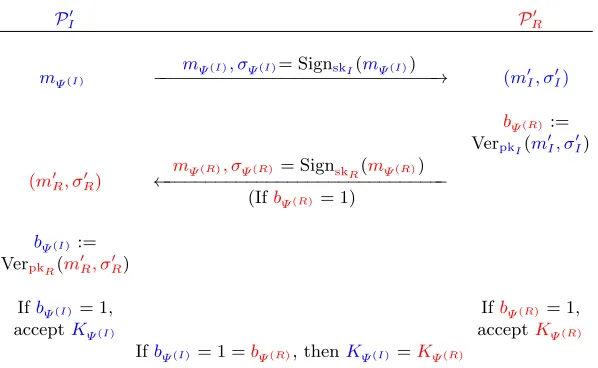
Figure2in AppendixA.2illustrates a pair of matching sessions of a generic protocolΠ0 constructed according to Theorem1.
7
A Protocol using Supersingular Elliptic Curve Isogenies
Here we apply the generic construction from Section 6 to construct a secure authenticated key establishment protocol based on the Supersingular Isogeny Decisional Diffie-Hellman assumption (SIDH). The underling key establishment protocol is De Feo, Jao, and Plˆut’s scheme [8], with authentication provided by a signature scheme constructed by applying Eaton and Song’s [10] and Boneh and Zhandry’s [6] transformations to Sunet. al’s [22] strong designated verifier signature scheme, reminiscent of Soukharev, Jao, and Seshadri’s work in [21].
For readability we use the “vanilla” protocol from [8] without consideration for optimizations (e.g.[28]); such optimizations can be adapted for the protocol our protocol in a straightforward fashion without affecting the proof of security.
7.1 Our Authenticated Key Establishment Protocol
First we list the required global parameters. Authentication requires
1. pA=`eSS` eV
V fA±1, a prime, for primes`S and `V and small cofactorfA; 2. EA, a supersingular elliptic curve defined overKA=GF(p2A);
3. {PS, QS} and{PV, QV}, bases forEA[`eSS] andEA[`eVV], respectively; 4. H= (Gen(Hc), H
c,Inv,Sample), a quantum-safe chameleon hash; and, 5. O1,O2,O3, random oracles (in practice, hash functions).
For key establishment we require
1. pK =`eII` eR
R fK±1, a prime, for primes`I and`R and small cofactorfK; 2. EK, a supersingular elliptic curve defined overKK=GF(p2K); and, 3. {PI, QI}and{PR, QR}, bases forEK[`eII] and EK[`eRR], respectively.
Each partyPk must establish authentication keys; associated to each will be a key pair for signing and a key pair for verification. In particular, Pk selects
m(k)S , n(k)S ∈ Z/`eSSZ not both divisible by `S uniformly at random, and sets
ES(k) = EA/hm (k) S PS +n
(k)
S QSi. Let φ (k)
S denote the isogeny with domain EA and image ES(k). Similarly,Pk selectsm
(k) V , n
(k) V ∈Z/`
eV
V Znot both divisible by
`V uniformly at random, sets E (k)
V =EA/hm (k) V PV +n
(k)
V QVi, and further sets
φ(k)V to be the isogeny with domain EA and image E (k)
private key/public key pair (sk(k)H ,pk(k)H ) for the chameleon hash function. Then
Pk’s authentication key pair is
(sk(k),pk(k)) = (sk(k)S ,sk(k)V ,skH(k)),(pk(k)S ,pk(k)V ,pk(k)H ) = (m(k)S , n(k)S ),(m(k)V , n(k)V ),sk(k)H
, (ES(k), φ(k)S (PV), φ (k) S (QV)), (EV(k), φ(k)V (PS), φ
(k)
V (QS)),pk (k) H
.
Then for each pair (Pk,P`) of parties there is a curveE (k,`)
SV defined by
ESV(k,`)=EV(`)/hm(k)S φ(`)V (PS) +n (k) S φ
(`) V (QS)i;
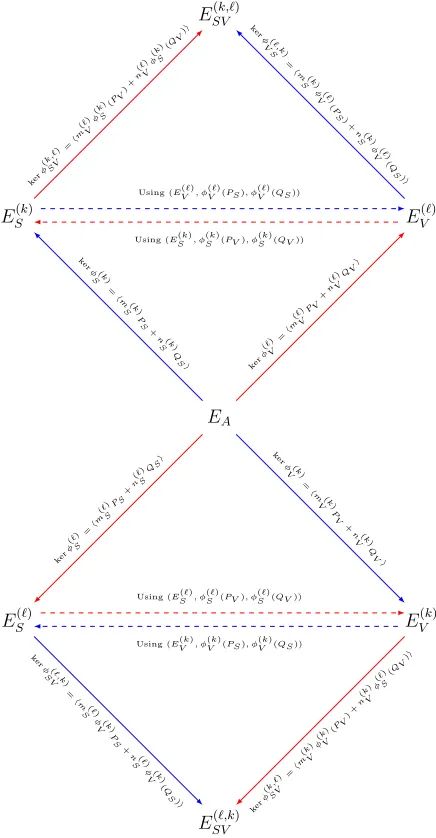
notice that ESV(k,`)=ESV(`,k), and so both Pk and P` can compute it using their secret keys and the other’s public keys. This curve will be used for Pk to sign a message toP`. Figure1in AppendixA.2depicts thej-invariant computation for this protocol.
The protocol is as follows (withPk initiating andP` responding):
1. Upon being instructed to start a session withP`,Pk: a) Selects a session identifierΨ;
b) Selects x(ΨI ), yI(Ψ) ∈Z/`eIIZ, not both divisible by `I, uniformly at ran-dom;
c) ConstructsR(Ψ)=x(Ψ) I PI+y
(Ψ)
I QI, definesφ(Ψ)to be the isogeny with kernelhR(Ψ)i, and sets
m(Ψ)= (E(Ψ)=EK/hR(Ψ)i, φ(Ψ)(PR), φ(Ψ)(QR),idk,id`, Ψ); d) Selectsr(Ψ)∈ {0,1}∗ at random;
e) Sets
σ(Ψ)= (σ1, σ2, σ3)
=(Sample(λ),O1(r(Ψ)||j(E(SVk,`))),Inv sk(Hk)(r
(Ψ)
,O2(O3(m(Ψ), σ1)||σ2))),
and;
f) Activates Send(id`, m(Ψ), σ(Ψ)) 2. Upon receiving (m, σ),P`:
a) Computes
b(Ψ0)=
(
1 ifσ2=O1(Hpk(k)
H
(O2(O3(m, σ1)||σ2), σ3)||j(E (k,`) SV ))
0 otherwise ;
Ifb(Ψ0) = 0 the delivered message is invalid and is hence rejected; then
c) Selects x(Ψ
0) R , y
(Ψ0) R ∈ Z/`
eR
R Z, not both divisible by `R, uniformly at random;
d) Constructs R(Ψ0) = x(Ψ0) R PR+y
(Ψ0)
R QR, defines φ(Ψ 0)
to be the isogeny with kernelhR(Ψ0)i, and sets
m(Ψ0)= (E(Ψ0)=EK/hR(Ψ 0)
i, φ(Ψ0)(PI), φ(Ψ 0)
(QI),idk,id`, Ψ, Ψ0);
e) Selectsr(Ψ0)∈ {0,1}∗ at random; f) Sets
σ(Ψ0)= (σ1, σ2, σ3) =(Sample(λ),O1(r(Ψ
0)
||j(ESV(`,k))),Inv
sk(H`)(r (Ψ0)
,O2(O3(m(Ψ 0)
, σ1)||σ2))),
and;
g) Activates Send(id`, m(Ψ 0)
, σ(Ψ0))
After receiving the message,P` computes the session key
K(Ψ0)=
(
⊥ ifb(Ψ0)= 0
m1/hx (Ψ0) R m2+y
(Ψ0)
R m3iotherwise
.
3. Upon receiving (m, σ),Pk computes the session key
b(Ψ)=
(
1 ifσ2=O1(Hpk(`)
H
(O2(O3(m, σ1)||σ2), σ3)||j(E (`,k) SV ))
0 otherwise ;
After receiving the message,Pk computes the session key
K(Ψ)=
⊥ ifb(Ψ)= 0
m1/hx (Ψ) I m2+y
(Ψ)
I m3iotherwise
.
Theorem 2. The scheme described above is correct.
Proof. This follows immediately from the results of [8, Section 3.1].
Theorem 3. Under the Supersingular Isogeny Decisional Diffie-Hellman as-sumption, the scheme described above is secure in the security model described in Section 5in the quantum random oracle model.
Proof. This follows from Theorem1by the security results of [8,22,10,6].
8
Conclusion
We have presented a security model for authenticated key establishment in which the adversary can deliver quantum superpositions of messages to parties who would ordinarily be participating in a classical protocol, analogous to allowing quantum signing queries in EUF-qCMA security of signature schemes or quan-tum encryption/decryption queries in standard quanquan-tum-safe security definitions of encryption. We demonstrated that the corresponding new security definition is achievable by constructing a specific example of a secure key establishment protocol assuming the quantum hardness of a Diffie-Hellman-type problem for isogenies of supersingular elliptic curves, and gave a generic construction for se-cure protocols using sufficiently sese-cure signature schemes and unauthenticated key establishment protocols.
Limitations and Future Work. Although the security model we present is a natural for quantum-safe authenticated key establishment, it remains to establish a separation between this security definition and, for instance, the more standard Canetti-Krawczyk model with a quantum adversary—that is, we must show that there are protocols which are secure in the Canetti-Krawczyk model when the adversary has access to a quantum computer which are insecure when the adversary can deliver quantum superpositions of messages. We would like to establish this separation to demonstrate the necessity of our quantum-safe security model. Once this separation is established, we can work solving the following problems:
1. Are current “quantum-safe” key establishment protocols secure in this model? 2. Are there other simple generic constructions for secure protocols; in
partic-ular, does our construction generalize to the case of many-round protocols? 3. Can we introduce more security properties: e.g.,resilience against key
com-promise impersonation and malicious insiders [16]?
4. Our security definitions do not adequately model stateful protocols; this choice was made to avoid entangling the (classical) state of the protocol user with the global (quantum) state of the adversary and environment. This means that the model is not sufficient for analyzing certain well-known types of protocols, such as hash-based schemes. How best to allow stateful protocols while remaining grounded in reality is a matter for further consideration.
References
1. Alagic, Gorjan and Broadbent, Anne and Fefferman, Bill and Gagliardoni, Tom-maso and Schaffner, Christian and St. Jules, Michael. Computational Security of Quantum Encryption. In Nascimento, Anderson C.A. and Barreto, Paulo, editor,
2. Paulo S. L. M. Barreto, Shay Gueron, Tim Gueneysu, Rafael Misoczki, Edoardo Persichetti, Nicolas Sendrier, and Jean-Pierre Tillich. Cake: Code-based algorithm for key encapsulation. Cryptology ePrint Archive, Report 2017/757, 2017. 3. Mihir Bellare, Ran Canetti, and Hugo Krawczyk. A modular approach to the
design and analysis of authentication and key exchange protocols. InProceedings of STOC ’98, pages 419–428. ACM Press, 1998.
4. Mihir Bellare and Phillip Rogaway. Entity Authentication and Key Distribution. In Stinson, Douglas R., editor, Advances in Cryptology — CRYPTO ’93, pages 232–249, Berlin, Heidelberg, 1994. Springer Berlin Heidelberg.
5. Jean-Fran¸cois Biasse, David Jao, and Anirudh Sankar. A Quantum Algorithm for Computing Isogenies between Supersingular Elliptic Curves. In Meier, Willi and Mukhopadhyay, Debdeep, editor, Progress in Cryptology — INDOCRYPT 2014, pages 428–442, Cham, 2014. Springer International Publishing.
6. Dan Boneh and Mark Zhandry. Secure Signatures and Chosen Ciphertext Security in a Quantum Computing World. In Canetti, Ran and Garay, Juan A., editor,
Advances in Cryptology — CRYPTO 2013, pages 361–379, Berlin, Heidelberg, 2013. Springer Berlin Heidelberg.
7. Ran Canetti and Hugo Krawczyk. Analysis of Key-Exchange Protocols and Their Use for Building Secure Channels. In Pfitzmann, Birgit, editor,Advances in Cryp-tology — EUROCRYPT 2001, pages 453–474, Berlin, Heidelberg, 2001. Springer Berlin Heidelberg.
8. Luca De Feo, David Jao, and J´erˆome Plˆut. Towards quantum-resistant cryptosys-tems from supersingular elliptic curve isogenies. J. Math. Cryptol., 8:209–247, 2014.
9. Whitfield Diffie and Martin Hellman. New Directions in Cryptography. IEEE Trans. Inf. Theor., 22(6):644–654, September 2006.
10. Edward Eaton and Fang Song. Making Existential-Unforgeable Signatures Strongly Unforgeable in the Quantum Random-Oracle Model. In Proceedings of TQC, pages 1–16, Germany, 2015. Dagstuhl Publishing.
11. Tommaso Gagliardoni, Andreas H¨ulsing, and Christian Schaffner. Semantic se-curity and indistinguishability in the quantum world. In Matthew Robshaw and Jonathan Katz, editors,Advances in Cryptology — CRYPTO 2016, pages 60–89, Berlin, Heidelberg, 2016. Springer Berlin Heidelberg.
12. Robin Hartshorne. Algebraic Geometry. Number 52 in Graduate Texts in Mathe-matics. Springer-Verlag, New York, 1977.
13. A.S. Holevo. An analog of the theory of statistical decisions in noncommutative probability theory. Trans. Mosc. Math. Soc., 26:133–149, 1972.
14. Marc Kaplan, Ga¨etan Leurent, Anthony Leverrier, and Mar´ıa Naya-Plasencia. Breaking symmetric cryptosystems using quantum period finding. In Matthew Robshaw and Jonathan Katz, editors,Advances in Cryptology — CRYPTO 2016, pages 207–237, Berlin, Heidelberg, 2016. Springer Berlin Heidelberg.
15. Hugo Krawczyk and Tal Rabin. Chameleon Hashing and Signatures, 1997. Manuscript.
16. Brian LaMacchia, Kristin Lauter, and Anton Mityagin. Stronger Security of Au-thenticated Key Exchange. In Susilo, Willy and Liu, Joseph K. and Mu, Yi, editor,
Provable Security: First International Conference, pages 1–16, Berlin, Heidelberg, 2007. Springer Berlin Heidelberg.
18. Michele Mosca, Douglas Stebila, and Berkant Ustao˘glu. Quantum Key Distribution in the Classical Authenticated Key Exchange Framework. In Gaborit, Philippe, editor,Post-Quantum Cryptography: 5th International Workshop, pages 136–154, Berlin, Heidelberg, 2013. Springer Berlin Heidelberg.
19. Joseph J. Rotman. An Introduction to the Theory of Groups. Number 148 in Graduate Texts in Mathematics. Springer, New York, 1995.
20. Joseph H. Silverman. The Arithmetic of Elliptic Curves. Number 106 in Graduate Texts in Mathematics. Springer, New York, 1986.
21. Vladimir Soukharev, David Jao, and Srinath Seshadri. Post-Quantum Security Models for Authenticated Encryption. In Takagi, Tsuyoshi, editor,Post-Quantum Cryptography: 7th International Workshop, pages 64–78, Cham, 2016. Springer International Publishing.
22. Xi Sun, Haibo Tian, and Yumin Wang. Toward Quantum-resistant Strong Desig-nated Verifier Signature. Int. J. Grid Util. Comput., 5(2):80–86, 2014.
23. John Tate. Endomorphisms of Abelian Varieties Over Finite Fields.Invent. Math., 2:134 – 144, 1966.
24. Dominique Unruh. Quantum Position Verification in the Random Oracle Model. In Garay, Juan A. and Gennaro, Rosario, editor,Advances in Cryptology — CRYPTO 2014, pages 1–18, Berlin, Heidelberg, 2014. Springer Berlin Heidelberg.
25. Umesh Vazirani and Thomas Vidick. Fully device-independent quantum key dis-tribution. Phys. Rev. Lett., 113:140501, Sep 2014.
26. Jacques V´elu. Isog´enies Entre Courbes Elliptiques. C. R. Acad. Sci. Paris S´er. A-B, 273:A238 – A241, 1971.
27. Han Weiwei and He Debiao. An authenticated key agreement protocol using iso-genies between elliptic curves. 2010 Second International Workshop on Education Technology and Computer Science, 1:366–369, 2010.
28. Gustavo H. M. Zanon, Marcos A. Simplicio Jr., Geovandro C. C. F. Pereira, Javad Doliskani, and Paulo S. L. M. Barreto. Faster isogeny-based compressed key agreement. Cryptology ePrint Archive, Report 2017/1143, 2017. https: //eprint.iacr.org/2017/1143.
29. Mark Zhandry. Secure Identity-Based Encryption in the Quantum Random Oracle Model. InAdvances in Cryptology — CRYPTO 2012, 2012.
A
Figures
A.1 A Depiction of thej-Invariant Computation for our Protocol
EA
ES(k)
ES(`)
E(V`)
EV(k)
ESV(k,`)
ESV(`,k)
Using (E(V`), φ(V`)(PS), φ(V`)(QS))
Using (ES(`), φ(S`)(PV), φ(S`)(QV)) Using (E(Sk), φ(Sk)(PV), φ(Sk)(QV))
Using (E(Vk), φ(Vk)(PS), φ(Vk)(QS)) ker
φ(k ) S
= hm(
k) S
P S +
n(k ) S Q S i ker φ (`) S =h m (`) S P S + n (`) S QS
i ker
φV(k)
= hm(k
) V
P V +
n(k ) V Q V i ker φ (`) V = hm (`) V P V + n (`) V QV i ker φ (k ,`) SV = hm (`) V φ (k ) S (P V
)+ n (`)
V φ (k)
S (QV
)i
ker φ(`,k
) SV
= hm(
`) S
φV(k)
P S
+ nS(`)
φV(k)
(Q S)i
ker φ (k,`
)
SV =h
m (k)
V φ (k)
V (P V
)+ n (k)
V φ (`)
S (QV
)i ker
φ(`,k
) V
S =
hm( k) S φ(` ) V (P S) + n(k
) S
φV(`)
(Q S)
i
Fig. 1.A diagram explaining thej-invariant computation for the authentication por-tion. If Pk wishes to send a message to P`, they follow the blue and red arrows,
respectively, in the upper half of the diagram to sign and verify. IfP`wishes to send a
A.2 A Depiction of a Pair of Matching Sessions for a Protocol Generated from our Construction (Theorem1)
PI0 P
0 R
mΨ(I)
mΨ(I), σΨ(I)= SignskI(mΨ(I))
−−−−−−−−−−−−−−−−−−−−−−−−−−−−→ (m0I, σ 0 I)
bΨ(R):= VerpkI(m0I, σ0I)
(m0R, σ 0 R)
mΨ(R), σΨ(R)= Signsk
R(mΨ(R))
←−−−−−−−−−−−−−−−−−−−−−−−−−−−−
(IfbΨ(R)= 1)
bΨ(I):=
VerpkR(m 0 R, σ
0 R)
IfbΨ(I) = 1, IfbΨ(R) = 1,
acceptKΨ(I) acceptKΨ(R)
IfbΨ(I)= 1 =bΨ(R), thenKΨ(I) =KΨ(R)
Fig. 2.An execution of a secure AKE protocol constructed as in Theorem 1. Values inblueare computed by the initiating party, while those inredare computed by the responding party.
B
Proof of Theorem
1
To prove this result, we must first show how, given an instance (pk) of the strongly EUF-qCMA game, we can emulate a quantum messaging oracle OPk
for a partyPk with public key pk forS.
For an unauthenticated key exchange protocolΠ, let the parties be denoted by Pk for some values of k, and for each such party let Pk0 denote the corre-sponding party for protocolΠ0 defined as in Theorem1. Notice that
Pk0(m, σ) =
(⊥,⊥) if Ver
pkP0(m, σ) = 0
(Pk(m),SignskPk(Pk(m)) otherwise
.
Then, to emulate the quantum messaging oracle, first writeP(m) to an auxiliary register to obtain
X
m,σ,y
αm,σ,y|mi |σi |P(m)i |yi.
Use the strongly EUF-qCMA signing oracle on the third register to obtain
X
m,σ,y
Then applyUVer which maps|m0i |σ0i |yi |zito
|m0i |σ0i |y⊕m0i |z⊕σ0i if Ver(m, σ) = 1
|m0i |σ0i |y⊕ ⊥i |z⊕ ⊥i otherwise to the last registers to obtain
X
m,σ,y
αm,σ,y|mi |σi |P(m)i |Signsk(P(m))i |y⊕ P(m, σ)i;
the last register is the one we give toA. Note in particular that we are holding onto the registers that contain valid message/signature pairs; in fact, we hold one such pair of registers for each query we make to the signing oracle. It follows that if we can persuadeAto send us a pair of registers which, when measured, yield a valid message-signature pair different from those that we will obtain by measuring the registers we already hold, then with non-negligible probability we can win the strongly EUF-qCMA game.
Knowing that we can use the quantum signing oracle for the strongly EUF-qCMA game to emulate a quantum messaging oracle for a party, we show that the security of the signature scheme restricts the class of messages that an adversary can construct. The results are presented in the following technical lemmas.
We first demonstrate two restrictions that we can place on the behaviour of
Awithout loss of generality.
Lemma 1. Suppose there is an adversaryAwho wins the security game forΠ0
with advantage Adv who delivers two or more messages to a single party in a given session. Then there is an adversaryA0 who wins the security game forΠ0
with the same advantage who never delivers two or more messages to a single party in a given session.
Proof. The response to any message delivered to a party in a given session beyond the first is (⊥,⊥); this is because Π is a two-round key establishment protocol and so any message delivered beyond the first is invalid. Let A0 be defined asAis, except that wheneverA0 would deliver the second message to a party in a given session, it instead simply writes (⊥,⊥) to its target register. It is clear thatA0 wins the security game with the same probability asA.
Lemma 2. Suppose there is an adversaryAwho wins the security game forΠ0
with advantageAdv, who at some point sends the last register of the global state
|Γi= X
µ,m,σ
αµ,m,σ|µi |m, σi
to a responding partyPR in sessionΨ0, who believes they are participating in a
sessionΨ with initiating party PI, such that
X
VerskI(m,σ)=1
X
µ
is negligible. Then there is an adversary A0 who wins the security game with
advantageAdv0 which differs only negligibly fromAdv, such thatA0 never sends
a register in such a state.
Proof. Let A be such an adversary. First we show that Ψ0 cannot possibly be the session on which Awill choose to be tested. Suppose to the contrary that
Ψ0 is the test session. The global state after theTestquery will be
|Γi= X
VerskI(m,σ)=0 X
µ
αµ,m,σ|µi |m, σi |⊥i
+ X
VerskI(m,σ)=1
X
µ
αµ,m,σ|µi |m, σi |κb(m)i
where κb(m) is either a correct key for sessionΨ0 on incoming message m, or a random string; in particular, in either case is it not⊥. Consider the state
|Γ0i= X
VerskI(m,σ)=0
X
µ
αµ,m,σ|µi |m, σi |⊥i
+ X
VerskI(m,σ)=1 X
µ
αµ,m,σ|µi |m, σi |r(m)i
for randomly chosen strings r(m). In particular, observe that the ensembles
D = {Dλ,r} and D0 = {Dλ,r} of measurement outcomes of |Γiand |Γ0i (pa-rameterized by the security parameter and random input) are computationally indistinguishable by the previous lemma, since if they were not, we could distin-guish|Γifrom|Γ0iwith non-negligible advantage. In particular, in this case this means that ifAwere instead given|Γ0i, and then performed his measurement in order to guess the valueb, the result would, except with negligible probability, be indistinguishable from the result of measuring |Γi, regardless of the value of b. Since |Γ0i carries no information about b, A cannot possibly guess b by measuring|Γ0iwith probability different from 12. Thus when measuring|Γiand guessing,Aguesses correctly with probability at most negligibly greater than 12, contradicting our assumption. HenceΨ0 cannot be the test session.
By a similar argument,A can construct a register that is indistinguishable from the response PR would give on this input register. Hence A0 proceeds exactly asAwould, except that whenever he would send a register as described in the statement of the lemma, he instead constructs an indistinguishable register. Since A deals with at most polynomially-many registers, we can make as many substitutions of this kind as required and the probability that the resultant state is distinguishable from the correct state is negligible; hence,A0, defined in this way, wins the security game with advantage at most negligibly different from Adv, as required.
negligible. This will allow us to use an adversaryAwho delivers a superposition of messages in a session for which the amplitude of a valid, but unsent, message is non-negligible as a forger for a signature scheme; this tells us then that the probability of the adversary delivering such a message is negligible.
Lemma 3. Let A be an adversary which wins the security game with non-negligible advantage. Let
|Γi= X
µ,mI,σI
αµ,mI,σI|µi |mI, σIi
be the global state after the last register is delivered byAtoPRin a clean session.
Further, let (m∗, σ∗) be the message and signature that PI would send in this
session. Let
F ={(mI, σI) : VerpkI(mI, σI) = 1and(mI, σI)6= (m∗I, σ∗I)}
of potential “forgeries.” If (Gen,Sign,Ver) is strongly EUF-qCMA, then except with negligible probability, the quantity
Φ≡ X
µ,(mI,σI)∈F
|αµ,mI,σI|
2
is negligible.
Proof. We show how to forge a signature against (Gen,Sign,Ver) in the strongly EUF-qCMA game if Φis non-negligible.
Suppose we are given an instance (pk) of the EUF-qCMA game. We will run Aessentially as normal, by establishing public key/private key pairs for as many parties asArequires; for one partyPi∗chosen at random, however, we will set their private key as pk (and the underlying secret key will remain unknown to us). With probability at least 1
p(λ), where p(λ) is a bound on the number of partiesA requires (and which is at most polynomial inλ), we have selected the initiator of this clean session. In particular this means that, at least until the session is over, A will not issueRequestPrivateKey(idi∗), and so we will not have to produce it. Whenever a party needs to sign a message we use their private key, unless that party is Pi∗, in which case we simply use the signing oracle from the strongly EUF-qCMA game, as described above. Notice that by our assumption thatAnever delivers two or more messages to a party in the same session, each time we query the signing oracle we are querying it for a different session; since the session identifier is included in the signed message, this means that, in particular, if we measure the results of our queries to the signing oracle we will never obtain the same message/signature pairs. Moreover, because of the construction we use to model the party from the signing oracle, each use of the signing oracle results in a register which will, with probability 1, yield a valid message/signature pair upon measurement. In particular, this means that if A
of a forged message is non-negligible, then by measuring that register and the registers we hold, we will obtain q+ 1 distinct valid message/signature pairs, whereq is the number of calls we have made to the signing oracle.
A will perform some unitary operations on the qubits he holds; thus the global state becomes
|Γi= X
µ,mI,σI
αµ,mI,σI|µi |m
∗, σ∗i |m I, σIi
and Asends the last register toPR (i.e.,to us). If we now measure the qubits we hold, then with probabilityΦ, we will obtain q+ 1 valid message/signature pairs. If Φis non-negligible, we can win the strongly EUF-qCMA game for our signature scheme; since the signature scheme is strongly EUF-qCMA, this forgery can occur with at most negligible probability, and so the probability that Φ
p(λ) is non-negligible (and hence thatΦis non-negligible) is negligible, as required.
Lemma 4. Let
|Γi= X
µ,mI,σI,mR,σR
αµ,mI,σI,mR,σR|µi |mI, σIi |mR, σRi
be the global state after the completion of a clean session Ψ owned by PR, the
responding party, where the second register is the message register sent by Ato
PR, and the third is the message register sent by AtoPI, the initiating party, if
it exists. Let(m∗I, σI∗)be the message and signature that would actually be sent by PI in step 3e of the protocol, and let(m∗R, σ
∗
R)be the message and signature
thatPRwould respond with if the messages were relayed faithfully. LetF denote
the set
{(mI, σI,mR, σR) : (∃ι∈ {I, R}: Verpkι(mι, σι) = 1 and(mι, σι)6= (m∗ι, σ∗ι))}
of potential tuples containing a “forged” signature. If(Gen,Sign,Ver)is strongly EUF-qCMA, then, except with negligible probability, the quantity
Φ≡ X
(mI,σI,mR,σR)∈F X
µ
|αµ,mI,σI,mR,σR|
2
is negligible.
Proof. Define
FI ={(mI, σI, mR, σR)∈F: VerpkI(mI, σI) = 1∧(mI, σI)6= (m∗I, σI∗)} and
F¬I ={(mI, σI, mR, σR)∈F: VerpkI(mI, σI) = 0∨(mI, σI) = (m∗I, σI∗)} and observe that F =FI∪F¬I and that this union is disjoint. By Lemma3, we know that
ΦI =
X
(mI,σI,mR,σR)∈FI X
µ
|αµ,mI,σI,mR,σR|
is negligible. Then we need only prove that
Φ¬I =
X
(mI,σImR,σR)∈F¬I X
µ
|αµ,mR,σR,mI,σI|
2
is negligible, sinceΦ=ΦI+Φ¬I. As in the proof of lemma3, we can try to win the EUF-qCMA game by choosing a random party P and hoping that A “forges” a signature against them; then we measure the registers we hold to obtain a forgery. This succeeds with probability at leastΦ¬I, and so this quantity must be negligible except with negligible probability, as required.
Lemma 5. Let
|Γi= X
m∈M
αm|mi+
X
c∈C
αc|ci and |Γ0i=
X
m∈M
αm|mi+
X
c∈C
αc|r(c)i
be normalized quantum states, where M and C are disjoint, nonempty, finite sets, r(c)6∈M for all c∈C, and P
c∈C|αc|2 is negligible. Then the advantage
that any adversary has in distinguishing|Γifrom|Γ0iis negligible.
Proof. Note that 1− | hΓ|Γ0i |2 ≤ 2P
c∈C|αc|2. The result then follows from the Holevo-Helstrom theorem [13, Sections 5–7].
Lemma 6. Consider the following state distinguishing game for some quantum states states|Γ0i,|Γ1i,|Γ00iand|Γ10i:
i. C selectsb∈ {0,1}uniformly at random, and sends |Γbi toA.
ii. Aperforms some computations and outputs a guess b0. iii. Awins ifb0=b.
Let Abe an adversary for this game, and now consider the following game:
i. C selectsb∈ {0,1}uniformly at random, and sends |Γb0itoA. ii. Aperforms some computations and outputs a guess b0. iii. Awins ifb0=b.
The probability that Awins the second game differs from the probability that A
wins the first game by at most
1 2
q
1− | hΓ0|Γ00i |2+
q
1− | hΓ1|Γ10i |2
Proof. Consider the problem of distinguishing |Γ0i from |Γ00i. By the Holevo-Helstrom Theorem the advantage that any procedure has in distinguishing these two states is at most 12p1− | hΓ0|Γ00i |2.
Consider the following distinguishing procedure: given a state|Γ000iwhich is either in the state|Γ0ior |Γ00i, each with probability
1
A produces the guess b0 = 0, guess that the state is |Γ0i, and otherwise guess that the state is|Γ00i. Then
P[This Method is Correct] =P[b0 = 0∧ |Γ000i=|Γ0i] +P[b0 = 1∧ |Γ000i=|Γ00i] =P[b0 = 0| |Γ000i=|Γ0i]·P[|Γ000i=|Γ0i]
+P[b0= 1| |Γ000i=|Γ00i]·P[|Γ000i=|Γ00i] = 1
2P[b
0= 0| |Γ00
0i=|Γ0i] + 1
2(1−P[b
0= 0| |Γ00
0i=|Γ00i])
so that
P[This Method is Correct] =
1 2+
1 2(P[b
0 = 0| |Γ00
0i=|Γ0i]−P[b0 = 0| |Γ000i=|Γ00i])
If this is not at least12, we obtain a better procedure by switching our guesses; in any case, there is a procedure that can be used to distinguish |Γ0ifrom|Γ00i with advantage 12(P[b0 = 0| |Γ000i=|Γ0i]−P[b0 = 0| |Γ000i=|Γ00i]),and so
|P[b0 = 0| |Γ000i=|Γ0i]−P[b0 = 0| |Γ000i=|Γ 0 0i]| ≤
q
1− | hΓ0|Γ00i |2.
A similar argument gives that
|P[b0 = 1| |Γ100i=|Γ1i]−P[b0 = 1| |Γ100i=|Γ10i]| ≤
q
1− | hΓ1|Γ10i |2.
Let|Γibe the state given toAin the first game, and|Γ0ibe the state given toAin the second game. Then
|P[Awins the first game]−P[Awins the second game]|
=|P[b0= 0∧ |Γi=|Γ0i] +P[b0= 1∧ |Γi=|Γ1i]
−P[b0= 0∧ |Γ0i=|Γ00i]−P[b0 = 1∧ |Γ0i=|Γ10i]| ≤|P[b0= 0| |Γi=|Γ0i]P[|Γi=|Γ0i]
−P[b0 = 0| |Γ000i=|Γ 0 0i]P[|Γ
0i=|Γ 0i]| +|P[b0= 1| |Γi=|Γ1i]P[|Γi=|Γ1i]
−P[b0 = 1| |Γ100i=|Γ 0 1i]P[|Γ
0i=|Γ 1i]|
≤1
2
q
1− | hΓ0|Γ00i |2+
q
1− | hΓ1|Γ10i |2
Corollary 1. Suppose the global state in an instance of the security experiment for the protocol just before theTest query is issued byAbe
|Γi=X
µ
αµ,m∗
I,σ ∗ I,m ∗ R,σ ∗
R|µi |m
∗ I, σ
∗ Ii |m
∗ R, σ
∗ Ri
+ X
µ VerpkI(mI,σI)=0
orVerpkR(mR,σR)=0
αµ,mI,σI,mR,σR|µi |m
∗
I, σI∗i |m∗R, σR∗i
+ X
µ (mI,σI,mR,σR)∈F
αµ,mI,σI,mR,σR|µi |m
∗ I, σ
∗ Ii |m
∗ R, σ
∗ Ri
where(m∗I, σI∗)is the message/signature pair that would actually have been sent by the initiating party in the test session, and (m∗R, σR∗) is the corresponding response. After the Test query is issued, the challenger selects b uniformly at random from {0,1}, and should return the last three registers of the global state
|Γbi=
X
µ
αµ,m∗
I,σI∗,m∗R,σ∗R|µi |m
∗
I, σI∗i |m∗R, σR∗i |κb(m∗I, m∗R)i
+ X
µ VerpkI(mI,σI)=0
orVerpkR(mR,σR)=0
αµ,mI,σI,mR,σR|µi |mI, σIi |mR, σRi |⊥i
+X
µ (mI,σI,mR,σR)∈F
αµ,mI,σI,mR,σR|µi |mI, σIi |mR, σRi |κb(mI, mR)i
toA, where as before κ0(mI, mR) is the session key corresponding to messages
mI, mR andκ1(mI, mR) is simply a random function. If instead C returns the
last three registers of the state
|Γb0i=X µ
αµ,m∗
I,σ ∗ I,m ∗ R,σ ∗
R|µi |m
∗ I, σ
∗ Ii |m
∗ R, σ
∗
Ri |κb(m∗I, m ∗ R)i
+ X
µ VerpkI(mI,σI)=0
orVerpkR(mR,σR)=0
αµ,mI,σI,mR,σR|µi |mI, σIi |mR, σRi |⊥i
+X
µ (mI,σI,mR,σR)∈F
αµ,mI,σI,mR,σR|µi |mI, σIi |mR, σRi |κ1(mI, mR)i
then except with negligible probability, the probability thatAguesses the value of
b correctly given this state differs at most negligibly from the probability that A
Corollary 2. Let |Γi be drawn from one of the following distributions, each with probability 12:
∆:X µ
α∗µ|µi |m∗i+ X µ;m∈M
αµ,m|µi |mi+
X
µ;c∈C
αµ,c|µi |ci form∗← D, and
ˆ
∆:X µ
α∗µ|µi |mˆ∗i+ X µ;m∈M
αµ,m|µi |mi+
X
µ;c∈C
αµ,c|µi |r(c)i formˆ∗←Dˆ
where D and D0 are probability distributions on some set, M,C, and the
sup-ports of D and Dˆ are disjoint, finite, nonempty sets, r(c) 6∈ M for all c ∈ C,
and P
µ;c∈C|αc|2 is negligible. Then if there is an efficient quantum adversary
Awhich determines from which distribution|Γiis drawn with non-negligible ad-vantageAdv, then there is an efficient procedure, usingAas a subroutine, which distinguishes Dfrom Dˆ with non-negligible advantage.
Proof. LetAbe as described. Suppose you are given ˜mand wish to know from which distribution it is drawn. Construct the state
|Γ0i=X
µ
α∗µ|µi |m˜i+ X µ
m∈M
αµ,m|µi |mi+
X
µ
c∈C
αµ,c|µi |ci.
Notice that if ˜mis drawn fromDthen|Γ0iis drawn from∆, while if ˜mis drawn from ˆD, then p1− | hΓ|Γ0i |2 is negligible; hence the probability that A wins the game given|Γ0idiffers only negligibly from the probability thatAwins the game given a true sample from∆ or ˆ∆ by Lemma6.
We will guess that ˜m is drawn fromDifAguesses that |Γ0iis drawn from
∆, and we guess that ˜mis drawn from ˆD ifAguesses that|Γ0iis drawn from ˆ
∆. The probability that we guess correctly is then
P[We guess correctly] =P[Aguesses∆|m˜ ← D] +P[Aguesses ˆ∆|m˜ ←Dˆ]
≥P[Aguesses∆| |Γi ←∆] +P[Aguesses ˆ∆| |Γ0i ←∆ˆ]
− |P[Ais correct| |Γi ←∆or ˆ∆]−P[Ais correct| |Γi=|Γ0i]|
≥ 1
2+ Adv−
for a negligible function. Indeed, this procedure works with non-negligible ad-vantage Adv−, as required.
Finally we are able to prove the security of the protocolΠ0.
Proof (Theorem1).Suppose we are faced with an instance of the security game for Π; that is, given the messages sent by the initiator PI in session Ψ with responderPR in sessionΨ0 arem∗I andm
∗
R, respectively, we wish to determine whether a given string κb is the true session key for session Ψ if b = 0, or a random string if b = 1. Suppose to the contrary that there is an adversary A
Before starting an instance ofA, select two indicesi∗, j∗ which are less than the (polynomially-bounded) number of parties pthat A will require. Further, choose a number s∗ less than the (polynomially-bounded) number of pairs of session ψ that A will use. Run A essentially as usual, but with the following modifications.
Set the private key/public key information forPi∗andPj∗to that ofPI and
PR, respectively. If A initiates fewer than s∗ sessions, if its s∗th session is not initiated byPi∗ with responderPj∗, or if itss∗th session is not the test session, abort and select newi∗, j∗ ands∗.
Given thatAinitiates thes∗th with initiatorPi∗ and responderPj∗, set the session identifier as Ψ and the peer session identifier as Ψ0. Set the initiator’s outgoing message as (m∗I, σ∗I = SignskI(idI,idR;Ψ;m
∗
I;rΨ)) and the responder’s message as (m∗R, σR∗), whereσR∗ = SignskR(idI,idR;Ψ, Ψ
0;m∗
R;rΨ0). If this is not eventually the test session, abort and choosei∗, j∗ands∗again; in particular, if
Aever issues a command that would make either session no longer clean, abort. By Lemma4, we know that the adversary cannot construct a state for which the amplitude of a valid responding message is non-negligible; hence by Lemma 2 we know that Amust pass some registers to the responding party Pj∗, since otherwise the probability amplitude of states for which the session key obtained from the registers sent to the initiating party will be valid forΨ is negligible, and there will be no matching sessionΨ0to test. Moreover, the adversary must either deliver some response registers to the initiating party or the test session must be Ψ0, since otherwise the adversary cannot win the game with non-negligible advantage. In either case, the global state before the test session is
|Γi=X
µ
αµ,m∗
I,σ
∗
I,m
∗
R,σ
∗
R|µi |m
∗ I, σ
∗ Ii |m
∗ R, σ
∗ Ri
+ X
µ VerpkI(mI,σI)=0
orVerpkR(mR,σR)=0
αµ,mI,σI,mR,σR|µi |mI, σIi |mR, σRi
+ X
µ (mI,σI,mR,σR)∈F
αµ,mI,σI,mR,σR|µi |mI, σIi |mR, σRi
where the second register is the one delivered to Pj∗ and the third is the one obtained fromPj∗ in sessionΨ0, possibly after applying some unitary operator, and, except with negligible probability,
Φ= X
µ (mI,σI,mR,σR)∈F
|αµ,mI,σI,mR,σR|
2
is negligible, again by Lemma4.
When theTestquery is issued, if the test session isΨ apply the map:
|mR, σRi |yi 7→
|mR, σRi |y⊕κbi if (mRσR) = (m∗R, σ∗R)
to the register received byPi∗ in session Ψ and the target register provided by
A, whereρmaps pairs of messages to random strings. If instead the test session isΨ0, apply the map
|mI, σIi |yi 7→
|mI, σIi |y⊕κbi if (mI, σI) = (m∗I, σ∗I)
|mI, σIi |y⊕ ⊥i if VerskI(mI, σI) = 0 |mI, σIi |y⊕ρ(mI)i otherwise In either case, the global state after the test query is
|Γi=X
µ,y
αµ,m∗
I,σ∗I,m∗R,σR∗|µi |m
∗
I, σI∗i |m∗R, σR∗i |y⊕κbi
+ X
µ,y VerpkI(mI,σI)=0
orVerpkR(mR,σR)=0
αµ,mI,σI,mR,σR|µi |mI, σIi |mR, σRi |y⊕ ⊥i
+X
µ,y (mI,σI,mR,σR)∈F
αµ,mI,σI,mR,σR|µi |mI, σIi |mR, σRi |y⊕ρ
0(m
I, mR)i.
Notice that this is simply|Γb0ifrom Corollary1, and soAwill guessbcorrectly (in the context of its security game) with advantage Adv−for some negligible function . Then, by Corollary 2, this correct guess will be the correct guess for our security game with advantage Adv−−0 where 0 is negligible; in particular, our advantage is non-negligible provided that we have chosen the correct i∗, j∗, and s∗. Since we choose these correctly with probability at least
1
p2ψ, a polynomial fraction, we see that our probability of winning the game usingAas a subroutine is at least 1
2+
Adv−−0