Shorter Messages and Faster Post-Quantum
Encryption with Round5 on Cortex M
Markku-Juhani O. Saarinen1, Sauvik Bhattacharya2, Oscar Garcia-Morchon2, Ronald Rietman2, Ludo Tolhuizen2, and Zhenfei Zhang3
1
PQShield Ltd., United Kingdom. Email:[email protected] 2 Philips, Netherlands. Email:[email protected] 3
OnBoard Security, USA. Email:[email protected]
Abstract. Round5 is a Public Key Encryption and Key Encapsulation Mechanism (KEM) based on General Learning with Rounding (GLWR), a lattice problem. We argue that the ring variant of GLWR is bet-ter suited for embedded targets than the more common RLWE (Ring Learning With Errors) due to significantly shorter keys and messages. Round5 incorporates GLWR with error correction, building on design features from NIST Post-Quantum Standardization candidates Round2 and Hila5. The proposal avoids Number Theoretic Transforms (NTT), allowing more flexibility in parameter selection and making it simpler to implement. We discuss implementation techniques of Round5 ring vari-ants and compare them to other NIST PQC candidates on lightweight Cortex M4 platform. We show that the current development version of Round5 offers not only the shortest key and ciphertext sizes among Lattice-based candidates, but also has leading performance and imple-mentation size characteristics.
Keywords: Post-Quantum Cryptography, Lattice Cryptography, GLWR, Em-bedded Implementation, Cortex M4
1
Introduction
There is well-founded speculation that the estimated time required for devel-opment of quantum computers capable of breaking RSA and Elliptic Curve Cryptography (ECC) [25,30] is shorter than the long term confidentiality re-quirements of some current highly sensitive communications and data. Such risk analysis prompted the National Security Agency (NSA) to revise its cryp-tographic algorithm recommendations in 2015 and to announce a “transition period” until quantum resistant replacement algorithms can be fielded [6,23].
The new proposals rely on a wide variety of quantum-resistant hard problems from areas such as lattices, coding theory, isogenies of supersingular curves, and multivariate equations. A set of selected PQC algorithms is expected to eventu-ally fulfill all of the tasks that have up to now been assigned to classiceventu-ally secure (RSA and ECC) public key algorithm standards. This includes cryptography in lightweight embedded applications and smart cards.
2
Round5 Ring-Switching Variants R5ND “b”
Round5 is an amalgam of two lattice-based first-round candidates in the NIST Post-Quantum cryptography project, Round2 [14] and Hila5 [29]. Like its two parent proposals, Round5 can be used for both public key encryption and key en-capsulation, and it inherits the use of a rounding problem from Round2 (GLWR, Section 2.1) and error correction from Hila5 (XEf, Section 3.1).
The use of a rounding problem together with error correction lends Round5 unique bandwidth efficiency properties. A full description of Round5, its design, classical and quantum security analysis, and parameter selection can be found in [5] and our upcoming NIST submission documents. Details of that analysis are outside the scope of this work but we note that the new parameter selection addresses the potential issues regarding classical attack bounds in the origi-nal Round2 submission. This work offers a technically simpler but functioorigi-nally equivalent description of the algorithm when compared to those specifications.
We further note that the Round5 “b” parameter sets discussed in this paper are not final or “official” since both the NIST standardization effort and Round5 algorithm development are still ongoing at the time of writing.
2.1 Generalized Learning With Rounding
There is a relatively large set of interrelated hard problems used in lattice cryp-tography. One of the most common ones is Learning With Errors (LWE), which has a security reduction to worst-case quantum hardness of shortest vector prob-lems GapSVP and SIVP [26,27]. Learning With Rounding (LWR) was intro-duced in [3], where it was shown to have a security reduction from LWE. Round2 utilizes a version called General Learning With Rounding (GLWR).
A key feature of Round5 is the use ofrounding in the form of a lossy com-pression function,Round. It mapsx∈Za toZb with rounding constant h:
Rounda→b(x, h) =
b
a·x+h
modb. (1)
This is equivalent to rounding of bx/a to closest integer when h = 1/2. Each coefficient is operated on separately whenRoundor modular reduction (“ mod ”) is applied to polynomials, vectors, or matrices.
Definition 1 (General LWR (GLWR)). Let d, n,p, q be positive integers such thatq≥p≥2, and n∈ {1, d}. LetRn,q be a polynomial ring, and letDs
– The search version of the GLWR problem sGLWRd,n,m,q,p(Ds)is as follows:
givenm samples of the form (ai, bi =Roundq→p(aTismodq,1/2) with ai ∈
Rd/nn,q and a fixeds←Ds, recover s.
– The decision version of the GLWR problem dGLWRd,n,m,q,p(Ds)is to
distin-guish between the uniform distribution onRd/nn,q × Rn,p and the distribution
(ai, bi=Roundq→p(aTisimodq,1/2))withai ← R d/n
n,q and a fixed s←Ds.
2.2 Highly Flexible Parameters: Embedded Use Case
The n= 1 case of GLWR corresponds to the original LWR problem of [3]. In this work we restrict ourselves to then=dcase, which corresponds to the Ring-LWR (RRing-LWR) problem and offers shorter public keys and ciphertext messages. See [5] for a full list of parameter sets.
Round5 has both chosen ciphertext (CCA) and chosen plaintext (CPA) se-cure versions. The CPA versions are faster and are configured to have smaller keys at the price of a slightly higher failure rate, making them better suited for ephemeral key establishment. On the other hand, parameter selection lead-ing to a negligible error rate and the added security of CCA Fujisaki-Okamoto Transform [13,15] is needed in public key encryption applications, where mes-sages and public keys have long lifetimes. Therefore the CCA variant is referred to as “Round5.PKE”, while the CPA version is called “Round5.KEM”. They both internally rely on the same building lock, an IND-CPA encryption scheme. Since both key establishment and public key encryption use cases are relevant to embedded applications, we consider them both.
In addition to the LWR / RLWR and CCA / CPA distinctions, Round5 de-fines parameter sets for each NIST encryption security category NIST1, NIST3, and NIST5. These correspond to the security level of AES with 128, 192, and 256 - bit key length, respectively, against a quantum or classical adversary [21]. However all applications clearly don’t need to implement all variants. We adopt the strategy taken in NSA’s Commercial National Security Algorithm (CNSA) suite [23] which standardizes only a single set of parameters and algo-rithms at 192-bit (classical) security level. This facilitates interoperability and parameter-specific implementation optimizations, leading to smaller implemen-tation footprint. CNSA is approved up to TOP SECRET in United States.
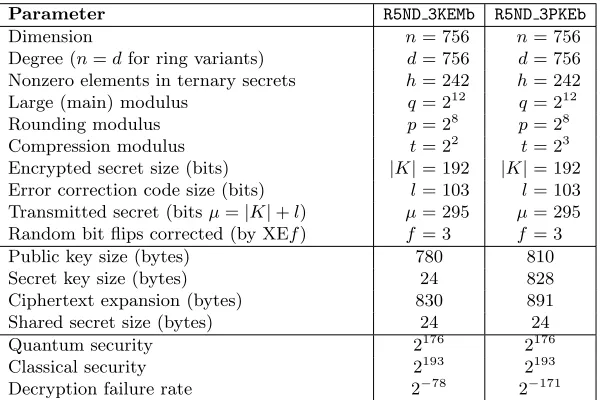
Round5 Designators. This work focuses on variants with designatorsR5ND_3KEMb
Table 1.Internal parameters and external attributes for the R5ND 3 “b” variants of Round5 discussed in this paper. The security estimates are made with very conservative assumptions and correspond to NIST3 security level. See also Tables 4 and 5.
Parameter R5ND 3KEMb R5ND 3PKEb
Dimension n= 756 n= 756
Degree (n=dfor ring variants) d= 756 d= 756 Nonzero elements in ternary secrets h= 242 h= 242 Large (main) modulus q= 212 q= 212
Rounding modulus p= 28 p= 28
Compression modulus t= 22 t= 23 Encrypted secret size (bits) |K|= 192 |K|= 192 Error correction code size (bits) l= 103 l= 103 Transmitted secret (bitsµ=|K|+l) µ= 295 µ= 295 Random bit flips corrected (by XEf) f= 3 f= 3
Public key size (bytes) 780 810
Secret key size (bytes) 24 828
Ciphertext expansion (bytes) 830 891 Shared secret size (bytes) 24 24
Quantum security 2176 2176
Classical security 2193 2193
Decryption failure rate 2−78 2−171
2.3 High-Level Algorithm Overview
Table 1 summarizes the internal and external parameters of our implementation. Round5 uses two polynomial rings4;xn+1−1, withn+1 prime, and its subring
Φn+1 = (xn+1−1)/(x−1) =xn+· · ·+x+ 1. We observe thatxnmodΦn+1= −Pn−1
0 x
i. Therefore one can utilize a trick for reducing modulo Φ
n+1, first reducing a result modulo cyclicxn+1−1 wherexi+n+1≡xi, and then subtracting
thexn coefficient from the rest of coefficients (and itself).
The small-norm secrets have special structure: sparse ternary polynomial set
D⊂ {−1,0,1}n has h
2 coefficients set to +1,
h
2 coefficients set to -1, andn−h coefficients being zero.
Ignoring a lot of detail, the basic key generation procedureKeyGenCPA() is given by Algorithm 1 while Algorithms 2 and 3 describe the basic encryption and decryption operations EncryptCPA() and DecryptCPA(), respectively. The functionSampleµtakesµlowest-order coefficients of input. Note that the
round-ing constant for Round is actually not always 1/2 – we refer to the submission documents and [5] for a full technical definition of Round5.
To see why the algorithm works, note that the shared secrets in Algorithms 2 and 3 satisfy approximatelyt≈t0 ≈a∗s∗r. Even though the two multiplications are in a different rings, the second ring is a subring of the first. Sincesandrare
4
Algorithm 1KeyGenCPA(σ, γ): Key generation for CPA case. Input: Random seedsσ,γ.
1: a←$σ
Znq Uniform polynomial, seedσ.
2: s←$γD Sparse ternary polynomial, seedγ. 3: b←Roundq→p(a∗s modΦn+1,1/2) Compress product to range0≤bi< p. 4: sk=s s: Random seedγ is sufficient. 5: pk= (a,b) a: Random seedσ,b:nlog2pbits. Output: Public keypk= (a,b) and secret keysk=s.
Algorithm 2EncryptCPA(m,pk, ρ): Public key encryption (CPA). Input: Messagem={0,1}m
, public keypk= (a,b), random seedρ.
1: r←$ρ D Sparse ternary polynomial, seedρ
2: u←Roundq→p(a∗r modΦn+1,1/2) Compress product to range0≤ui< p. 3: t←Sampleµ(b∗r modxn+1−1) Noisy shared secret, truncate to
Zµp. 4: v←Roundp→t(t+p2m,1/2) Add message + error correctionm∈Zµ
2. 5: ct= (u,v) u:nlog2pbits,v:µlog2tbits.
Output: Ciphertextct= (u,v).
“balanced”, their coefficients sum to zero and they are divisible by (x−1). High bits oft are used as a “one time pad” to transport the message payload.
CPA-KEM. The chosen-plaintext secure (IND-CPA) key encapsulation mode is constructed fromEncryptCPA() andDecryptCPA() in straightforward fashion by randomizing seedρand composing the messagem∈ {0,1}µfrom random key
k← {$ 0,1}|K|and an error correction code (Section 3.1). Both parties compute the shared secret asss=h(k,ct) (after error correction in decapsulation.)
CCA-KEM. The CPA scheme is transformed into a chosen ciphertext (IND-CCA2) secure one (inR5ND_3PKEb) using the Fujisaki-Okamoto Transform [13,15]:
– Key generation requires storing secret coinsz← {$ 0,1}|K|and the public key fromKeyGenCPAwith the secret key:CCAsk= (sk,z,pk).
– Encapsulation. We hashm∈ {0,1}µ consisting of a random message and
error correction with the public key to create a triplet of |K|-bit
quanti-Algorithm 3DecryptCPA(ct,sk): Decryption (CPA). Input: Ciphertextct= (u,v), secret keysk=s.
1: t0←Sampleµ(u∗s modx n+1−
0 1,000 2,000 3,000 4,000 SIKEp503
R5ND 1KEMb
R5ND 1PKEb SIKEp751
R5ND 3KEMb R5ND 3PKEb Saber Kyber-768
sntrup4591761
NTRU-HRSS17 NewHope1024-CCA
Bytes Transmitted
Public Key Ciphertext
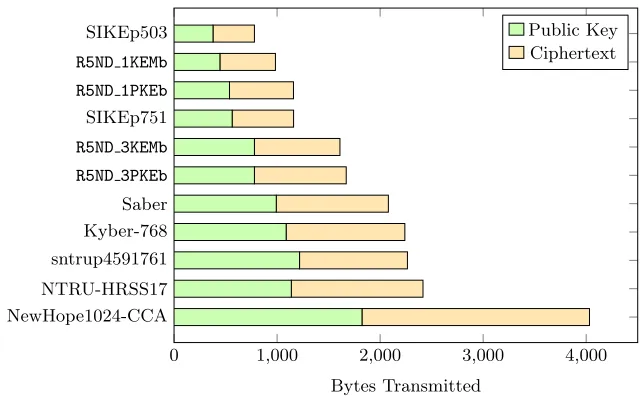
Fig. 1. Bandwidth usage in key establishment. In addition to other relatively bandwidth-efficient lattice schemes, we include SIKEp503 (Category 1) and SIKEp751 (Category 3), which are the only candidates with shorter messages. However their performance is several orders of magnitude slower than that of Round5 – see Table 2.
ties (l,g, ρ) =h(m,pk). Then compute c= (EncryptCPA(m,pk, ρ) and set ciphertext asct= (c,g). The shared secret isss=h(l,ct).
– Decapsulation computes m0 = DecryptCPA(c,sk) from the first part of ciphertext and uses that to create its version of triplet (l0,g0, ρ0) =h(m0,pk). This is then used in simulated encryption c0 = EncryptCPA(m0,pk, ρ0). If there is a match ct = (c0,g0), we set ss = h(l0,ct). In case of mismatch
ct6= (c0,g0) we use our stored coinszfor deterministic outputss=h(z,ct).
KEMs and Public Key Encryption. WhileR5ND_3KEMb(CPA) is sufficient for purely ephemeral key establishment, we suggestR5ND_3PKEb(CCA) for pub-lic key encryption [7]. One of course needs to further define a Data Encapsulation Mechanism (DEM) in order to transmit actual messages rather than just keys.
3
Implementation Tweaks and Optimizations
Simplifications. There are a number of practical simplifications related to our specific parameter choices. Since p and q are powers of two, there is a lot of masking by p−1 andq−1. However much of this is unnecessary since carry bits do not flow from higher bits towards lower bits in addition and subtraction. Therefore all intermediate values can be kept at full word length. Most of the arithmetic operates internally on 16-bit words, well suited for lightweight targets.
SHAKE-256. We use SHAKE-256 [11] consistently for hashing and random byte sequence generation. Round2 used SHA3-512 for “short-output hashing”, usually truncating the result to 32 bytes. SHA3-512 with its 1024-bit inter-nal state and slow speed is clearly an overkill. Round2 furthermore specified a “DRBG” based on AES-256 [10] in counter mode [9]. SHAKE-256 is designed as a extendable output function (XOF) and takes over the functions of DRBG. There were instances of double hashing within the algorithm, such as hashing input to get a fixed-length DRBG seed – which is of course unnecessary in case of an arbitrary-input XOF. Another case was the three-outputGfunction which was previously implemented with three iterations of hashing rather than cutting a longer XOF output into three shorter pieces.
Faster generation of sparse ternary vectors. We use a rejection sampling method rather than the sorting method originally used in Round2. This faster method allows us to store a random seed instead of a full ternary vector as the secret key. See Section 3.3 and Algorithm 4 for more details. The original method was chosen to have constant time execution (even though it didn’t always have that in practice). We note that even though rejection sampling has variable execution time, it does not leak secrets if the distribution is not secret, the original secret values are statistically independent, and a non-rejected result itself does not cause a timing variation (e.g. via memory accesses).
3.1 Error Correcting Code XEf
A 3-error correcting block code is used to decrease the failure rate. The code is built using the same strategy as codes used by TRUNC8 [28] (2-bit correction) and HILA5 [29] (5-bit correction).
Our linear parity code consists of 2f = 6 “registers”Ri of size|Ri|=li. We
view the payload blockmas a binary polynomialm|K|−1x|K|−1+· · ·+m1x+m0 of length equivalent to shared secretK. Registers are defined via cyclic reduction
Ri=mmodxli−1, (2)
or equivalently by
r(i,j)= X
k≡jmodli
mk (3)
wherer(i,j)is bitjof registerRi. A transmitted message consists of the payload
mconcatenated with register setr (a total of|K|+Pl
Upon receiving a message (m0 |r) one computes coder0 corresponding tom0
and compares it to the received code r– that may also have errors. Errors are in coefficientsm0j where there is parity disagreementsr(i,j modli)6=r
0
(i,j modli)
for multitude of registersRi. We use a majority rule and flip bitm0j if
2f
X
i=1
r(i,j modli)−r
0
(i,j modli)
mod 2≥f + 1 (4)
where the sum is taken as the number of disagreeing register parity bits atj. It is easy to show that if all length pairs satisfy lcm(li, lj)≥ |K|when i6=j
then this code always always corrects at least f errors. Typically one chooses coprime lengthsl1< l2<· · ·< l2f so thatl1l2≥ |K|.
OurR5ND 3variants have f = 3 and (l1, l2,· · · , l6) = (13,15,16,17,19,23). The code adds P
ili =l= 103 bits to the message, bringing the total to 192 +
103 = 295 bits. We have verified that our implementation always fixes 3 bit flips anywhere in the 295-bit block and 4 bit flips with P = 44785504/309177995≈ 14.5%. Its main advantage over other error-correcting codes is that it can be implemented without table look-ups and conditional cases and it is therefore resistant to timing attacks. See Tables 1 and 3 for overall failure rate estimates.
3.2 Arithmetic of Sparse Ternary Polynomials
Unlike many other fast lattice-based schemes, ourR5ND 3variants do not use the (Nussbaumer) Number Theoretic Transform (NTT) for its ring arithmetic [24]. This allows more flexibility for selection ofnand greater variance in implemen-tation techniques leading to substantial reduction in implemenimplemen-tation footprint.
Multiplication of a ring element with{−1,0,+1}coefficients requires only ad-ditions and subtractions. Furthermore the use of power-of-2 moduliq, p, tmeans that no modular reduction is required. This greatly simplifies implementation, especially on hardware targets, but also on microcontrollers without a multiplier (where performance gains are likely to be more significant than on Cortex M).
Implementation of sparse ternary multiplication required special attention as that is the workhorse of Round2 and a large portion of its execution time is spent performing this operation. Clearly its complexity isO(hn) but even though this is asymptotically worse thanO(nlogn) of NTT, our findings indicate that it is significantly better in practice with the parameters of R5ND_3KEMb and
R5ND_3PKEb.
The lowest level loops in multiplication are simple vector additions and sub-tractions. Since there is an equivalent number (h/2) of +1 and -1 terms in the ternary polynomials, the computation is organized in a way that allows an ad-dition and an subtraction to be paired in a each loop.
is no RAM cache 5) We note that our cache-resistant portable implementation runs at about half of the speed of normal version.
Algorithm 4SparseTernary(s): A ternary vector with weighthfrom seeds. Input: Seed values, dimension and degreen, scaling factork=b216/nc.
1: z←SHAKE256(s) Absorb the seedsinto Keccak state. 2: v←0n Initialize as zero.
3: fori= 0,1, . . . h−1do 4: repeat
5: repeat
6: t0←two bytes fromz z represents the (endless) output of XOF. 7: untilt0< kn Rejection step with the unscaled value. 8: t← bt0/kc Remove the integer scaling factork. 9: untilvt= 0 Another rejection. Vector is sparse. 10: vt←(−1)i Alternating+1,−1,+1,· · · . 11: end for
Output: A vectorvwhich has h2 elements set to +1, h2 set to -1 andn−hzeros.
3.3 Sparse Ternary Vector Generation
Algorithm 4 describes our deterministic method for creating sparse ternary vec-tors of weight h. It uses rejection sampling to obtain uniformly random index 0 ≤t < n. This is clearly not a constant time operation – however we can see that a rejection sampler does not leak information about tsince bytes in zare statistically independent. This has caused some false positives when automated tools are used to detect timing leaks.
Even though Algorithm 4 produces correct results, in practice the vectorv is only used to store only an “occupancy table” of free slots, while the actual indicestare stored in two lists of +1 and−1 coefficient offsets (which correspond to coefficient of degreen+ 1−tin ring polynomial representation). These lists of lengthh/2 are used in multiplication rather than scanningv. There is no reason to sort the lists – a randomized pattern may even work as a free cache attack countermeasure on targets where that may be a problem.
The use of scaling factor k greatly lowers the rejection rate of the inner sampler. WithR5ND_3KEMbandR5ND_3PKEbwe haven= 756 andk=b216/nc= 86, leading to rejection rate of just 1−kn/216= 0.007935.
There is a secondary rejection when finding non-empty slots in thevvector, which might make an algorithm of this sort run in essentially quadratic time if
his close ton. However in our case the density is bound byh/n≤1/3.
A simple implementation of secondary rejection should be timing attack re-sistant on the Cortex M4, which has no data cache. However we also have a
5
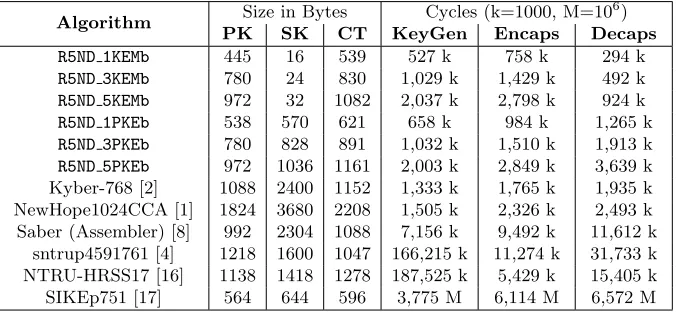
Table 2. Communication parameters and cycle count breakdown of the optimized C implementation on Cortex-M4 for some NIST PQC candidate KEMs. First columns give the size of public key, secret key, and ciphertext in bytes. The following columns give the number of cycles required for key generation, encapsulation, and decapsulation.
Algorithm Size in Bytes Cycles (k=1000, M=10 6)
PK SK CT KeyGen Encaps Decaps
R5ND 1KEMb 445 16 539 527 k 758 k 294 k
R5ND 3KEMb 780 24 830 1,029 k 1,429 k 492 k R5ND 5KEMb 972 32 1082 2,037 k 2,798 k 924 k
R5ND 1PKEb 538 570 621 658 k 984 k 1,265 k
R5ND 3PKEb 780 828 891 1,032 k 1,510 k 1,913 k R5ND 5PKEb 972 1036 1161 2,003 k 2,849 k 3,639 k Kyber-768 [2] 1088 2400 1152 1,333 k 1,765 k 1,935 k NewHope1024CCA [1] 1824 3680 2208 1,505 k 2,326 k 2,493 k Saber (Assembler) [8] 992 2304 1088 7,156 k 9,492 k 11,612 k
sntrup4591761 [4] 1218 1600 1047 166,215 k 11,274 k 31,733 k NTRU-HRSS17 [16] 1138 1418 1278 187,525 k 5,429 k 15,405 k SIKEp751 [17] 564 644 596 3,775 M 6,114 M 6,572 M
“countermeasure” version that stores the occupancy of vi in list of a dozen
64-bit words (the sign doesn’t matter, so a single 64-bit is enough). This version scans the entire list with constant-time Boolean logic for every probe.
4
Performance on Cortex M4
We benchmarked a group of comparable NIST First Round KEM and PKE pro-posals on Cortex-M4. A NIST Category 3 variant (“192 quantum bit security”) was used if available. We used an optimized C version in our tests, linked with an efficient assembler-language SHA3 implementation (excluded from code size). Our results are summarized in Table 2 and Figures 1 and 2. We are also including assembler optimized Cortex M4 numbers for Saber from [18] for completeness. Source code is available at https://github.com/mjosaarinen/r5nd_tiny.
Test Setup. We wanted a fair comparison that eliminates bias caused by poor testing setup. For example the initial NIST tests of Hila5 indicated poor perfor-mance, but this was caused by extremely poor implementation ofrandombytes()
in the NIST test suite. This function (i.e. the test suite itself) was consuming 80 % of cycles. Some other submitters were aware of this pitfall and created a faster layer of random number generationinsidetheir implementation. Our test code consistently uses a fast implementation of SHAKE for random numbers.
Micro-0 1 2 3 4 5 6 7 8 R5ND 1KEMb, C
R5ND 1PKEb, C
R5ND 3KEMb, C R5ND 3PKEb, C Saber, Asm [18]
Kyber-768, Asm
Kyber-768, C
NewHope1024CCA, Asm
NewHope1024CCA, C
Saber, Ref C
Million Cycles
KeyGen() Encaps() Decaps()
Fig. 2.Visualization of relative speed of key establishment, including assembler ver-sions from [18] and PQM4. We have excluded algorithms that require more than 200 M cycles (several seconds). Round5 implementations are in written in C, yet highly competitive in terms of speed.
controller on a Teensy6board, which we ran at 24 MHz. Cycle counts at higher speeds are slightly less accurate due to interference by the memory controller.
For comparison, a highly optimized X25519 scalar multiplication requires 907 k cycles on Cortex M4 [12] – but has only 128-bit classical security. Four scalar multiplications are needed for Diffie-Hellman, so our plain C implementations of
R5ND 1KEMb, R5ND 1PKEb, and even higher-securityR5ND 3KEMb are faster.
Dominance of Hashing in KEM Speed Measurement. Our measure-ment results on other candidates are consistent with those produced by the PQCRYPTO group in “PQM4: Post-quantum crypto library for the ARM Cortex-M4” project7. However we didn’t use their testing script system as it is targeted to a board using different flashing and communication mechanisms.
The reason for initial performance measurement divergence was that PQM4 experiments used a hand-crafted assembler implementation of the SHA3 core. This optimized permutation takes 11,785 cycles, while its optimized C language equivalent takes 32,639 cycles. This emphasizes the fact that benchmarks of fast lattice KEMs are also benchmarks of symmetric primitive implementations used.
6 Teensy 3.2 is an inexpensive (under $20) miniature (18×36 mm or 0.7×1.4”)
Cortex-M4 development board:https://www.pjrc.com/store/teensy32.html 7
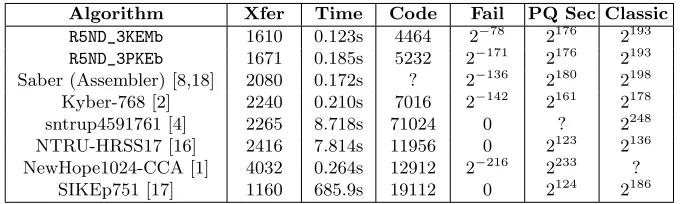
Table 3. Engineering and security comparison for key establishment use case with Cortex M4 at NIST Security Level 3. Xfer: Total data transferred (public key + ci-phertext). Time: Time required for KeyGen() + Encaps() + Decaps() on Cortex-M4 at 24 MHz. Code: Size of implementation in bytes, excluding hash function and other common parts. Fail: Decryption failure bound. PQ Sec: Claimed quantum complexity. Classic: Claimed classical complexity.
Algorithm Xfer Time Code Fail PQ Sec Classic R5ND_3KEMb 1610 0.123s 4464 2−78 2176 2193 R5ND_3PKEb 1671 0.185s 5232 2−171 2176 2193 Saber (Assembler) [8,18] 2080 0.172s ? 2−136 2180 2198 Kyber-768 [2] 2240 0.210s 7016 2−142 2161 2178 sntrup4591761 [4] 2265 8.718s 71024 0 ? 2248 NTRU-HRSS17 [16] 2416 7.814s 11956 0 2123 2136 NewHope1024-CCA [1] 4032 0.264s 12912 2−216 2233 ?
SIKEp751 [17] 1160 685.9s 19112 0 2124 2186
5
Conclusions
In this work we have examined the suitability of Round5 post-quantum key establishment and public key encryption algorithm for embedded and other limited-resource use cases. We focused on R5ND_3KEMb and R5ND_3PKEb vari-ants on Cortex M4 platform and compared them to some other compact NIST PQC proposals at the same security level.
Round5 combines the design features of two candidates in the NIST Post-Quantum Cryptography project, Round2 and Hila5. Round5 has new parameter selection, addressing various NIST PQC security levels and use cases. Optimiza-tion of parameters was performed primarily for bandwidth at given security level; the public key and ciphertext sizes of the new variant are smaller than those of other lattice candidates and second smallest only to SIKE (which is not practical on embedded targets due to its very high computational requirements).
References
1. Erdem Alkim, Roberto Avanzi, Joppe Bos, L´eo Ducas, Antonio de la Piedra, Thomas P¨oppelmann, Peter Schwabe, and Douglas Stebila. NewHope: Algorithm specifcations and supporting documentation. First Round NIST PQC Project Sub-mission Document, November 2017. URL: https://csrc.nist.gov/Projects/ Post-Quantum-Cryptography/Round-1-Submissions.
2. Roberto Avanzi, Joppe Bos, L´eo Ducas, Eike Kiltz, Tancr`ede Lepoint, Vadim Lyubashevsky, John M. Schanck, Peter Schwabe, Gregor Seiler, and Damien Stehl´e. CRYSTALS-Kyber: Algorithm specifications and supporting documentation. Fist Round NIST PQC Project Submission Document, November 2017. URL:https:// csrc.nist.gov/Projects/Post-Quantum-Cryptography/Round-1-Submissions. 3. Abhishek Banerjee, Chris Peikert, and Alon Rosen. Pseudorandom functions
and lattices. In David Pointcheval and Thomas Johansson, editors, EURO-CRYPT 2012, volume 7237 of LNCS, pages 719–737. Springer, 2012. doi: 10.1007/978-3-642-29011-4_42.
4. Daniel J. Bernstein, Chitchanok Chuengsatiansup, Tanja Lange, and Christine van Vredendaal. Ntru prime 20171130. Fist Round NIST PQC Project Sub-mission Document, November 2017. URL: https://csrc.nist.gov/Projects/ Post-Quantum-Cryptography/Round-1-Submissions.
5. Sauvik Bhattacharya, Oscar Garcia-Morchon, Thijs Laarhoven, Ronald Rietman, Markku-Juhani O. Saarinen, Ludo Tolhuizen, and Zhenfei Zhang. Round5: Com-pact and fast post-quantum public-key encryption. Submitted for publication, August 2018. URL:https://eprint.iacr.org/2018/725.
6. CNSS. Use of public standards for the secure sharing of information among na-tional security systems. Committee on Nana-tional Security Systems: CNSS Advisory Memorandum, Information Assurance 02-15, July 2015.
7. Ronald Cramer and Victor Shoup. Design and analysis of practical public-key en-cryption schemes secure against adaptive chosen ciphertext attack. SIAM Journal on Computing, 33(1):167–226, 2003. URL:http://www.shoup.net/papers/cca2. pdf,doi:10.1137/S0097539702403773.
8. Jan-Pieter D’Anvers, Angshuman Karmakar, Sujoy Sinha Roy, and Frederik Ver-cauteren. SABER: Mod-LWR based KEM. Fist Round NIST PQC Project Sub-mission Document, November 2017. URL: https://csrc.nist.gov/Projects/ Post-Quantum-Cryptography/Round-1-Submissions.
9. Morris Dworkin. Recommendation for block cipher modes of operation: Methods and techniques. NIST Special Publication 800-38A, December 2001.doi:10.6028/ NIST.SP.800-38A.
10. FIPS. Specification for the Advanced Encryption Standard (AES). Federal In-formation Processing Standards Publication 197, November 2001. URL: http: //csrc.nist.gov/publications/fips/fips197/fips-197.pdf.
11. FIPS. SHA-3 standard: Permutation-based hash and extendable-output functions. Federal Information Processing Standards Publication 202, August 2015. doi: 10.6028/NIST.FIPS.202.
12. Hayato Fujii and Diego F. Aranha. Curve25519 for the Cortex-M4 and beyond. In LATINCRYPT 2017, 2017. URL: http://www.cs.haifa.ac.il/~orrd/LC17/ paper39.pdf.
14. Oscar Garcia-Morchon, Zhenfei Zhang, Sauvik Bhattacharya, Ronald Riet-man, Ludo Tolhuizen, Jose-Luis Torre-Arce, and Hayo Baan. Round2: KEM and PKE based on GLWE. First Round NIST PQC Project Submis-sion Document, November 2017. URL: https://csrc.nist.gov/Projects/ Post-Quantum-Cryptography/Round-1-Submissions.
15. Dennis Hofheinz, Kathrin H¨ovelmanns, and Eike Kiltz. A modular analysis of the fujisaki-okamoto transformation. In Yael Kalai and Leonid Reyzin, editors, TCC 2017 (I), volume 10677 of LNCS, pages 341–371. Springer, 2017. URL: https://eprint.iacr.org/2017/604,doi:10.1007/978-3-319-70500-2_12. 16. Andreas H¨ulsing, Joost Rijneveld, John M. Schanck, and Peter Schwabe.
NTRU-HRSS-KEM: Algorithm specifications and supporting documentation. Fist Round NIST PQC Project Submission Document, November 2017. URL:https://csrc. nist.gov/Projects/Post-Quantum-Cryptography/Round-1-Submissions. 17. David Jao, Reza Azarderakhsh, Matthew Campagna, Craig Costello, Luca De
Feo, Basil Hess, Amir Jalali, Brian Koziel, Brian LaMacchia, Patrick Longa, Michael Naehrig, Joost Renes, Vladimir Soukharev, and David Urbanik. Su-persingular isogeny key encapsulation. First Round NIST PQC Project Sub-mission Document, November 2017. URL: https://csrc.nist.gov/Projects/ Post-Quantum-Cryptography/Round-1-Submissions.
18. Angshuman Karmakar, Jose Maria Bermudo Mera, Sujoy Sinha Roy, and Ingrid Verbauwhede. Saber on ARM: CCA-secure module lattice-based key encapsulation on ARM. InCHES 2018, 2018. URL:https://eprint.iacr.org/2018/682,doi: https://doi.org/10.13154/tches.v2018.i3.243-266.
19. Richard Lindner and Chris Peikert. Better key sizes (and attacks) for LWE-based encryption. In Aggelos Kiayias, editor,CT-RSA 2011, volume 6558 ofLNCS, pages 319–339. Springer, 2011. doi:10.1007/978-3-642-19074-2_21.
20. Dustin Moody. Post-quantum cryptography: NIST’s plan for the future. Talk given at PQCrypto ’16 Conference, 23-26 February 2016, Fukuoka, Japan, February 2016. URL:https://pqcrypto2016.jp/data/pqc2016_nist_announcement.pdf. 21. NIST. Submission requirements and evaluation criteria for the
post-quantum cryptography standardization process. Official Call for Pro-posals, National Institute for Standards and Technology, December 2016. URL: http://csrc.nist.gov/groups/ST/post-quantum-crypto/documents/ call-for-proposals-final-dec-2016.pdf.
22. NIST. Post-quantum cryptography – round 1 submissions. National Institute for Standards and Technology, December 2017. URL: https://csrc.nist.gov/ Projects/Post-Quantum-Cryptography/Round-1-Submissions.
23. NSA/CSS. Information assurance directorate: Commercial national security algo-rithm suite and quantum computing FAQ, January 2016. URL: https://apps. nsa.gov/iaarchive/library/ia-guidance/ia-solutions-for-classified/ algorithm-guidance/cnsa-suite-and-quantum-computing-faq.cfm.
24. Henri J. Nussbaumer. Fast polynomial transform algorithms for digital convolu-tion. IEEE Transactions on Acoustics, Speech and Signal Processing, 28:205–215, 1980. doi:10.1109/TASSP.1980.1163372.
25. John Proos and Christof Zalka. Shor’s discrete logarithm quantum algorithm for elliptic curves. Quantum Information & Computation, 3(4):317–344, July 2003. Updated version available on arXiv. URL: https://arxiv.org/abs/quant-ph/ 9508027.
27. Oded Regev. On lattices, learning with errors, random linear codes, and cryp-tography. Journal of the ACM, 56(6):34:1–34:40, September 2009. doi:10.1145/ 1568318.1568324.
28. Markku-Juhani O. Saarinen. Ring-LWE ciphertext compression and error cor-rection: Tools for lightweight post-quantum cryptography. In Proceedings of the 3rd ACM International Workshop on IoT Privacy, Trust, and Security, IoTPTS ’17, pages 15–22. ACM, April 2017. URL:https://eprint.iacr.org/2016/1058, doi:10.1145/3055245.3055254.
29. Markku-Juhani O. Saarinen. HILA5: On reliability, reconciliation, and error cor-rection for Ring-LWE encryption. In Carlisle Adams and Jan Camenisch, editors, SAC 2017, volume 10719 of Lecture Notes in Computer Science, pages 192–212. Springer, 2018. doi:10.1007/978-3-319-72565-9_10.
30. Peter W. Shor. Algorithms for quantum computation: Discrete logarithms and factoring. InProc. FOCS ’94, pages 124–134. IEEE, 1994. Updated version avail-able on arXiv. URL:https://arxiv.org/abs/quant-ph/9508027,doi:10.1109/ SFCS.1994.365700.
Table 4.Round5 “b” ring variant parameter sets for key establishment.
Parameters CPA NIST1 CPA NIST3 CPA NIST5
Round5.KEM
d, n, h 490, 490, 162 756, 756, 242 940, 940, 414
q, p, t 210,27,24 212,28,22 212,28,23
B,n,¯ m, f¯ 1, 1, 1, 3 1, 1, 1, 3 1, 1, 1, 3
µ 128 + 91 192 + 103 256 + 121 Public key 445 B 780 B 972 B Ciphertext 539 B 830 B 1082 B PQ Security 2118 2176 2232
Classical 2128 2193 2256 Failure rate 2−78 2−78 2−95 Version (fd,d(0)) R5ND_1KEMb R5ND_3KEMb R5ND_5KEMb
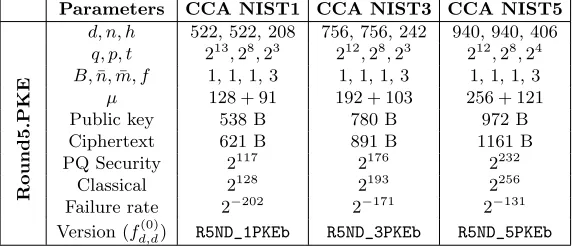
Table 5.Round5 “b” ring variant parameter sets for public key encryption.
Parameters CCA NIST1 CCA NIST3 CCA NIST5
Round5.PKE
d, n, h 522, 522, 208 756, 756, 242 940, 940, 406
q, p, t 213,28,23 212,28,23 212,28,24
B,n,¯ m, f¯ 1, 1, 1, 3 1, 1, 1, 3 1, 1, 1, 3
µ 128 + 91 192 + 103 256 + 121 Public key 538 B 780 B 972 B Ciphertext 621 B 891 B 1161 B PQ Security 2117 2176 2232
![Fig. 2. Visualization of relative speed of key establishment, including assembler ver-sions from [18] and PQM4](https://thumb-us.123doks.com/thumbv2/123dok_us/7977456.1322883/11.612.138.479.111.297/fig-visualization-relative-speed-establishment-including-assembler-sions.webp)