An
Application of Multilevel Modelling Techniques to
the Longitudinal Study of Student Progress in a Modular
Degree Course
PhD thesis
Vanessa Simonite
Acknowledgements
I would like to thank the School of Computing and Mathematical Sciences, Oxford Brookes University, for supporting this research through the Staff Development Fund and Professor Harvey Goldstein for his support as a supervisor.
Thank you Annie Jo, Laura, Tom and Jeremy for your support and entertainment too.
Abstract
This thesis presents a longitudinal study of undergraduate achievement
within a modular first degree course, analysing the academic records of a cohort of
students who graduated from the Modular Degree Programme at Oxford Brookes
University. Multilevel models are fitted to the marks achieved by members of this
cohort in each module taken. Level 1 units are individual module entries, nested
within occasions within individual student's programmes. These models were fitted
by maximum likelihood and used to study the effects of both student and module
characteristics on performance. The effects of these factors on mean marks, on the
consistency of students performance and on the variation between students were
studied by including complex variation at levelland random effects at student level
in the models. In addition, individual progress charts were fitted, showing how
patterns of progress vary from one student to another.
Reviewing the hierarchical structure, it was found that a more complex,
cross-classified structure is needed to represent the data accurately. This recognises that individual module entries are clustered within modules, as well as within
students. Fitting large multilevel cross-classified models is computationally difficult,
however newly developed MCMC estimation techniques allowed a model based on
the more complex structure and including random effects and complex variation to
be fitted. This analysis shows how MCMC estimation techniques can be used to fit a
large cross-classified multilevel model, incorporating random effects and complex
variation. The results obtained describe students' progress over the period of their
assessment methods, age and subject on mean levels of achievement, consistency of performance and the variation between students, providing a model for future studies of achievement within a modular framework.
Contents
1
Introduction
1.1 Introduction
1.2 Summary of Thesis
2
Review of Research Literature on the Academic Achievement of
Undergraduates
2.1 Introduction
2.2 Methods Used to Study the Academic Achievement of
Undergraduates
2.2.1 Measuring Academic Achievement
2.2.2 Absence of Key Variables
2.2.3 Sample Selection and Response Rates
2.2.4 Level of Analysis
2.2.5 Changes in Higher Education
2.2.6 Assumptions of Comparability between Degree Awards
2.2.6.1 Comparability between Degrees Awarded by Different
Institutions
2.2.6.2 Comparability between Degrees Awarded inDifferent
Years
2.2.6.3 Between Subject Comparability
2.2.6.4 A Subjective Definition of Comparability
2.3 Findings of Studies of The Academic Achievement of Undergraduates
2.3.1 Sex Differences in Academic Achievement 2.3.2 Age on Entry to Higher Education
2.3.3 Entry Qualifications 2.3.4 Class Size
2.3.5 Method of Assessment 2.3.6 Subject Studied
2.4 Modularisation in Higher Education in the United Kingdom 2.4.1 Comparability within a Modular Degree Scheme
2.4.1.1 Statistical Approaches to defining Comparability between Modules
2.4.1.2 A Subjective Definition of Comparability between Modules
2.4.2 Systems for Classifying Honours Degrees in Modular Degree Courses
2.4.2.1 Modules Contributing To Degree Classifications 2.4.2.2 Methods for Combining Module Outcomes 2.4.2.3 Degree Class Boundaries and Borderlines 2.4.2.4 Interpretation of Feedback during Programme 2.5 Summary and Proposed Analyses
3
The Sample
3.1 Introduction
3.2 The Modular Degree Programme at Oxford Brookes University
3.3 Content of Programmes
3.4 Planning a Programme
3.5 Assessment within Modules
3.6 Confirmation of Results and Feedback to Students
3.7 Classification of Honours Degrees
3.8 Ordinary Degrees 3.9 Selection of the Sample
3.9.1 Distribution of the Sample by Age, Sex and Parents' Social
Class
3.9.2 Distribution of the Sample by Measures of Prior Achievement
3.9.3 Subjects of Students' Degree Awards
3.9.4 Students' Programmes
3.9.5 Performance during Degree Programmes
3.10 Summary
4
A Hierarchical Model of Student Achievement
4.1 Introduction
4.2 Analysis of Raw vs. Standardised Marks
4.3 Variance Components Model
4.4 A more complex Three-Level Model
4.5 Results of Fitting Hierarchical Model to Student Record Data 4.5.1 A Main Effects Model
4.5.2 A Model including Interactions between Independent
Variables
4.5.4 A Model Including Effects Defined as Random at Level3 4.6 Summary
5
Models Based
OnAlternative Structures
5.1 Introduction
5.2 Accuracy of Three Level Hierarchical Structure 5.3 Structure of Covariance Matrix: an Example
5.4 Fitting Cross-Classified Multilevel Models using IGLS 5.4.1 Analyses of Subsets of Student Record Data
5.4.2 Practical Issues in Estimation of Multilevel Cross-Classified Models
5.4.3 Reducing Computational Demands of Multilevel Cross-Classified Models
5.5 MCMC Estimation Methods 5.5.1 Introduction to MCMC
5.5.2 Application of Gibbs Sampling to a multilevel cross-classified model
5.5.3 MCMC Analysis using AlP Algorithm
5.5.4 Comparisons between estimates generated by IGLS, MCMC and the AlP Algorithm
5.5.5 MCMC Estimation for Cross-classified model with complex variance structure
5.6 MCMC Estimation Of Cross-Classified Model 5.7 Summary and Conclusion
6 MCMC Analysis of cross-classified Model
6.1 Introduction
6.2 Choice Of Units: Modules Or Module Repetitions 6.3 The Final Model
6.4 MCMC Diagnostics
6.5 Parameter Estimates
6.6 Effects Of Student Characteristics OnPerformance 6.6.1 Sex differences
6.6.2 Domicile
6.6.3 Entry Qualifications
6.6.4 Social Class
6.6.5 Age
6.6.6 Workload
6.7 Effects of Module Characteristics 6.7.1 Assessment Methods 6.7.2 Subjects
6.7.3 Project
6.7.4 Single and Double Modules
6.7.5 Class Size
6.7.6 Term And Level
6.8 Student Level Random Effects
6.8.1 Variations in Progress
6.8.2 Individual Progress Charts
7
Conclusions
7.1 Introduction
7.2 Sample Selection! Extrapolating the Results
7.3 Methodological Approach for Studying Undergraduate Achievement in a Modular Degree Course
7.4 Evaluation Of Current Findings inthe Context of Previous Studies 7.4.1 Sex Differences
7.4.2 Age
7.4.3 Entry Qualifications 7.4.4 Class Size
7.4.5 Method of Assessment 7.4.6 Other Factors
7.5 New Information Concerning Student Progress
7.6 New Information Arising from the Random part of the Model 7.7 Future Research
7.8 Conclusions
List of Tables
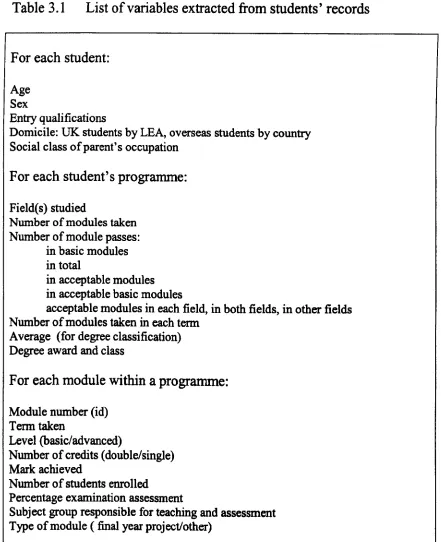
List of variables extracted from students' records Distribution of sample by age and sex
Distribution of sample by social class of parent's occupation Distribution of sample by type of entry qualification
Mean A-level points for students in different groups
Distribution of students' scores corresponding to entry grades for chosen degree award
Distribution of sample by school/department responsible for field(s) studied
Distribution of sample by school or department: single subject degrees
Table 3.9 Distribution of students by field: combined degrees Table 3.1
Table 3.2 Table 3.3 Table 3.4 Table 3.5 Table 3.6
Table 3.7
Table 3.8
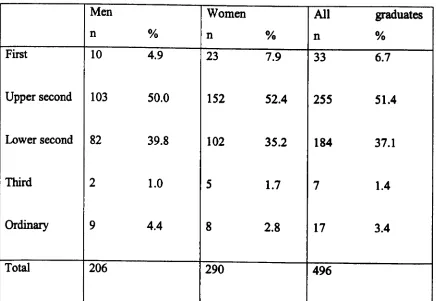
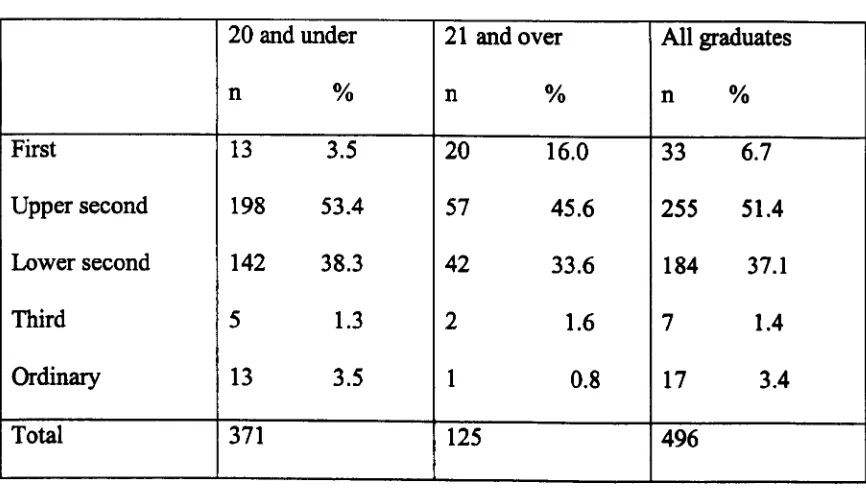
Table 3.10 Degree classifications of sample members by sex Table 3.11 Degree classifications of sample members by age
Table 4.1 Parameter estimates for variance components model (4.1) Table 4.2 Explanatory variables used in analyses
Table 4.3 Parameter estimates for fixed, main effects model (4.2)
Table 4.4 Parameter estimates for main effects model with revised model for progress
Table 4.5 Table 4.6
Parameter estimates for equation (4.4) including random effects and
complex variation at level 3
Parameter estimates after adding extra variables to the level 1
complex variance structure at level 1
Table 4.9 Parameter estimates after identifying 'abandoned' module entries
Table 4.10 Parameter estimates after 'streamlining' Table 4.7
Table 4.8
Table 5.1 Results of Fitting Models (5.1 )-(5.3) to Subset of First Year Data
Table 5.2 Results of Fitting Models (5.4) and (5.5) to Data for Term 2
Table 5.3 Worksheet Size Required to Fit Models (5.1), (5.2) and (5.3) to
Subset of First Year Data
Table 5.4
Table 5.5
Table 6.1
Table 6.2
Table 6.3
Table 6.4
Table 6.5
Worksheet Requirements for Fitting Models (5.1), (5.2) and (5.3) to
Full Data
Parameter Estimates obtained using IGLS, AlP and MCMC: term 2
data, cross-classification by students and modules, 1644 level 1 units
Parameter estimates for variance components model: three level
hierarchy cross-classified by modules and module repetitions
Parameter estimates: MCMC estimation, final model
Level 1 variances in modules using different forms of assessment
Estimated mean marks awarded in modules using 100% coursework
assessment minus estimated mean marks awarded in modules using
mixed assessment, by subject, standard modules and students
Estimated variance of student means: traditional and mature
students
Table 6.6
Table 6.7
Table 6.8
Variation between students in mean performance by assessment method, standard modules taken in stage 2
Correlations between students' individual responses to different forms of assessment
List
of Figures
Figure 3.1 Figure 3.2 Figure 3.3 Figure 3.4 Figure 3.5 Figure 3.6
Figure 3.7 Figure 3.8
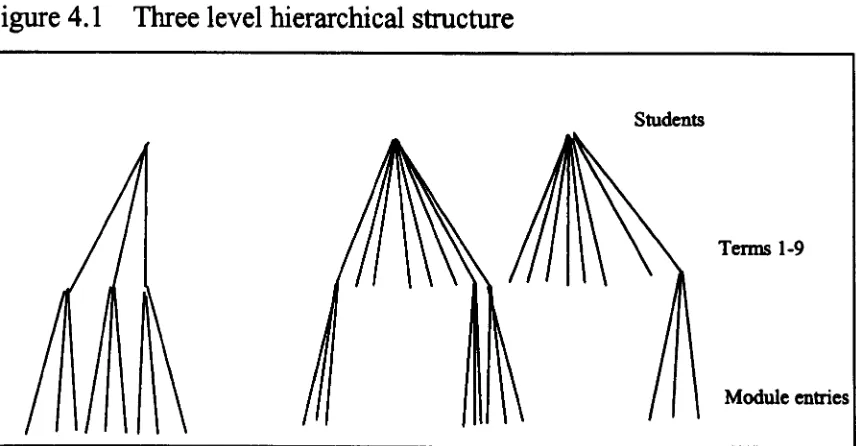
Figure4.1 Figure4.2 Figure 4.3 Figure4.4 Figure4.5
Figure 4.6
Figure 4.7
Figure 4.8
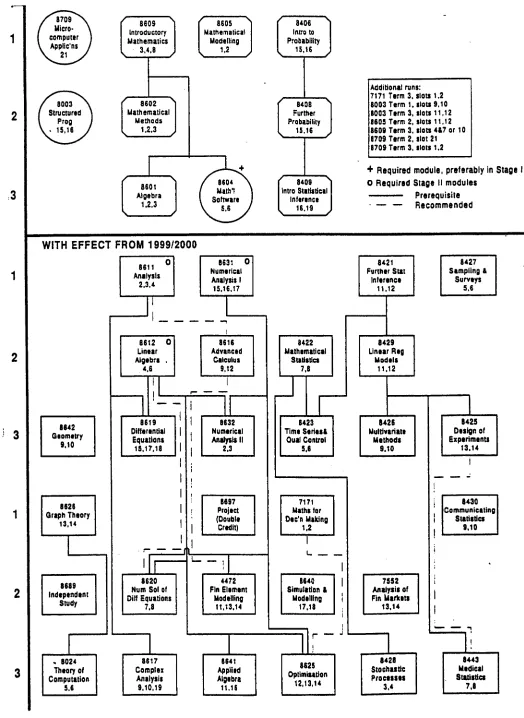
Field diagram BSc Mathematical Sciences Example of a student record
Histogram of A andAlS level scores
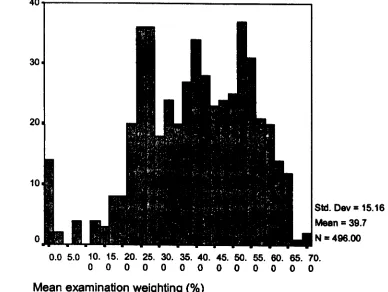
Mean examination weighting experienced by each student Mean class size experienced by each student by term
Distribution of marks for module entries listed 5th, 16th and 22ndin
students' programmes
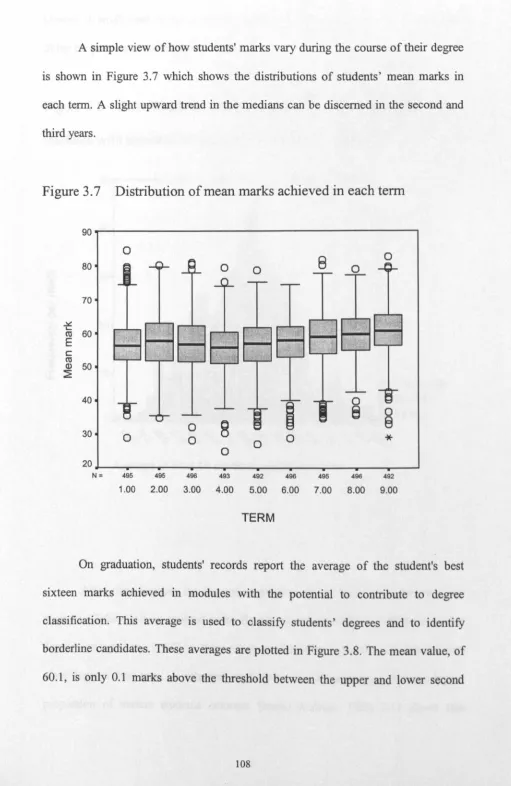
Distribution of mean marks achieved in each term
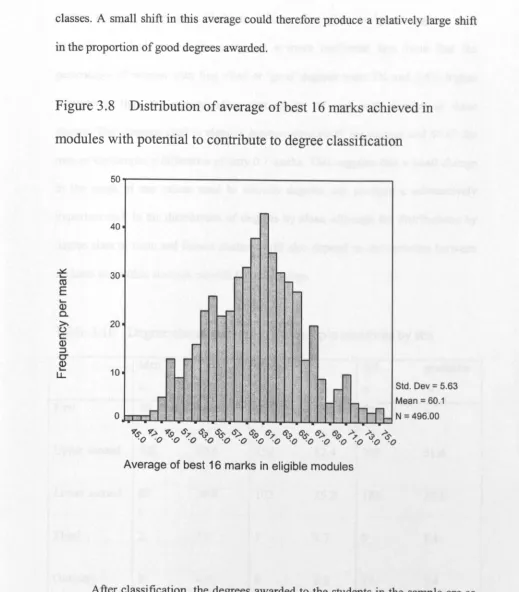
Distribution of average of best 16 marks achieved in modules with potential to contribute to degree classification
Three level hierarchical structure Mean marks by term, model (4.2)
Fitted progress curve using dummy variables to represent terms Revised model for mean progress
Standardised level 1 residuals by equivalent Normal scores for analysis shown in Table 4.7
Standardised level 1 residuals by equivalent Normal scores after adding variables to complex variance structure at level 1
Standardised level 1 residuals by equivalent Normal scores after identifying 112 'abandoned' module entries
Standardised level 3 residuals by equivalent Normal scores for Table
4.9
Standardised level 1 residuals by equivalent Normal scores for streamlined model
Figure 4.10 Standardised level 3 residuals by equivalent Normal scores for Figure 4.9
streamlined model
Figure 4.11 Standardised level 1 residuals vs. predicted values
Figure 4.11 a Standardised level 1 residuals vs. predicted values - completed module entries only
Figure 4.12 Standardised level3 residuals vs. predicted values
Figure 5.1 Cross-Classified Model: assuming module repetitions are independent units
Figure 5.2 Figure 5.3 Figure 5.4 Figure 5.5 Figure 5.6
Figure 5.7
Figure 6.1 Figure 6.2 Figure 6.3
Figure 6.4
Responses Generated By Structure Shown in Figure 5.1
Cross-Classified Model with Repetitions Nested within Modules Responses Generated Within Structure Shown in Figure 5.3 Variance/Covariance Matrix for Model (5.1) - 3 Level Hierarchy Variance/Covariance Matrix for Model (5.2) - cross-classification by module repetitions
Variance/Covariance Matrix for Model (5.3) - second cross-classification by module repetitions within modules
MCMC Diagnostics for
P
C1UMCMC Diagnostics for CfvaUaw/60111eaw
Estimated mean marks by term, for students according to parental occupation
Estimated mean marks, by term, for mature and traditional students
16
Predicted mean marks, by subject, for 'standard' students In
'standard' modules using 100% coursework assessment
Predicted mean marks, by subject, for 'standard' students in 'standard' modules using mixed coursework and examination assessment
Predicted mean marks, by subject, for 'standard' students In
'standard' modules using 100% examination assessment
Relationship between estimated mean and level 1 vanance, by subject, in modules using 100% coursework assessment
Relationship between estimated mean and level 1 variance, by subject, in modules using a mixture of coursework and examination assessment
Figure 6.10 Relationship between estimated mean marks and level 1 variance by Figure 6.5
Figure 6.6
Figure 6.7
Figure 6.8
Figure 6.9
subject, modules using 100% examination assessment
Figure 6.11 Predicted mean marks, with 95% confidence intervals, by module enrolment: standard modules in stage 2
Figure 6.12 Predicted mean marks, with 95% confidence intervals, by module enrolment: standard modules in hospitality and retail management Figure 6.13 Parameters describing student progress
Figure 6.14 Estimated student level residuals {vCOlllk }vs{va1lc.nMt}
Figure 6.15 Estimated student level residuals
{v
COlllk}vs{V.l'CIIII«.f1IIk}Figure 6.16 Student level residuals {Vca1lc.rwk }vs{V.I'OINC.!'Wk}
Figure 6.17 Estimated student level residuals
{v
COIIIk }vs{v
colUk +vallc.rwk }Figure 6.18 Estimated student level residuals
{v
COII.I'k }vs{v
COII.I'k +V.l'omllC.!'wk}Figure 6.19 Estimated level3 residuals {VCOlISk +Vallcswk }vs{VCOlISk +vsomecswk}
Figure 6.20 Simulated mean marks, by term, for 100 'standard' students in 'standard' modules using 100% examination assessment
Figure 6.21 Selected progress charts: 'standard' students in modules using mixed assessment
Figure 6.22 Selected progress charts: mature students in mixed assessment modules
Chapter 1
Introduction
1.1
Aims
Modular degree programmes are now the most common form of undergraduate education within the UK (HEQC, 1996). Modular courses share a common framework, in which students follow programmes of study consisting of modules chosen in accordance with the regulations governing their chosen degree. As students pursue their programmes of study, assessment takes place within
individual modules. The results of these assessments provide each student with regular feedback on their performance, determine a student's status on the course and, once sufficient 'credits' have been accumulated, are used to classify their degree. This thesis will examine the factors affecting the academic achievement of students within modular first degree programmes by analysing the detailed records of achievement for a cohort of students who graduated from the Modular Degree Programme at Oxford Brookes University. Within modular programmes, students undergo multiple assessments on each of a number of occasions and the data
recording the outcomes of these assessments is highly structured. By analysing the results achieved in each module contributing to a student's record and by taking into account the structure of this data, the first aim of this thesis is to provide a model for future studies of student achievement within modular programmes.
An understanding of the relationships between achievement and a student's
background is important in considering whether equal opportunities are available to
undergraduates on a modular degree programme and in targeting learning support at
the students who need it most. As characteristics such as age, gender and entry
qualifications may not be independently distributed, controlling for the effects of
other variables is important when comparing the achievements of groups of students.
Similarly, as students' programmes vary, comparisons between groups of students
need to take into account the effects of any differences in their programmes. The
research literature on undergraduate achievement shows that while several
performance-related factors have been identified, the analyses on which these
findings are based generally fail to control for the effects of factors related to those
being studied. The second aim of the research presented here is to re-evaluate the
effects on performance of variables studied in earlier research after controlling for
more concomitant variables.
As modular degree courses assess students on several occasions, changes in
their performance during the course of their first degree can be studied. The third
aim of the research presented here is to model student progress and to determine how
individual student's patterns of progress vary.
Further aims are concerned with variations in performance: between students
and within student records, between the marks awarded in different modules. The
fourth aim of this thesis is to determine which student and module characteristics
influence the variation between students and to measure their effects. The fifth aim
of this thesis is to examine factors affecting the consistency of individual students'
1.2
Summary of Thesis
Chapter 2 provides a review of the research literature on undergraduate achievement, identifying the need for more research. Previous research findings are based on analyses that generally fail to control for the effects of factors related to those being studied or use measures of achievement which discriminate poorly between students. The use of cross-sectional data in earlier studies of achievement in higher education means that there is no empirical evidence of how consistently students perform or of whether some groups of students perform more consistently than others. This consistency is an important feature of achievement within a modular course: a student's continued enrolment and their graduation both depend on their success in accumulating module credits and this in turn will depend on the level and consistency of their performance. Chapter 2 also includes a discussion of the properties of degree classification systems, concluding that degree classifications partly depend on the variation in the marks achieved within an individual's programme, so factors that influence this variation will also influence graduation and final degree awards.
The research presented here is based on analyses of data extracted from the student record system at Oxford Brookes University and consisting of the student records, including the marks achieved individual modules, of a sample of 496 students who graduated from the Modular Degree Programme in July 1997. Chapter 3 provides a detailed explanation of the structure of the Modular Degree Programme at Oxford Brookes University and describes the selection of the sample of graduates whose records are analysed here. Further sections in chapter 3 summarise the characteristics of the cohort of graduates and their programmes of study.
Chapter 4 proposes models in which the structure of the data is represented by a three level hierarchical model, in which marks for each module entry are clustered within terms within the student's programme. The model includes parameters representing the effects of student and module characteristics in a variety of ways. To achieve the aims of the thesis, student and module characteristics are represented as having fixed and random effects; individual patterns of progress and complex variance structures at student level and at the level of individual module entries (level 1) are also included in the model. The model proposed was fitted to the data in stages, adding different kinds of effects and reviewing the contributions of each variable to the model at each stage. Chapter 4 presents the results obtained at each stage and examines the residuals associated with the final selection of variables and effects.
here, using software under development (Browne, 2000). The cross-classified model, including variables and effects identified as important in the hierarchical analyses, and fitted to the student record data using MCMC estimation techniques, is presented in chapter 6. Chapter 7 evaluates the findings of the final analysis, showing how it enables the first four aims of the thesis to be met. The methodological approach used to obtain the research findings demonstrates the range and complexity of the questions that can be tackled using student record data and in doing so provides a model for future analyses of student achievement within modular programmes.
Chapter 2
Review
of
Research
Literature
on
the
Academic Achievement
of Undergraduates
2.1
Introduction
This chapter is concerned with the methods and findings of previous research studying the academic achievement of undergraduates and with two key issues related to modular degree courses: comparability and degree classification systems. Section 2.2 of this chapter reviews the methods used to investigate variations in academic achievement in first degree courses and finds that these studies have often been constrained by the data available from official or institutional statistics and sometimes by the methods of analysis chosen. The findings of these studies are reviewed in section 2.3, which identifies some of the limitations and gaps in the evidence on which our understanding of how students perform in higher education is based.
Section 2.4 describes the growth in modular degree courses in the United Kingdom. Modular schemes involve an implicit assumption of comparability between modules: this issue is discussed in section 2.4.1. The aggregation of module marks or grades to decide a student's degree classification is another important feature of a modular degree programme: the implications of different classification systems are discussed in section 2.4.2.
2.2
Methods
used
to
study
the
academic
achievement
of
undergraduates
Researchers have used primary and secondary data to study academic achievement in first degree courses and the student, course and institutional characteristics that may influence it. Official statistics provide an annual census of students in higher education, allowing researchers to look at patterns of variation across the whole of the higher education sector and the records maintained by individual institutions enable case studies to be carried out. Studies based on secondary analyses of official statistics or institutional records avoid labour intensive fieldwork and problems of non-response but there are other difficulties, such as the restricted set of variables available. Researchers who collect primary data are free to specify the variables to be collected but may find it hard to achieve a high response rate or to obtain accurate responses when collecting information retrospectively. Where studies are carried out within an individual course or module the teaching timetable can be used to contact and administer questionnaires to students but this approach is not available or appropriate in all cases.
2.2.1 Measuring academic achievement
Existing studies of academic achievement in first degree courses do not appear to have constructed their own measures of academic attainment, and instead use the results of assessments carried out within students' degree courses. Researchers analysing official statistics and frequently those using institutional data use degree class, or a function of it, to measure academic achievement. Although degree class is important, since it is used in selection for employment and for postgraduate education, Winter (1993) and Elton (1998) anticipate the replacement of degree classifications by a pass/fail system accompanied by profiling. Degree class does not discriminate well between students; graduates are allocated between four categories: first class, upper second lower second, third and pass/ordinary. The low level of
discrimination between students is illustrated by figures reported by the Higher Education Statistics Agency (HESA, 1997), showing that 41% of students who graduated in the UK. in 1995/6 were awarded upper second class degrees and 36% were awarded lower second class degrees. In some analyses, degree classes are combined to provide a binary measure, which distinguishes between students who achieve a 'good' degree (that is, a first class or upper second class degree) and those who do not. A further disadvantage is that it is not clear what degree class precisely measures and this will, in any case, vary from one degree course to another. The reliability of degree classifications does not appear to have been estimated.
Analyses of official statistics may involve the degree results for students graduating in different years, in different subjects, from different institutions, or combinations of more than one of these. For example: Boumer and Hamed (1987), analysing the degree results of students awarded degrees in 1983 by CNAA, combined results from a wide range of institutions and courses to study the relationship between students' ages and degree class and Tomlinson and MacFarlane (1995) distinguished only between 'Arts' and 'Science' degrees in a study of degrees awarded by 'old' universities. Analyses such as these assume first, that meaningful comparisons can be made between the achievements of students following different degree courses, however different the syllabi, methods of assessment or institutional cultures, and second, that the boundaries between degree classes define equivalent levels of attainment in all the courses concerned. The question of comparability, which is crucial to the interpretation of the findings of previous research and the analyses reported later, is discussed more fully later in this chapter.
mean performance, different standard errors and therefore different conclusions. Consequently, analyses using this approach are extremely difficult to interpret.
In some studies, researchers analyse students' marks or grades for a component of their degree (e.g. for the first year of a course or for a single module). These measures of performance are more successful than degree class in discriminating between students, but inevitably the scope of the research is restricted, so that for example, the large samples needed for multi-factor analyses are not available and similarly, comparisons between institutions are ruled out. The reliability of these assessments is generally unknown and, if the outcomes from different assessments are analysed together, then the question of comparability between components or modules needs to be considered.
2.2.2 Absence of Key Variables
The variables available for secondary analyses of institutional data or official statistics are those collected by the relevant administrative system. Apart from the degree course and institution attended, these are likely to consist of standard
demographic variables such as age, sex, parents' social class, domicile and ethnic origin combined with the students' qualifications on entry to the course and the type of previous educational establishment attended. Thus no information is available describing the student's circumstances or behaviour during their degree course, official statistics also lack information describing the teaching and assessment regimes experienced by the student.
The absence of potentially important explanatory variables in analyses of degree outcomes (or other measures of students' performance) means that, since these are observational studies, variations in performance cannot be attributed unambiguously to known factors since they may be produced by the influence of unobserved variables. This problem is accentuated in studies such as Bourner and Hamed (1987) or Woodley (1984) where the effects of only one or two potentially
influential factors on performance are considered at a time, even though, in both cases, additional variables were available.
Where differences in the performance of sub-groups of students are known to occur, possible explanations can be suggested or supported by empirical data showing other ways in which the sub-groups differ. Our understanding of factors influencing undergraduate performance is limited by the tendency for studies that are not directly concerned with academic achievement to be concerned with only one aspect of students' experiences. Studies of undergraduates that do not compare sub-groups cannot contribute this kind of evidence. For example, Ford et al (1995) studied students' part-time paid work and reported the occupations, hours and rates of pay for undergraduates sampled at four universities in the UK. A negative association between part-time work and student's grades was found by Paton-Salzburg and Lindsay (1996), but since Ford et al (1995) made no comparisons between men and women or between mature and other students, we cannot use their findings to assess how different patterns of part-time employment might lead to differences in the academic achievements of male and female or traditional and mature students.
2.2.3 Sample Selection and Response Rates
The selection of cases for study determines the population to which conclusions refer. Where researchers use official statistics covering a range of institutions, their conclusions may apply very broadly, subject to the assumption that degrees awarded by different institutions are comparable in standard.
undergraduates, which obtained an overall response rate of 60%. Studies in which data are collected within a lecture might be expected to achieve a higher response rate, given a 'captive' audience, but this is not always the case; for example, Richardson (1993) reports response rates of 64% and 54% when collecting information from first year students during lectures on two occasions. These response rates compare unfavourably with the census style coverage produced by agencies such as HESA or the USR.
Non-response bias may occur inofficial statistics and institutional data as the result of item non-response; for example, Rudd (1987) found that students for whom parents' social class had not been measured were not randomly distributed across classes, and therefore students for whom this variable was recorded were a biased sample of the student population as a whole.
2.2.4 Level of Analysis
Analyses of official statistics are based on the degree results for large numbers of students, graduating from many institutions. Although the education system within which degrees are awarded has a clear hierarchical structure, with students learning within institutions, analyses modelling this structure have yet tobe published. Hence the research literature on the relationship between degree results and entry qualifications includes some studies in which the student is the unit of analysis (for example, Boumer and Hamed, 1987) and others in which the institution is the unit of analysis (for example, Bee and Dolton, 1985 or Johnes and Taylor, 1987) but none in which a multilevel approach has been used. As a result, the extent to which relationships between degree results and other factors vary between institutions is unknown, since analyses at student level do not allow for such variations, while analyses of institution level data generate estimates which are unreliable, having large standard errors (Goldstein, 1995). A further problem is that relationships between variables at institution level may bear no relation to the relationships between the same variables at student level.
2.2.5 Changes in Higher Education
Changes in higher education in the UK during the last 30 years include increases in student numbers, increases in the proportion of women and mature students, the creation of the 'new' universities, changes in assessment practices and the widespread development of modular courses. Onthe one hand these changes generate interest in the research literature on related topics, but on the other hand the same changes raise questions about whether earlier research findings remain valid. For example, an increase in the proportion of female students taking engineering degrees may lead to interest in gender differences in achievement in such courses and research studies carried out earlier may provide estimates of the gender difference in achievement on engineering courses. The problem is that the recruitment of increased numbers of women may have been achieved by drawing students from a wider population than before and will change the mixture of male and female students on engineering courses. These changes may lead to changes in the differential in perfonnance between male and female students, so that the findings of earlier studies no longer apply. Research findings are 'of their own time' and extrapolating from one period in
higher education to another requires caution.
Woodley's study of the achievement of mature students, published in 1984, is based on the degree results of students who graduated in the 1970s.
Changes in higher education, for example in admission procedures, the student population or methods of assessment, can lead to worries about 'standards' and whether they may be declining so that the educational value of a degree compares poorly with the value of similar degrees in the past. The next section discusses this and other aspects of the comparability between degree awards.
2.2.6 Assumptions of Comparability between degree awards
Several of the studies whose findings are discussed in section 2.3 analyse the degree results of students graduating in different years, from different institutions, in different subjects, or combinations of these three. In studies that combine data for students who have been assessed differently, or in relation to different syllabuses, the conclusions are based on the assumption that these assessments are comparable. This section discusses what is meant by comparability of standards: between degrees in the same subject awarded by different institutions, between the same degrees awarded in different years and between degrees awarded in different subjects. Johnson (1988) notes that in higher education, there have been few attempts to investigate comparability between degree awards, and contrasts this with the large body of work on comparability between public examination results in secondary education. In spite of the differences between the grading of public examinations by examination boards and the awarding of degrees by different institutions, much of the work on public examinations can usefully be applied in the context of higher education.
2.2.6.1 Comparability between degrees awarded by different institutions
Comparability between degree awards in different institutions, is one of the central purposes of the external examining system, as the CVCP (1984) Code of Practice for external examiners states:
"The purposes of the external examiner system are to ensure, first and most important, that degrees awarded in similar subjects are comparable in standard in different universities in the United Kingdom, though their content does of course vary; and, secondly, that the assessment system is fair and is fairly operated in the classification of students. "
The requirement for comparability between institutions in 'similar' subjects and the reference to variations in course content suggests that meaningful comparisons can be made between courses whose syllabuses may differ substantially. This optimism is not shared by those who have studied comparability in relation to secondary education (Nuttall, 1979;Goldstein and Cresswell, 1996;Newton, 1997). Even different emphases in either questions or the marking schemes used in examinations covering the same syllabus, can prevent meaningful comparisons between students assessed by different examinations (Johnson, 1988). Similarly, it is difficult for examiners to identify comparable attainments on courses that use different styles of teaching or assessment. Identifying comparable standards of achievement in courses in 'similar' subjects or where the course content varies is therefore problematic. For now, comparability will be considered for degree awards in the same subject, assuming that the syllabuses are sufficiently similar for meaningful comparisons to be made and the question of wider comparisons will be considered later.
distribution of awards. A further criticism of this approach is that it makes no reference to the content and educational value of either the syllabuses or students' assessed work (Goldstein and Cresswell, 1996).
Since student intake varies between institutions, a better definition of comparability might be that 'degree awards in the same subject, given by different institutions are comparable if the distributions by degree class are the same in both institutions for students with the same entry qualifications'. "Value-added' analyses, in which within-subject comparisons between institutions are adjusted for student intake, have been carried out using data aggregated to institutional level (Chapman, 1996; HEQC, 1996a). Here the differences between institutions were measured by comparing the residuals for the institutions, found by adjusting the percentage of good degrees to take into account awarded the differences between institutions in the entry qualifications of their students. One problem with this approach is that the differences between institutions in their residuals could be explained by institutional or student characteristics not included in the model rather than their using different standards. This will be a problem even if results are adjusted for the effects of additional variables. The HEQC (1996a) report is suitably cautious about interpreting the residuals, although the effects of student variables are not mentioned. A further problem is that the relationship between entry qualifications (and any other variables included) and degree results may vary from one institution to another so that the differences between institutions are not fixed, but dependent on the type of student considered. 'Differential comparability' is a fundamental problem of statistical definitions of comparability (Newton, 1997; Goldstein & Cresswell, 1996). Another general problem with statistical definitions is that they do not take into account the educational content of courses or assessments or the way that examiners' responds to assessed work (Goldstein & Cresswell, 1996).
The 'value added' approach is an example of using a 'reference test', in this case entry qualifications, to define comparability. With this definition, two assessments are considered comparable if students who take one assessment achieve
the same outcome as students with the same score for the 'reference test' achieve on the other. Underlying this approach is the assumption that the assessments being compared are 'uni-dimensional', that is, that they measure the same underlying attribute (Goldstein and Cresswell, 1996) Inthe case of degrees awarded by different institutions, where students are assessed in relation to different syllabuses, this assumption is very unlikely to be true.
2.2.6.2
Comparability between degrees awarded in different years
Maintaining standards over time is important for individuals as well as institutions since it is common for individuals who graduated in different years to compete with each other for jobs or places on postgraduate courses. For selection based on degree awards to be fair, there must be comparability of standards between degrees awarded in different years. A report for the HEQC (1996a) expresses the view that changes in course content, assessment methods and discoveries and developments within disciplines prevent meaningful comparisons of standards over time. For year to year and short-term comparisons, courses may be sufficiently similar for meaningful comparisons to be made.
assessment is fairer to students. These varied conclusions illustrate the problems of using empirical data alone to draw conclusions about standards; the patterns of results obtained stimulate observers to produce competing explanations but do not help them to choose between them.
A 'norming' approach to defining comparability over time, awarding the same proportions of degrees in each class every year, makes it impossible to monitor the effects of changes in institutional, course or student characteristics related to performance. Changes in the student population can be dealt with by defining awards as comparable if they produce the same distribution of outcomes for students with the same entry qualifications. This is the reference test approach, but this requires the assumption that the assessment leading to the award of a degree is uni-dimensional, an assumption that is not true in this context. There is also the problem of differential comparability; changes inresults from one year to another may imply that different standards were used to assess students in different years or that there were changes in the population from which students are drawn. This means that with no educational assessment of the content of the course or the students assessed work, equivalent standards cannot be defined.
2.2.6.3
Between subject comparability
This aspect of comparability is the one that has given the most trouble (Nuttall, 1979; Johnson, 1998; Goldstein & Cresswell, 1996). Assessments in different subjects are concerned with qualitatively different attainments, so that identifying quantitatively equivalent levels on each is, logically speaking, impossible. There appears to be no support in higher education for requiring degrees indifferent subjects to use comparable standards (Silver et al, 1995; HEQC, 1996b), however, widespread modularisation of degree courses has lead to increased concerns about differences in marking practices between subjects at module level (HEQC, 1996); and these will be discussed in section 2.3.6.
2.2.6.4 A subjective definition of comparability
The last sub-sections show that statistical techniques for defining comparable standards for degree awards, between institutions, over time or between subjects, lead to problems and inconsistencies. This agrees with the conclusions reached in the work on comparability in public examinations in secondary education, where examination boards in the 1970s, having been unable to find a suitable statistical technique, adopted procedures based on expert judgement. A subjective definition of comparability is compatible with the external examiner system in higher education, which is based on an implicit assumption that comparability is a matter of academic judgement.
Cresswell (1996) gives a formal definition of comparability in terms of expert judgement:
'Two examinations have comparable standards if candidates for one of them receive the same grades as candidates for the other whose assessed attainments are accorded equal value by awarders accepted as competent to make such judgements by all interested certificated users. '
The definition involves three key elements: the students' attainments, the awarders, whose role is evaluate, or attach values to students attainments and the interested users who have the power to accept or reject the awarders' competence.
The idea that standards are negotiated between representatives of the institution and of the academic community as a whole is also compatible with views expressed in the Silver report (Silver et al, 1995, p.41) and the Dearing report (NCIHE, 1997).
The 'interested users' for degree awards include students and staff in the awarding and other institutions, employers, admission tutors for postgraduate courses, professional associations and other interested groups. An important feature of Cresswell's (1996) definition is that comparability is defined in a social context and is not achieved unless the users accept the awarders as competent and comparability may be achieved for some users but not others.
Inpublic examinations, the work which awarders carry out in order to reach their decisions involves comparing course syllabuses, evaluating the contents of assessment instruments, considering samples of marked scripts and reviewing relevant statistical data. In Cresswell's (1996) view, this work is of paramount importance and has two functions: first to ensure that the awarders' decisions, are reliable, in the sense that other awarders would usually reach the same conclusions if presented with the same evidence and second, to provide evidence of the awarders' competence in order to maintain their acceptance by interested user groups. Similar activities have traditionally been carried out by external examiners but there is now much greater diversity - in students, courses and institutions than in the higher education sector for which the external examiner system was designed (HEQC, 1996b; Silver et al, 1995). To be able to ensure comparability between institutions, the external examiners must be able to refer to, and therefore know about, implied common standards used across all institutions offering degrees in their subject. Johnson (1988) questions how any individual could acquire such knowledge and therefore proposes that individual external examiners could be replaced by teams who, collectively, would have wider knowledge. Within modular degree programmes, the module level focus is a handicap since although modular frameworks have common features, details such as module size, structure of the academic year, number of levels, grading systems, methods of aggregation and
'packaging' of degree contents into smaller units are determined at institutional level. Evaluating attainments within different structures must be extremely difficult, particularly given the external examiner's loss of an 'overview' of students' whole programme of studies. These represent real difficulties for external examiners and also for course teams setting and maintaining standards, even where comparability is sought across a group of similar institutions rather than the whole sector.
The Silver report found support for defining comparability within subjects within groups of similar institutions rather than across all institutions (Silver et al, 1995). This can be interpreted as groups of interested users specifying the conditions under which they would be prepared to accept awarders as competent to ensure comparability. Support for the training of external examiners (Silver et al, 1995) can also be interpreted as showing demand from interested users for evidence of greater competence of external examiners. Cresswell (1996) states that comparability can be achieved, if the interested parties agree to abide by the awarders' decision, even if they do not agree with the decision itself. An example of this is that although there is widespread evidence that comparability is not established across all institutions, degrees from all institutions are accepted as equal by research councils funding postgraduate study (Silver et al, 1995).
2.2.6.5 Interpreting analyses of degree awards
an interaction between age and gender, the findings can only be applied to other contexts in which these awards are assumed to be comparable. One problem in assessing the comparability of degree awards is that only relatively simple tables comparing institutions are provided by official statistics.
The use of single level techniques of analysis in the research literature means that researchers analysing data at student level have ignored the clustering of students within institutions. This involves sweeping assumptions of comparability between degrees awarded by different institutions and at the same time, provides no empirical evidence to inform a serious consideration of the standards used by different institutions.
Having discussed some of the methods and assumptions involved in research into academic achievement in higher education, the next section discusses the findings that have been produced in studies using these methods and assumptions.
2.3
Findings
of
studies
of
the
academic
achievement
of
undergraduates
2.3.1 Sex differences
in
academic achievement
Rudd (1984) made comparisons between the degree results of men and women who graduated from British universities in the years 1967,1978 and 1979 and found that the differences between men and women in the percentages awarded "good", that is, first class or upper second class degrees, varied from one subject to another: inarts, literature and languages, men achieved a higher percentage of 'good' degrees than women, but inother subjects, such as education, the reverse was true. Comparing men and women within subject groups, class by class, Rudd found a consistent tendency for women to obtain proportionately fewer firsts and thirds than male students studying the same subject. This pattern has been confirmed in analyses of degrees awarded by 'old' universities (Clarke, 1988; Tomlinson and Macfarlane, 1995), in studies of degree results in individual subjects (Cohen and Fraser, 1992;
Chapman, 1996) and can also be seen in recent results for all universities in the UK for students graduating in 1996/7 (RESA, 1998), in the s~e year as the cohort studied here. A similar pattern, of greater variation inperformance amongst boys, has been observed in research carried out into achievement in schools (Gipps and Murphy, 1994).
Comparing the entry qualifications of men and women, Rudd found no explanation for the differences in their degree results and produced a number of speculative explanations for the differences between men and women, ranging from marker bias to menstruation, finally suggesting that the differences inthe distribution of men and women by degree class were the result of innate sex differences in intelligence. Clarke (1988) strongly resisted Rudd's argument in favour of explanations involving marker bias and social pressures, varying between subjects and with differential effects on men and women. Clarke (1988) interpreted the superior performance of mature female students as supporting his argument, that mature women were able to resist social pressure to conform to stereotypes.
degrees. Both Hoskins et aI's (1997) study of students at the University of Plymouth, and Hartley et als (1997) study of students at the University of Keele use a simple scoring system to transform degree class into a 'continuous' variable which was then analysed using parametric techniques designed to be applied to ratio level measurements. The problems associated with this treatment of degree class were discussed earlier in section 2.2.1.
Peers (1994) and Johnes (1992), treating degree class as ordinal, found only weak evidence of sex differences in degree results, other things being equal. Both authors analysed subjects or subject groups separately, avoiding the assumption of comparability between subjects. Johnes (1992) analysed data from the National Survey of Graduates and Diplomates, a sample survey of individuals who graduated from universities, polytechnics and colleges of education in 1980. Johnes used a logit model to regress degree class on a collection of variables, and carried out separate analyses for each of 13 SUbjects. After allowing for type of institution, type of school, sponsorship, employment between secondary and higher education, age and A-level points, the sex of the student explained significant variation in degree results in only one analysis, for language degrees. Peers' (1994) study was based on information obtained from students at the University of Manchester, divided into four subject groups. Peers (1994) found significant sex differences only in social science degrees. " Peers' (1994) and Johnes' (1992) studies represent the best attempts to measure differences in the achievements of men and women graduates, after controlling for other factors, but are limited by an outcome measure which is relatively insensitive and a restricted set of explanatory variables.
The difference between the percentages of men and women achieving first class degrees is particularly marked in Oxford and Cambridge Universities; Gipps and Murphy (1994) discuss a series of papers on this subject, listing factors which have been proposed as explanations for the lower percentage of firsts achieved by women. These include the predominantly masculine culture, the lack of women academics, a 'combative' rather than 'collaborative' styles of learning, an emphasis
on high pressure, timed formal examinations for assessing students and differences between colleges in the mixture of male and female students admitted.
Richardson (1993) and raise the question of how differentials might vary from one institution to another. A further setback is that in a later study, Meyer (1995) argues that the development of the AS I, which was not designed to distinguish between male and female students' responses, resulted in a measure which is unable to detect variations between the sexes intheir approaches to study.
Considering assessment in general, Gipps and Murphy (1994) highlight the need to consider the effects on performance of students' attitudes and approaches and the contributions, direct and indirect, of teachers and assessors to the outcomes of assessment. Academics, individually and collectively can influence the outcomes of assessment in several ways: combining the roles of teacher and examiner, they define the nature of the subject and 'success' within it, choose the method of assessment, determine its style and content and mark the work which students submit. Differences in the assessed performance of sub groups of students can arise from differences in the responses of assessors to the students and their work or from differences in the responses of male and female students to their lecturers or the assessments they set. In studies of performance at secondary level, the method of assessment has been shown to influence the difference in performance between boys and girls (Gipps and Murphy, 1994), with girls benefiting from the introduction of coursework assessment at GCSE level. The literature on assessment in higher education has tended to focus on encouraging lecturers to adopt innovative forms of assessment rather than researching the impact of changes in assessment on the performance of sub-groups of students (see for example, Brown and Knight, 1994) Kniveton (1996) found that women students responded more positively than male students to statements that continuous assessment was fair, reliable, able to measure a range of ability and allowed students to organise their own work pattern. As yet, there appears to be little published research comparing the performance of undergraduates on different types of assessment. Upward trends in degree class have been attributed to the increasing use of coursework (Gibbs and Lucas, 1997). Ifthis
is the case, then we might expect women to have benefited more from the upward trend in degree class than men.
Outcomes of assessment may also differ between men and women students if assessors respond differently to work produced by male and female students, or if decisions taken by examiners are more likely to be favourable if the student is one sex rather than another. Repeated attempts to investigate these possibilities have lead to different conclusions, even after repeated analysis of the data (Bradley, 1984 and
1993; Newstead and Dennis 1990; Dennis and Newstead, 1994).
2.3.2
Age on entry to higher education
research carried out by Richardson (1994) was largely based on studies using data from the period when mature students were still a small minority.
The small numbers of mature students contributing data may explain why most researchers were reluctant to adopt a multi-factorial approach in their analyses. Peers (1994) found age to be a statistically significant factor, other things being equal, in determining degree class in science and technology, but not in other subjects, but acknowledges the potential lack of power associated with very small numbers of mature students. Research carried out using more recent data, and based in 'new' universities, in which mature students are represented in larger numbers, shows that performance on degree courses initially improves with student's age on entry to the course, until, for students entering degree courses in their late thirties or early forties mean performance falls, though not to below the level achieved by traditional students (Bourner and Hamed, 1987; Simonite, 1997).
Mature students differ from traditional students in several ways: they are more likely to be admitted on the basis of vocational and other 'non-standard' qualifications and those with A-levels or Scottish Highers tend to have lower grades for these qualifications than traditional students (Metcalf, 1993). Mature students also include a higher percentage of women and part-time students than students in the traditional age group and are distributed differently by subject. Changes in the distribution of these characteristics amongst mature students could lead to changesin
the differences in the performance of students in different age groups, but, inthe absence of multi-factor analyses, these changes cannot be anticipated. The lack of multi-factor analyses also means that the effects of changes in teaching and assessment in higher education also cannot be anticipated since, for example, the extent to which the differential between mature and traditional students depends on methods of assessment or the rewarding of transferable skills is unknown.
Studies of mature and other students' approaches to studying have shown (Richardson, 1993) that mature students are more likely to adopt a deep approach to
studying than younger students. Sub-scales of the Approaches to Studying Inventory (Entwhistle and Ramsden, 1983) measuring behaviour associated with a deep approach have been shown to be positively correlated with age, while those associated with a surface approach to learning are negatively correlated with age (Richardson, 1995). Although these findings give support to the theory that the mature students' success is explained by their deeper approach to learning, no relationship was found between AS! sub-scale scores and degree class. This could have been because of the time elapsed between the measurement of AS! and the assessments on which degree classifications were based. However, another analysis failed to find a relationship between AS! scores and A-level qualifications so the problem may be that AS! does not measure those approaches to learning which are most related to success.
2.3.3
Entry Qualifications
which may not be appropriate. Some authors solve this by considering students with 2 or 3 A-levels separately (for example, Boumer and Hamed (1987)).
Studies designed to measure the association between A level grades and degree outcomes have consistently found only a weak relationship between A-level grades and degree results. Peers and Johnson's (1994) meta-analysis of the findings of 20 published studies produced a combined estimate of the correlation between degree results and A level grades ofO.276, suggesting that A-level scores account for approximately 7.6% of variation in degree outcomes. In some ways, the low correlation between A levels and degree outcomes is unsurprising: students with the same achievements at A-level may respond differently to the learning environments offered to them as undergraduates and assessments at degree level are unlikely to measure the same abilities as are measured at A- level, even where similar subjects are studied.
Some studies attempting to measure the relationship between degree results and entry qualifications will have been affected by a lack of comparability between the degree results obtained in different subjects or institutions. This problem could be tackled by using a multilevel model including institutional and/or subject variation, but as yet this does not appear to have been attempted.
In studies that control for the effects of other factors, some variations, according to either the context or students characteristics, have been found in the relationship between degree outcomes and A-level grades. Hence Sear (1983) found that the relationship between degree class and A-level scores appeared weaker amongst mature students than for students as a whole; Boumer and Hamed (1987) found, on CNAA degree courses, that the relationship between degree class and A-level grades appeared to vary between subjects, being strongest for languages and arts and weakest for engineering and technology and health-related subjects. Since other potentially influential factors were not controlled, interpreting this result is problematic.
More complex analyses, by Peers (1994) and Johnes (1992), examined the impact of A levels on degree outcomes and confirmed that A-level scores explain some variation in outcomes, but that substantial variation remains to be explained by other factors. Peers' (1994) analysis of the degree performances of students at the University of Manchester was designed to show variations in the relationship between degree outcomes and A-level scores according to age and gender. Carrying out separate analyses in each of four subject areas (humanities, social science, engineering and technology and physical sciences), Peers found that A-level scores contributed significantly to degree class after allowing for age and gender, but did not present parameter estimates which could be used to estimate the size of this effect. Peers' (1994) discussion of these findings emphasises the role of A-level grades in the admission process: his concern is to determine whether, after allowing for A level points, degree outcomes depend on factors such as age and gender, holding the view that if this was so, then an admission process based solely on A-levels would be unethical, and would discriminate against students belonging to those groups which achieve better outcomes than others with the same entry qualifications. Johnes (1992) uses her analysis to argue that widening access to higher education by lowering admission criteria would lead to a higher proportion of degrees being awarded in the lower degree classes. These arguments are speculative, as both Johnes and Peers are extrapolating their findings to predict the outcome of admitting students with entry qualifications outside the range covered in their sample: Johnes, by imagining what would happen if entry criteria were to belowered and Peers by suggesting that entry criteria should be lowered for students of the appropriate age and gender.
between achievement in higher education and levels. After controlling for A-levels, aptitude test scores did not contribute significantly in analyses of subsequent academic achievement. Wood interpreted this finding as an example of the general case that aptitude tests are poor predictors of those abilities which they are intended to predict.
One element in the expansion of the higher education system has been the admission of students with qualifications other than A-levels. Boumer and Hamed's (1987) study of CNAA graduates found that students with non-traditional qualifications obtained marginally higher results than those with A-levels. Leopold and Osborne (1996) found that former Access students were almost as successful as students with 'school qualifications' although it should be noted that no steps were taken to control for the differences between groups in their distribution by subject studied. Comparisons between students with traditional and other entry qualifications are complicated by differences in the age distributions of these groups, with students with alternative entry qualifications tending to be older on average
than those with A-levels (Boumer and Hamed, 1987). Comparative studies of students with traditional and alternative entry qualifications are few and those that exist are relatively small. Contributing factors include the small numbers of students for whom degree outcomes are as yet known and of defining groups which are sufficiently homogeneous to justify further study and the difficulty of classifying students' sometimes varied educational history.
In analyses of outcomes at degree level, entry qualifications are of interest not only because of their role in the admission, but also as a way of adjusting for pre-existing differences between groups whose perfonnance in higher education is to be compared. In this context, the weak relationship between entry qualifications and degree outcomes means that other controlling variables will be needed to explain a high proportion of variation in the academic achievement in first degree courses.
2.3.4
Class size
Mahler et al (1986) observed a large number of classes of different sizes and found differences in the cognitive diversity of teaching and the characteristics of verbal interactions occurring in small, medium and large classes. In this study, classes with 17-50 students were designated large; hence the maximum class size studied was substantially lower than those which occur commonly in higher education. The impact of class size on academic achievement is an important issue, because assessment is intended to measure student achievement, not institutional resources. Class size might influence student's learning and achievement directly, as a result of the student being part of a large class, or indirectly, by producing changes in the teaching style or number and type of assessments used. Ineither case, this means that the assessment is measuring the impact of class size as well as student performance. Where students aiming for the same award can choose between programmes, this would mean that some students might gain anunfair advantage by virtue of taking a programme including more classes with small enrolments (if large class sizes are
associated with poorer outcomes).
Published evidence on the impact of class size on academic achievement in first degree courses appears to be based entirely on the findings of a series of papers based on termly module reports produced for the Modular Degree Programme at Oxford Brookes University (Feamley, 1995; Lindsay& Paton-Salzburg, 1987; Gibbs
access to staff will depend on the relationship between time available and student demand rather than simple class size per se. Modules with similar enrolment may therefore teach students in groups of different sizes and offer students different opportunities for individual attention.
Feamley (1995), Lindsay & Paton-Salzburg (1987) and Gibbs and Lucas (1995) all look at the relationship between the module level results and class size, after controlling to some extent for subject differences in mark distributions by running separate analyses for subsets of modules within different subjects (Fearnley, 1995) or within broad subject groups (Lindsay & Paton-Salzburg, 1987; Gibbs and Lucas, 1995). All three studies use data for several years, but treat repeated observations on the same modules as independent. This approach was criticised by Bristow (1989) since a more appropriate, longitudinal approach would have been able to relate changes in module enrolment to changes in the outcomes, providing a more direct evaluation of the effects of class size. Bristow (1989) also put forward the view that differences between modules needed to be adjusted to take into account any pre-existing differences in the abilities of the students. Modules that have a number of pre-requisites, are specialised in nature and are not compulsory are likely to have lower recruitment than modules at the same level which are more easily accessed or which are compulsory for some students. These modules are also more likely to be taken later in a degree programme. Higher mean marks for smaller modules could therefore be explained as the result of students enrolled on specialist modules being more motivated, more experienced or more able in the relevant domain.
The studies of class size provide evidence of a negative relationship between module outcomes and class size but the measurements of this effect are unreliable because of the narrow focus of analyses which exclude other performance related variables. In addition the use of module level data offers no opportunity to examine the impact of class size at individual level nor of how this may vary from one student to another.
2.3.5 Method of assessment
Changes in higher education in the United Kingdom have lead to the introduction of new forms of assessment, particularly through the growth .in the continuous assessment (Jackson, 1996). Diversity in assessment has been criticised as threatening the reliability of student's degree classifications (Morrison et al, 1997) and used to support the case for the abolition of degree classifications (MacFarlane,
1998). The impact of new forms of assessment on students have been studied largely through attitude questionnaires (for example, Kniveton, 1996; Franklyn-Stokes and Newstead, 1995) rather than studies of the effects of assessment methods on students' marks or grades or the role of assessment methods in determining the differences inachievement between sub-groups of students. Gibbs and Lucas' (1995) study of module averages at Oxford Brookes University showed that in modules with a high percentage of coursework assessment, module averages were higher than in modules relying on traditional examinations. Gibbs and Lucas' (1995) work has