On inversion modulo pseudo-Mersenne primes
Michael Scott
Cryptographic Researcher MIRACL Labs
Abstract. It is well established that the method of choice for imple-menting a side-channel secure modular inversion, is to use Fermat’s little theorem. So 1/x=xp−2modp. This can be calculated using any square-and-multiply method safe in the knowledge that no branching or indexing with potentially secret data (such asx) will be required. However in the case where the moduluspis a pseudo-Mersenne, or Mersenne, prime of the formp= 2n−c, where cis small, this process can be optimized to
greatly reduce the number of multiplications required. Unfortunately an optimal solution must it appears be tailored specifically depending onn
andc. What appears to be missing from the literature is a near-optimal heuristic method that works well in all cases.
Keywords:Elliptic Curves
1
Introduction
In elliptic curve cryptography (ECC), a pseudo-Mersenne modulus is often pro-posed, as it introduces no known weaknesses, and allows a much faster modular reduction algorithm, independent of the underlying computer architecture. Less appreciated is the fact that modular inversions can also benefit from such a choice. For maximum efficiency projective coordinates are most often used for ECC, which greatly diminishes the significance of the cost of modular inversion. Nevertheless in a paper that popularised such moduli, Bernstein [1] pointed out that modular inversion still absorbed 7% of the time for a curve computation, and in a recent paper Nath and Sarkar [12] point out that as a consequence of the vigorous optimization of the other aspects of implementation, this may rise as high as 9%.
Unfortunately working out the optimal strategy in the general case wherep= 2n−cis not that simple, as it depends on bothnandc. Since the binary expansion
of such apmostly consists of 1 bits, a simple square and multiply algorithm will be particularly inefficient, requiring nearly as many multiplications as squarings. In fact it is impossible to avoidn−1 squarings. So any attempt at optimisation will focus on reducing the number of multiplications.
x2 ←x2 # 2
x4 ←x22 # 4
x8 ←x24 # 8
x9 ←x.x8 # 9
x11←x2.x9 # 11
x22←x211 # 22
t0 ←x9.x22 # 25−1
t1 ←t2 5
0 .t0 # 210−1
t2 ←t2 10
1 .t1 # 220−1
t3 ←t2 20
2 .t2 # 240−1
t4 ←t2 10
3 .t2 # 250−1
t5 ←t2 50
4 .t4 # 2100−1
t6 ←t2 100
5 .t5# 2200−1
t7 ←t2 50
6 .t4 # 2250−1
x ←t25
6 .x11 # 2255−21
On closer examination the process consists of 3 phases. It makes extensive use of the identity
x2n+m−1= (x2n−1)2mx2m−1 (1)
By the end of the second phase we have calculated x2250−1
. Note that
c + 2 = 21 and 25 −21 = 11. The third phase then calculates x2255−21 = (x2250−1)25.x25−21. It is easily confirmed that the whole process requires 254 squarings and just 11 multiplications.
Clearly the final phase requires only one extra multiplication. In the first phase the important work is the calculation of k =x11 and x31 =x25−1
. The former to provide the “key” value needed by the final phase, and the latter is used to kick-start the second phase with some value of the formx2m−1
. Therefore there are two addition chain calculations involved, the first to determinex31, with the constraint that the chain pass through the value of x11. The second applies to the second phase where the point is to calculate in as few steps as possible
x2250−1using identity (1) above. The first chain requires a multiplication for each addition step in the chain (but not for a doubling). The second addition chain requires a multiplication for each step, so the shortest possible chain is desired. To generalise this approach, first choose a value w such that 2w > c+ 2.
Calculate the key k = x2w−c−2
and x2w−1
in phase 1. Raise this value up to
that an optimal solution must be tailored by hand to each pseudo-Mersenne prime of interest.
The alternative is to come up with a heuristic approach which can quickly produce a good (if sub-optimal) solution given onlynandc. That is the contri-bution of this paper.
2
A heuristic approach
Choose wto be the smallest number such that 2w> c+ 2. Next calculate and
store powers ofxusing this fixed addition chain of exponents
[1 2 3 6 12 15 30 60 120 240 255]
This will require three multiplications and seven squarings. Next evaluate the key value k=x2w−c−2 by multiplying together appropriate powers, which will probably require a few more multiplications. It is easily confirmed that this is possible for any values of 2w−c−2<745, which will cover most cases of interest.
Note that these stored values include all ofx, x22−1, x24−1, x28−1. Extract these values, and use them to initialise another addition chain in the exponents, where the entryirepresents the powerx2i−1.
[1 2 4 8 16...2m... n−w]
which is just the powers of 2 whilen−w <2m. Finally complete the addition chain using a simple binary method. This chain dictates how to use the identity (1) to ramp upx28−1 to x2n−w−1. Finally calculate the result by squaring this final valuewtimes, and multiplying it by the keyk.
For the modulus 2255−19, w = 5 and the key value will be k = x11 =
x2.x3.x6, which would require two extra multiplications. The addition chain in the exponents will be
[1 2 4 8 16 32 64 128 192 224 240 248 250]
which will require 9 further multiplications (recall that the first 4 entries are already available), plus one for phase 3. The total number of multiplications is 15, somewhat inferior to the optimal value of 11.
When it comes to implementing this method, note that the same array used to store the powers of xin phase 1, can be re-used in phase 2. Specifically the 11 element array used in phase 1 can be re-used in phase 2 for values of nless than 2048. Therefore the method as described will work for all primes of the form 2n−c forn <2048 andc <1024. See algorithm 1.
3
Performance
Algorithm 1Modular inversion with respect to a pseudo-Mersenne prime
Input: An elementx∈Fp,nandc, where primep= 2n−c,n <2048,c <1024
Input: An arraya=[1,2,3,6,12,15,30,60,120,240,255]
Output: 1/xmodp
1: functionFpinv(x, n, c)
2: h[0]←x ◃Phase 1
3: h[1]←x2 4: h[2]←x.h[1] 5: h[3]←h[2]2 6: h[4]←h[3]2 7: h[5]←h[4].h[2] 8: h[6]←h[5]2 9: h[7]←h[6]2 10: h[8]←h[7]2 11: h[9]←h[8]2 12: h[10]←h[9].h[5] 13: b←0
14: w←1
15: whilew < c+ 2do
16: w←2w
17: b←b+ 1 18: j←w−c−2 19: ifj̸= 0then
20: i←10
21: whilea[i]> jdo
22: i←i−1
23: k←h[i] ◃Calculate Key 24: j←j−a[i]
25: whilej̸= 0do
26: i←i−1 27: if j≥a[i]then
28: k←k.h[i] 29: j←j−a[i]
◃Phase 2 30: h[1]←h[2] ◃Re-use the array 31: h[2]←h[5]
32: h[3]←h[10] 33: j←3 34: m←8 35: n←n−b
36: while2m < ndo ◃Double up
37: t←h[j] 38: j←j+ 1
39: fori←0; i < m; i←i+ 1do
40: t←t2 41: h[j]←t.h[j−1] 42: m←2m
43: l←n−m
44: r←h[j]
45: whilel̸= 0do ◃Complete addition chain 46: m←m/2
47: j←j−1 48: if l≥mthen
49: l←l−m
50: t←r
51: fori←0; i < m; i←i+ 1do
52: t←t2
53: r←t.h[j]
◃Phase 3 54: fori←0; i < b; i←i+ 1do
55: r←r2
56: ifw−c−2̸= 0then
57: r←r.k
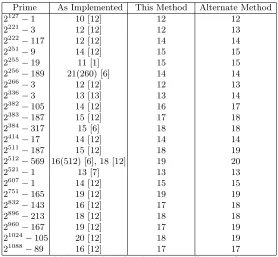
code and libraries. Specifically we looked at the code associated with references [1], [6], [7], [12] and [13] in October 2018. In Table 1 we show the number of multiplications as implemented, and as required by the method described here. In cases where the number of squarings exceeds n−1, these are recorded as well. As expected our method is suboptimal, but not by much. In fact it may be considered as better than expected. For example Bos et al. [6] found that they could always calculate the modular inversion using at most 1.11⌈log2(p)⌉ squarings and multiplications. With our much larger sample we find that it can be done using at most 1.09⌈log2(p)⌉. As can be seen we also find that on occasion this method improves on a manually tailored solution.
Prime As Implemented This Method Alternate Method
2127−1 10 [12] 12 12
2221−3 12 [12] 12 13
2222−117 12 [12] 14 14
2251−9 14 [12] 15 15
2255−19 11 [1] 15 15
2256−189 21(260) [6] 14 14
2266−3 12 [12] 12 13
2336−3 13 [13] 13 14
2382−105 14 [12] 16 17
2383−187 15 [12] 17 18
2384−317 15 [6] 18 18
2414−17 14 [12] 14 14
2511−187 15 [12] 18 19
2512−569 16(512) [6], 18 [12] 19 20
2521−1 13 [7] 13 13
2607−1 14 [12] 15 15
2751−165 19 [12] 19 19
2832−143 16 [12] 17 18
2896−213 18 [12] 18 18
2960−167 19 [12] 17 19
21024−105 20 [12] 18 19
21088−89 16 [12] 17 17
Table 1.Number of Multiplications (Squarings)
4
A Generalisation
Here we consider prime moduli of the form 2m−2n−c, where 2n≤mand c is small and positive. This covers at least two cases likely to be of particular interest, Hamburg’s recently standardised Goldilocks curve [9] with a modulus of 2448−2224−1, and the NIST standard curve secp256k1, as used in Bitcoin with its modulus of 2256−232−977. Observe that
x2a−2b−c=x(2a−b−1−1)2
b+1
x2b−c
From here the strategy is straightforward. Calculate the second term just as described above, and then extend the addition chain as necessary to calculate the larger first term. We omit the details.
Prime As Implemented This Method
2448−2224−1 13 [9] 15
2256−232−977 15 [12] 17
Table 2.Number of Multiplications
5
Two birds, one stone
The same idea can be used to efficiently calculate modular square roots, as often required in ECC implementation for point decompression [8]. If the prime
p = 3 mod 4, then the square root of a quadratic residue xcan be calculated fromy=x(p−3)/4as√x=xymodp, and ifp= 5 mod 8, the square root can be calculated fromy=x(p−5)/8, with a small amount of extra work – see algorithm 3.37 in chapter 3 of [11] for details. By modifying our algorithm in an obvious way to calculate these y values instead, and then re-using the same function, the inversexp−2modpcan be found in the former case asxy4, and in the latter case asx3y8. See [4] and the implementation associated with [9] for an example of the deployment of this idea.
Next we generalise this idea. First we categorise the prime moduli according to the value of e, where e is the maximum integer such that 2e|p−1. If as is commonly the case the modulus is 3 mod 4, then e = 1 and if the modulus is 5 mod 8 then e= 2. Larger values of emight also occur for the case where the modulus is 1 mod 8.
Now in the general case both modular inverses and tests for quadratic resid-uosity can start with the calculation of the progenitorvaluey
y=x(p−2e−1)/2e+1modp
From here the modular inverse can be calculated as
Quadratic residuosity can be determined from (xy2)2e−1. If an elementxis a quadratic residue, then its square root can be calculated.
We acknowledge that using this more round-about method to calculate mod-ular inverses and modmod-ular square roots may require a small amount of extra work – for the former case see the last column in table 2. And in certain cases modular square roots can be achieved significantly faster, as √x =x(p+1)/4 if
c= 1, and from√x=x(p+3)/8 ifc= 3, as clearly in these cases only squarings are required, with no multiplications at all.
When considering the calculation of square roots it is common in the liter-ature to make assumptions about p, as the calculation is much simpler for the cases wheree= 1 ande= 2. Here we eschew this attractive but specialised ap-proach and instead use the more complex Tonelli-Shanks algorithm (algorithm 3.34 [11]), which is normally reserved only for the “difficult” p= 1 mod 8 case. This requires knowledge of a fixed quadratic non-residued, which ideally should be small. As is well known in the case e = 1, then d = −1 is a good choice. For the case e= 2, thend= 2. However for e >2 often no automatic value is available, and indeed no deterministic algorithm is known which can find one. In practice however the prime modulus is known in advance and a simple off-line search through the small primes will quickly find a suitable non-residue. Also needed will be a precomputed 2e-th root of unity, that isz=d(p−1)/2e.
In the application of Tonelli-Shanks we again assume that the progenitoryis first calculated as above. Indeed this may already be available from a prior test for quadratic residuosity, as it would obviously be pointless to proceed to try and find the square root of a non-square. This is the case when performing elliptic curve point decompression for example. Then the algorithm to find the square root of x proceeds as follows (in a Pythoneque pseudo-code, where the cmov
function moves the second parameter into its first parameter if the condition specified in its third parameter is true. Such a function is a staple of constant-time implementation).
s=y*x t=s*y
for k in range(e,1,-1) : b=t
for i in range(1,k-1) : b*=b
cmov(s,s*z,b!=1) z*=z
cmov(t,t*z,b!=1)
The square root will be the final value ofs. Observe that in the case where
e= 1 the for loop is not executed.
This ability to calculate both inverses and square roots from the same initial computation of the progenitory, leads immediately to the “inverse square root” trick [4], where
√
u/v=u2. 1 u3v.
√
u3v
This calculation, requiring just one modular exponentiation, is relevant if implementing the Elligator2 method for deterministic mapping to elliptic curve points [3], or if performing point decompression on Edwards curves [4].
In the past prime moduli of the form p = 1 mod 8 have been avoided due to their perceived difficulty, and often libraries did not offer support. However the extra cost and complexity is in fact not excessive for moderate values of
e. This opens up more possibilities for elliptic curve moduli with an exploitable form for fast implementation, for example the primes 2255−31 and 2383−31. We observe that in the original paper introducing Curve25519 Bernstein [1] preferred 2255−19 over 2255−31 solely because “19 is smaller than 31”. However in later work [2] the prime 2414−17 is recommended as 17 is close to a power of 2, as also is 31. A suitable Weierstrass curve for p= 2255−31 of prime order (and with prime order twist) would bey2=x3−3x+ 5313.
6
Exploiting the Scholz-Brauer conjecture
Finally we re-consider our approach for primes of the particular generalised Mersenne form 2n−2e+ 1, wheree >0. As can be easily observed in these cases
the progenitory becomes y =x2m−1modpwhere m=n−e−1. In this case the well-known Scholz-Brauer conjecture on addition chains applies (see [10], Chapter 4.6.3).
l(2m−1)≤m−1 +l(m)
where l(m) is the length of the optimal addition chain form. No counter-example to this conjecture has been found, and indeed in many cases the equality relationship is known to hold. Therefore we can take m−1 +l(m) to be very close to optimal. This suggests the following much simpler (and almost certainly superior) algorithm for calculating the progenitory.
First find a simple shortest star chain form, using tools freely available on the net. For example for p= 2255−31, then m= 249, and a suitable chain of length 10 would be
1,2,3,6,9,15,30,60,120,240,249
Now see algorithm 2, inspired by the proof of Theorem G in [10], Chapter 4.6.3. The performance comparison for the calculation of the progenitor valuey
Algorithm 2 Calculation of progenitor y for pseudo-Mersenne prime of the form 2n−2e+ 1
Input: An elementx∈Fp,nande, for primep= 2n−2e+ 1
Input: An addition chain lengthLform=n−e−1,a=[1,2,...]
Output: y=x2 m−1
modp
1: functionFpy(x) 2: r ←x 3: h[0]←x 4: f[1]←0
5: fork←1; k≤L; k←k+ 1do 6: d←a[k]−a[k−1]
7: fori←0; i < d; i←i+ 1do
8: r←r2
9: r←r.h[f[d]] 10: h[k]←r 11: f[a[k]]←k
12: returnr
Prime Algorithm 1 Algorithm 2
2127−1 11 9
2221−3 11 10
2255−31 12 10
2266−3 11 11
2336−3 12 11
2383−31 13 11
2495−31 13 11
2521−1 12 12
2607−1 14 12
7
Conclusion
When implementing an easy-to-maintain general purpose cryptographic library, it helps to avoid duplication and special case implementation where possible, while still obtaining respectable performance. In the case of side-channel resis-tant modular inversion with respect to pseudo-Mersenne primes, the method of choice is to use Fermat’s Little Theorem. Optimal performance seems to require a tailored solution for each modulus of interest, a process prone to error. Here we have first presented a slightly suboptimal algorithm which provides accept-able performance, but using a single function which works well for most cases likely to be of interest to cryptographers. Then we extend the idea to cover the determination of quadratic residuosity and the calculation of modular square roots, for primes of any form. Finally we present a much simpler method that often gives improved performance for a large subset of pseudo-Mersenne prime moduli.
One last observation: Basically the whole problem goes away if instead we were to use moduli of the form 2n+cfor positive values ofc. Again such primes were also once considered by Bernstein [1]. And there are some nice such primes available, such as 2255+ 95, 2263+ 9, 2390+ 3 and 2510+ 15. One objection might be to the extra bit required in the representation, but in many cases, depending on how exactly field elements are represented, this might not be an issue.
References
1. D. Bernstein. Curve25519: New Diffie-Hellman speed records. InPKC 2006, vol-ume 3958 ofLecture Notes in Computer Science, pages 207–228. Springer Berlin Heidelberg, 2006.
2. D. Bernstein, C. Chuengsatiansup, and T. Lange. Curve41417: Karatsuba revisited. InCryptographic Hardware and Embedded Systems – CHES 2014, volume 8731 of
Lecture Notes in Computer Science, pages 316–344. Springer Berlin Heidelberg, 2014.
3. D. Bernstein, M. Hamburg, M. Krasnova, and T. Lange. Elligator: elliptic-curve points indistinguishable from uniform random strings. InProceedings of the 2013 ACM SIGSAC conference on computer and communications security, pages 967– 980, 2013.
4. Daniel J. Bernstein, Niels Duif, Tanja Lange, Peter Schwabe, and Bo-Yin Yang. High-speed high-security signatures. Cryptology ePrint Archive, Report 2011/368, 2011. http://eprint.iacr.org/2011/368.
5. J. Bos. Constant time modular inversion. Journal of Cryptographic Engineering, 4(4):275–281, 2014.
6. J. Bos, C. Costello, P. Longa, and M. Naehrig. Selecting elliptic curves for cryp-tography: An efficiency and security analysis. Cryptology ePrint Archive, Report 2014/130, 2014. http://eprint.iacr.org/2014/130.
7. R. Granger and M. Scott. Faster ECC overF2521−1. InPublic-Key Cryptography – PKC 2015, volume 9020 ofLecture Notes in Computer Science, pages 539–553. Springer Berlin Heidelberg, 2015.
9. M. Hamburg. Ed448-Goldilocks, a new elliptic curve. Cryptology ePrint Archive, Report 2015/625, 2015. https://github.com/otrv4/little-ed448-Goldilocks. 10. D. Knuth. The Art of Computer programming, Volume 2: Seminumerical
Algo-rithms, Third edition. Addison-Wesley, 1997.
11. Alfred J. Menezes, Paul C. van Oorschot, and Scott A. Vanstone. Hand-book of applied cryptography. CRC Press, Boca Raton, Florida, 1996. URL:
http://cacr.math.uwaterloo.ca/hac.
12. K. Nath and P. Sarkar. Efficient inversion in (pseudo-)Mersenne prime order fields. Cryptology ePrint Archive, Report 2018/985, 2018. http://eprint.iacr.org/ 2018/985.
13. M. Scott. Ed3363 (highfive) – an alternative elliptic curve. Cryptology ePrint Archive, Report 2015/991, 2015. http://eprint.iacr.org/2015/991.
14. J. Solinas. Generalized Mersenne numbers. Technical CORR-39, University of Waterloo, 1999.
Extending Scholz-Brauer method to a larger class of
pseudo-Mersenne primes
Consider generalised pseudo-Mersenne primes of the form 2n−2d+e+1+ 2e+1− 2e+ 1, where e > 0 and d ≥ 0. In this case the progenitor becomes y =
x2m−2dmodp, which can be calculated asy=x(2m−d−1)2d. Therefore the same method as described can be used, followed bydsquarings, without requiring any more multiplications.
Now for primesp = 2n−c, if e = 1 this method applies to values of c =
2d+2−3, for example c = 1,5 and 13. If e = 2 the method applies for c = 2d+3−5, which includes c = 3,11,27. For e = 3, then c = 2d+4 −9, which includes c = 7,23. Therefore this simpler and faster method can be used for