Attribute-Based Encryption and Searchable
Encryption for Flexible Data Sharing
?Antonis Michalas1[0000−0002−0189−3520] Tampere University of Technology,
Tampere, Finland [email protected]
Abstract. Secure cloud storage is considered one of the most important issues that both businesses and end-users are considering before moving their private data to the cloud. Lately, we have seen some interesting approaches that are based either on the promising concept of Symmetric Searchable Encryption (SSE) or on the well-studied field of Attribute-Based Encryption (ABE). In the first case, researchers are trying to design protocols where users’ data will be protected from bothinternal andexternalattacks without paying the necessary attention to the prob-lem of user revocation. On the other hand, in the second case existing approaches address the problem of revocation. However, the overall ef-ficiency of these systems is compromised since the proposed protocols are solely based on ABE schemes and the size of the produced cipher-texts and the time required to decrypt grows with the complexity of the access formula. In this paper, we propose a protocol that combines both SSE and ABE in a way that the main advantages of each scheme are used. The proposed protocol allows users to directly search over en-crypted data by using a SSE scheme while the corresponding symmetric key that is needed for the decryption is protected via a Ciphertext-Policy Attribute-Based Encryption scheme.
Keywords: Cloud Security·Storage Protection·Access Control· Poli-cies·Attribute-Based Encryption·Symmetric Searchable Encryption · Hybrid Encryption
1
Introduction
One of the most well-studied problems of cloud security, is how to protect users’ private data. When it comes to protecting sensitive data, different organizations have different needs. Each use-case brings its own level of risk and correspond-ing risk reduction once it is addressed. However, and despite the different needs of each use-case the main problem always remains the same – how to prevent
?This work was funded by the ASCLEPIOS: Advanced Secure Cloud Encrypted
unauthorized access to the data that are stored in a remote location. Further-more, it has been observed that failing to provide users with proper security and privacy-preserving mechanisms it can slow down the overall adoption of cloud services.
Having this in mind, researchers have proposed many protocols where users’ data are sent to the cloud service provider (CSP) over an encrypted channel and upon reception, the CSP is responsible for storing encrypted versions of the data. However, most of the existing approaches fail to protect users’ data against internal attacks. This is due to the fact that the key used for the encryption of the data is known to the CSP. Hence, a malicious CSP is able to reveal the content of all stored data – even without user’s permission. To overcome this problem, researchers lately started proposing solutions that are based on the promising concept of symmetric searchable encryption (SSE) [16,?]. SSE allows users to symmetrically encrypt data with a key that is not known to the CSP and then search directly over the encrypted data. However, these approaches discourage a user from sharing data with other users. Sharing a symmetrically encrypted file requires the sharing of the secret key. Hence, when a user needs to be revoked, data owner needs to re-encrypt data with a fresh key and distribute the new key to the rest of the legitimate users.
To address the problem of data access and revocation, solutions that are based on Attribute-Based Encryption schemes (ABE) [23,?] have been proposed. ABE schemes allow user to encrypt a file based on a certain policy. Then, a unique key is generated for each user that has access to the CSP resources. This key is generated based on a list of attributes. Then a user is able to decrypt a file that is associated with a certain policy only if the attributes of her key satisfy the underlying policy. As a result, revoking a user does not affect the rest of the users. This is due to the fact that only the key for the corresponding revoked user has been blacklisted while the keys for the rest of the users are still functional. While ABE schemes offer great flexibility in terms of access management, the size of the produced ciphertexts and the time required to both encrypt and decrypt them grows with the complexity of the underlying policy [15]. As a result, protocols and cloud-based services that are solely based on such schemes are currently considered as inefficient.
1.1 Contribution
techniques and we hope that will inspire protocol designers to conduct further research towards that direction.
Apart from that, in this work we have been looking at the problem of key revocation in ABE schemes. As pointed out in [8], key revocation is traditionally a difficult to solve problem in ABE schemes. The main problem is that in such schemes several different users might satisfy the decryption policy. In this paper, we tried to overcome this problem by looking on alternative ways to revoke users’ access. To this end, in our design weseparated the revocation functionality from the actual ABE scheme. More precisely, we used Intel’s Software Guard Exten-sions (SGX) to host a revocation authority in a trusted execution environment. The proposed technique is considered as practical and provably secure since Intel SGX provides hardware support for isolated program execution environments.
1.2 Organization
The remainder of this paper is organized as follows: In Section 2, we present important works that have been published and address the problem of secure cloud storage and data sharing in the cloud. In Section 3, we present the main entities that participate in our system model and we proceed by defining the problem statement. In Section 4, we describe the cryptographic primitives that are needed for a proper run of the protocol and we introduce the threat model that we will consider throughout the paper. In Section 5 we provide a formal construction of the protocol while in Section 6 we prove the soundness of our protocol against several malicious behaviors. In Section 7 we present extended experimental results that shows the performance of our approach under real life (i.e. realistic) scenarios. Finally, in Section 8 we present our conclusions.
2
Related Work
In this section we present related works that mainly focus on the problem of secure cloud storage with data sharing functionality.
In [20] authors presented a framework for data and operation security in Infrastructure-as-a-Service (IaaS) clouds, consisting of protocols for a trusted launch of virtual machines and domain-based storage protection. Its security guarantees are supported by an extensive theoretical analysis with proofs about protocol resistance against attacks in the defined threat model. The protocols allow trust to be established by remotely attesting host platform configuration prior to launching guest virtual machines and ensure confidentiality of data in remote storage, with encryption keys maintained outside of the IaaS domain. In addition to that, authors provide functionality for sharing data between different domains. To this end, they presented an XML-based language framework [21] which enables clients of IaaS clouds to securely share data and clearly define access rights granted to peers.
tenant-specified policy. Excalibur introduces a new trusted computing abstrac-tion,policy-sealed datato address the fact that TPM abstractions are designed to protect data and secrets on a standalone machine, at the same time over-exposing the cloud infrastructure by revealing the identity and software fingerprint of in-dividual cloud hosts. The core of Excalibur is “the monitor”, which is a part of the cloud provider, which organises computations across a series of hosts and provides guarantees to tenants. Tenants first decide a policy and receive evidence regarding the status of the monitor along with a public encryption key, and then encrypt their data and policy using ciphertext-policy attribute-based encryption (CP-ABE) [8]. To decrypt, the stored data hosts receive the decryption key from the monitor who ensures that the corresponding host has a valid status and sat-isfies the policy specified by the client at encryption time. The main drawback of this work is that the protocol does not offer revocation functionality. In addition to that, users’ files are stored by using explicitly a CP-ABE scheme. Hence, the overall performance of the framework is considered as low.
In [1] the authors presented a forward-looking design of a cryptographic cloud storage built on an untrusted IaaS infrastructure. The approach aims to pro-vide confidentiality and integrity, while retaining the benefits of cloud storage – availability, reliability, efficient retrieval and data sharing – and ensuring secu-rity through cryptographic guarantees rather than administrative controls. The solution requires four client-side components: data processor, data verifier, cre-dential generator and token generator. Important building blocks of the solution are: Symmetric searchable encryption (SSE), appropriate in settings where the data consumer is also the one who generates it (efficient for single writer-single reader (SWSR) models) and Asymmetric searchable encryption (ASE), appro-priate for many writer single reader (MWSR) models, offers weaker security guarantees as the server can mount a dictionary attack against the token and learn the search terms of the client.
In [17] authors presented a constructive design for secure storage and file sharing in cloud environments. The scheme was based on a SSE scheme that allows patients of an electronic healthcare system to securely store encrypted versions of their medical data and search directly on them without having to decrypt them first. Even though the scheme offers some kind of secure sharing it lacks flexibility since data sharing is not based on policies. Furthermore, even though authors provide a discussion regarding access revocation they do not provide a concrete solution. Hence, the protocol is considered as inefficient for sharing large amount of data between multiple users.
Authors in [26] proposed an efficient access control scheme that allows users to dynamically update a policy. The policy update is outsourced to the cloud server while at the same time the server does not learn any private information regarding the processed data. In addition to that, the scheme is based on ABE and assumes a semi-trusted and not fully trusted cloud service provider. Fur-thermore, the proposed scheme supports different types of access policies (e.g., Boolean Formulas, LSSS Structure and Access Tree).
In [18], author showed how to construct a framework for secure file sharing by using the benefits of Revocable Attribute-Based Encryption. More precisely, the protocol is using a Key-Policy Attribute-Based technique through which access revocation is optimized. In addition to that, author showed how to securely remove access to a file, for a certain user that is misbehaving or is no longer part of a user group, without having to decrypt and re-encrypt the original data with a new key or a new policy.
Boldyreva et al. proposed a revocation scheme [9] that supports only a lim-ited set of ABE functionality. Sahai et al.’s revocation scheme [22], which is based on the notion of re-encrypting from one policy to another more restrictive policy by utilizing the delegation capabilities of the underlying ABE construct, requires maintaining additional attributes and relatively expensive operations even though the complexity is reduced to the polylogarithm number of group members. Furthermore, in applications involving stateless members where it is not possible to update the initially given private keys and the only way to revoke a member is to exclude it from the public information, an ABE based approach does not readily work.
While the last schemes provide an interesting solution for the problem of revocation, they solely rely on the use of ABE schemes. As a result, the produced ciphertexts are rather long and the decryption requires lot of computational resources [15]. In our approach, we mainly rely on the use of an SSE scheme for the decryption of users’ data. Thus, making the overall protocol more efficient. Additionally, our approach can pave the way for key-industrial players to build novel cloud-based services based on these two promising encryption techniques.
3
System Model and Problem Statement
In this section, we introduce the system model that we consider by explicitly describing the main entities that participate in our protocol as well as their capabilities. Furthermore, we strictly define the problem statement.
IaaS provider similar to the one described in [20]. The IaaS platform consists of cloud hosts which operate virtual machine guests and communicate through a network. In addition to that, we assume a Platform-as-a-Service (PaaS) provider, like the one described in [25], that is built on top of the IaaS platform and can host multiple outsourced databases. Furthermore, the cloud service provider is responsible for storing users’ data. Finally, the CSP must support the Intel Soft-ware Guard Extensions (SGX) [12] since core entities of the protocol will be running in a trusted execution environment offered by SGX.
Master Authority (MS): MS is responsible for setting up all the necessary public parameters that are needed for the proper run of the underlying protocols. Furthermore, MS is responsible for generating and distributing ABE keys to the registered users. Finally, MS is considered as a single trusted authority. Thus, we assume that MS is SGX-enabled and is running in an enclave called the Master Enclave.
Key Tray (KeyTray): KeyTray is a key storage that exists in the CSP and stores ciphertexts of all the symmetric keys that have been generated by various data owners and are needed in order to decrypt data. Every registered user can contact the KeyTray directly and request access to the stored ciphertexts. Furthermore, the symmetric keys are encrypted with a CP-ABE scheme. Thus, a single symmetric key is encrypted only once and users with certain access rights and different keys are able to access it (i.e. decrypt it). Moreover, similar to MS, KeyTray is also SGX-enabled and is running in an enclave called the KeyTray Enclave.
Revocation Authority (REV): REV is responsible for maintaining a revoca-tion list (rl) with the unique identifier of the users that have been revoked. At this point it is worth mentioning that a single user might own more than one CP-ABE secret key. Therefore, rl maintains a mapping of users with the CP-ABE keys they own. Every time that a key of a user is revoked, REV needs to update rl. This, as we will see later, will prevent revoked users from accessing ciphertexts that are not authorized anymore. Similar to MS and KeyTray, REV is also SGX-enabled and is running in an enclave called the Revocation Enclave.
Registration Authority (RA):RA is responsible for the registration of users in the CSP. Additionally, RA has a public/private key pair denoted as pkRA/skRA.
RA can run as a separate third party but can be also implemented as part of the CSP. The registration process is out of the scope of this paper. Thus, we will not describe how the registration of a new user takes place. Instead, we will assume that a user has been already registered and has access to the remote storage and the services offered by the CSP.
(pki/ski). The private key is kept secret, while the public key is shared with the
rest of the community. These keys will be used to secure message exchanges. Hence, the communication lines between parties are assumed to be secure. It is also assumed that the public keys of all entities in the system model are known to all registered users.
Problem Statement: Let U = {u1, . . . , un} be the set of all users that
are registered through a registration authority (RA) and CSP the cloud service provider that stores users’ data. Lets assume that a user ui stores a set of m
different files to the CSP. We denote this set of files asDi=
di
1, . . . dim . The
problem here is to find a way to achieve the following:
1. Keep the content of each di
j ∈ Di private against both internal and external
attacks;
2. Userui should be able to securely share a filedij with another user based on
a certain policy;
3. A data owner ui should be able to efficiently revoke access to a user uc for
a file that has shared with her. This should not require the data owner to decrypt and re-encrypt the file with a fresh key and it should not affect the access to the rest of the legitimate users.
4
Cryptographic Primitives and Threat Model
In this section, we introduce the notations that we use throughout the paper while we also give a formal definition for the two main encryption schemes that the paper is based on. Finally, we present the threat model that we consider.
4.1 Cryptographic Primitives
In order to provide a concrete and reliable solution for the problem described in Section 3, we need to build a protocol through which newly encrypted data will not be decryptable by a user if her access has been revoked. Additionally, we want to allow users with certain access rights to be able to search directly over encrypted data. To this end, we will be using a CP-ABE scheme. In a CP-ABE scheme every secret key (e.g. user key) is generated based on a public and a private key as well as on a concrete list of attributesA. Then, every ciphertext is associated with a policy P. Then, decryption is only possible if P(A) =True
– if the attributes on a key satisfy the policy on the ciphertext. From now on we will refer to the space of attributes as Ω={a1, . . . , an}, while the space of policies will be denoted asP ={P1, . . . , Pm}.
We now proceed with the definition of a CP-ABE scheme as described in [8].
Definition 1 (Ciphertext-Policy ABE). A CP-ABE scheme is a tuple of the following four algorithms:
1. CPABE.Setup is a probabilistic algorithm that takes as input a security
pa-rameter λ and outputs a master public key MPK and a master secret key
2. CPABE.Gen is a probabilistic algorithm that takes as input a master secret key, a set of attributesA ∈Ωand the unique identifier of a user and outputs a secret key which is bind both to the corresponding list of attributes and the user. We denote this by(skA,ui)←Gen(MSK,A, ui).
3. CPABE.Enc is a probabilistic algorithm that takes as input a master public
key, a message m and a policy P ∈ P. After a proper run, the algorithm outputs a ciphertextcP which is associated to the policy P. We denote this
bycP←Enc(MPK, m, P).
4. CPABE.Dec is a deterministic algorithm that takes as input a user’s secret
key and a ciphertext and outputs the original message m iff the set of at-tributes A that are associated with the underlying secret key satisfies the policyP that is associated withcp. We denote this byDec(skA,ui, cP)→m.
Apart from the CP-ABE scheme, one of the core components of our solution is the SSE component which will allow users to encrypt their data using a sym-metric secret key and later search directly over the encrypted data. In the rest of the paper, we will be assuming the existence of the following SSE scheme:
Definition 2 (Dynamic Index-based SSE). A dynamic index-based sym-metric searchable encryption scheme is a tuple of nine polynomial algorithms
SSE= (Gen,Enc,SearchToken,AddToken,DeleteToken,Search,Add,Delete,Dec)such
that:
– SSE.Gen is probabilistic key-generation algorithm that takes as input a se-curity parameter λ and outputs a secret key K. It is used by the client to generate her secret-key.
– SSE.Enc is a probabilistic algorithm that takes as input a secret key K and a collection of files f and outputs an encrypted index γ and a sequence of ciphertextsc. It is used by the client to get ciphertexts corresponding to her files as well as an encrypted index which are then sent to the storage server.
– SSE.SearchTokenis a (possibly probabilistic) algorithm that takes as input a
secret key K and a keyword w and outputs a search token τs(w). It is used
by the client in order to create a search token for some specific keyword. The token is then sent to the storage server.
– SSE.AddToken is a (possibly probabilistic) algorithm that takes as input a
secret keyK and a file f and outputs an add token τa(f) and a ciphertext
cf. It is used by the client in order to create an add token for a new file as
well as the encryption of the file which are then sent to the storage server.
– SSE.DeleteToken is a (possibly probabilistic) algorithm that takes as input a
secret keyK and a file f and outputs a delete tokenτd(f). It is used by the
client in order to create a delete token for some file which is then sent to the storage server.
– SSE.Search is a deterministic algorithm that takes as input an encrypted
index γ, a sequence of ciphertexts c and a search token τs(w) and outputs
a sequence of file identifiers Iw ⊂ c. This algorithm is used by the storage
encrypted data and determine which ciphertexts correspond to the searched keyword and thus should be sent to the client.
– SSE.Add is a deterministic algorithm that takes as input an encrypted index γ, a sequence of ciphertexts c, an add tokenτa(f) and a ciphertextcf and
outputs a new encrypted indexγ0 and a new sequence of ciphertextsc0. This algorithm is used by the storage server upon receive of an add token in order to update the encrypted index and the ciphertext vector to include the data corresponding to the new file.
– SSE.Delete is a deterministic algorithm that takes as input an encrypted
index γ, a sequence of ciphertextscand a delete token τd(f)and outputs a
new encrypted indexγ0 and a new sequence of ciphertextsc0. This algorithm is used by the storage server upon receive of a delete token in order to update the encrypted index and the ciphertext vector to delete the data corresponding to the deleted file.
– SSE.Dec is a deterministic algorithm that takes as input a secret keyK and a ciphertext c and outputs a file f. It is used by the client to decrypt the ciphertexts that she gets from the storage server.
4.2 Threat Model
Our threat model is similar to the one described in [20], which is based on the Dolev-Yao adversarial model [13] and further assumes that privileged access rights can be used by a remote adversaryADV to leak confidential information.
ADV, e.g. a corrupted system administrator, can obtain remote access to any host maintained by the IaaS provider, but cannot access the volatile memory of guest VMs residing on the compute hosts of the IaaS provider.
Hardware Integrity: We assume that the cloud provider has taken all the
necessary technical and non-technical measures in order to protect the underling hardware from tampering.
Physical Security: We assume physical security of the data centres where
the IaaS is deployed. This assumption holds both when the IaaS provider owns and manages the data center (as in the case of Amazon Web Services, Google Compute Engine, Microsoft Azure, etc.) and when the provider utilizes third party capacity, since physical security can be observed, enforced and verified through known best practices by audit organizations. This assumption is im-portant to build higher-level hardware and software security guarantees for the components of the IaaS. We assume the record is kept on protected storage with read-only access and the adversary cannot tamper with it.
Network Infrastructure:The IaaS provider has physical and
administra-tive control of the network.ADV is in full control of the network configuration, can overhear, create, replay and destroy all the exchanged messages between the CSP and their resources (virtual machines, database components etc.) as well as with other entities in our system model (e.g. the Master Authority).
Cryptographic Security:We assume encryption schemes are semantically
decrypt a ciphertext without knowing the corresponding secret key. Furthermore, we assume that the probability ofADV guessing a generated random number is negligible. Finally, we explicitly exclude denial-of-service attacks from our adver-sarial model and we focus onADV that aims to compromise the confidentiality of data by forging existing access policies generated by the corresponding data owners.
5
The Lord of the Shares (LotS)
In this section, we present the Lord of the Shares (LotS) that constitutes the core of this paper’s contribution. To this end, we continue with providing the construction of the main protocols that are involved. As we described earlier,
LotS runs three secure enclaves (Master, KeyTray and the Revocation enclave) and it contains the following nine main protocols: Setup, ABEUserKey, Store,
KeyTrayStore, KeyShare, Search, Update, Delete and Revoke. Due to space
con-straints, we omit the description of trivial functions such as the registration of a new user.LotS mainly comprises a public-key encryption scheme, a ciphertext-policy attribute-based encryption scheme and a symmetric searchable encryption scheme.
LotS.Setup: Each entity from the described system model obtains a pub-lic/private key pair (pk,sk) for a CCA2 secure public cryptosystem and pub-lishes its public key while it keeps the private key secret. Apart from that, all three entities that are running in an enclave they generate a signing and a veri-fication key. Furthermore, MS runsCPABE.Setupand generates a master public and private key. Below we provide the list of the generated key pairs:
– (pkCSP,skCSP) – public/private key pair for the cloud service provider;
– (pkMS,skMS), (sigMS,verMS), (MPK,MSK) – public/private, verification/signing
and master key pairs for the Master Authority;
– (pkKT,skKT,sigKT,verKT) – public/private and verification/signing key pairs
for the KeyTray;
– (pkREV,skREV, sigREV,verREV) – public/private key and verification/signing
key pairs for the Revocation Authority.
LotS.ABEUserKey: This phase is taking place between a registered userui that wishes to obtain a CP-ABE key and MS who is responsible for generating such keys. This is a probabilistic key-generation algorithm that runs in the mas-ter enclave and takes as inputMSK, the identity of the user that is requesting a key and a list of attributesAthat is derived from user’s registered information. More precisely, ui contacts MS and proves that she is a registered user. Then, attests MS and requests a new CP-ABE key. MS then runs CPABE.Gen and generatesskA,ui. This is then sent back to the user over a secure channel.
this phase the communication takes place between the user and the CSP. First,ui contacts the CSP by sending the following:m1=hr1,EpkCSP(Auth), StoreReq, H1i, where r1 is a random number generated by u1, Auth is an authenticator that allowsui to prove to the CSP that is a legitimate/registered user andH1is the following hashH(r1||Auth||StoreReq). Upon reception, CSP verifies the fresh-ness of the message, the identity of the user and starts processing the store request. To do so, CSP creates the messagem2 =hr2, σCSP(H2)i, whereH2 is the following hashH(r2||ui) andσCSP(H2) is a signature of CSP on H2. Then,
m2 is sent back toui. Upon reception,u1 verifies both the freshness as well as the integrity of the message. Now, ui simply generates a symmetric key Ki by
runningSSE.Gen. This key will be used to protect the data that will be stored in the cloud. The final step of this phase is the storage of encrypted files byui to a storage resource offered by the CSP. User ui runs StoreFile– a determin-istic algorithm that takes as input the symmetric secret keyKi that generated
earlier and a collection of files fi and outputs a collection of ciphertexts ci as
well as an encrypted index γi. Both γi and ci are then send to the CSP via
a secure channel. More precisely, ui sends the following message to the CSP:
m3 = hr3,EpkCSP(γi),ci, H3i, where H3 = H(r3||γi||ci). Upon reception, CSP verifies both the integrity and the freshness of m3 and storesci along with the
encrypted indexγiin a local database.
LotS.KeyTrayStore: A key storage algorithm allows an already logged-in user to safely store a symmetric secret key Ki, that generated earlier, in the
Key-Tray. This is a probabilistic algorithm that takes as input a symmetric key
Ki, MPK and a policy P and outputs an encrypted version of Ki which is
as-sociated with P. This is done by running cKi
P ← CPABE.Enc(MPK,Ki,P). The
generated ciphertext, is sent by ui to the KeyTray who stores it locally. More precisely, ui first attests the KeyTray and then sends the following message:
m4 = D
EpkKT(r4), c
Ki P, σi
Hr4||cKPi E
. Additionally, the KeyTray generates a random numberrKi encrypts it withpkiand stores it next toc
Ki
P. As we will see later, this number will be used during the revocation phase to prove that ui is the owner of Ki.
LotS.KeyShare: Now that ui has stored an encrypted version of Ki to the
KeyTray, other users should be able to access it. Hence, ui must have a way to share the encrypted data ci that stored earlier. Lets assume that there is
another registered useruj,j6=ithat wishes to accessci. To do so,uj needs to get access toKithat is stored in the KeyTray. The important thing to notice here
is that the data sharing will be done without the involvement ofui. Therefore, after ui stores cKPi to the KeyTray, she can be offline. In order for uj to access
cKi
hr6,EpkKT(uj),EpkKT(τKS), σREV (H(r6||uj||τKS))i. Upon reception, uj forwards
m6 to the KeyTray who verifies the signature as well as the freshness and user’s id and sendscKi
P touj. At this point,uj uses her private CP-ABE key to recover
Ki. The decryption will only work if the attributes that are associated withuj’s key satisfy the policy that is associated withcKi
P. Apart from that, the KeyTray sends also the following to uj: m7 = hEpkCSP(uj, t), σKT(H(uj||t))i, where t is the time that uj accessedcKPi. As we will see in the next step,t plays a crucial role in the access control.
LotS.Search: Now that uj has gained access to Ki, she can start searching
directly over encrypted data. Lets assume thatuj wishes to search over cipher-texts that have been encrypted withKi, for a specific keywordw. To do so, she
first forwards to the CSPm7that received in the previous step. Upon reception, CSP decryptsEpkCSP(uj, t), verifies the signature and then checks iftis valid. We assume that there is a time interval sinceujgot access toKi, where she is eligible
to access files that are stored in the CSP. After that time, uj will have to run again the previous step in order to receive a fresh timestamp. This will guarantee that uj has not been revoked since the last time that got access to Ki. Then,
if all the verifications are successful, uj runs SSE.SearchToken(Ki, w)→ τs(w) and obtains a tokenτs(w). Then, she sends the generated token to the CSP who runsSSE.Search(γi,ci, τs(w))→Iwthat outputs a sequence of file identifiersIw, such that Iw ⊆ ci. In addition to that, all files in Iw contain the keyword w that uj searched for. The resultedIw is sent back to the user. Upon reception,
uj executes the SSE.Dec algorithm by giving as input Ki and the sequence of
encrypted files that corresponds to the list of identifiers that received from the CSP. By doing this,uj recovers the files that contain keywordw.
LotS.Update: Apart from storing data and searching over the encrypted data, users also need to be able to update stored data. Here, we consider the scenario where ui wishes to add a new file f to the cloud storage. A naive approach that ui could follow would be to run LotS.Store again, generate the ciphertext of f and send it to the CSP. However, this would mean that ui would also create a new encrypted index that would correspond to the encryption of file
f. Such an approach is not efficient since the user would end-up with a long list of encrypted indexes that are not related to each other and every time that wishes to perform a search over her data would require from the CSP to search over all the encrypted indexes. To avoid this, ui needs to store f but instead of creating a separate encrypted index she needs to update the current one in order to also include the newly added file. To achieve that,ui first generates an add token by executing (τα(f), cf)←AddToken(Ki, f) and sends it to the CSP. Upon reception, CSP executesSSE.Add(γi,ci, τα(f), cf)→(γ0,c0i) and outputs
an updated encrypted indexγi0 and an updated sequence of ciphertextsc0ithat corresponds to the data stored byui. Thus, by runningSSE.Add, CSP stores the ciphertext of f and updates the existing encrypted index and ciphertext list of
ui.
sym-metric keyKiand the file that needs to be deleted and outputs a delete token:
τd(f)←DeleteToken(Ki, f). The generated token is sent to the CSP with the
following message: m8 =hm7,EpkCSP(τd(f), γ 0
i),c0i, H(τd(f)||γi0||c0i)i Upon
recep-tion, the CSP first checks thatuiis eligible to delete a file and she has not been revoked (this is done by openingm7and looking at the timestamp provided by the KeyTray). Then, the CSP runsSSE.Delete(γ0i,c0i, τd(f))→(γi00,c00i) which
re-moves the requested filef and updates both the corresponding encrypted index and the sequence of ciphertexts.
LotS.Revoke: The last phase of our protocol allows a data owner to revoke access to a user. We assume thatuiwishes to revoke access touj. To do so,ui con-tacts the revocation authority (REV) by sendingm9=
D
r9,EpkREV(ui, uj, c
Ki
P), H(ui||uj||cKPi) E
. Upon reception, REV checks the integrity and the freshness of the message and
recovers the identity of data owner (ui) as well as the user that needs to be revoked (uj). Then, REV contacts the KeyTray by requesting the ciphertext of
rKithat was stored next toc
Ki
P during the run ofLotS.KeyTrayStore. So, KeyTray sends the following message to REV:m10=
D
Epkui(rKi), σKT(H(rKi||r9)) E
. Upon reception, REV forwardsm10touiwho recoversrKiand verifies that the message has been generated by the KeyTray (verifying the signature). Then,ui signsrKi and sends it to the KeyTray through REV. KeyTray verifies the signature and is also convinced that ui is the owner ofKi. Hence, KeyTray generates a fresh
random numberr0K
i that replacesrKiand also sends an acknowledgement to REV that ui has the right to revoke access touj for all files that are encrypted with
Ki. Finally, REV adds the identity of uj in rl. As a result, the next time that
uj will try to access any of the files that are encrypted withKi access will be
denied.
6
Security Analysis
We now analyzeLotSbehavior in the presence of a malicious adversary. We prove the security of the scheme through a theoretical analysis, showing its resistance to a list of malicious behaviours. Our security analysis explicitly focuses on the described protocol and not on the underlying cryptographic schemes. The secu-rity of all utilized cryptographic schemes (including CP-ABE and SSE) has been proved in other works [8,?]. Hence, we assume that all the involved cryptographic schemes are semantically secure.
Realistic Assumption.We assume that all user ids have the same length (or
at least they are not a prefix of each other). By ensuring this property is satisfied, we can avoid a prefix attack, such as the following:
Proposition 1 (Compromise Revoked Users).LetUKibe the set of all users
that have been given access to Ki and RKi the set of all users that their access
toKi has been revoked. Assume an adversaryADV corruptsn,n≤ |RKi|users
out of those in the set RKi. ThenADV cannot infer any information about the files that have been encrypted withKi.
Proof. Here, we consider the case whereADVcorrupts at least one useruc∈ RKi. In other words,ADVcorrupts at least a user who in the past was eligible to use
Kiand therefore she was able to decrypt all files fromcithat were encrypted with
that key.ADV will try to useucin order to obtain the collection of ciphertexts
ciand access the contents of the files.
ADV trying to access the content of any file in ci can succeed if all the
following conditions hold:
a. Access the symmetric keyKi that used to encrypt the files;
b. Successfully bypass the authentication of CSP during theLotS.Searchphase; c. Access the latest ciphertexts listcif resh.
- Condition a is always true. We know thatuc ∈ RKi. Therefore, at some point in the pastucwas member ofUKi. Hence, we can safely assume thatuc was able to decryptcKi
P and recover Ki.
- Condition b can only be true if the adversary convince the CSP thatuc∈ RK/ i. To do so, the adversary needs to generate a valid m8 messages that will also contain a fresh timestamp, say tc, that will prove that uc received access toKi
recently and it is still active. Generating a valid m8 message can be done with the following two options:
- Replay Old Message:First, we consider the case wereADV replays an older message m7 in order to generate a valid m8 that will allow her to bypass the checks of the CSP. To this end,ADV uses the following message that was received in the past: m7 = hEpkCSP(uc, t), σKT(uc||t)i. This is a valid message that contains the identity of the corrupted user as well as a valid signature from the KeyTray. ThenADVgenerates a fresh random numberr80 and creates the messagem8=
D
r08, m07, σj(m7||r 0 8)
E
that is sent to the CSP. Even though the structure of the generated message is correct, the CSP will drop the connection since it will identify it as an old message. This is due to the fact that the timestamp t contained in m7 has expired. Therefore, the CSP cannot be sure ifuc’s access right is still active. To bypass that,ADV will try to replacetwith the current timetc. To do so, the adversary will use
pkCSPto generateEpkCSP(uc, tc), and replace the first part ofm7. However, the second part of the message has a signature from the KeyTray that contains the initial timestampt. Replacing this with a valid signature ontc fails due to the assumption of soundness of the signature scheme. Therefore, ADV
will fail to bypass CSP’s authentication.
overhears the communication betweenuland the CSP. By doing this, ADV intercepts the messagem8thatulsent to the CSP. This message is fresh and contains an acceptable timestamp t. However, it also contains (in m7) the identity oful. This will be used at the end of theLotS.Searchphase where the CSP will usepkulto encrypt the data that will be sent to the user. Therefore,
ADVwill usepkCSP and will replaceEpkCSP(ul, t) withEpkCSP(uc, t) we denote the new message asmc
7. In addition to that, she will calculateσj(mc7||r8and will contact the CSP by sending the following: m8 = hr8, mc7, σj(mc7||r8)i. Upon reception, CSP will verify the first signature but will fail to verify the one that is included inmc7. This is due to the fact thatADV had to change the identity of the legitimate user touc but she could not generate a valid signature on the new message. Hence, the attack will fail.
- Condition c cannot be true. This implies immediately from the exculpability of the previous attack. More precisely, in order forADV to access cif resh, she
needs to first bypass CSP’s authentication. However, we showed that this is not
possible. 2
Proposition 2 (Revoke Legitimate Users).Letuibe the owner of data that
has been encrypted withKi. Additionally, letU the set of all users that have been given registered with the CSP andUKi be the set of all users that have been given access toKi. Assume an adversaryADV corrupts a user uc,uc∈ U \ {ui}. Then
ADV cannot successfully revoke access to anyul∈ UKi.
Proof. Here, we consider the case where ADV corrupts a user uc such that
uc∈ U \ {ui}. The attack will be successful ifADV manages to revoke access to
data that has been encrypted withKi for a legitimate userul ∈ UKi. To do so,
ADV needs to runLotS.Revokeand convince REV that she is the data owner. Hence, ADV generates mc
9 = D
rc
9,EpkREV(uc, ul, c
Ki
P), H(uc||uj||cKPi) E
and sends it to REV. Upon reception, REV checks the integrity and the freshness of the message and recovers the identity ofuc, who is pretending to act as data owner, as well as the id of user that needs to be revoked ul. Then, REV contacts the KeyTray by requesting the ciphertext of Epki(rKi) that was stored next to c
Ki P) during the run ofLotS.KeyTrayStore. So, REV will receive the following:m10= D
Epkui(rKi), σKT(H(rKi||r c 9))
E
. REV forwards m10 to uc who fails to recoverrKi since it is encrypted withui’s public key. Therefore,ADV will fail to prove that is the data owner and the attack will not succeed.
An alternative, would be thatADV usesui’s id inm9. More precisely,ADV would send mc
9 = D
rc
9,EpkREV(ui, ul, c
Ki
P), H(ui||uj||cKPi) E
to REV. However, this case is identical to the previous one sincecKi
P remains the same. Hence, KeyTray mapping will again identifyui as the data owner.
Finally, uc could bypass this step is either if she gains access to ski or by
replacingcKi P withc
Kc
ul’s access to data that uc has generates. As a result, a corrupted user cannot revoke access to data that has not been encrypted and generated by her. 2
6.1 SGX Security
The security of LotS heavily depends on the use of Intel’s SGX functionality. More precisely, we are using Intel SGX to create isolated environments and launch trusted entities that any third party would be able to attest and ver-ify their integrity. In the next paragraphs, we provide some basic information regarding Intel SGX as well as the functionality that we are using inLotS.
Isolation. Intel Software Guard Extensions (SGX) is an extension to Intel’s
x86 design and allows the creation of isolated execution environments, called enclaves, in which small pieces of code can be executed in isolation from the rest of the system. Software developers can use Intel SGX enclaves to create trusted execution environments (TEEs) during OS execution. Such enclaves, rely for their security on the platform’s trusted computing base (TCB) code and data loaded at initialization creation time, processor firmware and processor hard-ware.Program execution within an enclave is transparent to both the underlying operating system and other enclaves.Multiple mutually distrusting enclaves can operate on the platform. Enclaves operate in a dedicated memory area called the Enclave Page Cache (EPC) which in turn is a subset of Processor Reserved Memory (PRM). The PRM is a range of DRAM reserved by BIOS that cannot be accessed by system software or peripherals. Furthermore, EPCM is a data structure that contains a mapping between the enclave identities and the EPC pages that belong to them. This mapping is used by the CPU to verify enclave access to memory pages andprevent unauthorized access. The CPU firmware and hardware are the Root of Trust of an enclave. It prevents access to the memory segment of the enclave either by the platform operating system, other enclaves, or other external agents.
Attestation. Simply assuming that trustworthy software is executing on the
target device is (in most cases) insufficient for a remote user to establish a trust relationship with the target platform. That is because remote users cannot know whether they are communicating with the intended software or a maliciously modified instance. Therefore, attestation is of central importance for trust es-tablishment in a remote system. Attestation of a target can be performed either by a dedicated appraiser, or directly by the remote user. Users delegate trust (either directly or transitively) to an appraiser, which is an entity – generally a computer or a network – making a decision about one or more other targets. A target is a party (for example a computer system) about which an appraiser needs to make such a decision. Alternatively, a remote user can itself assume the appraiser role and attest the target using components that are part of it or under its control. As described in [11] “Attestation is the activity of making a claim to an appraiser about the properties of a target by supplying evidence which supports that claim. An attester is a party performing this activity. An appraiser’s decision-making process based on attested information is appraisal.”
of the target prior to establishing a trust relationship. This is done by collecting enough information about the target – such as hardware, software, and configu-ration data – in order to establish that the target is in an acceptable state or will not transfer to an unacceptable state after a trust relationship is established.
Attestation can be done either remotely or locally. The main idea of the remote attestation, is that any remote party can verify the integrity and the trustworthiness of a an entity. For a detailed description of a remote attestation protocol we refer reader to [20]. On the other hand, local attestation is taking place between two enclaves that are part of the same platform. In our case, we assume that each time two enclaves communicate with each other, they first run a local attestation protocol. For more information on how local attestation works, we refer reader to [14].
7
Experimental Results
This section presents the implementation of the main parts of our protocol. More precisely, in order to prove the effectiveness of the protocol we conducted extensive experimental results even under conditions that can be considered as unrealistic (e.g. creating a key that is associated with a list of 1,000 attributes). These experiments allowed us to examine the behavior of the utilized encryp-tion schemes under various scenarios (demanding, less demanding etc.) and ar-gue about the overall applicability of our approach. As it is evident from the conducted experiments, the overall performance of the protocol proves that it can be used in real life scenarios and has the potential to considerably expand the cryptographic methods that we currently use in most of the existing online services.
Our experiments mainly aimed at analyzing the processing time of both uti-lized encryption schemes (ABE and SSE). In order to provide a well-rounded analysis that would also allow us to identify possible incongruities, we consid-ered several scenarios to give a concrete picture of the performance of our ap-proach. Our test bed for the cloud environment included a Dell PowerEdge R320 host connected on a Cisco Catalyst 2960 switch . Furthermore, we used Linux CentOS, kernel version 2.6.32-358.123.2.openstack.el6.x86 64 and the OpenStack IaaS platform1 (version Icehouse) using KVM virtualization support. For the client, all experiments were implemented on a Macbook Pro laptop with a 2.9 GHz Intel Core i5 processor and 8GB RAM.
7.1 Ciphertext-Policy Attribute-Based Encryption
For the implementation of the ciphertext-policy attribute-based encryption, we used the library provided by Bethencourt et al. [8]. Furthermore, our experiments were implemented in Python 2.7.10.
1
Setup Phase The first phase of the experiments, was dedicated to measuring the time that is needed to generate a pair of keys for a master entity. This is part of the setup phase for our framework. Even though applications that will be based on our protocol or in general, applications that will be using an ABE scheme can run with the existence of a single master entity, it is common that more than one master entities will exist. Especially, in multi-cloud environments where several CSPs are connected to each other, one master entity can be gener-ated for each CSP. Apart from that, depending on the security level that needs to be achieved, a master key pair might be generated for each data owner. Such an approach can also lead to a multi-authority ABE model as described in [10]. By doing this, someone could argue that the overall security of the system is increased since there is no single point of failure. However, it has been observed that in a multi-authority setting malicious adversaries may collude to successfully launch attacks based on information received by key components from different authorities. To cover all these cases, we ran an algorithm where up to 200 master key pairs were generated simultaneously. The result of the experiment is illus-trated in Figure 1. As can be seen, the time needed to generate 200 master key pairs at the same time (e.g. during the setup phase of a large cloud environment) is less than 12 sec. Furthermore, the average time to generate just one pair of master keys (i.e. one single master entity) is 0.061 sec – which is considered as acceptable. Apart from that, as can be seen from Figure 1, the processing time is increasing almost linearly with the number of pairs that are generated.
Fig. 1: Generation of master public/private key pairs.
Users Key Generation The next phase of our experiments, focused on the
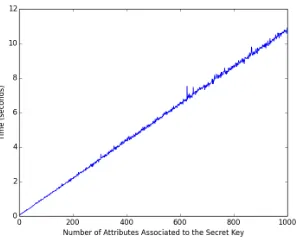
check if a user is at least 21 years old) and thus give results that are closer to real world scenarios. Hence, we also used a list of numerical attributes. Then, we measured the processing time needed for the generation of a user key. Each of the generated keys was associated with a list of attributes of different length. More precisely, for every generated key we were increasing the number of as-sociated attributes by one. Since we wanted to measure the overall processing time even under demanding circumstances, we created keys with up to 1000 attributes. This is considered enough even for very large organizations and/or publicly available online services where typically an abundance of information about users is stored. The results of this experiment are illustrated in Figure 2. As can be seen from the figure, the time for generating a key associated with 1000 attributes takes around 11 sec. However, this is considered as an extreme and not very likely case. However, generating a key that is associated with 100 attributes takes around 1.2 sec. This number of attributes is considered suitable for covering even complex cases where companies need to generate keys based on a wide variety of information. Hence, it is clear that the time needed in order to generate keys for a large number of users, while at the same time cover a long list of options (i.e. attributes), is realistic and does not prevent an organization from adopting such an approach.
Fig. 2: Generation of user key with up to 1000 attributes
Fig. 3: Disk size of the key as the number of attributes is increasing
Encryption & Decryption The last part of the ABE experiments, was to
measure both the encryption and decryption time. Recall that our protocol is only using ABE to encrypt a symmetric key and not other files that are stored in the cloud. Thus, we only ran experiments where we were encrypting a symmetric key with different policies and decrypting the generated ciphertext with keys that are associated with a different number of attributes. Moreover, we used access policies of different structure in order to measure the performance of the decryption not only when all conditions need to be fulfilled (most demanding case) but also when a random number of attributes is needed to satisfy the underlying policy.
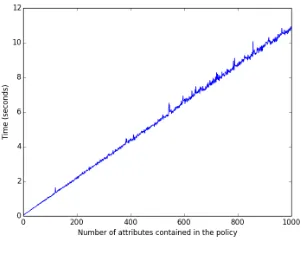
Fig. 4: Encryption
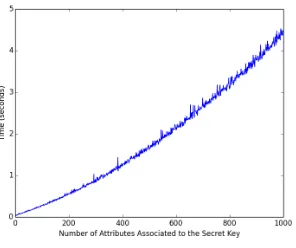
Figure 5, shows the time needed to decrypt that file by using a key with up to 1000 number of attributes where all were required to satisfy the policy. As can be seen from Figure??the time to encrypt and decrypt a file also depends on the particular attributes available and the size of the policy. More precisely, the time needed to encrypt a file with a policy of size 1000 is around 11 sec while the time needed to decrypt the same file is 4.5 sec. However, having such a long attribute list is not considered as a realistic scenario. Hence, the results show that using the proposed scheme to encrypt and decrypt a file of small size (in our case only a symmetric key) does not put any real burden to the overall performance of the protocol.
Fig. 5: Decryption
The second experiment of this phase aimed at analyzing the behavior of the underlying CP-ABE scheme under a randomly generated policy that contained a mix of regular and numerical attributes as well as conditions like the following:
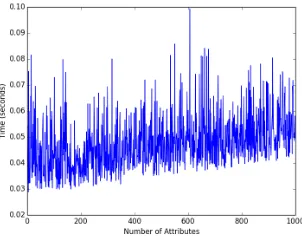
the policy. Hence, we can safely conclude that the decryption time even when large policies are used maintains reasonable running times.
Fig. 6: Decryption of ciphertext associated with a random policy
As a conclusion, it is clear that both encryption and decryption run in a predictable amount of time based on the number of attributes in a key or leaves in a policy tree. Moreover, the performance of these functions depends on the specific policy of the ciphertext as well as on the attributes available in user’s private key. Furthermore, the overall performance of these operations can be improved by optimizing the way we generate policies. However, we leave this as a future study. Most importantly, from these experiments it is evident that the overhead remains at acceptable levels while at the same time large private keys and policies are possible in practice while maintaining reasonable running times.
7.2 Symmetric Searchable Encryption
For the needs of our protocol, we also implemented a Searchable Encryption Scheme on top of a Blind Storage System as proposed in [19]. This part of the ex-periments was implemented in standard C++ using the Boost [2], Crypto++ [3] and CurlPP [7,4] libraries. Moreover, to test the overall performance of the un-derlying SSE scheme, we used files of different size and structure. To this end, we selected random data from the Enron dataset [5]. Our experiments on the SSE scheme were focused on two main aspects:(1)Indexing and uploading files and(2) Searching for a specific keyword.
Index & Upload The Enron test set consists of a large number of ASCII files
Therefore, we also ran the same experiment with 250 files resulting in a net total size of approximately 1 MB. In that case, our experiment indicated a the total execution time of 350 sec.
Keyword Search During this phase, we measured the execution time for finding
all files that contained the word “the” in our dataset. Searching for a specific keyword is merely comparable with downloading the corresponding index file. We ran the search algorithm for the files that we uploaded earlier. The results, indicated that the total execution time for finding all the files that contained the specified keyword was less than 0.6 sec.
8
Conclusion
In this paper, we proposed LotS – a protocol for secure and privacy-preserving data sharing in a cloud environment.LotSis based on Ciphertext-Policy Attribute-Encryption and Symmetric Searchable Attribute-Encryption. The described protocol used the advantages of both techniques and can be seen as an independent contribu-tion to the field ofhybrid encryption. The offered solution allows cloud users to encrypt files based on an SSE scheme while using a CP-ABE scheme to control their access rights and securely remove access to a file without having to decrypt and re-encrypt the original data. Finally, we believe that this work can pave the way for privacy-preserving data sharing between different organizations that are using separate and completely distinct cloud platforms. Hence, one of our main future goals is to test LotS in a multi-cloud environment. We hope that this has the potential to solve important problems, such as how a patient that is for example travelling and is in a critical health condition, can share her medical history with (authorized) doctors of a different country.
References
1. In: Financial Cryptography and Data Security, Lecture Notes in Computer Science, vol. 6054 (2010)
2. Boost c++ libraries (8 2014),http://www.boost.org/ 3. Crypto++ library (11 2015),https://www.cryptopp.com/ 4. curl and libcurl (12 2015),http://curl.haxx.se/
5. Enron email dataset (5 2015),https://www.cs.cmu.edu/~enron/
6. Agrawal, S., Chase, M.: Fame: Fast attribute-based message encryption. In: Proceedings of the 2017 ACM SIGSAC Conference on Computer and Com-munications Security. pp. 665–682. CCS ’17, ACM, New York, NY, USA (2017). https://doi.org/10.1145/3133956.3134014,http://doi.acm.org/10.1145/ 3133956.3134014
7. Barrette-LaPierre, J.P.: curlpp (5 2015),http://www.curlpp.org/
9. Boldyreva, A., Goyal, V., Kumar, V.: Identity-based encryption with efficient revocation. In: Proceedings of the 15th ACM Conference on Computer and Communications Security. pp. 417–426. CCS ’08, ACM, New York, NY, USA (2008). https://doi.org/10.1145/1455770.1455823,http://doi.acm.org/10.1145/ 1455770.1455823
10. Chase, M.: Multi-authority attribute based encryption. In: Proceedings of the 4th Conference on Theory of Cryptography. pp. 515–534. TCC’07, Springer-Verlag, Berlin, Heidelberg (2007), http://dl.acm.org/citation.cfm? id=1760749.1760787
11. Coker, G., Guttman, J., Loscocco, P., Herzog, A., Millen, J., O’Hanlon, B., Ramsdell, J., Segall, A., Sheehy, J., Sniffen, B.: Principles of remote attestation. Int. J. Inf. Secur. 10(2), 63–81 (Jun 2011). https://doi.org/10.1007/s10207-011-0124-7,http://dx.doi.org/10.1007/s10207-011-0124-7
12. Costan, V., Devadas, S.: Intel sgx explained. Cryptology ePrint Archive, Report 2016/086 (2016),https://eprint.iacr.org/2016/086
13. Dolev, D., Yao, A.C.: On the security of public key protocols. Information Theory, IEEE Transactions on29(2) (1983)
14. Fisch, B., Vinayagamurthy, D., Boneh, D., Gorbunov, S.: Iron: Functional encryp-tion using intel sgx. In: Proceedings of the 2017 ACM SIGSAC Conference on Com-puter and Communications Security. pp. 765–782. CCS ’17, ACM, New York, NY, USA (2017). https://doi.org/10.1145/3133956.3134106,http://doi.acm.org/10. 1145/3133956.3134106
15. Green, M., Hohenberger, S., Waters, B.: Outsourcing the decryption of abe ci-phertexts. In: Proceedings of the 20th USENIX Conference on Security. pp. 34–34. SEC’11 (2011)
16. Kamara, S., Papamanthou, C., Roeder, T.: Dynamic searchable symmetric encryp-tion. pp. 965–976 (2012)
17. Michalas, A., Dowsley, R.: Towards trusted ehealth services in the cloud. In: 2015 IEEE/ACM 8th International Conference on Utility and Cloud Computing (UCC). pp. 618–623 (Dec 2015). https://doi.org/10.1109/UCC.2015.108
18. Michalas, A.: Sharing in the rain: Secure and efficient data sharing for the cloud. In: Proceedings of the 11th IEEE International Conference for Internet Technology and Secured Transactions (ICITST-2016). IEEE (2016)
19. Naveed, M., Prabhakaran, M., Gunter, C.A.: Dynamic searchable encryption via blind storage. pp. 639–654 (2014). https://doi.org/10.1109/SP.2014.47
20. Paladi, N., Gehrmann, C., Michalas, A.: Providing user security guarantees in public infrastructure clouds. IEEE Transactions on Cloud Computing 5(3), 405– 419 (July 2017). https://doi.org/10.1109/TCC.2016.2525991
21. Paladi, N., Michalas, A., Gehrmann, C.: Domain based storage protection with secure access control for the cloud. In: Proceedings of the 2014 International Work-shop on Security in Cloud Computing. ASIACCS ’14, ACM, New York, NY, USA (2014)
22. Sahai, A., Seyalioglu, H., Waters, B.: Dynamic credentials and ciphertext delega-tion for attribute-based encrypdelega-tion. In: Proceedings of the 32Nd Annual Cryptol-ogy Conference on Advances in CryptolCryptol-ogy — CRYPTO 2012 - Volume 7417. pp. 199–217 (2012)
24. Santos, N., Rodrigues, R., Gummadi, K.P., Saroiu, S.: Policy-Sealed Data: A New Abstraction for Building Trusted Cloud Services. In: Presented as part of the 21st USENIX Security Symposium (USENIX Security 12). pp. 175–188. USENIX, Belle-vue, WA (2012)
25. Verginadis, Y., Michalas, A., Gouvas, P., Schiefer, G., H¨ubsch, G., Paraskakis, I.: Paasword: A holistic data privacy and security by design framework for cloud ser-vices. In: Proceedings of the 5th International Conference on Cloud Computing and Services Science. pp. 206–213 (2015). https://doi.org/10.5220/0005489302060213 26. Yang, K., Jia, X., Ren, K., Xie, R., Huang, L.: Enabling efficient access control