Available Online atwww.ijcsmc.com
International Journal of Computer Science and Mobile Computing
A Monthly Journal of Computer Science and Information Technology
ISSN 2320–088X
IMPACT FACTOR: 6.017
IJCSMC, Vol. 6, Issue. 5, May 2017, pg.218 – 226
Development of Knowledge Based Expert
System for Indian Legal Domain with Specific
Reference to Consumer Protection Act
Goldi Soni
1, Jyoti Singh
21
Research Scholar, CV Raman University, Kargi Road, Kota, Dist. Bilaspur (CG), India 2
Joint Controller, Chhattisgarh Vyavasik Pariksha Mandal, Raipur (CG), India
[email protected]; [email protected]
_____________________________________________________________________________________
Abstract- The basic aim of research, described in this paper is to develop a knowledge based expert system for Indian legal domain with specific reference to the consumer protection act which is often in demand. Most legal expert systems attempt to implement complex models of legal reasoning. But the utility of a legal expert system lies not in the extent to which it simulates a lawyer’s approach to a legal problem, but in the quality of its predictions and of its arguments. A useful legal expert system should be capable of producing advice similar to that which one might get from a lawyer, so it should operate at the same pragmatic level of abstraction as does a lawyer. The aim of this paper is to develop a legal expert system for consumer protection act of Indian legal domain. The authors have used Microsoft Visual Studio for development of rule based expert system.
Keywords: Artificial Intelligence, Knowledge Based System, Consumer Protection Act, Rule based Expert System.
_____________________________________________________________________________________ I. INTRODUCTION
Knowledge-base systems (KBS) are computer based systems which support, or perform automatically, cognitive tasks in a narrow problem domain which are usually only carried out by human experts.
A Knowledge Based Expert System
Knowledge-based systems in principle replaces the human problem solver capable of performing the task by himself, either completely or more commonly by allowing less skilled workers to perform the same task assisted by the KBS. The introduction of a KBS is typically intended to take boring routine tasks out of the hands of scarce experts so that they can spend more time on the hard problems. The KBS for instance is capable of handling the great bulk of law applications without any human intervention.
2). Components of Rule Based Expert System: The domain knowledge needed to solve problems is contained in the knowledge-base in the form of rules. Components of the rule-based expert system:
User Interface: Explanation Facility Working Memory Inference Engine Agenda
(optional) Knowledge Acquisition Facility
B Legal aspects of Consumer Protection Act
1). Types of Consumer Cases: In the constitution of India, social and economic justice is an important part in which a consumer justice and protection is also a part. As per this, many acts are formed to safeguards the rights of the citizens. Depending upon various types of situation broadly the cases are divided into three types of case: Criminal Case, Civil Case, and Consumer Case. For Criminal Cases there is the Code of Criminal Procedure, 1973 (the CrPC) which is the procedural law providing the machinery for punishment of offenders under the substantive criminal law. For Civil Cases there is Code of Civil Procedure, which provides the procedure for punishment of offenders under civil law. For consumer cases there is Consumer Protection Act which deals with the cases related to consumer disputes. This research work is done on the Consumer Cases, hence Consumer Protection Act is considered in detail
2). Consumer Protection Act: In order to provide for better protection of the interests of the consumer the Consumer Protection Bill, 1986 was introduced in the Lok Sabha on 5th December, 1986.An Act to provide for better protection of the interests of consumers and for that purpose to make provision for the establishment of consumer councils and other authorities for the settlement of consumers' disputes and for matters connected therewith.
3). Related Terminology
Goods - Goods means every kind of movable property other than actionable claims and money and includes stocks and shares and growing crops grass and things attached farming apart of the land which are agreed to be served before sale or under the contract of sale.
Service - It means service of any description which is made available to potential user. It includes the financing, insurance, transport ,processing ,supply of electrical or other energy, boarding and lodging or both, housing, entertainment , amusement or purveying a news or other information . But service not included rendering any service free of charge or under contract of personal service.
Consumer – Consumer means any person who buys any goods for consideration. Consumer also includes any user of such goods other the buyer himself.
Consumer Disputes – A dispute where a person against whom complain has been made denies or disputes the allegation contained in the complaint.
Unfair Trade Practice- Unfair trade practice which for the purpose of promoting the sale, use or supply of any goods or for the provision of any service, adopts any unfair method or unfair deceptive practices
4). Three Tier System: According to this act following three-tier system has been provided under the Act to deal with consumer complaints;
District Forum- It operates at the district level and deals with consumer complaints pertaining to the value of goods or services and compensation not exceeding Rs. 20 lac.
State Commission- It operates at the state level and deals with complaints of the value exceeding Rs. 20 lac but not exceeding Rs. 100 lac. It also hears appeals against the orders of the District Forum.
C Rule Based Expert System for Consumer Protection act
The problem statement for the present work can be stated as follows- he overall objective of the research is to develop rule based knowledge expert system of legal reasoning for Consumer Protection act of the Indian Legal domain. In this research work law is regarded as knowledge. Thus prototype is developed by generating knowledge database which is rule based in nature. This problem can be divided into following sub problems:-
To develop a prototype
To develop rule-based reasoning system.
To evaluate the performance of proposed system and relate the performance through the case study.
II. EXPERT SYSTEM FOR CONSUMER PROTECTION ACT
A Designing of Expert System
Expert systems require special approaches to systems analysis, especially to the collection of the data (or rather knowledge) on which the system is based. The process of gathering the knowledge to stock the expert system's knowledge-base & knowledge acquisition has proved to be the most difficult component of the knowledge engineering process.
B Implementation of Expert System for Consumer Protection Act
The detail procedural analysis was carried out. After going through the analysis we arrived at the Procedure which should be adopted to develop a prototype. The work was carried out under the heads mentioned below. Each of these heads will be deal in detail subsequently.
1). Discussions/interviews with legal experts in field and academicians in Law: A series of discussion and the interviews were held with the practicing advocates who are experts in the field of Consumer Protection Law. The discussions consisted of understanding the concept of Laws of Consumer Protection Act and the intricacies involved in them. The broad outlines of the rules which need to be framed were noted. We had also the discussions and the interviews with the academicians who are teaching law and involve in Consumer Protection Law. The suggestions were of great help in framing of the rules
2). The framing of rules using Legal Knowledge and incorporation with Expert System: There are different types of cases in legal domain, among them any cases can be broadly divided among criminal, civil or consumer case. As objective of this research work is to develop an expert system for Consumer Protection Act, hence it mainly focuses consumer related cases and the expert system will help to solve consumer related cases. The Consumer Protection Act is an Act to provide for better protection of the interests of consumers and for that purpose to make provision for the establishment of consumer councils and other authorities for the settlement of consumers' disputes and for matters connected therewith. The first level in the research work will be to identify the case whether it is consumer case or not. A consumer case can be further divided into N number of sub cases depending upon the services rendered or item purchased by the consumer
3). Testing and Implementations of rules: The rules were framed and thoroughly checked by the legal experts, after which the implementation is taken up. The testing of the rules was done and then again verification was done by the Legal Experts and scholars in field of law.
III. KNOWLEDGE BASE FOR CONSUMER PROTECTION ACT
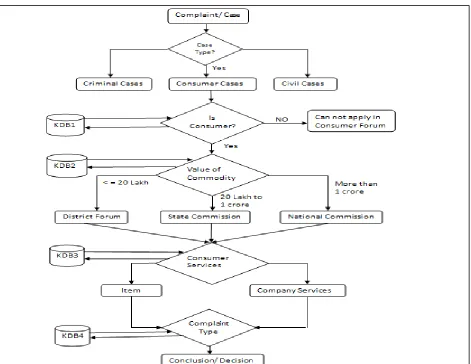
Here basically five modules and four knowledge database are developed. Each knowledge database consists of set of questionnaires corresponding to it module. For e.g. knowledge database 1 consist of set of questions like “is the commodity purchased is for personal use or not?” in order to find out whether user is a consumer or not. The first level expert system will check the answer available by Knowledge Database1 and after processing it a solution for first level will be provided to the consumer.
Work flow can be understood by the following Fig1:
Fig 1 Flow of Proceeding of Consumer Case
A Defragmentation of Cases
Here a first level knowledge database is generated in order to defragment the cases. Cases will be defragmented according to the question generated in KDB-1 in civil, criminal or consumer case. Defragmentation of different types of cases on the basis of YES/NO questions:
1. Is case is related to dowry? 2. Is case is related to robbery?
3. Is case is related to violence against /woman/sexual offence/ rape? 4. Is case is related to cheque bounce?
5. Is case is related to self/private defense?
6. Is case is related to abatement (encouraging for crime)? 7. Is case is related to murder?
8. Is case is related to criminal conspiracy? 9. Is case is related to any offence against state? 10. Is case is related to public nuisance?
11. Is case is related to false evidence?
12. Is case is related to any offence related to coins & government stamps? 13. Is case is related to miscarriage of unborn child?
14. Is case is related of hurt?
17. Is case is related to criminal trespass? 18. Is case is related to criminal force assault? 19. Is case is related to divorce?
20. Is case is related to service issue (Government/Private)? 21. Is case is related to possession of property?
22. Is case is related to recovery of money? 23. Is case is related to succession issue? 24. Is case is related to execution of order? 25. Is case is related to compensation claim? 26. Is case is related to postal services? 27. Is case is related to railway services? 28. Is case is related to educational services? 29. Is case is related to medical services? 30. Is case is related to banking services? 31. Is case is related to transportation services? 32. Is case is related to insurance services? 33. Is case is related to housing items? 34. Is case is related to electronic items?
35. Is case is related to telecommunication items? 36. Is case is related to automobiles?
37. Is case is related to electricity board?
If the answer of any question from 1-19 is YES than it will consider under CRIMINAL CASE, else if the answer of any question from 20-25 is YES than it will consider under CIVIL CASE, else if the answer of any question from 26-37 is YES than it will consider under CONSUMER CASE.
Work flow can be understood by the following figure:
Fig 2: Flow of defragmentation of cases
B Jurisdiction Type Knowledge Database
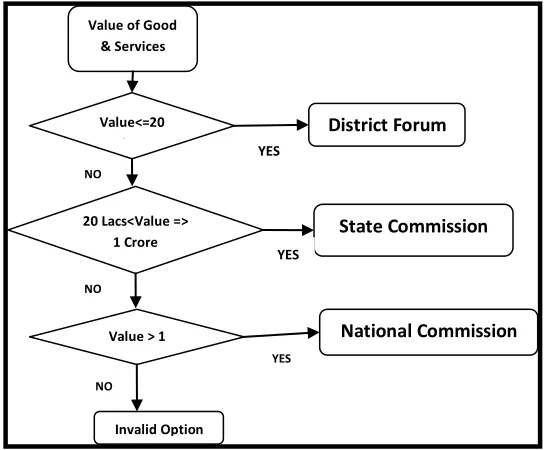
Following are the rules designed for determining where the Consumer Cases will proceeds:-
a) Is the value of the goods or services and the compensation, if any, claimed is less than or equal to 20 lacks? b) Is the value of the goods or services and compensation, if any, claimed is greater than 20 lacks but less than or equal to 1 crore?
c) Does the appeal is against the orders of any District Forum within the State?
d) Is the value of the goods or services and compensation, if any, claimed is greater than 1 crore? CASE
KDB1
Defragmen tation of cases
CIVIL CASE CRIMINAL CASE CONSUMER CASE If any from 1-19
is YES
If any from 20-24 is YES
Fig 3 Flow of Jurisdiction in Consumer Cases
If the answer of Rule-1 is YES than the District Forum shall have jurisdiction, if the answer of Rule-2 or Rule-3 is YES than the State Commission shall have jurisdiction and if the answer of Rule-4 or rule-4 is YES than the National Commission shall have jurisdiction
C Consumer Service Type Knowledge Database
In this database we will design the set of rules which will determine the type of consumer services a) Is the complaint related to items?
b) Is the complaint related to services?
Fig 4 Flow of Service type in Consumer Case
1. Item Purchased Knowledge Database: If the answer of Rule-a) is YES than it can be further classified into types of item purchased according to the following rules:-
i) Is complaint related to housing?
ii) Is complaint related to electronics?
iii) Is complaint related to automobiles?
iv) Is complaint related to telecommunications?
Type of service
If Service==
Item Item
Services
YES
NO Value of Good
& Services
Value<=20 Lac
District Forum
20 Lacs<Value =>
1 Crore State Commission
National Commission
Invalid Option Value > 1
Crore
YES
YES
YES NO
NO
Fig.5 Flow of item type complaint in Consumer Cases
Knowledge Database for Housing Cases:-
In this database we will design the set of rules which will determine the type of issues related to housing cases. a) Is the case is related to not giving physical possession issues?
b) Is the case is related to deficiency in service issues?
Knowledge Database for Electronic Cases:-
In this database we will design the set of rules which will determine the type of issues related to electronic cases. a) Is the case is related to manufacturing defects issues?
b) Is the case is related to deficiency in service issues?
Knowledge Database for automobiles Cases:-
In this database we will design the set of rules which will determine the type of issues related to automobiles issues. a) Is the case is related to manufacturing defects issues?
b) Is the case is related to problem during warranty period Issues?
Knowledge Database for Telecommunication Cases:-
In this database we will design the set of rules which will determine the type of issues related to telecommunication services.
a) Is the case is related to inflated bills/ overcharging/Unfair deduction issues? b) Is the case is related to disconnection without notice/intimation Issues? c) Is the case is related to call drops/network problems Issues?
d) Is the case is related to delay in activation of desired service issues?
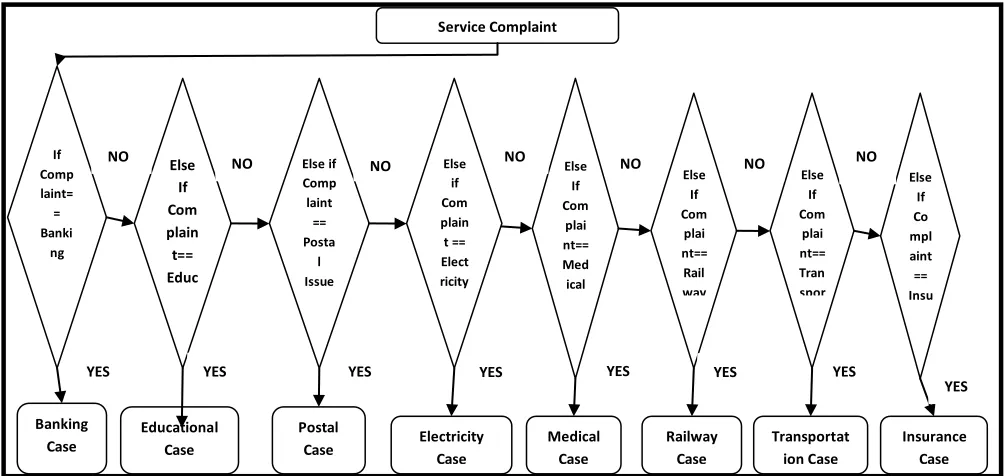
2. Service Type Knowledge Database: If the answer of Rule-b) is YES than it can be further classified into types of services opted according to the following rules:-
i. Is complaint related to banking?
ii. Is complaint related to educational issues? iii. Is complaint related to postal issues? iv. Is complaint related to medical issues?
v. Is complaint related to railway issues? vi. Is complaint related to transportation? vii. Is complaint related to insurance?
Item Complaint
If Complai
nt== Housing
Housing Case
Else If Complaint
== Electronic
Electronic Case Automobiles Case Others
Else if Complaint
== Automobil
es
YES YES
YES
NO NO
NO
Else If Complai nt== Telecom municati on
Telecommunication Case YES
Fig 6 Flow of Service complaint in Consumer Cases
Knowledge Database for Banking Cases:-
In this database we will design the set of rules which will determine the type of issues related to banking services. a) Is the case is related to Cheque issues?
b) Is the case is related to M-Banking Issues? c) Is the case is related to Loan Issues?
d) Is the case is related to Credit Cards/Debit Cards/ ATM? e) Is the case is related to General Issues?
Knowledge Database for Educational Cases:-
In this database we will design the set of rules which will determine the type of issues related to educational services.
a) Is the case is related to Fees Refund issues? b) Is the case is related to False advertisement issues? c) Is the case is related to Affiliation issues?
d) Is the case is related to Caution Money issues? e) Is the case is related to Others issues?
Knowledge Database for Postal Cases:-
In this database we will design the set of rules which will determine the type of issues related to educational services.
a) Is case is related to Late Delivery issues? b) Is case is related to Not delivered issues?
c) Is case is related to Delay or non receipt of money order issues? d) Is case is related to undelivered of registered letter issues? e) Is case is related to Delay or non receipt of speed post issues?
Knowledge Database for Electricity Cases:-
In this database we will design the set of rules which will determine the type of issues related to electricity services. a) Is case is related to Reduction/Addition of load issues?
b) Is case is related to meter billing issues?
c) Is case is related to Meter related grievances issues?
Service Complaint If Comp laint= = Banki ng Else If Com plain t== Educ atio nal issu es Educational Case Postal Case Else if Comp laint == Posta l Issue s YES
YES YES
NO NO Else If Com plai nt== Med ical issu es Electricity Case YES NO Else If Com plai nt== Rail way Else If Com plai nt== Tran spor tati on Else If Co mpl aint == Insu ran ce Medical Case Railway Case Transportat ion Case
YES YES
NO NO
Banking Case Else if Com plain t == Elect ricity
NO NO
Insurance Case YES
d) Is case is related to Others issues?
Knowledge Database for Medical Cases:-
In this database we will design the set of rules which will determine the type of issues related to medical services a) Is case is related to damage of organ due to negligence issues?
b) Is case is related to wrong treatment due to wrong diagnosis issues? c) Is case is related to issues in which any instrument left in the body? d) Is case is related to a wrong part removed issues?
e) Is case is related to other issues?
Knowledge Database for Railway Cases:-
In this database we will design the set of rules which will determine the type of issues related to railway services a) Is case is related to ticket issues?
b) Is case is related to theft during journey issues? c) Is case is related to deficiency in services?
Knowledge Database for Transportation Cases:-
In this database we will design the set of rules which will determine the type of issues related to transportation services
a) Is case is related to order not received in time issues? b) Is case is related to order received in damage conditions?
Knowledge Database for Insurance Cases:-
In this database we will design the set of rules which will determine the type of issues related to insurance services. a) Is the case is related to Motar Insurance issues?
b) Is the case is related to Life Insurance Issues? c) Is the case is related to Health Insurance Issues? d) Is the case is related to Travel Insurance Issues? e) Is the case is related to Accidental Insurance Issues?
IV. FUTURE SCOPE OF THE STUDY
In next phase of the research work the comprehensive development of Rule Based Expert system for the Consumer Protection Act in Indian Legal domain will be developed.
V. CONCLUSION
The authors have made an attempt to develop a Rule Based Expert System Prototype for consumer protection act which consists of many rules of law. The prototype has been tested very successfully. The same is also confirmed by the expert advocates. Hence it is possible to develop a Comprehensive Rule based System for Consumer Protection Act, which can act as great tool for Experts in the field of Law.
REFERENCES
[1] V.R. Sharma. Asia Pacific Journal of Marketing & Management Review, 2012, vol. 4, pp.78-84
[2] G Soni; J Singh, International Journal in Foundation of Computer Science & Technology, 2014, vol. 4, pp.77-84
[3] G Soni, International Journal of Computer Science and Technology,2014, vol-5,pp.124-128
[4] Online available at http://dc-siwan.bih.nic.in/Consumer_Act.pdf
[5] Online available at http://www.nationalconsuerhelpline.in/Banking.aspx
[6] G Soni; J Singh, European Journal of Advances in engineering & Technology, 2014,vol-1,pp.279-282