Available Online atwww.ijcsmc.com
International Journal of Computer Science and Mobile Computing
A Monthly Journal of Computer Science and Information Technology
ISSN 2320–088X
IMPACT FACTOR: 6.017IJCSMC, Vol. 8, Issue. 3, March 2019, pg.76 – 90
Enhancing the Capacity of LSB Method
by Introducing LSB2Z Method
Ziad Alqadi
1; Bilal Zahran
2; Qazem Jaber
3; Belal Ayyoub
4; Jamil Al-Azzeh
51Computer Engineering Department, Al Balqa’a Applied University, Amman, 11134, Jordan
E-mail: [email protected]
2Computer Engineering Department, Al Balqa’a Applied University, Amman, 11134, Jordan
E-mail: [email protected]
3
Department of Mechatronics Engineering, Al Balqa’a Applied University, Amman, 11134, Jordan
E-mail: [email protected]
4Computer Engineering Department, Al Balqa’a Applied University, Amman, 11134, Jordan
E-mail: [email protected]
5Computer Engineering Department, Al Balqa’a Applied University, Amman, 11134, Jordan
E-mail: [email protected]
Abstract: The purpose of steganography is to conceal the existence of the secret message in the holding image, thus making a message unreadable by a third party. Steganography is an important process due to many factors such as the confidentiality, personality of the message to be sent from the sender to receiver through unsecure communication environment. In this paper we will introduce LSB2 method of data hiding in order to double the capacity of the holding image, by doubling the maximum message size which can be covered by the image. The proposed methodology of applying LSB2 will be implemented and tested in order to prove the efficiency of this method comparing with LSM method.
Keywords: Steganography, LSB, LSB2, hiding time, extracting time, PSNR.
1-
Introduction
Personal data are very private and confidential.
Data are very sensitive
Confidential data and trade secrets
Misuse of data is not acceptable.
Data does not bear unintentional damage, or human error and accidental deletion.
Data should not be exposed monetary and blackmail purposes
Data does not deal with hiding traces of crime
Any data hiding technique shall express certain features such as:
Capacity, which refers to the amount of data that can be hidden in cover medium [10], least significant bit (LSB) of data hiding, allows hiding a message with size equal the image covering size divided by 8. [10]
Security, the data hiding method should provide security such that only the intended user can gain access to it. In other words, it refers to the inability of un-authorized user to detect hidden information. This is very crucial to protect the confidentiality and sensitivity of information being sent [3], [4].
Robustness, which refers to the amount of data that can be hidden without showing any negative effects and destroying hidden information [1]. In other words making it difficult to distinguish them with the naked eye, here the mean square error(MSE) between the covering image and the holding one must be closed to zero [15], [16], [17], or here the used method of data hiding must give a big value of peak signal to noise ratio (PSNR) [18], [19].
Perceptibility, the data hiding method should hide data in such a manner that the original covering data and the hidden data
are perceptually indistinguishable.[5], [15].
Efficiency, [11], [12], the used method of data hiding must hide and extract the secret message with minimum time or the
method must provide a maximum throughput [13], [14].
2-
LSB method of data hiding
LSB method of data steganography is a simple method, and it is popular and has being used in many
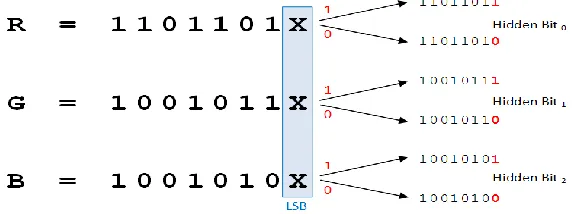
applications [6], [7]. LSB method reserves 8 bytes from the holding image to hide one character from the secret
message [9], [10], so the maximum message size to be covered must not exceed the image size divided by 8[6].
Figure (1) shows how to reserve bytes in the color image to be used for hiding the message character bits:
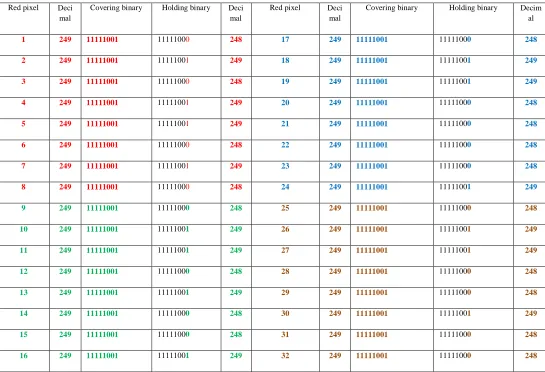
Table (1) shows how to use LSB method to hide the message "Ziad" in bytes of a covering color image:
Message= Ziad = 90 105 97100
Binary=01011010011010010110000101100100
Table (1): Hiding a message using LSB method
Red pixel Deci mal
Covering binary Holding binary Deci mal
Red pixel Deci mal
Covering binary Holding binary Decim al
1 249 11111001 11111000 248 17 249 11111001 11111000 248
2 249 11111001 11111001 249 18 249 11111001 11111001 249
3 249 11111001 11111000 248 19 249 11111001 11111001 249
4 249 11111001 11111001 249 20 249 11111001 11111000 248
5 249 11111001 11111001 249 21 249 11111001 11111000 248
6 249 11111001 11111000 248 22 249 11111001 11111000 248
7 249 11111001 11111001 249 23 249 11111001 11111000 248
8 249 11111001 11111000 248 24 249 11111001 11111001 249
9 249 11111001 11111000 248 25 249 11111001 11111000 248
10 249 11111001 11111001 249 26 249 11111001 11111001 249
11 249 11111001 11111001 249 27 249 11111001 11111001 249
12 249 11111001 11111000 248 28 249 11111001 11111000 248
13 249 11111001 11111001 249 29 249 11111001 11111000 248
14 249 11111001 11111000 248 30 249 11111001 11111001 249
15 249 11111001 11111000 248 31 249 11111001 11111000 248
16 249 11111001 11111001 249 32 249 11111001 11111000 248
LSB method adds a minor changes to the holding image, so the third party will not notice any changes between the covering image and the holding image, thus LSB will optimize MSE and PSNR, table (2) shows the minimum changes ( if they exist) in the holding bytes.
Table (2): Changes in the covering byte using LSB method
LSB of the covering byte Character bit Remarks
0 0 No changes in the covering byte
1 Add 1 to the covering byte
1 0 Subtract one from the covering byte
3-
LSB2Z description and implementation
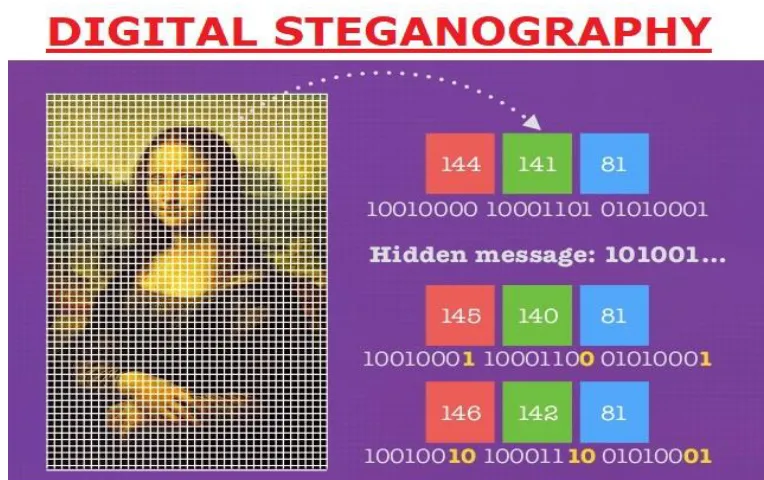
The proposed LSB2Z method of data hiding reserves 4 bytes from the covering image to be used to hide a message character, thus this method will double the size of the message to be hidden in a covering color image as shown in figure (2):
Figure (2): Steganography using LSB and LSB2Z
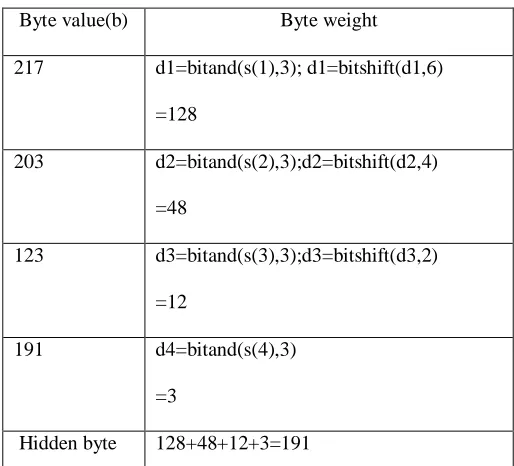
Tables (3) and (4) show how to hide and extract a character using LSB2Z method:
Data to be hidden (a1) =191= 10111111 binary
n=2
Table (3): Hiding using LSB2Z method
Byte value(b)
Binary Holding byte Binary
218 11011010 s(1)=uint8(bitor(bitand(b(1),bitcmp(2^n-1,8)),bitshift(a1,-6)));
=218
11011010
200 11001000 a=bitand(a1,48); a=bitshift(a,2);
s(2)=uint8(bitor(bitand(b(2),bitcmp(2^n-1,8)),bitshift(a,-6)));
=203
11001011
120 01111000 a=bitand(a1,12);a=bitshift(a,4);
s(3)=uint8(bitor(bitand(b(3),bitcmp(2^n-1,8)),bitshift(a,-6)));
=123
190 10111110 a=bitand(a1,3);a=bitshift(a,6);
s(4)=uint8(bitor(bitand(b(4),bitcmp(2^n-1,8)),bitshift(a,-6)));
=191
10111111
Table (4): Extracting character using LSB2Z method
Byte value(b) Byte weight
217 d1=bitand(s(1),3); d1=bitshift(d1,6)
=128
203 d2=bitand(s(2),3);d2=bitshift(d2,4)
=48
123 d3=bitand(s(3),3);d3=bitshift(d3,2)
=12
191 d4=bitand(s(4),3)
=3
Hidden byte 128+48+12+3=191
Here we will describe the proposed method of hiding and extracting a character in/form a color image.
Hiding process:
To hide a character into a color image apply the following steps:
1) Get a character, get the decimal and binary values of the character (let us say: a1=191=10111111.
2) Reserve four bytes from the covering image (let us say b= [218 200 120 190]).
3) Find the complement of 3(11 in binary):cmp3=252.
4) Insert the first 2 bits in the first covering byte: to do this apply the following steps:
A. Apply ANDING of the first byte with cmp3:
C1=bitand (b (1), cmp3) =216.
B. Shift right a1 6 times: C2=bitshift (a1,-6) =2.
C. Get the first holding byte by ORING C1 and C2: S (1) =bitor (C1, C2) =218.
5) Insert the second 2 bits in the second covering byte: to do this apply the following steps:
A. Apply ANDING a1 with 48: a=bitand (a1, 48) =48.
C. Apply ANDING of the second byte with cmp3:
C1=bitand (b (2), cmp3) =200.
D. Shift right a 6 times: C2=bitshift (a,-6) =3.
E. Get the second holding byte by ORING C1 and C2: S (2) =bitor (C1, C2) =203.
6) Insert the third 2 bits in the third covering byte: to do this apply the following steps:
A. Apply ANDING a1 with 12: a=bitand (a1, 12) =12.
B. Shift left a 4 times: a=bitshift (a, 4) =192.
C. Apply ANDING of the second byte with cmp3:
C1=bitand (b (3), cmp3) =120.
D. Shift right a 6 times: C2=bitshift (a,-6) =3.
E. Get the second holding byte by ORING C1 and C2: S (3) =bitor (C1, C2) =123.
7) Insert the fourth 2 bits in the fourth covering byte: to do this apply the following steps:
A. Apply ANDING a1 with 3: a=bitand (a1, 3) =3.
B. Shift left a 6 times: a=bitshift (a, 4) =192.
C. Apply ANDING of the second byte with cmp3:
C1=bitand (b (4), cmp3) =188.
D. Shift right a 6 times: C2=bitshift (a,-6) =3.
E. Get the second holding byte by ORING C1 and C2: S (3) =bitor (C1, C2) =191.
Extracting process
This process can be implemented applying the following steps:
1) Get the four holding bytes S= [218 203 123 191].
2) Get the character first weight by applying the following steps:
A. ANDING the first holding byte with 3:d1= bitand(s (1), 3) =2.
B. Shift left d1 6 times: d1=bitshift (d1, 6) =128.
3) Get the character second weight by applying the following steps:
A. ANDING the second holding byte with 3:d2= bitand(s (2), 3) =3.
B. Shift left d1 6 times: d2=bitshift (d1, 4) =48.
4) Get the character third weight by applying the following steps:
B. Shift left d1 2 times: d3=bitshift (d1, 2) =12.
5) Get the character fourth weight by ANDING the fourth holding byte with 3: d4=bitand(s (4), 3) =3.
6) Find the character decimal value by summing the weights d1+d2+d3+d4=191.
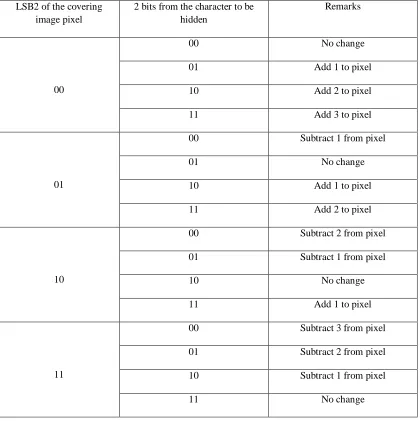
This method also added a minor changes ( if any) by adding a maximum of 3 or a subtracting -3 from the covering byte as shown in table (5):
Table (5): Changes in the covering byte
LSB2 of the covering image pixel
2 bits from the character to be hidden
Remarks
00
00 No change
01 Add 1 to pixel
10 Add 2 to pixel
11 Add 3 to pixel
01
00 Subtract 1 from pixel
01 No change
10 Add 1 to pixel
11 Add 2 to pixel
10
00 Subtract 2 from pixel
01 Subtract 1 from pixel
10 No change
11 Add 1 to pixel
11
00 Subtract 3 from pixel
01 Subtract 2 from pixel
10 Subtract 1 from pixel
11 No change
4-
Implementation and experimental results
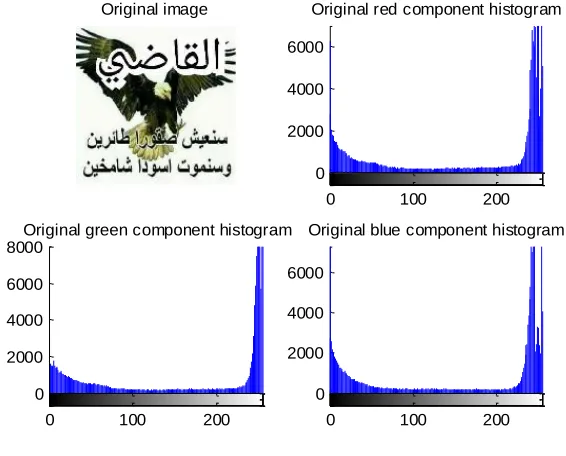
LSB and the proposed LSB2Z methods were implemented using matlab, several deferent color images in sizes and types were used as a covering and holding images, different messages in size were used to be hidden in the selected images.
Original image
0 100 200
0 2000 4000 6000
Original red component histogram
0 100 200
0 2000 4000 6000 8000
Original green component histogram
0 100 200
0 2000 4000 6000
Original blue component histogram
Figure (3): Original image
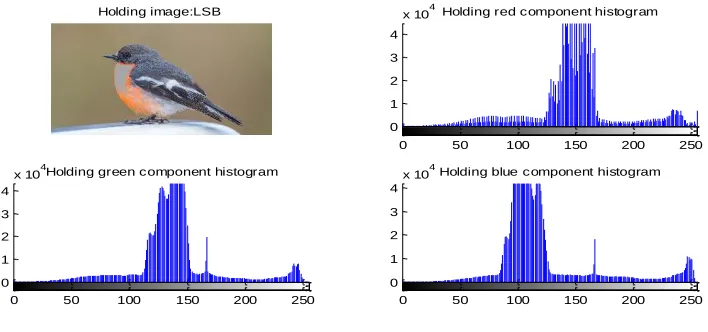
Holding image:LSB
0 100 200
0 2000 4000 6000
Holding red component histogram
0 100 200
0 2000 4000 6000 8000
Holding green component histogram
0 100 200
0 2000 4000 6000
Holding blue component histogram
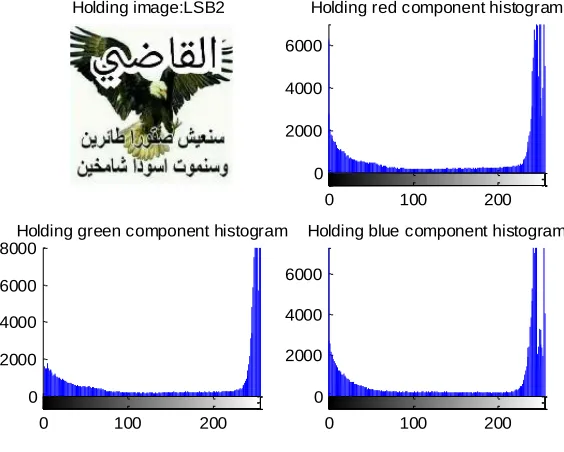
Holding image:LSB2
0 100 200
0 2000 4000 6000
Holding red component histogram
0 100 200
0 2000 4000 6000 8000
Holding green component histogram
0 100 200
0 2000 4000 6000
Holding blue component histogram
Figure (5): Holding image using LSB2Z method
Experiment 1:
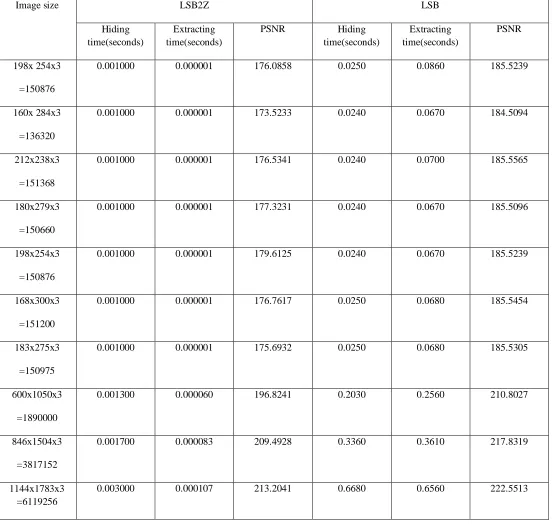
A message of 26 character message "ABCDEFGHIJKLMNOPQRSTUVWXYZ" (short message) was selected and hidden in various images using LSB and LSB2Z methods.
Table (6) shows the results of this experiment:
From the obtained results obtained shown in table (6 ) we can raise the following facts concerned the short message hiding:
- LSB2 is more efficient by decreasing the hiding and extraction times.
- LSB2Z does not destroy the holding image by keeping high value of PSNR and this value is closed to LSB PSNR value.
Experiment 2:
Here we select a covering image with size equal 1144x1783x3=6119256 bytes to be used as a covering image for various in sizes messages (including huge size messages).
Figures (6), (7) and (8) show the covering and holding images after hiding a message with 53248 characters (huge message).
Also, looking to the holding image by eyes, it comes to us that these holding images are identical to the covering image.
Table (6): Experiment 1 results
Image size LSB2Z LSB
Hiding time(seconds)
Extracting time(seconds)
PSNR Hiding
time(seconds)
Extracting time(seconds)
PSNR
198x 254x3
=150876
0.001000 0.000001 176.0858 0.0250 0.0860 185.5239
160x 284x3
=136320
0.001000 0.000001 173.5233 0.0240 0.0670 184.5094
212x238x3
=151368
0.001000 0.000001 176.5341 0.0240 0.0700 185.5565
180x279x3
=150660
0.001000 0.000001 177.3231 0.0240 0.0670 185.5096
198x254x3
=150876
0.001000 0.000001 179.6125 0.0240 0.0670 185.5239
168x300x3
=151200
0.001000 0.000001 176.7617 0.0250 0.0680 185.5454
183x275x3
=150975
0.001000 0.000001 175.6932 0.0250 0.0680 185.5305
600x1050x3
=1890000
0.001300 0.000060 196.8241 0.2030 0.2560 210.8027
846x1504x3
=3817152
0.001700 0.000083 209.4928 0.3360 0.3610 217.8319
1144x1783x3 =6119256
Original image
0 50 100 150 200 250 0
1 2 3 4
x 104Original red component histogram
0 50 100 150 200 250 0
1 2 3 4
x 104Original green component histogram
0 50 100 150 200 250 0
1 2 3 4
x 104Original blue component histogram
Figure (6 ): Covering original image with size = 6119256 pixels
Holding image:LSB2
0 50 100 150 200 250 0
1 2 3 4
x 104Holding red component histogram
0 50 100 150 200 250 0
1 2 3 4
x 104Holding green component histogram
0 50 100 150 200 250 0
1 2 3 4
x 104Holding blue component histogram
Figure (7): The same image holding a message with size= 53248 bytes using LSB2
Holding image:LSB
0 50 100 150 200 250 0
1 2 3 4
x 104Holding red component histogram
0 50 100 150 200 250 0
1 2 3 4
x 104Holding green component histogram
0 50 100 150 200 250 0
1 2 3 4
x 104Holding blue component histogram
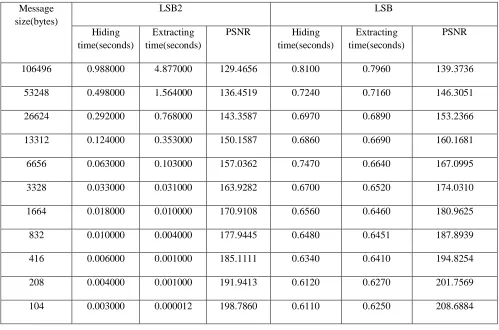
Table (7): Experiment 2 results
Message size(bytes)
LSB2 LSB
Hiding time(seconds)
Extracting time(seconds)
PSNR Hiding
time(seconds)
Extracting time(seconds)
PSNR
106496 0.988000 4.877000 129.4656 0.8100 0.7960 139.3736
53248 0.498000 1.564000 136.4519 0.7240 0.7160 146.3051
26624 0.292000 0.768000 143.3587 0.6970 0.6890 153.2366
13312 0.124000 0.353000 150.1587 0.6860 0.6690 160.1681
6656 0.063000 0.103000 157.0362 0.7470 0.6640 167.0995
3328 0.033000 0.031000 163.9282 0.6700 0.6520 174.0310
1664 0.018000 0.010000 170.9108 0.6560 0.6460 180.9625
832 0.010000 0.004000 177.9445 0.6480 0.6451 187.8939
416 0.006000 0.001000 185.1111 0.6340 0.6410 194.8254
208 0.004000 0.001000 191.9413 0.6120 0.6270 201.7569
104 0.003000 0.000012 198.7860 0.6110 0.6250 208.6884
From table (7) we can see that PSNR values of LSB2Z method are closed to LSB method values and the required times for hiding short messages Using LSB2Z method are better than the times provided by LSB method, as shown in figure (9)
0 2 4 6 8 10 12
x 104 0
0.5 1 1.5 2 2.5 3 3.5 4 4.5 5
LSB2 Hiding LSB Hiding LSB2 extracting LSB extracting
Conclusion
A proposed methodology of data steganography was proposed, tested and implemented. LSB2Z and LSB methods are close in competency. LSB2Z method doubles the maximum size of the message to hidden in a covering image.
It was shown that LSB2Z method can be used to hide short messages and big messages without affecting or distorting the covering image by providing a high PSNR value, and maintains efficiency factors closed or better than LSB efficiency factors.
References
1. Ziad A. Alqadi, Majed O. Al-Dwairi, Amjad A. Abu Jazar and Rushdi Abu Zneit, Optimized True-RGB color Image Processing, World Applied Sciences Journal 8 (10): 1175-1182, ISSN 1818-4952, 2010.
2. Waheeb, A. and Ziad AlQadi, Gray image reconstruction. Eur. J. Sci. Res., 27: 167-173, 2009..
3. A. A. Moustafa, Z. A. Alqadi, “Color Image Reconstruction Using A New R'G'I Model”, Journal of Computer Science,
Vol.5, No. 4, pp. 250-254, 2009.
4. K Matrouk, A Al-Hasanat, H Alasha'ary, Z. Al-Qadi,H Al-Shalabi, “Speech fingerprint to identify isolated word person”, World Applied Sciences Journal, Vol. 31, No. 10, pp. 1767-1771, 2014
5. J. Al-Azzeh, B. Zahran, Z. Alqadi, B. Ayyoub, M. Abu-Zaher, “A Novel zero-error method to create a secret tag for an
image”, Journal of Theoretical and Applied Information Technology, Vol . 96. No. 13, pp. 4081-4091, 2018.
6. Prof. Ziad A.A. Alqadi, Prof. Mohammed K. Abu Zalata, Ghazi M. Qaryouti, Comparative Analysis of Color Image Steganography, JCSMC, Vol.5, Issue. 11, November 2016, pg.37–43.
7. M. Jose, “Hiding Image in Image Using LSB Insertion Method with Improved Security and Quality”, International Journal of Science and Research, Vol. 3, No. 9, pp. 2281-2284, 2014.
8. R. M. Patel, D. J. Shah, “Conceal gram :Digital image in image using LSB insertion method”, International Journal of
Electronics and Communication Engineering & Technology, Vol. 4, No.1, pp. 230-2035, 2013,
9. N. Akhtar, P. Johri, S. Khan, “Enhancing the security and quality of LSB based image steganography”, 5th International
Conference on Computational Intelligence and Communication Networks, Mathura,India, Seprember 27-29, 2013.
10. M. Juneja, P. S. Sandhu, “An improved LSB based Steganography with enhanced Security and Embedding/Extraction”,
3rd International Conference on Intelligent Computational Systems, Hong Kong China, January 26-27, 2013.
11. H. Alasha'ary, K. Matrouk, A. Al-Hasanat, Z. A lqadi, H. Al-Shalabi (2013), Improving Matrix Multiplication Using Parallel Computing, International Journal on Information Technology (I.RE.I.T.) Vol. 1, N. 6 ISSN 2281-2911
12. Bilal Zahran, Ziad Alqadi, Jihad Nader, Ashraf Abu Ein A COMPARISON BETWEEN PARALLEL AND
SEGMENTATION METHODS USED FOR IMAGE ENCRYPTION-DECRYPTION, International Journal of Computer Science & Information Technology (IJCSIT) Vol 8, No 5, October 201.
13. Z.A. Alqadi, A. Abu-Jazzar (2005), Analysis Of Program Methods Used For Optimizing Matrix Multiplication, Journal
of Engineering, vol. 15 n. 1, pp. 73-78.
14. Z.A. Alqadi, M. Aqel, I.M. El Emary, (2008) "Performance Analysis and Evaluation of Parallel Matrix Multiplication
Algorithms" , World Applied Sciences Journal, vol. 5 (2):, ISSN 1818-4952, 2008
15. H. Alasha'ary, K. Matrouk, A. Al-Hasanat, Z. Alqadi, H. Al-Shalabi (2013), Improving Matrix Multiplication Using Parallel Computing, International Journal on Information Technology(I.RE.I.T.) Vol. 1, N. 6 ISSN 2281-2911
16. Ziad Al-Qadi, Musbah Aqel, Performance analysis of parallel matrix multiplication algorithms used in image processing, World Applied Sciences Journal, vol. 6, issue 1, pp 45-52, 2009.
17. Jamil Al-Azzeh, Bilal Zahran and Ziad Alqad, Salt and Pepper Noise: Effects and Removal International Journal on Electrical Engineering and Informatics 2(4),
18. T. Vimala,“Salt And Pepper Noise Reduction Using Mdbutm Filter With Fuzzy Based Refinement”, Volume 2, Issue 5,
May 2012.
19. F. A. Jassim, “Image Denoising Using Interquartile Range Filter with Local Averaging”, International Journal of Soft
Computing and Engineering (IJSCE), vol. 2, Issue 6, pp: 424 –428, January 2013.
20. Jamil S. AL-Azzeh: Distributed Mutual Inter-Unit Test Method For D-Dimensional Mesh-Connected Multiprocessors
With Round-Robin Collision Resolution: Jordanian Journal of Computers and Information Technology April 2019.
21. Jamil Al-Azzeh, Bilal Zahran, Ziad Alqadi, Belal Ayyoub, Muhammed Mesleh : A Novel Based On Image Blocking
Method To Encrypt-Decrypt Color JOIV: International Journal on Informatics Visualization, 2019
22. Jamil S. Al Azzeh, Abdelwadood Mesleh ,Sergiy Gnatyuk and Anastasiia Abakumova, Evaluation Method for SDN Network Effectiveness in Next Generation Cellular Networks : International Journal of Communication Networks and
Information Security December 2018.
23. Jamil S. AL-Azzeh: Improved testability method for mesh-connected VLSI multiprocessors: Jordanian Journal of
Computers and Information Technology August 2018.
24. Jamil Al-Azzeh, Bilal Zahran, Ziad Alqadi, Belal Ayyoub And Mazen Abu-Zaher: A Novel Zero-Error Method to Create
25. Jamil AL-Azzeh, Oleksandr Kovalenko , Oleksii Smirnov Anna Kovalenko , Serhii Smirnov : Qualitative risk analysis
of software development ; Asian Journal of Information Technology July 2018.
26. Bilal Zahran , Jamil Al-Azzeh ,Ziad Alqadi, Mohd-Ashraf Al Zoghoul : A Modified Lbp Method To Extract Features
From Color Images : Journal of Theoretical and Applied Information Technology May 2018.
27. Jamil AL-Azzeh, Information Technologies for Supporting Administrative Activities of Large Organizations; DESIDOC
Journal of Library & Information Technology, Vol. 38, No. 3, May 2018.
28. Jamil S. AL-Azzeh: A Distributed Multiplexed Mutual Inter-Unit in-Operation Test Method for Mesh-Connected VLSI
Multiprocessors; Jordan Journal of Electrical Engineering; 2017 Volume 10, Number 5.
29. Jamil S. AL-Azzeh: Fault-Tolerant Routing in Mesh-Connected Multicomputer based on Majority-Operator-Produced Transfer Direction Identifiers; Jordan Journal of Electrical Engineering Volume 3, Number 2, April 2017.
30. Jamil S. AL-Azzeh, Mazin Al Hadidi, R. Odarchenko,S. Gnatyuk, Z. Shevchuk :Analysis of Self-Similar Traffic Models
in Computer Networks; International Review on Modelling and Simulations; October 2017 Volume 10, Number 5.
31. Jamil Al Azzeh, Ziad Alqadi Qazem, M. Jabber: Statistical Analysis of Methods Used to Enhanced Color Image Histogram; XX International Scientific and Technical Conference; Russia May 24-26, 2017.
32. Mazen Abuzaher, Jamil AL-Azzeh: JPEG Based Compression Algorithm; International Journal of Engineering and
Applied Sciences Volume 4, Number 4, 2017
33. Mazin al hadidi, Jamil s. Al-azzeh, oleg p. Tkalich,roman s. Odarchenko,sergiy o. Gnatyuk and yulia ye. Khokhlachova2: Zigbee, Bluetooth and Wi-Fi Complex Wireless Networks Performance Increasing; International
Journal On Communications Antenna And Propagation, vol 7 No 1 February 2017. (SJR indicator = 0.620).
34. Jamil Al Azzeh, Daniel Monday Afodigbokwu ,Denis Olegovich Bobyntsev, Igor Valerievich Zotov: Implementing
Built-In Test in Analog and Mixed-Signal Embedded-Core-Based System-On-Chips; Asian Journal of Information Technology, Medwell Journals ,2016. (SJR indicator = 0.11).
35. Jamil Al Azzeh, Hussein Alhatamleh, Ziad A. Alqadi, Mohammad Khalil Abuzalata : Creating a Color Map to be used
to Convert a Gray Image to Color Image; International Journal of Computer Applications (0975 – 8887).Volume 153 –
No2, November 2016.
36. Jamil Al-Azzeh: Analysis of Second Order Differential Equation Coefficients Effects on PID Parameters International
Journal on Numerical and Analytical Methods in Engineering (IRENA) Vol 4, No 2 2016.
37. Dmitriy Skopin and Jamil Al-Azzeh; Automated Demodulation of Amplitude Modulated Multichannel Signals with Unknown Parameters Using 3D Spectrum Representation Research Journal of Applied Sciences, Engineering and
Technology, Maxwell Scientific Publication June 05, 2016
38. Mazin Al Hadidi, Jamil S. Al-Azzeh, R. Odarchenko, Sergiy Gnatyu,k and A. A bakumova Adaptive Regulation of
Radiated Power Radio Transmitting Devices in Modern Cellular Network Depending on Climatic Conditions. Contemporary Engineering Sciences, Vol. 9, 2016,
39. Mazin Al Hadidi, Jamil S. Al-Azzeh, B. Akhmetov, O. Korchenko,S. Kazmirchuk, M. Zhekambayeva: Methods of Risk
Assessment for Information Security Management International Review on Computers and Software (I.RE.CO.S.), Vol. 11, N. 2 ISSN 1828-6003 (impact factor = 6.14). February 2016.
40. Jamil Al Azzeh, Bidirectional Virtual Bit-slice Synchronizer: A Scalable Solution for Hardware-level Barrier Synchronization. Research Journal of Applied Sciences, Engineering and Technology, 11(8): 902-909. Maxwell Scientific Publication Corp November 2015.
41. Jamil Al Azzeh, Michael E. Leonov. Dniitriy E. Skopm. Evgeny A. Titenko, Isor V Zotov; The Organization of Built-in
Hardware-Level Mutual Self-Test in Mesh-Connected VLSI Multiprocessors; International Journal on Information Technology (I.RE.I.T.) Vol. 3, Praise Worthy Prize, March 2015.
42. Jamil Al Azzeh, Dmitriy B. Borzov2, Igor V. Zotov3 and Dmitriy E. Skopin’; an approach to achieving increased
fault-tolerance and availability of multiprocessor-based computer systems" ; Australian Journal of Basic and Applied Sciences. Apr. 2014
43. Jamil Al -Azzeh,S. F. Yatsun, A.A. Cherepanov, I.V. Lupehina4 and V.S. Dichenko; Computer simulation of vibration
robot created for the wall movement; Research Journal of Applied Sciences.; 2014 , Issue: 9, Page No.: 597-602, 44. AL-Azzeh Jamil, Review of Methods of Distributed Barrier Synchronization of Parallel Processes in Matrix VLSI
Systems, International Review on Computers and Software (IRECOS), Praise Worthy Prize, Part A, vol. 8, no. 4, pp.42- 46, April 2013
45. Skopin Dmitriy, Al-Azzeh Jamil, Nader Jihad And Abu-Ein Ashraf, Australian Journal Of Basic And Applied Sciences.
Dec 2013, Vol. 7 Issue 14, p83-89. 7p. Fastest Color Model For Image Processing Using Embedded Systems.
46. Jamil Al-Azzeh, Mazin Al Hadidi , Using Virtual Network to Solve Freight Company Problems; World Applied Sciences Journal 27 (6): 754-758, 2013; (SJR indicator = 0.17)
47. Mesleh, A. Al-Azzeh, , Abu Zneit, R., Abu Ain, A.: Detection of eyes using FCM, International Review on Computers
and Software (IRECOS), Praise Worthy Prize, Part A, vol. 7, no. 4, pp.1428-1434, Jul. 2012 (impact factor = 6.14). 48. Mesleh, A., Sharadqh, A., Al-Azzeh, J., Abu-Zaher, M., Al-Zabin, N., Jaber, T., Odeh, A., Hasn, M., An optical
character recognition, Contemporary Engineering Sciences, vol. 5, no. 11, pp. 521-529, 2012.
Multiplication Computational Methods European Journal of Scientific Research Vol.121 No.3, 2014, pp.258-266. 50. Ziad A. Al-Qadi, Musbah J. Aqel Performance analysis of parallel matrix multiplication algorithms used in image
processing: World Applied Sciences Journal 6 (1): 45-52, 2009.
51. Mohammed Abuzalata; Ziad Alqadi, Jamil Al-Azzeh; Qazem Jaber Modified Inverse LSB Method for Highly Secure Message Hiding: ; International Journal of Computer Science and Mobile Computing, Vol.8 Issue.2, February- 2019, pg. 93-103
52. Qazem Jaber Rashad J. Rasras, Mohammed Abuzalata, Ziad Alqadi, Jamil Al-Azzeh; Comparative Analysis of Color Image Encryption-Decryption Methods Based on Matrix Manipulation: International Journal of Computer Science and Mobile Computing, Vol.8 Issue.2, 2019/3
53. Jamil Al-Azzeh, Ziad Alqadi, Mohammed Abuzalata; Performance Analysis of Artificial Neural Networks used for Color Image Recognition and Retrieving: International Journal of Computer Science and Mobile Computing, Vol.8 Issue.2, February- 2019
54. Rashad J. Rasras, Mohammed Abuzalata ; Ziad Alqadi ; Jamil Al-Azzeh ; Qazem Jaber, Comparative Analysis of Color
Image Encryption-Decryption Methods Based on Matrix Manipulation International Journal of Computer Science and Mobile Computing, Vol.8 Issue.3, March- 2019, pg. 14-26.
55. Jamil Al-Azzeh#, Bilal Zahran# , Ziad Alqadi#, Belal Ayyoub#, Muhammed Mesleh ;A Novel Based on Image Blocking
Method to Encrypt-Decrypt Color; INTERNATIONAL JOURNAL ON INFORMATICS VISUALIZATION VOL 3 (2019) NO 1
56. J. Al-Azzeh, B. Zahran, Z. Alqadi, B. Ayyoub and M. Mesleh," A Novel Based On Image Blocking Method To Encrypt-Decrypt Color",International Journal on Informatics Visualization, Vol 3, No 1. 2019.
57. B. Zahran, J. AL-Azzeh, Z. Al Qadi, M. Al Zoghoul and S. Khawatreh,"A MODIFIED LBP METHOD TO
EXTRACT FEATURES FROM COLOR IMAGES", Journal of Theoretical and Applied Information
Technology(JATIT), Vol.96. No 10, 2018.
58. J. AL-AZZEH, B. ZAHRAN, Z. ALQADI, B. AYYOUB, M. ABU-ZAHER, "A novel Zero-error Method to Create a Secret Tag for an Image", Journal of Theoretical and Applied Information Technology(JATIT), Vol.96. No 13, 2018.pp: 4081-4091.
59. J. AL-AZZEH, B. ZAHRAN, Z. ALQADI,"Salt and Pepper Noise: Effects and Removal", International Journal on Informatics Visualization, Vol.2. No 4, 2018.pp: 252-256.
60. Jihad Nader, Ziad Alqadi, Bilal Zahran, "Analysis of Color Image Filtering Methods", International Journal of Computer Applications (IJCA), Volume 174, issue 8, 2017, pp:12-17.