Review on Challenges in Various Storage
Architectures in Cloud Computing
Amruta Magdum
Department of Computer Engineering, Bharati Vidyapeeth Deemed University College of Engineering, Pune Deemed University, Maharashtra, India
ABSTRACT: Cloud storage Architecture is a real theme in now daily in light of the fact that the information
utilization and the capacity limit are expanded multi-step by step. The current cloud storage suppliers are essentially focused on execution, cost issues,and different stockpiling alternatives. Cloud storage is one of the numerous administrations offered by the distributed computing. Cloud storage is much looked for due to whenever; anyplace get to utilizing wide assortments of gadgets, for example, workstation, work area,and advanced mobile phones. Because of these capacities, various people and in addition associations are buying in for this administration from the different sellers existing here. These cloud suppliers contrast from their administrations in an awesome arrangement. Cloud storage is one of the distributed computing based administrations, which gives remote stockpiles and administration tasks for assets.The potential advantages of a distributed storage framework rely upon various components, for example, having the capacity to store and control information in the cloud with higher execution, greater adaptability, and less expensive stockpiling. While there are many distributed storage frameworks, for example, Amazon s3, cloud drive, Drop Box, Microsoft Sky Drive, Google Drive and SugarSync being created, they are utilizing diverse innovation for capacity information.
KEYWORDS: loud Computing Security; Cloud Computing Risk.
I. INTRODUCTION
Right now, Cloud stockpiling is a model of arranged online stockpiling where information is put away on various virtual servers, instead of being facilitated on the devoted server. In this manner, Cloud stockpiling administrations have begun to wind up mainstream and available by means of the Internet. There are three categories of data storage technologies including Storage Area Network (SAN), DAS (Direct Attached Storage), and NAS (Networks Attached storage). Over the network get the sharing storage resources benefit it appears from this comparison, and different scheme can achieved the sharing storage resources task.[1]
Notwithstanding a few administrations, for example, bolster non-concurring asset sharing among different stages, online reinforcement and chronicling, enables the client to store their information at remote stockpiles and access them whenever from Today, each one of those offer distributed storage arrangements, particularly Amazon EC2, Microsoft Azure, Google Apps and IBM blue cloud [1].
II. RELATED WORK
CLOUD STORAGE ARCHITECTURES
Direct Attached Storage (DAS):
DAS is the least difficult and maximum generally used capacity show found in maximum independent PCs, server and workstations. A run of the mill DAS design comprises of a PC that is straightforwardly associated with one or a few plate exhibits or hard disk drives (HDDs). Standard transports are utilized between the PCs and HDDs, for example, SCSI, fiber channel, ATA, or Serial - ATA. The second case utilizes Fiber Channel to interface the host PC and JBOD1/RAID stockpiling framework together [3].
Fig -1:Direct Attached Storage
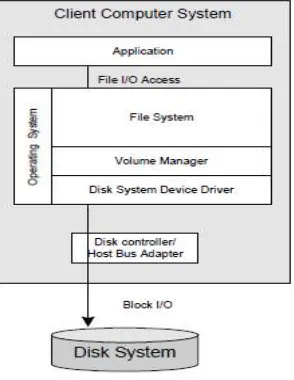
The product layers of a Direct Attached Storage framework is delineated in Fig-2. Specifically appended capacity circle framework is overseen by the customer working framework [3].
Fig -2:Capacity framework
Network Attached Storage (NAS):
square and report level access is of minute hugeness can be viably terminated as use purposes of intrigue.System record frameworks, all things considered, dwell on circle squares. [3].
Fig -3:Network Attached Storage
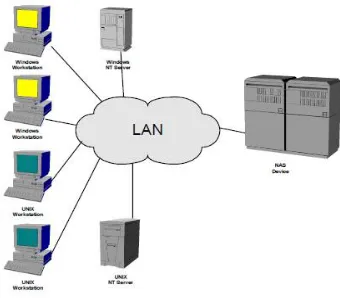
The common architecture of NAS amassing are delineated in Fig-4. Reliably, a NAS storing structure integratesthere two types of devices: NAS devices, and the client PC systems. There aredifferent events for each sort in NAS mastermind. User Application gets to virtual amassing resource without datalocationadvantage [3].
Fig -4:NAS storing structure
Storage Area Network (SAN):
Fig -5:Storage Area Network
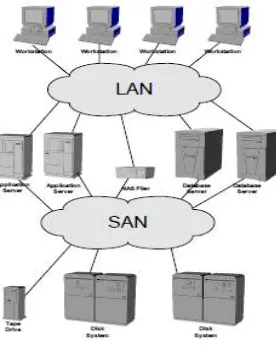
SAN programming building required PC structures, showed up in Fig 6, item plan is same as DAS system. Using Fiber Channelthe block I/O SCSI mapped at FC-4 layers on fiber channel schemes. FC-1 and FC-2 layer are gives the physical transport and hailing of the edges by methods for HBA equipment and driver. At the block level the storage resources are given as per the discussion, in SAN condition and also in DAS the channel data can work as application[3].
CHALLENGES:
We can see diverse cloud storage architecture; however these structures are normally inconsistent and complex. We centre on the test of execution and versatility in our engineering of cloud storage [1].
1 .High Performance
Cloud storage performance is an imperative metric inside this innovation and in each layer of the distributed storage being seen as the innovation of nowadays and furthermore what's to come. In the client application layer, applications facilitating stage layer, stockpiling administration layer, and capacity asset layer. [6] [1]Cloud storage performance can be improved by utilizing numerous innovations of capacity; for instance circle to-plate, preview and information deduplication to expand execution as far as capacity limit, dependability, versatility, and accessibility. There are numerous examinations between various distributed storage administrations, yet a large portion of them identified with capacity and cost [7]. However, our view the adaptability, execution, and cost are getting to be real issues in distributed storage and which decides distributed storage engineering administrations limit while getting to, recovering and sparing information :
The Coverage
Network Bandwidth
The separation between Cloud Providers and Cloud Customers
Transfer Speeds
2. Scalability
III. CONCLUSIONS
Cloud storage benefit gives high versatility, financially savvy execution and information administrations for various applications. Yet in addition in general dependence on the web makes a few difficulties in taking full preferred standpoint of its administrations, for example, stockpiling, and reinforcement on the web, and furthermore in enhanced execution and versatility, particularly those in creating nations. The target of this work is to learning the difficulties of distributed storage in view of two factors the cloud's execution and the versatility. In this paper, it has been talked about and comprehends the adaptability and execution in the cloud storage, which has demonstrated that there is a critical requirement for maintaining a strategic distance from some test. In this paper, it has been examined the flexibility and implementation in the cloud storage that has demonstrated that there is a pressing requirement for evading some test.
IV. ACKNOWLEDGEMENT
To prepare proposed methodology paper on “Review on Challenges in Various Storage Architectures in Cloud Computing" has been prepared by Mrs. Amruta Magdum Author would like to thank my faculty as well as my whole department, parents, friends for their support. Author has obtained a lot of knowledge during the preparation of this document.
REFERENCES
[1]HATEM Taha*, ALI. Manea, El KADIRI. Kamal Eddine. “A STUDY to CHALLENGES of CLOUD STORAGE ARCHITECTURE: PERFORMANCE and SCALABILITY” International Journal of Scientific & Engineering Research, Volume 7, Issue 11, November-2016.
[2] Gurudatt Kulkarni1 , Rani Waghmare2 , Rajnikant Palwe3, Vidya Waykule4, Hemant Bankar5 , Kundlik Koli6, “Cloud Storage Architecture” 2012 7th International Conference on Telecommunication Systems, Services, and Applications (TSSA) 978-1-4673-4550-7/12/$31.00 ©2012 IEEE. [3] Heng Liao. “Storage Area Network Architectures” Issue 1: April, 2003 PMC-2022178 © 2003 PMC-Sierra, Inc.
[4] Storage Networking Industry Association. Cloud Storage for Cloud Computing, Jun.2009.
[5]Curino, Jones, Popa, Malviya, Wu, Balakrishnan and Zeldovich, Relational Cloud: A Database-as-a-Service for the Cloud, 2010 [6] « Performance advantages of the new Google Cloud Storage Connector for Hadoop », Google Cloud Platform Blog.
[7] « Cisco Global Cloud Index: Forecast and Methodology, 2014–2019 White Paper », Cisco. [En
ligne].Disponiblesur:http://cisco.com/c/en/us/solutions/collateral/serviceprovider/global-cloud-index-gci/Cloud_Index_White_Paper.html. [Consulté le: 15-janv-2016].
[8] « Cloud object storage makes scalability a reality: An expert podcast », SearchCloudtorage. [En ligne]. Disponiblesur:http://searchcloudstorage.techtarget.com/podcast/Cloud-objectstorage-makes-scalability-a-reality-An-expert-podcast. [Consulté le: 16-oct-2016].
[9] « From infrastructure delivery to service management in clouds ». [En ligne]. Disponiblesur:
http://www.sciencedirect.com/science/article/pii/S0167739X100 00294. [Consulté le: 15-oct-2016].
[10] Akash U. Suryawanshi, P. D. N. K. (2018). Review on Methods of Privacy-Preserving auditing for storing data security in cloud. International Journal of Advanced Research in Computer and Communication Engineering (IJARCCE), ISSN, 7(4), 247–251.
[11] Desai, P., & Jayakumar, N. (n.d.). AN EXTENSIBLE FRAMEWORK USING MOBILITYRPC FOR POSSIBLE DEPLOYMENT OF ACTIVE STORAGE ON TRADITIONAL STORAGE ARCHITECTURE.
[12] DivyanshShrivastavaAmol K. Kadam, AarushiChhibber, NaveenkumarJayakumar, S. K. (2017). Online Student Feedback Analysis System with Sentiment Analysis. International Journal of Innovative Research in Science, Engineering and Technology, 6(5), 8445–8451.
[13] Jayakumar, D. T., &Naveenkumar, R. (2012). SDjoshi,“. International Journal of Advanced Research in Computer Science and Software Engineering,” Int. J, 2(9), 62–70.
[14] Jayakumar, M. N., Zaeimfar, M. F., Joshi, M. M., & Joshi, S. D. (2014). INTERNATIONAL JOURNAL OF COMPUTER ENGINEERING & TECHNOLOGY (IJCET). Journal Impact Factor, 5(1), 46–51.
[15] Jayakumar, N. (2014). Reducts and Discretization Concepts, tools for Predicting Student’s Performance. Int. J. Eng. Sci. Innov. Technol, 3(2), 7–15.
[16] Jayakumar, N. (2015). Active storage framework leveraging processing capabilities of embedded storage array.
[17] Jayakumar, N., Bhardwaj, T., Pant, K., Joshi, S. D., &Patil, S. H. (2015). A Holistic Approach for Performance Analysis of Embedded Storage Array. Int. J. Sci. Technol. Eng, 1(12), 247–250.
[18] Jayakumar, N., Iyer, M. S., Joshi, S. D., &Patil, S. H. (2016). A Mathematical Model in Support of Efficient offloading for Active Storage Architectures. In International Conference on Electronics, Electrical Engineering, Computer Science (EEECS) : Innovation and Convergence (Vol. 2, p. 103).
[19] Jayakumar, N., & Kulkarni, A. M. (2017). A Simple Measuring Model for Evaluating the Performance of Small Block Size Accesses in Lustre File System. Engineering, Technology & Applied Science Research, 7(6), 2313–2318.
[21] Kumar, N., Angral, S., & Sharma, R. (2014). Integrating Intrusion Detection System with Network Monitoring. International Journal of Scientific and Research Publications, 4, 1–4.
[22] Namdeo, J., & Jayakumar, N. (2014). Predicting Students Performance Using Data Mining Technique with Rough Set Theory Concepts.International Journal, 2(2).
[23] Naveenkumar, J. (2011). Keyword Extraction through Applying Rules of Association and Threshold Values. International Journal of Advanced Research in Computer and Communication Engineering (IJARCCE), ISSN, 1021–2278.
[24] Naveenkumar, J. (2015). SDJ, 2015. Evaluation of Active Storage System Realized Through Hadoop. International Journal of Computer Science and Mobile Computing, 4(12), 67–73.
[25] Naveenkumar, J., & Joshi, S. D. (2015). Evaluation of Active Storage System Realized Through Hadoop. Int. J. Comput. Sci. Mob. Comput, 4(12), 67–73.
[26] Naveenkumar, J., Makwana, R., Joshi, S. D., &Thakore, D. M. (2015b). Performance Impact Analysis of Application Implemented on Active Storage Framework. International Journal of Advanced Research in Computer Science and Software Engineering, 5(2), 550–554. Naveenkumar, J., & Raval, K. S. (2011). Clouds Explained Using Use-Case Scenarios. INDIACom-2011 Computing for Nation Development, 3.
[27] Naveenkumar J, P. D. S. D. J. (2015). Evaluation of Active Storage System Realized through MobilityRPC. International Journal of Innovative Research in Computer and Communication Engineering, 3(11), 11329–11335.
[28] Osho Tripathi Dr. Naveen Kumar Jayakumar, P. G. (2017). GARDUINO- The Garden Arduino. International Journal of Computer Science andTeChnology, 8(2), 145–147.
[29] Prashant Desai, N. J. (2018). AN EXTENSIBLE FRAMEWORK USING MOBILITYRPC FOR POSSIBLE DEPLOYMENT OF ACTIVE STORAGE ON TRADITIONAL STORAGE ARCHITECTURE. IIOAB Journal, 9(3), 25–30.
[30] R. Salunkhe N. Jayakumar, and S. Joshi, A. D. K. (2015). “Luster A Scalable Architecture File System: A Research Implementation on Active Storage Array Framework with Luster file System. In ICEEOT.
[31] Rishikesh Salunkhe, N. J. (2016). Query Bound Application Offloading: Approach Towards Increase Performance of Big Data Computing. Journal of Emerging Technologies and Innovative Research, 3(6), 188–191.
[32] Salunkhe, R., Kadam, A. D., Jayakumar, N., &Thakore, D. (2016). In search of a scalable file system state-of-the-art file systems review and map view of new Scalable File system. In Electrical, Electronics, and Optimization Techniques (ICEEOT), International Conference on (pp. 364– 371). IEEE.