Performance during Dual-Task Paradigms. (Under the direction of Dr. Jason Mihalik and Dr. Lianne Cartee).
by
Maria Katherine Talarico
A thesis submitted to the Graduate Faculty of North Carolina State University
in partial fulfillment of the requirements for the degree of
Master of Science
Biomedical Engineering
Raleigh, North Carolina 2015
APPROVED BY:
_______________________________ _______________________________
Jason P. Mihalik Lianne A. Cartee
Co-Chair of Advisory Committee Co-Chair of Advisory Committee
_______________________________ _______________________________
BIOGRAPHY
ACKNOWLEDGMENTS
TABLE OF CONTENTS
LIST OF TABLES ... viii
LIST OF FIGURES ... ix
CHAPTER I - INTRODUCTION ... 1
1.1. Rationale... 1
1.2. Introduction ... 1
1.3. Research Questions and Hypotheses ... 3
1.4. Clinical Significance ... 4
CHAPTER II – REVIEW OF THE LITERATURE... 6
2.1. Introduction ... 6
2.2. Postural Control System and Assessments ... 6
2.2.1. Static Postural Control Assessments ... 8
2.2.2. Dynamic Postural Control Assessments ... 11
2.3. Single Leg Squats ... 12
2.4. Dual-Task Paradigm ... 14
2.4.1. Dual-Task Deficits of Healthy Individuals ... 15
2.5. Deficits and Assessments Following Concussion ... 16
2.5.1. Symptomology... 17
2.5.2. Neurocognition ... 18
2.5.3. Static Postural Control Post-Concussion ... 19
2.5.4. Dynamic Postural Control Post-Concussion ... 21
2.5.5. Dual-Task Paradigm Testing Post-Concussion ... 23
2.6. Rationale for Study... 24
CHAPTER III - METHODOLOGY ... 26
3.1. Participants ... 26
3.2. Instrumentation... 26
3.2.1. Force Plate ... 26
3.2.2. Electromagnetic Tracking Sensor ... 26
3.3. Procedure ... 27
3.3.1. Cognitive Assessments ... 28
3.3.2. Postural Control Assessments ... 29
3.3.3. Single-Task Paradigm... 31
3.3.4. Dual-Task Paradigms ... 31
3.4. Data Reduction ... 31
3.5. Statistical Analyses ... 33
4.1. Introduction ... 35
4.2. Methods ... 37
4.2.1. Participants ... 37
4.2.2. Instrumentation ... 38
4.2.2.1. Force Plate ... 38
4.2.2.2. Electromagnetic Tracking Sensor ... 38
4.3. Procedure ... 38
4.3.1. Cognitive Assessments ... 40
4.3.2. Postural Control Assessments ... 41
4.3.3. Single-Task Paradigm... 42
4.3.4. Dual-Task Paradigm ... 42
4.4. Data Reduction ... 43
4.5. Statistical Analyses ... 44
4.6. Results ... 45
4.6.1. Total Center of Pressure Speed ... 45
4.6.2. A/P Center of Pressure Speed ... 45
4.6.3. M/L Center of Pressure Speed ... 46
4.6.4. Sway Area... 46
4.6.5. A/P Center of Pressure Range ... 46
4.6.6. M/L Center of Pressure Range ... 47
4.6.7. Sacrum Vertical Displacement Range ... 47
4.6.8. Sacrum Vertical Speed ... 47
4.7. Discussion ... 48
4.7.1. Postural Control Assessment Differences ... 49
4.7.2. Static Postural Control Performance ... 50
4.7.3. Dynamic Postural Control Performance ... 51
4.7.4. Dual-Task Difficulty... 53
4.7.5. Limitations ... 54
4.7.6. Future Work ... 56
4.8. Conclusion ... 56
LIST OF TABLES
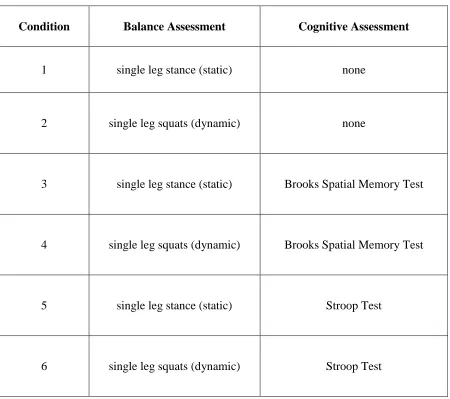
Table 1: Six test conditions completed by all participants to test postural control performance. Balance and cognitive assessments for each condition were performed
concurrently during testing. ... 62 Table 2: Definitions and formulae of postural control outcome variables. ... 63 Table 3: Definition and formulae of kinetic outcome variables. ... 64 Table 4: Mean values ± standard deviations of postural control variables for all conditions. ANOVA statistical significance indicated by: a, interaction effect (p<0.05); b, effect for balance condition (p<0.05); c, main effect for cognitive condition (p<0.05). Post hoc pairwise statistical significance indicated by: d, different from single-task (p<0.00714); e, different from dual-task with Brooks (p<0.00714); f, different from both single-task and dual-task with Brooks (p<0.00714). ... 65 Table 5: Mean values ± standard deviations of kinematic variables for dynamic postural control conditions. Post hoc pairwise statistical significance indicated by: *, different from single-task (p<0.017); ‡, different from both single-task and dual-task with Brooks
LIST OF FIGURES
CHAPTER I - INTRODUCTION 1.1. Rationale
Single leg postural control testing plays a crucial role in the evaluation of athletic performance1 and the assessment of sports-related injuries such as ankle sprains,2-7 anterior cruciate ligament deficiency,8-10 and concussions.11-14 The current approach for balance screening requires athletes to perform a battery of single leg stance balance assessments exclusively.5,15-19 This approach has been proven successful in identifying abnormal balance or balance deficiencies following injury.2-14 But, it is possible these single-task, single leg stance balance assessments may not reflect postural control during everyday activity and therefore limited in analyzing performance of the postural control system. Therefore this study examined postural control of healthy individuals while performing static and dynamic balance assessments in single- and dual-task paradigms.
1.2. Introduction
Assessing postural control has been implemented in the sports medicine field to quantify a key aspect of neuromuscular control in athletes, identify athletes at higher risk for injury, improve prevention strategies, and track rehabilitation progress from injury.20 Maintaining postural control during athletic activities requires a complex interaction of sensory input and motor output21,22 which should be reflected in dual-task assessments through the use of dynamic balance and cognitive tests.
Dynamic balance is the ability to complete a balance assessment that requires performing some movement or task.2 Dynamic balance may better represent athletic activity than static balance due to the constant demand for movement during competition.48 Static balance requires an individual to respond to perturbations while maintaining stability whereas
dynamic balance requires an individual to maintain balance while simultaneously executing a functional task; therefore, further research should examine the effects of dynamic balance following injury.
One such dynamic postural control assessment could include the single leg squat. The single leg squat is traditionally used to clinically test hip muscle function during dynamic activity, where those with good hip strength and activation tend to perform the single leg squat very well with minimal loss of balance.49 The single leg squat assesses postural control of a functionally applicable movement used in dynamic activities.50 Due to the high proprioceptive demand of the single leg squat on the body,51 this dynamic
assessment may prove effective in assessing postural and neuromuscular control and could help clinicians better and more accurately determine return-to-play status of athletes following injury.
sensory, and motor systems of an athlete following injury in order to fully assess recovery.22 Balance assessment under dual-task conditions should be further studied in order to better understand and detect underlying balance and cognitive deficits in dynamic situations.
A dynamic postural control assessment such as the single leg squat, which mimics athletic movement performed concurrently with a cognitive assessment may prove an effective dual-task paradigm for post-injury assessment of athletes. Therefore, preliminary analysis on healthy individuals should be examined to develop a better understanding of dynamic postural control. Thus the purpose of this study was to 1) examine differences between static and dynamic postural control during a single-task paradigm, 2) examine differences between single- and dual-task paradigms during static and dynamic postural control assessments, and 3) examine differences between two dual-task paradigms during static and dynamic postural control assessments.
1.3. Research Questions and Hypotheses
Research Question 1: What are the differences between static and dynamic postural control performance during a single-task paradigm for healthy participants?
Hypothesis 1: Participants will display better postural stability (slower total center of
pressure, anterior-posterior, and medial-lateral speed, smaller sway area, and
smaller anterior-posterior and medial-lateral range) while performing single leg
stance compared to single leg squat during single-task.
Hypothesis 2A: Participants will display better postural stability (slower total center
of pressure, anterior-posterior, and medial-lateral speed, smaller sway area, and
smaller anterior-posterior and medial-lateral range) while performing single leg
stance during single-task compared to single leg stance during dual-task with the
Stroop test and dual-task with the Brooks Spatial Memory Test.
Hypothesis 2B: Participants will display better postural stability (slower total center
of pressure, anterior-posterior, and medial-lateral speed, smaller sway area, and
smaller anterior-posterior and medial-lateral range) while performing single leg
squats during single-task compared to single leg squats during dual-task with the
Stroop test and dual-task with the Brooks Spatial Memory Test.
Research Question 3: What are the differences between two dual-task paradigms during static and dynamic postural control performance for healthy participants?
Hypothesis 3: Participants will display better postural stability (slower total center
of pressure, anterior-posterior, and medial-lateral speed, smaller sway area, and
smaller anterior-posterior and medial-lateral range) while performing both single leg
stance and single leg squats during task with the Stroop test compared to
dual-task with the Brooks Spatial Memory Test.
1.4. Clinical Significance
Postural control variation between static and dynamic single leg balance assessments in single- and dual-task conditions for healthy participants may provide a more
CHAPTER II – REVIEW OF THE LITERATURE 2.1. Introduction
The need for both static and dynamic postural control is readily apparent in the sport setting due to the constant requirement of athletes to maintain balance during competitive activity for optimal performance.48 Assessing postural control has been implemented in the sports medicine field to quantify a key aspect of neuromuscular control in athletes, identify athletes at higher risk for injury, improve prevention strategies, and track rehabilitation progress from injury.20 Although several static assessments have been implemented to evaluate postural control, it is questionable if they effectively assess and challenge the postural control limits of healthy individuals and athletes. Implementing dynamic balance assessments in a dual-task paradigm with a cognitive assessment may better reflect the everyday environment of healthy individuals and competitive environment in which athletes perform to better assess postural control performance.
2.2. Postural Control System and Assessments
Postural control, often identified as balance, is the attempt to counteract unstable equilibrium53 or the ability of the body to maintain the center of gravity within the limits of stability as determined by the base of support54 or the dynamics of body posture to prevent falling.55 Postural control is an essential component to assess the effectiveness of
interventions for improving balance.56
which then generates an appropriate contraction to maintain postural control.58-65 All three sensory systems are vital in maintaining postural control through the integration of
information, but information may not be easily integrated following an injury, especially a sports-related concussion, which could affect postural stability.
The visual system is the primary sensory system used in maintaining postural control.66-68 Visual stimulation of the peripheral visual field decreases postural sway in the direction of the observed visual stimulus to the anterior-posterior direction rather than the medial-lateral direction.69 Individuals use peripheral vision for visual stabilization of spontaneous or visually induced body sway to control posture.70 Reliance on vision is dominant among populations younger than 40 years old.71
Information from the vestibular system is used in a multitude of ways in order to maintain postural control. Vestibular information helps control eye muscles so that when the head changes position, the eyes can stay fixed to one point.58 This information is also used to maintain upright posture through the semicircular canal system and the otoliths, which
indicate rotational and linear movements, respectively.58 The vestibular system is primarily involved in stabilizing slow body sway.63,72-74 The automatic control mechanism, provided by vestibular information, stabilizes the direction of gaze and controls equilibrium when sudden perturbations are induced and sudden body movement or change in head position occurs causing postural instability.58
determines the relative positions and rates of movement of parts of the body.75,76 Muscle spindles and Golgi tendon sensory receptors provide the nervous system with continuous feedback about the status of each muscle.58 Mechanoreceptors send information to the spinal cord regarding changes in the muscle’s length and velocity of contraction, which is then
transferred to motor neurons that carry information back to the muscle fibers and muscle spindle to contract the muscle to prevent or control postural sway.74 Information about the muscle’s change in length and velocity of contraction contributes to an individual’s ability to
recognize joint movement and sense position of limbs.77
2.2.1. Static Postural Control Assessments
Static postural control is the attempt to maintain a position with minimal movement78 or balance on a surface without intentionally moving.2 Static postural control assessments often used to identify postural control instability following injury are the Sensory
Organization Test (SOT) on the NeuroCom International Smart Balance Master System (NeuroCom International, Inc., Clackamas, OR), the Balance Error Scoring System (BESS),79 and the Clinical Test of Sensory Interaction and Balance (CTSIB).64,80
referenced) and two surface conditions (fixed and sway referenced). Postural sway and center of pressure date are used to quantify an equilibrium score, which can be objectively used to determine postural control performance. An equilibrium score is calculated by comparing the angular difference between maximum anterior-posterior center of gravity displacement and the theoretical maximum displacement of 12.5 degrees, which is the anterior-posterior sway an average adult can perform without loss of balance. A score of 100% indicates no motion and a score of 0% indicates a fall. The composite score is the equilibrium mean score for all trials across the six conditions.
Along with the composite score, sensory analysis ratios are also calculated. The somatosensory, visual, and vestibular ratios determine the ability of an individual to use the respective system’s information to maintain postural control. Sensory ratios close to a value
of one reflect greater ability of an individual to rely on that particular sensory system to maintain postural control under conditions in which the vestibular (condition five), visual (condition four), and somatosensory (condition two) systems are required to compensate for altered signals from other systems.86
three and six have sway-reference vision parameters and fixed support and sway-reference support respectively. If an individual is overly reliant on vision to maintain postural control, then conditions three and six may prove the most challenging because the visual input for both conditions is sway-referenced. Individuals with vestibular system deficits show problems in maintaining balance during conditions five and six where visual and somatosensory inputs are altered and reliance on vestibular information in required. Individuals can use visual or somatosensory information to compensate for vestibular feedback deficiency in order to maintain postural control.87 Those who rely on the
somatosensory system the most to maintain postural control may have the most trouble with conditions four, five, and six because the base of support is sway-referenced. Condition four contains parameters of normal vision and sway-reference support.
A clinical balance test also used to evaluate postural control before and after injury is the BESS,79 which consists of three stance positions, double-leg stance, single-leg stance, and tandem stance, performed on two surfaces, a firm and a foam surface. Errors are recorded by the clinician during a 20-second trial for each of the six conditions. A few of the errors include lifting hands off hips, stepping, falling out of position, or lifting heel. Described as a rapid, easy-to-administer, and inexpensive clinical postural control test, the BESS has been widely accepted by clinicians as a reliable postural control assessment tool due to its high validity in identifying postural control deficits in concussed populations.28,31,88-90
somatosensory systems allows individuals to maintain postural control.64,80 Six 30-second trials are completed under three visual conditions (eyes open, eyes closed, visual conflict dome) and two support-surface conditions (firm and foam). The time that an individual is able to maintain the starting position for each trial is recorded to quantify postural control stability and identify any reliance on one or more of the three senses for postural control.
2.2.2. Dynamic Postural Control Assessments
Contrary to static postural control, dynamic postural control is the ability to maintain a stable base of support while completing a prescribed movement91 or complete a postural control assessment that requires performing some movement or task.2 The fundamental goals of static and dynamic postural control are one and the same: to maintain balance. The difference between static and dynamic postural control remains in how this goal is
accomplished. Static postural control aims to maintain postural control during quiet standing or in response to a sensory perturbation whereas dynamic postural control aims to maintain postural control while performing a functional movement.
more conservative gait strategies34,35,39,40,103-105 and postural control deficits of individuals following concussion.21,34,103,104
The YBT assesses dynamic postural control performance of single leg stance while simultaneously reaching the non-stance limb in three of the six directions used in the SEBT: anterior, posteromedial, and posterolateral.17,93,94 Due to redundancy found in the SEBT, the YBT was developed to improve reliability and standardize performance of a modified
SEBT.94 Deficits in single leg stance excursions, or YBT reach distances, have been found in those with a history of lower extremity injury, including ankle sprains, chronic ankle
instability, and anterior knee pain.106-109 A recent study found that athletes with an anterior asymmetry (absolute difference between legs in anterior reach performance) greater or equal to four centimeters have significantly greater odds of injury compared with those with less than four centimeters anterior asymmetry, suggesting that an imbalance with anterior reach during single leg stance identifies elevated risk for injury of athletes across multiple sports may be a useful measurement to identify risk of future injury.110
It is becoming more evident that maintenance of postural control during locomotion or sport activities requires a complex interaction of sensory input and motor output21,22 which should be reflected in post-injury dynamic postural control assessments.
2.3. Single Leg Squats
lower extremity injury, similar unilateral leg assessments should be considered for examining dynamic balance following injury. The use of a biomechanically comparable movement to the anterior reach of the YBT, such as the single leg squat, may prove equally challenging to an athlete’s dynamic postural control and thus an effective measurement of dynamic postural
control performance following injury.
The single leg squat is traditionally used to clinically assess dynamic postural
control50,112 and test hip muscle function during dynamic activity, where those with good hip strength and activation tend to perform the single leg squat very well with minimal decrease of postural control.49 Clinicians apply the single leg squat as a tool to help identify faulty lower extremity biomechanics,113 which ultimately could increase musculoskeletal injury risk. Similar to the single leg stance, which is applied in static postural control assessment, the single leg squat challenges postural control ability due to a reduced base of stability.50 But, unlike static single leg stance, the single leg squat assesses postural control of a functionally applicable movement used in dynamic activities.50 Individuals with hip chondropathy demonstrate reduced postural control performance compared to healthy
controls while completing the single leg squat as measured by greater coronal plane sway.114 This indicates the effective, clinical use of the single leg squat in evaluating dynamic postural control of injured individuals.
control assessments, such as the single leg squat, have not been traditionally introduced in assessing balance performance of concussed individuals, many clinicians practice and are familiar with using the single leg squat as a lower extremity injury tool. Therefore, single leg squat could be readily transitioned into effect as a dynamic postural control post-injury assessment tool and assist with return-to-play evaluation.
2.4. Dual-Task Paradigm
Single-task paradigms effectively measure either cognitive function or postural control, but these paradigms may be limited as they only evaluate domains in isolation and not the interaction of these domains across concurrent assessments.117 Therefore, a dual-task paradigm may be more suitable in assessing cognitive and postural control deficits since performance in sport requires simultaneous processing of information across multiple
cognitive domains.22 Furthermore, it has been shown that sports-related head injuries reduce attentional resources and consequentially affects the ability to perform simultaneous
assessments and results in decreased ability to successfully perform in dual-task paradigms.32 A dual-task paradigm requires a person to perform two different assessments concurrently and is thought to address cognitive, postural control, and or visual deficits following sports injuries.118-121 Executing multiple assessments simultaneously in dual-task can be
accomplished if there is adequate processing capacity, but if capacity is exceeded by the undertaking of concurrent assessments, performance in one or all assessments is
assessments, thus as dual-task demands increase in difficulty postural control performance suffers and simultaneously decreases.115,116,124
Dual-task paradigms using dynamic postural control in conjunction with a cognitive assessment have been proposed as a method for assessing deficits following injury rather than the traditional use of single-task paradigms.39,40,125 Dynamic postural control methods currently used in post-concussion dual-task paradigms include gait stability with
neurocognitive tests.21,33-44 Because performance in sport requires simultaneous processing of cognitive, sensory, and motor information,22 it is suggested that dual-task paradigms provide a better representation of sport, where cognitive function and postural control must be simultaneously processed and attention must be divided, compared to single-task
paradigms.21,22,42,44,117,126
2.4.1. Dual-Task Deficits of Healthy Individuals
Under static dual-task conditions, studies have reported contradictory results with some individuals exhibiting increased coronal plane sway30 while others exhibit decreased coronal plane sway.59 These discrepancies may be due to different postural control
methodologies where the former uses a modified SOT and the latter uses a tandem stance similar to that used in the BESS. Healthy individuals also have slower sway velocity in dual-task than in single-dual-task.30
single-task, such as shorter stride length,21,34 longer stride time,21,34,40 and slower gait speed.21,34,39,40,44
Along with spatial-temporal gait deficiencies, healthy individuals also experience dynamic instability under dual-task settings. Decreased sagittal plane sway21,34,39,40 is consistently reported for healthy individuals in dynamic dual-task, but some inconsistencies exist in the results regarding sagittal and coronal plane sway velocities. Some studies report that in dual-task, non-injured individuals display slower sagittal plane sway velocity21,34,39 while one study reports them to demonstrate faster sagittal plane sway velocity compared to single-task.41 In similar form, a few studies report healthy individuals having faster coronal plane sway velocity34,44 whereas one study reports contradictory findings in that healthy individuals display slower coronal plane sway velocity.21 Differences in these results are likely due to inconsistent methodology carried out between the studies. In regards to neurocognitive performance, non-injured individuals have slower reaction times under dual-task conditions compared to single-dual-task conditions.22,117
2.5. Deficits and Assessments Following Concussion
Concussion, often causing impairment in balance and cognitive performance, is a complex pathophysiological process affecting the brain and induced by traumatic
annual concussion incidence rate increase of 7% over 16 years for all sports.130 It was originally anticipated that this study examine changes in postural control of athletes following a sports-related concussion. Due to limited subject availability and time constraints, adjustments were made and the study currently is examining the effects of dynamic postural control assessments in dual-task paradigms in healthy, active participants. Initial findings from this study are anticipated to encourage future studies to examine
dynamic postural control assessments for both healthy and post-injury athletes to improve return-to-play conclusions.
Sports-related concussion is commonly assessed using a battery of tests that evaluate neurocognitive function, postural control, and self-reported symptoms.90 Each assessment measure adds additional information on the status of concussed athletes by independently evaluating differing aspects of cerebral function.90 Evaluating information from each assessment may be used to help in the return-to-play decision by examining the progression of recovery from lingering symptoms, postural control deficiencies, and neurocognitive deficits.
2.5.1. Symptomology
administered quickly by a clinician following concussion. The Sideline Concussion
Assessment Tool 3rd Edition (SCAT3),145 the Post-Concussion Scale,146 and the Concussion Symptom Inventory (CSI),147 are just a few tools used to evaluate symptoms immediately post-concussion and throughout the recovery stage. The majority of symptoms experienced by athletes recede over 7 to 10 days following concussion.18,21-25 It has been reported, though, that some athletes may have a brief period of symptoms immediately after
concussion followed by a short disappearance, only to have the symptoms return anywhere from several hours to a few days later.127,148,149
2.5.2. Neurocognition
Athletes may also experience neurocognitive impairment following concussion which could include deficiencies in attention, memory, concentration, and information
processing.25,150-160 Neurocognitive assessments evaluate brain function by quantifying multiple cognitive domains such as memory, attention, information processing, planning, and reaction time90 which can help identify underlying deficiencies following concussion.23-30,32 It has been suggested that neurocognitive evaluations provide the greatest amount of
information post-concussion and thus are often used by clinicians as the primary source of information in determining return-to-play status.161-163 While the use of neurocognitive evaluation has recently been advocated as the “cornerstone” of proper concussion
Assessment Metrics (ANAM, (US Army Medical Research and Material Command; Fort Detrick, MD),165 or the Immediate Postconcussion and Cognitive Test (ImPACT, ImPACT Applications, Pittsburgh, PA) following concussion.
Concussed athletes score poorly on neurocognitive tests when compared with their own pre-concussion baseline scores, normative data, and with uninjured matched control athletes.151,155,157,166-169 Some variation is evident in reports as to when neurocognitive deficits subside following concussion, but the majority of those injured return to normal cognitive performance within 7 to 10 days.89,170-172 High school athletes have been found to demonstrate significant memory impairment one to two weeks171,173 and reaction time impairments up to two to three weeks following concussion.171,174 For college athletes, neurocognitive impairment in auditory attention and visuomotor processing speed is found to be resolved within five days of concussion.157
2.5.3. Static Postural Control Post-Concussion
increased compared to pre-concussion measures, indicating postural control deficiencies as a result of brain injury.19,28,31
Following concussion, individuals demonstrate decreased postural stability, indicated by the SOT composite score, on day one post-concussion in comparison with their baseline performance as well as in relation to healthy individuals’ postural stability day three post-concussion.28,31 It has also been reported that the composite SOT score is significantly less for up to 10 days following a concussion compared to that of healthy individuals.84 After further evaluation, researchers determine that the vestibular system is the most disrupted following concussion with deficits lasting three to five days post-concussion.28,84
Injured individuals have been found to have decreased postural stability on day one post-concussion in comparison with baseline and day three post-concussion scores as well as the healthy individuals’ post-concussion day one, three, and five BESS scores.28 Concussed
individuals also have higher BESS error scores in comparison with healthy individuals on day one post-concussion on firm surface and on days one and three post-concussion on foam surface.31
Similar to symptoms and neurocognitive function, overall postural stability usually recovers within 7 to 10 days following concussion,89,170-172 but may reports indicate that, specifically, postural sway returns to baseline around three days post-concussion.19,28,31,79 As measured by the SOT, concussed athletes return to normal postural control within three to five days following concussion.28,31,82-84 Participants with a mild traumatic brain injury demonstrate impaired postural stability during quiet standing or during standing with altered sensory inputs for one to three days following concussion.19
2.5.4. Dynamic Postural Control Post-Concussion
Many studies that have examined postural control deficiencies post-concussion have exclusively assessed static postural control, which has drawn most of the attention from the scientific community.19,23-32 The investigation of dynamic postural control deficiencies has only recently made its mark in sports-related concussion literature through the examination of gait stability.21,33-44 The general consensus among these researchers is that following concussion, individuals display increased caution during gait as demonstrated by slower gait speed34,35,39,40,103,104 and shorter stride length.34,103-105 Previously concussed individuals also adopted more conservative gait strategies by reducing the time spent in less stable positions, such as single-leg stance.35 Postural sway during gait is also affected by concussion.
individuals with concussion may maintain postural control throughout gait progression by reducing center of mass forward momentum, as indicated through smaller sagittal plane movement, in order to compensate for increased coronal plane movement.21,34,36,39,40,125,191,192
Through the use of gait, some studies have found that dynamic postural instability is maintained for up to 28 days following concussion,21,34 which is more than two weeks longer than static postural control and neurocognitive deficits persist. Previous research on
concussed athletes has shown though that complex motor functions require a longer recovery period than cognitive assessments,21,34,193 which may explain the prolonged gait stability deficits compared to neurocognitive deficits Other studies have found that gait parameters return to that of healthy normal controls within the first six to seven days following
concussion.21,33,34,36,39-41,125,194,195 One longitudinal study found that individuals reporting a history of concussion over six years prior to participation continued to show significant differences in gait patterns compared to healthy controls.35
2.5.5. Dual-Task Paradigm Testing Post-Concussion
Similar to healthy individuals, those with concussion show similar gait, dynamic postural control, and neurocognitive performance deficits in dual-task conditions. It is widely reported that concussion adversely affects dual-task performance as demonstrated by instability and decreased motor function.39,40,44,196-202 Immediately following concussion, individuals display a more distinct inability to appropriately control posture during dual-task revealed through greater sway and sway velocity compared to healthy individuals. 21,33,34,36,39-42,125,195 In general, following concussion, individuals walk slower in dual-task than in
single-task21,34,36,39,40,44 when compared with healthy individuals.34,39,40 One potential reason for this slower gait speed exhibited by concussed individuals during dual-task conditions is that concussed individuals demonstrate shorter stride length compared to healthy
individuals34 and compared to single-task performance.21,34 Concussed individuals also exhibit shorter stride length in dual-task when compared to that of healthy individuals.21,34,40 A gait conservation method adopted by concussed individuals in dual-task is spending more time in double-support stance and shorter time in single-leg stance throughout the
progression of gait.35
sagittal plane sway21,34,39,40,125 and sway velocity.21,34,39,44,125 Concussed individuals also have slower reaction times during gait in dual-task conditions where a more cautious gait strategy is utilized.21,34,39-41 There is some inconsistency in the reporting of how long dual-task deficits linger, but many studies report the deficits last up to one month following concussion.33,34,36,41,125,194 Some studies even report that individuals about six years post-concussion still are found to have divided attention deficits.35,42,203 Initial findings of dual-task effects persisting almost three times as long as single-dual-task effects suggests the necessity of implementing dual-task paradigms in post-concussion assessment to better determine return-to-play status.
2.6. Rationale for Study
Assessing cognitive and motor performance following injury is critical in determining responsible return-to-play status. Static postural control assessments in single-task
Exploring the effects of dynamic balance assessments in dual-task paradigms is critical in the athletic post-injury population, but preliminary examination should be completed with an active, healthy population. Comprehensive information obtained from healthy participants could be used to create a platform for further pre- and post-injury testing in the athletic setting.
If changes in postural control can be identified between a dynamic balance test, single leg squat, and a static balance test, single leg stance, within a healthy population, then
CHAPTER III - METHODOLOGY 3.1. Participants
The cross-sectional study design included 30 healthy college students (female = 22, male = 8; age = 20.83±1.64 years, height = 157.88±13.04 cm, mass = 67.79±20.64 kg) who volunteered to participate in this study. All participants had 1) no previous history of a concussion within the past two years, 2) full medical clearance for physical activity, 3) no history of surgical procedure to the lower extremities or low back, 4) no injury to the lower extremities or low back within the past six months that resulted in an inability to participate in physical activity for three consecutive days, 5) no color blindness, and 6) no known vestibular or balance disorders. Participants signed an informed consent approved by the University of North Carolina’s Institutional Review Board prior to participation in the study.
3.2. Instrumentation 3.2.1. Force Plate
For all trials, participants stood on a tri-axial force plate (Model #4060-NC Bertec Co., Columbus, OH) embedded in a raised wooden platform on level floor that measured translational forces and moments about three axes. Center of pressure values were calculated using custom Matlab (MathWorks, Inc., Natick, MA, USA) programs.
3.2.2. Electromagnetic Tracking Sensor
direction as the participant, positive y-axis to the left of the participant, and positive z-axis superiorly to the participant. Sacral displacement in the z-axis was used to determine vertical displacement during testing.
3.3. Procedure
All participants reported for one testing session that lasted approximately 75 minutes. Before testing, participants were asked to complete a health history questionnaire. Following the questionnaire, height and mass were measured and recorded. Participants wore their own athletic shorts and a shirt and were barefoot throughout testing. Prior to testing, participants were instructed to warm-up on a stationary bike for five minutes at a self-selected pace followed by self-directed stretches.
leg squats during dual-task with the Stroop test. Table 1 describes the six test conditions completed by all participants. Each participant performed all six postural control conditions on both their dominant (the leg the participant would use to kick a soccer ball for maximum distance) and non-dominant limb. The order of testing for the 12 assessments (6 postural control conditions on both limbs) were randomized for each participant. Participants completed one trial for each of the 12 assessments and then repeated the same order of testing two more times for a total of three trials for each of the 12 postural control
assessments. Trials were discarded and repeated if the non-weight bearing foot touched the floor or force plate. The researcher manually marked each trial, within the computer software, to indicate the start and stop of a trial. For all assessments, participants were instructed to face forward throughout testing and reduce head and eye movement as best as possible. During performance of the Stroop test, participants were instructed to look at the computer screen throughout testing. These instructions were given in order to minimize the effect of voluntary head and eye movement which may affect postural control performance.
3.3.1. Cognitive Assessments
repeated during any one participant’s testing session. All participants were allowed one
practice trial in order to familiarize themselves with the test before baseline assessments. Participants completed a computerized, modified Stroop test utilizing CNS Vital Signs (CNS Vital Signs, LLC, Morrisville, NC). During the Stroop test, a series of color names (red, yellow, blue, and green) in color fonts (red, yellow, blue, and green) were
displayed on the computer screen in a random order. If the color name and color font did not match, the participant was instructed to press the trigger. If the color name and color font matched, the participant was instructed to take no action. The laptop on which the Stroop test was performed was placed at eye level approximately one meter away directly in front of the participant. The Stroop test lasted for 20 seconds. Participants used a hand-held trigger to respond as quickly as possible to the computerized Stroop test. The hand-held trigger was held in the participant’s dominant hand (defined as the hand the participant uses for writing)
and held at the ipsilateral hip with the other hand placed on its respective hip. This position was identical to the hand positions during single-task postural control assessments. All participants were allowed one practice trial of the Stroop test in order to familiarize themselves with the test prior to baseline assessments.
3.3.2. Postural Control Assessments
forward. Participants were instructed to remain as motionless as possible with eyes open during testing. A trial was considered incomplete if the participant could not sustain the stance position for longer than 5 seconds. Participants were provided with a minimum of 1 practice trial on each limb lasting 7 seconds to familiarize themselves with the assessment.
During the single leg squat postural control assessment, participants were asked to stand on the limb to be tested on the force plate, toes facing forward, and heel on the ground. Participants were instructed to flex the non-stance leg to 90° of hip flexion and 90° of knee flexion and to place the hands on the hips with head and eyes facing forward. Participants were instructed to flex the stance knee as deep as comfortably possible and to repeat the same squat depth to the best of their ability throughout testing. Following a squat, participants were instructed to return to the upright position in a fluid motion. Additionally, participants were instructed to (a) maintain proper testing position throughout the entire motion, (b) not touch down with the non-stance limb, (c) maintain heel contact of the stance limb with the ground, and (d) complete the assessment in a fluid motion while maintaining balance. No additional feedback or instruction was given to the participants regarding technique. Participants were allowed a minimum of one practice trial of five consecutive squats, to familiarize themselves with the assessment.
3.3.3. Single-Task Paradigm
During single leg stance, participants were instructed to maintain balance for 20 seconds following the single leg stance procedure previously described. For single leg squats, participants completed five consecutive squats at a self-selected pace and squat depth following the single leg squats procedure previously described.
3.3.4. Dual-Task Paradigms
For dual-task paradigms, participants concurrently performed a cognitive and postural control assessment. Instructions were not given to focus attention on either task, but rather to maintain postural stability while completing the cognitive task as best as possible.
Performing the single leg stance during dual-task with Stroop lasted 20 seconds for all participants. Total trial time varied while performing the single leg stance during dual-task with the Brooks assessment, depending on the time it took the participant to repeat the number positions. When completing the single leg squats, participants were instructed to continuously squat throughout the entire cognitive assessment performance, which was defined as the start of the cognitive assessment through the end of the cognitive assessment. The total number of squats completed during the dual-task assessments varied depending on the amount of time it took each participant to complete the cognitive assessment.
3.4. Data Reduction
remaining single leg squats within each trial were then used to calculate all outcome variables.
Kinetic and kinematic data were synchronized using the Motion Monitor motion capture system (Innovative Sports Training, Chicago, IL). Although previous research reports a sampling frequency of around 100 Hz for kinetic data,56,111,205,206 we used a
sampling rate of 1400 Hz. Kinematic data were collected at 140 Hz. All data were low-pass filtered at 14 Hz (fourth-order zero-phase lag Butterworth). Kinetic data were smoothed with
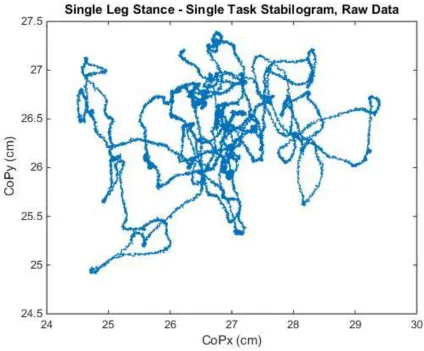
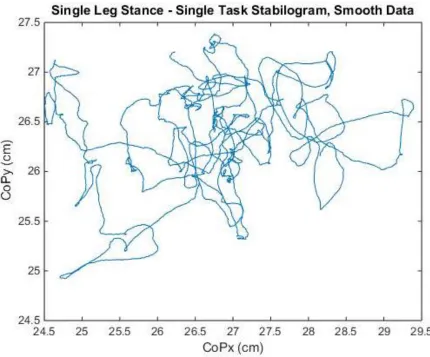
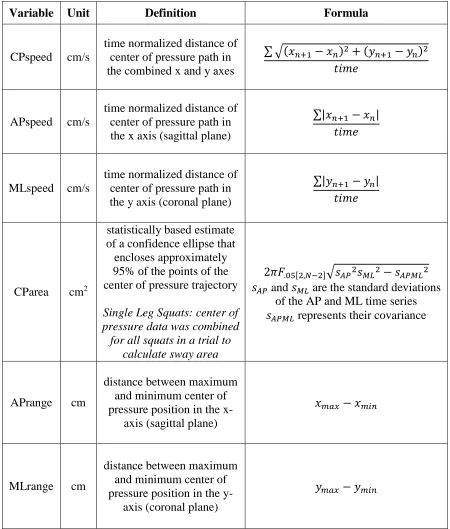
a 10 ms sliding window average. Figures 1 and 2 shows a comparison of stabilograms using raw and smooth data to trace the total center of pressure path. Custom Matlab programs were used to calculate the primary outcome variables to quantify postural control: total center of pressure speed (CPspeed), anterior-posterior center of pressure speed (APspeed), medial-lateral center of pressure speed (MLspeed), 95% elliptical sway area (CParea), anterior-posterior center of pressure range (APrange), and medial-lateral center of pressure range (MLrange). Definitions and explanations of postural control variables are shown in Table 2. Traditionally, trial time normalized excursion is identified as speed and was labeled as such for this study. Center of pressure data were only analyzed for the active squat movement (full extension, to maximum flexion, to full extension) for all single leg squat trials. The method used to identify single leg squats is shown in Figure 3.
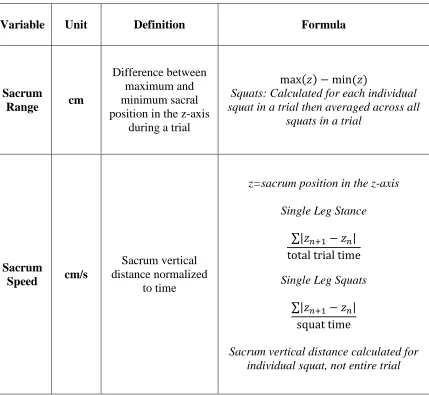
z-axis. For single leg stance postural control conditions, total trial time was measured as the time, in seconds, between the start and end of a trial as manually recorded by the researcher. For single leg squat postural control conditions, total squat trial time was measured as the sum of the times to complete the individual squats in a trial. Definitions and formulas for kinematic variables can be found in Table 3. Kinematic variables and trial times were analyzed via custom Matlab programs. Kinematic variables were only of interest for the dynamic postural control assessments, therefore kinematic variables were not reported for the static postural control assessments.
3.5. Statistical Analyses
Paired t-tests were used to compare dominant and non-dominant means for all outcome variables. No significant differences were found, therefore dominant and
CHAPTER IV - MANUSCRIPT 4.1. Introduction
Single leg postural control assessments are critical in the evaluation of athletic
performance1 and the assessment of sports-related injuries including ankle sprains,2-7 anterior cruciate ligament deficiency,8-10 and concussions.11-14 Sports medicine clinicians assess postural control to quantify a key aspect of neuromuscular control in athletes, identify athletes at higher risk for injury, improve injury prevention strategies, and as a progressive marker for rehabilitation following injury.20 The current standard for postural control assessments requires athletes to perform a battery of static, single leg and double leg stance assessments.5,15-19 While this approach is successful in identifying abnormal postural control or postural control deficiencies following injury,2-14 it may not be sensitive enough to fully identify all postural control deficiencies.
Dynamic postural control may better represent the physical and cognitive demands of athletic activity than static postural control due to the constant demand for movement during competition.48 Dynamic postural control requires an individual to maintain balance while simultaneously executing a functional assessment.2 Recently, dynamic postural control deficiencies have been identified through the examination of gait stability following injury.21,33-47 These studies identified postural control deficiencies that were not identified through traditional static postural control assessments.
Due to the high proprioceptive demand of the single leg squat on the body,51 this dynamic assessment may prove effective in assessing postural and neuromuscular control and could help clinicians better and more accurately identify postural control deficiencies.
Postural control during athletic activity requires a complex interaction of sensory input and motor output.21,22 Therefore, postural control assessments should reflect the environment in which athletes participate. This can be accomplished through dual-task paradigms and with the use of dynamic postural control assessments. A dual-task paradigm requires a person to perform two different assessments concurrently, typically a motor and a cognitive assessment, and is thought to address cognitive, postural control, and or visual deficits following an injury.118-121 Associations between cognitive and motor function have been strengthened through examinations of dual-task performance where dynamic postural control is adversely affected when a secondary cognitive assessment is introduced.21,39,41-44,52 Dual-task paradigms may better represent the physical and cognitive demands of athletic activity than single-task postural control due to the constant demand for movement during competition.48
paradigm, 2) examine differences between single-task and dual-task paradigms during static and dynamic postural control assessments, and 3) examine differences between two dual-task paradigms during static and dynamic postural control assessments. We hypothesize that there will be poorer postural stability during the dynamic assessment compared to the static assessment during single-task. We also believe that individuals will display poorer postural stability during dual-task paradigms compared to single-task paradigms for both static and dynamic postural control assessments. Comparing postural control performance between dual-tasks, we hypothesize that poorer postural stability will be seen under the dual-task with Brooks condition compared to the dual-task with Stroop condition.
4.2. Methods 4.2.1. Participants
4.2.2. Instrumentation 4.2.2.1. Force Plate
For all trials, participants stood on a tri-axial force plate (Model #4060-NC Bertec Co., Columbus, OH) embedded in a raised wooden platform on level floor that measured translational forces and moments about three axes. Center of pressure values were calculated using custom Matlab (MathWorks, Inc., Natick, MA, USA) programs.
4.2.2.2. Electromagnetic Tracking Sensor
An electromagnetic motion tracking sensor (TrakStar, Ascension Technology Corp., Burlington, VT) was used for kinematic analysis during testing. Using double-sided tape, the 6-degrees-of-freedom sensor was placed on the sacral body of the participant. The world and sensor axis system were established and designed as the positive x-axis facing the same direction as the participant, positive y-axis to the left of the participant, and positive z-axis superiorly to the participant. Sacral displacement in the z-axis was used to determine vertical displacement during testing.
4.3. Procedure
Following warm-up, participants completed three trials each of two cognitive baseline assessments, the Brooks Spatial Memory Test that uses visuospatial working memory204 and a modified computerized Stroop test. Baseline testing for both cognitive assessments were completed while in double-limb stance. The order of baseline testing between the two neurocognitive assessments was randomized for each participant. Following the baseline neurocognitive assessments, postural control assessments under six conditions were then completed. In order to minimize the effect of fatigue, a maximum of 30 seconds were given for all participants to rest between trials unless a participant verbally indicated they were ready to begin the next trial before the end of 30 seconds. The postural control conditions included: 1) single leg stance, 2) single leg squats, 3) single leg stance during dual-task with the Brooks Spatial Memory Test, 4) single leg squats during dual-task with the Brooks Spatial Memory Test, 5) single leg stance during dual-task with the Stroop test, and 6) single leg squats during dual-task with the Stroop test. Table 1 describes the six test conditions completed by all participants. Each participant performed all six postural control conditions on both their dominant (the leg the participant would use to kick a soccer ball for maximum distance) and non-dominant limb. The order of testing for the 12 assessments (6 postural control conditions on both limbs) were randomized for each participant. Participants completed one trial for each of the 12 assessments and then repeated the same order of testing two more times for a total of three trials for each of the 12 postural control
software, to indicate the start and stop of a trial. For all assessments, participants were instructed to face forward throughout testing and reduce head and eye movement as best as possible. During performance of the Stroop test, participants were instructed to look at the computer screen throughout testing. These instructions were given in order to minimize the effect of voluntary head and eye movement which may affect postural control performance.
4.3.1. Cognitive Assessments
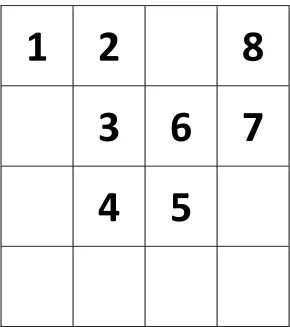
For the Brooks Spatial Memory test, participants were shown a card with unique locations of eight numbers, listed as 1-8 in numerical order and placed in a 4x4 grid. Figure 4 shows an example card. When the presentation of numbers was completed, lasting no more than one minute, the participant verbally recalled the position of each digit at a self-selected pace while standing on the testing limb. Total time to complete the Brooks test varied for each participant. A total of 30 unique cards were used throughout the study and no card was repeated during any one participant’s testing session. All participants were allowed one
practice trial in order to familiarize themselves with the test before baseline assessments. Participants completed a computerized, modified Stroop test utilizing CNS Vital Signs (CNS Vital Signs, LLC, Morrisville, NC). During the Stroop test, a series of color names (red, yellow, blue, and green) in color fonts (red, yellow, blue, and green) were
the participant. The Stroop test lasted for 20 seconds. Participants used a hand-held trigger to respond as quickly as possible to the computerized Stroop test. The hand-held trigger was held in the participant’s dominant hand (defined as the hand the participant uses for writing)
and held at the ipsilateral hip with the other hand placed on its respective hip. This position was identical to the hand positions during single-task postural control assessments. All participants were allowed one practice trial of the Stroop test in order to familiarize themselves with the test prior to baseline assessments.
4.3.2. Postural Control Assessments
For the single leg stance postural control assessment, participants were asked to stand on the limb to be tested with their toes facing forward (positive x axis) and centered on the force plate. Participants were instructed to maintain the non-stance limb in 20°-30° of hip flexion and 40°-50° of knee flexion with hands placed on the hips and head and eyes facing forward. Participants were instructed to remain as motionless as possible with eyes open during testing. A trial was considered incomplete if the participant could not sustain the stance position for longer than 5 seconds. Participants were provided with a minimum of 1 practice trial on each limb lasting 7 seconds to familiarize themselves with the assessment.
squat depth to the best of their ability throughout testing. Following a squat, participants were instructed to return to the upright position in a fluid motion. Additionally, participants were instructed to (a) maintain proper testing position throughout the entire motion, (b) not touch down with the non-stance limb, (c) maintain heel contact of the stance limb with the ground, and (d) complete the assessment in a fluid motion while maintaining balance. No additional feedback or instruction was given to the participants regarding technique. Participants were allowed a minimum of one practice trial of five consecutive squats, to familiarize themselves with the assessment.
4.3.3. Single-Task Paradigm
During single leg stance, participants were instructed to maintain balance for 20 seconds following the single leg stance procedure previously described. For single leg squats, participants completed five consecutive squats at a self-selected pace and squat depth following the single leg squats procedure previously described.
4.3.4. Dual-Task Paradigm
For dual-task paradigms, participants concurrently performed a cognitive and postural control assessment. Instructions were not given to focus attention on either task, but rather to maintain postural stability while completing the cognitive task as best as possible.
continuously squat throughout the entire cognitive assessment performance, which was defined as the start of the cognitive assessment through the end of the cognitive assessment. The total number of squats completed during the dual-task assessments varied depending on the amount of time it took each participant to complete the cognitive assessment.
4.4. Data Reduction
The three trials performed on the dominant and non-dominant limbs were averaged for separate dominant and non-dominant means for all outcome variables. The first and last single leg squats were excluded from single leg squat trials during data analysis. The remaining single leg squats within each trial were then used to calculate all outcome variables.
Kinetic and kinematic data were synchronized using the Motion Monitor motion capture system (Innovative Sports Training, Chicago, IL). Although previous research reports a sampling frequency of around 100 Hz for kinetic data,56,111,205,206 we used a
sampling rate of 1400 Hz. Kinematic data were collected at 140 Hz. All data were low-pass filtered at 14 Hz (fourth-order zero-phase lag Butterworth). Kinetic data were smoothed with
Traditionally, trial time normalized excursion is identified as speed and was labeled as such for this study. Center of pressure data were only analyzed for the active squat movement (full extension, to maximum flexion, to full extension) for all single leg squat trials. The method used to identify single leg squats is shown in Figure 3.
Kinematic variables were calculated as secondary outcome variables to help further explain postural control performance. Vertical displacement of the sacrum was calculated for each trial in order to determine sacrum range and sacrum speed along the z-axis. Definitions and formulas for kinematic variables can be found in Table 3. Kinematic variables were analyzed via custom Matlab programs. Kinematic variables were only of interest for the dynamic postural control assessments, therefore kinematic variables were not reported for the static postural control assessments.
4.5. Statistical Analyses
Paired t-tests were used to compare dominant and non-dominant means for all outcome variables. No significant differences were found, therefore dominant and
(adjusted for 3 post hoc analyses). The alpha level was set a prior at p<0.05 for ANOVA analyses. All analyses were performed using Statistical Package for the Social Sciences version 21 (SPSS Inc, Chicago, IL).
4.6. Results
4.6.1. Total Center of Pressure Speed
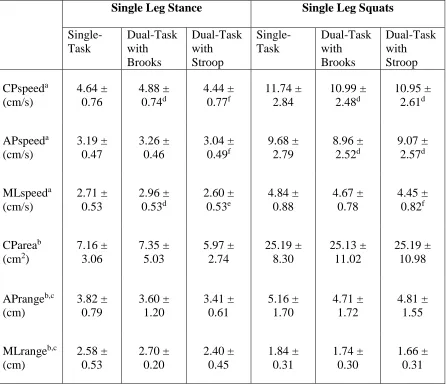
There was a significant interaction for total CPspeed (F2,58=11.58, p<0.001). Post-hoc pairwise comparisons revealed significantly faster CPspeed during dual-task with Brooks (4.88±0.74 cm/s) as compared to single-task (4.62±0.76 cm/s; p<0.001) and dual-task with Stroop (4.44±0.77 cm/s; p<0.001) during single leg stance balance. Significantly slower CPspeed was observed during dual-task with Stroop as compared to single-task (p<0.001) during single leg stance balance. Significantly slower CPspeed was observed during dual-task with Brooks (10.99± 2.48 cm/s; p=0.006) and dual-dual-task with Stroop (10.95±2.61 cm/s; p<0.001) as compared to single-task (11.74±2.84 cm/s) during single leg squats balance. CPspeed means and standard deviations can be found in Table 4.
4.6.2. A/P Center of Pressure Speed
(9.68±2.79 cm/s) during single leg squats balance. APspeed means and standard deviations can be found in Table 4.
4.6.3. M/L Center of Pressure Speed
There was a significant interaction for total MLspeed (F2,58=11.87, p<0.001). Post-hoc pairwise comparisons revealed significantly faster MLspeed during dual-task with Brooks (2.96±0.53 cm/s) as compared to dual-task with Stroop (2.60±0.53 cm/s; p<0.001) and single-task (2.71±0.53 cm/s; p<0.001) during single leg stance balance. During single leg squats balance, significantly slower MLspeed was observed during dual-task with Stroop (4.45±0.82 cm/s) as compared to both the dual-task with Brooks (4.67±0.78 cm/s; p=0.003) and single-task (4.84±0.88 cm/s; p<0.001) conditions. MLspeed means and standard deviations can be found in Table 4.
4.6.4. Sway Area
No significant interaction was observed for CParea (F2,58=0.55, p=0.582). A main effect for balance condition was observed (F1,29=166.41, p<0.001) such that single leg squats balance (25.17±1.71 cm2) had significantly greater CParea than single leg stance balance (6.81±0.52 cm2). CParea means and standard deviations can be found in Table 4.
4.6.5. A/P Center of Pressure Range
such that no cognitive condition (4.49±0.019 cm) had significantly greater APrange than the Brooks condition (4.15±0.22 cm, p=0.026) and the Stroop condition (4.11±3.77 cm,
p<0.001). APrange means and standard deviations can be found in Table 4.
4.6.6. M/L Center of Pressure Range
No significant interaction was observed for MLrange (F2,58=1.41, p=0.251). A main effect for balance condition was observed (F1,29=59.07, p<0.001) such that single leg stance condition (2.56±0.11 cm) had significantly greater MLrange than single leg squats condition (1.75±0.05 cm). A main effect for cognitive condition was observed (F2,58=4.32, p=0.034) such that no cognitive condition (2.21±0.06 cm) had significantly greater MLrange than the Stroop condition (2.03±0.06 cm, p=0.001). MLrange means and standard deviations can be found in Table 4.
4.6.7. Sacrum Vertical Displacement Range
There was a significant difference between sacrum range for single leg squats
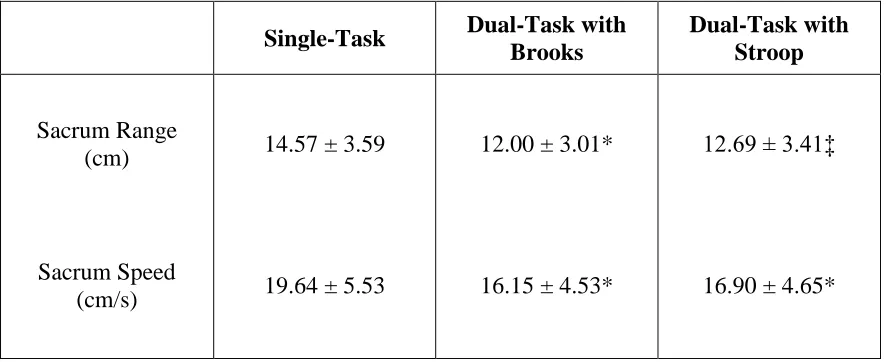
conditions (F2,58=46.58, p<0.001). Post-hoc pairwise comparisons revealed significantly less squat depth during dual-task with Brooks (12.00±3.01 cm, p<0.001) and dual-task with Stroop (12.69±3.41 cm, p<0.001) as compared to single-task (14.57±3.59 cm). Significantly less squat depth was observed during dual-task with Brooks as compared to dual-task with Stroop (p=0.001). Sacrum Range means and standard deviations can be found in Table 5.
4.6.8. Sacrum Vertical Speed
faster squats during single-task (19.64±5.53 cm/s) as compared to the dual-task with Brooks (16.15±4.53 cm/s; p<0.001) and dual-task with Stroop (16.90±4.65 cm/s; p<0.001)
conditions. Sacrum Speed means and standard deviations can be found in Table 5. 4.7. Discussion
The aim of this study was to determine if changes in postural control performance existed under static and dynamic postural control assessments during dual-task paradigms. We hypothesized that greater postural stability would be seen during the static postural control assessment compared to the dynamic postural control assessment. We also hypothesized that poorer postural stability would be seen during the dual-task paradigms compared to the single-task paradigm and poorer stability would be seen during dual-task with the Brooks Spatial Memory Test compared to the Stroop test. The most important finding of this study is that not all dual-task paradigms have the same effect on postural stability. Attention is finite and can only accommodate as much as the limited capacity allows.123 If capacity is exceeded by one assessment in a dual-task paradigm that requires more attentional capacity than the other assessment, performance on the latter assessment will be impaired which is reflected in our findings and other relevant studies.21 Surprisingly, the effect of concurrently performing Brooks while maintaining balance was not consistent between static and dynamic postural control assessments and could be attributed to
4.7.1. Postural Control Assessment Differences
Performance of a dynamic postural control assessment resulted in significantly poorer postural stability compared to performance of a static postural control assessment in single-task. These findings reveal that a dynamic postural control assessment challenges the postural control system more than a static postural control assessment, which supports our hypothesis and previous research examining a similar population and postural control assessments.207 Significantly faster sway speed and a larger sway area may indicate greater postural instability during single leg squats.115,116 These findings may be misleading
interpretations of postural control performance due to the biomechanical differences that naturally exist between single leg squats and single leg stance. A significantly greater anterior-posterior sway can be supported by the displacement of the center of pressure
population within one study.114,209 This warrants further investigation into comparing
postural control performance of similar dynamic and static postural control assessments used in this study.
4.7.2. Static Postural Control Performance
Employing the dual-task paradigm with Brooks resulted in poorer postural stability compared to the single-task paradigm; whereas, employing the dual-task paradigm with Stroop resulted in improved postural stability compared to the single-task paradigm. Previous research reported significantly decreased postural stability during a dual-task paradigm compared to single-task, which supports our findings for postural control
performance during dual-task with Brooks.120,210 It should be noted that these studies used tandem stance instead of single leg stance for the static postural control assessment. Our findings for postural control performance during dual-task with Stroop are similar to the findings of previous studies, where improved postural stability was seen during a dual-task paradigm with a static postural control assessment.22,30,59,211 These studies also did not use single leg stance as the static postural control assessment, but rather the tandem59 and Sensory Organization Test (SOT)22,30,211 instead.
used to regulate the stance phase by exciting the CPG extensor half-canter.212 Based on this theory, a more difficult cognitive assessment may compromise postural control due to increased attentional demand of the postural control system as observed in our findings with Brooks. If no other activity is required of an individual except maintaining postural control, increased attention on single leg stance may increase muscle tension and in turn cause greater postural instability59 where a CPG may not require as much attention given. This
observation was seen in our findings where improved postural stability occurred with Stroop. The Stroop test may not be as challenging of a cognitive assessment and by taking focus off of a task that does not require attention, like the single leg stance, concurrent performance of the simple Stroop may in turn improve stability.
4.7.3. Dynamic Postural Control Performance
The Star Excursion Balance Test (SEBT) is a valid and reliable outcome measure of dynamic balance95 used to identify injury risk and serve as a measure of unilateral balance and neuromuscular control.17 The previously validated and reliable anterior reach component of the SEBT shares similar movement patterns as the single leg squat92 which was
Significantly slower sway was observed in postural control performance during both dual-tasks compared to single-task, which indicates improved postural stability while concurrently performing single leg squats and a cognitive assessment. These findings support previous research on gait performance40,4121,39,44 and may suggest other factors contribute to postural control performance during dynamic dual-task paradigms.
Sacrum displacement and sacrum speed may help explain how the postural control system performs during dual-task paradigms compared to single-task. Participants displayed significantly less squat depth and significantly slower squat speeds during dual-task
postural control system performs under single- and dual-task conditions and should be further investigated in future studies.
4.7.4. Dual-Task Difficulty
The findings from this study indicate that there is a difference in level of difficulty between the cognitive assessments. This can be explained by the difference in postural control and dynamic motor performance between the concurrent performance of the Brooks and Stroop tests while maintaining static and dynamic postural stability. We hypothesized that postural stability would be less with the concurrent performance of Brooks compared to Stroop, which was confirmed through our findings for both static and dynamic postural control.
During static and dynamic postural control assessments, employing the dual-task with Brooks resulted in faster sway compared to dual-task with Stroop. In the current study, the level of difficulty of dual-task paradigms was compared and determined by the impact each cognitive assessment had on measures of postural control and squat performance.
Conceptually, the Brooks test, which assesses visuo-spatial memeory, is more difficult than the Stroop test, which measures reaction time. Compared to the simple Stroop test, the more mentally challenging Brooks test worsened static and dynamic postural stability. The
attentional demands of a visuo-spatial memory assessment show that it requires more focus than a reaction-time assessment while concurrently maintaining postural control.