ABSTRACT
KIM, HYEONGSIK. Semantics-Oriented Optimization Techniques for Large Semantic Network Processing. (Under the direction of Kemafor Ogan.)
LargeSemantic Networksare becoming increasingly pervasive in recent data analysis scenarios be-cause of the need to integrate and query a broad range of data sources. A semantic network is a labeled directed graph where vertices and edges represent concepts and semantic relationships between concepts respectively. Many semantic networks available on the Web are expressed using the Resource Descrip-tion Framework (RDF), which is a standard data model for the Semantic Web. Semantic networks are also often accompanied by ontologies which describe specifications of concepts and relations in a do-main using ontology languages such as RDF Schema (RDFS) and Web Ontology Language (OWL). The standardized concepts and relations in ontologies allow interlinking different networks, and there-fore large-scale networks begin to emerge as many ontologies are publicly available on the Web.
Semantic networks can be used for answering various types of queries, but the most common work-load is processing graph pattern matching query that seeks subgraphs that match patterns explicitly stated in queries. However, semantic networks also represent entailed structures that are not explicitly described in queries. Therefore, another common workload is processingontological queryexpressed in terms of ontological descriptions to capture both explicit and entailed structures in networks. The entailed structures can be computed using forward/backward-chaining techniques, but they often do not scale well with respect to the number of rules and the volume of datasets. More recently, some fragments of OWL (e.g., OWL2 QL) support scalable inferencing by reformulating queries into unions of conjunc-tive queries (UCQs or unions of graph patterns) based on ontological axioms. While the reformulation would allow leveraging database systems to process ontological queries in a scalable manner, in reality UCQs are often composed of many conjunctive patterns connected by unions, which poses challenges for an efficient evaluation of UCQs. It is therefore crucial to optimize the evaluation of UCQs to support efficient query answering over large semantic networks.
For optimizing the evaluations of UCQs, many different strategies can be considered based on which processing and storage models are employed. Most existing models employ fine-grained storage mod-els, which store semantic networks edgewise. Consequently, query processing involves incremental as-sembling of matching edges using many joins and unions. However, processing many operations often involves a considerable amount of overhead. In particular, when distributed processing platforms such as Hadoop are employed to process large-scale networks, the cost of joins becomes prohibitively expen-sive because each operation leads to re-partitions of intermediate data, causing a substantial amount of disk and network I/Os.
such as (i) semantic equivalence between subexpressions of graph patterns, (ii) semantic context of resource, and (iii) formal semantics of properties on concepts and definitions in accompanied ontologies. The goal of this dissertation is, therefore, developingsemantic optimization techniques which exploit semantic properties of RDF queries and data for optimizing query processing over semantic networks. In particular, the techniques introduced in this dissertation focus on (i) optimizing query expressions to eliminate redundant evaluation of “contents-equivalent” conjunctive subexpressions using rewriting techniques (ii) developing type-aware query processing and storage models which allow for eliminating redundant assertions by leveraging ontological axioms and entailment rules, and (iii) improving the evaluation of UCQs by sharing the evaluation of contents-equivalent disjunctive subexpressions over the type-aware model.
© Copyright 2017 by HyeongSik Kim
Semantics-Oriented Optimization Techniques for Large Semantic Network Processing
by HyeongSik Kim
A dissertation submitted to the Graduate Faculty of North Carolina State University
in partial fulfillment of the requirements for the Degree of
Doctor of Philosophy
Computer Science
Raleigh, North Carolina
2017
APPROVED BY:
Rada Chirkova Xipeng Shen
Ranga Vatsavai Kemafor Ogan
DEDICATION
BIOGRAPHY
ACKNOWLEDGEMENTS
I would never have been able to finish my dissertation without the guidance of my committee mem-bers, assistant from lab peers, and support from my family. First and foremost, I would like to express my sincere gratitude to my advisor, Kemafor Anyanwu, for the continuous support of my Ph.D study and related research. Without her guidance and persistent help, this dissertation would not have been possible. I also thank Rada Chirkova, Xipeng Shen, and Ranga Vatsavai for serving on my doctoral committee and providing valuable feedback on my dissertation research. I am grateful to my internship mentor, DooSoon Kim (Bosch USA) for their continued support and guidance that has extended beyond summer internships. I also would like to thank Aaron Peeler and his team at the Virtual Computing Lab (VCL), North Carolina State University for their help and support in reserving large-scale Hadoop clusters for my study. Heartfelt gratitude goes to all the helpful staff in the Department of Computer Science at the North Carolina State University.
I would like to acknowledge the support of my peers, both present and past members of the Se-mantic Computing Research Lab (COUL) - Haizhou Fu, Sidan Gao, Padmashree Ravindra, Seokyong Hong, Sahibi Miranshah, Avimanyu Mukhopadhyay, Shalki Shrivastava, Ruth Okoilu, and Abhisha Bhattacharyya. I would like to specially thank Padmashree Ravindra and Seokyong Hong for enlight-ening me the first glance of research and helping me to develop my background. I would also like to extend my thanks to Haizhou Fu and Sidan Gao for providing a friendly and cooperative atmosphere at work and insightful comments on my work. My sincere thanks also goes to Holly J. L. Kim and Eugene M. Kim for the support they have lent me during my stay at San Jose.
Last but not the least, I would like to extend my deepest gratitude to my family, in particular my parents, JiChul Kim and Bokhee Byeon, and sister, SeulA Kim, for their support during my dissertation and throughout my degree as well as my career in general. Without them I would not be where I am today. Thank you.
TABLE OF CONTENTS
List of Tables . . . vii
List of Figures . . . viii
Chapter 1 Introduction . . . 1
1.1 Key Components . . . 4
1.1.1 Optimizing the Processing of Queries with Semantically Related Subexpressions 4 1.1.2 Automatic Semantic Typing Scheme for Semantics-Oriented RDF Storage Model on Hadoop . . . 5
1.1.3 Optimizing Processing of Complex Queries on RDF data Using SemStorm . . 5
1.2 Related Work . . . 6
1.3 Outline . . . 8
Chapter 2 Preliminaries . . . 9
2.1 Resource Description Framework Schema (RDFS) . . . 9
2.2 RDFS Entailment . . . 10
2.3 SPARQL Protocol and RDF Query Language (SPARQL) . . . 12
2.4 The MapReduce Framework . . . 12
2.4.1 MapReduce . . . 12
2.4.2 Hadoop Distributed File System (HDFS) . . . 13
2.5 SPARQL Query Processing on MapReduce . . . 14
2.5.1 Graph Pattern Matching Using Relational Algebra . . . 14
2.5.2 Nested Triplegroup Algebra and Data Model (NTGA) . . . 15
Chapter 3 Optimizing the Processing of Queries with Semantically Related Subexpressions 17 3.1 Motivation . . . 17
3.1.1 Contributions . . . 18
3.1.2 Related Work . . . 18
3.2 Foundations . . . 19
3.2.1 Well-formed, Ambiguous, and Perfect Triplegroups . . . 19
3.2.2 Triplegroup Cloning . . . 20
3.3 Empirical Evaluation . . . 21
3.3.1 Testbed Setup . . . 22
3.3.2 Evaluation Results . . . 23
3.4 Chapter Summary . . . 25
Chapter 4 Automatic Semantic Typing Scheme for Semantics-oriented RDF Storage Model on Hadoop . . . 26
4.1 Motivation . . . 26
4.1.1 Contributions . . . 28
4.1.2 Related Work . . . 29
4.2 Type-Based Optimization of RDF Graph Pattern Queries . . . 29
4.2.2 Autonomic R-Type Model Generation and Storage on Hadoop . . . 30
4.2.3 Implementation of R-Type Model Generation . . . 32
4.3 Query Processing on SemStorm . . . 34
4.3.1 Query Compilation . . . 34
4.3.2 Query Execution . . . 36
4.4 Semantic Optimization Using Ontological Axioms . . . 37
4.4.1 Optimizing SemStorm’s Physical Model Using Triple Dematerialization . . . . 37
4.4.2 Eliminating Redundant Joins from R-Type Expressions . . . 39
4.5 Empirical Evaluation . . . 43
4.5.1 Testbed Setup . . . 43
4.5.2 Evaluation Results . . . 46
4.6 Chapter Summary . . . 50
Chapter 5 Optimizing Processing of Complex Queries on RDF Data Using SemStorm . . 51
5.1 Motivation . . . 51
5.1.1 Related Work . . . 54
5.2 Optimization Strategies for Processing UCQs in Distribute Contexts . . . 54
5.2.1 Increasing the Selectivity of Graph Patterns in UCQs . . . 54
5.2.2 Rewriting Strategies for Optimizing the execution of UCQs . . . 56
5.3 Optimizing UCQs Using Type-based Semantic Reformulation . . . 59
5.3.1 Rewriting Techniques for Eliminating Chain-Joins via Inverting . . . 60
5.3.2 Extending R-Type Query Processing Model for UCQs . . . 61
5.4 Empirical Evaluation . . . 63
5.4.1 Testbed Setup . . . 63
5.4.2 Evaluation Results . . . 65
5.5 Chapter Summary . . . 71
Chapter 6 Conclusion and Future Work . . . 72
6.1 Overview of Dissertation . . . 72
6.2 Future Directions . . . 73
LIST OF TABLES
Table 2.1 RDF statement and RDFS constraints . . . 11
Table 4.1 Dataset characteristics . . . 46
LIST OF FIGURES
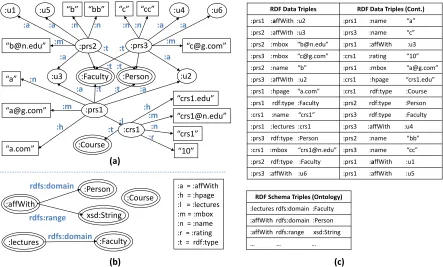
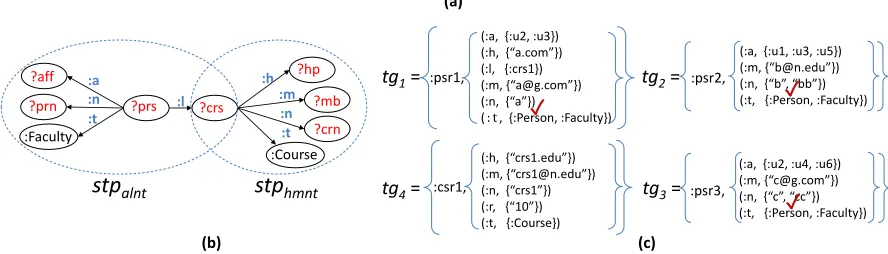
Figure 1.1 An example (a) semantic network and (b) ontology describing an academic domain, and (c) a set of RDF triples corresponding to the example network and ontology. Labels over edges are abbreviated due to space constraints, e.g., rdf:typeis represented as:t . . . 2 Figure 1.2 (a) An example graph pattern matching queryQand (b) an relational expression
for the queryQ. . . 3 Figure 1.3 A categorization of related work . . . 7
Figure 2.1 (a) An example SPARQL queryQ, (b) a graph representation of the queryQ, and (c) an relational expression for the queryQ. . . 10 Figure 2.2 An overview of MapReduce job execution. . . 13 Figure 2.3 (a) a set of triplegroups corresponding to example triples and (b) content-equivalence
between a triplegrouptg5and n-tuplestup1andtup2. . . 15
Figure 2.4 (a) A relational query execution plan and (b) a NTGA-based query execution plan for queryQ. . . 16
Figure 3.1 (a) An example queryRQand (b) a query execution plan forRQon MapReduce 18 Figure 3.2 Cloning in the context of ambiguous triplegroups . . . 20 Figure 3.3 Comparison of MR execution time of three approaches (Pig-Def, NTGA, and
SHARD) for dq4 (BSBM-250k) . . . 23 Figure 3.4 Comparison of the execution time, the number of HDFS read/written for varying
the number of DupPs ((a)∼(c)) and the frequency of DupPs in a query ((d)∼(e)). 24 Figure 3.5 Scalability study of scan-sharing approach for query dq4 with increasing sizes
of RDF graphs . . . 25
Figure 4.1 (a) Graph representation of graph pattern query Q that retrieves faculties who lecture courses (b) star subgraphs (triplegroups). . . 27 Figure 4.2 A physical representation of typed triplegroups using polymorphic-typed file
organization and file format. . . 33 Figure 4.3 Pre-processing triples to construct triplegroups using RAPID+ on SemStorm. . 34 Figure 4.4 Retrieving RDF triples matching queries from SemStorm. . . 37 Figure 4.5 Dematerializing a D-inferable triple (:prs1,rdf:type, :Faculty) in a
triple-group tg1 based on a domain constraint (:l,rdfs:domain,:crs1) and RDFS
entailment rule (rdfs2). . . 40 Figure 4.6 An overall processing flow of the queryQover the R-Type model with semantic
optimization techniques . . . 43 Figure 4.7 An overall architecture of SemStorm on Hadoop 2 . . . 44 Figure 4.8 Comparisons of queries withoutrdf:typetriple patterns using LUBM Univ 20k
dataset on 80-node cluster: (a) high-selectivity queries and (b) low-selectivity queries . . . 48 Figure 4.9 Comparisons on 20-node cluster using DBSPB-200 dataset: (a) query
Figure 4.10 Answering negative queries (a) LUBM (b) DBPSB . . . 49 Figure 4.11 Evaluating queries withrdf:type triple patterns using LUBM datasets
(Univ-20k, 80-node cluster) . . . 50 Figure 4.12 A performance comparison of queries with multiple (non-)inferablerdf:type
triple patterns (DBSPB-200, 20-node cluster) . . . 50
Figure 5.1 Rewriting two star patternstp1andstp2 . . . 52
Figure 5.2 (a) An execution plan for a reformulation of the triple patterntp,h?srdf:type ub:Studentiand (b) the rewriting process that generates more selective plans. 56 Figure 5.3 Execution plans for a graph pattern with (a) disjunctive predicates and (b) unions
of reformulated triple patterns. (c) An reformulated query using multi-query optimization and (d) an execution plan of the query . . . 57 Figure 5.4 An overall flow of semantic optimizations for range-invertable triples: (a) data
and (b) query rewriting process. . . 59 Figure 5.5 Interpreting ontological query gp as (a) unions of FOL formulas and (b)
dis-junctions of MSO formulas. . . 62 Figure 5.6 Execution time of queries with a varying number of union branches: (a) high
and (b) low selectivities (unit: s) . . . 66 Figure 5.7 Execution time of queries with a varying size of common expressions: (a) high
and (b) low selectivities (unit: s) . . . 68 Figure 5.8 HDFS read of queries with a varying size of common expressions: (a) high and
(b) low selectivities (unit: GB) . . . 68 Figure 5.9 Execution time of queries with a varying number ofrdfs:rangeaxioms: (a)
Chapter 1
Introduction
Recently large Semantic Networks are becoming increasingly common in data analysis scenarios be-cause of the need to integrate and query a broad range of data sources. For example, public health and biomedicine communities have actively built and used large semantic networks such as Knowledge Base of BioMedicine (KABOB) [56], Uniprot [20], BioPortal [70]. These semantic networks are essen-tially labeled directed graphs where vertices and edges represent concepts and semantic relationships between concepts, respectively. Fig. 1.1(a) shows an example semantic network describing resources in academic domains such as faculties (e.g., :prs1,:prs2, and :prs3) and courses they are teaching (e.g., :crs1). Many semantic networks available on the Web are often expressed using the Resource Description Framework (RDF) [17], which is a standard data model for the Semantic Web. RDF offers a common framework for describing knowledge using a triple (Subject,Property,Object) which asserts that a Subject has a Property whose value is denoted by the Object. For example, the triple (:prs1, :name, “aaron”) asserts that the resource:prs1has a named Property:namewhose Object is the literal “aaron”. The standardization based on RDF allows different semantic networks to be automatically interconnected, which leads to the emergence of large semantic networks. For example, Uniprot is a database of protein sequences which consists of loosely interconnected resources from many different datasets such as genomes, enzymes, publications, etc, and the number of RDF triples in the database recently reaches approx.17B.
In the context of semantic network processing represented in RDF, two classes of queries can be considered.
1. The first class of queries called graph pattern matching queries is ‘shallow’ in that they focus on finding exact structural matches to a given query pattern. Fig. 1.2(a) shows an example graph pattern matching query that retrieves alist of faculties and the courses that they teach. Variable are denoted by leading ’?’, which are mapped to resources in a semantic network, e.g., valid bindings for the variables?prsand?crsin Fig. 1.2(a) are:Prs1and:Crs1respectively.
accompa-RDF Data Triples RDF Data Triples (Cont.) :prs1 :affWith :u2 :prs1 :name “a” :prs2 :affWith :u3 :prs3 :name “c” :prs2 :mbox “[email protected]” :prs1 :affWith :u3 :prs3 :mbox “[email protected]” :crs1 :rating “10” :prs2 :name “b” :prs1 :mbox “[email protected]” :prs3 :affWith :u2 :crs1 :hpage “crs1.edu” :prs1 :hpage “a.com” :crs1 rdf:type :Course :prs1 rdf:type :Faculty :prs2 rdf:type :Person :crs1 :name “crs1” :prs3 rdf:type :Faculty :prs1 :lectures :crs1 :prs3 :affWith :u4 :prs3 rdf:type :Person :prs2 :name “bb” :crs1 :mbox “[email protected]” :prs3 :name “cc” :prs2 rdf:type :Faculty :prs1 :affWith :u1 :prs3 :affWith :u6 :prs1 :affWith :u5
(c) :prs1 :crs1 :Faculty :u1 :u3 :u5 “[email protected]” :Person :prs3 :u2 :u4 :u6 “[email protected]” “[email protected]” “a.com” “a” :prs2
“b” “bb” “c” “cc”
:Course “crs1.edu” “[email protected]” “crs1” “10” :a :a :a
:a :n :n :n :n :a :a
:m :m :m :m :h :h :n :r :t :t :t :a :t :t :t :t :a :n :l :affWith :Person rdfs:domain xsd:String rdfs:range
:lectures rdfs:domain :Faculty
(b) (a)
:a = :affWith :h = :hpage :l = :lectures :m = :mbox :n = :name :r = :rating :t = rdf:type
:Course RDF Schema Triples (Ontology)
:lectures rdfs:domain :Faculty :affWith rdfs:domain :Person :affWith rdfs:range xsd:String … … …
Figure 1.1: An example (a) semantic network and (b) ontology describing an academic domain, and (c) a set of RDF triples corresponding to the example network and ontology. Labels over edges are abbreviated due to space constraints, e.g.,rdf:typeis represented as:t
:l
?prs ?crs ?aff
?prn
:Faculty
?hp
?mb ?crn
:Course
:a :n :t
(a)
:h :m :n :t
(
:affWith⋈(?𝑝𝑟𝑠 = ?𝑝𝑟𝑠):name ⋈(?𝑝𝑟𝑠 = ?𝑝𝑟𝑠)…⋈…)
⋈(?𝑐𝑟𝑠 = ?𝑐𝑟𝑠)
(
:hpage⋈(?𝑐𝑟𝑠 = ?𝑐𝑟𝑠):mbox⋈(?𝑐𝑟𝑠 = ?𝑐𝑟𝑠)… ⋈…)
(b)stp1 stp2
Figure 1.2: (a) An example graph pattern matching queryQand (b) an relational expression for the queryQ.
and involves orders of magnitude blow-up in data size. Other systems [69, 80] employ backward-chaining which computes only the relevant part of the closure in a dynamic way. However, these algorithms tend to be inherently sequential making them difficult to parallelize and scale up for large semantic networks. But more recently, some fragments of OWL (e.g., OWL2 QL) support scalable inferencing over large semantic networks by rewriting queries into unions of conjunctive queries (UCQs or unions of graph patterns) based on ontological axioms [26, 23, 36, 52]. As a simple ex-ample, the pattern (?prs,rdf:type,:Faculty) can be rewritten into a union of (?prs,rdf:type, :Faculty) and (?prs,:lectures,?x) to explicitly find both implicit and explicit structures. While UCQs can be evaluated using existing RDF databases, the number of graph patterns in UCQs is often very high, which may pose challenges for efficient evaluation of UCQs. For example, the ontology in Uniprot consists of over1M classes and1M rdfs:subclassOfstatements. Therefore, a trivial ontological query on Uniprot that involves the classTaxoncould easily exceed800disjuncts, with each disjunct being a multi-join graph pattern. It is therefore crucial to optimize the evaluation of UCQs to support efficient query answering over large semantic networks.
and sideways information passing [61].
Note that these techniques primarily focus on exploiting structural properties of the RDF data model such as co-partitioning subgraphs based on common nodes/edges. However, they do not consider lever-agingsemantic properties of the RDF data modelsuch as (i)semantic equivalence between subexpres-sions of graph patternsand (ii)formal semantics of properties with respect to concepts and definitions in accompanied ontologies. The goal of this dissertation is therefore developingsemantic optimization techniques which exploit semantic properties of RDF queries and data for optimizing graph pattern processing on MapReduce.
1.1
Key Components
In this dissertation, we present three components focusing on (i) optimizing query expressions to elim-inate redundant evaluation of “contents-equivalent” conjunctive subexpressions using rewriting tech-niques (ii) developing a type-aware storage model which allows for eliminating redundant assertions by leveraging ontological axioms and entailment rules, and (iii) improving the evaluation of UCQs by sharing the evaluation of contents-equivalent disjunctive subexpressions over the type-aware storage model.
1.1.1 Optimizing the Processing of Queries with Semantically Related Subexpressions Most conjunctive graph pattern matching queries contain semantically related subexpressions, e.g., common subexpressions across multiple star patterns. Existing approaches often represent the subex-pressions based on the first-order relational exsubex-pressions and evaluate the exsubex-pressions independently, which results in significant performance overhead. However, the expressions can be reformulated into semantically equivalent second-order expressions using Nested TripleGroup Data Model and Algebra (NTGA). NTGA employs atriplegroup(or a star subgraph) as a first-class citizen where each group is a set of triples that have the same Subject resource. These triplegroups can be considered as candidate matches for star patterns in queries, therefore an NTGA-based query plan includes operators that scan all triplegroups and select only triplegroups that match (one of) star patterns. Such a query plan al-lows for evaluating all star subgraph patterns concurrently, which provides opportunities for processing all semantically related subexpressions in different star patterns. However, this model introduces chal-lenges in query executions. In particular, an interpretation of semantically related subexpressions using NTGA needs to handleambiguities. Because multiple star graph patterns include common subexpres-sions which need to be evaluated concurrently, a triplegroup can potentially match multiple star patterns, creating ambiguities during the matching process.
Proposed Solution: This component proposes to extend NTGA operators to deal with ambiguities, which allows for avoiding redundant evaluation of semantically related subexpressions. These opera-tions focus on transforming an single subgraph (triplegroup) into matches of multiple subexpressions, thereby avoiding multiple scans and multiple query execution paths for semantically related subexpres-sions.
1.1.2 Automatic Semantic Typing Scheme for Semantics-Oriented RDF Storage Model on Hadoop
Typing in databases is fundamental to query optimization, e.g., for compile-time semantic analysis of query correctness and pruning of state-space during query execution. Typing is also employed in Seman-tic Query Optimization(SQO) where it can be combined with integrity constraints for use in rewriting queries into more efficient ones by eliminating redundant expressions, e.g., eliminating joins. However, when dealing with semi-structured data that often lack strongly typed models (and in some cases even schemas), enabling similar type-based optimizations is challenging. While this has been considered for XML data, the problem remains open in the context of RDF. Given the growing popularity of RDF and the challenges that still remain with respect to query processing in the large, the investigation of type-based query optimization techniques for RDF is likely to be a worthwhile research direction. Research Questions:What kind of typing models would be appropriate for RDF data? How can types be automatically induced from a triple model and schema to avoid the need for users to explicitly define them? What is an appropriate storage organization and physical representation for types?
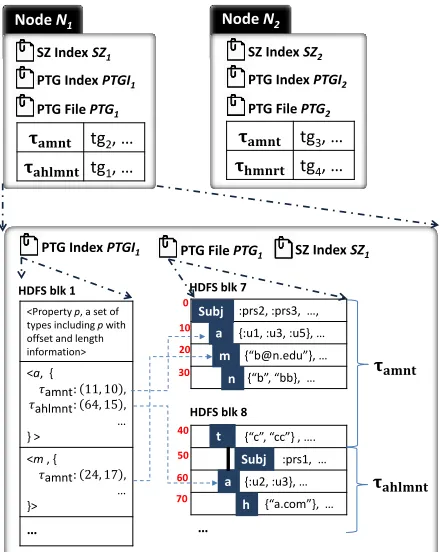
Proposed Solution: To address the questions, this component proposes a two-pronged approach to enabling type-based optimization for Big RDF query processing. First is anAutonomic Typing Model for RDF called R-Typingthat (i) autonomically induces a strongly typed (R-Type) model for RDF and rewrites SPARQL graph pattern queries into expressions over R-Types to achieve state-space pruning, and (ii) a distributed storage and indexing scheme for R-Typed Models calledSemStorm, which intro-duces apolymorphic nested column-oriented file organization and formatfor Hadoop Distributed File System (HDFS). SemStorm enables efficient index-based access to query relevant data from HDFS. Second, we propose semantic optimization techniques which exploit ontological axioms in ontologies that often accompany RDF data, in a manner analogous to integrity constraints. This enables optimiza-tions of both SemStorm’s physical storage models (eliminating ‘redundantly stored data’) and queries (eliminating ‘redundant’ subexpressions).
1.1.3 Optimizing Processing of Complex Queries on RDF data Using SemStorm
into unions of conjunctive queries (UCQs), which are generated by rewriting conjunctive queries with respect to ontological constraints. However, processing UCQs is orders of magnitude more challenging than regular graph pattern queries because the number of conjunctive queries tends to be exponential. It is particularly difficult to evaluate such queries on distributed platforms because many union branches where each of them contains joins are translated into a significant number of operators. Such a large number of operators often lead to a large number of data re-partitions of intermediate data, which obvi-ously involves a huge amount of disk and network I/Os.
Research Questions:How can we translate UCQs into more optimized query plans that do not require a large number of data re-partitions? What are the possible execution strategies to optimize such plans? Proposed Solution:A worthwhile observation is that UCQs tend to contain many semantically related subexpressions across union branches, which implies that the evaluation of such expressions can be shared over the semantics-oriented storage model. In this context, we focus on developing alternative query rewritings that can produce more efficient expressions in the context of distributed environments. We adapt two classes of techniques to the context of a strong type system for RDF data: (i) Union Pushdown- an algebraic method for reformulating disjunctive queries and (ii)Multi Query Optimization - which attempts to achieve shared execution of common subexpressions across subqueries in UCQs. We also integrate such techniques with semantic optimizations that utilize ontological axioms to eliminate common chain-joins in UCQs, which further allows reducing the re-partitions of intermediate data. Comprehensive experiments conducted on synthetic benchmark datasets with customized query sets show that our reformulation techniques with semantic optimizations are highly effective, which is up to 25Xfaster than existing approaches.
1.2
Related Work
Related Work
Type-based and Semantic Query Optimizations
Type-based Optimizations
[14, 45, 44]
Semantic Query Optimizations
[33, 65, 37, 38, 58, 59, 21, 39]
Optimizing Queries with Common Subexpressions
Inter-query Optimizations
[54, 68, 40, 48]
Intra-query Optimizations [60, 42]
Storage Models for RDF Data
Triple-based Models [47, 32, 11, 29, 28, 1, 64, 24, 57]
Subgraph-based Models
[41, 31, 69, 67, 51]
Typed Models
[69, 67]
Untyped Models
[51, 41, 31]
Ontological Query Optimizations
Compact UCQs Generation
[61, 19, 26, 53, 23]
Optimizing The Execution of UCQs
[17]
Figure 1.3: A categorization of related work
that are not possible when each type is considered separately.
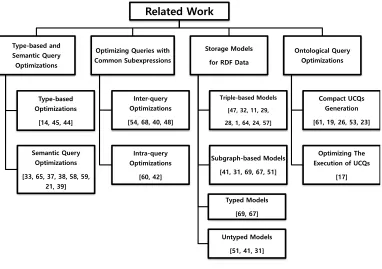
Queries with Common Subexpressions. Many efforts have been made to exploit similar or related subexpressions for optimization. In particular, it has been extensively studied in the context of optimiz-ing multiple related queries, i.e., multi-query optimizations (MQO) in [68, 87]. MQO is also studied in the context of optimizing multiple graph pattern matching queries [53]. In addition, there are also a number of studies that identify similar workflows and share the execution on MapReduce. For example, MRShare [62] identifies different types of sharing opportunities by analyzing MR job workflows gener-ated from a set of queries and shares the execution or the output of Map/Reduce phases to reduce the cost of execution. Recently, these techniques have been studied in the context of intra-query optimizations, which leverage related subexpressions in subqueries. Cascade-style optimizers in Scope [75] is extended to employ such optimizations and select globally optimal plans based on its cost model. YSmart [55] leverages correlations between subqueries to reduce the cost of query execution on MapReduce. It em-ploys a correlation-aware SQL-to-MapReduce translator that identifies correlated subplans and merges them based on a set of rewriting rules to minimize the number of MR jobs. However, they only focus on query transformation for optimization without considering a transformation of intermediate data to share the evaluation of related subexpressions.
models for RDF data model, i.e.triple-based models[61, 44, 19, 41, 40, 5, 83, 33, 72] vs. subgraph-based models[54, 43, 88, 86, 65]. The former uses a triple for the units of storage and retrieval while the latter uses coarser-grained units of storage and retrieval such as subgraphs. Whereas the triple-based models require a join operation to add each new triple to a subgraph, the subgraph-based models have the advantage of requiring fewer join operations during query processing since triples have already been assembled into coarser-grained units. Another perspective of storage models is the issue of whether they aretyped[88, 86] oruntyped[65, 54, 43]. Typed storage models partition data based on types, labels, or signatures of data units so that units with the same type (or label/signatures) can easily be differentiated. The advantage of such differentiated storage models is that graph patterns can easily be matched without processing triples whose types are not included in a query. On the other hand, untyped storage models which do not partition data do not enable that level of discrimination during query processing. However, they often rely on specialized access methods such as indexes to achieve selective access based on either the subject or the object of triples.
Ontological Query Processing.Query rewriting algorithms for ontological queries has been extensively studied for RDFS or OWL2 QL [78, 27, 36]. However, such algorithms often produce an exponential size of the rewritings [27], i.e., generated UCQs often contain hundreds or thousands of subqueries in reality, which are too big to be evaluated efficiently on existing database systems. To mitigate this com-plexity issue, much effort has been put into the development of optimization techniques that produces more succinct queries [36] or rewrites queries into other expressive languages such as Datalog [67, 32]. In recent years, a few authors have begun to investigate techniques for optimizing the execution of UCQs as orthogonal approaches for handling the complexity issue. In [25], ontological queries are decomposed into different combinations of (possibly overlapping) subqueries, producing a set of covers for queries. Since the queries reformulated from these covers have different query processing costs, efficient one is selected and evaluated using a greedy cost-based algorithm. While such techniques can be effective for traditional query processing systems, it is possible that selected plans would not be plans that produce optimized MapReduce job flows for processing ontological queries.
1.3
Outline
Chapter 2
Preliminaries
2.1
Resource Description Framework Schema (RDFS)
Resource Description Framework Schema (RDF Schema/RDFS)1 is a set of standardized vocabularies for describing concepts and and semantic relationships between the concepts. RDFS represents con-cepts using special vocabulariesrdfs:Classandrdf:type. For example, there are three classes describing conceptsPerson,Course, andFacultyin Fig. 1.1(b), which can be represented by adding new schema triples such as (:Person,rdf:type,rdfs:Class), (:Course,rdf:type,rdfs:Class), and (:Faculty, rdf:type,rdfs:Class),
Resources can be categorized into classes and resources that belong to a class are called as instances of that class. These relationships can be described usingrdf:type. For example, (:prs1, rdf:type, :Faculty) asserts that:prs1 is an instance of class :Faculty. Note that RDFS allows resources to have multiple classifications without necessarily conforming descriptions of classes they belong to. For example,rdf:typestatements in Fig. 1.1(b) assert that:prs1is an instance of class:Facultyas well as :Person.
RDFS also provides two special properties rdfs:domain andrdfs:range to define associations between classes and properties.rdfs:domainassociates a class with a Property’s Subject. For example, (:lectures,rdfs:domain,:Faculty) denotes that the subject described using a property:lectures is an instance of the class:Faculty. Similarly,rdfs:rangeassociates a class with a Property’s Object. For instance, (:affWith,rdfs:range,xsd:String) expresses that the object of property:takeCourse are represented as String Data Types defined in XML Schema Language2.
Class hierarchy also can be expressed using a special property called rdfs:subClassOf, e.g., (:Faculty,rdfs:subClassOf,:Person) represents that:Facultyis a subclass of:Person. Likewise, property hierarchy can be represented using a propertyrdfs:subProperty, e.g., (:hasMasterDegreeOf,
1
http://www.w3.org/TR/rdf-schema
2
:l
?prs ?crs
?aff
?prn
:Faculty
?hp
?mb
?crn
:Course :a
:n :t
(b)
:h :m :n :t
(
:affWith⋈(?𝑝𝑟𝑠 = ?𝑝𝑟𝑠):name ⋈(?𝑝𝑟𝑠 = ?𝑝𝑟𝑠)…⋈…)
⋈(?𝑐𝑟𝑠 = ?𝑐𝑟𝑠)
(
:hpage⋈(?𝑐𝑟𝑠 = ?𝑐𝑟𝑠):mbox⋈(?𝑐𝑟𝑠 = ?𝑐𝑟𝑠)… ⋈…)
(c)
stp1 stp2
Q. SELECT * WHERE { ?prs :affWith ?a . ?prs :name ?n1 . ?prs :lectures ?crs . ?prs rdf:type :Faculty .
?crs :hpage ?h . ?crs :mbox ?m . ?crs :name ?n2 . ?crs rdf:type :Course . }
stp2 = {h, m, n, tC}
stp1 = {a, n, l, tF}
(a)
Figure 2.1: (a) An example SPARQL queryQ, (b) a graph representation of the query Q, and (c) an relational expression for the queryQ.
rdfs:subPropertyOf,:hasDegreeOf) expresses that:hasMasterDegreeOfis a subproperty of:hasDegreeOf.
2.2
RDFS Entailment
RDFS provides a set of entailment rules that allow infer implicit information from schema and data. Among RDFS entailment patterns, we briefly cover some of core ones used in next chapters below. Variables are denoted with a leading question mark such as?a.
1. Rulerdfs2:rdfs2infers a newrdf:typetriple (a triple with a propertyrdf:type) throughrdfs:domain constraints.
h?a,rdfs:domain, ?xi h?u, ?a, ?xi h?u,rdf:type, ?xi
For example, given triples (:takeCourse,rdfs:domain,:Student) and (:prs1,:takeCourse,:Database), a new triple (:prs1,rdf:type,:Student) can be inferred based onrdfs2.
2. Rulerdfs3:rdfs3derives a newrdf:typetriple throughrdfs:rangeconstraints.
h?a,rdfs:range, ?xi h?x, ?a, ?ui h?u,rdf:type, ?xi
Usingrdfs3, a new triple (:Database,rdf:type,:Course) can be inferred from triples (:takeCourse, rdfs:range,:Course) and (:prs1,:takeCourse,:Database).
Table 2.1: RDF statement and RDFS constraints
RDF statement Triple RDFS statement Triple Class assertion (rdf:type) sτ o Subclass (rdfs:subClassOf) s⊆sco Property asssertion s p o Subproperty (rdfs:subPropertyOf) s⊆spo Domain type (rdfs:domain) s⊆do Range type (rdfs:range) s⊆ro
Let RDF knowledgebase kbbe a tuplehS,Diwhere SandDrepresent a set ofschematriples and instancetriples, respectively. Schema triples are a set of statements that conform the form in the right side of Table 2.1, which shows templates of the triples that use meta classes/properties defined in RDF Schema (RDFS) [15]. Instance triples are a set of statements that follow the form in the left side of the Table 2.1, which lists a general form of RDF triples. Answering a queryqoverkbinvolves the process of finding explicit matches overDbut also deriving implicit information using the process called RDFS entailment [15]. This process can be achieved using the following techniques.
• Materialization.The techniques under this category [81, 79, 35] repeatedly applies entailment rules overkbin a forward-chaining manner, materializing the closure ofkb. The evaluation of queryqover the materialization produces complete answers, which can be represented asq(M aterialize(kb))= q(kb∞)whereM aterializeandkb∞denote the algorithm and the closure ofkbrespectively. • Query Reformulation.This type of techniques [80, 35, 25] reformulatesqby applying a
reformula-tion algorithm overkbin a backward-chaining manner, which can be denoted asRef ormulate(q,kb). The algorithm returns a reformulated query,qref, which is composed of a union of basic graph pat-tern queriesRef ormulate(q,kb) = qref. Note that the evaluation of the reformulated query over non-materializedkbreturns complete answers, which are equal to the ones using the materialization technique, i.e.,q(kb∞)=qref(kb).
• Hybrid Approach.The authors in [78] observe that closure computations of (i) rdf:type statements and (ii) other statements dependent on the rdf:type statements are major overheads of the materi-alization approach. To relieve this overhead, the authors present a hybrid approach that uses both materialization and query reformulation, which can be summarized as follows.
1. Generate a partial materialization ofkbcalled schema closure, kb+, using simplified entailment rulesM aterialize−that derives all non-rdf:typestatements first. The computation ofrdf:type triples is deferred until processing queries using reformulation (M aterialize−(kb)=kb+). 2. Reformulate the queryq using rulesRef ormulate−that compute all statements derivable from
rdf:typetriples, producingqref−(Ref ormulate−(q,kb+) =qref−)
3. Evaluate the reformulated query (qref−) overkb+, which produces complete answers (qref−(kb+) = q(kb∞).
the next section.
h?s τ?oi ∈q
h?x ⊆sc?oi,h?s τ?xi R3 (2.1a)
h?s τ ?ei ∈q
h?c⊆sc?ei,h?p⊆sp?ri,h?r⊆d?ci,h?s?p?xi
R4
(2.1b)
h?s τ ?ei ∈q
h?c⊆sc?ei,h?p⊆sp?ri,h?r⊆r?ci,h?x?p?si R5 (2.1c)
Note that we omit ruleR1andR2because these rules essentially generate statements that some sub-jects/objects are simply the type of class resources, which may not be useful as answers.R3essentially captures allrdfs:subClassOfhierarchies,R4andR5handle instances represented using rdfs:domain and rdfs:range axioms with the combinations ofrdfs:subClassOfandrdfs:subProperty.
2.3
SPARQL Protocol and RDF Query Language (SPARQL)
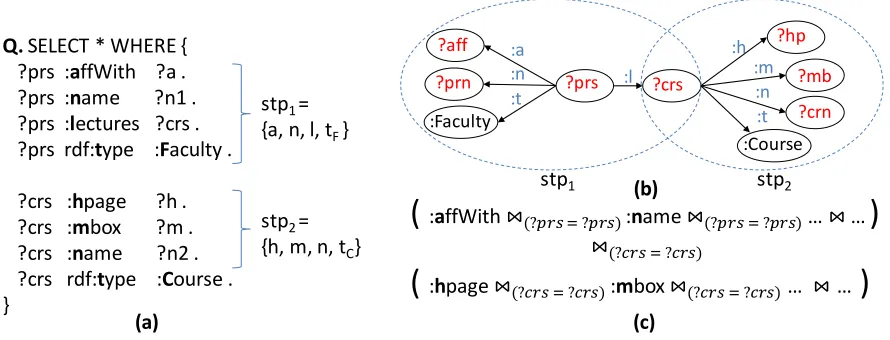
SPARQL3 is a standard query language designed for data modeled using RDF. The main construct of SPARQL is agraph patternwhich is a composition oftriple patterns. Atriple patternis a triple with at least one variable (denoted by leading ’?’) in either the Subject, Property or Object positions. For example, the triple pattern (?prs:name?n1) has two variables?prsand?n1. The semantics of a triple pattern is the subset of a triple model that is produced by substituting query variables in the triple pattern. For example, the common (join) variables?prsand?crscan be substituted as:Prs1and:Crs1based on triples in Fig. 1.1(a). Fig. 4.1(a) shows an example SPARQL query to retrieve alist of faculty and the courses that they teach. The SPARQL query also can be represented as a form of graph. Fig. 4.1(b) shows the graph version of the queryQ. The answer to our example query is a 2-ary relation containing valid bindings for the variables?prsand?crs(here our result relation consists of a single tupleh:Prs1, :Crs1i).
2.4
The MapReduce Framework
2.4.1 MapReduce
MapReduce [31] is a parallel programming model that allows programs to be automatically parallelized over arbitrary-sized clusters of commodity-grade machines. Many different types of MapReduce
im-3
M
1↓
↓
Split 0...k
☼
R
1𝐃𝐍𝟏
M
2↓
↓
Split k+1...n
☼
R
2𝐃𝐍𝟐
Part 1
Part 2
= sort
= merge
↓
☼
HDFS HDFS
Map
Reduce
Figure 2.2: An overview of MapReduce job execution.
plementations are available and the most widespread one is Apache Hadoop4. Recent Hadoop releases support MapReduce as one of its distributed applications. Users only need to translate their function-ality into a set of MR jobs which consist of the two primitive functions to implement a task using the MapReduce (MR) model, i.e.,mapandreduce. The encoded Map and Reduce functions are executed across multiple slave nodes in a Hadoop cluster where each node has a number ofMapper/Reducer slots to executeMap/Reducefunctions independently.
Fig. 2.2 shows an overall execution flow of amapandreducefunction using two physical slave nodes (DN1andDN2). Themapfunction is defined asmap(Key1,Value1)→list(Key2,Value2). Each node
first reads input splits from Hadoop Distributed File System (HDFS), processes the input key-value pairs based on user’s codes described in the map function (M1 andM2), and produces intermediate
data as a list of key-value pairs. The reducefunction is defined asreduce(Key2, list(Value2)) →
(Key3,Value3). Each reduce node pulls intermediate data from nodes that execute Map functions, merges values into a group according to the intermediate key, executes user’s codes inreducefunction (R1
andR2), and finally generates a final key-value pair for each group. Each MR job is accompanied by
I/O coststo materialize the outputs of map and reduce functions,sorting costsfor grouping tuples with same keys and communication costs to move data between the Mappers and Reducers (nodes which execute the map and reduce functions respectively).
2.4.2 Hadoop Distributed File System (HDFS)
The physical unit of input and output in MR jobs is a file, which is loaded from and stored to HDFS (Hadoop Distributed File System). HDFS stores application data and filesystem metadata in a separate manner; data is stored across slave nodes calledDatanodes, and metadata of logical files are stored in
4
a dedicated node calledNamenode. Namenode also maintains in-memory mappings between between logical files and physical data blocks in datanodes. Each data block consists of unstructured byte streams stored in physical files managed by a local file system of datanodes.
While HDFS is suitable for processing a small number of large files, the performance of HDFS quickly begins to degrade when a MR job need to process many small files, i.e. the small-files prob-lem [18]. This is because the namenode becomes a bottleneck due to significant amount of network I/Os with datanodes, resulting in performance degradation or failed execution of MR jobs. It is also likely that a namenode experiences memory shortage due to large number of in-memory file mappings. Recently, Hadoop supports multiple namenodes using HDFS Federation [9], but the issue of handling many files still results in performance degradation.
To relieve the small-files problem, Hadoop provides a number of custom file formats that can be used to group files such asSequenceFileandMapFile[8].SequenceFileis a flat file that stores multiple entries using a key-value pair format but does not support random access.MapFileprovides key-based random access using twoSequenceFiles(indexanddata). Anindexfile contains keys and offsets of entries in thedatafile. When accessing aMapFile, itsindexfile is loaded into a node’s memory, which allows for in-memory probing and random-access of entries in thedatafile based on keys.
2.5
SPARQL Query Processing on MapReduce
2.5.1 Graph Pattern Matching Using Relational Algebra
RDF triples are commonly stored as ternary relations. In this context, SPARQL graph pattern queries can be interpreted as a set of scans and joins. For example, assuming that we partition the relation based on properties using the vertical partitioning [19] in advance, the queryQcan be expressed using relational algebra as shown in Fig. 4.1(b). However, this interpretation often requires a significant number of joins to be processed. For example, the number of required joins is 7 in Fig. 4.1(b) even though the query is relatively simple. In reality, several join operations are typical in SPARQL graph pattern matching [21]. Therefore, SPARQL query processing often requires a significant amount of computing resources and processing time.
(:a, {:u1, :u3, :u5}) (:m, {“[email protected]”}) (:n, {“b”, “bb”}) (: t, {:Person, :Faculty}) (:a, {:u2, :u3}) (:h, {“a.com”}) (:l, {:crs1}) (:m, {“[email protected]”}) (:n, {“a”}) (: t, {:Person, :Faculty})
tg1=
(:h, {“crs1.edu”}) (:m, {“[email protected]”}) (:n, {“crs1”}) (:r, {“10”}) (:t, {:Course})
tg2= :psr2, tg4=
(:a, {:u2, :u4, :u6}) (:m, {“[email protected]”}) (:n, {“c”, “cc”}) (t:, {:Person, :Faculty})
tg3= :psr3,
:psr1,
:csr1,
<foaf:name, “Bill”>, <:emailAddr, “[email protected]”> <:emailAddr, “[email protected]”>
tup1 = (:Stud3, foaf:name, “Bill”, :emailAddr, “[email protected]”) ≅(content-equivalent)
:Stud3,
tup2 = (:Stud3, foaf:name, “Bill”, :emailAddr, “[email protected]”) tg5=
(a) (b)
Figure 2.3: (a) a set of triplegroups corresponding to example triples and (b) content-equivalence be-tween a triplegrouptg5and n-tuplestup1andtup2.
2.5.2 Nested Triplegroup Algebra and Data Model (NTGA)
One optimization technique that may be used to mitigate the cost of joins on MapReduce is to ag-gressively group operations into as few cycles as possible. In this context, one observation that can be exploited is that i) graph patterns often consist of multiple star structures as sub patterns and ii) all star subgraphs matching any star sub patterns can be computed using a single GROUP BY operation. Based on this observation, an alternative algebra called theNested TripleGroup Algebra(NTGA) was proposed in our previous works [65]. NTGA allows for processing RDF data in a more natural way - in terms of groups of triples sharing Subject/Object ortriplegroupsrather than a set of n-tuples in relational algebra. For example,tg1in Fig. 2.3(a) is a triplegroup sharing a common subject:prs1. These triplegroups can
be computed using a single GROUP BY operation, thus NTGA does not require multiple MR cycles (one for each star subpattern) to evaluate multiple star subpatterns using relational-style joins.
Two advantages of the triplegroup model are (i) conciseness of representation, similar to the ad-vantage of the nested relational model over the classic relational model and (ii) efficiency of compu-tation. As an example of (i), the triplegrouptg5 in Fig. 2.3(b) represents the same information as, or
iscontent-equivalentto the set ofn-tuples{tup1,tup2}. Intuitively, we can produce an equivalent set ofn-tuples from a triplegroup by splitting the triples in the triplegroup based on the property types, and then applying a Cartesian product between the resulting subsets, e.g.,tg.triples(f oaf:name)1 tg.triples(:emailAddr)wheretg.triples(prop)is the set of triples intgwith property typeprop. More precisely, since triples in a triplegroup all share the same subject, the content-equivalence relationship is always with the set ofn-tuples resulting from a star-join. With respect to (ii), it is possible to compute all triplegroups represented in data (irrespective of structure) using an operation similar to a relational GROUP BY operation on the Subject column.
summa-γ(P =:t ∧ 𝐨=:F∨ … )(𝐓) 𝛾(S)
𝜎𝛾
({:t, ∶a, ∶n, ∶l} ∨ {:t, ∶h, ∶m, ∶n})
⋈𝛾
( :t, ∶a,∶n,∶l , {:t, ∶h,∶m,∶n})
MR Job MR1 MR Job MR2
(𝑃=‘:𝑡’ ⋀𝑂=‘:𝐹’)(T)
(?prs = ?prs = ?prs = ?prs)
(𝑃=‘:𝑎’)(T)
(?crs = ?crs)
MR Job MR1
MR Job MR3
(𝑃=‘:𝑛’)(T) (𝑃=‘:𝑙’)(T)
(𝑃=‘:𝑡’ ⋀𝑂=‘:𝐶’)(T)
(?crs = ?crs = ?crs = ?crs)
(𝑃=‘:ℎ’)(T)
MR Job MR2
(𝑃=‘:𝑚’)(T) (𝑃=‘:𝑛’)(T)
(a) (b)
Figure 2.4: (a) A relational query execution plan and (b) a NTGA-based query execution plan for query Q.
rize the most relevant operators for the discussion in this chapter. Details can be found in [65].
1. TG GroupBy (γ): Similar to the relational GROUP BY operator, this operator constructs triple-groups from triples sharing a common Subject.
2. TG GroupFilter (σγ): This operator enforces structural constraints specified in sub star
pat-terns over triplegroups resulting from TG GroupBy. For example, TG GroupFilteroperator in Fig. 2.4(a) filters outtg2 andtg3 since they do not match structural constraints of star patterns.
In other words, these triplegroups do not contain ‘all’ properties in star patterns, i.e., {rdf:type, :affWith,:name,:lectures}or{rdf:type,:hpage,:mbox,:name}.
3. TG Join (1γ): A “join” operator defined on triplegroups that produces nested triplegroups as a result. Nested triplegroups have a root triplegroup and one or more child triplegroups. For example, the nested triplegroup ntgis produced by the TG Joinoftg1 withtg4 on the object of property
:lecturesintg1with the subject oftg4.
Chapter 3
Optimizing the Processing of Queries with
Semantically Related Subexpressions
3.1
Motivation
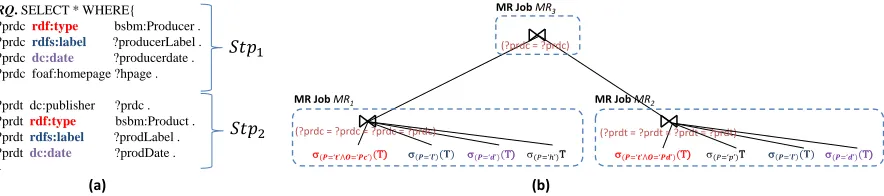
Many real-world semantic networks represented using RDF often consist of entities described using common vocabularies to ensure interoperability and support automatic interconnections with other net-works. For example, most protein entities in Uniprot are often additionally described using predefined RDFS vocabularies such asrdfs:seeAlso, which is often used to provide additional information about entities. As a result, complex graph patterns often containsemantically related subexpressions, i.e., com-mon subexpressions which consist of repeated properties over multiple star patterns. Fig. 3.1(a) shows a two-star-pattern queryRQthat retrieves a list of products and their producers from datasets modeled based on e-commerce usecase scenario. Note that a set of properties are repeated across two star pat-ternsstp1 andstp2 to retrieve labels and (registered) dates of resources typed asbsbm:Productand
bsbm:Producer, e.g.,rdfs:label(blue),dc:date(violet), andrdf:type(red).
Existing approaches often represent these subexpressions based on the first-order relational expres-sions and evaluate them independently, i.e., scan the input relation for that property as many times as it participates in join subqueries. Fig. 3.1(b) shows an execution plan for the queryRQ(Properties/Objects are abbreviated due to space restrictions, e.g.,ldenotesrdfs:label). The plan requires scanning the input relations containing the propertyrdfs:labeltwice, once for each join in which the property par-ticipates. Similarly, relations containingrdf:typeanddc:dateare each scanned twice. Depending on the approach used to partition the joins into MR cycles, such repeated properties may result in redundant scans that increase the overall I/O overhead of such workflows. Hence, there is a need for approaches that enable scan-sharing while processing graph pattern queries with repeated properties.
𝑆𝑡𝑝1
𝑆𝑡𝑝2 RQ.SELECT * WHERE{
?prdcrdf:type bsbm:Producer . ?prdcrdfs:label ?producerLabel . ?prdcdc:date ?producerdate . ?prdc foaf:homepage ?hpage .
?prdt dc:publisher ?prdc . ?prdtrdf:type bsbm:Product . ?prdtrdfs:label ?prodLabel . ?prdtdc:date ?prodDate . }
(a)
(?prdc = ?prdc)
MR Job MR3
(?prdt = ?prdt = ?prdt = ?prdt)
MR Job MR2
(𝑷=‘𝒕’⋀𝑶=‘𝑷𝒄’)(T)
(?prdc = ?prdc = ?prdc = ?prdc)
𝑷=‘𝒍’(𝐓) MR Job MR1
(𝑷=‘𝒅’)(T) (𝑃=‘ℎ’)T
(b)
(𝑷=‘𝒕’⋀𝑶=‘𝑷𝒅’)(T) (𝑃=‘𝑝’)T 𝑷=‘𝒍’(𝐓) (𝑷=‘𝒅’)(T)
Figure 3.1: (a) An example queryRQand (b) a query execution plan forRQon MapReduce
the output of an operator can be sent to more than one operator. This requires either inter-operator or pipelined parallelism which allows concurrent execution of operators to be enabled. However, neither one of these scenarios is possible in the MapReduce model. One of promising approaches to solve these issues is toreformulate the expression into semantically equivalent second-order expressions us-ing NTGA. NTGA allows for evaluating all star subgraph patterns concurrently using a single TG
-GroupFilter, thus it is also possible to concurrently evaluate all related subexpressions in the
pat-terns. However, this model introduces challenges in query executions. In particular, an interpretation of semantically related subexpressions using NTGA needs to handleambiguities. Because multiple star graph patterns include common subexpressions which need to be evaluated concurrently, a triplegroup can potentially match multiple star patterns while triplegroups are assumed to be mapped to a single star pattern in NTGA. Therefore, we need to extend our approach for managing and identifying triplegroups in a way that relaxes the assumption of a single star pattern for each triplegroup.
3.1.1 Contributions
In this chapter, we address the limitation by extending NTGA to identify and manage ambiguities. Specifically, we propose
1. A formal conceptual model that enables a shared evaluation of semantically related subexpressions. 2. A design and algorithm ofTriplegroup Cloningfor handling ambiguities in NTGA.
3. A comprehensive evaluation demonstrating performance benefits of cloning operations.
3.1.2 Related Work
generated from a set of queries and shares the execution or the output of Map/Reduce phases to reduce the cost of execution. However, these studies mostly focus oninter-queryaspects that exploit common expressions across different queries for optimizations rather thanintra-queryones that leverage related subexpressions in subqueries.
Recently intra-query optimizations have been explored in several studies. For example, Cascade-style optimizers in Scope [75] is extended to employ such optimization and select globally optimal plans based on its cost model. YSmart [55] leverages correlations between subqueries to reduce the cost of query execution on MapReduce. It employs a correlation-aware SQL-to-MapReduce translator that identifies correlated subplans and merges them based on a set of rewriting rules to minimize the number of MR jobs. While these works have some resemblances to the approaches introduced in this chapter, they often only focus on query transformation for optimization without transforming intermediate data to share the evaluation of common operations.
Some RDF query processing systems also employ intra-query optimization techniques such as Side-ways Information Passing (SIP) in RDF-3x [61]. However, the goal of optimizations is often different, e.g., SIP focuses on reducing the cost of joins by exchanging meta information between join operators and removing irrelevant intermediate results in advance. However, it does not specifically eliminate the redundant evaluation of related subexpressions. These techniques are complementary to our approach, which could further improve the performance of graph pattern matching queries.
3.2
Foundations
3.2.1 Well-formed, Ambiguous, and Perfect Triplegroups
In the following description of basic concepts, we will assume the existence of an RDF datasetDthat is a collection of statements about propertiesP1, P2, ..., Pn.Dis represented as a set of vertically partitioned
relations P1,P2, ...,Pn. We further assume the existence of the following convenience functions for
any set S of triples or triple patterns: props() returns the set of distinct property names in the set; triples(propname)returns the subset of S whose properties arepropname.
Definition 3.2.1. WELL-FORMED, AMBIGUOUS AND PERFECT TRIPLEGROUPS.
I. Let Q be a query consisting of star patternsstp1, stp3, ..., stpkandtg={t1, t2, ..., tm}be a
triple-group. tg is said to be well-formedwith respect to Q if there exists a subset tg0 of tg such that tg0.props() = stpi.props()for some i. In other words, a well-formed triplegroup contains triples
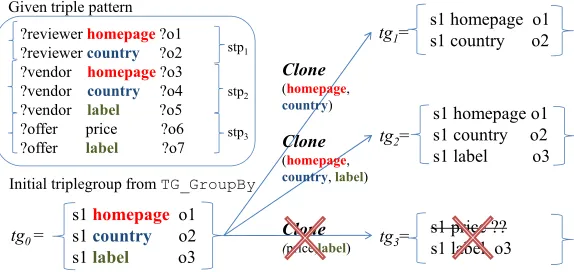
whose properties overlap with some star pattern in a query and therefore can be considered relevant to the query. For example, the triplegroupstg0,tg1, andtg2in Fig. 3.2 are well-formed.
ambiguous triplegroup is one whose properties span multiple star patterns in a query; therefore,tg0
in Fig. 3.2 is an ambiguous triplegroup.
III. Finally, we say thata triplegroup is perfect if tg.props() = stpk.props()for exactly one k. It is
unambiguous and contains no properties except those instpk. Perfect triplegroups are valid answers
for a query. The triplegroupstg1 andtg2in Fig. 3.2 are examples of perfect triplegroup.
?reviewer homepage?o1 ?reviewer country ?o2 ?vendor homepage?o3 ?vendor country ?o4 ?vendor label ?o5 ?offer price ?o6 ?offer label ?o7
s1 homepage o1 s1 country o2 s1 label o3
s1 homepage o1 s1 country o2
Given triple pattern
Initial triplegroup from TG_GroupBy
tg1= stp1
stp2
s1 homepage o1 s1 country o2 s1 label o3
tg2= stp3
s1 price ?? s1 label o3
tg3=
Clone
(homepage,
country)
Clone (price,label)
Clone
(homepage,
country, label)
tg0=
Figure 3.2: Cloning in the context of ambiguous triplegroups
3.2.2 Triplegroup Cloning
Since the currentTG GroupFiltersemantics assume perfect triplegroups as input, we need to ex-tend its definition to deal with ambiguous triplegroups. Specifically, our approach is to have TG -GroupFiltersplit any ambiguous triplegroup tainto a set of subgroups (not necessarily disjoint) representing all perfect triplegroups that are derivabletawith respect to the query. However, care must be taken not to introduce redundant or invalid triplegroups which could result in spurious results. This is handled by a concept we callcloning.
Definition 3.2.2. TRIPLEGROUP CLONING Given a queryQconsisting of star patternsstp1, stp2, ..., stpn
and an ambiguous triplegroupta, cloning creates a triplegroupta0 ⊆taifta0is perfect with respect to some star patternstpi.
Fig. 3.2 shows how perfect triplegroupstg1andtg2 are cloned from the ambiguous triplegrouptg0
and the non-perfect triplegrouptg3is rejected.
Lemma 3.2.1. Triplegroup cloning is lossless.
1. Since ambiguous triplegroups are not perfect for any single star pattern, they do not represent valid intermediate results for any star pattern. Consequently, decomposing an ambiguous triplegroup into subgroups does not destroy any valid intermediate subquery results.
2. Since cloning is applied only to ambiguous triplegroups, we do not introduce redundant triplegroups (redundant triplegroups will amount to duplicate answers in a star pattern subquery result).
3. Since each cloned triplegroup is perfect for a star pattern i.e. is a valid unique result for a star pat-tern subquery, the only other possible way of introducing redundancies is via the redundancies that exists within subgroups of different triplegroup clones (recall that the triples whose properties are re-peated across star patterns will be rere-peated across the corresponding clones). However, each rere-peated property plays a different role in the query and separate bindings are needed for each role. This is analogous to have multiple copies of a relation for a self join. When these the different properties are eventually joined, there will be a single occurrence of the property for each of its roles which is equivalent to the result produced using the relational join operator.
Since cloning is lossless, the final results obtained from joining such intermediate triplegroups using theTG Joinoperator are correct and complete. This is straightforward due to the above lemma and the correctness of our already existingTG Joinoperator which joins intermediate triplegroup results. Algorithm 1 shows the extensions to StarGroupFilterto support handling of ambiguous triple-groups. In themap phase, the tuples are annotated based on the S(subject) component (line 1). In the
reducephase, all tuples corresponding to the same subject component are processed in the same re-duce function. A bitmap (locBitset) is used to keep track of the property types processed (line 3) and the (Property,Object) pairs are stored in a temporary map (tempMap in line 4). After processing all tuples in the group, the locBitSet is matched with all the equivalence classes (star subpatterns) in the query (ECList in line 5). A match with a single equivalence class represents a perfect triplegroup (line 10). A match with more than one equivalence class indicates an ambiguous triplegroup and the temporary map is cloned to retrieve the relevant (Property, Object) pairs corresponding to the matched star subpatterns (lines 7-8). The cloned maps are then used to create perfect triplegroups (line 9) corresponding to the star subpatterns required in the query. A mismatch with all of the star subpatterns results in filtering out of the group of tuples.
3.3
Empirical Evaluation
Algorithm 1: StarGroupFilter
1 Map (key:null, val: Tuple tup(s,p,o)); 3
3 emit hs, tupi ;
4 Reduce (key:Sub, val:List of tuples T);
6
6 foreach tup(s, p, o)∈T do
8
8 set p in locBitset ; 10
10 add (p,o) to tempM ap ; 12
12 matchedList = match(locBitSet, ECList); 14
14 if (|matchedList| >1) then
//Ambiguous TripleGroup 16
16 foreach EC∈matchedList do
18
18 propM ap ← cloneM ap(tempM ap, EC.propList) ; 20
20 emit hRDF M ap(Sub, EC, propM ap)i;
21 else
//Perfect TripleGroup 23
23 emit hRDF M ap(Sub, matchedList[0], tempM ap)i;
in section II.B.1), and (iii) all-star-joins-1-cycle (NTGA approach). Four tasks are designed for the evaluation by varying the selectivity of DupPs (Task 1), the number of DupPs (Task 2), the ambiguity of triplegroups (Task 3), and the size of graphs (Task 4).
3.3.1 Testbed Setup
SetupThe experiments were conducted on 10-node clusters in VCL1, an on-demand virtual comput-ing environment. Each node was equipped with a dual core intel x86 processor (2.33 GHz) and 4GB memory. Pig 0.8.0 and Hadoop 0.20.1 were installed and configured with 256MB for block size and 1GB for the heap-size of child JVMs. We chose Apache Pig that supports relational-style operators (Pig-Def), and extended it to include the NTGA operators (NTGA). Jena2’s ARQ was integrated into Apache Pig to interpret SPARQL queries. SHARD[66] uses a pre-processing MR job to transform all the star-subgraphs (edges sharing the same subject node) into a single record, e.g., triples of a triple-grouptg1in Fig. 3.2 are represented as “s1, (homepage, o1, country, o2)” in SHARD. Other additional
MR jobs such as to process the SELECT clause in a SPARQL query, were disabled. All results recorded were averaged over two or more trials.
TestbedThe BSBM benchmark tool3was used to generate four synthetic datasets using number of Products as the scalability factor – BSBM-{250k, 500k, 750k, 1000k}, with the size of data ranging from 22GB (BSBM-250k with 250k Products and approx. 86M triples in total) to a data size of 87 GB (BSBM-1000k with 1M Products and approx. 350M triples in total). BSBM dataset includes 7 repeated properties - some defined across all classes e.g.type,publisher, and some defined for a smaller subset of classes, e.g.label. The size and selectivity4 of each DupP in BSBM-250k is as follows:publisher
1http://vcl.ncsu.edu
2
http://jena.sourceforge.net
3
http://www4.wiwiss.fu-berlin.de/bizer/BerlinSPARQLBenchmark/spec/
4
Selectivity(P) =|TP|
{1.7GB, 0.091}, type {1.8GB, 0.105}, label {49MB, 0.003}, and date {1.4GB, 0.091}. Additional details are available on the project website5.
3.3.2 Evaluation Results
Task1: varying the selectivity of DupP The task evaluated two queries with varying selectivity of DupPs: (i) rq1 with low selectivity DupP (label) and (ii) rq2 with high selectivity DupP (publisher), both having two star subpatterns each. The experiments showed that NTGA has around 42% perfor-mance gain over Pig-Def for rq1 and increases to around 48% gain for rq2. With the higher selectivty DupP (rq2), Pig-Def uses additional 70 seconds than rq1 due to the overhead of redundant scans. It was observed that NTGA showed similar performance for both rq1 and rq2 and hence, performs better than Pig-Def for queries with varying selectivity of DupP.
00:00 07:12 14:24 21:36 28:48
Pig-Def MR1 MR2 MR3 MR4 NTGA MR1 MR2 SHARD MR1 MR2 (…) MR12 MR13
Map Reduce
Figure 3.3: Comparison of MR execution time of three approaches (Pig-Def, NTGA, and SHARD) for dq4 (BSBM-250k)
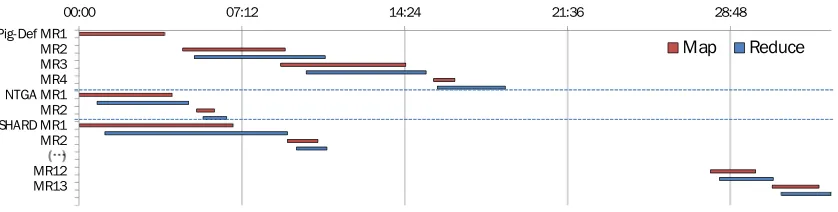
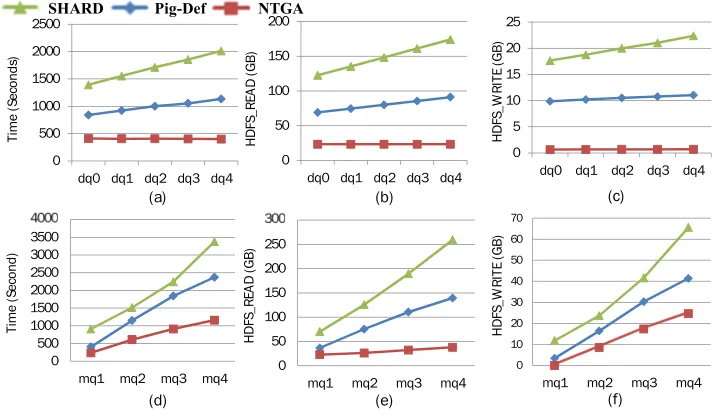
Task2: varying the number of DupPs This task studies the effect of increasing the number of DupPs across a query with two star-joins for BSBM-250k using the three approaches. Four queries (dq0 to dq4) containing two star patterns were considered, with equal numbers of unique properties and varying number of DupPs (from 0 to 4 respectively) in the second star subpattern. The queries include the following DupPs: dq0 (none), dq1 (publisher), dq2(publisher, type), dq3(publisher, type, label), and dq4(publisher,type,label,date). Fig. 3.4(a)∼(c) shows the execution time and HDFS read/write for this task using the three approaches. In general, the 1-join-per-cycle approach in SHARD results in highest execution time and I/O compared to other two approaches. Further, the execution time in SHARD increases as the number of triple patterns increase from 8 to 12 in dq0 to dq4 respectively. For example, the query dq4 is processed using 13 MR cycles in SHARD (including MR1 for pre-processing), 4 MR cycles in Pig-Def and 2MR cycles using the NTGA approach as shown in Fig. 3.3. Note that the execution time of the MR1 in SHARD is longer than the grouping phase of NTGA because SHARD stores the output as raw text format without using any compression or format; such trends were
Pig-Def SHARD NTGA 0 500 1000 1500 2000 2500
dq0 dq1 dq2 dq3 dq4
Ti m e (S ec on ds ) 0 50 100 150 200
dq0 dq1 dq2 dq3 dq4
H D FS _R EA D (G B) 0 5 10 15 20 25
dq0 dq1 dq2 dq3 dq4
H D FS _W RI TE (G B) 0 500 1000 1500 2000 2500 3000 3500 4000
mq1 mq2 mq3 mq4
Ti m e (S ec on d) 0 50 100 150 200 250 300
mq1 mq2 mq3 mq4
H D FS _R EA D (G B) 0 10 20 30 40 50 60 70
mq1 mq2 mq3 mq4
H D FS _W RI TE (G B)
(a) (b) (c)
(d) (e) (f)
Figure 3.4: Comparison of the execution time, the number of HDFS read/written for varying the num-ber of DupPs ((a)∼(c)) and the frequency of DupPs in a query ((d)∼(e)).
observed across other queries. Pig-Def shows relatively better performance compared with SHARD because the number of MR jobs for star-join is mainly affected by the number of star patterns in the queries. Additionally, theSPLIToperator in Pig-Def triggers the insertion of a preceding map-only job (Pig-Def’s MR1 in Fig. 3.3), which helps to reduce some HDFS read I/O in their subsequent jobs due to the compression of the output of MR1. However, the amount of HDFS reads for all queries in Pig-Def is still larger than in NTGA. This is because the DupPs are scanned and processed in BOTH the star-join cycles (MR2 and MR3) in Pig-Def, which results in an increasing amount of HDFS bytes read as the number of DupPs increase. However, in NTGA, it is observed that the execution time and the amount of HDFS reads does not change much with varying numbers of DupPs. This is due to the grouping-based star-join computation approach in NTGA that enables scan-sharing while processing star subpatterns containing DupPs. Additionally, NTGA shows relatively small amount of HDFS written compared with the other approaches due to the compact representation of intermediate data.
Task3: varying the frequency of DupPs in a queryThis task focuses on the evaluation of the three approaches with the increasing occurrence of a DupP across a graph pattern query. Four queries (mq1
52.8% 54.8%
55% 58%
0 500 1000 1500 2000 2500
BSBM-250k
(22GB) BSBM-500k(43GB) BSBM-750k(66GB) BSBM-1000k(86GB)
Ex
ec
ut
io
n
Ti
m
e
(in
s
ec
on
ds
) Varying Input Data Size
Pig-Def NTGA
Figure 3.5: Scalability study of scan-sharing approach for query dq4 with increasing sizes of RDF graphs
Though the occurrence of DupP across increasing number of star patterns leads to an increasing number of ambiguous triplegroups in NTGA, no significant overhead of the cloning process is observed. Similar to Task2, the HDFS writes using NTGA approach is relatively smaller than the other approaches.
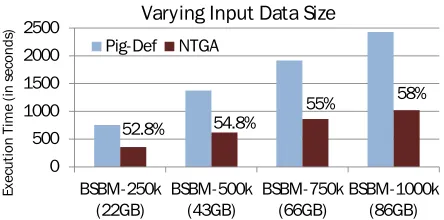
Task4: varying the size of graphsFig. 3.5 shows a comparative evaluation of the two approaches with increasing number of RDF triples for query dq4 used in Task2. The NTGA approach scales well with a performance gain of 52% to 58% ranging over BSBM-250k to BSBM-1000k data sizes, respec-tively.
3.4
Chapter Summary
Chapter 4
Automatic Semantic Typing Scheme for
Semantics-oriented RDF Storage Model
on Hadoop
4.1
Motivation
Type-based optimization [22, 59] has been used for tasks ranging from checking validity of queries to pruning state-space for optimizing queries in relational and semi-structured databases. It has also been foundational to someSemantic Query Optimizationtechniques [22, 58](SQO) where together with the use of integrity constraints, more complex query rewritings or reformulations into efficient queries are achieved. SQO refers to techniques that use integrity constraints to eliminate subexpressions from queries (often joins). But in the case of the growing amount of data represented using RDF, SQO has not been considered for a few reasons. For one thing, the RDF model does not have a strong typing model that is required for type-based optimization, nor does it have integrity constraints in the true sense.