Effect of Salinity on Geotechnical Properties
of Expansive Soils
Bale Nikhil Kumar
1, Jeevana Smitha
2, Dr. K V Uday
3P.G. Student, Department of Civil Engineering, VNR VJIET, Hyderabad, Telangana, India1
Assistant Professor, Department of Civil Engineering, VNR VJIET, Hyderabad, Telangana, India2
Assistant Professor, Department of Civil Engineering, IIT Mandi, Himachal Pradesh, India3
ABSTRACT: Clays are important constituent of soils, the rapid growth in population needs to be settling their lives at various places like sea shore, railway lines, highway embankments etc. So the Geotechnical properties will change depending upon the type of the place. The extent of modification of properties depends not only on the nature of contaminant, but also on the type of soil such as chemical composition, physical nature, mineralogy and metallurgical properties. These contaminants may be inorganic, organic solvents or organic matter. In this study effect of saline water on various geotechnical properties of clayey soil are being explored. A series of tests have been carried out, in order to determine the geotechnical properties like Atterberg limits, Compaction Characteristics and Unconfined Compressive Strength test and their respective results are compared with distilled water. The effect of saline water on expansive soil, carried out using inorganic salt solutions such as NaCl at three types of concentrations (0.001, 0.01, 0.05) are used to study the geotechnical properties of commonly used clayey soils.
KEYWORDS:Saline water, Salts, Geotechnical Properties, Laboratory Tests. I. INTRODUCTION
Expansive soils, with high swell and shrink behavior prove to be challenging for construction and pavement activities. Expansive soils will heave and cause lifting of building or other structures during high moisture variations and they attain shrinkage and it will be result in building settlement during dry spells [1]. They also exert pressure on the vertical face of the foundations, basements and retaining walls resulting in lateral movements [2]. Apart from its effects on building constructions and foundations, they will surely gain impact on roads, ground anchors, underground pipelines and other ground structures.
Expansive soils cover almost 20% of India’s land cover and about 8% of the world’s land cover. Hence, they cannot be simply ignored of construction and pavement activities because of their problematic nature [3]. There are several methods available for improving the characteristics of expansive soils, but an efficient and cost effective method with less time is always preferable.
Most researches on improvement of expansive soils have come out with numerous fruitful solutions including chemical stabilization techniques and deep foundation techniques. The most significant among them being the lime stabilization. The basic concept behind chemical stabilization for expansive soil is that, expansion occurs because of absorption water molecules in the diffuse double layer through three possible mechanisms, the stabilization works on the concept of introducing cation of high valence than that of water, which gets attracted to the clay minerals and brings clay minerals closer together[4].
II. LITERATUREREVIEW
Atterberg limits are one of the tests that are done on dam construction materials. Atterberg limits can be useful indicators of clay behavior. The liquid limit and plastic limits of a type of soil can be correlated with various engineering properties, such as permeability, shrinking and swelling behavior, shear strength, and compressibility of the soil. In addition the evolution of consistency limits provides some very basic mechanical data about the soil and also gives a first insight into the chemical reactivity of clays (Arasan and Yetimoglu, 2008; Shariatmadari et al , 2011). Alamdar, 1991; Mahasneh, 2004; Mansour et al , 2008; Yukselen-Aksoy et al., 2008; Arasan and Yetimoglu, 2008; have studied the effect of salt solutions on the consistency limits of soil. The results have shown the liquid limit and plastic limit of soil decrease as the salinity of pore fluid increases.
Sivapullaiah and Manju, 2005, have investigated the effect of NaOH solution on some geotechnical properties of the soil with low plasticity (LL=38%). Their results have shown that the liquid limit of the soil increases as NaOH solution concentration increases. The reason behind that is the formation of a new swelling compound created by reaction of alkali solution with clay. The effect of four salt solutions including NH4Cl, KCl, CuSO4 and FeSO4 on consistency limits of CL clay and CH clay have been investigated by (Arasan and Yetimoglu, 2008). Their experimental results indicate the liquid limit of CL clay increases as the slat concentration increases whereas the liquid limit of CH clay decreases as the slat concentration increases.
Another test performed on dam construction materials is compaction test. Soil compaction improves strength characteristics of soil and consequently increases bearing capacity of foundations constructed on it. Emami, 2008; Mansour et al., 2008 and Alainachi and Alobaidy, 2010, have evaluated the effect of salinity on the compaction test results. Their results showed that optimum moisture content decreases and maximum dry unit weight of soil increases as the salinity of water increases.
The effects of salt solution on shear strength of soil have been investigated by Chattopadhyay, 1972; Di Maio and Fenelli, 1994; Alamdar, 1999; Tiwari et al., 2005; Ayininuola et al., 2009; Naeini and Jahanfar, 2011 and Siddiqua et al., 2011. In these studies, shear strength of soil has increased as concentration of water increased.
III.EXPERIMENTAL PROGRAM
Materials
For the purpose of stabilization, Black cotton Soil (BC) and NaCl have been used in this study available in Hyderabad. The soil sample was air dried and grounded to determine the various properties, discussed herewith.
Atterberg Limits: The tests were performed according to IS 2720-Part 15, (1985) on soil passing 425µ sieve. For saline water, this test was performed at different concentrations.
Specific Gravity: The Specific gravity (G) of the soil has been determined by exploited some density bottle and pycnometer as per the guidelines provided by IS 2720-Part 3, (1980). The average value has been taken from the three trials was obtained and the result as shown in the table.
Standard Proctor Compaction Test: The soil sample was oven dried at 110 oC for about 24 hours. Later, as per [8] standards, the soil is mixed with the various concentrations (0.001 M, 0.01 M and 0.05M) of salt in weight and then this mix has been compacted in three equal layers with each set of experiments with increasing the water content. Later, based on the compaction curves plotted for the different mix, optimum moisture content (OMC) and maximum dry density (MDD) for each test specimens were obtained.
proving ring to zero. Axial load increment was applied at a strain rate of 1.5 mm/min. Noted the proving reading value at regular intervals of the dial gauge reading.
Index Properties:
Table 01: Properties of the selected material Property BC
Specific Gravity (G) 2.59
Atterberg Limits
LL 44
PL 28
PI 16
Soil Classification CH
Optimum Moisture Content (OMC), (%) 16.8
Maximum Dry Density (MDD) (g/cc) 1.82
Cohesion (kg/cm2) 2.18
Angle of Internal Friction ( o) -
UCC in (kg/cm2) 4.37
IV.RESULTS AND DISCUSSIONS
Geotechnical Properties
Atterberg Limits
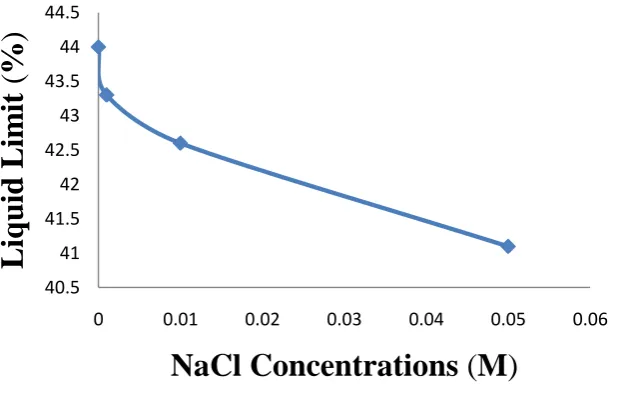
The Atterberg Limits are the primary constituents among the geotechnical properties. These Liquid Limits and plastic limits are determined by performing the Casagrande apparatus and palming respectively. Low influence of salinity on plastic limit can arise little moisture of soil, at this condition that lead to decrease the interaction between soil and solute in water. But in the liquid limit, in which soil moisture is higher, the effect of salinity will be more.
Fig.01 BC + NaCl Liquid Limit Variation corresponding to different concentrations
Mansour et al , 2008 have indicated that the presence of high valence exchangeable cations in Dead Sea brine decrease the distance between particles by decreasing the repulsive forces in the soil microstructure. This causes the Vander
40.5 41 41.5 42 42.5 43 43.5 44 44.5
0 0.01 0.02 0.03 0.04 0.05 0.06
Liqu
id Lim
it
(
%
)
Waals attractive force to be dominant, hence increasing of capillary stress that formed between particles boundaries and finally forming the aggregation. The liquid limit has decreased when the salt concentration is increases as shown in the Fig.01.
Fig. 02 BC + NaCl Plastic Limit Variation corresponding to different concentrations
The Plastic Limit is observed in the sense when the soaking soil is tested for plastic limit; the plasticity gradually decreases with the increase in the salt concentrations. The Plasticity is decreased due to the salt content increment. The plasticity is decreased due to the effect of salt solution on particle adhesive strength. As clay particles flocculates, transforms natural plate like clays particles into needle like interlocking metalline structures, Making the Clay soils
drier and less susceptible to water content changes (Roger et al, 1993).The flocs behave as silt particles which is least
plastic. That is why a reduction is observed in the plastic limit according to Fig.02.
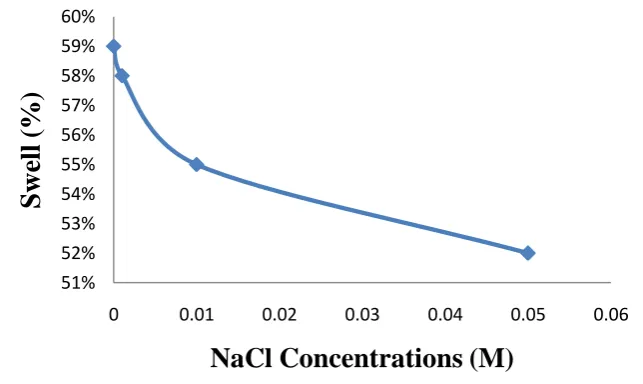
Free Swell Index
Fig.04 Free Swell Index
0.05, 26.6 26.4
26.6 26.8 27 27.2 27.4 27.6 27.8 28 28.2
0 0.01 0.02 0.03 0.04 0.05 0.06
Plas
tic
Lim
it
(
%
)
NaCl Concentration
(
M
)
51% 52% 53% 54% 55% 56% 57% 58% 59% 60%
0 0.01 0.02 0.03 0.04 0.05 0.06
Sw
el
l
(%
)
The Free Swelling Index of the chosen soil has gradually decreases from 0 concentrations to 0.05 Conc. The Free swelling index decreases by increasing the salt concentration in the distilled water due to the decrement in the attraction between the soil particles and fineness increment can be observed.
Compaction Characteristics
Fig.03 BC + NaCl OMC variation at different Concentrations
According to Fig.03, the Optimum Moisture Content of the BC soil has decreases gradually with the increasing of the salinity of water. For Normal soaked BC soil the omc value is 16.8 % and it is slowly obtained to 14.8 % at 0.05 M concentration of soil. It is observed that when the salt content added to the soil particles, then the particles are divided each other due to clay mineral salt reactions.
Fig.04 BC + NaCl MDD variation at different Concentrations
14.5 15 15.5 16 16.5 17
0 0.01 0.02 0.03 0.04 0.05 0.06
Op
tim
u
m
M
oistu
re
Conte
n
t
(%
)
NaCl Concentrations (M)
1.8 1.82 1.84 1.86 1.88 1.9 1.92 1.94 1.96
0 0.01 0.02 0.03 0.04 0.05 0.06
M
axim
um
D
ry
D
ens
ity
(
g/c
c)
To fill the pores among the soil particles to bind the soil particles each other, there is requirement of excess amount of water. Due to this one some amount of water is added for each compaction. In the result, there is an increment of optimum moisture content of the soil. The maximum dry density of the soil increases as the concentration levels increased as depicted in the Fig.04.
Unconfined Compressive Strength
Fig.05 BC + NaCl 0.001 M UCC Strength
The Unconfined Compressive Strength of the Black cotton soil treated with the 0.001 M concentration of NaCl salt has been shown in the Fig.05. The UCC value is observed as increment from the normal black cotton soil treated with
distilled water. The UCC value was obtained as 4.82 kg/cm2.
Fig.06 BC + NaCl 0.01 M UCC Strength
0
1
2
3
4
5
6
0
2
4
6
8
10
12
14
16
A
x
ia
l
Str
es
s
(k
g
/cm
2
)
Axial Strain (%)
0
1
2
3
4
5
6
0
2
4
6
8
10
12
14
16
Axi
a
l
Str
es
s
(k
g
/cm
2
)
The Unconfined Compressive Strength of the Black cotton soil treated with the 0.01 M concentration of NaCl salt has been shown in the Fig.06. The UCC value is observed as increment from the normal black cotton soil treated with
distilled water and BC + Nacl 0.001 M sample. The UCC value was obtained as 5.52 kg/cm2.
Fig.07 BC + NaCl 0.01 M UCC Strength
The Unconfined Compressive Strength of the Black cotton soil treated with the 0.01 M concentration of NaCl salt has been shown in the Fig.07. The UCC value is observed as increment from the normal black cotton soil treated with
distilled water, BC + NaCl 0.001 M and BC + NaCl 0.01 M sample. The UCC value was obtained as 6.24 kg/cm2.
Fig.08 BC + NaCl 0.01 M UCC Strength
0
1
2
3
4
5
6
7
0
2
4
6
8
10
12
14
16
A
x
ia
l
Str
es
s
(k
g
/cm
2
)
Axial Strain (%)
0
1
2
3
4
5
6
7
0
0.01
0.02
0.03
0.04
0.05
0.06
A
x
ia
l
Str
es
s
(k
g
/cm
2
)
According to Fig.08, the Unconfined Compressive strength of normal black cotton soil and the soil which is treated with different concentrations namely 0.001 M, 0.01 M and 0.05 M. The Unconfined compressive strength value is
gradually increased from 4.37 kg/cm2 to 6.24 kg/cm2.
V. CONCLUSIONS
Reference to the above results and discussion, the study reached the following conclusions:
The Atterberg Limits are decreased gradually by increasing the salt content to the soil sample.
The maximum dry unit weight increased by adding solute water compared to the samples tested using distilled
water.
The optimum moisture content decreased by adding saline water to the soil in the sense of difference
concentrations namely 0.001M, 0.01M, and 0.05M.
The Decrement observed in the Free swell index of the chosen soil by conducting the Swelling test.
UCC value has also varied for the tested samples by adding saline water compared to the samples tested using
distilled water in the Laboratory.
Soil UCC strength is an important index to be determined for laying foundations in the sea shores and the salty
soil areas. The UCC strength has been increases with the addition of salt content to the water which have to be treated with soil.
REFERENCES
[1] Abbasi, N., “The Role of Anions in the Dispersion Potential of Clayey Soil,” Journal of Agricultureal Engineering Research, 12. (In pertioan), 2011.
[2] Alainachi, I. H., and G.A. Alobaidy., “The Effects of Basra Gulf Salt Water on The Proctor Compaction and CBR Test Results of Soil Samples at Baniyas City, Abu Dhabi, UAE,” Electronic Journal of Geotechnical Engineering, 15., 2010.
[3] Alamdar, S. S.,“Long time Effect of Saline Water on Clay,” M.Sc Thesis, Faculty of Engineering, Tarbiat Modares University. (In Pertioan)., 1999.
[4] Arasan, S., and T. Yetimoglu., “Effect of Inorganic Salt Solutions on the Consistency Limits of Two Clays,” Turkish J. Eng. Env. Sci, 32, 107-115., 2008.
[5] Ayenu-Prah, Jr. A. Y., “Effect of the Chemical Composition of Compaction Water on the Performance of Soil Subgrades and Embankments,” M.Sc. Thesis,Texas Tech University, 62 P, 2004.
[6] Ayininuola, G. M., O. A., Agbede and S. O. Franklin., “Influence of Calcium Sulphate on Subsoil Cohesion and Angle of Friction,” Journal of Applied Sciences Research, 5, 297-304, 2009.
[7] Chaudhari, S., “Saturated Hydraulic Conductivity, Dispersion, Swelling, and Exchangeable Sodium Percentage of Different Textured Soils as Influenced by Water Quality,” Communications in Soil Science and Plant Analysis, 32, 2439-2455, 2001.
[8] Chattopadhyay, p. K., “Residual Shear Strenght of Some Pure Clay Mineral,” Ph.D Dissertation, Department of Civil Engineering of Alberta. Edmonton, 1972.
[9] Di Maio, C., and G. b. Fenelli., “Residual Strenght of Kolin and Bentonit: The Influence of Their Constituent Pore Fluid,” Geotecnique, 44, 2, 217-226, 1994.
[10] Emami Azadi, M. R., “The Effects of Urmieh Lake Salt Water on the Proctor Compaction and CBR Test Results of Well Graded Gravel-Sand Mixed With Clay (GSCW) Soil Samples,” Electronic Journal of Geotechnical Engineering, 13, 2008.
[11] Knodel, P. C., “Characteristics and Problems of Dispersive Clay Soils,” U.S. Department Of The Interiorbureau of Reclamation Denver Off IceResearch and Laboratory Services Division Materials Engineering Branch, 1991.
[12] Mansour, Z. M., M. R. Taha and Z. Chik., “Fresh- Brine Water Effect on the Basic Engineering Properties of Lisan Marl-Dead Sea- Jordan,” Journal of Applied Sciences, 8, 3603-3611, 2008.
[13] Mahasneh, B. Z., “Dead Sea Water as a Soil Improvement Agent,” Electronic Journal of Geotechnical Engineering, 9, 2004.
[14] Naeini, S. A., and M. A. Jahanfar., “Effect of Salt Solution and Plasticity Index on Undrain Shear Strength of Clays,” World Academy of Science Engineering and Technology, 73, 2011.