79
IMPROVING THE STRENGTH PROPERTIES OF SUBGRADE SOILS WITH
FLY ASH
1,2
Abiola, O. S.,
2Molemo, S.,
2Muluvhu, M. E.,
2Zitholele, M. V.,
2Sephai, K., and
2Kupolati, W. K
Department of Civil Engineering, Federal University of Agriculture, Abeokuta Nigeria Department of Civil Engineering, Tshwane University of Technology, Pretoria South Africa
e-mail: [email protected] Phone no: +2348062483207 Abstract
Subgrade soils encountered during road construction are not always good materials to respond to the imposed stresses which has become a dominating factor for the failure of pavements in Nigeria. The subgrade materials were sourced from three locations within South Africa namely, Heanertsburg Village (A), Laudium, South West of Pretoria (B), and Eskia Mphahele drive to Francis Baard Street, Pretoria (C). Fly Ash (FA) was added to samples A, B, and C at 3-12%, 5-15%, and 9-12% respectively. Sieve analysis, compaction, Unconfined Compressive Strength (UCS) and Indirect Tensile Strength (ITS) tests were conducted on the virgin and stabilized soil samples for a curing time of 1, 7 and 28 days. The soils were classified as A-7-6, A-6 and A-2-6 according to AASHTO for samples A, B and C respectively. UCS and ITS was improved with the addition of FA to all the soil samples. The UCS results for sample A (406 kN/m2) and B (625 kN/m2) falls short of 1710 kN/m2 specified for
cement stabilized base materials but 12% and 10% FA treated soils may be used as improved subgrade for flexible pavement construction. However, sample C result meets the requirement of 687-1373 kN/m2 for sub-base at 100% relative compaction. All the stabilized samples increase in ITS with respect to increasing curing days and FA. Only sample C attained to the specified ITS value. Therefore, FA can be used to improve the subgrade in order to withstand the imposed stress.
Keywords: subgrade, fly ash, stabilization, unconfined compressive strength, indirect tensile strength
Introduction
Poor subgrade soil conditions can result in inadequate pavement support and reduce pavement life. Soil may be improved through the addition of chemical or cementation additives. These chemical additives range from waste products to manufactured materials and include lime, fly ash, coal ash, slag, rice husk ash, gypsum, sludge ash, bitumen, cement, proprietary and cement kiln dust. They can be used with a variety of soils to help improve their native engineering properties(Ahmed
et. al., 2010; Ahmed et. al., 2011; Kamei et. al., 2007; Miller & Azad, 2000; Baghdadi et. al., 1995; Sobhan & Mashnad, 2003; Arora & Aydilek, 2005; Lin et al., 2007; Maslehuddin et. al., 2008; Chen & Lin, 2009; Ahmed et. al., 2009; Ugai & Ahmed, 2009; Sreekrishnavilasam, Rahardja, & Santagta, 2007, Kamei et al, 2013). The effectiveness of these additives depends on the soil treated and the amount of additives used. Expansive soils are more problematic for construction and are predominantly available in majority places in semi-arid region. These soils undergo swelling and shrinkage, thus they pose lot of problems to the structure found on them(Osinubi et al., 2010; Sabtan, 2005). The swelling of this clay is related to three factors: geology, the engineering factors of the soil, and local environmental conditions. Geology determines primarily the presence of types of
expansive clay minerals while the engineering factors include moisture content, plasticity and dry density. The local environmental conditions considered are the amount of clay fraction in the soil, initial moisture conditions and confining pressure (Sabtan, 2005). Stabilization using additives controls the adverse effects on structures and pavement. When additives containing calcium hydroxide are mixed with the soil, the calcium causes the clay particles to flocculate into a more sand-like structure reducing the plasticity of the soil (Little, 1995). This reduction in plasticity is called modification, reduces the swell characteristics of the soil. Soil stabilization includes the effects from modification with significant additional strength gain. The soil must be able to react with the chemical additives to achieve the soil stabilization or modification that is desired.
80 (2013) examined the physical and compaction behavior of clay soil-fly ash mixtures. Physical properties and compaction characteristics as well as swell potential tests were evaluated. Results showed that consistency limits, compaction characteristics and swelling potential of expansive soil-fly ash mixtures were significantly modified and improved at 40% fly ash content. Hakari & Puranik, (2012)explored the effect of Dandeli Fly Ash (FA) treatment of the black cotton soils of Hubbali–Dharwad on their index, compaction and strength properties in an effort to improve their geotechnical characteristics. It was observed that the geotechnical properties of the soil was improved using the FA at 20–40%. The plasticity parameters exhibit favourable changes in their values. The compaction characteristics, namely the Maximum Dry Density (MDD), increase with a corresponding decrease in the Optimum Moisture Content (OMC). The California Bearing Ratio (CBR) as well as the Unconfined Compressive Strength (UCS) of these soils showed an increase in their values upon the addition of FA. This study investigatedweak soils from three different locations in South Africa with the aim to improve their strength properties with Fly Ash addition.
Materials and Experimental Details
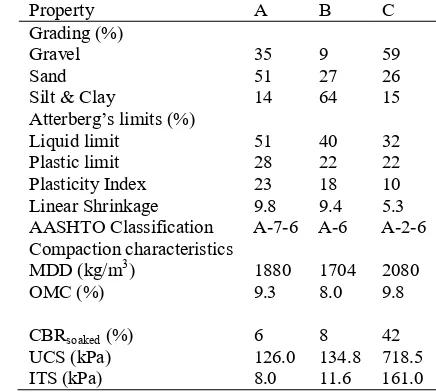
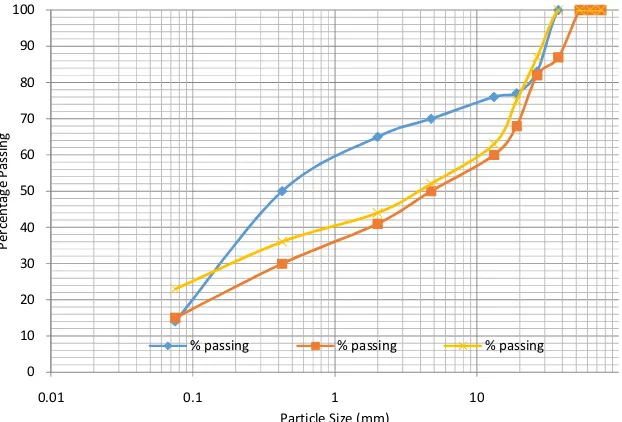
The subgrade materials were sourced from three locations within South Africa namely, Heanertsburg Village, 60 km east of Polokwane city (Type A), Laudium, 10km South West of Pretoria (Type B), and Eskia Mphahele drive to Francis Baard street, Pretoria (Type C). The materials were obtained from a depth of 700-1000 mm below natural ground level in plastic bags and taken to the laboratory while Fly Ash (FA) was obtained commercially. The soil samples A,B, and Cwere air-dried, clumps pulverized in abrasion machine and index properties of the soils were presented in Table 1. Sieve analysis, compaction characteristics, Unconfined Compressive Strength (UCS) and Indirect Tensile Strength (ITS)tests were conducted on the virgin and stabilized soil samples in accordance with TMH 1- Standard Methods of Testing Road Construction Materials (1986) and American Association of State Highways and Transportation Officials (AASHTO). The grain size distribution for the samples is shown in Figure 1. FA was added to samples A, B, and C at 3-12%, 5-15%, and 9-12% respectively
Table 1 Geotechnical Characteristics of Natural Soil Samples
Property A B C
Grading (%) Gravel Sand Silt & Clay
35 51 14
9 27 64
59 26 15 Atterberg’s limits (%)
Liquid limit Plastic limit Plasticity Index Linear Shrinkage
51 28 23 9.8
40 22 18 9.4
32 22 10 5.3 AASHTO Classification A-7-6 A-6 A-2-6 Compaction characteristics
MDD (kg/m3)
OMC (%) 1880 9.3 1704 8.0 2080 9.8
CBRsoaked (%) 6 8 42
UCS (kPa) 126.0 134.8 718.5
81
Figure 1 Particle size distribution of the natural soil samples at OMC compacted to 100% modified AASHTO as
outlined in TMH 1. The compacted specimens were placed in humidity room for a curing time of 1, 7 and 28 days (Abiola et. al., 2017; Osinubi et al., 2010; Horpibulsuk et. al., 2010) before testing.
Results and Discussion
The soils were classified as A-7-6, A-6 and A-2-6 according to AASHTO classification system for samples A, B and C respectively. The Nigerian General Specification (1997) recommended the use of materials with percent passing BS No. 200 sieve to be less than but not greater than 35% was met in sample C, the requirement of liquid limit not greater than 50% for subgrade soil was deficient in sample A. CBR of the samples A, B, and C were 6, 8 and 42% respectively, TRH 14 classifies material with CBR value ranging from 3-7% as poor to fair.
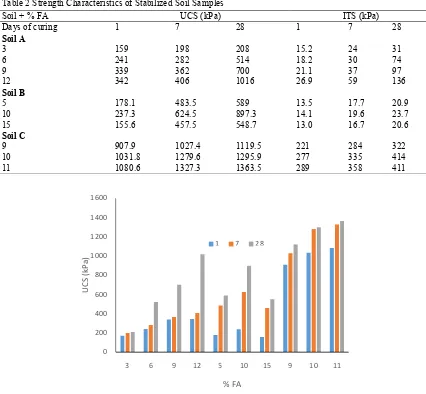
Figure 2 shows the trend of changes of UCS with various percentages of FA for 1, 7 and 28-day curing with soil samples A, B and C. The addition of FA generally increased the UCS of the soil specimens with increase in FA content. The observed trends could be attributed to ion exchange at the surface of clay particles. The Ca2+ in FA
reacted with clay microstructure which resulted in agglomeration of the clay particles (Salahudeen et al., 2014). The increase in the UCS values was primarily as a result of the formation of various compounds such as calcium silicate hydrates and calcium aluminate hydrates (Horpibulsuk et al., 2012a; Horpibulsuk et al., 2013). Stabilized
sampleA with increase in FA from 3 to 12%, UCS increases to 31, 113, 106 and 197% from 1 day to 28 days respectively while sample B with FA has its optimum UCS at 10% FA for all the curing periods considered. SampleC showed increase in UCS for all percentages of FA and the curing periods considered.
The UCS results obtained for sample A (406 kN/m2) and B (625 kN/m2) falls short of 1710
kN/m2specified by (TRRL, 1977) for base
materials stabilization using cement, but 12% and 10% FA treated soils may be used as improved subgrade for flexible pavement construction. However, sample C results meets the requirement of 687-1373 kN/m2 for sub-base as specified by
Ingles & Metcalf (1972) and C4 (cemented natural gravel-TRH14, 1985)-750 kN/m2 at 100% relative
compaction (Maneli et al, 2015).
Tensile strength is a very important geotechnical parameter to predict the cracking behavior of pavements, earth dams and earth structures using stabilized soils(Ismaiel, 2006). Table 2 summarizes the results of ITS stabilized with FA for different curing periods. It was observed for all the stabilized samples increase in ITS with respect to increasing curing days and FA. TMH 1 specifies minimum limit for ITS of cemented materials, these are 200 kPa for C4 and 250 kPa for C3 materials at 100% relative density.Only sample C attained to the required ITS for both C3 and C4 materials. There is great improvement in both compressive and tensile strength for the stabilized materials compared with the virgin material.
0 10 20 30 40 50 60 70 80 90 100
0.01 0.1 1 10
Pe
rc
en
ta
ge
P
as
sin
g
Particle Size (mm)
82
0 200 400 600 800 1000 1200 1400 1600
3 6 9 12 5 10 15 9 10 11
UC
S (
kP
a)
% FA
1 7 28
Table 2 Strength Characteristics of Stabilized Soil Samples
Figure 2 Variability of UCS wth FA
Conclusion
This article investigates subgrade soil from three different locations in South Africa to improve their strength properties with Fly Ash to ascertain their use in pavement construction. The following conclusions can be drawn:
(a) The soils were classified as A-7-6, A-6 and A-2-6 according to AASHTO classification system for samples A, B and C respectively, sample C met the condition for percent passing BS No. 200 sieve to be less than but not greater than 35%, while the requirement of liquid limit not greater than 50% for subgrade soil was deficient in sample A.
(b) CBR of the samples A, B, and C were 6, 8 and 42% respectively
(c) Stabilized sample A with increase in FA from 3 to 12%, UCS increases to 31, 113, 106 and 197% from 1 day to 28 days respectively while sample B with FA has
its optimum UCS at 10% FA but Sample C showed increase in UCS for all percentages of FA and the curing periods considered.
(d) The UCS results obtained for sample A (406 kN/m2) and B (625 kN/m2) falls short
of 1710 kN/m2specified for cement
stabilized base materials but 12% and 10% FA treated soils may be used as improved subgrade for flexible pavement construction. However, sample C results meets the requirement of 687-1373 kN/m2
for sub-base at 100% relative compaction. (e) All the stabilized samples increase in ITS
with respect to increasing curing days and FA. Only sample C attained to the specified ITS for both C3 and C4 materials.
References
Soil + % FA UCS (kPa) ITS (kPa)
Days of curing 1 7 28 1 7 28
Soil A
3 159 198 208 15.2 24 31
6 241 282 514 18.2 30 74
9 339 362 700 21.1 37 97
12 342 406 1016 26.9 59 136
Soil B
5 178.1 483.5 589 13.5 17.7 20.9
10 237.3 624.5 897.3 14.1 19.6 23.7
15 155.6 457.5 548.7 13.0 16.7 20.6
Soil C
9 907.9 1027.4 1119.5 221 284 322
10 1031.8 1279.6 1295.9 277 335 414
83 Abiola, O. S., Maneli, A., Kupolati, W. K., & Ndambuki, J. M. (2017). Influence of curing time and compaction effort on black cotton soil stabilised with fly ash, ground granulated blast furnace slag and lime. Nigeria Journal of Engineering and Applied Sciences, 4(1), 25-30.
Ahmed, A., Shehata, M., & Easa, S. (2009). Use of factory-waste shingles and cement kiln dust to enhance the performance of soil used in road works. Adv Civil Eng J.Pg???
Ahmed, A., Ugai, K., & Kamei, T. (2010). Application of gypsum waste plasterboard and waste plastic trays to enhance the performance of sandy soil. Proceedings of Geo-Shangai 2010, ground improvement and
geosynthetic, vol. 207 (pp. 165-173). ASCE.
Ahmed, A., Ugai, K., & Kamei, T. (2011). Investigation of recycled gypsum in conjunction with waste plastic trays for ground improvement. Constr Build Mater, 25(1), 208-217.
Amiralian, S., Chegenizadeh, A., & Nikraz, H. (2012). A review on the lime and fly ash application in soil stabilization. Int J Biological, Ecological and Environmental Sci 1(3), 124-126.
Arora, S., & Aydilek, A. H. (2005). Class F fly ash amended soils as highway base material. Mater Civil Eng, ASCE, 17(6), 640-649.
Baghdadi, Z. A., Fatani, M. N., & Sabban, N. A. (1995). Soil modification by cement kiln dust. Mater Civil Eng, 4, 218-222.
Chen, L., & Lin, D. F. (2009). Stabilization treatment of soft subgrade soil by sewage sludge ash and cement. J Hazard Mater, 162, 321-327.
Hakari, U. D., & Puranik, S. C. (2012). Stabilization of black cotton soil using fly-ash Hubbali-Dharwad municipal corporation area, Karnataka India. Global Journal of Researches in Engineering (E), 12(11).Pg ??? Harichane, H., Ghrici, M., & Kenai, S. (2012). Effect of the combination of lime and natural pozzolana on the compaction and strength of soft clayey soil: A
preliminary study. Environmental Earth Sciences, 66(8), 2197-2205.
Harichane, K., Ghrici, M., & Missoum, H. (2011). Influence of natural pozzolana and lime additives on the temporal variation of soil compaction and shear strength.
Frontiers of Earth Science, 5(2), 162-169. Horpibulsuk, R., Rachan, A., Chinkulkijniwat, Y., Raksachon, A., & Suddeepong, A. (2010). Analysis of strength development in cement-stabilized silty clay from microstructural considerations. Contr Build Mater, 24(10), 2011-2021.
Horpibulsuk, S., Phetchuay, C., & Chinkulkijniwat, A. (2012a). Soil stabilization by calcium carbide residue and
fly ash. J. Mater. Civ. Eng., 10.1061/(ASCE)MT.1943-5533.0000370. , 184-193.
Horpibulsuk, S., Phetchuay, C., Chinkulkijniwat, A., & Cholaphatsorn, A. (2013). Strength development in silt clay stabilized with calcium carbide residue and fly ash.
Soils Found., 53(4), 477-486.
Ingles, O. G., & Metcalf, J. B. (1972). Soil Stabilization: Principles and Practice. Sydney, Australia: Butterworths. Ismaiel, H. A. (2006). Treatment and Improvement of the geotechnical properries of different soft fine-grained soils using chemical stabilization. Germany: Unpublished PhD Martin Luther Halle-Wittenberg University.
Kamei, T., Kato, T., & Shuku, T. (2007). Effective use for bassanite as soil improvement materials-recycling of waste plasterboard. Geotech Soc Electr J, 2(3), 245-252. Kavak, A., & Bayakal, A. (2012). Long-term behaviour of lime-stabilized kaolinite clay. Environmental Earth Sciences, 66(7), 1943-1955.
Lin, D. F., Lin, K. L., Hung, M. J., & Luo, H. L. (2007). Sludge ash/hydrated lime on the geotechnical properties of soft soil. J Hazard Mater, 145, 58-64.
Little, D. N. (1995). Handbook for Stabilization of Pavement Subgrades and Base Courses with Lime. Dubuque, Iowa: National Lime Association, Kendall/Hunt Publishing Company.
Maneli, A., Kupolati, W. K., Abiola, O. S., & Ndambuki, J. M. (2015). Influence of fly ash, ground-granulated blast furnace slag and lime on unconfined compressive strength of black cotton soil. Road Materials and Pavements Design, 17 (1), 252-260.
Maslehuddin, M., Al-Amoudi, O. S., Shameem, M., & Rehman, M. K. (2008). Usage of cement kiln dust in cement products-research review and preliminary investigations. Const Build Mater, 22, 2369-75.
Miller, G. A., & Azad, S. (2000). Influence of soil type on stabilization with cement kiln dust. Constr Build Mater, 14, 89-97(in Japanese).
Mir, B. A., & Sridlam, A. (2013). Physical and compaction behaviour of clay soil-fly ash mixtures. Geotechnical Geological Engineering, 31, 1059-1072.
Osinubi, K. J., Soni, E. J., & Ijimdiya, T. S. (2010). Lime and slag admixture improvement of tropical black clay road foundation. TRB 89th Annual Meeting CD-ROM: Recycled Materials in Transportation Infrastructure
(pp. 1-18). Washington, D. C. USA: Transportation Research Board. Sabtan, A. (2005). Geotechnical properties of
84 Arabia. J Asian Earth Sci, 25(5) ,
747-757.
Salahudeen, A. B., Eberemu, A. O., & Osinubi, K. J. (2014). Assessment of cement kiln dust-treated expansive soil for the construction of flexible pavements. Geotech Geol Eng. Sobhan, K., & Mashnad, M. (2003). Mechanical
stabilization of cement soil-fly ash mixtures with recycled plastic strips. J Environ Eng, 129(10), 943-947. Sreekrishnavilasam, A., Rahardja, S., & Santagta,
M. (2007). Soil treatment using fresh and land-filled cement kiln dust. Constr Build Mater, 21(2), 318-327.
TRH14. (1985). Guidelines for road construction materials. Pretoria: South African Roads Board.
TRRL. (1977). A Guide to the structural design of bitumen surfaced roads in tropical and sub-tropical countries. London: Transport and Road Research Laboratory, Road Note 31, Her Majesty Office. Geo-Institute ASCE.
Ugai, K., & Ahmed, A. (2009). Evaluation of using gypsum waste plasterboard in ground improvement. Proceeding of the National workshop on recycling waste