COMPARATIVE STUDY OF CHEMICAL
STABILIZATION OF SOFT SOILS USING LIME AND
FLY ASH
*Krishna Kumar.P, **Aswin Lekha.D, ***Sakthivel.M
*Assistant Professor, Dept of Civil Engineering, KCG College of Technology, Chennai, India
** Student, Dept of Civil Engineering, B.S.Abdur Rahman University, Chennai, India
***Assistant Professor, Dept of Civil, KCG College of Technology, Chennai , India
ABSTRACT
Soft soils were clay soils found in many parts of the world. The clay soils possess excessive heave, low shear strength, internal erosion, swell shrink behaviour and poor drainage properties etc. When compared to other type of soils, the strength development of soft soil is time dependent. General construction problems in this soil deposit were insufficient bearing capacity, excessive post construction settlement and instability on excavation and embankment forming. The engineering characteristics on soft soil were well documented through researches and field trials. One of the possible solutions to overcome the undesirable properties of clayey soil is chemical stabilization to modify its characteristics by addition of admixtures like lime, cement, polymers, fly ash, polystyrene etc. The easily available additives among them were lime and fly ash. Stabilization of soils is essential for utilizing existing ground for various construction purposes. This paper represents the results of geotechnical investigations on lime treated and fly ash treated clay soil from a part of Kerala. Dosage of lime as well as fly ash applied in the order was 2%, 4%, 6%, 8% and 10% by weight. Laboratory experiments were done after a curing period of 7 days. Various tests including consistency limits, unconfined compressive strength tests, proctor compaction tests, permeability tests and California bearing ratio tests were conducted on the untreated, lime-treated and fly ash-treated soils. The optimum dosage of lime and fly ash required for the satisfactory stabilization of clay soils is acquired by the end of test results. The test results also indicated that the addition of lime to clayey soil was more effective in improving the properties than the addition of fly ash.
Keywords – addition of admixtures, clay soil properties, general construction problems, lime treated and fly ash treated clay soil, optimum dosage, tests to study the geotechnical properties.
INTRODUCTION
need to be stabilized to improve their properties. Moreover, more construction of civil engineering structures is carried out over soft soil, which leads to the establishment and development of various ground improvement technique such as soil stabilization, Expedite pore water dissipation, platform settlements through the insertions of prefabricated vertical drains (PVD) and surcharge fills. Other methods were to modify subsoil bearing capacity through the installation of stone column or sand compaction piles, Embankment basal strengthening with geosynthetics, Use of light weight material made of Expanded Polystyrene blocks to replace conventional fills, etc. The applications of these methods were constrained by technical feasibility, construction cost, space and time.
Soil stabilization is a technique introduced many years ago with the main purpose to render the soils capable of meeting the requirements of the specific engineering projects. Several additives, which may be utilized for ground modification such as cement, lime and mineral additives such as fly ash, silica fume, rice husk ash, have been used under various context. The stabilization, especially with lime, is a common applied method among the others due its effective and economic usage. Lime as an additive, brings several beneficial changes in the engineering properties of soil.
In recent years, industrial by-products have been added and mixed with soft soils to improve their engineering properties. The improved characteristics of soft soils, resulting from the utilization of cementing additives like fly ash, rice husk ash and silica fume, bring about environmental and economic benefits.
The effectiveness of these by-products for stabilization of soft soils has been investigated.
MATERIALS AND METHODS
The materials used were clayey soils and the additives used were lime and fly ash.
Clayey soil: the soil sample used for the study was collected from Palakkad, a part of Kerala.
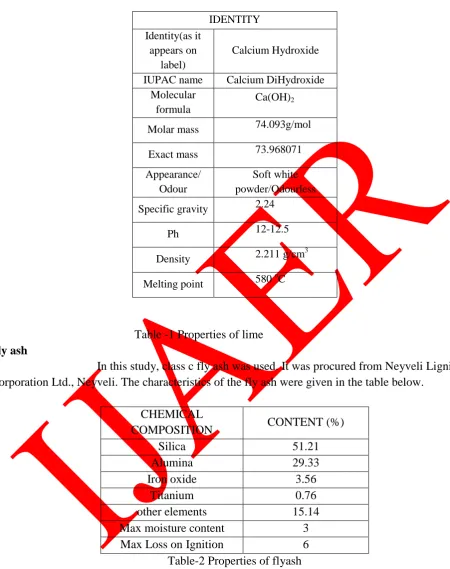
Table -1 Properties of lime
Fly ash
In this study, class c fly ash was used. It was procured from Neyveli Lignite Corporation Ltd., Neyveli. The characteristics of the fly ash were given in the table below.
CHEMICAL
COMPOSITION CONTENT (%)
Silica 51.21
Alumina 29.33
Iron oxide 3.56
Titanium 0.76
other elements 15.14
Max moisture content 3
Max Loss on Ignition 6
Table-2 Properties of flyash
METHODS
The tests performed on the procured soil sample were, IDENTITY Identity(as it
appears on label)
Calcium Hydroxide
IUPAC name Calcium DiHydroxide Molecular
formula
Ca(OH)2
Molar mass 74.093g/mol
Exact mass 73.968071
Appearance/ Odour
Soft white powder/Odourless
Specific gravity 2.24
Ph 12-12.5
Density 2.211 g/cm
3
Melting point 580
Specific gravity determination
The tests performed on both treated and untreated soil samples were, Consistency limits test
Unconfined compressive strength test Proctor compaction test
Permeability test
California bearing ratio test
RESULTS
Untreated sample
The clay soil sample is collected and before treating the soil sample with the additives was tested for the basic properties and the results obtained were given in the table below.
Property Value
Specific gravity 2.44
Liquid limit (%) 47.75
Plastic limit (%) 24.26
Shrinkage limit (%) 15.29
Plasticity index (%) 23.49
Grain size distribution Sand
Silt Clay
47% 20% 33%
Unified soil classification symbol CI
Compaction Characteristics Maximum dry density (g/cc) Optimum moisture content (%)
CBR value (%) Permeability (cm/s)
Lime treated sample
Unconfined compressive strength test
The lime treated soils were casted into UCC samples of dimensions 3.8cm diameter and 7.6cm length and were tested. The results obtained were shown in the graph.
Figure 1 Unconfined compressive strength test
Consistency limits test
Figure 2 consistency limits test results of lime treated soi
Proctor compaction test
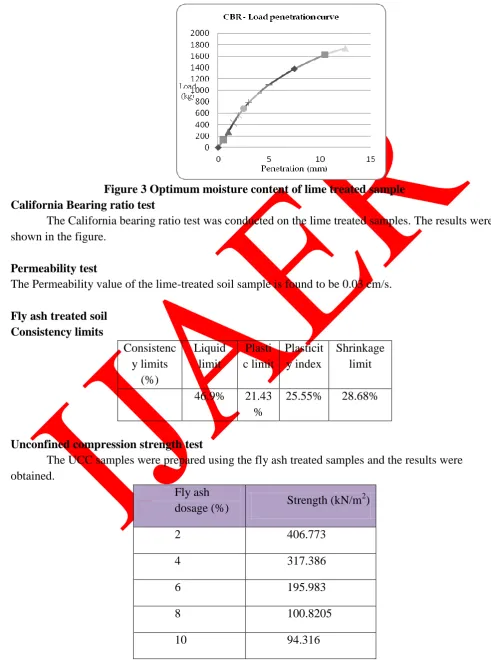
Figure 3 Optimum moisture content of lime treated sample California Bearing ratio test
The California bearing ratio test was conducted on the lime treated samples. The results were shown in the figure.
Permeability test
The Permeability value of the lime-treated soil sample is found to be 0.03 cm/s.
Fly ash treated soil Consistency limits
Consistenc y limits
(%)
Liquid limit
Plasti c limit
Plasticit y index
Shrinkage limit
46.9% 21.43 %
25.55% 28.68%
Unconfined compression strength test
The UCC samples were prepared using the fly ash treated samples and the results were obtained.
Fly ash
dosage (%) Strength (kN/m
2
)
2 406.773
4 317.386
6 195.983
8 100.8205
Proctor compaction test
The Maximum dry Density obtained was 1.56 at optimum moisture content of 17.6% whereas the maximum dry density obtained for untreated sample was 1.68 at an optimum moisture content of 16.13%.
California bearing ratio test
The CBR value obtained for the fly ash treated soil specimen was 16% at 2.5 mm penetration.
Permeability test
The permeability value for fly ash treated soil was 0.004409 cm/s and that for untreated soil specimen it was 0.0011713 cm/s.
DISCUSSIONS
From the literature review, it is found that, clay soils were soft soils that have poor geotechnical properties which causes severe damage to the construction by differential settlement issues. Previously, the researches on stabilization of soil using various additives were studied. The lime and fly ash were some of the easily available additives.
Pozzolanic reaction occurs between lime and, the silica and alumina of the clay mineral and produces cementing material including calcium-silicate-hydrates and calcium alumina hydrates.
Ca(OH)2 + SiO2→ CaO-SiO2-H2O Ca(OH)2 + Al2O3→ CaO- Al2O3-H2O
The effect of fly ash addition to the soils will reduce swelling of expansive soils. It was found that the change of expansive soils has been taken place when fly ash is added to it. Liquid limit increases there by increases the plasticity index of soil. As the amount of fly ash is increased, there is an apparent reduction in dry density swelling and optimum moisture content and increasing bearing capacity of soils.
In order to accomplish and clarify the objectives of this research, a series of soil mechanics laboratory tests including Atterberg limits using Casagrande’s apparatus, unconfined compressive strength, compaction tests, CBR, Permeability tests etc. were conducted on non-treated, as well as, lime and lime-fly ash treated soils under controlled conditions. Strength behaviour was studied with the help of unconfined compressive strength test, following the stipulations of IS Code. The tests were performed on both untreated and treated specimens of soft soils. Treated specimens were cured for a required period of days before being tested.
In addition to the other literature and researches available, this study tests the properties of clay soils procured from southern part of India, whereas no other study has dealt about the soil that belongs to this particular location.
CONCLUSIONS
The change produced by the additives in the plasticity properties of the soil can be attributed to the reduction in the diffused double layer thickness, ion mobility and ion exchange which make the material hydrophobic by eliminating the absorption of water. The result is a soil material that is much less sensitive to moisture.
The lime-treated and fly ash-treated samples showed a significant improvement of all the properties that were tested.
The lime treated samples showed a higher increase than the fly ash treated samples from which we can infer that lime is a better additive for the stabilization of clay soil when compared to that of fly ash.
REFERENCES
Use of Certain Admixtures in the Construction of Pavement on Expansive Clayey Subgrade by D.Neeraja and Prof .A.V.Narasimha Rao,[2010].
Modern soil stabilization techniques by Tim E. Kowalski and Dale W.Starry, [2007].
Performance of soil stabilization agents by Justin P. Milburn and Robert L. Parsons, [2004]. Lime-treated Soil Construction Manual (Lime Stabilization and Lime Modification) by
National Lime Association, [2004].
Utilization of Lime for Stabilizing Soft Clay Soil of High Organic Content by Mohamed A. Sakr, ohamed A. Shahinand Yasser M. Metwally, [2008].
Compressibility behaviour of lime-treated marine clay by G. Rajasekaran and S. Narasimha Rao, [2002].