Latest LHCb results
Maurizio Martinelli1,aon behalf the LHCb collaboration 1École polytechnique fédéral de Lausanne
Abstract. The LHCb experiment is one of the major research projects at the Large Hadron Collider. Its acceptance and instrumentation is optimised to perform high-precision studies of flavour physics and particle production in a unique kinematic range at unprecedented collision energies. Using large data samples accumulated in the years 2010-2012, the LHCb collaboration has conducted a series of measurements providing a sensitive test of the Standard Model and strengthening our knowledge of flavour physics, QCD and electroweak processes. The status of the experiment and some of its recent results are presented here.
1 The LHCb experiment
The LHCb experiment is one of the major research projects at the Large Hadron Collider (LHC). It is designed for detecting particles containingbandcquarks and search for phenomena beyond the Standard Model (SM) in the heavy flavour sector. Sincebandcquarks are produced mostly in the forward or backward regions at the LHC, LHCb is a forward detector covering about 4% of the total solid angle (2< η <5), which corresponds to 40% of the totalbbandcccross-section. The detector recorded about 3 fb−1ofppcollisions in the three years of data collection, between 2010 and 2012, at center-of-mass energies of 7 TeV and 8 TeV.
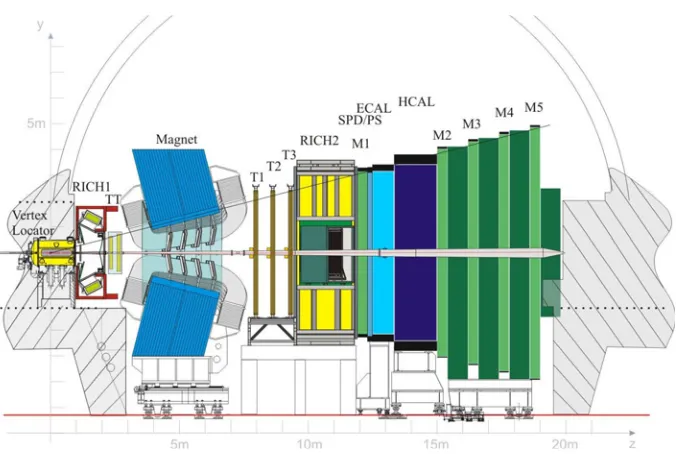
The layout of the LHCb detector is shown in Fig. 1. It includes a high-precision tracking system consisting of a silicon-strip vertex detector surrounding the ppinteraction region [1], a large-area silicon-strip detector located upstream of a dipole magnet with a bending power of about 4 Tm, and three stations of silicon-strip detectors and straw drift tubes [2] placed downstream of the magnet. The tracking system provides a measurement of momentum,p, with a relative uncertainty that varies from 0.4% at low momentum to 0.6% at 100 GeV/c. The minimum distance of a track to a primary vertex, the impact parameter, is measured with a resolution of (15+29/pT)μm, wherepT is the component
of p transverse to the beam, in GeV/c. Different types of charged hadrons are distinguished using information from two ring-imaging Cherenkov detectors [3]. Photon, electron and hadron candidates are identified by a calorimeter system consisting of scintillating-pad and preshower detectors, an elec-tromagnetic calorimeter and a hadronic calorimeter. Muons are identified by a system composed of alternating layers of iron and multiwire proportional chambers [4]. The trigger [5] consists of a hard-ware stage, based on information from the calorimeter and muon systems, followed by a softhard-ware stage, which applies a full event reconstruction.
ae-mail: maurizio.martinelli@epfl.ch DOI: 10.1051/
C
Owned by the authors, published by EDP Sciences, 2014
/2 014800000
Figure 1.Overview of the LHCb detector
2 Selected physics results
The LHCb physics case spans a wide range of topics, from high-precisionCPviolation measurements, to the search for new exotic particles, to cross-section measurements. In the following a few selected results are shown.
2.1 Exotic particles
One of the major results published recently is the confirmation of theZ+(4430) resonance inB0 → J/ψK+π− decays [6]. Its minimal quark content of ccdumakes it a clear exotic state, for which tetraquark and molecular hypotheses have been made. The existence of this state has been debated since its first evidence by the Belle collaboration [7] and the non-conclusive BaBar results [8].
The LHCb analysis uses model-independent and model-dependent techniques to exploit the full potential of the data. The results of the two approaches are shown in Fig. 2. Both approaches do not allow the data to be described adequately without including theZ+(4430) resonance. The four-dimensional model-dependent fit allows to measure the massm=4475±7+15−25MeV/c2and the width Γ = 172±13+37−34MeV/c2 of the resonance, and to exclude the JP = 0− spin hypothesis in favour
of the 1+ with exceedingly large significance. An Argand diagram of the observed peak confirms its resonant structure. Indications for the presence of another resonant structure at a mass of about 4.1 GeV/c2have been considered, but the Argand plot is not conclusive in this case. Further analysis
will be pursued once larger data samples will be available.
Another decay mode that recently provided insights on exotic particles is B0 → J/ψπ+π− [9]. From this decay mode, exact information about the substructure of light mesons decaying toπ+π−can be extracted. Considerations on the tetraquark nature of thef0(500) and f0(980) are made by studying
the relative branching ratios ofB0→J/ψf
0(980) andB0→J/ψf0(500). Stone et al. [10] have argued
[GeV] − π ' ψ m
3.8 4 4.2 4.4 4.6 4.8
Ef
ficiency corrected yield / ( 25 MeV
) 0 0.01 0.02 0.03 0.04 LHCb ] 2 [GeV
2'π− ψ m
16 18 20 22
)
2
Candidates / ( 0.2 GeV
0 500 1000
LHCb
Figure 2.The projection on theψπ−invariant mass of the results of a model-independent analysis of theB0→
J/ψK+π− decays are shown on the left. Similarly, the results of a model-dependent fit to the data are shown on the right including theZ+(4430) resonance (red) and excluding it (brown). Reflections from other resonant contributions decaying toK+π−are shown with different colours.
An angular analysis is needed for extracting this information, therefore the distribution of the events is studied in the four-dimensional space defined by theπ+π−invariant mass, the cosine of the muon (pion) helicity angle in theJ/ψ (π+π−) rest-frame cosθJ/ψ (cosθπ+π−), and the angleχbetween
the decaying planes of the two pions and the two muons. About 18,000 events have been selected in 3 fb−1 data. The fit used to extract the B0 signal contribution is shown in Fig. 3 alongside the
projections of the fit results on theπ+π−invariant mass spectrum. The fit required six interfering states
) [MeV] -π + π ψ m(J/
Combinations / (5 MeV)
1000 2000 3000 4000 5000 6000 7000 LHCb
5300 5400 5500 -5
0 5 0 ) [GeV] -π + π m(
0.5 1 1.5 2
Combinations / (18.6 MeV)
0 200 400 600 800 1000 1200 1400 Data Fit Signal Background (770) ρ (500) 0 f (1270) 2 f (782) ω (1450) ρ (1700) ρ 0 S K LHCb
Figure 3.Signal events distribution (red line) is extracted from a fit to theJ/ψπ+π−invariant mass distribution (left). The projection of the fit results on theπ+π−invariant mass are shown on the right.
to converge, among which the f0(980) was not found. A limit is set on the mixing angle between the f0(500) and f0(980),φm<17◦at 90% confidence level.
2.2 Rare decays
]
4 c
/
2
[GeV
2 q
0 5 10 15 20
'5
P
-1 -0.8 -0.6 -0.4 -0.2 0 0.2 0.4 0.6 0.8 1
SM Predictions
Data
LHCb
] 4 c
/ 2 [GeV 2 q
0 5 10 15 20
FB
A
-1 -0.5 0 0.5 1
LHCb
Theory Binned LHCb
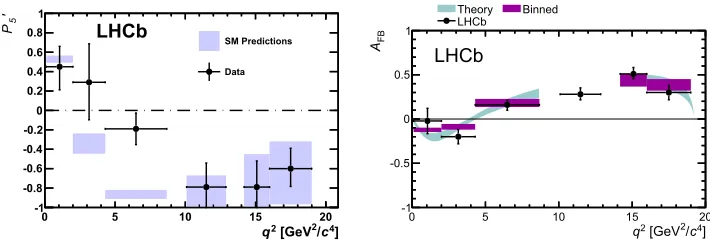
Figure 4.The measured values ofP5are compared with the SM predictions on the left. The forward-backward asymmetry is shown on the right with the LHCb measurement overlaid to the SM predictions.
them particularly sensitive to beyond-the-SM (BSM) processes that could affect their decay rates, angular observables, andCPasymmetries.
The most famous of these decay modes is probably theB0
s →μ+μ−decay. Its branching ratio is
precisely predicted in the SM to beB(B0
s →μ+μ−)=(3.65±0.23)×10−9[11]. Such a small branching
ratio is due to GIM and helicity suppressions in the SM. Processes beyond the SM could contribute by enhancing this branching ratio, for example through the mediation of new particles from an extended Higgs sector. The LHCb [12] and CMS [13] experiments, studying the whole data sample collected in 2011 and 2012, found evidence of thisB0
sdecay with a rate consistent with the SM, placing strong
constraints to BSM effects.
Further searches for effects of BSM physics are made through theB0 → K∗0μ+μ−decay mode. A large set of observables is studied for comparing the results with the SM predictions. In Fig. 4, the results of the LHCb analysis on the data collected in 2011 are shown [14, 15]. A large local discrepancy in the form-factor-independent angular observableP5 is observed, while the forward-backward asymmetryAFBis found to be consistent with the SM predictions. This analysis requires
more data to establish the discrepancy and will be soon updated with the addition of the 2012 data sample. Nevertheless, it stimulated a wide theoretical interest, since such discrepancy is difficult to explain within SUSY scenarios [16], and is consistent to aZ boson with 7 TeV mass [17]. Other authors suggest that this is due to the underestimation of theoretical uncertainties [18, 19].
Anotherb→sloop transition that has been recently investigated by the LHCb involves photons. The photon produced after theb→sγloop diagram is predominantly left-handed, since the recoiling squark that couples to theW boson is left-handed. Within the SM, maximal parity violation holds up to within a few percent. Processes beyond the SM, could let the photon acquire an appreciable right-handed component due to the chirality flip along a heavy fermion line in the electroweak loop process. For example, due to left-rightW boson orsquark mixing.
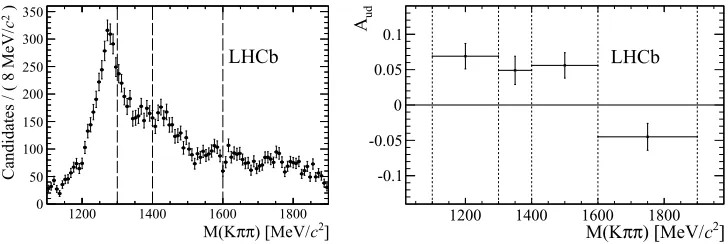
The photon polarisation in b → sγ transitions has been studied in LHCb through the B+ → K+π+π−γdecay mode [20]. The measurement is conceptually similar to the Wu measurement of parity violation [21], but in this case the polarisation angle of the photon is measured with respect to the normal to the plane of theK∗daughters. Unpolarised photons would show no asymmetry. Using data collected in 2011 and 2012, about 14,000B+decays have been identified. TheK+π+π−invariant mass spectrum is then studied and found rich of resonant states. Contributions fromK1(1270)+, K1(1400)+,K2∗(1430)+, andK∗(1410)+are clearly present as shown in Fig. 5. TheK+π+π−invariant
]
2 c
) [MeV/
π π
M(K
1200 1400 1600 1800
)
2c
Candidates / ( 8 MeV/
0 50 100 150 200 250 300 350
LHCb
]
2
c ) [MeV/ π π M(K
1200 1400 1600 1800
ud
A
-0.1 -0.05 0 0.05 0.1
LHCb
Figure 5.TheK+π+π−invariant mass spectrum forB+→K+π+π−γdecays is shown on the left. The four different regions in which up-down asymmetry is measured are separated by dashed lines. The up-down asymmetry for each of these four regions is shown on the right.
photon polarisation asymmetry is measured in each of them. The photon polarisation is described by means of the distribution of the polarisation angle ˆθ, that is the angle described by photon direction with respect to theK+π+π−decay plane. The distribution of events in cos ˆθis parametrised by using a linear expansion of Legendre polynomials up to the 4th power. By considering the asymmetry
measured in the four regions, this analysis provides the first observation of photon polarisation with a significance of 5.2 standard deviations.
2.3 Charm physics
A large sample of charmed hadrons is produced within the LHCb acceptance as well. It was natural for the LHCb collaboration to develop a wide program for studying charm decays at the LHC. The search forCPviolation in the charm sector is one of the most interesting topics in this field. CP violation is expected to be suppressed atO(10−3) in the SM due to the small amplitude of the Cabibbo-Kobayashi-Maskawa matrix elements involved. One simple way to obtainCP violation in charm decays is through the interference of the tree and penguin diagrams in Cabibbo suppressedc→uqq¯ decays. Such processes are sensitive to effects of BSM particles, that could enhanceCPviolation up to the percent level. The experimental sensitivity at LHCb is atO(10−3), which allows possible effects
to be observed.
The most sensitive analysis forCPviolation in Charm is the measurement ofΔACP =ACP(D0 → K+K−)−ACP(D0 →π+π−) [22]. In the limit ofU-spin symmetry theCPviolating asymmetry should
be opposite inD0 → K+K−andD0 → π+π−. Therefore, the observation ofΔA
CP 0 would be
a signal ofCPviolation in at least one of the two decay modes considered. Using D0 originating
from semileptonic Bdecays, about 2,000,000 D0 → K+K− and 700,000 D0 → π+π− decays are
reconstructed in 3 fb−1of data (see Fig. 6), corresponding to a sensitivity onΔACPof 0.16%.
Even if the muon detection and B production asymmetries cancel in the difference between Ameas
CP (D
0 → K+K−) and Ameas
CP (D
0 → π+π−), theCPviolating asymmetry cannot be directly
com-pared between the two due to acceptance effects. These effects are corrected by applying weights to one of the two samples such that the transverse momentum and pseudorapidity distributions of theD0
match between the two. Once the corrections are applied, the valueΔACP = (+0.14±0.16 (stat)±
] 2 c [MeV/ ) + K − M(K 1850 1900 ) 2c
Candidates / ( 1.1 MeV/
0 20 40 60 80 100 120 140 160 3 10 × LHCb Data Total Signal Comb. bkg. ] 2 c [MeV/ ) + π − π M(
1800 1850 1900
)
2c
Candidates / ( 1.45 MeV/
0 10 20 30 40 50 60 3 10 × LHCb Data Total Signal Comb. bkg. + π − K → 0 D
Figure 6.The invariant mass spectrum forD0 →K+K−(π+π−) decays is shown on the left (right). The results
of the fit are overlaid to the data point with a blue solid line. A red dashed line shows the projection of the signal distribution. A green-filled area represents the combinatorial background and the purple-filled one the background from Cabibbo-favouredD0→K−π+decays in which the kaon has been misreconstructed as a pion.
In the same analysis,ACP(D0 → K+K−) andACP(D0 → π+π−) are also measured. The
Cabibbo-favouredD0 →K−π+decay from semileptonicBdecays is used to correct for the muon detection and Bproduction asymmetries. Since the detector introduces a spurious asymmetry on the reconstruction of K−π+ and K+π− pairs, prompt D+ → K−π+π+ decays are used to correct for it. This in turn introducesD+andπ+detection asymmetries that are corrected by promptD+ → K0π+decays. The
remainingK0 detection asymmetry is corrected by using calculations of the expected asymmetry
fromK0-K0 mixing and regeneration effects in the LHCb detector. TheCPviolating asymmetries
are found to beACP(D0 → K+K−) = (−0.06±0.15 (stat)±0.10 (syst))% andACP(D0 → π+π−) =
(−0.20±0.19 (stat)±0.10 (syst))%, respectively, and show no sign ofCPviolation so far.
Another high-sensitivity measurement recently published by the LHCb collaboration usesD+(s)→ K0
Sh+decays, whereh=K, π[23]. In this case, the Cabibbo-suppressed decay modes areD+→K 0 SK+
andD+s → K0
Sπ+, and the Cabibbo-favouredD+s → KS0K+ and D+ → K 0
Sπ+ decays are used for D+(s) production and π/K detection asymmetry corrections. The K0-K0 regeneration and material
interaction asymmetries are estimated analytically. The events reconstructed in 3 fb−1of LHCb data are shown in Fig. 7. A similar procedure to that outlined above is used to correct for theD+(s)production andπ/Kdetection asymmetry. The results areACP(D+→KS0K+)=(+0.03±0.17 (stat)±0.14 (syst))%
andACP(D+s →K0Sπ+)=(+0.38±0.46 (stat)±0.17 (syst))%. No sign ofCPviolation is observed yet.
3 Future prospects
In 2015 the LHC will deliverppcollisions with an increased center-of-mass energy of 13 TeV. The LHCb experiment plans to record about 2 fb−1of data per year in order to collect 10 fb−1of data by the end of the second run of the LHC in 2018. Afterwards, a second long period of LHC shutdown is planned, during which the LHCb collaboration will install upgraded components [24, 25].
] 2 c ) [MeV/
+ π
0 S m(K
1800 1850 1900 1950 2000
)
2c
Candidates / (1.0 MeV/102
3
10
4
10
a)
LHCb1800 1850 1900 1950 2000
Pull
-4 -20 2 4
]
2
c
) [MeV/ + K
0 S
m(K 1850 1900 1950 2000
)
2c
Candidates / (1.0 MeV/
10
2
10
3
10
4
10
LHCb
c)
1850 1900 1950 2000
Pull
-4 -20 24
Figure 7.The invariant mass spectrum ofK0 Sπ+(K
0
SK+) decays is shown on the left (right). The results of the fit are overlaid to the data point with a blue solid line. A red dashed line shows the projection of theD+andD+s signal distributions. The combinatorial background is shown by a dash-dotted blue line. A solid green line represents the background fromD+→K0
Sπ+π
0in the left plot andD+
s →K+K−π+π0in the right plot. The magenta dash-dotted line represents the background from Cabibbo-favouredD+(s) → K
0 Sπ+(K
0
SK+) decays in which the pion (kaon) has been misreconstructed as a kaon (pion).
for the vertex locator, the silicon strips tracking stations upstream the magnet will be redesigned to enlarge the acceptance of the sub-detector at high pseudorapidity, and the downstream tracking sta-tions will use scintillating fibres to maintain the same excellent tracking performance of LHCb in the high-multiplicity environment.
The LHCb upgraded detector will record 10 fb−1 of data per year, and the plan is to record at
least 50 fb−1in total. These data will allow to perform measurements of several key observables with unprecedented sensitivity [26].
4 Conclusions
The LHCb detector performed very well during the 2011 and 2012 data-taking periods, allowing the collaboration to produce many interesting results with the best sensitivity to date.
The analysis of the events collected during the 2011 and 2012 runs of the LHC is not yet over, and there are new searches and updates foreseen in the next future. Most of the LHCb results have very small systematic uncertainties, therefore significant improvements are expected with the addition of more data.
The LHCb experiment has just started to probe the SM with unprecedented precision in many physics decay channels. The addition of data in the coming years and the LHCb Upgrade will improve the sensitivity of the experiment towards uncertainties comparable to those from the most precise theoretical calculations, providing the most powerful searches for BSM effects.
References
[1] R. Aaijet al., arXiv:1405.7808 [physics.ins-det].
[2] R. Arinket al., JINST9, 01002 (2014) [arXiv:1311.3893 [physics.ins-det]].
[5] R. Aaijet al., JINST8, P04022 (2013) [arXiv:1211.3055 [hep-ex]].
[6] R. Aaijet al., Phys. Rev. Lett.112, 222002 (2014) [arXiv:1404.1903 [hep-ex]]. [7] S. K. Choiet al., Phys. Rev. Lett.100, 142001 (2008) [arXiv:0708.1790 [hep-ex]]. [8] B. Aubertet al., Phys. Rev. D79, 112001 (2009) [arXiv:0811.0564 [hep-ex]]. [9] R. Aaijet al., Phys. Rev. D90, 012003 (2014) [arXiv:1404.5673 [hep-ex]].
[10] S. Stone and L. Zhang, Phys. Rev. Lett.111, no. 6, 062001 (2013) [arXiv:1305.6554 [hep-ex]]. [11] C. Bobethet al., Phys. Rev. Lett.112, 101801 (2014) [arXiv:1311.0903 [hep-ph]].
[12] R. Aaijet al., Phys. Rev. Lett.111, 101805 (2013) [arXiv:1307.5024 [hep-ex]]. [13] S. Chatrchyanet al., Phys. Rev. Lett.111, 101804 (2013) [arXiv:1307.5025 [hep-ex]]. [14] R. Aaijet al.[LHCb Collaboration], JHEP1308, 131 (2013) [arXiv:1304.6325 [hep-ex]]. [15] R. Aaijet al., Phys. Rev. Lett.111, 191801 (2013) [arXiv:1308.1707 [hep-ex]].
[16] W. Altmannshofer and D. M. Straub, Eur. Phys. J. C73, 2646 (2013) [arXiv:1308.1501 [hep-ph]].
[17] D. M. Straub, JHEP1308, 108 (2013) [arXiv:1302.4651 [hep-ph]].
[18] F. Beaujeanet al., Eur. Phys. J. C74, 2897 (2014) [arXiv:1310.2478 [hep-ph]]. [19] S. Jäger and J. Martin Camalich, JHEP1305, 043 (2013) [arXiv:1212.2263 [hep-ph]]. [20] R. Aaijet al., Phys. Rev. Lett.112, 161801 (2014) [arXiv:1402.6852 [hep-ex]]. [21] C. S. Wuet al., Phys. Rev.105, 1413 (1957).
[22] R. Aaijet al., JHEP1407, 041 (2014) [arXiv:1405.2797 [hep-ex]]. [23] R. Aaijet al., arXiv:1406.2624 [hep-ex].