Fine grained Process Modelling:
An Experiment at British Airways
Wolfgang Emmerich
City University London Computer Science Northampton Square London, EC1V 0HB, UK
Sergio Bandinelli
ESI
Parque Tecnologico, 204 48170 Bizkaia, Spain [email protected]
Luigi Lavazza
Politecnico di Milano and CEFRIEL Via Emanueli 15 20126 Milano, Italy [email protected]
Jim Arlow
8a Butler Ave. Harrow Middx, HA1 4EH, UK [email protected]
Abstract
We report on the experimental application of process technology at British Airways (BA). We used SLANG to model BA's C++ class library management process, and we constructed an experimental process-centred software engineering environment (PSEE) based on SPADE. BA required processes to be automated at a ner degree of granularity than tool invocation. We have demonstrated that SLANG and SPADE oer the basic mechanisms for modelling these ne-grained pro-cesses. We have also shown that it is feasible to gener-ate tools for dedicgener-ated processes and integrgener-ate them with a SLANG model so as to facilitate ne-grained process automation. However, our experience highlighted some open problems. For instance, SLANG process models are tuned to ecient enactment, thus containing very detailed process fragments. These are not the most ap-propriate representation for humans trying to under-stand the process model. A more comprehensible nota-tion is needed for design and documentanota-tion purposes. Although the airline did not deploy the PSEE in its pro-duction environment, the experiment proved benecial for BA. The modelling uncovered serious aws in the existing process, and the BA engineers improved their knowledge of process technology.
This work has been partly funded by the CEC within ESPRIT-III project 6115 (GOODSTEP). The work was done while W. Emmerich was with University of Dortmund (Ger-many), S. Bandinelli was with CEFRIEL (Italy) and J. Arlow was with British Airways (UK).
1. Introduction
During the past decade, a great deal of research has been devoted to process technology. Process mod-elling languages have been dened in order to spec-ify software processes on a formal basis. Exam-ples of these languages are extensions to program-ming languages (e.g. extensions of Ada [24] and Pro-log [21]), Petri net based approaches (FUNSOFT [15] and SLANG [4]) and multi-paradigm approaches in-tegrating several high-level descriptions (such as ES-CAPE [18]). Process modelling environments have been constructed for these languages so as to edit, sim-ulate, analyse, enact and evolve process models. Exam-ples include the Merlin environment [20], the SPADE environment [2], Melmac [10] or Marvel [6]. A central component of these environments is a process engine that interprets a process model. A number of attempts have been made to build environments that, in addi-tion to process modelling components, include tools for the actual software development. These tools are inte-grated with the process engine so as to provide services for process automation and to inform the engine about process-relevant events that they have captured. We refer to such an environment as a process-centred
soft-ware engineering environment (PSEE).
The contribution of this paper is an account of the experience that we gained when we applied the SLANG process modelling formalism and the SPADE environ-ment to the modelling and enactenviron-ment of a software process in an industrial setting, namely at British Air-ways. British Airways is a large software developer in the UK, with some 2,000 IT sta. An increasing num-ber of operations research programs (such as eet or crew allocation) are now being developed with object-oriented techniques. To increase productivity and qual-ity, BA have founded a group calledInfrastructurewho is in charge of maintaining the design, implementation and documentation of reusable C++ class libraries. SLANG was used to capture, model and improve the class library development and maintenance process.
The process was not only modelled, but also sup-ported with a customised PSEE, the British Airways SEE. It integrates the SPADE process engine with tools for the development of Booch class diagrams, C++ class interface denitions, C++ class implementations and class documentations. These tools were gener-ated from a high-level specication written in GTSL (the GOODSTEP Tool Specication Language). An account of this tool construction eort is given in a companion paper [14]. The integration of tools and process model was done in a way that facilitates pro-cess guidance at a ner level of granularity than tool invocation.
The paper is structured as follows. Section 2 out-lines the goals of our process modelling experiment. It is followed by a discussion of the baseline of the ex-periment, i.e. the existing process at British Airways, the BA SEE tools that have been generated and the SLANG process modellinglanguage. Section 4 presents the way the process modelling experiment was con-ducted. Section 5 summarises the experiment results. We then conclude with a summary of the lessons that we have learned from this process modelling experi-ment in Section 6.
2. Goals of the Experiment
The goals for this experiment were manifold and can be considered from the point of view of technol-ogy providers and technoltechnol-ogy users.
The motivation of technology providers in this ex-periment was to evaluate process technology in an in-dustrial setting. The goals of the experiment are re-ected by the following questions:
Feasibility:
Is it feasible with the language primitives available in SLANG and GTSL to decrease the level of granularity of process models, in order to improve process automation?Scalability:
Is SLANG suciently scalable to han-dle complex processes such as those that occur in industrial practice? Are the resulting process models of any use for supporting communication among the developers involved?User Acceptance:
Does the resulting process model provide developers with sucient freedom to ex-press their creativity or does it impose strict con-straints that could make the development harder and less productive?Performance:
Is the performance of a ne-grained process enactment appropriate or does it slow down users more than it helps?The main motivation of technology users was to un-derstand what process technology can do for them. They were interested in:
Process Understanding:
The Infrastructure group wanted to check whether it had reached a common (i.e., consistent) understanding of the process, af-ter having worked for two years on the mainte-nance of class libraries.Process Improvement:
The group knew aws of their process and wanted to remove them. They were curious to see how formal process modelling could help.Process Automation:
Several tasks of the group were done manually and the group was fascinated by the idea that an environment customised to their particular needs might automate a relevant part of the work.3. Baseline of the Experiment
3.1. Existing Library Development Process at BA
The Infrastructure group has created a process handbook entitled Standard Development and Release
Procedures. It elaborates on the process to be used for
class library development and maintenance. The hand-book suggests, in a rather informal manner, the vari-ous actions to be taken for class library development and maintenance. It identies a number of document types, including Booch class diagrams, C++ class in-terface denitions, C++ class implementations, class documentation, Makeles, congurations for dynamic linkage and the like.
libraries. To date, one developer is aQA engineer, who is in charge of approving new or changed libraries. A
librarianadministers the dierent versions contained in
library congurations.
Two mainproblems were identied by Infrastructure with their approach to process management. The rst problem is that their informal denition of the process easily leads to misunderstandings. Two Infrastructure developers, who have worked in the same oce for two years, discovered a serious misunderstanding of a key concept dened in the handbook when we discussed their process in a meeting. It turned out that they did not have a shared understanding of the semantics of a library conguration in beta test as opposed to
development mode. The second problem is mentioned
in the following quote from Infrastructure members:
\Within Infrastructure, we have had to ap-ply an excessive amount of eort to estab-lish change control procedures, but these pro-cedures are only partially eective as they are not enforceable by our current toolset. As BA's stock of reusable components grows, the problems of eective change control will be-come more and more pronounced." [1]
An obvious approach to enforcing the change con-trol procedures is to model them with a process mod-elling language and to guide the process by enacting the model. This requires development tools to be in-tegrated into the process environment in a way that tools cannot be abused to circumvent the process that has been modelled. Moreover, tool integration, at least partially, has to be ne-grained so that the process model can react to the execution of individualtool com-mands, rather than complete tool sessions. The reason is that there are usually documents, such as Booch dia-grams, whose components represent other documents. Inter-document consistency constraints require the cre-ation, modication or deletion of documents whenever components are created, modied or deleted. When-ever a new class icon is created in a Booch diagram, for instance, a corresponding class interface denition document has to be created. Since documents are gen-erally considered as rst class process modelling con-cepts, the process model should at least be notied about document creation, if not be responsible for the creation itself. Therefore, a tool command for the cre-ation of a component in one document that represents another document has to be integrated with the pro-cess model.
We modelled the BA class library development and maintenance process with SLANG. Then a dedicated set of tools tailored towards the particular needs of
In-frastructure was generated. This toolset was integrated with the SLANG process model to enforce the process and to support process automation at the required lev-els of granularity.
3.2. Tool Specification and Generation
The need for rapid tool construction through a tool generator is motivated by the observation given above that enforcement of process denitions, such as change control procedures, require process sensitive tools to be used. Process sensitive tools interact with a pro-cess model through a joint communication protocol, and thus contribute to the implementation of a pro-cess model.
A exible tool construction mechanism is required to develop tools for use with particular process models. GTSL was dened as a high-level language to accom-plish rapid tool customisation and construction. Tools for the BA SEE have been generated from GTSL spec-ications [14]. While the basic concepts of GTSL have been presented in [13], language primitives for the de-scription of ne-grained process integration of GTSL based tools are illustrated in Section 3.2.2, after a brief presentation of the functionality of tools to be inte-grated with the process model.
3.2.1 BA SEE Tools
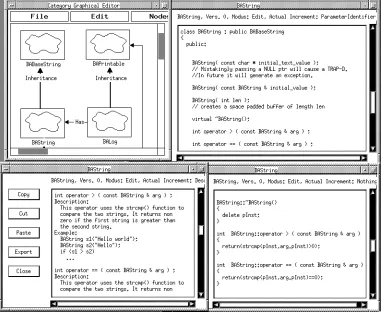
The Booch class diagram editor, whose user inter-face is shown in the upper left corner of Figure 1, en-ables users to decompose libraries hierarchically into
categories and classes. A category is a set of related
classes and/or nested categories. Top-level categories represent libraries. Dierent types of relationships are supported to facilitate inheritance, aggregation and ref-erence relations between classes.
The C++ class interface editor supports syntax-directed editing of C++ class denitions. The editor includes structure-oriented and free textual editing fa-cilities that enforce syntactic correctness of class def-initions. Moreover, the editor checks for correctness of the C++ static semantics while the user edits and visualises errors by underlining. Checking is done in-crementally and transparently to the user. The C++ class interface editor has been specied in a way that it is integrated with the Booch editor so that, for in-stance, the creation of a new relationship in the Booch class diagram is reected automatically in the C++ class interface denition.
Figure 1. User Interface of BA SEE Tools
integrated with the C++ class interface editor in a way that any changes to, for instance, a method signature are automatically reected in the implementation.
The class documentation editor implements the British Airways documentation standard, which re-quires a description for any method within a class to-gether with an example of its application. The editor is also integrated with the C++ class interface editor, so that stubs are generated for each method identied in the class interface and users only have to complete these stubs. OS/2 IPF hypertexts and HTML les are generated from class documentations without requiring further actions of the developer. These two representa-tions enable users of a class library to access documen-tation as on-line help facilities with standard browsers, i.e. without having to use the BA SEE.
3.2.2 Integration Facilities in GTSL
GTSL specications of environments use the object-oriented paradigm to dene the tools and documents, which are internally represented as project-wide ab-stract syntax graphs [16]. An environment specica-tion is structured into a number oftool congurations. Each of these consists of a number ofclassesthat dene
the dierent node types that occur in project-wide ab-stract syntax graphs. Dierentsectionsare provided to dene properties of a class such as attributes, abstract syntax and semantic relationships. The available oper-ations to modify graph nodes are dened in amethod
section. The invocation of operations from commands
and their availability are specied as patterns in
inter-action sections. Multiple inheritanceenables properties
from super classes to be reused in subclasses.
congura-tions [13] and implemented in the same style as GTSL interactions.
Events allow the tool to inform the environment
about certain incidents as opposed to services, which enable the environment to communicate with a tool. An event can either be a requestor a notication. A request is sent to a consumer, who either grants the request or rejects it. Requests are used in interactions of BA SEE tools to ask the process engine for the per-mission necessary to perform certain activities. A no-tication informs the receiver about a certain action, but does not await its response.
As examples consider service and event declarations from the Booch and INT tool congurations given
be-low. The rst declaration is a request that asks the process engine for permission to create a new library. The request is used as a condition in the interaction that implements the tool command for creating a new library. The second declaration is a specic service of the class interface editor for the creation of an in-heritance relationship between two C++ class interface denitions. It is invoked from the Booch editor as soon as a user creates an inheritance relationship in the di-agram and then the relationship will also be reected in the aected C++ class interface denitions.TOOL CONFIGURATION Booch;
EVENT CrLibraryRequest(name:STRING):ERROR; ...
END CONFIGURATION Booch.
TOOL CONFIGURATION INT; ...
SERVICE CrInheritance(inh_from : STRING; visibility : STRING; virtual: BOOLEAN):ERROR; ...
END CONFIGURATION INT.
The GTSL language and, in particular, events and services are therefore powerful facilities to specify tools that are customised for use with particular pro-cess models. They accomplish propro-cess automation at a much ner degree of granularity than tool en-velopes [25], because multiple events and services can be exchanged during the execution of a tool.
3.3. SPADE and SLANG
SPADE (Software Process Analysis, Design and En-actment) is a project that was carried out at CEFRIEL and Politecnico di Milano. Two results of this project were the SLANG (Spade LANGuage) process
mod-elling language and its implementation in SPADE-1. We do not explain SLANG and SPADE here and as-sume that the reader is familiar with the concepts. A language reference manual is available in [7]. Detailed descriptions of SLANG can also be found in [2, 4, 3].
In the next subsection we describe how SLANG was used to model the BA process.
3.3.1 SLANG
Use of SLANG Activities
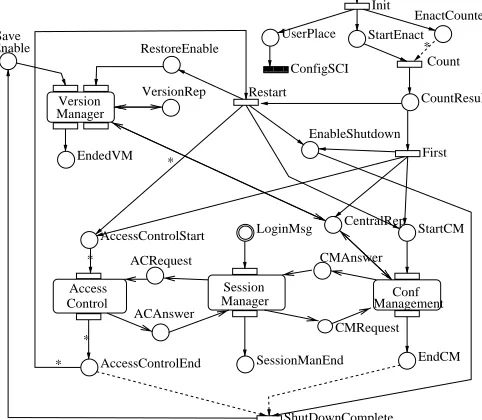
SLANG allows complex process to be decomposed into a structured set of fairly independent activities. The activity construct was also used to model the BA process. Figure 2 presents the overall process model (therootactivity), which contains sub-activities
SessionManager, AccessControl, ConfManagement, and
VersionManager, each modeling a specic sub-process.
According to the principles of information hiding, an activity denition has aninterfaceand an implementa-tion part. The activity interacts with other activities through its interface, while the implementation part remains hidden.
Activity invocations are represented graphically by embedding an activity interface into a SLANG net. Ac-tivity interfaces are provided with interface transitions, i.e.,starting transitions(placed on the upper side of the activity box) andending transitions(on the lower side). When a starting transition res, a new instance of the activity (called active copy) is created. Active copies are executed in parallel; this feature was used to model the concurrent work of BA engineers. For instance, two tokens in place LoginMsgcause the starting transition
of activitySession Managerto re twice, thus creating
two instances of that activity. These active copies are executed in parallel with the root activity. When an ending transition res, it deposits the resulting tokens into some output places (e.g.,SessionManEnd),
belong-ing to the callbelong-ing activity, then the terminated active copy is deleted. An activity can also exchange data with the calling activity through shared places. For instance, the SessionManagersends CMRequeststo the
root activity and receives CMAnswers.
White transitions represent elementary steps of pro-cesses. Their execution is atomic, in the sense that no intermediate state of the transition execution is visible outside the transition. Each transition is associated with a guard and an action. The guard is a predicate indicating whether the transition is enabled to re or not. The action species how output tokens are com-puted. An example is theRestarttransition in the root
activity of the BA model.
Use of SLANG Integration Facilities
UserPlace Init Start
ShutDownComplete
EndCM SessionManEnd
AccessControlEnd AccessControlStart EndedVM
LoginMsg StartCM First CountResult
Count StartEnact
*
0000 0000 1111 1111
*
*
Restart
*
* CMRequest
CMAnswer EnableShutdown Version
Manager
Session
Manager ManagementConf VersionRep
RestoreEnable
CentralRep ACRequest
ACAnswer
EnactCounter EnableSave
ConfigSCI
Access Control
Figure 2. Root Activity
external events. Normal places are graphically repre-sented by a single circle, user places are reprerepre-sented by double circles. User places have been exploited to model communication of events between tools and pro-cess model. Whenever a Booch editor is started, for instance, it creates a login message token on the user input placeLoginMsg.
Process steps involving eects in the user environ-ment (e.g., launching a tool or changing a tool state) are called black transitions. They are represented as lled rectangles. An example is the ConfigSCI
tran-sition that congures the SPADE Communication In-terface to route messages in a given way (see below). Black transitions are also exploited in the BA process model for the denition of the invocation of tool ser-vices.
3.3.2 SPADE
Process Enactment Environment
The Process Enactment Environment is the bottom layer of the SPADE architecture displayed in Figure 31.
It is the run-time support that drives the execution of the BA process model. It is composed of a multi-threaded process engine (PE) based on the O
2 object
database [11]. Process data (tokens) are stored in the
1Figure 3 reports only the componentsused in the BA model.
The current implementation of SPADE oers also bridges for DEC FUSE and OLE2 tools, in addition to the possibility of invoking black-box tools.
O
2database, thus the SPADE process engine is an O
2
client, which uses the O
2run-time system as the
back-bone for the execution of SLANG interpreters. During process execution, each process engine executes one or more SLANG interpreter threads, each managing a set of active copies.
User Interaction Environment
Process Enactment Environment
Repository
Booch Editor Interface Editor
Implementation Editor
SLANG Interpreter SLANG Interpreter SLANG Interpreter
Process Engine
O 2 SCI
ToolTalk
bridge Monitor display SPADE shell
SPADE Monitor ToolTalk
message server
Documentation Editor
Figure 3. Customisation of SPADE
User Interaction Environment
The user interaction environment is composed of the tools used by process agents to perform their work. Tools are seen by the SPADE-1 environment as service-providers that can possibly share data with the process engine: a tool exhibits a control interface indicating the oered services and a data interface specifying the structure of used data. The dierences among tools are basically dierences of the granularity between the oered services.
Tools can be classied into two classes: black-box
tools and service-based tools. Black-box tools oer a
for-wards them to the recipient tools according to a given strategy. This mechanism, originallyproposed by Reiss for the FIELD environment [22] is becoming very pop-ular and has been used in several commercial products (including DEC FUSE [8], HP SoftBench [17], and SUN ToolTalk [23]).
SPADE Communication Interface
The SPADE Communication Interface (SCI) is respon-sible for communication between the User Interaction Environment (UIE) and the Process Enactment En-vironment(PEE). Thus, the SCI provides facilities for converting the communication protocol dened for the PEE into a specic protocol tools in the UIE can under-stand. The SCI acts as a communication server used by two kinds of clients:
PEE clients: These are SLANG Interpreters that
use the SCI as a means to communicate and inter-act with the \outside world", i.e., the User Inter-action Environment.
UIE clients: These are the BA SEE tools that
pro-vide services and notications of relevant events to the SCI and (through the SCI) to the PEE. Communication between the SCI, tools and the pro-cess enactment environment is based on the message passing paradigm [22] and follows the SCI Protocol. Tools that are able to communicate through the SCI protocol are directly connected to the SCI, while other tools can be connected to the SCI through a sort of gateway (that we call a bridge). Since GTSL gener-ated tools send and receive Sun ToolTalk messages, the
ToolTalk bridgeis exploited in the BA SEE.
PEE clients can request the invocation of an inte-grated service-based tool. The invoking SLANG inter-preter provides the command to be executed (a com-mand uniquely identies a tool and a service) and the name of the host computer on which the tool must be executed. When the SCI receives an invocation request message from a SLANG Interpreter, it invokes the tool on the specied host and, in case of successful invoca-tion, returns the tool identier in the message reply, thus enabling further direct reference to the same tool.
4. The Experiment
The BA experiment is the rst case study where the SPADE environment was used to model and enact an industrial-scale process model with the purpose of be-coming the "heart" of a PSEE. The experiment had a total duration of nine months, starting in November
1994. Three parties participated: CEFRIEL, where the process model was developed, University of Dort-mund, where development tools were generated and integrated into the BA SEE and BA's Infrastructure group, from whom the process was elicited.
It is worthwhile to note that the skills of BA In-frastructure engineers were not sucient to exploit SLANG nets for process modelling. The development eort was, therefore, mainly carried out full time by two Master students at CEFRIEL and University of Dortmund, who were supervised by experts in process modeling. When the development started, the students and their supervisors had a sucient degree of knowl-edge of the languages used.
4.1. Process Elicitation and Modelling
The starting point for process modelling was the BA process handbook. It provided an appropriate scenario from which other information regarding roles, respon-sibilities and library structure could be elicited during the rst (kick-o) meeting. From there, process elici-tation and modelling proceeded in a parallel and incre-mental way.
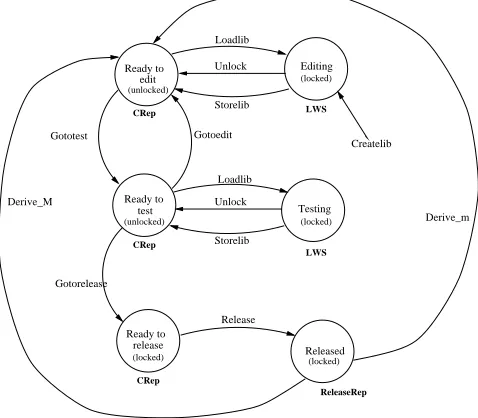
We started the formalisation of the process in the kick-o meeting using state transition diagrams, a no-tation Infrastructure members were familiar with. The result of this discussion is shown in Figure 4. It was during the development of this state transition diagram that the two participating Infrastructure members dis-covered the misunderstanding mentioned in Section 3. The modelling activity continued by enriching the state chart with other context information regarding roles, library attributes, access restrictions etc. The state transition diagram was then formalised in a com-plete process program written in SLANG and in a protocol specication for the messages exchanged with tools through the SCI.
An important result that evolved from the develop-ment of this state transition diagram was the require-ment that one developer should be responsible for a complete library and that only one developer at a time should work on a library. This implied that the gran-ularity of documents considered by the process model had to be at the level of libraries rather than individual classes.
4.2. Architecture of the Integration
Editing Ready to
edit
Loadlib Loadlib
Testing Ready to
test
Release
Released Ready to
release
Createlib
Derive_M
Derive_m
(locked)
(locked)
(locked) (locked)
(unlocked) (unlocked)
LWS
ReleaseRep LWS
CRep CRep CRep
Gototest Gotoedit
Gotorelease
Storelib
Storelib Unlock
Unlock
Figure 4. State Transitions during Library Management
it would have unnecessarily complicated the process model, since the process model needed only to manage whole libraries, not data (like class interfaces) at a ner granularity. In other words, the interface, implementa-tion and documentaimplementa-tion editor could be integrated in a static way among themselves, without involving the process environment.
Therefore the architecture that was nally adopted is based on the observation that only the Booch Ed-itor tool needs to exchange control information with the process engine. Initially the Booch editor was directly integrated with the SCI. The interface edi-tor, implementation editor and documentation editor were locally integrated with the Booch editor through a ToolTalk based message server. Later, when the ToolTalkbridge was released, the nal architecture was established, as shown in Figure 3.
Based on this architecture, the next step in the mod-elling was to develop an appropriate communication protocol between the process engine and the Booch editor. A rst version of this protocol took into ac-count only services for session management and access control. Then the protocol was extended to capture the semantics of class library management at BA and the rst enactable process model prototype was demon-strated in a meeting with BA Infrastructure members. The availabilityof an enactable prototype in this meet-ing proved very useful and triggered valuable feedback from Infrastructure members.
5. Results
5.1. Integration of Tools and Process Program
Process-sensitive events, such as the creation of a new library, are captured by tools and the process model needs to be informed about them. This means that, from a modelling perspective, GTSL events are associated with SLANG user input places. Likewise, the invocation of tool services of a particular tool has to be expressed in the process model. During mod-elling this means that some of the black transitions are associated with GTSL services.
From an architectural point of view, the SCI has been successfully employed for implementing the asso-ciation of GTSL events with user input places as well as for implementing black transition occurrences that invoke GTSL services. An event declared in the Booch editor specication is transformed into a Sun ToolTalk message, which is then sent via the ToolTalk bridge to the SCI. The SCI transforms the message into tokens, which include the message data, and user input places are marked with these tokens. Vice versa, a black tran-sition causes the SCI to create a message that is then translated into a Sun Tooltalk message created by the ToolTalk bridge. Receipt of the message by the Booch editor causes the GTSL run-time system to invoke the services that is associated with the message.
5.2. Protocol Specification
The tools and the process model have to agree on some common message protocol. This involves syntac-tic and semansyntac-tic concerns. From a syntacsyntac-tic point of view, tools and process model have to agree on the messages and their parameters. From a semantic point of view the meaning of messages and their parameters must be dened as well as the actions that they cause. For the British Airways process model, an informal protocol specication has been dened that includes 22 dierent messages. An example is thecreatemessage
below.
Syntax: create(lib_name:string)
Parameters: lib_name is the name of the library to be created
Return: OK: library <lib_name> created
ERROR: library <lib_name> already exists
ERROR: agent is not a librarian
5.3. The Process Model
The whole process model developed for the experi-ment consisits of ve activities, the root activity, as dis-played in Figure 2, plus other four activities invoked by the root. All the activities contain, in total, 50 places and 65 transitions. The translation of the graphical representation of the model into a textual representa-tion generates a le of about 4 KLOC. This provides a quantitative idea of the model size.
One of the activities invoked by the root activity
isSessionManager, whose denition is displayed as the
net shown in Figure 5. Whenever a user starts the Booch editor, the editor will notify a start-up event to the process model, which will appear as a token on place LoginMsg. This token enables StartSM, which
will eventually re, thus creating a new active copy of activitySessionManager. A component of the token
identies the user who has logged into the environment and this component is red on placeOwner. From there
on, the activity awaits messages from the user inter-action environment. These will appear as tokens on places MsgFromSSorMsgFromBE. After the net has done
some consistency checks on the message and approved the message, the message tokens will appear on place
UserMsg. Consequently, transitions are in conict over
these tokens and guards are used to determine the tran-sition that res. DispatchToCM, for instance, res if the
guard identies the message as a conguration manage-ment message and transfers it to the place CMRequest
from where it is consumed by the ConfManagement
ac-tivity.
SessionManager is a SLANG implementation of a
command interpreter. Messages can be seen as com-mand strings and the SLANG net checks the appro-priateness of the command (for instance in transitions
BECommandErrorand NotBEMess). The implementation
of SessionManager required a considerable amount of
time. This was because SLANG provides low-level con-cepts for expressing computations on the basis ofO
2 C,
but it does not provide high-level constructs, such as ordered-attribute grammars [19], that would be more appropriate for specifying command interpreters. This caused the eect that even minor changes to the mes-sage protocol were quite time-consumingto implement. The process model development has been directed towards ecient enactment of the BA software process and its integration with tools from the user interaction environment. During the process of its development, BA Infrastructure members learned quite a lot about their process. The process of eliciting and modelling the development process was probably more useful for understanding than its result. Unexperienced readers
*
StartSM
SSCommandError
BECommandError
MsgFromBE MsgFromSS
BEMess
DisplayCM
DispatchToCM UserMsg
Owner
CheckRole
Shutdown
ShowAcList
Items
DisplayList
RoleOK
Configured NS
EndSM LoginAccepted
Registered
Unregistered
ACAnswer
ACAnswer
OwnerLoggedOut LoggedOut
ShowACError
SSKill
Logout
Exit
Ending
BEKill
BEKilled
Started StartSS
CMRequest ACRequest CMAnswer NotBEMEss
SSMess NotSSMess
ShutErr
DispatchToAC
Dummy SSLogin
ConfigSSLogin
ConfigSSMsg
SessionManEnd LoginMsg
Figure 5. Refinement of Session Manager
will nd it dicult to understand the SLANG model of the process. One reason is that activity denitions do not distinguish between net components that are criti-cal to understanding the overall process (e.g. CheckRole
in Figure 5) and those included for enacting the model (e.g. Dummy).
Decomposition of the overall net into activities com-plicates further an understanding of the model. Cer-tain transitions that belong together from the point of view of control ow have been separated by decompo-sition into activities. The next trandecompo-sition that will re
inSessionManagerafterDispatchToAChas occurred will
either be LoginAccepted, or Registered, Unregistered
or LoggedOut. This, however, is not evident from just
reviewing theSessionManageractivity or the root
activ-ity. To resolve this problem, activity interfaces should not only be dened from a structural viewpoint, but should also provide a behavioural perspective. Such a perspective would have to show, at the activity invoca-tion level, that markingACRequestleads to a token at
ACAnswerand that markingCMRequestproduces a token
onCMAnswer.
6. Lessons Learned
and enacting it by a ne-grained integration of devel-opment tools and process engine. We now revisit the experiment goals presented in Section 2 and examine the lessons that we have learned.
6.1. Experience of Technology Provider
A rst concern was to assess the expressiveness for process automation of both the process modelling con-cepts of SLANG and its support environment SPADE. The language was deliberately designed to have two very simple and powerful means for modelling commu-nication between process and tools: black transitions and user places. These two basic mechanism made it feasible to model virtually any interaction policy, pro-vided an appropriate message protocol is previously agreed.
Through the BA experiment, we learned how com-plex process policies can be in industry. Policy im-plementation has an impact on tools, on the commu-nication protocol between tools and on the process model fragment managing that protocol. This intro-duced additional complexity to the already complex process model. SLANG provides abstraction mecha-nisms that facilitated the hiding of complexity at the lower levels of the process model. For instance,
activ-itySessionManageris completely independent from the
access policy, which is hidden in theAccessControl
ac-tivity and in the denition of owner data. However, industrial scale process modelling also requires high-level, easily combinable, process-oriented abstractions or building blocks, which are missing in SLANG.
People who were not involved in the process mod-elling experiment are little able to understand the en-actable process model. For instance, during process elicitation it was necessary to use simple state transi-tion diagrams (as the one shown in Figure 4). Actu-ally, this did not surprise us, since SLANG was initially conceived mainly to support process enactment. The BA experience showed, however, that it is important to provide dierent views, which may require dier-ent levels of abstraction, dierdier-ent ways of structuring the process model and dierent formalisms to express them. This evidence supports the claims of [9, 18]. However, there are no satisfactory answers yet as to how such views may be kept consistent during both modelling and enactment.
British Airways did not deploy the BA SEE devel-oped in GOODSTEP. One of the reasons was that the impact of the deployment was too radical a change. The BA SEE contains completely new development tools, such as the Booch editor and the C++ class in-terface editor, and explicit process constraints, such as
a library code cannot be modied if the correspond-ing Booch diagram is not modied rst. In addition, the modelled processes were not fully understood and institutionalised at British Airways. The lessons that we have learned from this is that process technology adoption has to be done in an evolutionary rather than a revolutionary way and should focus on mature pro-cesses rst. For the purpose of bringing process tech-nology into industrial practice, it would have been more appropriate to start with partial process monitoring support which, for instance, provided context-sensitive process guidance on user demand, rather than support that attempted to completely control and automate the process. After some period of technology assimilation and process maturation, it might have been possible to introduce process automation and more advanced tools.
SLANG and SPADE would have supported this evo-lutionary introduction of process technology in several ways. Firstly, the introduction of process technology does not necessarily require the user interface to be changed. As a matter of fact, users can continue using tools they are familiar with without having to learn a new user interface. Secondly, the level of process enforcement is adjustable in the process model. There-fore, it can range from a simple process monitoring to complete process automation, depending on the char-acteristics of the organisation. Finally, the mechanisms available in SPADE for process evolution could be used to change the process model, even during its enact-ment.
The enactment experience has shown that, during process model execution, the process engine is idle for most of the time. The engine works as a reactive system, which wakes up whenever a process relevant event occurs. This observation seems to support the argument that performance issues are not relevant in process engines. However, ne-grained tool integration implies that the process engine becomes active dur-ing interactions of users with tools. To avoid low user acceptance of such an environment, response time con-straints below a second have to be met.
6.2. Experience of Technology Users
Much process understanding was gained through the process modelling process. The use of a formal pro-cess modelling language has lead to the removal of inconsistencies in the \Ocial Process", represented by Infrastructure's process handbook, and in the \Ob-served Process" [5], represented by what process agents thought the actual process was. In addition, the mod-elling activity was accomplished in considerable detail in order to obtain an enactable process representa-tion. This facilitated discussions on solid ground and prompted the removal of ambiguities in the process model.
The process modelling activity highlighted aws in the process, oering an opportunity to improve the pro-cess. In some cases, the introduction of process tech-nology naturally leads to changing the process during modelling. To a certain degree, this process improve-ment was achieved by the BA experiimprove-ment. However, to reduce the risk inherent to the introduction of process technology, it is advisable to apply it to already stable and well understood processes.
Although process automation has initially been per-ceived as a fascinating idea, not all processes are amenable to complete automation. Automated pro-cesses are less adaptable to unforeseen situations and, as pointed out above, their execution may introduce some performance overhead. Thus, while established administrative processes are better suited to process automation, less clearly dened creative processes can only be supported by, for example, providing guidelines or help information on demand.
Acknowledgements
Mark Phoenix provided us with valuable insights into daily development practice at British Airways. Ric-cardo Rodriguez rened the BA process with SLANG to a degree that it could be enacted. Jorg Brunsmann designed and implemented most of the integration be-tween the Booch tool and the process model. We are in-debted to Alain Ainsworth, for pointing us to the prob-lems of the BA Infrastructure group, and to Alfonso Fuggetta, Carlo Ghezzi, Wilhelm Schafer and Roberto Zicari for providing the support within GOODSTEP to undertake this eort. Finally, we thank Stephen Morris for comments that helped us to improve the presenta-tion of this paper.
References
[1] J. Arlow, M. Phoenix, and B. Pryce. The British
Airways Application Scenario for GOODSTEP. Deliverable ESPRIT Project GOODSTEP 26P, Commissionof the European Union, DG III, 1994. [2] S. Bandinelli, A. Fuggetta, and C. Ghezzi. Pro-cess Model Evolution in the SPADE Environ-ment. IEEE Transactions on Software Engineer-ing, 19(12):1128{1144, 1993.
[3] S. Bandinelli, A. Fuggetta, C. Ghezzi, and L. Lavazza. SPADE: An Environment for Soft-ware Process Analysis, Design and Enactment. In A. C. W. Finkelstein, J. Kramer, and B. Nuseibeh, editors, Advances in Software Process Technol-ogy, pages 223{247. Research Study Press Lim-ited, 1994.
[4] S. Bandinelli, A. Fuggetta, and S. Grigolli. Process Modeling-in-the-large with SLANG. In Proc. of the2ndInt. Conf. on the Software Process, Berlin,
Germany, pages 75{83. IEEE Computer Society
Press, 1993.
[5] S. Bandinelli, A. Fuggetta, L. Lavazza, M. Loi, and G. P. Picco. Modeling and Improving an In-dustrial Software Process. IEEE Transactions on
Software Engineering, 21(5):440{454, 1995.
[6] N. S. Barghouti and G. E. Kaiser. Multi-Agent Rule-Based Software Development Environments.
InProc. of the 5thAnnual Knowledge-Based
Soft-ware Assistant Conference, pages 375{387, 1990.
[7] Politecnico di Milano CEFRIEL. SLANG Pro-cess Modeling Language Reference Manual version 2.2. Deliverable ESPRIT Project GOODSTEP 8P, Commission of the European Union, December 1994.
[8] Digital Equipment Corporation. DEC-FUSE
Manual, 1992.
[9] W. Deiters. A View-based Approach to Software
Process Management. PhD thesis, University of
Dortmund, Dept. of Computer Science, 1993. [10] W. Deiters and V. Gruhn. Managing Software
Processes in MELMAC.ACM SIGSOFT Software
Engineering Notes, 15(6):193{205, 1990. Proc. of
the 4th ACM SIGSOFT Symposium on Software
Development Environments, Irvine, Cal. [11] O. Deux. TheO
2System.Communications of the
ACM, 34(10), 1991.
Workow Management Environment LEU. In P. Loucopoulos, editor, Proc. of the 13th
Entity-Relationship Approach, number 881 in Lecture
Notes in Computer Science, pages 46{63. Springer, 1994.
[13] W. Emmerich. Tool Specication with GTSL. In
Proc. of the8thInt. Workshop on Software
Speci-cation and Design, Schloss Velen, Germany, pages
26{35. IEEE Computer Society Press, 1996. [14] W. Emmerich, J. Arlow, J. Madec, and M.
Phoe-nix. Tool Construction for the British Airways SEE with the O
2 ODBMS. Theory and Practice
of Object Systems, 1997. To appear.
[15] W. Emmerich and V. Gruhn. FUNSOFT Nets: A Petri-Net based Software Process Modeling Lan-guage. InProc. of the6th Int. Workshop on
Soft-ware Specication and Design, Como, Italy, pages
175{184. IEEE Computer Society Press, 1991. [16] W. Emmerich, W. Schafer, and J. Welsh.
Databases for Software Engineering Environ-ments | The Goal has not yet been attained. In I. Sommerville and M. Paul, editors, Software
Engineering ESEC '93 | Proc. of the 4th
Euro-pean Software Engineering Conference,
Garmisch-Partenkirchen, Germany, volume 717 of
Lec-ture Notes in Computer Science, pages 145{162.
Springer, 1993.
[17] C. Gerety. HP SoftBench: a new generation of Software Development Tools. HP Journal, June 1990.
[18] G. Junkermann. A Dedicated Process Design Lan-guage based on EER-Models, Statecharts and Ta-bles. InProc. of the7thInt. Conf. on Software
En-gineering and Knowledge EnEn-gineering, Rockville,
Maryland, pages 487{496. Knowledge Systems
In-stitute, 1995.
[19] U. Kastens. Ordered Attributed Grammars. Acta
Informatica, 13(3):229{256, 1980.
[20] B. Peuschel and W. Schafer. Concepts and Im-plementation of a Rule-based Process Engine. In
Proc. of the14thInt. Conf. on Software
Engineer-ing, Melbourne, Australia, pages 262{279. IEEE
Computer Society Press, 1992.
[21] B. Peuschel, W. Schafer, and S. Wolf. A Knowledge-based Software Development Environ-ment Supporting Cooperative Work.International Journal for Software Engineering and Knowledge
Engineering, 2(1):79{106, 1992.
[22] S. Reiss. Connecting Tools using Message Pass-ing in the FIELD Program Development Environ-ment. IEEE Software, pages 57{67, July 1990. [23] Sun MicroSystems, Inc. Solaris Open Windows:
The ToolTalk Service, 1991.
[24] S. M. Sutton, D. Heimbigner, and L. Osterweil. Language Constructs for Managing Change in Process-Centred Environments. ACM SIGSOFT
Software Engineering Notes, 15(6):206{217, 1990.
Proc. of the 4th ACM SIGSOFT Symposium on
Software Development Environments, Irvine, Cal. [25] G. Valetto and G. Kaiser. Enveloping "Persis-tent" Tools for a Process-Centred Environment. In W. Schafer, editor, Proc. of the 4th European
Workshop on Software Process Technology,
Nord-wijkerhout, The Netherlands, volume 913 of
Lec-ture Notes in Computer Science, pages 200{204.