Smart System for Garbage Management
Asifa Indi
1, Nikitha Sukrithalal
2, Gayatri Babu
3, Jayshree Jha
4B.E. Student, Dept. of I.T., Atharva College of Engineering, Malad, Mumbai, India1 B.E. Student, Dept. of I.T., Atharva College of Engineering, Malad, Mumbai, India2 B.E. Student, Dept. of I.T., Atharva College of Engineering, Malad, Mumbai, India3 Assistant Professor, Dept. of I.T., Atharva College of Engineering, Malad, Mumbai, India4
ABSTRACT: In a smart city, maintaining hygienic conditions is crucial; hence a garbage management system is introduced. The objective is to determine the garbage level in dustbin with sensors and notify the controlling authority through wireless communication module. Garbage level is supervised with GUI built in Android application. Location of garbage bin is traced with the GPS system employed. This system introduced will considerably reduce the overall operational time required for regularly monitoring the bins.
KEYWORDS: Raspberry pi, Ultrasonic Sensor, Wi-Fi module, Graphical User Interface (GUI), Global Positioning System (GPS), Smart City.
I. INTRODUCTION
As the population in our country is increasing day by day, tonnes of trash are generated. Improper management of waste affects quality life of the citizens. Thus, waste management is an important issue to be considered. Zigbee and GSM technologies are used for connectivity in the previous areas of research. RFID technology has been used for identification of tags attached to objects. Some have used the combination of above technologies for connectivity purpose. These researches had drawbacks which led to inefficiency in the maintenance of clean environment to alert the authorities. Further improvements include use of more advanced wireless technologies and user-friendly applications. Threshold value set helps to determine the garbage full condition and informs the concerned authorities to initiate the cleaning operations. The application used to locate the bin reduces the time required for performing the cleaning process.
II. RELATED WORK
intimate about the overflowing of trash to the corporation office. The RFID placed at the corporation office is serial interfaced with PC. The paper [4] proposes a smart bin application based on RFID system without requiring the support of an external information system and a method to improve the quality of selective sorting. This approach is based on local interactions to track the waste flow of a city. Each waste is detected by information properties stored in a RFID tag associated to it. At each step where wastes are to be processed the RFID tags are read in order to provide the relevant information. This process improves the sorting quality of recyclable products. As organic wastes products are not recycled and hence RFID tags are not attached to it. In this way, undesirable wastes for a given container are either rejected or tracked, depending on the chosen policy for handling undesirable wastes. The concept of integrated analytics and electronics is used in order to create optimal changes in the conventional methodology of waste collection with the large amount of data that is being produced by the smart bin networks which is further analyzed and visualized at real time to gain insights about the status of waste around the city. The product which is designed to make every dustbin smart is very handy using GSM integrated model, sensors and microcontroller. This product will not only help to stop overflow of dustbins along roadsides and localities, but the cleaning time of smart bin will also be reduced using the prediction and route algorithm in a Real-Time monitor system which will smartly find the shortest route thus reducing the workforce [2].An automatic garbage level detecting system [7] informing the concerned authorities timely and also classification among the wastes aiding efficient waste management. GSM is used in the project as a communication backbone for the whole system for various reasons like low cost, easy to implement and less signal deterioration. It is an automatic dust bin monitoring system in order to detect the full condition of the garbage bins. This provides the authorized users timely updates of the status of the garbage bins and thus eliminates the need of periodic manual checks and overflowing garbage bins.
III. PROPOSED SYSTEM
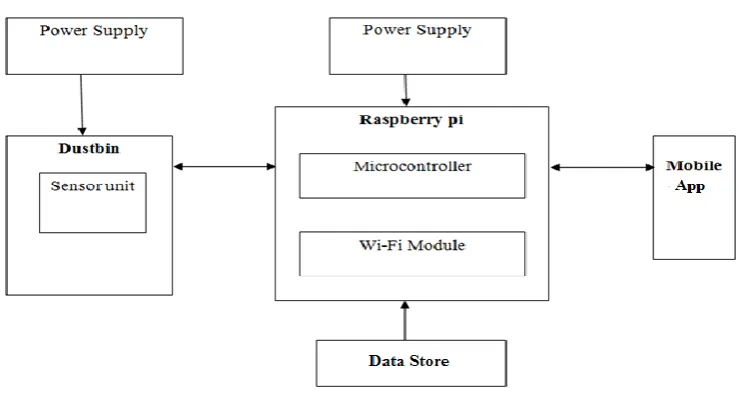
A. System Block Diagram[7]
Fig. 1: System Block Diagram
The Sensor unit placed on the dustbin performs the accurate detection of garbage full condition.
Wi-Fi module communicates the information from sensor to Raspberry pi.
The Power supply is mainly used to provide DC voltage to the components on board.
The Computer is used for coding and maintaining records.
IV. PSEUDO CODE
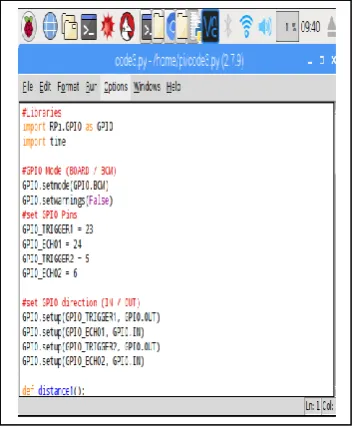
Step 1: Initially, import the libraries required, RPi.GPIO and time. RPi.GPIO takes care of revision checking. Step 2: Set up BCM GPIO numbering and disable warnings by setting warnings to False.
Step 3: Set GPIO Pins with respective pin numbers of TRIGGER1, TRIGGER2, ECHO1 and ECHO2.
Step 4: Setup GPIO direction (IN / OUT) of TRIGGER1 and TRIGGER2 as out and ECHO1 and ECHO2 as in respectively.
Step 5: Define a function named distance1 ():
Set TRIGGER1 to HIGH by setting the output value of TRIGGER1 to True.
Set TRIGGER1 to LOW by making it sleep for a time period of 0.01ms by setting the output value of TRIGGER1 to False.
Set input value of ECHO1 pin as 0 and record that time as Start time and; then set input value of ECHO1 pin as 1 and record that time as Stop time and; this Stop time is considered as arrival time. Find the time difference between start and arrival using this:
TimeElapsed = StopTime – StartTime.
Multiply TimeElapsed with the sonic speed (34300 cm/s) and then divide it by 2, hence, distance1 = (TimeElapsed * 34300) / 2
Return the value of variable distance1. Similarly, it can be performed for distance 2.
Step 6: For running the python module (the source file) as the main program, set the special __name__ variable to have a value "__main__".
Step 7: Use try block and start a forever loop using while True. Call the function distance1() in a variable dist1 and print the value of that variable. Pause the time for 1 seconds and then call the another function
distance2 () in a variable dist2 and then print the value of that variable. Alternate values would be printed.
Step 8: Reset by pressing CTRL + C. Step 9: Clean up all the ports you’ve used. Step 10: End.
V. RESULTS
Fig. 2: Raspbian window in VNC viewer. Fig. 3: File containing python code for distance measurement.
Fig. 4& Fig. 5 represents the codeand Run module output screens for code execution that the code is compiled and executed.
Fig. 4: Python code for distance measurement Fig. 5: Run Module for Code Execution
Fig. 6: Autoclean app icon Fig. 7: Splash screen for Autoclean
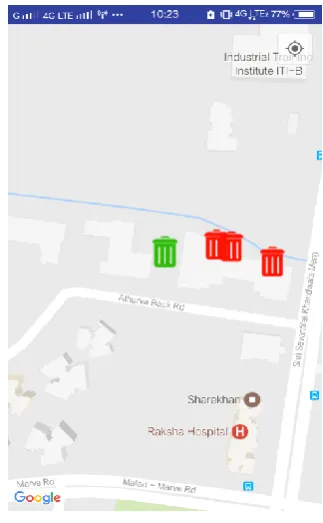
Fig. 8 and Fig. 9represents the Near me button which when clicked allows the employee to view the Garbage status of bin nearest to him or her with Red and Blue indicators for full and empty conditions respectively.
VI. CONCLUSION AND FUTURE WORK
Thus we have proposed to develop a Garbage Management System for Smart City, using Ultrasonic Sensor, Microcontroller and Wi-Fi/Bluetooth module. This system assures the cleaning of dustbin as soon as the garbage level reaches its threshold value and avoids overflow of garbage and reduces the operational time required by sensing the level of garbage and alerting the concerned authorities through an android application. This also makes use of GPS technology in Android application to alert the nearest employee and hence reducing the time for the dustbin cleaning process
.
Garbage bins being underutilized; compression of waste could help in higher storage of waste in the bins with same volume reducing the number of cleanups and improve efficiency. Identification of foul smells based on anomalies to predict cleanup schedules can be done with Air Quality sensors. Optimization of route for the pickup trucks to save resources can be done by application of Advanced Analytics Algorithms like Frequent Pattern Mining and Time Series Prediction.REFERENCES
1. Kasliwal Manasi H. and SuryawanshiSmitkumar B., “A Novel Approach to Garbage Management Using Internet of Things for Smart Cities,”
International Journal of Current Trends in Engineering & Research, e-ISSN 2455–1392, Volume 2, Issue 5, pp.8 – 353,May 2016.
2. GaikwadPrajakta, JadhavKalyani, and MachaleSnehal, “Smart Garbage Collection System In Residential Area,” IJRET: International Journal of
Research in Engineering and Technology, e-ISSN: 2319-1163 | pISSN: 2321-7308, Volume: 04, Issue: 03, pp.122-124, Mar-2015.
3. Dr. K. R. Nataraj and Meghana K. C., “IOT Based Intelligent Bin for Smart Cities,” International Journal on Recent and Innovation Trends in
Computing and Communication, ISSN: 2321-8169, Volume: 4, Issue: 5, pp. 225 - 229 IJRITCC, May 2016.
4. Narayan Sharma, NirmanSingha and TanmoyDutta, “Smart Bin Implementation for Smart Cities,” International Journal of Scientific &
Engineering Research, ISSN 2229-5518, Volume 6, Issue 9, pp. 787-791, September-2015.
5. Monika K. A., NikithaRao, Prapulla S. B. and Shobha G., “Smart Dustbin-An Efficient Garbage Monitoring System,” International Journal of
Engineering Science and Computing,ISSN 2321 3361 © 2016 IJESC,Volume 6 Issue No. 6,pp.7113-7116,June 2016.
6. Adil Bashir, Shoaib Amin Banday, Ab. Rouf Khan and Mohammad Shafi, “Concept, Design and Implementation of Automatic Waste
Management System,” International Journal on Recent and Innovation Trends in Computing and Communication, ISSN 2321 – 8169, Volume: 1, Issue: 7, pp. 604 – 609, IJRITCC ,JULY 2013.
7. Asifa Indi, NikithaSukrithalal and GayatriBabu, “Garbage Management System for Smart City,” International Journal of Engineering Research
& Technology, ISSN:2278-0181, Volume 5, Issue 01, pp. 38-41 IJERT , 2017.
BIOGRAPHY
Asifa Indi, Nikitha Sukrithalal and Gayatri Babuare students in the Information Technology Department, Atharva
College of Engineering. They are currently pursuing Bachelor of Engineering (B.E) degree.