ISSN(Online): 2319-8753 ISSN (Print): 2347-6710
I
nternational
J
ournal of
I
nnovative
R
esearch in
S
cience,
E
ngineering and
T
echnology
(An ISO 3297: 2007 Certified Organization)
Website: www.ijirset.com
Vol. 6, Issue 7, July 2017
Improving Performance of the Mining
Itemsets without Setting Minimum Utility
Thresholds
N. Naveen Kumar1, Thirandasu Sandeep Kumar2
Assistant Professor, Department of CSE, School of Information Technology, JNTUH, Kukatpally, District Ranga
Reddy, Telangana, India1
M.Tech Student, Department of Software Engineering, School of Information Technology, JNTUH, Kukatpally,
District Ranga Reddy, Telangana, India2
ABSTRACT: The problem of frequent itemset mining is popular. But it has some important limitations when it comes to analyzing customer transactions. An important drawback is that purchase quantities are not taken into account. Thus, an item may only appear once or zero time in a transaction. A second major drawback is that all items are viewed as having the same importance, utility of weight. Thus, frequent pattern mining may find many frequent patterns that are not interesting. To address these limitations, the problem of frequent itemset mining has been redefined as the problem
of High-Utility Itemset (HUI) mining. In this paper I propose top-k high utility itemset mining, where k is the desired
number of HUIs to be mined. In this propose work, I am using two efficient algorithms to mine HUIs without set minimum utility threshold.
KEYWORDS: Utility mining, high utility itemset mining, top-k pattern mining, top-k high utility itemset mining
I. INTRODUCTION
ISSN(Online): 2319-8753 ISSN (Print): 2347-6710
I
nternational
J
ournal of
I
nnovative
R
esearch in
S
cience,
E
ngineering and
T
echnology
(An ISO 3297: 2007 Certified Organization)
Website: www.ijirset.com
Vol. 6, Issue 7, July 2017
whereas selecting the edge depends on data characteristics that are unknown to users. Parameter k is employed instead of the min_util threshold; it's terribly useful for many applications. This idea is employed to research consumer purchase behavior. High k HUI mining is employed to look out, what are the top-k sets of merchandise that contribute the most effective profit to the company and also the thanks to expeditiously found these item-sets while not setting the min_util threshold. Top-k HUI mining is important to many applications, it's not an easy task for developing economical algorithms for mining such patterns .Two algorithms named TKU and technical knockout are projected for mining the entire set of high k HUIs in databases whereas not the need to specify the minutil threshold. The TKU rule uses a tree-based structure named UP-Tree; it's accustomed maintain the information of transactions and utilities of item-sets. TKU inherits useful properties from the TWU model and it consists of 2 phases. In phase I, potential top-k high utility item-sets are generated. In clinical test, top-k HUIs are far-famed from the set of PKHUIS generated in phase I. resulting rule is TKO; it uses a list-based structure named utility-list to store the utility information of item-sets among the data. It uses vertical data illustration techniques to look out top-k HUIs in one section.
II. RELATED WORK
ISSN(Online): 2319-8753 ISSN (Print): 2347-6710
I
nternational
J
ournal of
I
nnovative
R
esearch in
S
cience,
E
ngineering and
T
echnology
(An ISO 3297: 2007 Certified Organization)
Website: www.ijirset.com
Vol. 6, Issue 7, July 2017
the performance of FUM and DCG+ is additional economical than that of SHFSM and DCG, severally. Therefore, IIDS is a good strategy for utility mining.
III. FRAME WORK
A. System Architecture
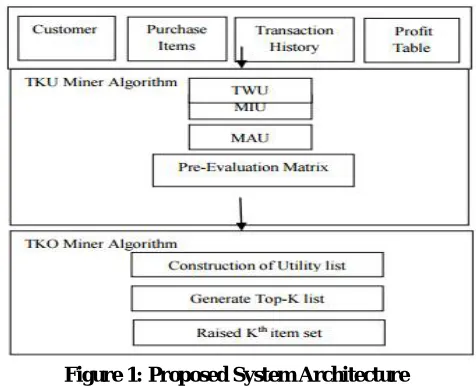
In this paper I tend to propose 2 economical algorithms like TKU (mining Top-K Utility itemsets) and KO (mining Top-K utility itemsets in one phase) algorithms. The TKU algorithmic program adopts a compact tree-based structure named UP-Tree to keep up the knowledge of transactions and utilities of itemsets. TKU inherits helpful properties from the TWU model and consists of 2 phases. In phase I, potential top-k high utility itemsets (PKHUIs) are generated. In clinical test, top-k HUIs are known from the set of PKHUIs discovered in phase I.
Figure 1: Proposed System Architecture
On the opposite hand, the KO algorithmic program uses a list-based structure named utility-list to store the utility info of itemsets within the information. It uses vertical information illustration techniques to search out top-k HUIs in mere one section.
The construct of group action weighted utilization (TWU) model was introduced to facilitate the performance of the mining task. Throughout this model, AN item set is termed high transaction-weighted utilization item set (HTWUI) if its TWU is not any but min_util, where the TWU of AN item set represents A boundary on its utility. Therefore, a HUI ought to be a HTWUI and every one the HUIs should be enclosed among the entire set of HTWUIs. A classical TWU model-based algorithmic program consists of 2 phases. Among the initial half, cited as phase I, the entire set of HTWUIs is found. Among the second half, cited as clinical test, all HUIs are obtained by shrewd the precise utilities of HTWUIs with one information scan.
Benefits of planned System:
1. 2 algorithms named TKU (mining Top-K Utility item-sets) and KO (mining Top-K utility item sets in one phase) are planned for mining the complete set of top-k HUIs in databases while not the requirement to specify the min-util threshold.
ISSN(Online): 2319-8753 ISSN (Print): 2347-6710
I
nternational
J
ournal of
I
nnovative
R
esearch in
S
cience,
E
ngineering and
T
echnology
(An ISO 3297: 2007 Certified Organization)
Website: www.ijirset.com
Vol. 6, Issue 7, July 2017
B. The TKU algorithm
Here, projected AN algorithmic program named TKU for locating top-k HUIs while not specifies min-util. The Baseline approach of TKU is and seize of UP-Growth, a tree-based algorithmic program for mining HUIs. TKU uses the UP-Tree structure of UP-Growth to manage the knowledge of transactions and top-k HUIs. TKU is worked in 3 steps. (1) Constructing the UP-Tree, (2) generating potential top-k high utility item-sets from the UP-Tree, (3) distinguishing top-k HUIs from the set of PKHUIs, UP-Tree structure, UP-Tree structure is delineate in, every node N of a UP-Tree have 5 entries: N.name is that the item name of N; N count is that the support count of N; N.nu is that the node utility of N; N. parent indicates the parent node of N; N link may be a node link which can purpose to a node having a similar item name as N.name. The Header table may be a structure used to facilitate the traversal of the UP-Tree. A header table entry contains an item name, a calculable utility worth, and a link. The link points to the primary node within the UP-Tree having a similar item name because the entry. The node whose item names are a similar is traversed with efficiency by following the links in header table and therefore the node links within the UP-Tree.
Construction of UP-Tree:
A UP-Tree is created by scanning the first information doubly. Among the initial scan, the group action utility of every group action and TWU of the each item are completed. Later on, things are inserted into the header table in descending order of their TW use. Throughout the second information scan, transactions are organized then inserted into the UP-Tree primarily; the tree is created with a supply.
When a group action is retrieved, things within the group action are sorted in descending order of TWU. A group action once the higher than reorganization is termed organized group action and its group action utility is termed organized group action utility; once inserting all the organized transactions, the development of the UP-Tree is completed.
C. The TKO Algorithm
It will understand top-k HUIs in precisely one section. It uses the basic search procedure of HUI-miner and its utility-list structure. Whenever AN item set is generated by KO, utility of the generated item set is calculated by its utility-list while not scanning the initial information. Construction of Utility-list structure: Utility list is delineated in, among the case of KO algorithms, each item connected with a utility-list. The utility-list of things is usually cited as initial utility lists. These are created by scanning the information doubly. Within the 1st scan, the TWU and utility values of things are calculated. Throughout the second scan, things every dealing as TWU values and therefore the utility list of each item is built and UP tree are generate later on run the TKU and KO algorithmic program.
IV. EXPERIMENTAL RESULTS
ISSN(Online): 2319-8753 ISSN (Print): 2347-6710
I
nternational
J
ournal of
I
nnovative
R
esearch in
S
cience,
E
ngineering and
T
echnology
(An ISO 3297: 2007 Certified Organization)
Website: www.ijirset.com
Vol. 6, Issue 7, July 2017
I can study that Minimum software threshold contrast chart among TKU and TKO algorithms chart TKU set of rules period is higher than TKO Algorithm duration. The distinction could be shown in the experience of Runtime. So I can consider that via the usage of this TKU and TKO set of rules to examine the item-sets without problems. Through our implementation I can improve the performance of the system at decrease value then examine to current methods.
V. CONCLUSION
In this paper, I conclude that I solved the top-k high utility itemsets mining problem without setting min_util thresholds. For that, I proposed an efficient two algorithms named as TKU (mining Top-K Utility itemsets) and TKO (mining Top-K utility itemsets in One phase). These two algorithms are used UP-Tree algorithm. From experimental results, I can say the proposed algorithms are efficient to mine the top-k high utility itemsets.
REFERENCES
[1] R. Chan, Q. Yang, and Y. Shen, “Mining high-utility item-sets,” in Proc. IEEE Int. Conf. Data Mining, 2003, pp. 19–26.
[2] P. Fournier-Viger and V. S. Tseng, “Mining top-k sequential rules,” in Proc. Int. Conf. Adv. Data Mining Appl., 2011, pp. 180–194.
[3] P. Fournier-Viger, C. Wu, and V. S. Tseng, “Mining top-k association rules,” in Proc. Int. Conf. Can. Conf. Adv. Artif. Intel. 2012, pp. 61–73.
[4] J. Han, J. Pei, and Y. Yin, “Mining frequent patterns without candidate generation,” in Proc. ACM SIGMOD Int. Conf. Manag. Data, 2000, pp. 1–12.
[5] J. Han, J. Wang, Y. Lu, and P. Tzvetkov, “Mining top-k frequent closed patterns without minimum support,” in Proc. IEEE Int. Conf. Data Mining, 2002, pp. 211–218.
[6] S. Krishnamoorthy, “Pruning strategies for mining high utility item-sets, ”Expert Syst. Appl., vol. 42, no. 5, pp. 2371–2381, 2015.
[7] C. Lin, T. Hong, G. Lan, J. Wong, and W. Lin, “Efficient updating of discovered high-utility item-sets for transaction deletion in Dynamic databases,” Adv. Eng. Informat., vol. 29, no. 1, pp. 16–27, 2015.
[8] G. Lan, T. Hong, V. S. Tseng, and S. Wang, “Applying the maximum utility measure in high utility sequential pattern mining,” Expert Syst. Appl., vol. 41, no. 11, pp. 5071–5081, 2014.
[9] Y. Liu, W. Liao, and A. Choudhary, “A fast high utility item-sets mining algorithm,” in Proc. Utility-Based Data Mining Workshop, 2005, pp. 90–99.