20th International Conference on Structural Mechanics in Reactor Technology (SMiRT 20) Espoo, Finland, August 9-14, 2009 SMiRT 20-Division III, Paper 1585
Phase-field Modeling of Microstructure Evolution in Nuclear Materials
San-Qiang Shi
a, Xianghua Guo
b, Zhihua Xiao
a, and Chung-ho Woo
ca
Department of Mechanical Engineering, The Hong Kong Polytechnic University, Hong Kong, China e-mail: [email protected]
b
State Key Laboratory of Explosion and Safety Science, Beijing Institute of Technology, Beijing 100081, China
c
Department of Electronic and Information Engineering, The Hong Kong Polytechnic University, Hong Kong, China
Keywords: phase-field modeling, hydrogen diffusion, hydride precipitation, void-lattice formation.
1
ABSTRACT
Microstructure evolution is common during material processing. Since many properties of materials are determined by the microstructure of materials, in recent years much effort was made to develop computational methodologies for predicting the evolution of microstructure of materials. One of these methodologies is the phase field method (PFM). PFM describes a microstructure using a set of conserved and nonconserved field variables that are continuous across the interfacial regions. The temporal and spatial evolution of the field variables is governed by the Cahn-Hilliard nonlinear diffusion equation and the time-dependent Ginzburg-Landau (TDGL) equation. With the fundamental thermodynamic and kinetic information as the input, PFM is able to predict the evolution of arbitrary morphologies and complex microstructures without explicitly tracking the positions of interfaces. This paper presents two examples of phase field modeling of microstructure evolution of materials used in nuclear power industry. In the first example, an elasto-plastic phase field model was developed to predict hydrogen diffusion, hydride precipitation and fracture in zirconium at crack and notch tips. In the second example, some preliminary results of our current research on void-lattice formation in irradiated materials will be given.
2
INTRODUCTION
Thermodynamic evolution of compositional (c) and structural (η) inhomogeneities in materials may be described by two types of dynamic equations (Chen, 2002).
One is Cahn-Hilliard diffusion equations (Cahn et al., 1961),
) , ( ) , ( ) , ( t r t r c F M t t r c i j ij i
!
"
"
+ # # $ % & & ' ( ) ) * + , , -. / / = 0 0i, j = 1, 2, 3, … (1)
where Mij is the mobility of compositional species, F is the total free energy of the system and ξi is the noise term to reflect thermal fluctuation. The other is Allen-Cahn (time-dependent Ginzburg-Landau) equations (Allen, 1977), ) , ( ) ,
(r t r t F
L
t q p
pq p
!
"#
"
#
+ $ = % %p, q = 1, 2, 3, … (2)
where Lpq is the kinetic coefficient, and ζp is the noise term for structural order parameter ηp. The total free energy of the system may include
o Chemical free energy if chemical reactions are involved;
o Interfacial and/or surface energy if multi-phases are present;
o Electrical, magnetic, thermal energy;
o Work done by external fields/forces;
o ……
Phase-field methodology has been successfully applied to various materials processes including solidification, solid-state structural phase transformations, grain growth and coarsening, domain evolution in thin films and smart materials, pattern formation on surfaces, dislocation microstructures and dynamics, crack propagation, and electromigration. Here, we report two examples of using phase-field method in nuclear materials.
3
HYDRIDE PRECIPITATION IN ZIRCONIUM
We have been working on hydride embrittlement in zirconium alloys since 1990s. This problem involves three distinct phenomena, hydrogen diffusion, hydride precipitation and hydride fracture. Our early theoretical models used idealized assumptions such as rectangular shaped hydrides (Shi et al. 1994a, 1994b, 1994c, 1995, Leitch et al., 1996, Sagat et al., 1994). In recent years, we have developed phase-field models to account for all three phenomena in one framework (Ma et al., 2002a, 2002b, Ma et al. 2006, Guo et al. 2008a, 2008b). Following factors are included in the models: effect of H concentration, hydrogen/hydride-induced strains (eigenstrains), interactions between hydrogen/hydrides and stress field/external load, crystalline structures, defects and flaws, and so on. In order to include the effects of plastic deformation around hydrides and at flaw tips, following additional kinetic equations are included (Guo et al. 2005),
)
,
(
)
,
(
t
r
Y
K
t
t
r
pz p kl ijkl pz p ij!"
!
"
#
=
$
$
(3) ) , ( ) , ( t r E N t t r def kl ijkl def ij!"
!
"
# = $ $ (4)where
!
ijp is plastic strains, rpz is the plastic zone, Y is the yield potential, def ij!
is the eigenstrains within defects and flaws, E is the strain energy of total system, and Kijkl and Nijkl are kinetic constants for plastic deformation and defect relaxation processes, respectively. Solving equations (1)~(4) simultaneously, we have predicted hydride precipitation in smooth specimens, or around a flaw (Guo 2008a, 2008b). Figures 1~3 give some examples.Combining with a fracture criterion (for example, Shi et al. 1995), one can use the above scheme to predict crack initiation at the hydrides. The fracture criterion may be one of the following, or a combination of them,
o A critical stress intensity factor;
o A critical stress component;
o A critical displacement;
o A critical strain component;
o A critical energy release rate…
No matter what fracture criterion is chosen, the above scheme can handle these parameters with ease because most of these parameters are
actually evaluated for any location at every time step within the
concerned specimen.
4
VOID-LATTICE FORMATION IN IRRADIATED METALS
phenomena in this connection is the ability of the material’s nano- and micro- structures to
self-assemble in well-organized, two- and three-dimensional periodic arrangements. For example, the
ordering of voids into a superlattice having the symmetry of the underlying crystal lattice has been
observed in many metals and alloys (UCLA). And yet, the formation of void lattices remains a
controversial subject without a generally accepted theory for more than thirty years. We are
currently developing a phase-field model to study this phenomenon. The diffusion of individual
vacancies and self-interstitials created by irradiation may be described by equation (1), while voids
and dislocation loops formed by coalescence of point defects may be treated as secondary phases
with associated eigenstrains, therefore to be modelled by equation (2). In addition, the production
rates for vacancies and self-interstitials and the recombination rate between these two types of
defects shall be included in the model.
Figure 1. Hydride precipitation in a smooth specimen: (a) theoretical simulation; (b) experimental observation.
Figure 2. Theoretical predictions of hydride precipitation near a notch: notch geometry and external load are the same for all three cases, while hydrogen concentrations in solid solution change from the highest at the left, to the lowest at the right. An external tensile stress is applied in the horizontal direction.
Figure 3. Theoretical predictions of hydride precipitation at notch and crack tips: notch geometry changes from blunt at the left, to sharp at the right. Average hydrogen concentrations and peak stresses at notches are kept the same for three cases. External tensile stresses are applied in the horizontal direction.
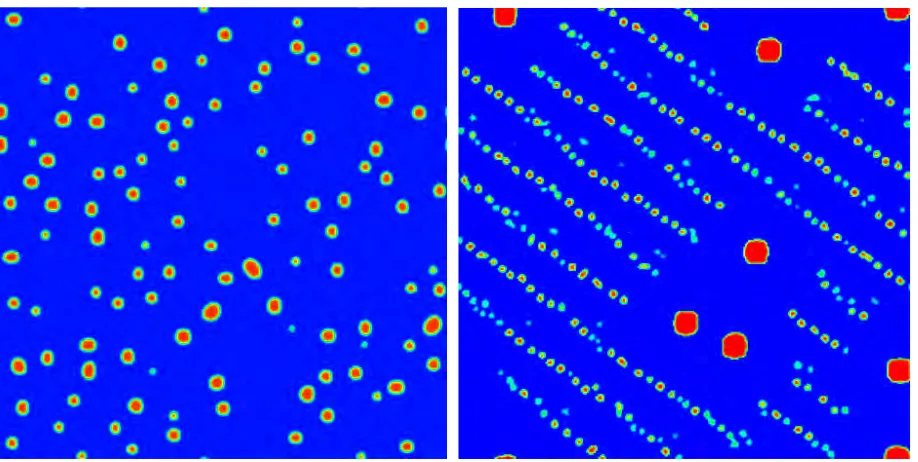
Figure 4 shows two preliminary results of our recent work. The left figure in figure 4 represents one of simulation results in which the assumption of isotropic diffusion for both vacancies and self-interstitials was applied. Clearly, the result showed random formation of voids in the single crystal of Mo. On the other hand, if we assumed an anisotropic diffusion coefficient for self-interstitials only, then under certain conditions (such as under certain defect production rates), an ordered pattern of void structures may occur, as seen in the right figure in figure 4. More studies are undergoing to understand the phenomenon.
Figure 4. Computer simulations of void evolutions under irradiation condition in Mo. Left figure: isotropic diffusion for both vacancies and self interstitials. Right figure: isotropic diffusion of vacancies, plus anisotropic diffusion of self-interstitials.
5
CONCLUSION
This paper reports two examples of applying phase-field method in predicting microstructure evolution in nuclear materials. These modelling efforts help us for better understanding of controlling parameters during microstructure evolution in materials. Combining with experimental validations, one may be able to establish a powerful tool for predicting properties of materials in reactor environment as well as designing advanced materials for nuclear industry.
Acknowledgements. This work was supported by grants from the Research Grants Council of Hong
Kong (PolyU 5265/06E and PolyU 5275/08E).
REFERENCES
Allen, S.M. and Cahn, J.W. 1977. J. Phys. Vol. 38, P.C7–51.
Cahn, J.W. 1961. Acta Metall. Vol. 9, P.795–801.
Chen, L.Q. 2002. Annu. Rev. Mater. Res. Vol. 32, P.113-40.
Ghoniem, N.M., Walgraef, D.A., and Zinkle, S.J. 2002. J. Computer Aided Materials Design, Vol. 8, P.1.
Guo, X.H., Shi, S.Q. and Ma, X.Q. 2005. Applied Physics Letters, Vol. 87, Art. No. 221910.
Guo, X.H., Shi, S.Q., Zhang, Q.M. and Ma, X.Q. 2008a. Journal of Nuclear Materials, Vol.378, P.110~119.
Guo, X.H., Shi, S.Q., Zhang, Q.M. and Ma, X.Q. 2008b. Journal of Nuclear Materials, Vol.378, P.120~125.
Leitch, B.W. and Shi, S.Q. 1996. Modelling and Simulation in Materials Science and Engineering, Vol. 4, P.281-292.
Ma, X.Q., Shi, S.Q., Woo, C.H. and Chen, L.Q. 2002a. Computational Materials Science, Vol. 23, P.283~290.
Ma, X.Q., Shi, S.Q., Woo, C.H. and Chen, L.Q. 2002b. Scripta Materialia, Vol. 47, P.237~241.
Ma, X.Q., Shi, S.Q., Woo, C.H. and Chen, L.Q. 2002c. Materials Science and Engineering A, Vol. 334, P.6~10.
Sagat, S., Shi, S.Q. and Puls, M.P. 1994. Materials Science and Engineering, A176, P.237-247.
Shi, S.Q. and Puls, M.P. 1994a. Journal of Nuclear Materials, Vol. 208, P.232-242.
Shi, S.Q., Puls, M.P. and Sagat, S. 1994b. Journal of Nuclear Materials, Vol. 208, P.243-251.
Shi, S.Q., Liao, M. and Puls, M.P. 1994c. Modelling and Simulation in Materials Science and Engineering, Vol. 2, P.1065-1078.