Maximize Energy Efficiency with QoS
Performance of Contention Window Adaptation
Algorithm for IEEE 802.11WLAN
Bhagat Abhimanyu, Prof. Nighot Jyoti
Department of Computer Engineering, KJCOEMR, Pune, India
ABSTRACT: Design of efficient MAC (medium access control) protocols with both high throughput performance and high degree of good performance is a major focus in distributed contention-based MAC protocol research. Energy efficiency issues are becoming very important with the increasing number of deployment of internet based application. There is a huge increase in the number of Wi-Fi enabled devices which leads to increased deployment of WLANs, with the growth of internet application deployment. Increased energy consumption has several detrimen- tal effects. In general, it leads to a rise in greenhouse gases as well as contributes to higher cost of business operation. Specifically, for WLANs since the user devices are mostly battery operated which limits the useful lifetime of a terminal, thus managing energy efficiently is extremely important in such devices to prolong the battery life. This paper introduces a new contention window (CW) adaptation algorithm to minimize the collision level in an IEEE802.11 based network with the main aim of maximizing energy efficiency while maintaining required Quality of Service (QoS) performance.
KEYWORDS: contention window (CW) energy efficiency, backoff, distributed coordination function (DCF).
I. INTRODUCTION
IEEE 802.11 plays very big role in wireless communica- tions. Due to the development of various modulation tech- niques and coding schemes, multiple transmission rates are now supported by 802.11 physical layers. IEEE 802.11 stan- dard has become ubiquitous and gained widespread popularity as a layer-2 protocol for wireless LANs (WLANs). Many research works have been carried out to develop algorithms to adapt the MAC to increase network QoS, such as optimize the throughputperformance.Thereareonlyafewworksthatfocus on optimizing both energy and QoS values. Contention is a media access method that is used to share abroadcastmedium.Once the node has waited the appropriate arbitration inter- frame space time, it randomly selects a value for its random back off timer. The timer value must be within the Contention Window values defined for the priority queue. Each of the 4 priority queues has a defined Contention Window range, initially defined as ranging from 0 to CWmin, where CWmin varies between each of the queues. If a collision occurs wh er e two nodes transmit at the same time, no acknowledgment of the frame will be received and the node will increment its retry counter and increase its contention window according to the binary exponential back off algorithm, up to a maximum contention window size of CWmax. Distributed coordination function (DCF) is the basic MAC technique of the IEEE
conditions, this is the main base of the proposed algorithm. Depends on that threshold level, the load condition is categorized into three different categories which are low, medium and high load conditions and each category applies different CW adjustment procedure. For low load condition, due to lower contention level, the algorithm set the CW to CWmin. As the load increase, more packets contend to access the channel thus leads to higher probability of collisions. In order to minimize the collision, the proposed algorithm increases the CW by double step sizes above CWmin for medium load condition. At very high load, the contention level keeps on increase due to congested networks hence the CW is increased to triple step sizes above the CW min. The remainder of this paper is structured as follows.InsectionIIwepresenttherelatedworkasareviewof literature.SectionIIIoutlinesanSystemoverviewofthewhole system.. Section IV presents details of the system analysis. After that, we discuss the conclusion in Section V. The last section presents our acknowledge and references.
II. REVIEW OF LITERATURE
In Literature, there is excellent work on influence of the two parameters CWmin and CWmax [2] of the EDCA on the energyconsumptionandthetrafficperformanceintheWMSN.The validation of the clear existence of influence, those variationsdependingonthedensityandtheload,mentionsthat the dynamic adjustment of CWmin and CWmax will beanef-fective technique to improve both the energy consumption and the traffic performance of the WMSN. EDCA CFB [3] access method gives better performance in terms of delay,throughput, packet delivery rate and energy consumption, while EDCA access method suffers from performance degradation whenthe density increases. There is work on performance evaluation of proposed mechanism called DFA-EDCA [4] hasshownsig-nificant improvement on the network performance especially at high channel load conditions. MAC protocol for WLAN [5] and the corresponding collision-resolution algorithm and proposes an effective algorithm, GDCF, based on 802.11 DCF protocols. The FCR algorithm [6] can achieve high throughput performance while preserving the implementation simplicity in wireless local area networks. The back off parameters in the IEEE 802.11 DCF [7] access method is far from being optimal in a heavy-loaded and error-prone WLAN environ- ment. This yields a high collision probability and degraded channel utilization in busty arrival or congested scenarios. In the IEEE 802.11 DCF [8], previous works to tune the back off parameters could drive the IEEE 802.11 protocol close to its optimal behavior in terms of throughput. However, they do not specifically address an appropriate setting of the back off parameters under non-saturated conditions. EARC[9]protocolfor tuning the rate and back off parameters in an IEEE 802.11 multi-rate environment. By utilizing reserved bits in 802.11 PLCP header and one extra byte carried in DATA packet, EARC incurs little communication overhead despite itsclosed- loop (receiver assisted) nature. The MAC-layer protocol DCF [10] has been enhanced by proposing a new method, known as the VBA, which is based on the sequencing technique. The performance of the MAC layer is good while using the VBA when compared with other methods like legacy DCF, ECA, BCR-CS, and EBA.
III. SYSTEM OVERVIEW
degradation. Fig. 1 also illustrates
Fig. 1. Different between DCF and proposed algorithm.[1]
difference between the DCF mechanism and the proposed algorithm. Based on 802.11 DCF [6, 13], the CW is decreased to the initial value (CWmin) after each successfultransmission without considering the load condition. Whereas the propose algorithm performs reduction of CW moderately based on network load conditions. The AP measures the network load within a short period of time, in this case for 100ms and this value is fed back to stations through beacons. Each station adjusts the CW appropriately based on the information of load conditions. Details of the proposed algorithm are illustrated in Fig. 3. The basic technique of the proposed algorithm is adjusting the CW based on the load conditions. We divide the load conditions into three different scenarios; low, mediumand high load conditions and every scenario results in a different CW adjustment. Different load condition is determined by threshold levels which represent network load (in packets per second). To define the threshold levels, we plot the graph of delay as a function of network load as shown in Figure 2. Based on the information of network load condition, the
Fig. 2. Threshold level selection based on different increases of delay [1]
the load condition that was fed back by the AP before deciding on the specific CW adjustment procedure that needs to be carried out. If at that time the total load falls under low load conditions, the CW will be mapped to the minimum CW, same as the legacy DCF procedure where the (CW = 15). On the other hand, if the total loads condition is within the range of medium load, the CW will be increased to two steps above the CWmin where the next value will be (CW
= 63). In the case of high load condition, the CW will be increased to three steps above the CWminwhich equal to (CW
= 127). On the contrary, when current delay reaches the threshold delay, the CW will be adjusted to CWmax.With the goal to maintain the QoS performance within required level, when the delay reach the threshold level, the algorithm immediately adjust the CW to CWmaxto provide larger backoff delay in order to aggressively reduce higher collisions. Details of the proposed CW adjustment are shown below;
Loop () {
if(Shortretrycount +Longretrycount ==0)
Check current delay and compare with threshold delay if(TC TQOSBE ){ Measure the total load {
if(TL>0.3 × PTH ){
CW=CWmin;}
Else if(0.3 × PTH TL 0.7PH ) CW=CWmin+2βi;}
Else if(TL >0.7× PTH ){
CW=CWmin+3βi;}} if(TC> TQOSBE ){ CW=CWmax;}}
The algorithm gain advantage of energy efficiency by in- creasing the CW because this action provides larger backoff interval that reduces the collision level. As a compensation of higher energy efficiency, larger backoff interval leads to higher delay value due to increase in back offdelay. However, with less collision occurred packets get transmitted quickly thereby reducing the queuing delay which overcomes the increase of backoffdelay. Therefore the overall delay is reduced, as will be discussed further in the next section. In addition to that, small amount of collisions give more chance for packet transmission, thus the proposed algorithm has a better throughput performance especially at higher load. The energy consumed to transmit one bit of payload can bedeterminedbycalculating the energy expenditure to transmit a MAC frame and dividing it with the size of the payload. Several frame transmission attempts could be necessary to transmit one frame successfully. Based on that assumption, (1-4) describes the energy perbit;
Fig. 3. Block diagram of the proposed algorithm [1]
a=(Pidle×(TDIF S+Tbackof f+TSIF S)+Ptx×TData+Prx ×
Tack) (2)
b=(Pidle×(Tbackof f+TEIF S+TDIF S))+Ptx×TData)×
Nattempt (3)
Part (a) of the equation describes the energy con- sumed during successful transmission while part (b) rep- resents the amount of energy consumed during unsuccess- ful transmission attempts. The energy consumed per bit re- quires the following input parameters:Lpayload(bits),the packet length,{Ptx,Prx,Pidle}efinedasthepowerconsumedbythe wireless interface when transmitting, receiving and idling respectively as listed in table II. For an unsuccessful packet transmission (part b), it is similar to part (a) but there are no costs for the ACK reception and TSIFS has to be replaced with TEIFS . After an unsuccessful transmission attempt, a node has to wait at least for an extended inter frame space (TEIFS )before starting the next transmission attempt. The energy consumed during unsuccessful transmission has to be multiplied with the number of unsuccessful transmission attempt,Nattemptas shown in (3).
IV. SYSTEMANALYSIS
busy, the transmission is deferred and the Backoff procedure is invoked. This procedure calculates a random time interval called BackoffTimer. This time interval is chosen randomly between 0 and the current size of the Contention Window (CW).
Backoff Timer = Random[0,CW] × SlotTime
Thereafter, if the channel becomes free, the station waits for a DIFS time, if the channel is still free, the previously calculated Backoff Timer is decremented SlotTime by SlotTime. The decrement is suspended if the transmission channel goes to busy state. Once the channel back to the free state, the station waits for DIFS and then continues to decrement the Backoff Timer previously suspended.
DCF requires a station wishing to transmit to listen for the channel status for a DIFS interval. If the channel is foundbusy during the DIFS interval, the station defers its transmission. In a network where a number of stations contend for the wireless medium, if multiple stations sense the channel busy and defer their access, they will also virtually simultaneously find that the channel is released and then try to seize the channel. As a result, collisions may occur. In order to avoid such collisions, DCF also specifies random backoff, which forces a station to defer its access to the channel for an extra period. DCF also has an optional virtual carrier sense mechanism that exchanges short Request-to-send (RTS) and Clear-to- send (CTS) frames between source and destination stations during the intervals between the data frame transmissions. DCF includes a positive acknowledge scheme,whichmeansthat if a frame is successfully received by the destination it is addressed to, the destination needs to send an ACK frame to notify the source of the successful reception. DCF does not solve the hidden terminal and/or exposed terminal problem completely, it only alleviates the problem through the use of RTS and CTS, and recommends the use of a larger carrier sensingrange.DCFisdefinedinsubclause9.3oftheIEEE
802.11 standard and is the de facto default setting for Wi- Fi hardware. 802.11 DCF consumes a significant amount of airtime, 802.11 control messages usually convey very little information. For example, an ACK message can take up to 60 s to transmit completely, which includes an amount of airtime sufficient to transmit 3240 bits at 54 Mbit/s, during which it conveys a single bit of relevant information. The IEEE 802.11 standard also defines an optional access method using a Point Coordination Function (PCF). PCF allows the access point acting as the network coordinator to manage channel access. The IEEE 802.11e amendment to the standard enhances the DCF and the PCF, through a new coordination function called Hybrid Coordination Function(HCF).
V. RESULT
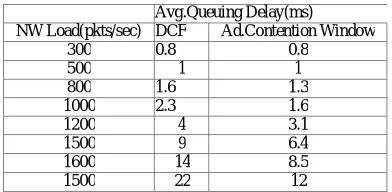
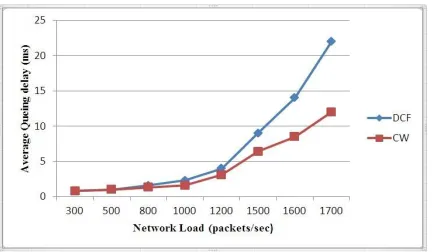
As per above fig. 4, it means that average queuing delay is for adaptive contention window is less (ex: for the netwotk load 1600 proposed algorithm has avg. queuing delay is 8.5 ms whereas for DCF it is 12 ms)as compared to previous DCF algorithm. Hence the the proposed algorithm is working better as it has less queuing delay which increases the Qos performance and hence as a result it reduces energy required for the overall system. It concludes that proposed Contention window algorithm has higher QoS and it is energy efficient.
TABLE I
COMPARISON OF QUEUING DELAY BETWEEN TWO APPROACHES
Avg.Queuing Delay(ms) NW Load(pkts/sec) DCF Ad.Contention Window
300 0.8 0.8
500 1 1
800 1.6 1.3
1000 2.3 1.6
1200 4 3.1
1500 9 6.4
1600 14 8.5
Fig. 4. Comparison of average queuing delay with offered load.
VI. CONCLUSION
The packet collisions in the wireless channel occur due to impairment of backoff algorithm in the contention based DCF mechanism. In this paper, we propose a new CW adap- tation algorithm for collision resolution with the main goal to reduce the energy consumption while improving the QoS performance. The proposed CW adaptation algorithm adap- tively changes the CW size according to the load conditions which reflect the congestion level. The proposed adaptation algorithm is more dynamic where different steps size for CW adjustment is introduced to achieve the required energy saving and QoS objectives. Simulation results show that the proposed algorithm outperforms previous CW adaptation schemes such as the FCR algorithm and the CW MAC parameters tuning in terms of reducing energy consumption as well as improving the QoS performance.
VII. ACKNOWLEDGMENT
I express great many thanks to Prof. Mrs. Nighot Jyoti for their great efforts of supervising and leading me, to accomplish this fine work. To college and department staff, they were great source of support and encouragement. To my friends and family, for their warm, kind encourages and loves. To every person gave us something too light my pathway, I thanks for believing in me.
REFERENCES
[1] Wan NorsyafizanW.Muhamad, Jamil Y. Khan and Jason Brown(2015) Energy Efficient Contention Window Adaptation Algorithm for IEEE 802.11 WLAN in Computer Networks, 2015 ICT.
[2] H. Touil, Y. Fakhri, and M. Benattou, ”Contention Window MAC parameterstuningforwirelessmultimediaSensorNetworks,”inComputer Systems and Applications (AICCSA), 2013 ACSInternationalConference on, 2013, pp. 1-4.
[3] H. Touil, Y. Fakhri, and M. Benattou, ”Energy-efficient MAC protocol based on IEEE 802.11e for Wireless Multimedia Sensor Networks,” in Multimedia Computing and Systems (ICMCS), 2012 International Conference on, 2012, pp. 53-58.
[4] A. A. Shakir, ”Efficient Backoff Mechanism for Multimedia Support in 802.11e EDCA Wireless Ad Hoc Networks,” Wireless Personal Commu- nication, vol. 71, pp. 439-466, 2013.
[5] W. Chonggang, L. Bo, ”A new collision resolution mechanism to enhance the performance of IEEE 802.11 DCF,” Vehicular Technology, IEEE Transactions, vol. 53, pp. 1235-1246, 2004.
[6] K. Younggoo, F. Yuguang, and H. Latchman, ”A novel MAC protocol with fast collision resolution for wireless LANs,” 22nd Annual Joint Conference of the IEEE Computer and Communications. IEEE Societies, 2003, pp. 853-862vol.2.
[7] D. Der-Jiunn, K. Chih-Heng, C. Hsiao-Hwa, and H. Yueh-Min, ”Con- tention window optimization for ieee 802.11 DCF access control,” Wire- less Communications, IEEE Transactions on, vol. 7, pp. 5129-5135,2008.
[8]H.Kunho,L.SuKyoung,K.Kyungsoo,andK.YoonHyuk,”ChannelCon- dition Based Contention Window Adaptation in IEEE 802.11 WLANs,” Communications, IEEE Transactions on, vol. 60, pp. 469-478, 2012.
[9] L. Ting-Yu, T. Ching-Yi, and W. Kun-Ru, ”EARC: Enhanced Adaptation of Link Rate and Contention Window for IEEE 802.11 Multi-Rate Wireless Networks,” Communications, IEEE Transactions on, vol. 60, pp. 2623-2634,2012.
![Fig. 1. Different between DCF and proposed algorithm.[1]](https://thumb-us.123doks.com/thumbv2/123dok_us/1611600.1199740/3.595.194.403.566.698/fig-different-dcf-proposed-algorithm.webp)
![Fig. 3. Block diagram of the proposed algorithm [1]](https://thumb-us.123doks.com/thumbv2/123dok_us/1611600.1199740/5.595.196.395.184.446/fig-block-diagram-proposed-algorithm.webp)