Removal of Artifacts from ECG Signal Using
CSLMS Algorithm Based Adaptive Filter :
A Review
Suyog Moon 1, Rajesh Kumar Nema 2
M. Tech. Scholar, Dept. of Electronics & Communication, Technocrats Institute of Technology, Bhopal, India1
Associate Professor, Dept. of Electronics & Communication, Technocrats Institute of Technology, Bhopal, India2 ABSTRACT: The electrocardiogram (ECG) is the recording of the electrical activities of the heart. Every portion of the ECG is very important for the diagnosis of different cardiac problems. But the amplitude and duration of electrocardiographic signals are usually corrupted by different noises. These noises are power line interference, base line wander, random noise and electrode movement. These noise signals are also called as artifacts. These noises mislead the diagnosis of the heart which is not desired. Different types of the adaptive filter has been proposed to remove these noises. The adaptive filter algorithms, such as; Least Mean Square (LMS), Normalized Least Mean Square (NLMS) and Constrained Stability Least Mean Square (CSLMS) algorithms are applied to remove these noises. Here the utilization of adaptive filtering technique gives us the idea of the effective method for denoising of a signal. This paper deals with CSLMS algorithm based adaptive filter for removal of artifacts from ECG signal. The adaptive filter algorithm is designed using MATLAB and tested on ECG signal corrupted with various noises. For performance measurement different output parameters are used such as signal to noise ratio (SNR), percent root mean square difference (%PRD) and mean square error (MSE).
KEYWORDS: Electrocardiogram (ECG), Adaptive Filter, Least mean square (LMS), Normalized least mean square (NLMS), CSLMS algorithm.
I. INTRODUCTION
Electrocardiogram (ECG) is the graphical record of the electrical potentials produced by the heart. The ECG signal wave is generated by depolarization and repolarization of certain cells due to movement of Na+ ions and k+ ions in the blood. ECG signal is a low amplitude voltage signal typically in the range of 2mV and requires a bandwidth in the range of 0.1 to 120Hz.
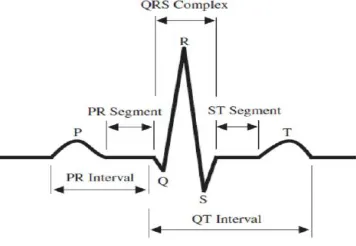
The ECG has been set up as the most common, easiest, accurate and a very rapid diagnosis of numerous cardiovascular incidents. A number of patients treated in the emergency room and in the intensive care unit (ICU) present with cardiovascular complaints. In such cases, the need of early and accurate diagnosis, this is the main importance of electrocardiography. The ECG signal measured from the patient results in a periodic waveform known as PQRST complex. Figure 1 shows a PQRST-complex waveform. The PQRST- complex waveform is labeled with P, Q, R, S and T, which are generally used in medical ECG terminology. PQRST complex waveform consists of a complete cardiac cycle. In a cardiac cycle consists of P wave, QRS Complex, and T wave. The baseline of ECG signal can be determined by measuring the part of the ECG signal preceding the P wave and the part following the T wave. Different noises affect the Electrocardiogram (ECG) signal during its acquisition. Generally, two types of noises are present in the ECG signals which are high frequency noise and low frequency noise. Noises with high frequency include power line interference and noises with low frequency include baseline wander noise. The noises present in the ECG signal may lead wrong interpretation. The objective is to separate the wanted ECG signals and unwanted noises as to obtain an accurate ECG signal. The removal of power line interference and baseline wander noises from most sensitive ECG signal can also be removed by implementing various useful techniques.
A. Power Line Interference (PLI)
The ECG signal can be affected by power line interference means the interference caused due to 50 Hz or 60 Hz power supply to which ECG machine is connected. Power line interference contains 50 Hz pickup in India and 60 Hz pickup in the United States. Another cause is improper grounding of ECG machine [10]. It is indicated as spike or impulse at 60Hz/50Hz harmonics, and it will appear as spikes at integral multiples of the fundamental frequency.
B. Baseline Wander (BW)
Baseline wander is defined as continuous drifting of ECG signal from baseline. The frequency and amplitude of the sinusoidal signal component should be variable. Patient movement and respiration cause the baseline wander i.e. low frequency noise. It causes a problem in the detection and analysis of ECG signals. Amplitude variation is 15% of peak to peak ECG signal amplitude and variation in the baseline is 15% of the ECG signal amplitude at 0.15 to 0.3. ECG signals affected by power line noise of relatively large amplitude where the frequency of the power line interference accurately at 50 Hz or 60 Hz, an adaptive filter would be able to separate and eliminate the power line interference and baseline wander noise from the ECG signal.
II. RELATED WORK
In the past few years, various contributions have been made in the literature regarding ECG signal beat detection, noise removal and classification of ECG signals. Most of them use either in the time domain or in the frequency domain representation of the ECG waveform.
In the paper [1], “ECG Signal Denoising by Using Least-Mean-Square and Normalized- Least-Mean-Square Algorithm Based Adaptive Filter”, Uzzal Biswas, Anup Das, Saurov Debnath and Isabela Oishee have implemented Least-Mean-Square and Normalized- Least-Mean-Square algorithm based adaptive filter for noise reduction in the electrocardiogram. They have analyzed the performance by comparing parameters such as signal to noise ratio (SNR), percentage root mean square difference (PRD) and mean square error (MSE). Signal Processing Toolbox built in MATLAB® is used for simulation. According to their paper, the NLMS algorithm based adaptive filter has better performance in comparison to LMS adaptive filter.
mean square algorithm [6]. The method uses a primary input also called desired input signal containing the corrupted signal and secondary input also called a reference input containing noise correlated in some unknown way with the primary noise. The secondary input is adaptively filtered signal and subtracted from the primary input to obtain the signal estimate. In this paper focused on the applications of the adaptive noise cancellation technique in a variety of practical applications that included the cancelling of various forms of noises in ECG signals.
In 2010, “Performance Evaluation of Different Adaptive Filters for ECG Signal Processing”, Sachin Singh and Dr. K.L. Yadav [9] introduced a new adaptive algorithm. In this paper, the proposed method RLS algorithm reduces the computation time without degrading the accuracy of the system. When compared to the LMS algorithm, it was shown to have superior performance. The LMS algorithms are simple and easy to implement, but the convergence speed is slow for small values of step size Sachin Singh and Dr. K.L. Yadav introduced an efficient Recursive least square (RLS) algorithm for noise cancellation in ECG signal. The performance of the proposed algorithm was compared with other adaptive algorithms for denoise ECG signal. It was shown that the proposed algorithm has a good overall performance.
In the paper [4], “Least-Mean-Square Algorithm Based Adaptive Filters for Removing Power Line Interference from ECG Signal”, Md. Maniruzzaman, Kazi Md.Shimul Billah and Bablu Gain have used adaptive filters for the cancellation of noise in electrocardiographic (ECG) signal. According to their paper, adaptive filtering has become one of the effective and popular methods for the processing and analysis of the ECG signal and the LMS based adaptive filter remove noise from ECG signal more effectively.
In the paper titled, “ECG Noise Removal using GA tuned Sign-Data Least Mean Square Algorithm”, Baby Paul, P. Mythili proposed an adaptive filtering technique for denoising the ECG signal based on Genetic Algorithm (GA) tuned Sign-Data Least Mean Square (SD-LMS) algorithm. The proposed implementation is suitable for noise cancellation. The proposed algorithm gave an average signal to noise ratio Improvement in ECG signal for power line interference and baseline wander noises [5].
In the paper,“Denoising of ECG Signal based on the Improved Adaptive filter with EMD and EEMD”, J. Jenitta and Dr. A. Rajeswari have implemented a new method for denoising Electrocardiogram (ECG) signal based on the adaptive filter with Empirical mode Decomposition (EMD) and Ensemble Empirical mode Decomposition (EEMD). In this EMD and EEMD methods are used to decompose the ECG signal into intrinsic mode functions (IMF). Block least mean square (BLMS) algorithm also used with EMD and EEMD to improve the computational efficiency of adaptive processing. They have analyzed the performance by comparing parameters such as signal to noise ratio (SNR) and mean square error (MSE). According to their paper Ensemble Empirical mode Decomposition (EEMD) with Block least mean square (BLMS) algorithm performs better than traditional Empirical mode Decomposition (EMD) based methods [2].
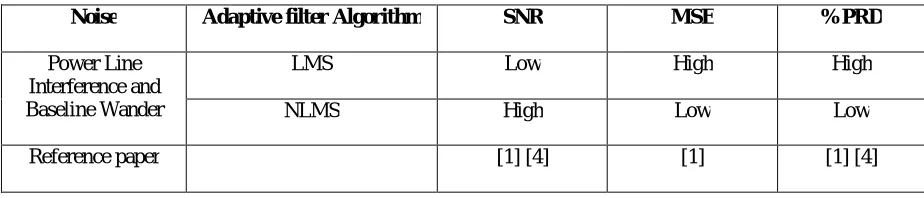
Table 1: Comparison of Adaptive filter Algorithm
Noise Adaptive filter Algorithm SNR MSE %PRD
Power Line Interference and Baseline Wander
LMS Low High High
NLMS High Low Low
III. PROPOSED METHODOLOGY
(1) Adaptive Filter
Filtering is a signal processing operation. Its main objective is to process a signal in order to manipulate the information contained in the signal. In another word, a filter can describe as it is a device that maps its input signal to another output signal facilitating the extraction of the desired information contained in the input signal. A digital filter is the one that processes, discrete time signals represented in digital format. In time-invariant filters, the internal parameters and the structure of the linear filter are fixed, and if the filter is linear then the output signal is also a linear function of the input signal. Once the linear filter specifications are given, the design of time-invariant linear filters requires three basic steps, namely; the approximation of the specification of a rational transfer function, appropriate structure defining the algorithm, and the choice of the form of implementation of the algorithm.
An adaptive filter is required when the fixed specifications are not given and the adaptive filter specifications cannot be satisfied by time-invariant filters. An adaptive filter is a nonlinear filter since its characteristics are dependent on the input signal and consequently the homogeneity and additivity conditions are not satisfied.
The adaptive filters are time-varying since their parameters are continually varied in order to meet a performance requirement. In this sense, we can interpret an adaptive filter as a filter that performs the approximation step in-line. Usually, the definition of the performance criterion requires the existence of a reference signal that is usually hidden in the approximation step of fixed-filter design.
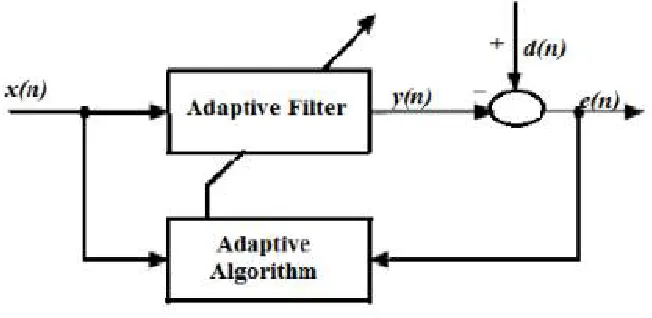
Figure 2 Adaptive filter structure
The above figure is a general adaptive filter diagram. The main idea behind the block diagram is that a adaptive filter has FIR (Finite Impulse Response structure) and For such structures, the impulse response is equal to the filter coefficients.
The coefficients for FIR filter of order N are defined as
w(n)=[w0 (n), w1(n),…….wN-1(n)]T (1)
y(n)=W(n)T x(n) (2) The error signal e(n) is the difference between the desired and the estimated signal
e(n) = d(n) - y(n) (3) The variable filter updates the filter coefficients W(n+1) at every time instant
W(n+1)=W(n)+∆W(n) (4)
Where, ΔW(n) is a correction factor for the FIR filter coefficients. The adaptive algorithm generates this correction factor based on the input signal and error signals and estimate of the desired filter. A digital filter (FIR filter) is applied on the input signal x(n) andproduce output signal y(n). Adaptive algorithm adjusts the filter coefficient included in the vector w(n), in order to delay the error signal e(n). Error signal is the difference of desired signal d(n) and the filter output y(n).
(i) Least Mean Square (LMS) Algorithm
The least mean square (LMS) algorithm is a type of adaptive filter known as stochastic gradient-based algorithm as it utilizes the gradient vector of the adaptive filter tap weights to converge on the optimal wiener solution. It is widely used due to its computational simplicity. With every iteration of the LMS algorithm, the filter tap weights of the adaptive filter are updated according to the following formula:
The tap weights of the FIR vector are updated in preparation for the next iteration, by Eq. (5).
Wherex(n) is the input vector of time delayed input values and is given by
x(n)=[x(n),x(n-1)………..x(n-N+1)]T (6)
w(n)=[w0 (n), w1(n),…….wN-1(n)]T represents the coefficients of the adaptive FIRfilter tap weight vector at time n and µ is known as the step size parameter and is a small positive constant.
The step size parameter controls the updating factor. Selection of a suitable value for µ is compulsory to the performance of the LMS algorithm. For the small value of µ the adaptive filter takes the time to converge to the optimal solution will be too long and for the large value of µ the adaptive filter becomes unstable and its output diverges
(ii) Normalized Least Mean Square (NLMS) Algorithm
In the standard Least Mean Square (LMS) algorithm when the convergence factor µ is large, the algorithm experiences a gradient noise amplification problem. In order to solve this difficulty, we can use the NLMS algorithm [4]. The correction applied to the weight vector w(n) at iteration n+1 is "normalized" with respect to the squared Euclidian norm of the input vector x(n) at iteration n. We may view the Normalized Least Mean Square (NLMS) algorithm as a time-varying step-size algorithm, calculating the convergence factor µ as in Eq. (7)
For i=0,1,2,………….N-1
w(n + 1) = w(n) + μx(n)e(n) (5)
(7)
µ(n) = α
where α is the NLMS adaption constant, which optimize the convergence rate of the algorithm and should satisfy the
condition 0<α<2, and c is the constant term for normalization and is always less than 1.
w(n+1) = w(n) + µi(n)e(n)xi(n) (8)
It is important to note that given an input data (at time n) represented by the input vector x(n) and desired response d(n).
(iii) Constrained Stability Least Mean Square (CSLMS) Algorithm
A major drawback of adaptive noise canceller based on LMS and NLMS algorithm is the large value of mean square which results in signal distortion in the noise-canceled signal. In the CSLMS algorithm time varying step size parameter that is µ inversely proportional to the squared norm of the difference between two consecutive inputs. The CSLMS algorithm is implemented in MATLAB steps in the following order: It is essentially an improvement over LMS and NLMS algorithm with the added calculation of step size parameter for each iteration [7]. In the CSLMS algorithm the time varying step size that is inversely proportional to the squared norm of the difference between two consecutive input vectors rather than the input data vector as in the LMS and NLMS.
The output of the FIR filter y(n) is calculated using Eq.(10)
The value of the error estimation is calculated using Eq. (11)
e(n)= d(n) - y(n) (11)
The filter tap weight vectors are updated using the following equation (12)
w(n + 1) = w(n) +μ ‖ ( )‖ δx(n)δe(n)
Where δx(n)=x(n) - x(n-1) is the difference between two consecutive input vectors. Also δe(n)=e(n) - e(n-1)) is the difference in the priori error sequence. The weight adaptation rule can be made more robust by introducing a small p and by multiplying the weight increment by a constant step size µ to control the speed of the adaptation. Where µ is the CSLMS adaption constant and p is the constant term for normalization.
IV. CONCLUSION
In this paper, we have discussed electrocardiogram (ECG), different types of noise and ECG enhancement using CSLMS algorithms. In the second section, we present the Adaptive filter techniques that can be applied to de-noise the ECG signal. The adaptive filter is the best choice for removing the power line interference and baseline wander noise. In further work CSLMS algorithm based Adaptive filter and improved signal to noise ratio (SNR) and reduced percent root mean square difference (%PRD) and mean square error (MSE) for power line interference and baseline wander
(9) ( + 1) = ( ) +
+‖ ( )‖ ( ) ( )
(10)
y(n) = w(n) x(n−i) = w (n)x(n)
noise. The different performance parameters SNR, % PRD, MSE reveals that the adaptive CSLMS filter is more appreciable than LMS and NLMS for removing various type of noises from ECG signal.
REFERENCES
[1] Uzzal Biswas, Anup Das, Saurov Debnath and Isabela Oishee,“ECG Signal Denoising by Using Least Mean Square and Normalised Least Mean Square Algorithm Based Adaptive Filter” IEEE Conference (ICIEV) 3rd international conference on informatics, Electronics and vision, pp.1-6, July 2014.
[2] Dr.A.Rajeswari and J.Jenitta, “Denoising of ECG Signal based on Improved Adaptive filter with EMD and EEMD”, Proceedings of IEEE Conference on Information and Communication Technologies (ICT), pp.957-962, April 2013.
[3] Ruqaiya Khanam, Syed Naseem Ahmad, “Selection of Wavelets for Evaluating SNR, PRD and CR of ECG Signal” International Journal of Engineering Science and Innovative Technology (IJESIT), Vol. 2, p.p. 112-119, Jan 2013.
[4] Md. Maniruzzaman, Kazi Md. Shimul Billah, Uzzal Biswas, and Bablu Gain, “Least-Mean-Square Algorithm Based Adaptive Filters for Removing Power Line Interference from ECG Signal”, IEEE (ICIEV) International Conference on Informatics, Electronics & Vision, pp. 737- 740, May 2012.
[5] Baby Paul and P. Mythili, “ECG Noise Removal using GA tuned Sign-Data Least Mean Square Algorithm”, IEEE International Conference on Advanced Communication Control and Computing Technologies (ICACCCT), pp. 100-103, Aug. 2012.
[6] Raymundo Cassani, Patricia Mejia, Jose Antonio Tavares, Juan Carlos, Raul Martinez, “Adaptive Filtering for Respiration Influence Reduction on Heart Rate Variability”, Electrical Engineering Computing Science and Automatic Control (CCE), pp. 1-5, Oct. 2011.
[7] Mohammad Zia-Ur-Rahman, D V Rama Koti Reddy and Y. Sangeetha, “Stationary and non-stationary noise removal from cardiac signals using a Constrained Stability Least Mean Square algorithm”, 2011 International Conference onCommunications and Signal Processing (ICCSP), PP. 485- 488, Feb. 2011.
[8] Arnold M. Katz, “Physiology of the Heart”, 5thedition, 2011, Lippincott Williams & Wilkins, Philadelphia, ISBN 10:1-60831-171-6.
[9] Dr K. L. Yadav and Sachin singh, “ Performance Evaluation of Different Adaptive Filters for ECG Signal Processing”, IJCSE Vol. 02, No. 05, p.p.1880-1883, 2010.
[10] G. Garg, S. Gupta, V. Singh, J. Gupta, and A. Mittal, “Identification of optimal wavelet-based algorithm for removal of power line interferences in ecg signals,” in Power Electronics (IICPE), 2010 India International Conference on. IEEE, pp. 1-5, 2011.
[11] A.Bhavani Sankar , D.Kumar and K.Seethalakshmi, “Performance Study of Various Adaptive Filter Algorithms for Noise Cancellation in Respiratory Signals”, Signal Processing : An International Journal (SPIJ), vol. 4, no. 5, pp. 267-278, Dec. 2010.