ISSN(Online): 2319-8753 ISSN (Print): 2347-6710
International Journal of Innovative Research in Science,
Engineering and Technology
(An ISO 3297: 2007 Certified Organization)
Website: www.ijirset.com
Vol. 6, Issue 8, August 2017
Experimental Analysis of Mechanical
Behaviour on AA7075-T651 Hybrid
Composite by Stir Casting Technique
July Randhari1, Pruthiraj Das2
Assistant Professor, Department of Mechanical Engineering, IGIT, Sarang, Dhenkanal, Odisha, India1
Research Scholar, Department of Mechanical Engineering, IGIT, Sarang, Dhenkanal, Odisha, India2
ABSTRACT: Now a day’s, in modern manufacturing technology, Aluminium-alloy based metal matrix composites (AMMCs) are worldwide attracting component because of their superior physical, mechanical and tribologicalcharacteristics. In the present study, effects of variation of the ceramic particles such as SiC and B4C with
various compositions are investigated in Al7075-T651 alloy. The hybrid composites fabricated by liquid stir casting technique with varying SiC as 4%, 8% & 12% and B4C as 2%, 4% & 6%, the percentage of Mg as binder element was
maintained at 2 %. The mechanical properties investigated on both reinforced composite andunreinforced base alloys. Samples have been prepared for Tensile strength, Vickers hardness and Impact strength as per the ASTM standards. Results have revealed that the developed composites have significantly improves the mechanical properties as compare to unreinforced base alloys up to a specific weight % of reinforcement. It is also observed that the addition of both the ceramic reinforcements improves the tensile strength, and hardness, while impact strength certainly decreases by adding boron carbide particles due to brittleness of composites.
KEYWORDS:AMMCs, Stir casting technique, Mechanical Properties,SiC, B4C.
I. INTRODUCTION
Composite material represents a class of advanced engineering material, which is cover more than the base material’s property [1]. In this century, usages of these composites has been increasing rapidly day by day which has superior and unique properties used in variable fields like aerospace, defence, automobile and in general engineering structural applications. Aluminium is preferred as a matrix material in MMCs compared to other available metals like Ag, Be, Co, Cu, Fe, Mg, Ni, and Ti. It has a high strength when it is chosen as low density matrix [2].
Aluminium can being alloyed with a no. of different elements, both primary and secondary, which shows better physical and mechanical properties than base aluminium [3]. Al7075 aluminium alloy is one of the highest strength aluminium alloys available and it is also known as an aerospace material, while it is often used for wings and fuselage, where parts are highly stressed. Al7075-T651 alloy is a type of Al7075, which is furnished in the T651 temper [4]. There are various particles available which are used for reinforcement such as SiC, B4C, Al2O3, TiC, TiB2, and TiO2 [5].
With the reinforcement of high modulus ceramics particulates such as silicon carbide (SiC) and boron carbide (B4C)
having properties like more stability and chemical compatibility with aluminium matrix [6].
ISSN(Online): 2319-8753 ISSN (Print): 2347-6710
International Journal of Innovative Research in Science,
Engineering and Technology
(An ISO 3297: 2007 Certified Organization)
Website: www.ijirset.com
Vol. 6, Issue 8, August 2017
II. LITERATURE REVIEWS
S. Abirami et al. [1] analysed that the brinell hardness and impact strength were increased with increase in %wt. of Al2O3 particulates, while tensile strength were decreased with increase in wt.% of Al2O3particulates. CihadNazık et al.
[2] determined the effect of milling time and wt. % of B4C on AA7075. The highest tensile strength is obtained in 10%
B4C reinforced composite material at milling time 1hr as compare to pure AA7075, but other samples’ values were
decreased to 8h milling time. Kalyan Kumar Singh et al. [3] studied the tribological behaviour of silicon carbide (10% by weight) based AMMCs under dry and lubricated environment. The values of coefficient of friction are found to be maximum in case of dry condition in matrix alloy at maximum sliding speed and minimum in case of lubricated condition in composite at minimum sliding speed.
T. S. A. Suryakumai et al. [4] were developed the AMMCs reinforced with particulate 7.5% SiC and 7.5% Al2O3 by
stir casting method. The fabricated specimens were solution treated and then precipitation treated for T-6 condition. The addition of SiC particles improved the hardness and wear properties results by the addition of Al2O3. Further,
micro hardness and tensile strength was improved by 34% and 7% by heat treatment. VeeravalliRamakoteswara Rao et al. [5] studied that the AA7075/TiC composites at cast condition exhibits less hardness, tensile strength and wear resistance than heat treated (T6) condition, due to failure to form good hardening, but better than AA7075 matrix material in both conditions. R. Harichandran et al. [6] evaluated the effect of nano/micro B4C particles on the
AMMCs and found that nanoB4C -reinforced composites were better than the micro B4C-reinforced composites.
Chellapandi P et al. [7] analysed that the B4C content is increased the hardness number (Hv) increases considerably.
Also, observed that 15 % weight content of B4C is suitable for automotive and engine applications.
A. Basithrahman et al. [8] analysed the mechanical properties of Al alloy/ Al2O3/B4C /SiC hybrid MMCs are
produced by stir casting. The hardness of the specimen increases by increasing the wt. % of alumina in the aluminium alloy. ShivrajKoti et al. [9] were carried out to investigate the mechanical properties of AA7475/B4C metal matrix
composites by stir casting method. The B4C particles with 4 wt. % in AA7475 matrix shows better hardness, ultimate
tensile strength and yield strength values than others.
III.SCOPE
From the above literature survey it was cleared that, there is wide scope to studies on mechanical behaviour of Al-SiC-B4C hybrid MMCs.
Therefore, for the evaluation of mechanical characteristics of such type of composites, AA7075-T651 is chosen as matrix material and a combination of two different ceramic particles such as SiC and B4C as reinforcement
materials.
The percentage of SiC has been varied from 4 to 12% and B4C from 2 to 6%.
The main objective of this paper is to study the effect of ceramic reinforcements with variation of wt. % on mechanical characteristics of aluminium alloy based hybrid MMCs.
Mechanical test like Tensile strength test, Vickers hardness test, and Impact strength test have been carried out.
Evaluate the best composition of material for suitable application.
IV.MATERIALS AND METHODS
A. Raw Materials
In this present work, AA7075-T651 was used as matrix material, procured from G. R. Alloys Pvt. Ltd., Ahmedabad, Gujarat, India in the form of scraps (Fig.1). The chemical composition of AA7075-T651 is presented in the Table1. Reinforcements such as silicon carbide (Fig.2) and boron carbide (Fig.3) were used in the form of particulates having average grain size 40microns and 50microns respectively, procured from Parshwamani Metals, Mumbai, Maharashtra, India. To increase the wettability of SiC and B4C with aluminium molten, magnesium (Mg) powder having grain size
ISSN(Online): 2319-8753 ISSN (Print): 2347-6710
International Journal of Innovative Research in Science,
Engineering and Technology
(An ISO 3297: 2007 Certified Organization)
Website: www.ijirset.com
Vol. 6, Issue 8, August 2017
Fig. 1: AA7075-T651 Scraps Fig. 2: SiC Particles
Fig. 3: B4C Particles
Table 1: Chemical Composition of AA 7075-T651
Elements Percentage
Silicon (Si) 0.06
Iron (Fe) 0.18
Copper (Cu) 1.3
Manganese (Mn) 0.04
Magnesium (Mg) 2.4
Chromium (Cr) 0.20
Zinc (Zn) 5.7
Titanium (Ti) 0.08
Others 0.15
Aluminium (Al) 89.89
Table 2: Mechanical Properties of AA7075-T651, SIC and B4C
Properties Values Units (S.I.)
AA7075-T651 SiC B4C
Density 2.81 3.16 2.52 g/cm3
Poisson’s ratio 0.33 0.14 0.18-0.21 No Unit
Melting Point 477-635 2830 2763 oC
B. Sample Preparation
ISSN(Online): 2319-8753 ISSN (Print): 2347-6710
International Journal of Innovative Research in Science,
Engineering and Technology
(An ISO 3297: 2007 Certified Organization)
Website: www.ijirset.com
Vol. 6, Issue 8, August 2017
experimental setup is shown in Fig.4. After reaching the freezing point temperature of alloy then hexa-chloro-ethane tablets (approx. 1.5 wt. % of matrix) was added for degassing purpose by employing a dry and clean plunger to allow straightforward gas bubble escape. An appropriate amount of SiC and B4C particulates was then added slowly to the
molten metal. The SiC and B4C particulates added to the molten metal were pre-heated up to 300oC to remove the
moisture in it. To increase the wettability of aluminium, magnesium particulates (approx. 2 wt. %) are added at high temperatures so that the reinforcement added to the aluminium molten is evenly dispersed. Simultaneously, the molten metal was stirred continuously by graphite stirrer gradually raised to 550rpm for 10minutes. The molten alloy has been poured into the sand mould (Fig.5) and composite specimens were given 24 h for solidifying inside the mould (Fig.6). Then the samples were taken out for machining (Fig.7) to attain the desired samples according to the ASTM standards.
Table3: Composition of Samples in gms
Samples AA7075 SiC B4C Mg Total
1 800 0 0 0 800
2 736 32 16 16 800
3 688 64 32 16 800
4 640 96 48 16 800
Fig 4: Muffle furnace setup Fig 5: Molten metal poured into the sand mould
Fig 6: Solidifying specimens Fig 7: Casted Specimens
V. EXPERIMENTAL APPROACH
A. Tensile Strength Test
ISSN(Online): 2319-8753 ISSN (Print): 2347-6710
International Journal of Innovative Research in Science,
Engineering and Technology
(An ISO 3297: 2007 Certified Organization)
Website: www.ijirset.com
Vol. 6, Issue 8, August 2017
Fig 8: ASTM E08-M dimensions Fig 9: Specimen before the test Fig 10: Specimen after the test
B. Vickers Hardness Test
The hardness test was carried out for the polished samples of the matrix material and hybrid MMCs using Blue Star Ltd. Vickers hardness tester (model no. VM-50, Sr. No. 90/07-106) with 5kg load. The indentation duration for the measurement of hardness was 12 seconds. The measurement of hardness was taken at three different places on each sample to obtain an average value of hardness. Vickers hardness specimen is cylindrical with dimensions 20mm diameter and 15mm height as per ASTM E-18 (Fig.11). Fig.12and Fig.13 shows the imageof specimen before and after the Vickers hardness test respectively.
Fig 11: ASTM E-18 dimensions Fig. 12: Specimen before the test Fig. 13: Specimen after the test
C. Impact Strength Test
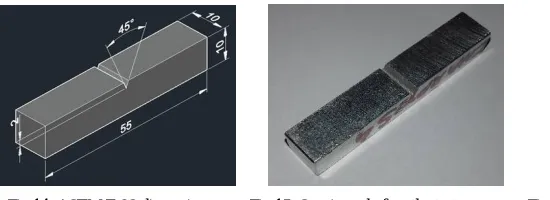
The impact test of the composite samples was measured using impact testing machine (manufactured by Krystal Elmec with model no. KI-300, Sr. No. 92/1021) with energy range capacity of 0 to 300J. The specimen for impact test as per ASTM E-23 is rectangular bar with dimensions 55mm x 10mm x 10mm (l x b x h) respectively (Fig.14). Fig.15and Fig. 16 shows the image of specimen before and after the impact strength test respectively.
ISSN(Online): 2319-8753 ISSN (Print): 2347-6710
International Journal of Innovative Research in Science,
Engineering and Technology
(An ISO 3297: 2007 Certified Organization)
Website: www.ijirset.com
Vol. 6, Issue 8, August 2017
VI.RESULTS AND DISCUSSION
A. Tensile Strength Test
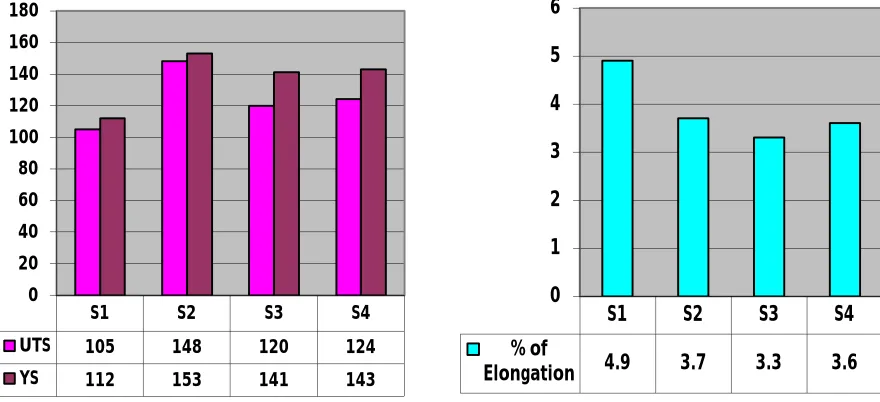
The average values of the ultimate tensile strength, yield strength, and % of elongation obtained from the tensile strength test are represent in Fig.17. It is observed that the tensile strength and yield strength of the composite was increased and more significant for the composition 4% SiC and 2% B4C reinforcements as compare to monolithic
alloys. This is due to the presence of hard and higher modulus SiC particles embedded in the Al 7075 matrix, which act as a barrier to resist plastic flow when the composite is subjected to strain from an applied load, also the decreased antiparticle spacing, due to the increasing volume percent of SiC reinforcement, creates increased resistance to dislocation motion, which contributes to the enhanced strength of the composites. But by increasing the reinforcement percentage beyond 4% SiC+2% B4C, UTS decreases because of higher content of reinforcement. The material tends to
be brittle after fracture. Therefore, further addition of reinforcement reduces the strength. From the Fig.18, it can be concluded that as the weight percentage of SiC and B4C increases elongation is decreases. This is due to enhanced
hardness associated with higher SiC content and decrease in ductility.
`
Fig 17: Variation of UTS & YS with the samples Fig 18: Variation of % of elongation with the samples
B. Vickers Hardness Test
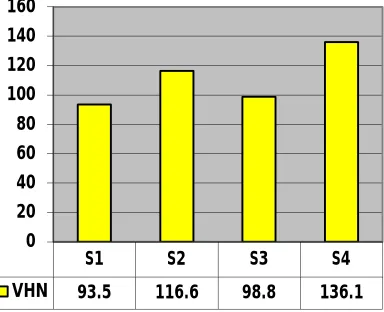
Fig.19 shows the hardness reading for composite samples with different reinforcement percentage. It is seen that, with addition of the reinforcement, hardness of the composite increases when compared to pure AL7075 alloys. But when % of reinforcement increases the VHN for Sample2 and 4 increases but for Sample3 decreases but higher than Sample1. This is due to SiC and B4C particles have very high hardness and when it is reinforced in the matrix material, it helps to
improve the hardness properties of composite by considerable amount. The increase in hardness due to strong interface bonding. And the fluctuation arising because of, the composite depends on various factors like porosity, non-uniform distribution, and presence of cluster formation.
It was concluded that from the hardness test, the Sample4 i.e. the composition of 12% of SiC with 6% of B4C has more
hardness value compared to other three compositions. There is considerable increase in the hardness as B4C and SiC %
is increased. This is turn enhances the mechanical properties in terms of their strength.
S1 S2 S3 S4
UTS 105 148 120 124
YS 112 153 141 143
0 20 40 60 80 100 120 140 160 180
S1 S2 S3 S4
% of
Elongation 4.9 3.7 3.3 3.6 0
ISSN(Online): 2319-8753 ISSN (Print): 2347-6710
International Journal of Innovative Research in Science,
Engineering and Technology
(An ISO 3297: 2007 Certified Organization)
Website: www.ijirset.com
Vol. 6, Issue 8, August 2017
Fig 19: Variation of VHN with the samples
C. Impact Strength Test
The impact strength of a material is its capability to soak up and dissipate energies beneath impact or shock loading. Fig.20 present the measured impact energy values of the AL7075 metal matrix composites filled with SiC and B4C
particles respectively. It is seen that the impact energies of the composites decrease with the increase in % of reinforcement. This is because when the hardness increases the brittleness property of the material increases which reduce the impact strength of the composites.
Fig 20: Variation of Charpy energy absorbed with the samples
VII. CONCLUSIONS
After observing the experiment, that is, the mechanical behaviour analysis of AA7075-T651/SiCp/B4Cp hybrid
composites compared with casted base alloy, the following conclusions can be drawn:
1. The tensile strength test results shows, both the tensile strength and yield strength significantly improves after adding the ceramic particles as compare to casted base alloys. After sample2 both tensile strength and yield strength has decreased, but more than sample1. The percentage of elongation subsequently decreases except sample4 due to brittleness.
S1 S2 S3 S4
VHN 93.5 116.6 98.8 136.1
0 20 40 60 80 100 120 140 160
S1 S2 S3 S4
Charpy 36 4 2.2 2
ISSN(Online): 2319-8753 ISSN (Print): 2347-6710
International Journal of Innovative Research in Science,
Engineering and Technology
(An ISO 3297: 2007 Certified Organization)
Website: www.ijirset.com
Vol. 6, Issue 8, August 2017
2. Reinforcing composites have better hardness properties than base alloys. The sample4 reveals better Vickers hardness values after sample2.
3. Impact strength of composite specimen drastically decreases as compare to base alloys.
4. From the above analysis it can be concluded that the mechanical characteristics has been significantly improved after adding the ceramic particulates such as SiC and B4Cas reinforcement in matrix AA7075-T651
and have a potential for structural applications due to their high specific stiffness and strength.
REFERENCES
[1] S. Abirami, R. Arravind, “Experimental Analysis of Mechanical Behaviour on AA 7075 Hybrid Composite”, International Journal of Engineering Research & Technology (IJERT), Vol. 5 (Issue 06), PP. 142- 146, June, 2016.
[2] CihadNazık, Necmettin Tarakçıoglu, SerdarOzkaya, FatihErdemır, AykutÇanakçı, “Determination of Effect of B4C Content on Density and Tensile Strength of AA7075/ B4C Composite Produced via Powder Technology”, International Journal of Materials, Mechanics and Manufacturing, Vol. 4, No. 4,PP. 251- 254, November, 2016.
[3] Kalyan Kumar Singh, Saurabh Singh, Anil Kumar Shrivastava, “Study of Tribological Behaviour of Silicon Carbide Based Aluminium Metal Matrix Composites under Dry and Lubricated Environment”, Advances in Materials Science and Engineering, Volume 2016,PP. 1-11, 11 February 2016.
[4] T. S. A. Suryakumai, S. Ranganathan, J. Sai Krishna, N. SanjeevSai Reddy, K. Loknath Reddy, “Development Of Aluminium Hybrid Metal Matrix Composite”, ARPN Journal of Engineering and Applied Sciences, Vol. 11, No. 12, PP. 7973-7977, June 2016.
[5] VeeravaliRamakoteswara Rao, NalluRamanaia, Mohamm, MoulanaMohiuddinSarcar, “Mechanical and tribological properties of AA7075–TiC metal matrix composites under heat treated (T6) and cast conditions”, Journal of Materials Research and Technology, Vol. 5 (4), PP. 377–383, 22 March 2016.
[6] R. Harichandran, N. Selvakumar, “Effect of nano/micro B4C particles on the mechanical properties of aluminium metal matrix composites fabricated by ultrasonic cavitation-assisted solidification process”, Archives of civil and mechanical engineering, Vol. 16, PP. 147 – 158, 2016.
[7] Chellapandi P, Senthil Kumar A, ArungalaiVendan. S, “Experimental Investigations on Mechanical, Micro-Structural and Tribological Behaviour of B4C, SiC and Mg Reinforced Aluminium Metal Matrix Composites”, International Journal of Advanced Engineering Technology, Vol. VII, Issue II, PP. 754-756, April-June, 2016.
[8] A. Basithrahman, R. Arravind, “Experimental Analysis of Mechanical Properties of Aluminium Hybrid Metal Matrix Composites”, International Journal of Engineering Research & Technology, Vol. 5, Issue 06, PP. 132- 135, June 2016.