DOI: 10.1051/epjconf/201610606001
C
Owned by the authors, published by EDP Sciences, 2016
Three-Dimensional (X,Y,Z) Deterministic Analysis of the
PCA-Replica Neutron Shielding Benchmark Experiment using
the TORT-3.2 Code and Group Cross Section Libraries for
LWR Shielding and Pressure Vessel Dosimetry
Massimo Pescarinia
, Roberto Orsi, and Manuela Frisoni
ENEA, CR “E. Clementel”, via Martiri di Monte Sole 4, 40129, Italy
Abstract.The PCA-Replica 12/13 (H2O/Fe) neutron shielding benchmark experiment was
analysed using the ORNL TORT-3.2 3D SN code. PCA-Replica, specifically conceived
to test the accuracy of nuclear data and transport codes employed in LWR shielding and radiation damage calculations, reproduces a PWR ex-core radial geometry with alternate layers of water and steel including a PWR pressure vessel simulator. Three broad-group coupled neutron/photon working cross section libraries in FIDO-ANISN format with the same energy group structure (47 n + 20 ) and based on different nuclear data were alternatively used: the ENEA BUGJEFF311.BOLIB (JEFF-3.1.1) and BUGENDF70.BOLIB VII.0) libraries and the ORNL BUGLE-96 (ENDF/B-VI.3) library. Dosimeter cross sections derived from the IAEA IRDF-2002 dosimetry file were employed. The calculated reaction rates for the Rh-103(n,n)Rh-103 m, In-115(n,n )In-115m and S-32(n,p)P-32 threshold activation dosimeters and the calculated neutron spectra are compared with the corresponding experimental results.
1. Introduction
The ENEA-Bologna Nuclear Data Group analysed the PCA-Replica 12/13 [1] water/iron (H2O/Fe)
low-flux engineering neutron shielding benchmark experiment included in the SINBAD [2] international database. Three-dimensional (3D) fixed source transport calculations in Cartesian geometry through the TORT-3.2 [3] discrete ordinates (SN) code, included in the ORNL DOORS [4] system of deterministic
transport codes, were performed. PCA-Replica reproduces a PWR ex-core radial geometry and is particularly suitable to test the cross section libraries specifically dedicated to LWR shielding and pressure vessel dosimetry applications. Two ENEA-Bologna freely released multi-group libraries named BUGJEFF311.BOLIB [5] and BUGENDF70.BOLIB [6], respectively based on the OECD-NEADB JEFF-3.1.1 [7,8] and US ENDF/B-VII.0 [9] evaluated nuclear data libraries, were alternatively used in the calculations together with the ORNL BUGLE-96 [10] similar library based on ENDF/B-VI.3 data. In particular BUGLE-96, internationally widely used with success for a long time, was assumed as a reliable reference standard to test the ENEA libraries. All the cited libraries dedicated to the
aCorresponding author:[email protected]
mentioned applications include parameterized sets of problem-dependent self-shielded neutron cross sections specifically prepared for BWR and PWR applications, adopt the FIDO-ANISN format and have the same broad-group coupled (47 n+20) neutron/photon energy group structure. They were obtained through problem-dependent cross section collapsing from their fine-group mother libraries with a similar nuclear data processing methodology using in particular the same compositional, geometrical and temperature input data (see [11]) to perform the cross section collapsing. In particular the BUGJEFF311.BOLIB and BUGENDF70.BOLIB libraries were respectively obtained from the ENEA-Bologna VITJEFF311.BOLIB [12] and VITENDF70.BOLIB [13] fine-group libraries in AMPX format for nuclear fission applications through problem-dependent cross section collapsing with the ENEA-Bologna 2007 revision [14] of the ORNL SCAMPI [15] nuclear data processing system. Both previous libraries are based on the Bondarenko [16] self-shielding factor method and have the same fine-group energy structure (199 n+42) as the ORNL VITAMIN-B6 [10] similar library from which BUGLE-96 was obtained at ORNL. The ENEA-Bologna programs ADEFTA-4.1 [17] and BOT3P-5.3 [18, 19] were respectively employed for the calculation of the isotopic atomic densities and for the automatic generation of the spatial mesh grid of the geometrical model. The calculated neutron dose and spectrum integral results were compared with the corresponding experimental data (see [20]), respectively obtained using three types of threshold activation dosimeters and two kinds of spectrometer. The dosimeter neutron cross section sets used in the calculations were derived (see [21]) from the IAEA IRDF-2002 [22] international reactor dosimetry file.
2. The PCA-Replica Experimental Facility and Measurements
Graphite: 1, 5. Water: 11, 13, 18.
Aluminium: 2, 4, 7, 9, 10, 15, 17. Stainless Steel: 12.
Void (Air): 3, 6, 16. Mild Steel: 14, 20, 21.
Alloy Fuel (Fission Plate): 8. Concrete: 19.
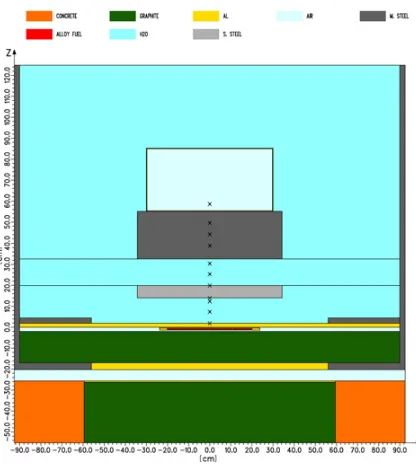
Figure 1. PCA-Replica – Layout of the 12/13 configuration (see [1]).
proportional counters of type SP-2 were used in combination, to cover the energy range from 50.0 keV to 1.2 MeV. The neutron fluxes between 1.0 and 10.0 MeV were determined with a spherical 3.5 ml organic liquid (NE213) scintillator.
3. Transport Calculations and Discussion of the Results
Figure 2. PCA-Replica – Geometrical and compositional model horizontal section at Y=0. cm, dosimeter locations “×”, TORT-3.2 (X,Y,Z) with 65X×63Y×182Z spatial meshes.
sections from the three library packages were used when available. It is underlined that the stainless steel TS and the mild steel RPV simulators of PCA-Replica were characterized by atomic densities quite similar to those used to determine the background cross sections employed in the self-shielding of the BUGJEFF311.BOLIB, BUGENDF70.BOLIB and BUGLE-96 neutron cross sections. Group-organized files of macroscopic cross sections, requested by TORT-3.2, were prepared through the ORNL GIP (see [4]) program. Fixed source transport calculations with one source (outer) iteration were performed using fully symmetrical discrete ordinates directional quadrature sets for the flux solution. The P3-S8
approximation was adopted as the standard reference. PN corresponds to the order of the expansion
in Legendre polynomials of the scattering cross section matrix and SNrepresents the order of the flux
angular discretization. It is underlined that the P3-S8 approximation is the most widely used option in
the fixed source calculations dedicated to LWR safety analyses. A further parametric analysis, using exclusively BUGJEFF311.BOLIB, was performed on the PN and SN orders. P3 and P5 calculations
were performed with different sets of fully symmetrical quadrature: P3-S8, P3-S12, P3-S16, P5-S12 and
P5-S16. The same value (1.0E-03) for the point-wise flux convergence criterion was employed. The
vacuum boundary condition was selected at the left, right, inside, outside, bottom and top geometrical boundaries. The same set of flat weighting dosimeter cross sections for the Rh-103(n,n)Rh-103 m, In-115(n,n)In-115 m and S-32(n,p)P-32 nuclear reactions derived (see [16]) from IRDF-2002 was used for the water and steel experimental measurement positions in the calculations with all working libraries. Three different sets of 1/4 T RPV weighting dosimeter cross sections derived (see [16]) from IRDF-2002, singularly included in each package of the three working libraries, were used in addition in the calculations for the steel measurement positions (1/4 T RPV and 3/4 T RPV).
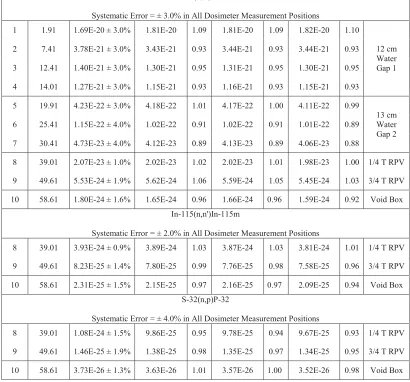
Table 1. PCA-Replica – Summary of Experimental (E) and Calculated (C) Rh-103(n,n), In-115(n,n) and S-32(n,p) reaction ratesaper NESTOR reactor Watt along the horizontal axis Z.
Dos. Pos. Distance from Fission Plate on the Axis Z [cm] Experimental Reaction Ratea±
Random Error (1σ)
(E) BUGJEFF311. BOLIB Calculation BUGENDF70. BOLIB Calculation BUGLE-96 Calculation Reference Location Calculated Reaction Ratea (C) C/Eb Calculated Reaction Ratea (C) C/Eb Calculated Reaction Ratea (C) C/Eb Rh-103(n,n')Rh-103m
Systematic Error = ± 3.0% in All Dosimeter Measurement Positions
1 1.91 1.69E-20 ± 3.0% 1.81E-20 1.09 1.81E-20 1.09 1.82E-20 1.10
12 cm Water Gap 1 2 7.41 3.78E-21 ± 3.0% 3.43E-21 0.93 3.44E-21 0.93 3.44E-21 0.93
3 12.41 1.40E-21 ± 3.0% 1.30E-21 0.95 1.31E-21 0.95 1.30E-21 0.95
4 14.01 1.27E-21 ± 3.0% 1.15E-21 0.93 1.16E-21 0.93 1.15E-21 0.93
5 19.91 4.23E-22 ± 3.0% 4.18E-22 1.01 4.17E-22 1.00 4.11E-22 0.99
13 cm Water Gap 2 6 25.41 1.15E-22 ± 4.0% 1.02E-22 0.91 1.02E-22 0.91 1.01E-22 0.89
7 30.41 4.73E-23 ± 4.0% 4.12E-23 0.89 4.13E-23 0.89 4.06E-23 0.88
8 39.01 2.07E-23 ± 1.0% 2.02E-23 1.02 2.02E-23 1.01 1.98E-23 1.00 1/4 T RPV
9 49.61 5.53E-24 ± 1.9% 5.62E-24 1.06 5.59E-24 1.05 5.45E-24 1.03 3/4 T RPV
10 58.61 1.80E-24 ± 1.6% 1.65E-24 0.96 1.66E-24 0.96 1.59E-24 0.92 Void Box
In-115(n,n')In-115m
Systematic Error = ± 2.0% in All Dosimeter Measurement Positions
8 39.01 3.93E-24 ± 0.9% 3.89E-24 1.03 3.87E-24 1.03 3.81E-24 1.01 1/4 T RPV
9 49.61 8.23E-25 ± 1.4% 7.80E-25 0.99 7.76E-25 0.98 7.58E-25 0.96 3/4 T RPV
10 58.61 2.31E-25 ± 1.5% 2.15E-25 0.97 2.16E-25 0.97 2.09E-25 0.94 Void Box
S-32(n,p)P-32
Systematic Error = ± 4.0% in All Dosimeter Measurement Positions
8 39.01 1.08E-24 ± 1.5% 9.86E-25 0.95 9.78E-25 0.94 9.67E-25 0.93 1/4 T RPV
9 49.61 1.46E-25 ± 1.9% 1.38E-25 0.98 1.35E-25 0.97 1.34E-25 0.95 3/4 T RPV
Figure 3. PCA-Replica – Rh-103(n,n) reaction rate ratios (Calculated/Experimental).
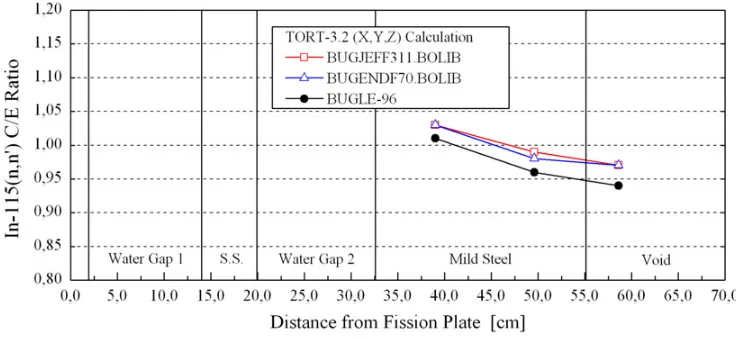
Figure 4. PCA-Replica – In-115(n,n) reaction rate ratios (Calculated/Experimental).
source for each working library, the common value of ¯ν(U-235)=2.437 (see [1]) for the average number of neutrons produced per U-235 thermal fission was used in order to assure a consistent result intercomparison. The value of 6.74E-04 fission plate Watts per NESTOR Watt (see [1]) was given to the source multiplier parameter for the inhomogeneous neutron source.
All the dosimetric and spectral results reported herewith refer to TORT-3.2 calculations in P3
-S8approximation using the inhomogeneous fission neutron source. Concerning the dosimetric results
obtained with flat weighting cross sections (see Table 1 and Figs. 3, 4 and 5), only few calculated results for the Rh-103(n,n) dosimeters, obtained with the three working libraries in the second water gap, present underestimated values slightly outside the range of deviation of ±10% from the corresponding experimental results. The deviations of the calculated results for the In-115(n,n) and S-32(n,p) dosimeters are always contained within±10% the corresponding values of the experimental results, available only in the RPV and void box measurement positions.
Figure 5. PCA-Replica – S-32(n,p) reaction rate ratios (Calculated/Experimental).
Figure 6.PCA-Replica – Spatial distribution of the Rh-103(n,n) reaction rates per NESTOR Watt. Horizontal section at Y=0. cm, dosimeter locations “×”, TORT-3.2 (X,Y,Z) with 65X×63Y×182Z spatial meshes. [reactions×s−1×atom−1 ×NESTORWatt−1
].
Figure 7. PCA-Replica – Spatial distribution of the neutron fluxes per NESTOR Watt for E>1.0 MeV. Horizontal section at Y=0. cm, dosimeter locations “×”, TORT-3.2 (X,Y,Z) with 65X×63Y×182Z spatial meshes. [neutrons×barn−1×s−1×NESTORWatt−1
].
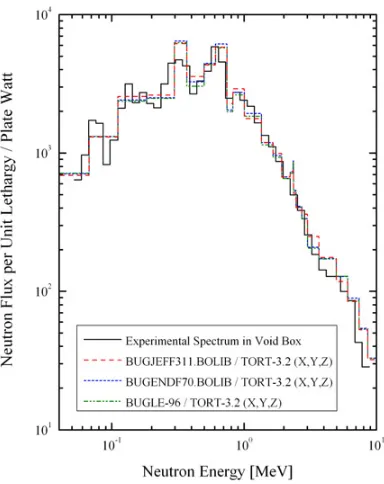
Figure 9.PCA-Replica – Comparison of experimental and calculated neutron spectra in air, in the void box measurement position at Z=58.61 cm.
to the corresponding ones obtained with the inhomogeneous spatial distribution. The analysis of the dosimetric results got from calculations with several combination of PN-SNapproximations was limited
to two key measurement positions: 1/4 T RPV (mild steel) and void box (air). In the P3-S8calculations,
slight C/E differences (few percents higher) for all the dosimeters were found in both measurement positions with respect to the corresponding C/E values obtained from the P3-S12and P3-S16calculations
which, on the contrary, gave C/E results fully stabilized for all the dosimeters. In the P5calculations, all
the C/E results appear completely stabilized for all the dosimeters in both measurement positions, i.e. no meaningful C/E difference for a given dosimeter is evident between the corresponding results of the P5-S12and P5-S16calculations.
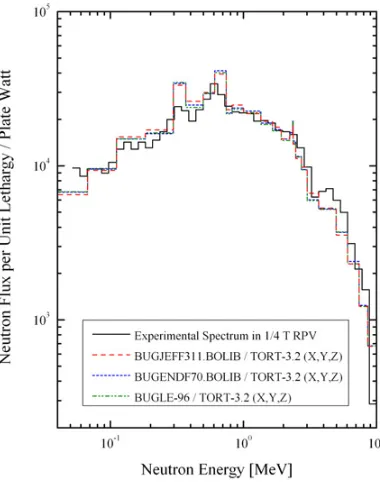
The neutron spectra calculated in the 1/4 T RPV and in the void box measurement positions using BUGJEFF311.BOLIB, BUGENDF70.BOLIB and BUGLE-96 are compared with the corresponding experimental neutron spectrum and are respectively shown in Figs. 8 and 9. The normalization per fission plate Watt is assumed in the previously cited figures as in reference [1]. The group values of the experimental neutron spectra were taken from the corresponding “as measured” data reported in reference [1] and were reduced by 4% to eliminate the contribution from the NESTOR core neutron leakage background in the RPV and void box.
4. Conclusion
References
[1] J. Butler et al., UKAEA, AEE Winfrith Report AEEW-R 1736 (January 1984)
[2] SINBAD, OECD-NEADB/ORNL-RSICC, SINBAD REACTOR, NEA-1517 (2009 Edition) [3] W.A. Rhoades, D.B. Simpson, TORT Version 3, ORNL/TM-13221 (October 1997)
[4] DOORS3.1, ORNL, RSIC CCC-650 (August 1996)
[5] M. Pescarini, V. Sinitsa , R.Orsi, M. Frisoni, ENEA Int. Report UTFISSM-P9H6-2 Rev.1 (2013) [6] M. Pescarini, V. Sinitsa , R.Orsi, M. Frisoni, ENEA Int. Report UTFISSM-P9H6-8 (2013) [7] The JEFF-3.1.1 Nuclear Data Library, JEFF Report 22, OECD-NEA Data Bank (2009) [8] The JEFF-3.1 Nuclear Data Library, JEFF Report 21, OECD-NEA Data Bank (2006) [9] M.B. Chadwick et al., Nuc. Data Sheets,107, 12, pp. 2931–3060, (December 2006) [10] J.E. White et al., ORNL-6795/R1, NUREG/CR-6214, Revision 1 (January 1995)
[11] M. Pescarini, V. Sinitsa, R.Orsi, M. Frisoni, BUGJEFF311.BOLIB (JEFF-3.1.1) and BUGENDF70.BOLIB (ENDF/B-VII.0) – Generation Methodology and Preliminary Testing of Two ENEA-Bologna Group Cross Section Libraries for LWR Shielding and Pressure Vessel Dosimetry, Proceedings of ISRD-15, Aix-en-Provence, F, May 18–23, 2014 (to be published) [12] M. Pescarini, V. Sinitsa, R. Orsi, ENEA Int. Report UTFISSM-P9H6-003 Rev.1 (2011) [13] M. Pescarini, V. Sinitsa, R. Orsi, M. Frisoni, ENEA Int. Report UTFISSM-P9H6-005 (2012) [14] V. Sinitsa, M. Pescarini, ENEA Int. Report FPN-P9H6-006 (2007)
[15] SCAMPI, ORNL, RSIC PSR-352 (September 1995)
[16] I.I. Bondarenko et al.,Group constants for nuclear reactors calculations(Cons. Bureau, 1964) [17] R. Orsi, ENEA Int. Report FPN-P9H6-10 (2008)
[18] R. Orsi, ENEA Int. Report FPN-P9H6-11 (2008)
[19] R. Orsi, Nuc. Sci. and Eng., Technical Note,146, pp. 248–255 (2004)
[20] M. Pescarini, Orsi, M. Frisoni, ENEA Int. Report UTFISSM-P9H6-9, to be published. [21] R. Orsi, M. Pescarini, V. Sinitsa, ENEA Int. Report UTFISSM-P9H6-6 (2012) [22] O. Bersillon et al., IRDF-2002, IAEA, Tech. Reports Series No. 452 (2006) [23] W.N. McElroy Editor, HEDL-TME 80-87, NUREG/CR-1861 (1981)
[24] P.C. Miller, A Review of LWR Pressure Vessel Dosimetry and Associated Shielding Studies, Proceedings of ICRS-7, Bournemouth, UK, September 12–16, 1988, Vol. 1, pp. 33–47
[25] J.H. Baard, W.L. Zijp, H.J. Nolthenius, Nuclear data guide for reactor neutron metrology, (Kluwer Academic Publishers, 1989)
![Figure 1. PCA-Replica – Layout of the 12/13 configuration (see [1]).](https://thumb-us.123doks.com/thumbv2/123dok_us/8170436.1363897/3.482.119.403.52.376/figure-pca-replica-layout-conguration.webp)