International Journal of COPD 2016:11 3121–3136
International Journal of COPD
Dove
press
submit your manuscript | www.dovepress.com
3121
R e v I e w
open access to scientific and medical researchOpen Access Full Text Article
exercise training alone or with the addition of
activity counseling improves physical activity levels
in COPD: a systematic review and meta-analysis
of randomized controlled trials
Aroub Lahham
1,2Christine F McDonald
2–4Anne e Holland
1,2,51Discipline of Physiotherapy, La Trobe
University, 2Institute for Breathing and
Sleep, 3Department of Respiratory
and Sleep Medicine, Austin Health,
4Department of Medicine, The
University of Melbourne, 5Department
of Physiotherapy, Alfred Health, Melbourne, vIC, Australia
Background: Physical inactivity is associated with poor outcomes in COPD, and as a result, interventions to improve physical activity (PA) are a current research focus. However, many trials have been small and inconclusive.
Objective: The aim of this systematic review and meta-analysis was to study the effects of randomized controlled trials (RCTs) targeting PA in COPD.
Methods: Databases (Physiotherapy Evidence Database [PEDro], Embase, MEDLINE,
CINAHL and the Cochrane Central Register for Controlled Trials) were searched using the following keywords: “COPD”, “intervention” and “physical activity” from inception to May 20, 2016; published RCTs that aimed to increase PA in individuals with COPD were included. The PEDro scale was used to rate study quality. Standardized mean differences (effect sizes, ESs) with 95% confidence intervals (CIs) were determined. Effects of included interventions were also measured according to the minimal important difference (MID) in daily steps for COPD (599 daily steps).
Results: A total of 37 RCTs with 4,314 participants (mean forced expiratory volume in one second (FEV1) % predicted 50.5 [SD=10.4]) were identified. Interventions including exercise training (ET; n=3 studies, 103 participants) significantly increased PA levels in COPD com-pared to standard care (ES [95% CI]; 0.84 [0.44–1.25]). The addition of activity counseling to pulmonary rehabilitation (PR; n=4 studies, 140 participants) showed important effects on PA levels compared to PR alone (0.47 [0.02–0.92]), achieving significant increases that exceeded the MID for daily steps in COPD (mean difference [95% CI], 1,452 daily steps [549–2,356]). Reporting of methodological quality was poor in most included RCTs.
Conclusion: Interventions that included ET and PA counseling during PR were effective strategies to improve PA in COPD.
Keywords: pulmonary disease, chronic obstructive, physical activity, interventions
Introduction
Physical inactivity is a key predictor of increased hospitalization and all-cause mortality
in COPD.
1,2A systematic review comparing activity levels in COPD patients with
age-matched controls showed a marked reduction in activity duration, intensity and daily
step counts, regardless of disease severity.
3Physical activity (PA) levels are strongly
correlated with functional exercise capacity.
4In addition, a large 5-year follow-up
study showed important associations between levels of PA and health-related quality
of life (HRQL) in COPD.
5Correspondence: Aroub Lahham Discipline of Physiotherapy, La Trobe University Clinical School, Alfred Health, 99 Commercial Road, Melbourne, vIC 3004, Australia
email [email protected]
Journal name: International Journal of COPD Article Designation: Review
Year: 2016 Volume: 11
Running head verso: Lahham et al
Running head recto: Physical activity in COPD DOI: http://dx.doi.org/10.2147/COPD.S121263
International Journal of Chronic Obstructive Pulmonary Disease downloaded from https://www.dovepress.com/ by 118.70.13.36 on 22-Aug-2020
For personal use only.
Number of times this article has been viewed
This article was published in the following Dove Press journal: International Journal of COPD
Dovepress Lahham et al
In light of the strong relationship between PA and health
outcomes in COPD, the past decade has witnessed the
development of several strategies aiming to improve PA
levels in COPD. The number of randomized controlled trials
(RCTs) designed to test the efficacy of these interventions
is growing rapidly. A recent review that studied the effects
of RCTs, non-RCTs and experimental studies of PA
inter-ventions concluded that although exercise training (ET) is
the most commonly used approach, its effects on PA levels
are uncertain.
6The inclusion of non-RCTs in this review
is a potential source of bias that might overestimate the true
effects of PA interventions.
7To date, attempts to compare
effects of interventions on PA levels using meta-analysis
of published RCTs exclusively have not been reported.
In this systematic review, we aimed to analyze and compare
the effects of various PA interventions reported through
RCTs in COPD.
Methods
The systematic review protocol is registered in
PROS-PERO (CRD42013004460,
http://www.crd.york.ac.uk/
PROSPERO
).
Inclusion criteria
Studies that recruited participants diagnosed with COPD
according to the Global Initiative for Chronic Obstructive
Lung Diseases (GOLD) guidelines were included.
8In the
case of mixed populations, studies were included if 80% or
more of individuals had COPD. RCTs published in
peer-reviewed journals that aimed to evaluate the efficacy of
interventions to improve PA levels were included. These
comprised, but were not limited to, pulmonary
rehabilita-tion (PR), ET, pharmaceutical treatment, self-management
or written advice. Studies were included if PA was either a
primary or a secondary outcome.
The primary outcome of the review was PA measured
either objectively (eg, time spent in PA measured by
activ-ity monitors) or subjectively (eg, scores of questionnaires).
Secondary outcomes of the review were functional and
maximal exercise capacity, HRQL, dyspnea and lung
func-tion variables.
Search methods
Databases searched were the Cochrane library,
Physio-therapy Evidence Database (PEDro), Embase, MEDLINE
and CINAHL. The subject headings were “COPD”,
“interventions” and “physical activities” (
Supplementary
materials
). Databases were searched through two separate
periods: from their inception to the end of January 2015
and from February 2015 to May 20, 2016. In addition, we
searched major trial registries including
ClinicalTrials.gov
,
European Union Clinical Trial Register, Australian New
Zealand Clinical Trials Registry and WHO International
Clinical Trials Registry Platform for relevant projects.
One author (AL) reviewed the title and abstract of trials
and two authors (AL and AEH) independently assessed the
full text of articles to decide on inclusion. Any disagreement
was resolved by discussion. Data were extracted
indepen-dently by two authors (AL and AEH) using a standardized
data extraction sheet (
Supplementary materials
). Online
software was used to extract data from plots and graphs where
necessary (
www.arohatgi.info/WebPlotDigitizer
).
Quality assessment was performed using the PEDro
qual-ity scale, which is an 11-item scale that assesses internal and
external validity of clinical trials.
9The higher the given score,
the better the quality. Cut points of the scale were excellent
(9–10), good (6–8), fair (4–5) and poor (
3).
Data interpretation and synthesis
Comparisons of interest were interventions aimed to improve
PA versus usual care (or placebo), interventions aimed to
improve PA added to PR versus PR alone, and PA intervention
versus another active PA intervention. Effects of
inter-ventions on continuous outcome measures were assessed
using standardized mean differences (SMDs) and 95%
confidence intervals (CIs), to allow comparison of effect
size (ES) across interventions. Trials reporting effects
of interventions using comparable outcome measures at
comparable time points were combined in a meta-analysis.
Software used to conduct meta-analysis and compute ESs
was Review Manager 5.3 manufactured by the Nordic
Cochrane Centre. Based on Cohen’s classifications, an
SMD of 0.2 is small, 0.5 is moderate and 0.8 or higher is
a large effect.
Meta-analysis was conducted where trials were
statisti-cally and clinistatisti-cally homogeneous. Statistical homogeneity
was defined as I
2
40%.
7Clinical homogeneity was defined
as similarity of study population, intervention components
and their comparators and selected outcome measures. In the
case of PA levels in an included RCT being measured using
more than one variable, the variable that best reflects PA
levels was selected for meta-analysis (eg, objectively
mea-sured time spent in walking was selected over self-reported
PA time,
10and overall PA time was selected over PA time
spent in 1 day).
11Objectively and subjectively measured
PA variables were not pooled together in a meta-analysis.
International Journal of Chronic Obstructive Pulmonary Disease downloaded from https://www.dovepress.com/ by 118.70.13.36 on 22-Aug-2020
Dovepress Physical activity in COPD
When available, change scores were extracted to measure
the effects of interventions. In the case of a change score
not being directly provided, baseline and final scores were
used to measure mean differences, and available variables of
the change (eg, correlation coefficient of the change) were
used to compute standard deviation of the change.
7When
necessary, study investigators were contacted for additional
information to compute change scores. Final scores at
avail-able time points were extracted when change score was
unable to be computed.
We intended to perform sensitivity analyses to examine
the effects of trial quality by excluding trials without
con-cealed allocation and assessor blinding; however, insufficient
data prevented these analyses.
In trials where PA was measured in daily steps,
weighted mean differences in steps achieved by
interven-tions were compared. Changes in the number of steps from
baseline produced by different interventions were
com-pared to the minimal important difference (MID), which
has been estimated to be a change of 599 daily steps.
12MID
is defined as a meaningful change or effect that might be
considered important to produce sizeable change in vital
outcomes.
13Results
The search yielded a total of 4,178 records identified
through-out the two separate periods, with 81 full texts reviewed
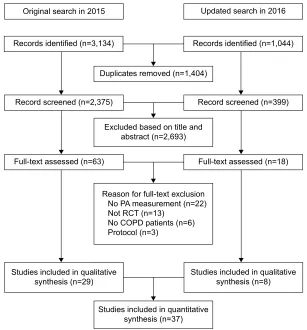
for eligibility. A Preferred Reporting Items for Systematic
Reviews and Meta-Analyses flow diagram (Figure 1) depicts
the search process. A total of 37 RCTs identified in 40
sepa-rate reports met our selected criteria and were included in
the systematic review.
Quality assessment
The quality of included studies ranged from fair to good (median
PEDro score, interquartile range [IQR]
=
6 [5–7]; Table 1), with
only one study scoring poorly.
14A total of 18 studies (48% of
included RCTs) failed to conceal allocation, 27 studies (73%
of included RCTs) failed to blind subjects and 23 studies (62%
of included RCTs) failed to blind outcome assessors. Another
common limitation was the inability to report outcomes
for
85% of randomized subjects (n
=
20, 54%; Table 1).
2ULJLQDOVHDUFKLQ 8SGDWHGVHDUFKLQ
5HFRUGVLGHQWLILHGQ
'XSOLFDWHVUHPRYHGQ
([FOXGHGEDVHGRQWLWOHDQG DEVWUDFWQ
5HDVRQIRUIXOOWH[WH[FOXVLRQ 1R3$PHDVXUHPHQWQ 1RW5&7Q
1R&23'SDWLHQWVQ 3URWRFROQ
5HFRUGVLGHQWLILHGQ
5HFRUGVFUHHQHGQ
)XOOWH[WDVVHVVHGQ
6WXGLHVLQFOXGHGLQTXDOLWDWLYH
V\QWKHVLVQ 6WXGLHVLQFOXGHGLQTXDOLWDWLYHV\QWKHVLVQ
6WXGLHVLQFOXGHGLQTXDQWLWDWLYH V\QWKHVLVQ
)XOOWH[WDVVHVVHGQ 5HFRUGVFUHHQHGQ
Figure 1 PRISMA flow diagram for database search and study selection process.
Abbreviations: PA, physical activity; PRISMA, Preferred Reporting Items for Systematic Reviews and Meta-Analyses; RCT, randomized controlled trial.
International Journal of Chronic Obstructive Pulmonary Disease downloaded from https://www.dovepress.com/ by 118.70.13.36 on 22-Aug-2020
Dovepress Lahham et al
Table 1
Qualitative synthesis of included studies using P
eDro scale for the quality of RCTs
Study name
Eligibility criteria
a
Random allocation Concealed allocation Baseline similarity Blinding (subject) Blinding (therapist) Blinding (assessor) Measure for
85%
ITT
Group comparison Point measure Quality score
Studies comparing PA interventions versus usual care (or placebo; n
=
16)
Berry et al
15 * * * * * * * 6
Borges and Carvalho
16 * * * * * * * * * 8
Breyer et al
17 * * * * * * 5
Dal Negro et al
46,47 * * * * * * * * * * * 10
Faulkner et al
19 * * * * * * 5
Goris et al
48 * * * * * * * 6
Hornikx et al
31 * * * * * * * 6
Hospes et al
32 * * * * * * 5
Jonsdottir et al
39 * * * * * * * 6
Kruis et al
53 * * * * * * * * * 8
Larson et al
20 * * * * * * * * * * 9
Sandland et al
51 * * * * * * * 6
Schuz et al
41; w
alters et al
42 * * * * * * * * * 8
Steele et al
37 * * * * * * 5 w
atz et al
45 * * * * * * * * * * 9 w
ilson et al
24 * * * * * * * 6
Studies comparing PA interventions added to PR versus PR alone (n
=
8)
Altenburg et al
25 * * * * * * 5
Burtin et al
27 * * * * * * * * 7
Cruz et al
29 * * * * * * * * 7
de Blok et al
30 * * * * * 4
Duiverman et al
50 * * * * * 4
Kawagoshi et al
33 * * * * * * 5
Kesten et al
43 * * * * * * * 6
Pleguezuelos et al
52 * * * * * * * 6
Studies comparing PA interventions versus another PA intervention (n
=
13)
Berry et al
26 * * * * * * * 6
Casaburi et al
49 * * * * * * 5
Effing et al
18 * * * * * * * 6
Mendoza et al
34 * * * * * * * * 7
Moy et al
35 * * * * * * * 6
Nguyen et al
36 * * * * * * * * 7
Nguyen et al
40 * * * * * * * * 7
Pomidori et al
21 * * * * * * 5
Probst et al
22 * * * * * * 5
Sewell et al
23 * * * * * * * 6
Tabak et al
38 * * * * * * * * 7
Troosters et al
44 * * * * * * * * * * * 10 v
ergeret et al
14 * * * * 3 Notes: *Yes, score = 1.
aItem does not contribute to total quality score. The higher the given score, the better the quality. Cut points of the scale were excellent (9–10), good (6–8)
, fair (4–5) and poor (3).
Abbreviations:
ITT, intention to treat; PA, physical activity; P
eDro, Physiotherapy
evidence Database; PR, pulmonary rehabilitation; RCTs, randomized controlled trials.
International Journal of Chronic Obstructive Pulmonary Disease downloaded from https://www.dovepress.com/ by 118.70.13.36 on 22-Aug-2020
Dovepress Physical activity in COPD
Characteristics of included RCTs
Included RCTs measured the effects of ET (n
=
10),
15–24activity counseling (n
=
15),
25–40health monitoring (n
=
1),
41,42pharmacological treatment (n
=
3),
43–45nutritional
interven-tions (n
=
2),
46–48oxygen therapy (n
=
4),
14,49–51urban
walk-ing circuits (n
=
1)
52and integrated disease management
(n
=
1)
53on PA levels in COPD. PA counseling was
deliv-ered either in a center-based setting (n
=
9),
25–27,29,30,32–34,39through phone calls (n
=
3)
31,36,37or by internet-mediated
approaches (n
=
3).
35,38,40Studies compared interventions
to usual care (n
=
16),
15–17,19,20,24,31,32,37,39,41,42,45–48,51,53PR
pro-grams (n
=
8)
25,27–30,33,43,50,52or another active intervention
(n
=
13).
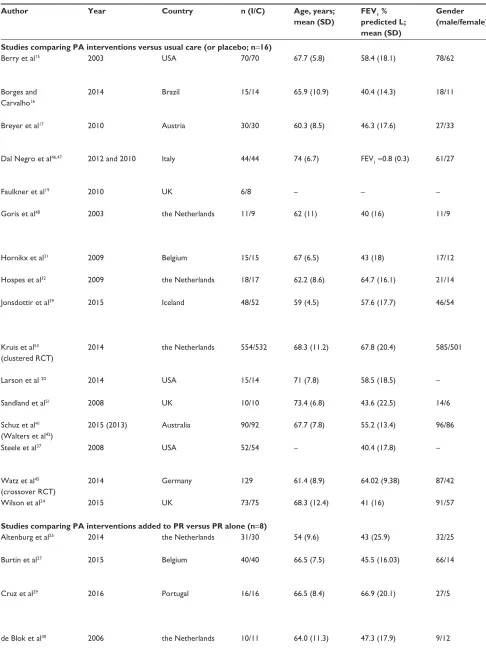
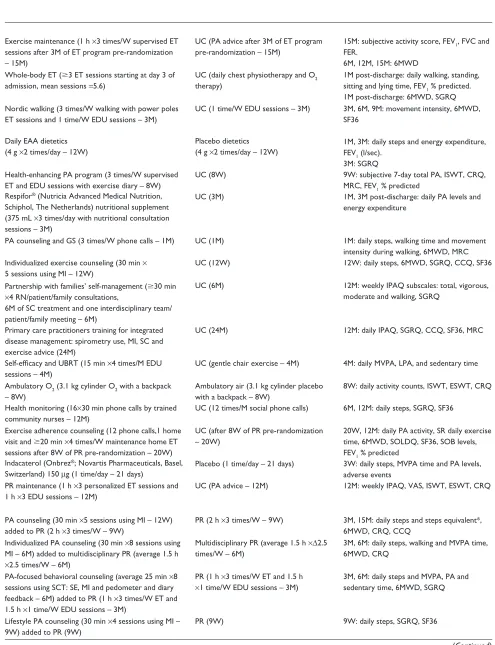
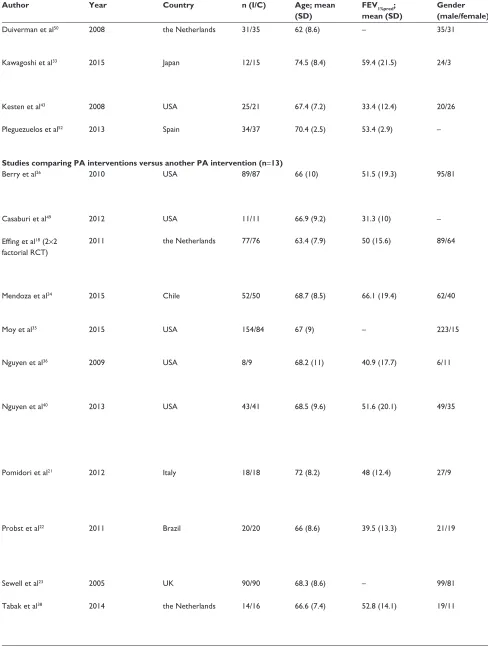
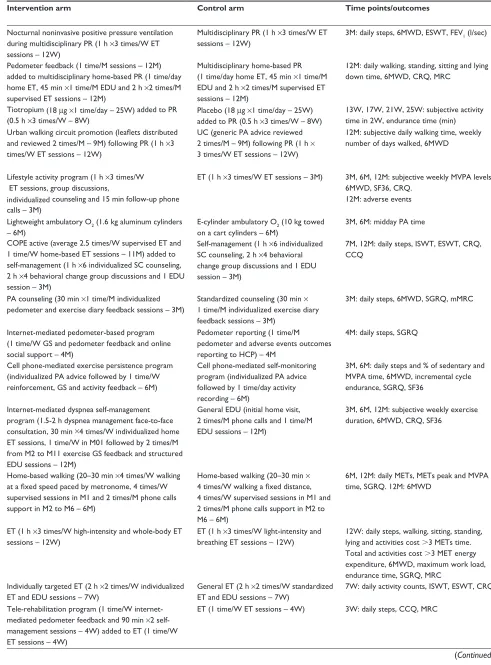
14,18,21–23,26,34–36,38,40,44,49Characteristics of included
studies are summarized in Table 2.
Characteristics of included subjects
This review included a total of 4,314 participants (males
=
58%). Mean age of included participants was 66.2 (SD 4.3)
years with a mean forced expiratory volume in one second
(FEV
1) % predicted of 50.5 (10.4). All participants had
a confirmed diagnosis of COPD according to the GOLD
guidelines.
8Characteristics of PA measurement tools
RCTs assessed PA using several outcome measures.
Objective measures included accelerometers (n
=
18,
50%),
16,17,20–23,27,29,33,36,37,41,44–49,51pedometers (n
=
8,
22%)
18,25,30,32,34,35,38,50and an activity monitor (n
=
1).
31PA
was also measured subjectively using validated tools such
as Seven-Day PA Recall Questionnaire (n
=
1),
19PA Scale
for the Elderly (PASE) questionnaire (n
=
1),
15Community
Healthy Activities Model Program for Seniors (CHAMPS)
questionnaire (n
=
1)
26and the International PA
Question-naire (IPAQ; n
=
3).
24,39,53Nonvalidated tools to measure
PA included exercise diary cards (n
=
1)
52and trial-designed
activity questionnaires (n
=
3).
14,40,43Analysis of included interventions
effects of PA interventions on PA levels
Studies comparing PA interventions versus usual
care or placebo
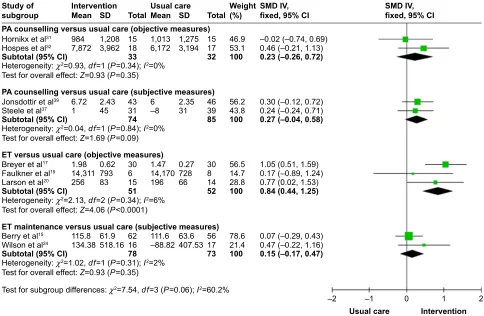
When comparing PA counseling alone to usual care, there
were small and nonsignificant effects of counseling on PA
for both objective measures (n
=
2 studies, SMD [95% CI]
0.23 [
−
0.26 to 0.72], time point 1–3 months; Figure 2)
31,32and subjective measures (n
=
2 studies,
−
0.27 [
−
0.04 to 0.58],
12 months; Figure 2).
37,39Four months of ET produced
moderate to large statistically significant effects on PA (n
=
3
studies, 0.84 [0.44–1.25]; Figure 2),
17,19,20whereas long-term
maintenance exercise programs showed small
nonsignifi-cant effects on PA at 12 and 15 months post-intervention
(n
=
2 studies, 0.15 [
−
0.17 to 0.47]; Figure 2).
15,24None of
the studies included in the meta-analyses had blinded the
assessors or the therapists from study groups. One study of
essential amino acid (EAA) supplementation
46,47reported an
increase in steps favoring the intervention arm at 3 months
(577.6 steps, P
=
0.02); however, insufficient sample size
details prevented ES calculations (
Table S1
). Important
increases in daily steps were also reported in a crossover
RCT in favor of the once-daily long-acting beta agonist,
indacaterol 150
µ
g,
45compared to placebo at 3 weeks (0.32
[0.02–0.63];
Table S1
).
Studies comparing PA interventions added to PR
versus PR alone
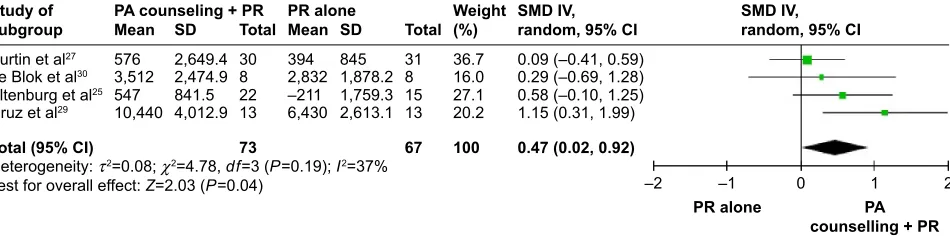
Adding activity counseling to PR produced short-term
improvements in PA at 3 months compared to PR alone
(n
=
4 studies, 0.47 [0.02–0.92]; Figures 3 and 4).
25,27–30Two
of the four studies included in this meta-analysis had
asses-sor blinding and concealed allocation.
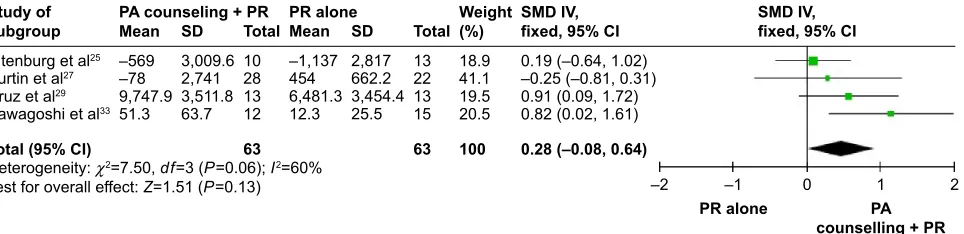
27,29When analyzing
sustainability of results, pooled meta-analysis showed small
to moderate long-term effects of PA counseling added to
PR that trended to statistical significance versus PR alone
(n
=
4, 0.28 [
−
0.08 to 0.31]; I
2, 60%; Figure 4).
25,27,29,33Of the
included studies pooled in this analysis, the only study with
assessor blinding did not report similar long-term effects on
steps at 6 months post-intervention (n
=
1 study, 0.25 [
−
0.81
to 0.31]; Figure 4).
27Introducing an urban walking circuit
promotion program for 12 months after a 3-month course of
PR improved baseline walking time when compared to usual
care after PR (1.36 [0.84–1.88];
Table S2
).
52Studies comparing PA interventions versus another
intervention
ET: Although 3 months of high-intensity ET had similar
effects to light-intensity training on daily steps and
walk-ing time (
−
0.13 [
−
0.76 to 0.49] and 0.26 [
−
0.36 to 0.89],
respectively; Table 3), effects on time spent in moderate to
vigorous physical activity (MVPA) favored the high-intensity
training group at 3 months (1.16 [0.49–1.84]; Table 3).
22When comparing 6 months of home-based walking with
fixed speed program to home-based walking with fixed
distance,
21significant increases in daily metabolic equivalent
tasks (0.94 [0.25–1.63]; Table 3) and daily MVPA time (0.72
[0.04–1.39]; Table 3) were achieved by fixed speed walking
International Journal of Chronic Obstructive Pulmonary Disease downloaded from https://www.dovepress.com/ by 118.70.13.36 on 22-Aug-2020
Dovepress Lahham et al
Table 2 Characteristics of included studies
Author Year Country n (I/C) Age, years;
mean (SD)
FEV1 %
predicted L; mean (SD)
Gender (male/female)
Intervention arm Control arm Time points/outcomes
Studies comparing PA interventions versus usual care (or placebo; n=16)
Berry et al15 2003 USA 70/70 67.7 (5.8) 58.4 (18.1) 78/62 exercise maintenance (1 h ×3 times/w supervised eT
sessions after 3M of eT program pre-randomization – 15M)
UC (PA advice after 3M of eT program pre-randomization – 15M)
15M: subjective activity score, Fev1, FvC and FeR.
6M, 12M, 15M: 6MwD Borges and
Carvalho16
2014 Brazil 15/14 65.9 (10.9) 40.4 (14.3) 18/11 whole-body eT (3 eT sessions starting at day 3 of
admission, mean sessions =5.6)
UC (daily chest physiotherapy and O2
therapy)
1M post-discharge:daily walking, standing, sitting and lying time, Fev1 % predicted. 1M post-discharge: 6MwD, SGRQ
Breyer et al17 2010 Austria 30/30 60.3 (8.5) 46.3 (17.6) 27/33 Nordic walking (3 times/w walking with power poles
eT sessions and 1 time/w eDU sessions – 3M)
UC (1 time/w eDU sessions – 3M) 3M, 6M, 9M: movement intensity, 6MwD, SF36
Dal Negro et al46,47 2012 and 2010 Italy 44/44 74 (6.7) Fev
1=0.8 (0.3) 61/27 Daily eAA dietetics
(4 g ×2 times/day – 12w)
Placebo dietetics (4 g ×2 times/day – 12w)
1M, 3M: daily steps and energy expenditure, Fev1 (l/sec).
3M: SGRQ
Faulkner et al19 2010 UK 6/8 – – – Health-enhancing PA program (3 times/w supervised
eT and eDU sessions with exercise diary – 8w)
UC (8w) 9w: subjective 7-day total PA, ISwT, CRQ, MRC, Fev1 % predicted
Goris et al48 2003 the Netherlands 11/9 62 (11) 40 (16) 11/9 Respifor® (Nutricia Advanced Medical Nutrition,
Schiphol, The Netherlands) nutritional supplement (375 mL ×3 times/day with nutritional consultation sessions – 3M)
UC (3M) 1M, 3M post-discharge: daily PA levels and energy expenditure
Hornikx et al31 2009 Belgium 15/15 67 (6.5) 43 (18) 17/12 PA counseling and GS (3 times/w phone calls – 1M) UC (1M) 1M: daily steps, walking time and movement
intensity during walking, 6MwD, MRC
Hospes et al32 2009 the Netherlands 18/17 62.2 (8.6) 64.7 (16.1) 21/14 Individualized exercise counseling (30 min ×
5 sessions using MI – 12w)
UC (12w) 12w: daily steps, 6MwD, SGRQ, CCQ, SF36
Jonsdottir et al39 2015 Iceland 48/52 59 (4.5) 57.6 (17.7) 46/54 Partnership with families’ self-management (30 min
×4 RN/patient/family consultations,
6M of SC treatment and one interdisciplinary team/ patient/family meeting – 6M)
UC (6M) 12M: weekly IPAQ subscales: total, vigorous, moderate and walking, SGRQ
Kruis et al53
(clustered RCT)
2014 the Netherlands 554/532 68.3 (11.2) 67.8 (20.4) 585/501 Primary care practitioners training for integrated
disease management: spirometry use, MI, SC and exercise advice (24M)
UC (24M) 12M: daily IPAQ, SGRQ, CCQ, SF36, MRC
Larson et al 20 2014 USA 15/14 71 (7.8) 58.5 (18.5) – Self-efficacy and UBRT (15 min ×4 times/M eDU
sessions – 4M)
UC (gentle chair exercise – 4M) 4M: daily MvPA, LPA, and sedentary time
Sandland et al51 2008 UK 10/10 73.4 (6.8) 43.6 (22.5) 14/6 Ambulatory O
2 (3.1 kg cylinder O2 with a backpack
– 8w)
Ambulatory air (3.1 kg cylinder placebo with a backpack – 8w)
8w: daily activity counts, ISwT, eSwT, CRQ
Schuz et al41
(walters et al42)
2015 (2013) Australia 90/92 67.7 (7.8) 55.2 (13.4) 96/86 Health monitoring (16×30 min phone calls by trained
community nurses – 12M)
UC (12 times/M social phone calls) 6M, 12M: daily steps, SGRQ, SF36
Steele et al37 2008 USA 52/54 – 40.4 (17.8) – exercise adherence counseling (12 phone calls,1 home
visit and 20 min ×4 times/w maintenance home eT sessions after 8w of PR pre-randomization – 20w)
UC (after 8w of PR pre-randomization – 20w)
20w, 12M: daily PA activity, SR daily exercise time, 6MwD, SOLDQ, SF36, SOB levels, Fev1 % predicted
watz et al45
(crossover RCT)
2014 Germany 129 61.4 (8.9) 64.02 (9.38) 87/42 Indacaterol (Onbrez®; Novartis Pharmaceuticals, Basel,
Switzerland) 150 µg (1 time/day – 21 days)
Placebo (1 time/day – 21 days) 3w: daily steps, MvPA time and PA levels, adverse events
wilson et al24 2015 UK 73/75 68.3 (12.4) 41 (16) 91/57 PR maintenance (1 h ×3 personalized eT sessions and
1 h ×3 eDU sessions – 12M)
UC (PA advice – 12M) 12M: weekly IPAQ, vAS, ISwT, eSwT, CRQ
Studies comparing PA interventions added to PR versus PR alone (n=8)
Altenburg et al25 2014 the Netherlands 31/30 54 (9.6) 43 (25.9) 32/25 PA counseling (30 min ×5 sessions using MI – 12w)
added to PR (2 h ×3 times/w – 9w)
PR (2 h ×3 times/w – 9w) 3M, 15M: daily steps and steps equivalent*, 6MwD, CRQ, CCQ
Burtin et al27 2015 Belgium 40/40 66.5 (7.5) 45.5 (16.03) 66/14 Individualized PA counseling (30 min ×8 sessions using
MI – 6M) added to multidisciplinary PR (average 1.5 h ×2.5 times/w – 6M)
Multidisciplinary PR (average 1.5 h ×∆2.5 times/w – 6M)
3M, 6M: daily steps, walking and MvPA time, 6MwD, CRQ
Cruz et al29 2016 Portugal 16/16 66.5 (8.4) 66.9 (20.1) 27/5 PA-focused behavioral counseling (average 25 min ×8
sessions using SCT: Se, MI and pedometer and diary feedback – 6M) added to PR (1 h ×3 times/w eT and 1.5 h ×1 time/w eDU sessions – 3M)
PR (1 h ×3 times/w eT and 1.5 h ×1 time/w eDU sessions – 3M)
3M, 6M: daily steps and MvPA, PA and sedentary time, 6MwD, SGRQ
de Blok et al30 2006 the Netherlands 10/11 64.0 (11.3) 47.3 (17.9) 9/12 Lifestyle PA counseling (30 min ×4 sessions using MI –
9w) added to PR (9w)
PR (9w) 9w: daily steps, SGRQ, SF36
(Continued)
International Journal of Chronic Obstructive Pulmonary Disease downloaded from https://www.dovepress.com/ by 118.70.13.36 on 22-Aug-2020
Dovepress Physical activity in COPD
Table 2 Characteristics of included studies
Author Year Country n (I/C) Age, years;
mean (SD)
FEV1 %
predicted L; mean (SD)
Gender (male/female)
Intervention arm Control arm Time points/outcomes
Studies comparing PA interventions versus usual care (or placebo; n=16)
Berry et al15 2003 USA 70/70 67.7 (5.8) 58.4 (18.1) 78/62 exercise maintenance (1 h ×3 times/w supervised eT
sessions after 3M of eT program pre-randomization – 15M)
UC (PA advice after 3M of eT program pre-randomization – 15M)
15M: subjective activity score, Fev1, FvC and FeR.
6M, 12M, 15M: 6MwD Borges and
Carvalho16
2014 Brazil 15/14 65.9 (10.9) 40.4 (14.3) 18/11 whole-body eT (3 eT sessions starting at day 3 of
admission, mean sessions =5.6)
UC (daily chest physiotherapy and O2
therapy)
1M post-discharge:daily walking, standing, sitting and lying time, Fev1 % predicted. 1M post-discharge: 6MwD, SGRQ
Breyer et al17 2010 Austria 30/30 60.3 (8.5) 46.3 (17.6) 27/33 Nordic walking (3 times/w walking with power poles
eT sessions and 1 time/w eDU sessions – 3M)
UC (1 time/w eDU sessions – 3M) 3M, 6M, 9M: movement intensity, 6MwD, SF36
Dal Negro et al46,47 2012 and 2010 Italy 44/44 74 (6.7) Fev
1=0.8 (0.3) 61/27 Daily eAA dietetics
(4 g ×2 times/day – 12w)
Placebo dietetics (4 g ×2 times/day – 12w)
1M, 3M: daily steps and energy expenditure, Fev1 (l/sec).
3M: SGRQ
Faulkner et al19 2010 UK 6/8 – – – Health-enhancing PA program (3 times/w supervised
eT and eDU sessions with exercise diary – 8w)
UC (8w) 9w: subjective 7-day total PA, ISwT, CRQ, MRC, Fev1 % predicted
Goris et al48 2003 the Netherlands 11/9 62 (11) 40 (16) 11/9 Respifor® (Nutricia Advanced Medical Nutrition,
Schiphol, The Netherlands) nutritional supplement (375 mL ×3 times/day with nutritional consultation sessions – 3M)
UC (3M) 1M, 3M post-discharge: daily PA levels and energy expenditure
Hornikx et al31 2009 Belgium 15/15 67 (6.5) 43 (18) 17/12 PA counseling and GS (3 times/w phone calls – 1M) UC (1M) 1M: daily steps, walking time and movement
intensity during walking, 6MwD, MRC
Hospes et al32 2009 the Netherlands 18/17 62.2 (8.6) 64.7 (16.1) 21/14 Individualized exercise counseling (30 min ×
5 sessions using MI – 12w)
UC (12w) 12w: daily steps, 6MwD, SGRQ, CCQ, SF36
Jonsdottir et al39 2015 Iceland 48/52 59 (4.5) 57.6 (17.7) 46/54 Partnership with families’ self-management (30 min
×4 RN/patient/family consultations,
6M of SC treatment and one interdisciplinary team/ patient/family meeting – 6M)
UC (6M) 12M: weekly IPAQ subscales: total, vigorous, moderate and walking, SGRQ
Kruis et al53
(clustered RCT)
2014 the Netherlands 554/532 68.3 (11.2) 67.8 (20.4) 585/501 Primary care practitioners training for integrated
disease management: spirometry use, MI, SC and exercise advice (24M)
UC (24M) 12M: daily IPAQ, SGRQ, CCQ, SF36, MRC
Larson et al 20 2014 USA 15/14 71 (7.8) 58.5 (18.5) – Self-efficacy and UBRT (15 min ×4 times/M eDU
sessions – 4M)
UC (gentle chair exercise – 4M) 4M: daily MvPA, LPA, and sedentary time
Sandland et al51 2008 UK 10/10 73.4 (6.8) 43.6 (22.5) 14/6 Ambulatory O
2 (3.1 kg cylinder O2 with a backpack
– 8w)
Ambulatory air (3.1 kg cylinder placebo with a backpack – 8w)
8w: daily activity counts, ISwT, eSwT, CRQ
Schuz et al41
(walters et al42)
2015 (2013) Australia 90/92 67.7 (7.8) 55.2 (13.4) 96/86 Health monitoring (16×30 min phone calls by trained
community nurses – 12M)
UC (12 times/M social phone calls) 6M, 12M: daily steps, SGRQ, SF36
Steele et al37 2008 USA 52/54 – 40.4 (17.8) – exercise adherence counseling (12 phone calls,1 home
visit and 20 min ×4 times/w maintenance home eT sessions after 8w of PR pre-randomization – 20w)
UC (after 8w of PR pre-randomization – 20w)
20w, 12M: daily PA activity, SR daily exercise time, 6MwD, SOLDQ, SF36, SOB levels, Fev1 % predicted
watz et al45
(crossover RCT)
2014 Germany 129 61.4 (8.9) 64.02 (9.38) 87/42 Indacaterol (Onbrez®; Novartis Pharmaceuticals, Basel,
Switzerland) 150 µg (1 time/day – 21 days)
Placebo (1 time/day – 21 days) 3w: daily steps, MvPA time and PA levels, adverse events
wilson et al24 2015 UK 73/75 68.3 (12.4) 41 (16) 91/57 PR maintenance (1 h ×3 personalized eT sessions and
1 h ×3 eDU sessions – 12M)
UC (PA advice – 12M) 12M: weekly IPAQ, vAS, ISwT, eSwT, CRQ
Studies comparing PA interventions added to PR versus PR alone (n=8)
Altenburg et al25 2014 the Netherlands 31/30 54 (9.6) 43 (25.9) 32/25 PA counseling (30 min ×5 sessions using MI – 12w)
added to PR (2 h ×3 times/w – 9w)
PR (2 h ×3 times/w – 9w) 3M, 15M: daily steps and steps equivalent*, 6MwD, CRQ, CCQ
Burtin et al27 2015 Belgium 40/40 66.5 (7.5) 45.5 (16.03) 66/14 Individualized PA counseling (30 min ×8 sessions using
MI – 6M) added to multidisciplinary PR (average 1.5 h ×2.5 times/w – 6M)
Multidisciplinary PR (average 1.5 h ×∆2.5 times/w – 6M)
3M, 6M: daily steps, walking and MvPA time, 6MwD, CRQ
Cruz et al29 2016 Portugal 16/16 66.5 (8.4) 66.9 (20.1) 27/5 PA-focused behavioral counseling (average 25 min ×8
sessions using SCT: Se, MI and pedometer and diary feedback – 6M) added to PR (1 h ×3 times/w eT and 1.5 h ×1 time/w eDU sessions – 3M)
PR (1 h ×3 times/w eT and 1.5 h ×1 time/w eDU sessions – 3M)
3M, 6M: daily steps and MvPA, PA and sedentary time, 6MwD, SGRQ
de Blok et al30 2006 the Netherlands 10/11 64.0 (11.3) 47.3 (17.9) 9/12 Lifestyle PA counseling (30 min ×4 sessions using MI –
9w) added to PR (9w)
PR (9w) 9w: daily steps, SGRQ, SF36
(Continued)
International Journal of Chronic Obstructive Pulmonary Disease downloaded from https://www.dovepress.com/ by 118.70.13.36 on 22-Aug-2020
Dovepress Lahham et al
Table 2 (Continued)
Author Year Country n (I/C) Age; mean
(SD)
FEV1%pred; mean (SD)
Gender (male/female)
Intervention arm Control arm Time points/outcomes
Duiverman et al50 2008 the Netherlands 31/35 62 (8.6) – 35/31 Nocturnal noninvasive positive pressure ventilation
during multidisciplinary PR (1 h ×3 times/w eT sessions – 12w)
Multidisciplinary PR (1 h ×3 times/w eT sessions – 12w)
3M: daily steps, 6MwD, eSwT, Fev1 (l/sec)
Kawagoshi et al33 2015 Japan 12/15 74.5 (8.4) 59.4 (21.5) 24/3 Pedometer feedback (1 time/M sessions – 12M)
added to multidisciplinary home-based PR (1 time/day home eT, 45 min ×1 time/M eDU and 2 h ×2 times/M supervised eT sessions – 12M)
Multidisciplinary home-based PR (1 time/day home eT, 45 min ×1 time/M eDU and 2 h ×2 times/M supervised eT sessions – 12M)
12M: daily walking, standing, sitting and lying down time, 6MwD, CRQ, MRC
Kesten et al43 2008 USA 25/21 67.4 (7.2) 33.4 (12.4) 20/26 Tiotropium (18 µg ×1 time/day – 25w) added to PR
(0.5 h ×3 times/w – 8w)
Placebo (18 µg ×1 time/day – 25w) added to PR (0.5 h ×3 times/w – 8w)
13w, 17w, 21w, 25w: subjective activity time in 2w, endurance time (min)
Pleguezuelos et al52 2013 Spain 34/37 70.4 (2.5) 53.4 (2.9) – Urban walking circuit promotion (leaflets distributed
and reviewed 2 times/M – 9M) following PR (1 h ×3 times/w eT sessions – 12w)
UC (generic PA advice reviewed 2 times/M – 9M) following PR (1 h × 3 times/w eT sessions – 12w)
12M: subjective daily walking time, weekly number of days walked, 6MwD
Studies comparing PA interventions versus another PA intervention (n=13)
Berry et al26 2010 USA 89/87 66 (10) 51.5 (19.3) 95/81 Lifestyle activity program (1 h ×3 times/w
eT sessions, group discussions,
individualized counseling and 15 min follow-up phone calls – 3M)
eT (1 h ×3 times/w eT sessions – 3M) 3M, 6M, 12M: subjective weekly MvPA levels, 6MwD, SF36, CRQ.
12M: adverse events
Casaburi et al49 2012 USA 11/11 66.9 (9.2) 31.3 (10) – Lightweight ambulatory O
2 (1.6 kg aluminum cylinders
– 6M)
e-cylinder ambulatory O2 (10 kg towed on a cart cylinders – 6M)
3M, 6M: midday PA time
Effing et al18 (2×2
factorial RCT)
2011 the Netherlands 77/76 63.4 (7.9) 50 (15.6) 89/64 COPe active (average 2.5 times/w supervised eT and
1 time/w home-based eT sessions – 11M) added to self-management (1 h ×6 individualized SC counseling, 2 h ×4 behavioral change group discussions and 1 eDU session – 3M)
Self-management (1 h ×6 individualized SC counseling, 2 h ×4 behavioral change group discussions and 1 eDU session – 3M)
7M, 12M: daily steps, ISwT, eSwT, CRQ, CCQ
Mendoza et al34 2015 Chile 52/50 68.7 (8.5) 66.1 (19.4) 62/40 PA counseling (30 min ×1 time/M individualized
pedometer and exercise diary feedback sessions – 3M)
Standardized counseling (30 min × 1 time/M individualized exercise diary feedback sessions – 3M)
3M: daily steps, 6MwD, SGRQ, mMRC
Moy et al35 2015 USA 154/84 67 (9) – 223/15 Internet-mediated pedometer-based program
(1 time/w GS and pedometer feedback and online social support – 4M)
Pedometer reporting (1 time/M pedometer and adverse events outcomes reporting to HCP) – 4M
4M: daily steps, SGRQ
Nguyen et al36 2009 USA 8/9 68.2 (11) 40.9 (17.7) 6/11 Cell phone-mediated exercise persistence program
(individualized PA advice followed by 1 time/w reinforcement, GS and activity feedback – 6M)
Cell phone-mediated self-monitoring program (individualized PA advice followed by 1 time/day activity recording – 6M)
3M, 6M: daily steps and % of sedentary and MvPA time, 6MwD, incremental cycle endurance, SGRQ, SF36
Nguyen et al40 2013 USA 43/41 68.5 (9.6) 51.6 (20.1) 49/35 Internet-mediated dyspnea self-management
program (1.5-2 h dyspnea management face-to-face consultation, 30 min ×4 times/w individualized home eT sessions, 1 time/w in M01 followed by 2 times/M from M2 to M11 exercise GS feedback and structured eDU sessions – 12M)
General eDU (initial home visit, 2 times/M phone calls and 1 time/M eDU sessions – 12M)
3M, 6M, 12M: subjective weekly exercise duration, 6MwD, CRQ, SF36
Pomidori et al21 2012 Italy 18/18 72 (8.2) 48 (12.4) 27/9 Home-based walking (20–30 min ×4 times/w walking
at a fixed speed paced by metronome, 4 times/W supervised sessions in M1 and 2 times/M phone calls support in M2 to M6 – 6M)
Home-based walking (20–30 min × 4 times/W walking a fixed distance, 4 times/w supervised sessions in M1 and 2 times/M phone calls support in M2 to M6 – 6M)
6M, 12M: daily MeTs, MeTs peak and MvPA time, SGRQ. 12M: 6MwD
Probst et al22 2011 Brazil 20/20 66 (8.6) 39.5 (13.3) 21/19 eT (1 h ×3 times/w high-intensity and whole-body eT
sessions – 12w)
eT (1 h ×3 times/w light-intensity and breathing eT sessions – 12w)
12w: daily steps, walking, sitting, standing, lying and activities cost 3 MeTs time. Total and activities cost 3 MeT energy expenditure, 6MwD, maximum work load, endurance time, SGRQ, MRC
Sewell et al23 2005 UK 90/90 68.3 (8.6) – 99/81 Individually targeted eT (2 h ×2 times/w individualized
eT and eDU sessions – 7w)
General eT (2 h ×2 times/w standardized eT and eDU sessions – 7w)
7w: daily activity counts, ISwT, eSwT, CRQ
Tabak et al38 2014 the Netherlands 14/16 66.6 (7.4) 52.8 (14.1) 19/11 Tele-rehabilitation program (1 time/w
internet-mediated pedometer feedback and 90 min ×2 self-management sessions – 4w) added to eT (1 time/w eT sessions – 4w)
eT (1 time/w eT sessions – 4w) 3w: daily steps, CCQ, MRC
(Continued)
International Journal of Chronic Obstructive Pulmonary Disease downloaded from https://www.dovepress.com/ by 118.70.13.36 on 22-Aug-2020
Dovepress Physical activity in COPD
Table 2 (Continued)
Author Year Country n (I/C) Age; mean
(SD)
FEV1%pred; mean (SD)
Gender (male/female)
Intervention arm Control arm Time points/outcomes
Duiverman et al50 2008 the Netherlands 31/35 62 (8.6) – 35/31 Nocturnal noninvasive positive pressure ventilation
during multidisciplinary PR (1 h ×3 times/w eT sessions – 12w)
Multidisciplinary PR (1 h ×3 times/w eT sessions – 12w)
3M: daily steps, 6MwD, eSwT, Fev1 (l/sec)
Kawagoshi et al33 2015 Japan 12/15 74.5 (8.4) 59.4 (21.5) 24/3 Pedometer feedback (1 time/M sessions – 12M)
added to multidisciplinary home-based PR (1 time/day home eT, 45 min ×1 time/M eDU and 2 h ×2 times/M supervised eT sessions – 12M)
Multidisciplinary home-based PR (1 time/day home eT, 45 min ×1 time/M eDU and 2 h ×2 times/M supervised eT sessions – 12M)
12M: daily walking, standing, sitting and lying down time, 6MwD, CRQ, MRC
Kesten et al43 2008 USA 25/21 67.4 (7.2) 33.4 (12.4) 20/26 Tiotropium (18 µg ×1 time/day – 25w) added to PR
(0.5 h ×3 times/w – 8w)
Placebo (18 µg ×1 time/day – 25w) added to PR (0.5 h ×3 times/w – 8w)
13w, 17w, 21w, 25w: subjective activity time in 2w, endurance time (min)
Pleguezuelos et al52 2013 Spain 34/37 70.4 (2.5) 53.4 (2.9) – Urban walking circuit promotion (leaflets distributed
and reviewed 2 times/M – 9M) following PR (1 h ×3 times/w eT sessions – 12w)
UC (generic PA advice reviewed 2 times/M – 9M) following PR (1 h × 3 times/w eT sessions – 12w)
12M: subjective daily walking time, weekly number of days walked, 6MwD
Studies comparing PA interventions versus another PA intervention (n=13)
Berry et al26 2010 USA 89/87 66 (10) 51.5 (19.3) 95/81 Lifestyle activity program (1 h ×3 times/w
eT sessions, group discussions,
individualized counseling and 15 min follow-up phone calls – 3M)
eT (1 h ×3 times/w eT sessions – 3M) 3M, 6M, 12M: subjective weekly MvPA levels, 6MwD, SF36, CRQ.
12M: adverse events
Casaburi et al49 2012 USA 11/11 66.9 (9.2) 31.3 (10) – Lightweight ambulatory O
2 (1.6 kg aluminum cylinders
– 6M)
e-cylinder ambulatory O2 (10 kg towed on a cart cylinders – 6M)
3M, 6M: midday PA time
Effing et al18 (2×2
factorial RCT)
2011 the Netherlands 77/76 63.4 (7.9) 50 (15.6) 89/64 COPe active (average 2.5 times/w supervised eT and
1 time/w home-based eT sessions – 11M) added to self-management (1 h ×6 individualized SC counseling, 2 h ×4 behavioral change group discussions and 1 eDU session – 3M)
Self-management (1 h ×6 individualized SC counseling, 2 h ×4 behavioral change group discussions and 1 eDU session – 3M)
7M, 12M: daily steps, ISwT, eSwT, CRQ, CCQ
Mendoza et al34 2015 Chile 52/50 68.7 (8.5) 66.1 (19.4) 62/40 PA counseling (30 min ×1 time/M individualized
pedometer and exercise diary feedback sessions – 3M)
Standardized counseling (30 min × 1 time/M individualized exercise diary feedback sessions – 3M)
3M: daily steps, 6MwD, SGRQ, mMRC
Moy et al35 2015 USA 154/84 67 (9) – 223/15 Internet-mediated pedometer-based program
(1 time/w GS and pedometer feedback and online social support – 4M)
Pedometer reporting (1 time/M pedometer and adverse events outcomes reporting to HCP) – 4M
4M: daily steps, SGRQ
Nguyen et al36 2009 USA 8/9 68.2 (11) 40.9 (17.7) 6/11 Cell phone-mediated exercise persistence program
(individualized PA advice followed by 1 time/w reinforcement, GS and activity feedback – 6M)
Cell phone-mediated self-monitoring program (individualized PA advice followed by 1 time/day activity recording – 6M)
3M, 6M: daily steps and % of sedentary and MvPA time, 6MwD, incremental cycle endurance, SGRQ, SF36
Nguyen et al40 2013 USA 43/41 68.5 (9.6) 51.6 (20.1) 49/35 Internet-mediated dyspnea self-management
program (1.5-2 h dyspnea management face-to-face consultation, 30 min ×4 times/w individualized home eT sessions, 1 time/w in M01 followed by 2 times/M from M2 to M11 exercise GS feedback and structured eDU sessions – 12M)
General eDU (initial home visit, 2 times/M phone calls and 1 time/M eDU sessions – 12M)
3M, 6M, 12M: subjective weekly exercise duration, 6MwD, CRQ, SF36
Pomidori et al21 2012 Italy 18/18 72 (8.2) 48 (12.4) 27/9 Home-based walking (20–30 min ×4 times/w walking
at a fixed speed paced by metronome, 4 times/W supervised sessions in M1 and 2 times/M phone calls support in M2 to M6 – 6M)
Home-based walking (20–30 min × 4 times/W walking a fixed distance, 4 times/w supervised sessions in M1 and 2 times/M phone calls support in M2 to M6 – 6M)
6M, 12M: daily MeTs, MeTs peak and MvPA time, SGRQ. 12M: 6MwD
Probst et al22 2011 Brazil 20/20 66 (8.6) 39.5 (13.3) 21/19 eT (1 h ×3 times/w high-intensity and whole-body eT
sessions – 12w)
eT (1 h ×3 times/w light-intensity and breathing eT sessions – 12w)
12w: daily steps, walking, sitting, standing, lying and activities cost 3 MeTs time. Total and activities cost 3 MeT energy expenditure, 6MwD, maximum work load, endurance time, SGRQ, MRC
Sewell et al23 2005 UK 90/90 68.3 (8.6) – 99/81 Individually targeted eT (2 h ×2 times/w individualized
eT and eDU sessions – 7w)
General eT (2 h ×2 times/w standardized eT and eDU sessions – 7w)
7w: daily activity counts, ISwT, eSwT, CRQ
Tabak et al38 2014 the Netherlands 14/16 66.6 (7.4) 52.8 (14.1) 19/11 Tele-rehabilitation program (1 time/w
internet-mediated pedometer feedback and 90 min ×2 self-management sessions – 4w) added to eT (1 time/w eT sessions – 4w)
eT (1 time/w eT sessions – 4w) 3w: daily steps, CCQ, MRC
(Continued)
International Journal of Chronic Obstructive Pulmonary Disease downloaded from https://www.dovepress.com/ by 118.70.13.36 on 22-Aug-2020
Dovepress Lahham et al
Table 2 (Continued)
Author Year Country n (I/C) Age; mean
(SD)
FEV1%pred; mean (SD)
Gender
(male/female) Intervention arm Control arm Time points/outcomes
Troosters et al44 2014 Belgium 238/219 61.7 (8.4) 65.7 (8.2) 312/145 Tiotropium HandiHaler 18 µg and salbutamol
(1 time/day – 24w) added to individualized activity plan and exercise diary feedback (20 min ×1 time/M sessions using MI – 24w)
Placebo HandiHaler and salbutamol (1 time/day – 24w) added to individualized activity plan and exercise diary feedback (20 min ×1 time/M sessions using MI – 24w)
24w: daily steps and age-appropriate LPA and MvPA time, Fev1 (l/sec)
vergeret et al14 1989 France 84/75 61.9 (7.8) – 139/20 LTOT with portable O
2 (15 h/day O2 concentrators
plus gaseous or liquid O2 – 12M)
LTOT with fixed O2 (15 h/day O2
concentrators – 12M)
12M: subjective daily indoor and outdoor rest and activities time, subjective daily outdoor distance walked
Note: *steps equivalent=steps + metabolic equivalent.
Abbreviations: C, control arm; CCQ, Clinical COPD Questionnaire; COPe, community based physiotherapeutic exercise; CRQ, Chronic Respiratory Questionnaire; eAA, essential amino acid; eDU, education; eSwT, endurance shuttle walk test; eT, exercise training; FeR, forced expiratory ratio; Fev1, forced expiratory volume in 1 second; FvC, forced vital capacity; GS, goal setting; HCP, health care professionals; I, intervention arm; IPAQ, International PA Questionnaire; ISwT, incremental shuttle walk test; LPA, light PA; LTOT, long-term oxygen therapy; M, month(s); MET, metabolic equivalent task; MI, motivational interviewing; mMRC, Modified Medical Research Council; MRC, Medical Research Council; MvPA, moderate to vigorous PA; 6MwD, 6-minute walk distance; PA, physical activity; PR, pulmonary rehabilitation; RCT, randomized controlled trial; RN, registered nurse; SC, smoking cessation; SCT, social cognitive therapy; SE, self-efficacy; SF36, 36-Item Short Form Survey; SGRQ, Saint George Respiratory Questionnaire; SOB, shortness of breath; SOLDQ, Seattle Obstructive Lung Disease Questionnaire; SR, self-reported; UBRT, upper-body resistance training; UC, usual care; vAS, visual Activity Scale; w, week(s).
at 12 months. Moreover, adding community-based ET to a
self-management program showed moderate and significant
effects on activity levels at 12 months when compared to
self-management alone (0.48 [0.10–0.86]; Table 3).
18Counseling and self-management: Four months of
pedometer-based counseling showed important effects on
daily steps when delivered via an internet-mediated
pro-gram (0.84 [0.59–1.08]; Table 3)
35or through 3 months of
individualized sessions (1.08 [0.65–1.15]; Table 3)
34when
compared to standard counseling. An internet-mediated
dyspnea self-management program also showed important
increases in exercise duration assessed by a nonvalidated
+HWHURJHQHLW\χ GI 3 , 7HVWIRURYHUDOOHIIHFW= 3
7HVWIRUVXEJURXSGLIIHUHQFHVχ GI 3 , +HWHURJHQHLW\χ GI 3 ,
7HVWIRURYHUDOOHIIHFW= 3 +HWHURJHQHLW\χ GI 3 , 7HVWIRURYHUDOOHIIHFW= 3
+HWHURJHQHLW\χ GI 3 , 7HVWIRURYHUDOOHIIHFW= 3
± ±
,QWHUYHQWLRQ 8VXDOFDUH
,QWHUYHQWLRQ 8VXDOFDUH
3$FRXQVHOOLQJYHUVXVXVXDOFDUHREMHFWLYHPHDVXUHV
±
± 0HDQ
6'
7RWDO
7RWDO
:HLJKW
±± ± ±
± ± ±
±
± ± ± 60',9
IL[HG&, 60',9IL[HG&, 6WXG\RI
VXEJURXS
(7YHUVXVXVXDOFDUHREMHFWLYHPHDVXUHV
3$FRXQVHOOLQJYHUVXVXVXDOFDUHVXEMHFWLYHPHDVXUHV
(7PDLQWHQDQFHYHUVXVXVXDOFDUHVXEMHFWLYHPHDVXUHV
0HDQ
+RVSHVHWDO
-RQVGRWWLUHWDO 6WHHOHHWDO
%UH\HUHWDO )DXONQHUHWDO /DUVRQHWDO
%HUU\HWDO :LOVRQHWDO 6XEWRWDO&,
6XEWRWDO&,
6XEWRWDO&,
6XEWRWDO&, +RUQLN[HWDO
6'
Figure 2 Studies comparing PA interventions versus usual care.
Abbreviations: CI, confidence interval; ET, exercise training; IV, independent variable; PA, physical activity; SMD, standardized mean difference.
International Journal of Chronic Obstructive Pulmonary Disease downloaded from https://www.dovepress.com/ by 118.70.13.36 on 22-Aug-2020
Dovepress Physical activity in COPD
Table 2 (Continued)
Author Year Country n (I/C) Age; mean
(SD)
FEV1%pred; mean (SD)
Gender
(male/female) Intervention arm Control arm Time points/outcomes
Troosters et al44 2014 Belgium 238/219 61.7 (8.4) 65.7 (8.2) 312/145 Tiotropium HandiHaler 18 µg and salbutamol
(1 time/day – 24w) added to individualized activity plan and exercise diary feedback (20 min ×1 time/M sessions using MI – 24w)
Placebo HandiHaler and salbutamol (1 time/day – 24w) added to individualized activity plan and exercise diary feedback (20 min ×1 time/M sessions using MI – 24w)
24w: daily steps and age-appropriate LPA and MvPA time, Fev1 (l/sec)
vergeret et al14 1989 France 84/75 61.9 (7.8) – 139/20 LTOT with portable O
2 (15 h/day O2 concentrators
plus gaseous or liquid O2 – 12M)
LTOT with fixed O2 (15 h/day O2
concentrators – 12M)
12M: subjective daily indoor and outdoor rest and activities time, subjective daily outdoor distance walked
Note: *steps equivalent=steps + metabolic equivalent.
Abbreviations: C, control arm; CCQ, Clinical COPD Questionnaire; COPe, community based physiotherapeutic exercise; CRQ, Chronic Respiratory Questionnaire; eAA, essential amino acid; eDU, education; eSwT, endurance shuttle walk test; eT, exercise training; FeR, forced expiratory ratio; Fev1, forced expiratory volume in 1 second; FvC, forced vital capacity; GS, goal setting; HCP, health care professionals; I, intervention arm; IPAQ, International PA Questionnaire; ISwT, incremental shuttle walk test; LPA, light PA; LTOT, long-term oxygen therapy; M, month(s); MET, metabolic equivalent task; MI, motivational interviewing; mMRC, Modified Medical Research Council; MRC, Medical Research Council; MvPA, moderate to vigorous PA; 6MwD, 6-minute walk distance; PA, physical activity; PR, pulmonary rehabilitation; RCT, randomized controlled trial; RN, registered nurse; SC, smoking cessation; SCT, social cognitive therapy; SE, self-efficacy; SF36, 36-Item Short Form Survey; SGRQ, Saint George Respiratory Questionnaire; SOB, shortness of breath; SOLDQ, Seattle Obstructive Lung Disease Questionnaire; SR, self-reported; UBRT, upper-body resistance training; UC, usual care; vAS, visual Activity Scale; w, week(s).
tool compared to internet-mediated education at 12 months
(0.57 [0.13–1.00]; Table 3). None of the other interventions
in this group showed important effects on PA when compared
to other active interventions (eg, individualized ET versus
general ET
23and the once-daily long-acting muscarinic
antagonist, tiotropium added to PA counseling versus placebo
added to PA counseling;
44Table S3
).
MID of PA
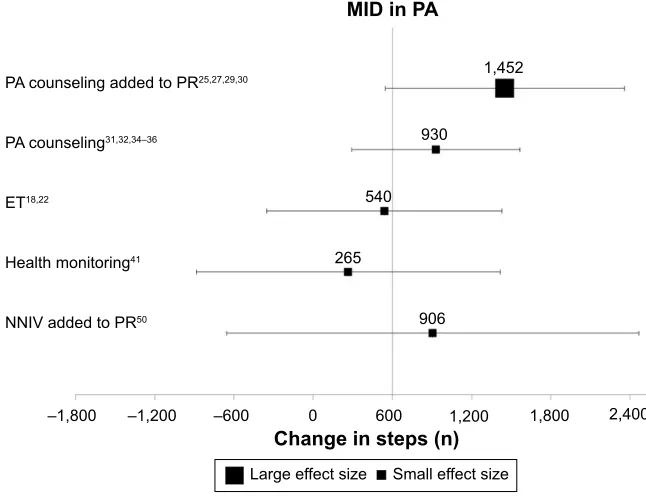
Limiting the analysis to 13 trials (456 actively treated
sub-jects) that used daily steps to measure the change in PA from
baseline, only the studies that tested the addition of activity
counseling to PR (n
=
4 studies)
25,27,29,30showed large effects
that exceeded the established MID of 599 daily steps (mean
difference [95% CI], 1452 [549–2,356]; Figure 5). While
PA counseling alone
31,32,34–36and the addition of nocturnal
noninvasive ventilation (NNIV)
50to PR achieved a mean
difference in steps that exceeded MID, the ES was small
and did not reach statistical significance (PA counseling
[n
=
5 studies]: 930 [293–1,566], NNIV
+
PR [n
=
1 study]:
906 [
−
655 to 2,467]; Figure 5). ET (n
=
2 studies)
18,22and
health monitoring via phone calls (n
=
1 study)
41achieved
differences in steps that did not exceed the MID for daily
steps in COPD (Figure 5).
effects of PA interventions on functional exercise
capacity
Compared to standard care, ET interventions including
maintenance program
15and Nordic walking
17significantly
improved 6-minute walk distance (6MWD) after 6 months
(0.48 [0.11–0.85] and 0.73 [0.20–1.25];
Table S4
),
respec-tively. Exercise adherence counseling also produced
important effects on 6MWD at 4 months (0.44 [0.01–0.86];
Table S4
).
37However, these effects were not sustained at
12 months when compared to usual care (0.29 [
−
0.18 to
0.76];
Table S4
).
37Adding tiotropium to PR produced moderate effects on
treadmill endurance time compared to placebo (0.67 [0.01–
1.33];
Table S4
).
43Moderate effects on exercise capacity
+HWHURJHQHLW\τ χ GI 3 , 7HVWIRURYHUDOOHIIHFW= 3
3$FRXQVHOLQJ35 35DORQH 60',9 UDQGRP&, 6WXG\RI
VXEJURXS
±
0HDQ
6'
7RWDO
7RWDO
:HLJKW
± ±
60',9 UDQGRP&,
±
0HDQ
$OWHQEXUJHWDO
7RWDO&,
GH%ORNHWDO %XUWLQHWDO
&UX]HWDO
6'
± ±
3$ FRXQVHOOLQJ35 35DORQH
Figure 3 Studies comparing PA counseling added to PR versus PR (short-term effect).
Abbreviations: CI, confidence interval; IV, independent variable; PA, physical activity; PR, pulmonary rehabilitation; SMD, standardized mean difference.
International Journal of Chronic Obstructive Pulmonary Disease downloaded from https://www.dovepress.com/ by 118.70.13.36 on 22-Aug-2020
Dovepress Lahham et al
+HWHURJHQHLW\χ GI 3 ,
7HVWIRURYHUDOOHIIHFW= 3
3$FRXQVHOLQJ35 35DORQH 60',9 IL[HG&, 6WXG\RI
VXEJURXS
0HDQ
±
6'
7RWDO
7RWDO
:HLJKW
±±
± 60',9
IL[HG&,
±
0HDQ
± ±
7RWDO&,
&UX]HWDO
%XUWLQHWDO
$OWHQEXUJHWDO
.DZDJRVKLHWDO
6'
± ±
3$ FRXQVHOOLQJ35 35DORQH
Figure 4 Studies comparing PA counseling added to PR versus PR (long-term effect).
Abbreviations: CI, confidence interval; IV, independent variable; PA, physical activity; PR, pulmonary rehabilitation; SMD, standardized mean difference.
were also achieved after the addition of an urban walking
circuit promotion program to usual care 12 months after PR
(0.59 [0.12–1.07];
Table S4
).
52The addition of self-management to
community-based ET moderately improved incremental shuttle walk
distance at 12 months (0.43 [0.09–0.77];
Table S4
).
18Improvements in endurance shuttle walk time were present
after individualized ET compared to general ET at 2 months
(0.72 [0.35–1.09];
Table S4
).
23effects of PA interventions on HRQL
Compared to usual care, only Nordic walking enhanced
HRQL using the 36-Item Short Form Survey (SF36) physical
performance domain at 3 months (1.17 [0.58–1.76];
Table S5
).
17Effects were sustained when reassessed 9 months
post-intervention (1.61 [0.98–2.24];
Table S5
).
17Pedometer-based counseling produced moderate to
large effects on HRQL measured using SGRQ at 3 months
when compared to standard counseling in two studies (0.43
[0.03–0.83] and 1.04 [0.00–2.07];
Table S5
).
34,35One month
of activity counseling via tele-rehabilitation produced
moder-ate effects on Clinical COPD Questionnaire when compared
to ET (0.53 [1.17–0.22];
Table S5
).
38None of the included interventions showed important
effects on dyspnea or lung function when compared to their
comparators at measured time points (
Tables S6
and
S7
).
Discussion
This systematic review found that when compared to usual
care, ET including Nordic walking,
17supervised exercise
19and self-efficacy enhancing exercise
20produce large effects
on PA levels in COPD. These effects were not sustained
after a long-term exercise maintenance program.
15,24While
PA counseling alone failed to improve PA, the addition
of counseling to PR programs succeeded in producing an
important increase in activity levels
25,27,29,30,33compared to
PR alone. Moreover, nutritional
46,47and pharmaceutical
45interventions significantly increased PA compared to
pla-cebo; however, insufficient data and poor methodological
quality restricted pooled ES calculations for these
interven-tions. Of all included interventions, only individualized and
pedometer-based counseling added to multidisciplinary PR
program produced changes that exceed the newly established
MID in daily steps for COPD.
25,27,29,30While PR alone achieved important increases in activity
levels,
6compared to usual care at 4 months, our analysis
showed that providing persistent and individualized
feed-back on activity levels using wearable monitors in
con-junction with PR achieved significant effects on activity
levels that exceeded effects produced by PR alone after
3–6 months.
25,27,29,30Moreover, the addition of counseling
to PR achieved significant differences in daily steps that
exceeded the established MID in daily steps at 3 months while
PR alone failed to produce comparable outcomes at similar
time points. It is important to mention that, of the included
studies that evaluated the addition of counseling to PR, three
of four studies failed to blind assessors, which indicates a low
methodological quality. While this report shows that effects
of the combination of PR and activity counseling significantly
increased PA in COPD, high-quality research, ideally using
large samples followed up for long periods, would shed light
on the true effects of this comprehensive strategy.
Current research concentrates on the importance of
lifestyle behavioral change interventions to improve PA.
54Examples of strategies that implement behavioral change are
pedometer-based activity counseling, motivational
interview-ing and well-constructed self-management interventions.
55,56Failure to report robust effects of these interventions may
be linked with the wide heterogeneity of self-management
interventions. An international expert group has recently
published a consensus definition of the construct of
self-management.
57Future studies should establish programs
International Journal of Chronic Obstructive Pulmonary Disease downloaded from https://www.dovepress.com/ by 118.70.13.36 on 22-Aug-2020