† Corresponding author
DOI: 10.18488/journal.1/2015.5.9/1.9.522.528 ISSN(e): 2224-4441/ISSN(p): 2226-5139
© 2015 AESS Publications. All Rights Reserved. 522
INTERPRETATIVE STRUCTURE MODEL FOR EFFECTIVE FACTORS ON
SUCCESSFUL KNOWLEDGE MANAGEMENT PROJECTS’ IMPLICATION
Reza Sepahvand
1--- Ali Pirzad
2†--- Hamdallah Jamshidi Nasrabadolea
3--- Iman
Rameshianfar
41Assistant professor of management faculty, Lorestan University, lorestan, Iran
2PhD student, Department of management, Lorestan University, lorestan, Iran
3, 4Department of Accounting, College of graduate studies, Science and Research Branch of kohgiluyeh and boyer-ahmad,
Islamic Azad University, yasouj, Iran
ABSTRACT
This research tries to design a structural model for knowledge management projects’ success factors adopted from counseling model of Rehman and Mahmood(2010) with factors of excellent
managerial supports (1), proper knowledge- centered culture (2), financial resources (3),
technologic infrastructure (4), intersection relationships (5), human resources development (6),
scholar people (7), knowledge management strategy(8), knowledge performance motives and
rewards (9),knowledge management systematic processes and activities (10), business principal values (11) and organizational infrastructure (12). To analyze, experts’ ideas have been used and research results show that managerial support is the highest factor with the most influence. In
addition, it was cleared that these factors have the least independency and are intensively related
to each other.
© 2015 AESS Publications. All Rights Reserved.
Keywords:
Knowledge management, Managerial supports, Financial resources, Technologic infrastructure,Intersection relationships, Human resources development, Scholar people, Knowledge management strategy.
Contribution/ Originality
This study contributes in the existing literature, and tries to design a structural model for factors affecting project success of knowledge management projects derived from Rahman and Mahmoud's model.
International Journal of Asian Social Science
ISSN(e): 2224-4441/ISSN(p): 2226-5139© 2015 AESS Publications. All Rights Reserved. 523
1. INTRODUCTION
Competitiveness in the present world becomes very much different from past; and therefore, traditional competitive methods don’t have necessary effectiveness and efficiency any more. Knowledge and information become key element; as though, nothing will happen without it. Organizational competitiveness basis in the present economics changes into knowledge from known and unknown previous knowledge. Business able to get efficient knowledge in its organization will have proper competitive merits in market. Many organizations are introduced as knowledge-centered business that knowledge management shapes the basis. Today, organizations introducing competitiveness in market as principal issue, consider knowledge management as known activity for their activities effectiveness. On the other hands, as the failure rate of management projects are considerable, recognition of success main factors can help businesses in knowledge management implication, execution and evaluation to decrease knowledge management projects’ failure. The importance and main usage of knowledge management main factors is that by identifying and observing on these factors, organization can implicate knowledge management successfully. Therefore, each activity organization does to implicate knowledge management should be explored and planned in advance to have favorite and proper performance in successful factors. Accordingly, question proposed is that what are success main factors in knowledge management implication in business? How are these factors in interaction?
Success main factors can be defined in fields’ titles that results there if satisfying can guarantee successful competitive performance for organization. Rockart (1979) knows success main factors in fields that results obtaining in them guarantee organization’s success. Vast spectrum of factors able to influence knowledge management successfully are seen in literature; in spite of this fact, no coherent work has been done to identify coherent collection of main success factors to fulfill
knowledge management projects successfully in small and medium businesses. Skryme and
Amidon (1997) studies have identified 7 factors of business by knowledge management execution,
knowledge landscape and plan, knowledge leadership, knowledge share and making culture, continuant learning, proper technologic infrastructure and organizational knowledge systematic processes. Davenport et al. (1998) have explored 31 knowledge management projects in 24 firms. In this research, 8 main factors have been identified that have great role in successful knowledge management implication. Liebowitz (1999) identified 6 important factors in successful knowledge management implication. He stated that to implicate successful knowledge management, excellent managerial support from knowledge management strategy, master knowledge manager or its equivalent and knowledge management infrastructure, knowledge and resources typology, knowledge management tools and systems, knowledge motives incentives and supporting culture are necessary. Haspell and Joushi stated 3 overall classifications of management, resources and environment on knowledge management in organizations that each of them includes other different factors. Hasan Ali (2002) limited these factors in successful knowledge management implications: leadership, culture, structure, roles and responsibilities, information technology infrastructures and measuring. Wong and Aspinwall (2005) stated managerial factors effective on successful knowledge management implication in 11 patterns, 11 extracted factors by Wong and Aspinwall
© 2015 AESS Publications. All Rights Reserved. 524 and strategy, evaluation, organizational infrastructures, organizational activities and processes, motivations, resources, education and human resources management. Another research was done
by Akhavan et al. (2006) that among 33 initial factors about literature they get to 16 selected
factors. These factors include: interactions and communication, job security, organization risk taking space, human resources management, team cooperation, knowledge share, firms readiness to accept knowledge management, having systematic attitude, knowledge management architects, technologic tools and data bank for knowledge researches, documenting, knowledge store,
performance evaluation, modeling and master knowledge managers. Rehman and Mahmood
(2010) research on small and intermediate businesses by Malaysia and Pakistan showed that
researchers stated 12 important factors including followings: excellent management support, proper knowledgeable culture, financial resources, technologic infrastructure, inter sections relationships, human resources development, scholar people utilization, knowledge management strategy, rewards and knowledge performance motives, systematic activities and processes of knowledge management, business principal values and organizational infrastructure. Valmohammadi (2010) research also states: financial management supports, organizational culture, technologic infrastructures, knowledge management strategy, performance evaluation, organizational infrastructure, activities and processes, rewards and motivations, resources limitation, education and treatment, human resources management and modeling.
2. RESEARCH METHODOLOGY
This research is applicable that research literature has been used to explore successful factors of knowledge management projects from Rehman and Mahmood (2010) model with factors of excellent management supports (1), proper knowledgeable culture (2), financial resources (3), technologic infrastructure (4), intersections relationship (5), human resources development (6), scholar people employment (7), knowledge management strategy (8), knowledge performance motives and rewards (9), knowledge management systematic activities and processes (10), business principal values (11) and organizational infrastructure (12). Notice that these factors are numbered according to their mental and relative important not to make any problem in interpretative structural modeling, then it is made using experts ideas structural self-interactive matrix and in the next step reachability matrix is made, by its help we can make all inputs and outputs matrix and finally, research interactive model comes out. Self-interactive matrix sign includes:
V: means i leads to j A: i is resulted from j
X: both lead and result from each other O: there is no relationship
In reachability matrix, 1 is attributed to first and third signs and 0 is attributed to second and fourth signs. Finally arrows and columns sum shows independency and dependency degree matrix.
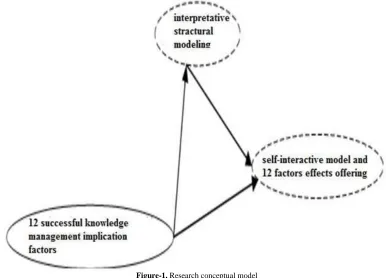
2.1. Research Conceptual Model
© 2015 AESS Publications. All Rights Reserved. 525 Figure-1. Research conceptual model
3. DATA ANALYSIS
Table 1 structural self-interactive matrix by experts’ ideas
Table-1. Structural self-interactive matrix
12 11 10 9 8 7 6 5 4 3 2 1 Factor V V V V V V V V V V V X 1 V V V V V V V V V V X A 2 V V V V V V V V V X A A 3 V V V V V V V V X A A A 4 V V V V V V V X A A A A 5 V V V V V V X A A A A A 6 V V V V V X A A A A A A 7 V V V V X A A A A A A A 8 V V V X A A A A A A A A 9 A V X A A A A A A A A A 10 X X A A A A A A A A A A 11 X X V A A A A A A A A A 12
© 2015 AESS Publications. All Rights Reserved. 526 Table-2. Initial reachability matrix
Penetration Degree 12 11 10 9 8 7 6 5 4 3 2 1 Factor 12 1 1 1 1 1 1 1 1 1 1 1 1 1 11 1 1 1 1 1 1 1 1 1 1 1 0 2 10 1 1 1 1 1 1 1 1 1 1 0 0 3 9 1 1 1 1 1 1 1 1 1 0 0 0 4 8 1 1 1 1 1 1 1 1 0 0 0 0 5 7 1 1 1 1 1 1 1 0 0 0 0 0 6 6 1 1 1 1 1 1 0 0 0 0 0 0 7 5 1 1 1 1 1 0 0 0 0 0 0 0 8 4 1 1 1 1 0 0 0 0 0 0 0 0 9 2 0 1 1 0 0 0 0 0 0 0 0 0 10 2 1 1 0 0 0 0 0 0 0 0 0 0 11 2 1 1 1 0 0 0 0 0 0 0 0 0 12 78 11 12 11 10 9 8 7 6 5 4 3 2 Connection Degree
Now we determine the collection of each factor inputs and outputs and identify mutual collection. In this table also factors can be classified according to output and mutual elements in a way that a factor with least output and mutual collection input in first row and in such a way rowing continuous to the last factor. If 2 factors have equal number of output and mutual elements, they put in same level. In order to direct or interact elements we should refer to table 1 and finally make and design structural self-interactive model.
Table-3. Second reachability matrix
Level Common Set Imported Set Balcony Set Factor Number 11 1 1 1…12 1 1 2 1,2 2…12 2 6 3 1…3 3…12 3 3 4 1…4 4…12 4 3 5 1…5 5…12 5 7 6 1…6 6…12 6 5 7 1…7 7…12 7 8 8 1…8 8…12 8 2 9 1…9 9…12 9 10 10
Except All 11 11,10 10 4 12,11 1…12 12,11 11 1 11,12
Except All 10 12,11,10
12
Factors with high influence and low dependency are influence cluster and factors with low influence and high dependency are dependency cluster, factors with high influence and dependency are communication cluster and factors with low influence and dependency are independency cluster.
© 2015 AESS Publications. All Rights Reserved. 527 Table-4. Factors clustering matrix
6 and 7 communication cluster 1.2.3.4.5 factors influence cluster
8,9,10,11,12 dependency cluster It doen’t have independency cluster
As it is seen, effective factors on knowledge management projects success do not get into any independent cluster and mostly they get into dependency and influence cluster.
Therefore, this note shows high interaction and exchange of these 12 factors, finally structural passing design model is as following:
Figure-2. Final interpretive structural modeling of 12 effective factors on knowledge management
One way rows show one way effects and two way row show two way effects. AS an example, there is two way effects between business principal values and organizational infrastructure, but between financial management and knowledge managerial proper culture there is just excellent management effects on knowledge management proper culture.
4. CONCLUSION AND SUGGESTIONS
© 2015 AESS Publications. All Rights Reserved. 528 proper culture outbreak and actually it has higher influence and effect that should be noticed. In addition, technologic infrastructures are very important and even its influence is higher than relationships among sections and of course human resources development, so for this reason it can change into knowledge strategies formulating by knowledge-centered talents help. Rewards for promoting mentality are necessary.
Finally, organizational infrastructure, value-centered businesses and knowledge systematic processes are other important factors.
Finally, it should be suggested to researchers to focus on knowledge management aspects to do other modeling well.
REFERENCES
Akhavan, P., M. Jafari and M. Fathian, 2006. Critical success factors of knowledge management systems: A
multi-case analysis. Eur. Bus. Rev, 18(2): 97-113.
Davenport, T.H., D.W. De Long and M.C. Beers, 1998. Successful knowledge management projects. Sloan
Management Review, 39(2): 43-57.
Hasan Ali, F., 2002. Critical success factors of knowledge management. Available from
www.kmadvantage.com/docs/km_articles/Critical_Success_Factors_of_KM..pdf.
Liebowitz, J., 1999. Key ingredients to the success of an organization’s knowledge management strategy.
Knowledge and Process Management, 6(1): 37-40.
Rehman, M. and A. Mahmood, 2010. Implementation of knowledge management in small and medium
enterprises. Journal of Knowledge Management Practice, 11(1): 234-259.
Rockart, J., 1979. Chief executive defines their own data needs. Harvard Business Review, 57(2): 81-93.
Skryme, D. and D. Amidon, 1997. The knowledge agenda. J of Knowledge Management, 1(1): 27-37.
Valmohammadi, C., 2010. Identification and prioritization of critical success factors of knowledge
management in Iranian SMEs: An experts’ view. African Journal of Business Management, 4(6):
915-924.
Wong, K.Y. and E. Aspinwall, 2005. An empirical study of the important factors for knowledge-management
adoption in the SME sector. J. Know. Manage, 9(3): 64-82.
BIBLIOGRAPHY
Holsapple, C.W. and K.D. Joshi, 2000. An investigation of factors that influence the management of
knowledge in organizations. Journal of Strategic Information Systems, 9(2/3): 235-261.