1
Recent Progress in Constructing Plasmonic
Metal/Semiconductor Hetero-nanostructures for
Improved Photocatalysis
Liang Ma a*, Shuang Chen a, You-Long Chen a, Mo-Xi Liu a, Hai-Xia Li a,
Yi-Ling Mao a
, Si-Jing Ding b*
a School of Science, Wuhan Institute of Technology, Wuhan, 430205, P. R. China.
b School of Mathematics and Physics, China University of Geosciences (Wuhan),
Wuhan 430074, Wuhan, P. R. China.
* Corresponding author E-mail: [email protected] (L. M.); [email protected]
(S. J. D)
Abstract
Hetero-nanomaterials constructed by plasmonic metals and functional semiconductors
show enormous potential in photocatalytic applications, such as water splitting,
hydrogen production, CO2 reduction, pollutants treatment. Their photocatalytic
performances can be better regulated through adjusting structure, ingredient, and
components arrangement. Therefore, the reasonable design and synthesis of
metal/semiconductor hetero-nanostructures is of vital significance. In this article, we
briefly review the recent progress in efficiently establishing metal/semiconductor
nanomaterials for improved photocatalysis. The defined photocatalysts mainly include
traditional binary hybrids, ternary multi-metals/semiconductor and
metal/multi-semiconductors heterojunctions. The underlying physical mechanism for the improved
photocatalytic activity of the established photocatalysts are highlighted. At the end of
this article, a brief summary and possible future perspectives for further development
in this field are demonstrated.
Keywords: photocatalysis; plasmon; metal/semiconductor; electron transfer; energy
conversion
2
1.
Introduction
The increasing energy crisis and environmental pollution are common problems
faced by the world in the twenty-first century, the whole world is seeking ways to ease
these issues. As a sustainable and clean way to convert solar energy,
semiconductor-based photocatalysis has been intensely investigated and widely used in energy store
and pollutant treatment. [1-10]. Since Fujishima and Honda firstly applied TiO2
electrode to electrochemical water splitting under ultraviolet light irradiation in 1972
[11], large amounts of semiconductor materials have been extensively explored for
photocatalytic applications, such as organic degradation, hydrogen production, CO2
reduction. [12-18]. In the case of photocatalytic process, semiconductor can absorb
sunlight when the energy of the incident photons is equal or larger than its band gap.
However, the commonly used semiconductors often have wide band gaps, indicating
that they can only be excited by ultraviolet light [19-20]. As the semiconductor is
excited by incident light, the formation of photogenerated electron-hole pairs occurs.
While, the fast the recombination of electron-hole pairs in semiconductor plays a
negative role on the photocatalytic reaction. Therefore, to optimize the photocatalytic
activity of semiconductor, the development of new strategies to expand the light
response region and speed up the separation rate of electron-hole pairs is necessary.
Over the past two decades, metal nanocrystals have attracted intense research
attention due to their extraordinary physical and chemical characteristics [21-23]. The
most fascinating property of metal nanocrystals is their plasmonic optical peculiarity.
Plasmon resonance of metal nanomaterials refers to the collective oscillations
light-excited free charges, which can endow metal nanocrystals with strong light absorption
and scattering cross-sections [24-30]. Furthermore, the localized surface plasmon
resonance excitation of a metal nanoparticle can induce strong local electromagnetic
field. Moreover, upon resonant excitation, plasmonic metal nanocrystals interact
strongly with light, the oscillation of free electrons quickly dephase and lead to the
generation of energetic hot electrons and holes. Only certain metal nanocrystals, such
3
resonance of these metal nanomaterials can be easily adjusted through varying the sizes
and morphologies, which could across the entire visible spectrum [35-40]. With these
characters, the plasmonic metals deservedly display great promises for the effective
solar energy conversion in photocatalytic reaction.
Incorporating plasmonic metal nanocrystals with semiconductor photocatalysts to
form metal/semiconductor hybrid nanostructures is a potential way to enhance the light
absorption, charge generation and separation in the photocatalytic process. Great efforts
have been applied to construct various metal/semiconductors hybrids with excellent
photocatalytic performance [41-45]. In present article, we give a brief review about the
recent efforts in efficient preparation of metal/semiconductor nanomaterials for
improved photocatalytic applications. The defined photocatalysts are mainly
centralized in traditional binary hybrids, ternary multi-metals/semiconductor and
metal/multi-semiconductors heterojunctions. The underlying physical mechanism
(including plasmon coupling of multi-metals, co-catalytic effect of functional metals,
plasmon-mediated Z-scheme and p-n heterojunctions of multi-semiconductors) for the
efficiently improved photocatalysis of metal/semiconductor heterojunctions are
highlighted. In the end, a brief summary and discussion on the future challenges in the
area of metal/semiconductor photocatalysis are demonstrated.
2. Binary Metal/Semiconductor Hybrids for Enhanced Photocatalysis
Binary photocatalysts constructed by one plasmonic metal and one semiconductor
are the most frequently studied. In metal/semiconductor heterojunction, plasmon can
modulate photocatalysis mainly through the following characteristics: 1) strong light
absorption and scattering; 2) large local electromagnetic field; 3) abundant hot electrons
generation [46-50]. Thus, in the photocatalytic process, plasmon could promote the
redox reaction via following pathways: enlarging light trapping, speeding charge
separation, plasmon-induced energy transfer, and hot electron injection [51-55]. Since
the optical and photocatalytic performances of metal/semiconductor hybrids are highly
depended on their morphologies and structures, the design of hetero-nanostructure is
4
structural adjustment of binary metal/semiconductor photocatalysts. Traditional
core-shell, yolk-shell and anisotropic morphologies are highlighted. The underlying
enhanced mechanism for photocatalysis of the classified nanostructures is
demonstrated.
Typical core-shell structural motif of metal/semiconductors has special advantages
for photocatalytic reaction, such as maximizing the active interface and protecting the
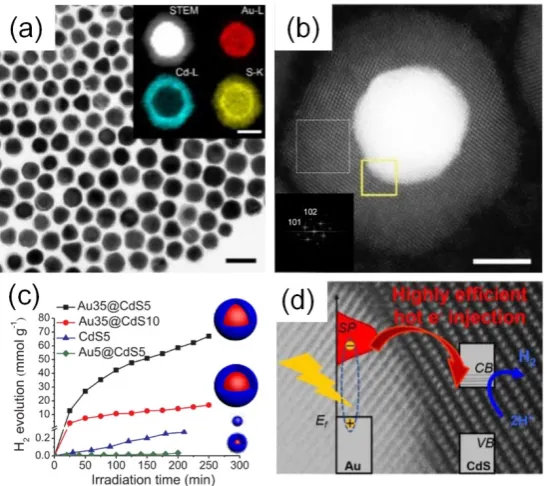
core metal [56-61]. Recently, Zhang and his co-workers reported the preparation of
high-quality Au@CdS core-shell hybrids with atomically organized interfaces [62].As
shown in Figure 1 a and b, the high-yield and monodisperse Au@CdS with quasi-single
crystalline shell were observed. The photocatalytic activity of Au@CdS was evaluated
by hydrogen evolution. The results indicated that Au35@CdS5 which the Au core size
was maintained around 35 nm and CdS shell thickness was 5 nm exhibited highest
activity with the rate reaching to 24.0 mmol g-1 h-1 (see Figure 1c). The femtosecond
transient absorption testing indicated that the unique interfacial features enabled highly
efficient hot electron injection from Au core to semiconductor shell.
5
photocatalysis that is facilitated by the atomically organized interface between Au core and CdS shell. Copyright 2018 Elsevier.
Apart from core-shell nanostructures, metal-semiconductor yolk-shell nanostructure
also benefits for photocatalysis. The unique void between metal and semiconductor
could efficiently improve light trapping and accelerate plasmon-induced resonant
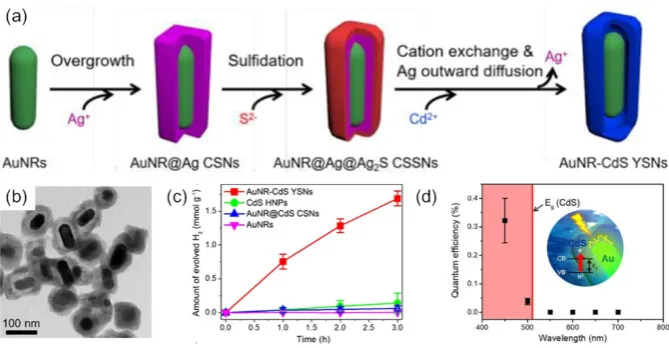
energy transfer [63-66]. For example, Han and co-workers reported a yolk-shell
nanostructure consisting of plasmonic Au nanorod yolk and CdS shell [67]. The
synthetic route was shown in Figure 2a, the most important point in the process was the
action exchange. The identified yolk-shell structure of Au/CdS was given in Figure 2b.
The prepared Au-CdS yolk-shell hybrids exhibited significantly enhanced activity for
photocatalytic hydrogen evolution under visible light (λ > 400nm) irradiation in
comparison to CdS hollow nanoparticles, Au@CdS core-shell nanostructures (see
Figure 2c). The synergism between multiple photon reflections rendered by the
yolk-shell structure and the radiative relaxation of plasmon energy were thought to be the
promotional effect for the photocatalysis, which were proposed in Figure 2d.
6
In addition, anisotropic binary metal/semiconductor hybrids have unique merits for
photocatalytic reaction. By selective growing semiconductor shells on the surface of
metal nanocrystals, the processes of electron injection and energy transfer can be
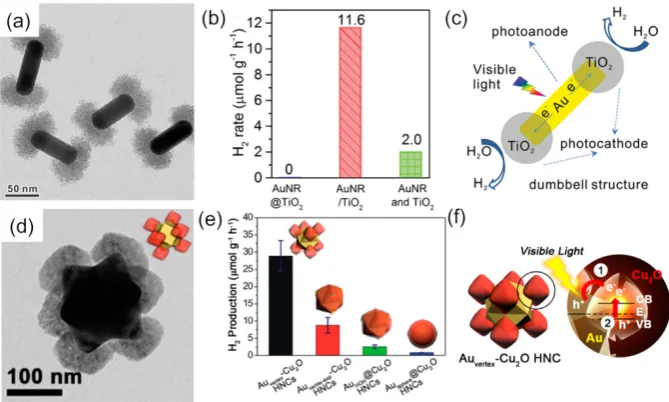
prominently accelerated [68-70]. In 2016, Stucky’s group prepared an anisotropic
Au/TiO2 nanodumbbell, which the TiO2 nanoshells was spatially grown at the two ends
of Au nanorod (see Figure 3a) [71]. Through testing the hydrogen production by
evaluating the photocatalytic degradation of methanol, the designed Au/TiO2 shown
best photocatalytic activity (see Figure 3b). As proposed in Figure 3c, for the
nanodumbbells, the oxidation pathway occurs on their side surface, when lateral side
of Au can be directly exposed to electron donors. With Au partially exposed, Au could
generate a concentrated electromagnetic field that focus energy flux around the
semiconductor, and thus enhancing hot-electron generation and photocatalytic activity.
Similarly, Han and co-workers reported a rational synthesis strategy for the
realization of plasmonic metal-semiconductor heteronanocrystals with intended
configurations through the site-selective overgrowth of semiconductor Cu2O on desired
sites of anisotropic Au nanocrystals [72]. The morphology characterization in Figure
3d clearly shown that the Cu2O were grown on the vertices of hexoctahedral Au
(Auvertex-Cu2O). The Auvertex-Cu2O exhibited outstanding photocatalytic activity for
hydrogen production relative to the other nanostructures. A series of experiments
(including adding insulating layer and theoretical simulation) indicated that the efficient
charge separation by strong plasmon excitation, subsequent sustainable hot electron
transfer and plasmon energy transfer process (1 and 2 labeled in Figure 3f) were
7
Figure 3. (a) TEM image of Au/TiO2 nanodumbells. (b) Hydrogen evolution rate by various catalysts. (c) Structure and mechanism of operation under visible light of individual Au/TiO2 dumbbell. Copyright 2016 American Chemical Society. (d) TEM image of Auvertex-Cu2O heteronanocrystal. (e) Photocatalytic hydrogen generation rates of different heteronanocrystals. (f) Schematic illustration of possible plasmon-induced charge separation processes for Auvertex-Cu2O. Copyright 2016 American Chemical Society.
4. Plasmon Coupling, Co-Catalytic Effect, and Components
Arrangement in Ternary Multi-Metals/Semiconductor Catalysts
Integrating one metal nanocrystal with binary metal/semiconductor to form ternary
hetero-nanostructure could dramatically improve the photocatalytic activity due to the
synergistic effect between the three nano-spaced components [73-74]. The introduced
metals could be a plasmonic donor or functional catalyst. In that way, the synergistic
effect includes plasmon coupling and co-catalytic effect. Furthermore, the
arrangements of the three different components also influence the whole photocatalytic
performance. In this section, we focus on the progress achieving in constructing ternary
multi-metals/semiconductor photocatalysts. The excellent photocatalytic performances
of defined nanomaterials and underlying physical mechanism are highlighted.
The plasmon coupling between two metals could generate excellent optical
properties. The strong coupling induced broad resonance region can largely enhance
8
efficiently accelerate the hot electron generation and suppress the recombination of
electron-hole pairs [77-78]. Recently, Huang and co-workers used Au-Ag bimetallic
nanoparticles to modify ZnO nanorods via simple photo-deposition procedure (see
Figure 4a) [79]. The photocatalytic tests indicated that ZnO co-decorated by 0.8 wt%
Au-Ag exhibited best photocatalytic ethylene-oxidation activity. The possible
mechanism of the excitation of surface plasmon and electron transfer process was
shown in Figure 4b, the cooperative action of plasmonic Au-Ag alloys induced large
visible-light absorption and efficient carrier separation were thought to be the enhanced
factor.
Besides, Kamimura et. al synthesized (core@shell)@shell ((Au@Ag)@Au)
nanoparticles by a multistep citrate reduction method for utilization as photosensitizers
of TiO2 (see Figure 4c) [80]. They confirmed that (Au@Ag)@Au/TiO2 could oxidize
2-propanol into acetone and CO2 under visible light irradiation, and its acetone
evolution rate was approximately 15-times higher than that of Au/TiO2. They proposed
that the excited electrons in the (Au@Ag)@Au were injected into the conduction band
of rutile TiO2, and then the electron-deficient (Au@Ag)@Au could oxidize 2-propanol
into acetone and CO2.
9
As a functional metal, Pt nanocrystal is an ideal catalyst for oxygen reduction
reaction due to its suitable Fermi level and excellent ability for trapping electrons [
81-83]. Pt nanocrystal is commonly used as effective co-catalyst and active site. It can be
decorated onto the surface of a semiconductor for improved photocatalysis. Combine
Pt with plasmonic metal/semiconductor hetero-nanostructures can extremely boost the
redox reaction [84-86]. In 2015, Moskovits’ group fabricated a device including both
Au nanorod, TiO2 and Pt to achieve panchromatic photoproduction of hydrogen [87].
Firstly, Au nanorods were dropped cast on quartz slides forming a dense layer with
panchromatic absorption. Then TiO2 film was deposited and acted as a hot electron
filter, and Pt nanoparticles were capped functioning as the hydrogen evolution catalyst
(see Figure 5a). The photocatalytic results revealed that the sample with Au nanorods
of aspect ratio 1.4 and 3.0 shown highest photocatalytic activity for hydrogen
production.
10 Chemical Society.
The arrangement of components in multi-metals/semiconductor heterojunction has
a great influence on their final photocatalytic performance. Properly optimizing the
structural configuration could increase the utilization efficiency of plasmon-induced
hot electrons [88-90]. Meanwhile, abundant pathway of electron transfer can speed the
separation of electron-hole pairs. Our previous work had certified the important role of
structural arrangement for improving the photocatalytic activity [91]. We prepared an
Au-Pt-CdS hetero-nanostructure, in which each component of Au, Pt, and CdS had
direct contact with other two materials; Pt was on the tips and a CdS layer along the
sides of an Au nanotriangle (see Figure 6a). The photocatalytic testing indicated that
Au-Pt-CdS hybrids exhibited excellent photocatalytic activity for hydrogen production.
Through testing the ultrafast time-resolved transient absorption (see Figure 6c), the
multipathway electron-transfer processed in Au-Pt-CdS hybrids could be attested,
which were illustrated in Figure 6d. The intimate and multi-interface contact between
components generated multiple effective electron-transfer pathways (Au to CdS, Au to
Pt, and CdS to Pt) for maximal utilization of photoexcited charges. Similar
nanostructure was reported by Dong and co-workers [92]. They synthesized a ternary
plasmonic photocatalyst, which featured an Au nanorod with tipped Pt nanoparticles
and sided CdS nanoshells. The as-prepared Au-Pt-CdS possessed efficient
UV-Vis-NIR-driven plasmonic photoactivity for hydrogen generation. The rational arrangement
of the components in Au-Pt-CdS induced to plasmonic resonance energy transfer and
hot electron transfer were thought be responsible for the outstanding photocatalytic
11
Figure 6. (a) TEM image of Au-Pt-CdS hetero-nanostructures. (b) Photocatalytic hydrogen production of contrast samples under light irradiation (λ > 420 nm). (c) Normalized time-resolved optical differential transmission of Au, Au@CdS, Au@CdS/Pt, and Au-CdS-Pt hetero-nanostructures. (d) Schematic illustration of the multipathway electron transfer in Au-Pt-CdS hetero-nanostructures. Copyright 2016 Wiley-VCH.
3. Plasmon-Mediated Heterojunctions Photocatalysis in Ternary
Metal/Multi-Semiconductors Hetero-Nanostructures
Properly engineered semiconductor heterojunction photocatalysts are proved to show
higher photocatalytic activity because of spatial separation of photo-generated
electron-hole pairs. The direct Z-scheme and p-n heterojunctions are the most frequently studied
due to their distinct advantages for charge migration [93-96]. By introduction of
plasmonic metal with these junctions, the separation of electron-hole pairs could be
observably expedited. In this section, we briefly review the recent works centered on
plasmon-modified Z-scheme and p-n heterojunctions for efficient photocatalysis.
The Z-scheme photocatalytic concept was proposed by Bard et al. in 1979 in order
to maximize the redox potential of the semiconductor heterojunction [97]. Several
advantages have been obtained for Z-scheme configuration, such as effective charge
separation, high reduction and oxidation power, more participant photocatalysts [
12
electrons and large utilization of light induced by plasmon resonance could further
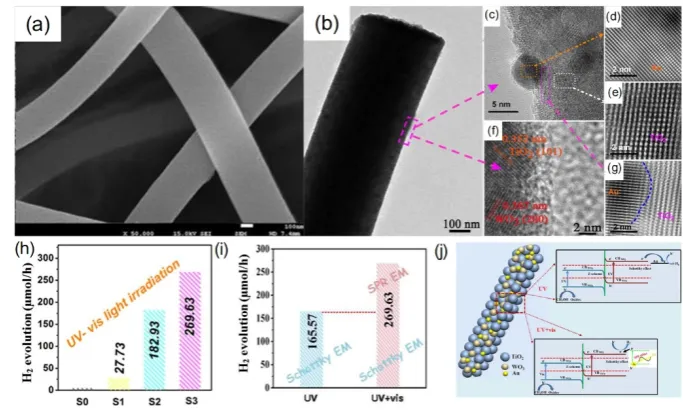
promote the photocatalytic reaction [100-102]. For instance, Gao et al. fabricated a
unique Au/TiO2/WO3 heterojunction photocatalyst for hydrogen production by a facile
electrospinning technique and subsequent annealing in air [103]. In this system,
plasmonic Au nanoparticles were combined with Z-scheme TiO2/WO3 heterojunctions
(see Figure 9a-g). The hydrogen production rate of the as-prepared composite was
greatly enhanced compared with pure TiO2 (S0) and TiO2/WO3 (S1) (see Figure 9 h and
i). In the catalytic reaction, WO3 and Au acted as hole and electron collector,
respectively. The connection of plasmonic effect and Z-scheme configuration further
promoted charge separation and absorption of visible light. The synergistic effect of
Schottky and plasmonic effect were thought to improve the performance of
photocatalytic hydrogen production.
Figure 7. (a-g) Morphology and composition characterizations of Au/TiO2/WO3. (h-i) Photocatalytic hydrogen production activity of the contrast samples. (J) Schematic diagram of the photocatalytic hydrogen generation over the ternary Au/TiO2/WO3. Copyright 2017 Elsevier.
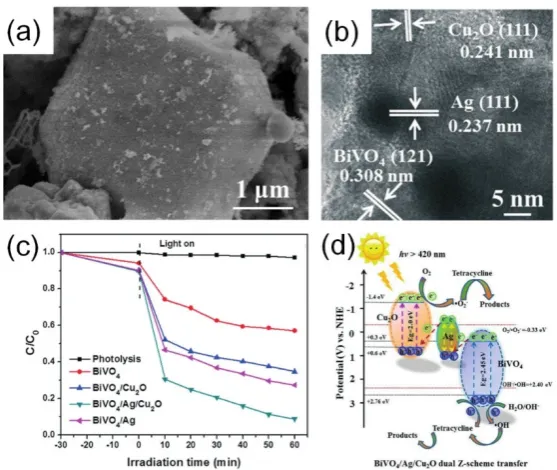
Meanwhile, Tang and co-workers reported a plasmon-excited dual Z-scheme
system in ternary BiVO4/Ag/Cu2O nanocomposite [104]. Specifically, the
nanocomposite had been synthesized via simple wet impregnation of Cu2O particles
coupled with a subsequent photo-reduction pathway for the deposition of metallic Ag
on the surface of BiVO4. The specific morphology of BiVO4/Ag/Cu2O was shown in
13
presented a great effect on the eventual photocatalytic activity of the photocatalysts,
and the optimum coating contents of Cu2O and Ag were obtained with their mass ratios
of 3% and 2%, respectively. Under optimum conditions, nearly 91.22% tetracycline
removal efficiency was obtained based on ternary BiVO4/Ag/Cu2O, higher than that of
pure BiVO4 (42.9%) and binary BiVO4/Cu2O (65.17%) and BiVO4/Ag (72.63%)
nanocomposites (see Figure 8c). The enhanced photocatalytic activity was attributed to
the synergistic effect of Cu2O, Ag and BiVO4, especially the surface plasmon resonance
excited dual Z-scheme and established local electric field brought about by metallic Ag,
which was proposed in Figure 8d.
Figure 8. Morphology (a) and composition (b) characterizations of BiVO4/Ag/Cu2O composites. (c) The photocatalytic degradation of tetracycline based on different photocatalysts. (d) Schematic illustration of the proposed reaction mechanism in the BiVO4/Ag/Cu2O nanocomposite-based reaction systems towards tetracycline degradation under visible light irradiation. Copyright 2017 Royal Society of Chemistry.
The p-n heterojunction photocatalyst concept was proposed to accelerate the
electron-hole migration across the heterojunction by providing an additional electric
field [105-107]. Generally, an effective p-n heterojunction photocatalyst can be
obtained by combining p-type and n-type semiconductors. When the p-type and n-type
14
their bandgap value, both p-type and n-type semiconductors can generate electron-hole
pairs. The photogenerated electrons and holes in the p-type and n-type semiconductors
will migrate under the influence of the internal electric field to the conductor band of
the n-type semiconductor and the valance band of the p-type semiconductor,
respectively, which results in the fast-spatial separation of the electron-hole pairs [
108-109]. Combing plasmonic metal nanocrystals with p-n heterojunction could further
speed the separation of electron-hole pairs [110-111]. For instance, Zhou et. al
fabricated a large-scale quantity of three-dimensional branched CuxO/ZnO@Au
heterostructure consisting of CuO nanowires and grafted ZnO nanodisks decorated with
Au nanoparticles via sequential hierarchical assemblies (see Figure 9a-d) [112]. The
photocatalytic results indicated that CuxO/ZnO@Au exhibited a highest hydrogen
production rate of 12.4 μmol cm-2 h-1. The possible enhanced mechanism was proposed
in Figure 9g. The synergistic effect from CuO, ZnO, and their formed intimate p-n
heterojunctions extends the light absorption range and inhibits the recombination of
photogenerated electron-hole pairs, as well as the strong plasmon resonance of Au were
thought to be responsible for the superior photocatalytic activity.
15
(f) Recycling test of photocatalytic hydrogen production over CuxO/ZnO@Au. (g) Schematic illustration of photoexcited carrier dynamics in CuxO/ZnO@Au. Copyright 2015 American Chemical Society.
5. Conclusion and outlook
In recent years, the researches focused on plasmon-mediated photocatalysis of
hetero-nanomaterials have been steadily expanding, the progress mentioned in this
article is only a drop in the bucket. In this article, we present a concise appraisal of the
recent achievements in the field of metal/semiconductor heterojunction photocatalysts,
including their designs, synthesis, and photocatalytic applications. The physical
mechanism for the enhanced photocatalysis in binary and ternary metal/semiconductor
heterojunctions is briefly classified.
Although many exciting results have been achieved in this field, but the practical
efficiency of the photocatalytic reaction is still low, the further industrialization and
commercialization of the photocatalysts requires untiring explores. In our option, the
future research in this field may be focused on the following aspects. Firstly, the
synthetic method is the footstone for the preparation of photocatalysts. Currently, there
still remains significant challenges in exploring facile, economic, environmentally
friendly strategies for preparing high-performance metal/semiconductor photocatalysts.
Secondly, searching new plasmonic materials and functional semiconductors to form
effective heterojunctions is one of the key research goals. More research efforts should
be centered on the developing new materials with low cost, high solar-conversion
efficiency. Thirdly, the mechanism of plasmon-enhanced photocatalytic activity
requires further systematic studies. Effective ultrafast spectral analysis technique
should be applied to quantitatively verify the migration pathway of charge. Meanwhile,
corresponding theoretical calculations and modeling methods for optimizing the
structural construct and charge transfer should be pay more attention. Further
theoretical achievement could offer a better understanding of the charge and energy
transfer kinetics, then guiding the design of high-quality photocatalyst.
16
metal/semiconductor photocatalyst for improved photocatalytic applications. Their
photocatalytic performances varied with structural adjustment and component
arrangement are demonstrated. We hope this article could inspire the further design and
fabrication of functional materials used in photocatalysis and other important
applications.
Acknowledgement: This study was supported by the National Natural Science
Foundation of China (11804257), Natural Science Foundation of Hubei Province
(2018CFB106), scientific research foundation of Wuhan Institute of Technology
(18QD24 and 18QD25).
Conflicts of Interest: There are no conflicts to declare.
References
1. Chen, X., Shen, S., Guo, L., Mao, S. S. Semiconductor-based photocatalytic hydrogen generation. Chem. Rev. 2010, 110, 6503-6570.
2. Martin, D. J., Reardon, P. J. T., Moniz, S. J., Tang, J. Visible light-driven pure water splitting by a nature-inspired organic semiconductor-based system. J. Am. Chem. Soc. 2014, 136, 12568-12571.
3. Marszewski, M., Cao, S., Yu, J., Jaroniec, M. Semiconductor-based photocatalytic CO2 conversion. Mater. Horiz. 2015, 2, 261-278.
4. Li, J., Wu, N. Semiconductor-based photocatalysts and photoelectrochemical cells for solar fuel generation: a review. Catal. Sci. Technol. 2015, 5, 1360-1384. 5. Kisch, H. Semiconductor photocatalysis-mechanistic and synthetic aspects. Angew.
Chem. Int. Ed. 2013, 52, 812-847.
6. Xiang, Q., Yu, J., Jaroniec, M. Graphene-based semiconductor photocatalysts. Chem. Soc. Rev. 2012, 41, 782-796.
7. Liu, G., Jimmy, C. Y., Lu, G. Q. M., Cheng, H. M. Crystal facet engineering of semiconductor photocatalysts: motivations, advances and unique properties. Chem. Commun. 2011, 47, 6763-6783.
8. Zhang, G., Zhang, J., Zhang, M., Wang, X. Polycondensation of thiourea into carbon nitride semiconductors as visible light photocatalysts. J. Mater. Chem. 2012, 22, 8083-8091.
9. Chen, X., Liu, L., Peter, Y. Y., Mao, S. S. Increasing solar absorption for photocatalysis with black hydrogenated titanium dioxide nanocrystals. Science
17
10. Zhang, G., Zhang, M., Ye, X., Qiu, X., Lin, S., Wang, X. Iodine modified carbon nitride semiconductors as visible light photocatalysts for hydrogen evolution. Adv. Mater. 2014, 26, 805-809.
11. Fujishima, A., Honda, K. Electrochemical photolysis of water at a semiconductor electrode. Nature, 1972, 238, 37.
12. Fu, J., Chang, B., Tian, Y., Xi, F., Dong, X. Novel C3N4-CdS composite
photocatalysts with organic–inorganic heterojunctions: in situ synthesis, exceptional activity, high stability and photocatalytic mechanism. J. Mater. Chem. A 2013, 1(9), 3083-3090.
13. Wang, C. C., Li, J. R., Lv, X. L., Zhang, Y. Q., Guo, G. Photocatalytic organic pollutants degradation in metal-organic frameworks. Energy Environ. Sci. 2014, 7, 2831-2867.
14. Ge, L., Han, C., Liu, J. Novel visible light-induced g-C3N4/Bi2WO6 composite
photocatalysts for efficient degradation of methyl orange. Appl. Catal. B: Environ.
2011, 108, 100-107.
15. Liang, Y. T., Vijayan, B. K., Gray, K. A., Hersam, M. C. Minimizing graphene defects enhances Titania nanocomposite-based photocatalytic reduction of CO2 for
improved solar fuel production. Nano Lett. 2011,11, 2865-2870.
16. Tran, P. D., Wong, L. H., Barber, J., Loo, J. S. Recent advances in hybrid photocatalysts for solar fuel production. Energy Environ. Sci. 2012, 5, 5902-5918. 17. Cowan, A. J., Durrant, J. R. Long-lived charge separated states in nanostructured semiconductor photoelectrodes for the production of solar fuels. Chem. Soc. Rev.
2013, 42, 2281-2293.
18. Müller, C. On the glass transition of polymer semiconductors and its impact on polymer solar cell stability. Chem. Mater. 2015, 27, 2740-2754.
19. Han, C., Yang, M. Q., Weng, B., Xu, Y. J. Improving the photocatalytic activity and anti-photocorrosion of semiconductor ZnO by coupling with versatile carbon. Phys. Chem. Chem. Phys. 2014, 16, 16891-16903.
20. Wu, W., Jiang, C., Roy, V. A. Recent progress in magnetic iron oxide– semiconductor composite nanomaterials as promising photocatalysts. Nanoscale,
2015, 7, 38-58.
21. Stamplecoskie, K. G., Kamat, P. V. Synergistic effects in the coupling of plasmon resonance of metal nanoparticles with excited gold clusters. J. Phys. Chem. Lett.
2015, 6, 1870-1875.
22. Juan, M. L., Righini, M., Quidant, R. Plasmon nano-optical tweezers. Nat. Photonics 2011, 5, 349.
23. Zhang, W., Huang, L., Santschi, C., Martin, O. J. Trapping and sensing 10 nm metal nanoparticles using plasmonic dipole antennas. Nano Lett. 2010, 10, 1006-1011. 24. Ni, W., Kou, X., Yang, Z., Wang, J. Tailoring longitudinal surface plasmon
wavelengths, scattering and absorption cross sections of gold nanorods. ACS Nano
2008, 2, 677-686.
18
26. Aydin, K., Ferry, V. E., Briggs, R. M., Atwater, H. A. Broadband polarization-independent resonant light absorption using ultrathin plasmonic super absorbers. Nat. Commun. 2011, 2, 517.
27. Schaadt, D. M., Feng, B., Yu, E. T. Enhanced semiconductor optical absorption via surface plasmon excitation in metal nanoparticles. Appl. Phys. Lett. 2005, 86, 063106.
28. Barnes, W. L., Dereux, A., Ebbesen, T. W. Surface plasmon subwavelength optics. Nature, 2003, 424, 824.
29. Luther, J. M., Jain, P. K., Ewers, T., Alivisatos, A. P. Localized surface plasmon resonances arising from free carriers in doped quantum dots. Nat. Mater. 2011, 10, 361.
30. Schuller, J. A., Barnard, E. S., Cai, W., Jun, Y. C., White, J. S., Brongersma, M. L. Plasmonics for extreme light concentration and manipulation. Nat. Mater., 2010, 9, 193.
31. Zijlstra, P., Paulo, P. M., Orrit, M. Optical detection of single non-absorbing molecules using the surface plasmon resonance of a gold nanorod. Nat. Nanotechnol. 2012, 7, 379.
32. Sherry, L. J., Chang, S. H., Schatz, G. C., Van Duyne, R. P., Wiley, B. J., Xia, Y. Localized surface plasmon resonance spectroscopy of single silver nanocubes. Nano Lett. 2005, 5, 2034-2038.
33. Chan, G. H., Zhao, J., Hicks, E. M., Schatz, G. C., Van Duyne, R. P. Plasmonic properties of copper nanoparticles fabricated by nanosphere lithography. Nano Lett.
2007, 7, 1947-1952.
34. Robatjazi, H., Zhao, H., Swearer, D. F., Hogan, N. J., Zhou, L., Alabastri, A., McClain, M. J., Nordlander, P., Halas, N. J. Plasmon-induced selective carbon dioxide conversion on earth-abundant aluminum-cuprous oxide antenna-reactor nanoparticles. Nat. Commun. 2017, 8, 27.
35. Orendorff, C. J., Gearheart, L., Jana, N. R., Murphy, C. J. Aspect ratio dependence on surface enhanced Raman scattering using silver and gold nanorod substrates. Phys. Chem. Chem. Phys. 2006, 8, 165-170.
36. Liao, H., Hafner, J. H. Gold nanorod bioconjugates. Chem. Mater. 2005, 17, 4636-4641.
37. Camargo, P. H., Rycenga, M., Au, L., Xia, Y. Isolating and probing the hot spot formed between two silver nanocubes. Angew. Chem. 2009, 121, 2214-2218. 38. Fu, Q., Ran, G., Xu, W. Direct self-assembly of CTAB-capped Au nanotriangles.
Nano Research 2016, 9, 3247-3256.
39. Tabatabaei, M., Sangar, A., Kazemi-Zanjani, N., Torchio, P., Merlen, A., Lagugné-Labarthet, F. Optical properties of silver and gold tetrahedral nanopyramid arrays prepared by nanosphere lithography. J. Phys. Chem. C 2013, 117, 14778-14786. 40. Li, Y., Sun, J., Wang, L., Zhan, P., Cao, Z., Wang, Z. Surface plasmon sensor with
gold film deposited on a two-dimensional colloidal crystal. Appl. Phys. A 2008, 92, 291-294.
19
enhanced photocatalytic activity. J. Phys. Chem. C 2016, 120, 26996-27002. 42. Ma, L., Ding, S. J. Synthesis of thermostable Au@ZnO core-shell nanorods with
efficient visible-light photocatalytic activity. Mater. Lett. 2018, 217, 255-258. 43. Jiang, R., Li, B., Fang, C., Wang, J. Metal/semiconductor hybrid nanostructures for
plasmon‐enhanced applications. Adv. Mater. 2014, 26, 5274-5309.
44. Wang, M., Ye, M., Iocozzia, J., Lin, C., Lin, Z. Plasmon‐mediated solar energy conversion via photocatalysis in noble metal/semiconductor composites. Adv. Sci.
2016, 3, 1600024.
45. Choi, W., Park, G., Bae, K. L., Choi, J. Y., Nam, K. M., Song, H. Metal– semiconductor double shell hollow nanocubes for highly stable hydrogen generation photocatalysts. J. Mater. Chem. A 2016, 4, 13414-13418.
46. Tu, W., Zhou, Y., Li, H., Li, P., Zou, Z. Au@TiO2 yolk-shell hollow spheres for
plasmon-induced photocatalytic reduction of CO2 to solar fuel via a local
electromagnetic field. Nanoscale, 2015, 7, 14232-14236.
47. Linic, S., Aslam, U., Boerigter, C., Morabito, M. Photochemical transformations on plasmonic metal nanoparticles. Nat. Mater. 2015, 14, 567.
48. Zhang, Y., He, S., Guo, W., Hu, Y., Huang, J., Mulcahy, J. R., Wei, W. D. Surface-plasmon-driven hot electron photochemistry. Chem. Rev. 2017, 118, 2927-2954. 49. Bernardi, M., Mustafa, J., Neaton, J. B., Louie, S. G. Theory and computation of
hot carriers generated by surface plasmon polaritons in noble metals. Nat. Commun.
2015, 6, 7044.
50. Hong, T., Chamlagain, B., Hu, S., Weiss, S. M., Zhou, Z., Xu, Y. Q. Plasmonic hot electron induced photocurrent response at MoS2-metal junctions. ACS Nano 2015
9, 5357-5363.
51. Li, W., Valentine, J. G. Harvesting the loss: surface plasmon-based hot electron photodetection. Nanophononics, 2017,6, 177.
52. Li, J., Cushing, S. K., Meng, F., Senty, T. R., Bristow, A. D., Wu, N. Plasmon-induced resonance energy transfer for solar energy conversion. Nat. Photonics
2015, 9, 601.
53. Wu, K., Chen, J., McBride, J. R., Lian, T. Efficient hot-electron transfer by a plasmon-induced interfacial charge-transfer transition. Science, 2015, 349, 632-635.
54. Ma, X. C., Dai, Y., Yu, L., Huang, B. B. Energy transfer in plasmonic photocatalytic composites. Light-Sci. Appl. 2016, 5, e16017.
55. Brongersma, M. L., Halas, N. J., Nordlander, P. Plasmon-induced hot carrier science and technology. Nat. Nanotechnol. 2015, 10, 25.
56. Li, M., Yu, X. F., Liang, S., Peng, X. N., Yang, Z. J., Wang, Y. L., Wang, Q. Q. Synthesis of Au-CdS core-shell hetero-nanorods with efficient exciton-plasmon interactions. Adv. Funct. Mater. 2011, 21, 1788-1794.
57. Ma, L., Liang, S., Liu, X. L., Yang, D. J., Zhou, L., Wang, Q. Q. Synthesis of dumbbell‐like gold-metal sulfide core-shell nanorods with largely enhanced transverse plasmon resonance in visible region and efficiently improved photocatalytic activity. Adv. Funct. Mater. 2015, 25, 898-904.
20
nanostructures with large lattice mismatches. Science, 2010, 327, 1634-1638. 59. Lu, B., Liu, A., Wu, H., Shen, Q., Zhao, T., Wang, J. Hollow Au-Cu2O core-shell
nanoparticles with geometry-dependent optical properties as efficient plasmonic photocatalysts under visible light. Langmuir, 2016, 32, 3085-3094.
60. Li, B., Gu, T., Ming, T., Wang, J., Wang, P., Wang, J., Yu, J. C. (Gold core)@(ceria shell) nanostructures for plasmon-enhanced catalytic reactions under visible light. ACS Nano, 2014, 8, 8152-8162.
61. Muhammed, M. A. H., Döblinger, M., Rodríguez-Fernández, J. Switching plasmons: gold nanorod-copper chalcogenide core-shell nanoparticle clusters with selectable metal/semiconductor NIR plasmon resonances. J. Am. Chem. Soc. 2015, 137, 11666-11677.
62. Liu, J., Feng, J., Gui, J., Chen, T., Xu, M., Wang, H., Dong, H., Chen, H., Li, X., Wang, L., Chen, Z., Yang, Z., Liu, J., Hao, W., Yao, Y., Gu, Y., Weng, Y., Huang, Y., Duan, X., Zhang, J., Li Y. Metal@ semiconductor core-shell nanocrystals with atomically organized interfaces for efficient hot electron-mediated photocatalysis. Nano Energy 2018, 48, 44-52.
63. Feng, J., Liu, J., Cheng, X., Liu, J., Xu, M., Zhang, J. Hydrothermal cation exchange enabled gradual evolution of Au@ZnS-AgAuS yolk-shell nanocrystals and their visible light photocatalytic applications. Adv. Sci. 2018, 5, 1700376. 64. Chang, Y., Cheng, Y., Feng, Y., Jian, H., Wang, L., Ma, X., Li, X., Zhang, H.
Resonance energy transfer-promoted photothermal and photodynamic performance of gold-copper sulfide yolk-shell nanoparticles for chemophototherapy of cancer. Nano letters, 2018, 18, 886-897.
65. Ji, M., Li, X., Wang, H., Huang, L., Xu, M., Liu, J., Liu, J., Wang, J., Zhang, J. Versatile synthesis of yolk/shell hybrid nanocrystals via ion-exchange reactions for novel metal/semiconductor and semiconductor/semiconductor conformations. Nano Research 2017, 10, 2977-2987.
66. Wan, G., Peng, X., Zeng, M., Yu, L., Wang, K., Li, X., Wang, G. The Preparation of Au@TiO2 yolk-shell nanostructure and its applications for degradation and
detection of methylene blue. Nanoscale Research Lett. 2017, 12, 535.
67. Lee, S. U., Jung, H., Wi, D. H., Hong, J. W., Sung, J., Choi, S. I., Han, S. W. Metal– semiconductor yolk-shell heteronanostructures for plasmon-enhanced photocatalytic hydrogen evolution. J. Mater. Chem. A 2018, 6(9), 4068-4078. 68. Costi, R., Cohen, G., Salant, A., Rabani, E., Banin, U. Electrostatic force
microscopy study of single Au-CdSe hybrid nanodumbbells: evidence for light-induced charge separation. Nano Lett. 2009, 9, 2031-2039.
69. Chakrabortty, S., Yang, J. A., Tan, Y. M., Mishra, N., Chan, Y. Asymmetric dumbbells from selective deposition of metals on seeded semiconductor nanorods. Angew. Chem. 2010, 122, 2950-2954.
70. Kim, Y., Park, K. Y., Jang, D. M., Song, Y. M., Kim, H. S., Cho, Y. J., Myung, Y., Park, J. Synthesis of Au-Cu2S core- shell nanocrystals and their photocatalytic and
electrocatalytic activity. J. Phys. Chem. C 2010, 114, 22141-22146.
21
production from water reduction. J. Am. Chem. Soc. 2016, 138, 1114-1117.
72. Hong, J. W., Wi, D. H., Lee, S. U., Han, S. W. Metal-semiconductor heteronanocrystals with desired configurations for plasmonic photocatalysis. J. Am. Chem. Soc. 2016, 138, 15766-15773.
73. Tsukamoto, D., Shiro, A., Shiraishi, Y., Sugano, Y., Ichikawa, S., Tanaka, S., Hirai, T. Photocatalytic H2O2 production from ethanol/O2 system using TiO2 loaded with
Au-Ag bimetallic alloy nanoparticles. ACS Catal. 2012, 2, 599-603.
74. Zhou, N., Polavarapu, L., Gao, N., Pan, Y., Yuan, P., Wang, Q., Xu, Q. H. TiO2
coated Au/Ag nanorods with enhanced photocatalytic activity under visible light irradiation. Nanoscale 2013, 5, 4236-4241.
75. Li, Y., Zhang, B. P., Zhao, J. X. Enhanced photocatalytic performance of Au-Ag alloy modified ZnO nanocomposite films. J. Alloys Compd. 2014, 586, 663-668. 76. Kamimura, S., Yamashita, S., Abe, S., Tsubota, T., Ohno, T. Effect of core@shell
(Au@Ag) nanostructure on surface plasmon-induced photocatalytic activity under visible light irradiation. Appl. Catal. B: Environ. 2017, 211, 11-17.
77. Zielińska-Jurek, A., Kowalska, E., Sobczak, J. W., Lisowski, W., Ohtani, B., Zaleska, A. Preparation and characterization of monometallic (Au) and bimetallic (Ag/Au) modified-Titania photocatalysts activated by visible light. Appl. Catal. B: Environ. 2011, 101, 504-514.
78. Tahir, M., Tahir, B., Amin, N. A. S. Synergistic effect in plasmonic Au/Ag alloy NPs co-coated TiO2 NWs toward visible-light enhanced CO2 photoreduction to
fuels. Appl. Catal. B: Environ. 2017, 204, 548-560.
79. Zhai, H., Wang, P., Zhang, Q., Liu, X., Wang, Z., Liu, Y., Zheng, Z., Huang, B. Plasmonic Au-Ag bimetallic alloy nanoparticles decorated ZnO nanorod with enhanced photocatalytic activity for ethylene-oxidation. Appl. Catal. A: General
2018, doi.org/10.1016/j.apcata.2018.06.019.
80. Kamimura, S., Miyazaki, T., Zhang, M., Li, Y., Tsubota, T., Ohno, T. (Au@Ag)@Au double shell nanoparticles loaded on rutile TiO2 for photocatalytic
decomposition of 2-propanol under visible light irradiation. Appl. Catal. B: Environ. 2016, 180, 255-262.
81. Zheng, Z., Tachikawa, T., Majima, T. Single-particle study of Pt-modified Au nanorods for plasmon-enhanced hydrogen generation in visible to near-infrared region. J. Am. Chem. Soc. 2014, 136, 6870-6873.
82. Li, K., Hogan, N. J., Kale, M. J., Halas, N. J., Nordlander, P., Christopher, P. Balancing near-field enhancement, absorption, and scattering for effective antenna-reactor plasmonic photocatalysis. Nano Lett. 2017, 17, 3710-3717.
83. Yu, L., Shao, Y., Li, D. Direct combination of hydrogen evolution from water and methane conversion in a photocatalytic system over Pt/TiO2. Appl. Catal. B:
Environ. 2017, 204, 216-223.
84. Xue, J., Ma, S., Zhou, Y., Zhang, Z., He, M. Facile photochemical synthesis of Au/Pt/g-C3N4 with plasmon-enhanced photocatalytic activity for antibiotic
degradation. ACS Appl. Mater. Interface 2015, 7, 9630-9637.
22
fine Au-Pt alloyed TiO2 photocatalysts. ACS Catal. 2015, 5, 3924-3931.
86. Zhang, Z., Li, A., Cao, S. W., Bosman, M., Li, S., Xue, C. Direct evidence of plasmon enhancement on photocatalytic hydrogen generation over Au/Pt-decorated TiO2 nanofibers. Nanoscale 2014, 6, 5217-5222.
87. Mubeen, S., Lee, J., Liu, D., Stucky, G. D., Moskovits, M. Panchromatic photoproduction of H2 with surface plasmons. Nano Lett. 2015, 15, 2132-2136.
88. Tanaka, A., Hashimoto, K., Kominami, H. Visible-light-induced hydrogen and oxygen formation over Pt/Au/WO3 photocatalyst utilizing two types of
photoabsorption due to surface plasmon resonance and band-gap excitation. J. Am. Chem. Soc. 2014, 136, 586-589.
89. She, P., Xu, K., Zeng, S., He, Q., Sun, H., Liu, Z. Investigating the size effect of Au nanospheres on the photocatalytic activity of Au-modified ZnO nanorods. J. Colloid. Interface Sci. 2017, 499, 76-82.
90. Yun, J., Hwang, S. H., Jang, J. Fabrication of Au@Ag core/shell nanoparticles decorated TiO2 hollow structure for efficient light-harvesting in dye-sensitized
solar cells. ACS Appl. Mater. Interface 2015, 7, 2055-2063.
91. Ma, L., Chen, K., Nan, F., Wang, J. H., Yang, D. J., Zhou, L., Wang, Q. Q. Improved hydrogen production of Au-Pt-CdS hetero‐nanostructures by efficient plasmon‐ induced multipathway electron transfer. Adv. Funct. Mater. 2016, 26, 6076-6083. 92. Wu, J., Zhang, Z., Liu, B., Fang, Y., Wang, L., Dong, B. UV‐Vis‐NIR‐driven
plasmonic photocatalysts with dual‐resonance modes for synergistically enhancing h2 generation. Solar RRL, 2018, 2, 1800039.
93. Xia, P., Zhu, B., Cheng, B., Yu, J., Xu, J. 2D/2D g-C3N4/MnO2 nanocomposite as
a direct Z-scheme photocatalyst for enhanced photocatalytic activity. ACS Sustain. Chem. Eng. 2017, 6, 965-973.
94. Zhou, P., Yu, J., Jaroniec, M. All‐solid‐state Z‐scheme photocatalytic systems. Adv. Mater. 2014, 26, 4920-4935.
95. Maeda, K. Z-scheme water splitting using two different semiconductor photocatalysts. ACS Catal. 2013, 3, 1486-1503.
96. Chen, Z., Wang, W., Zhang, Z., Fang, X. High-efficiency visible-light-driven Ag3PO4/AgI photocatalysts: Z-scheme photocatalytic mechanism for their enhanced photocatalytic activity. J. Phys. Chem. C 2013, 117, 19346-19352. 97. Bard, A. J. Photoelectrochemistry and heterogeneous photo-catalysis at
semiconductors. J. Photochem. 1979, 10, 59-75.
98. Jia, Q., Iwase, A., Kudo, A. BiVO4-Ru/SrTiO3: Rh composite Z-scheme
photocatalyst for solar water splitting. Chem. Sci. 2014, 5, 1513-1519.
99. Zhou, F. Q., Fan, J. C., Xu, Q. J., Min, Y. L. BiVO4 nanowires decorated with CdS
nanoparticles as Z-scheme photocatalyst with enhanced H2 generation. Appl. Catal.
B: Environ. 2017, 201, 77-83.
100.Jin, J., Yu, J., Guo, D., Cui, C., Ho, W. A Hierarchical Z-scheme CdS-WO3
photocatalyst with enhanced CO2 reduction activity. Small, 2015, 11, 5262-5271.
23
102.Zhang, J., Niu, C., Ke, J., Zhou, L., Zeng, G. Ag/AgCl/Bi2MoO6 composite
nanosheets: A plasmonic Z-scheme visible light photocatalyst. Catal. Commun.
2015, 59, 30-34.
103.Gao, H., Zhang, P., Zhao, J., Zhang, Y., Hu, J., Shao, G. Plasmon enhancement on photocatalytic hydrogen production over the Z-scheme photosynthetic heterojunction system. Appl. Catal. B: Environ. 2017, 210, 297-305.
104.Deng, Y., Tang, L., Zeng, G., Feng, C., Dong, H., Wang, J., Feng, H., Liu, Y., Zhou, Y., Pang, Y. Plasmonic resonance excited dual Z-scheme BiVO4/Ag/Cu2O
nanocomposite: synthesis and mechanism for enhanced photocatalytic performance in recalcitrant antibiotic degradation. Environm. Sci. Nano 2017, 4, 1494-1511.
105.Jiang, D., Chen, L., Zhu, J., Chen, M., Shi, W., Xie, J. Novel p-n heterojunction photocatalyst constructed by porous graphite-like C3N4 and nanostructured BiOI:
facile synthesis and enhanced photocatalytic activity. Dalton Trans. 2013, 42, 15726-15734.
106.Chen, C., Cai, W., Long, M., Zhou, B., Wu, Y., Wu, D., Feng, Y. Synthesis of visible-light responsive graphene oxide/TiO2 composites with p/n heterojunction.
ACS Nano 2012, 4, 6425-6432.
107.Zhang, Z., Shao, C., Li, X., Wang, C., Zhang, M., Liu, Y. Electrospun nanofibers of p-type NiO/n-type ZnO heterojunctions with enhanced photocatalytic activity. ACS Appl. Mater. Interface 2010, 2, 2915-2923.
108.Peng, Y., Yan, M., Chen, Q. G., Fan, C. M., Zhou, H. Y., Xu, A. W. Novel one-dimensional Bi2O3-Bi2WO6 p-n hierarchical heterojunction with enhanced
photocatalytic activity. J. Mater. Chem. A 2014, 2, 8517-8524.
109.Lin, L., Yang, Y., Men, L., Wang, X., He, D., Chai, Y., Zhao, B., Ghoshroy, S., Tang, Q. A highly efficient TiO2@ZnO n-p-n heterojunction nanorod photocatalyst.
Nanoscale, 2013, 5(2), 588-593.
110.Zhao, W., Dai, B., Zhu, F., Tu, X., Zhang, L., Li, S., Leung, D. Y. C., Cheng, S. A novel 3D plasmonic p-n heterojunction photocatalyst: Ag nanoparticles on flower-like p-Ag2S/n-BiVO4 and its excellent photocatalytic reduction and oxidation
activities. Appl. Catal. B: Environ. 2018, 229, 171-180.
111.Pal, J., Sasmal, A. K., Ganguly, M., Pal, T. Surface plasmon effect of Cu and presence of n-p heterojunction in oxide nanocomposites for visible light photocatalysis. J. Phys. Chem. C 2015, 119, 3780-3790.
112.Zhou, G., Xu, X., Ding, T., Feng, B., Bao, Z., Hu, J. Well-steered charge-carrier transfer in 3D branched CuxO/ZnO@Au heterostructures for efficient