International Journal of Asian Social Science, 2013, 3(12): 2382-2398
† Corresponding author
THE
MEDIATING
EFFECT
OF
SELF-EFFICACY
TOWARDS
THE
RELATIONSHIP BETWEEN ATTITUDES AND LEVEL OF USE TOWARDS
INSTRUCTIONAL COMPUTER TECHNOLOGY IN OMAN
Issa Mohamed Al Dafaei
†Minisitry of Education, Oman
Zurida Ismail
School of Educational Studies Universiti Science Malaysia
Mohd Ali Samsudin
School of Educational Studies Universiti Science Malaysia
Firas Jalal Shakir
School of Housing, Building and Planning UniversitiSains Malaysia
ABSTRACT
This study attempts to determine if attitudes towards instructional computer technology
significantly predict the level of use towards instructional computer technology among Oman social
studies teachers. The other purpose of this study is to determine if self-efficacy significantly mediate
the relationship between attitudes and level of use towards instructional computer technology. The
study utilized a survey methodology. Sample of the study consisted of 450 social studies teachers
from two regions in Oman. The results of hierarchical multiple regression showed that the attitudes
is a significant predictor towards the level of use on using instructional computer technology, after controlling for the influence of teacher’s gender and teaching experiences. Further data analysis using mediating analysis technique revealed that self-efficacy fully mediate the relationship
between attitudes and the level of use on using instructional computer technology. It is suggested
that self-efficacy be given consideration to promote social studies teachers in Oman to use
instructional computer technology through intensive and systematic trainings.
© 2013 AESS Publications. All Rights Reserved.
Keywords:
Mediating, self-Efficacy, Attitudes, Level of use, Instructional computer technology, Social Studies TeachersInternational Journal of Asian Social Science
ISSN(e): 2224-4441/ISSN(p): 2226-51391.INTRODUCTION
The Ministry of Education in Oman has started a large-scale educational reformate beginning of 1998/1999. A major reform in the education system of the Sultanate of Oman is the introduction of a new education model called "Basic Education". Basic Education has been defined (Ministry of Education, 2001) as a unified or common education provided by the state to all school-aged children in the Sultanate of Oman. The system covers various aspects including formulation of national educational goals, changing structure of school system and curriculum content, improving teaching methods, administrating restructuring at ministerial level, changes in assessment of students' performance and improving educational supervision (Ministry of Education, 1999).
In 1995 the government of Oman launched a conference entitled “Vision for Oman’s Economy – Oman: 2020” to consider the future direction of the Sultanate's economic and social development. The final report which emanated from this conference recognized that the globalization of the world economy would create a great need in Oman for creative and flexible workers who possess high quality scientific and technological skills (Ministry of Education, 2001; Ministry of Education, 2002). The conference on reforming secondary education, which was held under the auspices of UNESCO, had insisted on the integration of instructional computer technology into the secondary teaching process and recommended the ministry to supply technical facilities to the schools in Oman (Ministry of Education, 2007).
Computer technology has been introduced into Basic Education schools to provide opportunities for students to gradually become aware of the many ways in which computers and their peripheral components can be used as a personal tool to assist them in their learning and their future lives. Beginning in the first grade (1-4 grade), students use computers to complete integrated learning tasks in the learning resource centers. Computers are just another resource available to students as they learn how to access, interpret, organize, and present information. Knowledge, skills and values associated with both information literacy and information and communications technology comprise the expected outcomes of the programme.
In the second cycle (5-10 grade) students begin to have more formal classes and access to computers is quadrupled. Students not only explore the traditional personal productivity tools such as word processing, databases, spreadsheets and slideshows, they also learn how to design and control computer robots. Also, the knowledge, concepts, skills, processes and values associated with computer technology are integrated into all subject areas. Vertical integration takes place through the ways in which computer technology concepts, abilities and values are revisited each year at increasing levels of difficulty through the spiraling curriculum (Ministry of Education, 2008). Computers can be seen as an effective catalyst for any educational change. Introducing computers to the basic education schools is to improve the traditional educational practices and support the change from teacher and curriculum-centered learning to student-cantered learning. Many kinds of reforms have been bought into education including individualization, discovery, cooperative learning, and higher order thinking skills (Ministry of Education, 2006).
computer technology, and the idea that the information revolution should be part of the social studies curriculum (Dynneson and Gross, 1982). Davidson (1996) mentions that instructional computer technology can be used by social studies teachers as a teaching and learning tool. According to Dawson et al. (2000):
“Computer technology enables social studies teachers and students to access real time data, manipulate and present statistics in various formats, critique primary sources, develop global learning communities, participate in social and historic simulations, and analyze situations” (p. 590).
Hassell (2000) presents several uses of instructional computer technology in social studies: presentation packages, data logging (weather), data handling (databases and spreadsheets to analyze information), simulations and modeling software, mapping and graphic information, GIS (geographic information system), digital images, electronic communications, multimedia authoring machines and information rich sources (CD-ROM and WWW). With the introduction of instructional computer technology into the social studies, the teacher will be the facilitator and supervisor of the learning process. He/she will be an organizer of students' activities and a decision maker. White (1999) stated that computer technology is a very important tool in structuring the classroom. The use of instructional computer technological devices in teaching social studies helps in decreasing the time required to get information that means saving the students and teachers alot of time. Moreover, instructional computer technology facilitates professional learning through bridging the distance between the school and local environments. The use of instructional computer technology in teaching social studies offers students more opportunities to be in contact with current events all over the world (Rice and Wilson, 1999; Montigny, 2001).
Instructional computer technology use in education has become more popular in recent years thus there have been major developments in computer technology in the last decades which has increased the level of computer in education. Furthermore, the level of use of instructional computer technology use in education opens a new area of knowledge and offers a tool that has a potential to change some of traditional and ineffective educational methods (Hirvela, 2006). Thus, there has been an increased emphasis on the integration of instructional computer technology into curriculum and teaching (Peake et al., 2005).
Reports from the Ministry of Education in the Sultanate of Oman indicated that the use of instructional computer technology in schools is still below expectations despite efforts to make computers available in public schools for the teachers’ and students’ use (Ministry of Education, 2003; Ministry of Education, 2008). According to the Ministry reports using instructional computer technology is still limited, which implies that only a few teachers are involved; while others are lagging behind.
Halpin, 2002; Alzamil, 2003; Bullock, 2004; Acıkalın and Duru, 2005; Albirini, 2006; Kesten, 2006; Sadik, 2006; Sahin and Thompson, 2006; Boon, 2007; Almuqayteeb, 2009), teachers' positive attitudes towards computers are vital to the successful integration of computers in schools since teachers' attitudes may influence their effective use.
2. CONCEPTUAL FRAMEWORK
For purposes of the current study, the researcher suggests a revised model based on Technology Acceptance Model (TAM) (Davis et al., 1989) and Bandura's social cognitive theory (SCM) (Bandura, 1986) (Figure 2.4). According to (Davis et al., 1989), three propositions can be extracted from the TAM: (1) An individual’s actual intention to use technology is determined by that individual’s attitude towards technology; (2) attitudes towards using technology is jointly determined by the perception of usefulness and ease of use; and (3) the effects of various other factors (primarily system features, one’s behavioral intention) are fully dominated by the combination of the perceived ease of use and subsequent usefulness.
Davis et al. (1989) advanced that actual information technology usage behavior was determined by a behavioral intention to use a system, which was jointly determined by a person's attitude towards using the system and its perceived usefulness. This attitude, which reflects feelings of favorableness or unfavorableness towards using the system, is also jointly determined by perceived usefulness and perceived ease of use. Perceived usefulness, in turn, is influenced by perceived ease of use and external variables.
The Technology Acceptance Model (TAM) is an intention-based model that has also been used to provide an understanding of the determinants of information technology usage (Davis et al., 1989). This model uses behavioral intentions of individuals to predict usage and, in turn focus on the identification of the determinants of intention, such as attitudes, social influences and facilitating conditions (Davis et al., 1989). Perceived usefulness and perceived ease of use are determinants of attitude towards usage intentions and actual technology usage. Perceived usefulness is defined as "the degree to which a person believes that using a particular system would enhance his or her job performance" (Davis et al., 1989), while perceived ease of use is defined as "the degree to which a person believes that using a particular system would be free of effort" (Davis et al., 1989).
According to Dinev and Hu (2007), utilizes TAM refer to technologies that are designed to benefit employees in terms of productivity, efficiency, competitiveness. These positive technologies include enterprise resource planning computer technology, and other technologies that contribute directly to increased productivity, and improved performance of employees. Several studies indicated that TAM could be integrated with other acceptance and diffusion theories to improve its predictive and explanatory power (Taylor and Todd, 1995; Chen et al., 2007).
Model in the decision to use a spreadsheet and found that the theory explained the intention to use spreadsheet equally well. King and He (2006), Legris et al. (2003), Schepers and Wetzels (2007), Sun and Zhang (2006) and Woodrow (2000) reported that the teachers’ attitude towards computer is a necessary prerequisite and an integral part of computer use. Moreover, teachers' attitudes towards computers are recognized as a necessary condition for effective use of computers in the teaching. Figure 2.2 displays the model of the theory.
Davis et al. (1989) used a wide range of computer technology to supported instruction in his teaching, such as Internet to word processing, Database development, and Web Page development. Furthermore, he used of software programs such as Microsoft Excel and Power Point, and Hyper studio as other sorts of computer-supported instructions in his classroom. According to Davis et al. (1989), there were three ways to use computer technology in teaching: (a) information gathering; (b) using teachers in the classroom (presentation tool); and (c) manipulated by students. Davis et al. (1989) believed that the computer was a great instructional tool for teaching easier and faster and it provides opportunity for students to learn with more effective tool. Davis et al. (1989) indicated that the instructional computer technology is not different than any other instructional tools in teaching. According to the TAM model the level of using computer technology in instructional are usefulness and ease to use. Therefore, teachers who have high level of instructional computer technology use in teaching can utilize computer in his classroom and will be more confident.
Bandura proposed the theory of social cognitive which states that behavior is best understood in terms of "triadic reciprocality". Reciprocal determinism refers to the notion that cognition (perceived ability to perform the task), environment (the setting), and behavior (the task being performed) are bi-directional. Self-efficacy is a key concept in Bandura's social cognitive theory. Social cognitive theory of self-efficacy advocated a belief in one's capability of performing a specific task. Bandura (1986) reported that:
“In social cognitive theory, people are neither driven by inner forces nor automatically shaped and controlled by the environment... They function as a contributor to their own motivation, behavior, and development within a network of reciprocally interacting influences. Persons are characterized within this theoretical perspective in terms of a number of basic capabilities” (p. 6).
Figure- 1.Bandura's social cognitive theory (Bandura, 1986).
Social cognitive theory looks at the learning process from different angles. It holds that learning takes place due to the cognitive processes that occur inside the organism (Compeau et al., 1999). The learner interacts with the environment, processes the information, and elicits the response (Davis and Henry, 1993). According to Cognitive theory, learning results from interactions with the environment. Olson (1997) said that a psychological fact is anything of which a person is conscious and that all psychological facts make up the individual’s life space. As stated by Hill (1977), the life space is the environment as it affects an individual’s behavior. It contains the person himself or herself, the positive goals that he/she is seeking, the negative goals the person is trying to avoid, the barriers that restrict person movements, and the paths that he/she must follow to obtain the desired results. Some of these factors might exert a negative or positive influence on the individual’s behavior. Several studies indicate that the individuals have negative or positive ideas about a behavior before they use it and these ideas affect their course of action (Bandura, 1986; Albion, 2001; Topkaya, 2010).
Smith (2000) investigated the relationship of the sources of computer self-efficacy and the impact of computer technology education. Examination of the four sources of computer self-efficacy before and after course instruction revealed computer self-self-efficacy was significantly related to mastery experiences and affective states. In addition, overall perceptions of computer self-efficacy increased after computer technology education. Bandura (1986) theory of self-efficacy provide the theoretical framework to explain whether social studies teachers in Oman have the necessary confidence and beliefs to change their teaching styles from the traditional methods of instruction to one that incorporates computer assisted instruction.
Level of Use towards Instructional Computer Technology in the context of Social Studies Teachers in Oman. This study considered the differences between gender and teaching experience, based on the hierarchical multiple regression technique. This study will test the hypothesis whether the attitude predict the level of use towards instructional computer technology after the effect of social studies teachers’ gender and teaching experience have been controlled. This study also move one step ahead by studying the complex relationship between the attitudes and level of use towards instructional computer technology by making hypothesis that self-efficacy mediate the relationship between attitudes and level of use.
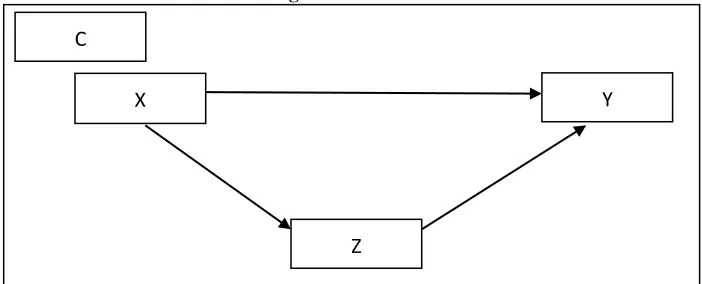
The case is made based on the idea of merging the Bandura’s Social Cognitive Theory into the TAM. While the TAM mention that attitudes is one of the determinants for the person to use computer, Bandura’s Social Cognitive Theory propose that people are able to generate innovative courses of action by drawing on their knowledge and symbolizing powers before plunging into action. Based on those two models, it is proposed that for people with positive attitudes towards using instructional computer, it is assumed that they should have high self-efficacy of using the instructional computer technology before taking the action to use the instructional computer technology. Therefore, this study tries to investigate whether self-efficacy mediates the relationship between attitudes and level of use towards instructional computer technology as illustrated in figure 2 below.
Figure- 2.Conceptual Framework.
3.RESEARCH METHODOLOGY
research involves the collection of data on one independent variable for two or more groups (Quintana, 2006).
The represented population in this study consisted of all social studies teachers in Oman (983 male and female teachers in the academic year 2012/2013), in the Basic Education schools (5-10 grades). A stratified sampling technique was employed to collect data from the two regions in Oman: Directorate of Education in Muscat and Al-Dhahirah in the Sultanate of Oman. These regions represent different parts of Oman: civilized and country society, seaboard and inland, mountainous and plains. The study sample was confined to these regions due to the characteristics which they have in common. The total number of social studies teachers is 450 with 247 female and 203 male. The instruments were distributed to all the social studies teachers in these schools. Table 3.1 displayed the research sample.This study utilized three instruments for collecting the data which are Teachers' Attitudes towards Instructional Computer Technology Questionnaire (TACTQ), Teachers' Self-Efficacy towards Instructional Computer Technology Questionnaire (TSECTQ) and Teachers' Level of Use towards Computer Technology Questionnaire (TLUCTQ). TACTQ was adopted from Kesten (2006). The original instrument was designed to examine social studies teachers’ attitudes towards computer technology. TSECTQ was developed to examine teachers’ self-efficacy with respect to using computers in teaching by Alhajri (2007). TLUCTQ was developed by Isleem (2003) to examine teachers’ level of use with respect to using computers in teaching. All the three instruments were translated from English into Arabic. Pilot-testing was conducted by distributing 30 questionnaires of each (TACTQ, TSECTQ, and TLUCTQ) to 30 Omani social studies teachers to determine the reliability of the instrument and to ensure an accurate survey measurement. A reliability test for the questionnaires was performed after the pilot study data was collected. The questionnaire had a Cronbach’s alpha values as follows: attitudes, σ = 0.80, self-efficacy, σ = 0.96, and Level of use, σ = 0.92 which are considered ideal (Nunnally, 1978; Pallant, 2005).The data is analysis by using mediated hierarchical multiple regression analysis technique. A hierarchical multiple regression was used to assess the ability of attitudes to predict the level of use towards using the instructional computer technology, after controlling for the influence of teachers’ gender and teaching experience. A mediation model for this study tested the relationships between Attitudes predictor “X” variables from the bivariate correlation matrix that demonstrated significant relationships to mediator “Z” and dependent “Y” variables.
Figure- 3.Mediation model.
X
Y
Indicators:
X = Independent variable (Attitudes)
Y = Dependent variable (Level of Use)
Z = Mediator variable (Self-Efficacy)
C= Controlled variables (Gender, Teaching Experiences)
A mediator is a variable that explains the relationship between the predictor variable and the dependant variable (Baron and Kenny, 1986). The attitudes towards using instructional computer technology served as the independent variable (predictor), whereas the level of use towards instructional computer technology served as the dependent variable. The self-efficacy towards using instructional computer technology served as the mediator variable for the relationship between the attitudes and the level of use.
The four steps to determine if mediation existed and if mediation was partial or full were based on the hierarchal regression procedures reported by Hair et al. (1998), Bates and Khasawneh (2007), and Baron and Kenny (1986). The steps were: Step 1: entered control variables which were gender and teaching experiences (C) as block one, entered the independent variable which was attitudes (X) as block two and regressed variables on the dependent variable which was level of use (Y); Step 2: entered control variables which were gender and teaching experience (C) as block one, entered mediator variable which was self-efficacy (Z) as block two, and regressed variables on the dependent variable which was level of use (Y); Step 3: entered control variables were gender and teaching experiences (C) as block one, entered the independent variable which was attitude (X) as block two, and regressed on the mediator variable which was self-efficacy (Z); and Step 4 was conducted if steps 1 - 3 produced significant models: entered control variables which were gender and teaching experience (C) as block one, entered mediator variable which was self-efficacy (Z) as block two, entered the independent variable which was attitudes (X) as block three, and regressed on the dependent variable which was level of use (Y). The results of step 4 determine the type of mediation. complete mediation is indicated if the previously significant attitudes predictor becomes non-significant in the final analysis. Partial mediation may occur when the standardized regression coefficient of attitudes shows a reduction from analyses of step 1 to step 3, but not to the extent that it becomes non-significant. Subsequently, Sobel’s test was used in order to verify whether a mediator variable significantly carries the influence of an independent variable to a dependent variable; i.e., whether the indirect effect of the independent variable on the dependent variable through the mediator variable is significant (Soper, 2011).
4. RESULT AND DISCUSSION
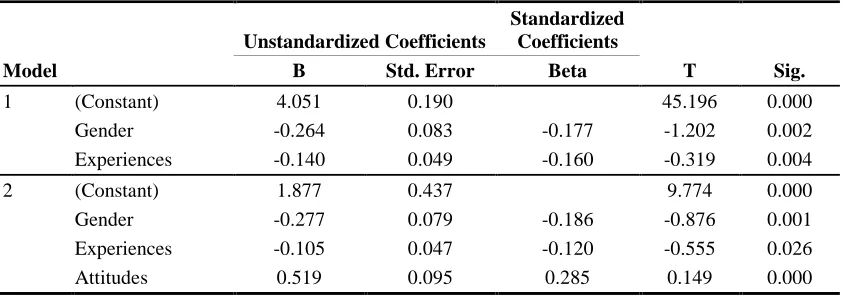
effects of teachers’ gender and teaching experience, R squared change = 0.080, F change (1, 331) = 29.997, p= 0.000. In the final model, attitudes (Table 1), recording to the beta value of 0.285 with p-value less than 0.05.
Table-1.The Result of Multiple Regression Test
Model
Unstandardized Coefficients
Standardized Coefficients
T Sig.
B Std. Error Beta
1 (Constant) 4.051 0.190 45.196 0.000
Gender -0.264 0.083 -0.177 -1.202 0.002
Experiences -0.140 0.049 -0.160 -0.319 0.004
2 (Constant) 1.877 0.437 9.774 0.000
Gender -0.277 0.079 -0.186 -0.876 0.001
Experiences -0.105 0.047 -0.120 -0.555 0.026
Attitudes 0.519 0.095 0.285 0.149 0.000
a. Dependent Variable: Level of Use
The findings showed that the attitude significantly predicts the level of use towards instructional computer technology when the effect of gender and teaching experience are controlled. The finding is aligned with Bullock (2004) who found that teacher attitude is a major influence in the adoption of technology. The finding also is almost similar with a number of studies which showed that attitudes towards instructional computer technology is a major factor related to both the initial acceptance of computer technology and future behavior regarding computer usage (Koohang, 1989; Violato et al., 1989; Selwyn, 1997). Indeed, teachers’ attitudes are regarded as a major predictor for the use of new technologies in instructional settings (Isleem, 2003; Albirini, 2006). According to Harrison and Rainer (1992), participants with negative attitudes toward computers were less skilled and slower to adopt technology than those with positive attitudes. Therefore, teachers’ attitudes towards computer technology play a significant role in actual use and acceptance.
As the finding of the showed that the attitudes predict the level of use, thus, the finding of the study, to a certain extent, support the Technology Acceptance Model (TAM) which provides an understanding of the determinants of information technology usage (Davis et al., 1989). According to TAM, behavioral intentions of individuals are used to predict usage and, in turn focus on the identification of the determinants of intention, such as attitudes which is the predictor variable for this analysis. As TAM did not go into details on how the determinant predicts the usage of computer, Bandura’s Social Cognitive Theory is suggested to be taken into account in order to complement TAM in explaining how attitudes predicts the level of use towards instructional computer technology. This leads to the further analysis which tested whether self-efficacy mediated the relationship between attitudes and level of use towards instructional computer technology.
standardized regression coefficient for peer victimization was ß = 0.285, p <.05 (F-change3,331 = 29.997, p <.05, R2change = 0.080). Step 2 demonstrated that the self-efficacy was a significant, positive predictor of level of use. The standardized regression coefficient for self-efficacy was ß = 0.285, p <.05 (F-change3,331 = 86.757, p <.05, R
2
change = 0.199). Step 3 demonstrated that the attitudes were a significant, positive predictor of self-efficacy. The standardized regression coefficient for attitudes was ß = 0.456, p <.05 (F-change3,331 = 93.132, p <.05, R2change = 0.204).
Table- 2. Meditational analysis for testing hypothesis 7
Note. “NA” represents not applicable, i.e., that variable was not entered into that step. *p<.05.
All conditions for mediation, according to Baron and Kenny (1986) hold for this model. The next analysis of step 4 revealed that a fully mediated model exists due to the result of attitudes (β = 0.095, p > 0.05), which was found not to be significant, unique predictor of the intention to level of use (F-change3,331 = 3.007, p >.05, R2change = 0.007). It was found that self-efficacy was a significant, positive predictor of level of use. The standardized regression coefficient for level of use was ß = 0.417, p <.05. The results for the meditational model between attitudes and self-efficacy were then examined using Sobel’s test ( Soper, 2011). This indicated that the self-self-efficacy did significantly mediate the relationship between attitudes and the level of use towards instructional computer technology (z′ = 6.73, p = 0.00, p < 0.05; using the Sobel calculator provided by Preacher and Leonardelli (2006). Thus, it can be concluded that self-efficacy fully mediates the relationship between the attitudes and level of use.
Further analysis through mediating statistical analysis in this study founded that self-efficacy fully mediates the relationship between the attitudes and the level of use towards instructional computer technology. This study found that social study teachers who had a positive attitudes towards instructional computer, had to have a believed in their capability of performing a specific task related with instructional computer technology before they use the instructional computer technology in performing their teaching tasks. The findings showed that Bandura’s Social Cognitive Theory can be used as an additional theory with TAM to explain the complex relationship between attitudes and level of use towards instructional computer technology which is mediated by self-efficacy.
The finding of self-efficacy which acts a mediator in this study is almost similar with findings of the study done by Hendrix (2010) and Saade and Kira (2009). As this study found that self-Variables
Standardized Betas
Step1 C+X = Y
Step 2 C+Z = Y
Step 3 C+X = Z
Step 4 C+Z+X = Y Controlled variables (C)
Gender Teaching experiences -0.186* -0.120* -0.164* -0.032 -0.043 -0.212* -0.168* -0.032 Independent variable (X)
Attitudes 0.285* NA 0.456* 0.417*
Dependent variables (Z)
efficacy serves a mediator for the relationship between attitudes and level of use towards instructional computer technology, thus, the findings can be connected with several past studies which indicate that individuals have negative or positive ideas about a behavior before they use it and these ideas affect their course of action (Bandura, 1986; Albion, 2001; Topkaya, 2010). Self-efficacy, according to Bandura (1977), is a belief that one can successfully execute behaviour or perform specific tasks to produce an outcome. Human motivation and action, Bandura believed, is regulated by forethought. People who feel capable of achieving the goal work harder and rarely give up as opposed to those with low self-efficacy (Bandura, 1986; 1999).
Many previous studies (Peng et al., 2006; Wu and Tsai, 2006; Kao and Tsai, 2009) had examined the relationship between attitudes and self-efficacy regarding the computer and/or the Internet. Several studies indicated that computer self-efficacy was associated with user attitudes toward computers (Smarkola, 2008; Hsu et al., 2009). Hsiao and Lin (2010) indicated that computer attitudes contribute to positive influence on computers self-efficacy. On the other hand, several studies revealed that self-efficacy predict the use of computer technology. For example, Teo (2009)examined the relationship between computer self-efficacy and intended uses of technology of student teachers. Analysis was conducted using the structural equation modeling approach and a good model fit was found for both the measurement and structural models. The results of Teo’s study offer some evidence that student teachers’ self-efficacy is a significant influence on whether they use technology in a traditionalist or constructivist way.
Also known as computer self-efficacy, teachers’ judgements of their ability has been found to be a significant predictor of technology usage and intention to use technology (Teo, 2009). Compeau and Higgins (1995) found that participants with higher self-efficacy beliefs used computers more often and experienced less computer-related anxiety. Compeau and Higgins also noted that individuals with higher computer self-efficacy beliefs tend to see themselves as able to use computer technology. On the other hand, individuals with lower computer self-efficacy beliefs become more frustrated and more anxious working with computers and hesitate to use computers when they encounter obstacles. Albion (2001) noted that teachers' self-efficacy or belief in their capacity to work effectively with computers was a significant factor in determining their patterns of computer use.
5. CONCLUSION AND IMPLICATION
teachers intensively and systematically in order to enhance their skills on using instructional computer technology.
REFERENCES
Acıkalın, M. and E. Duru, 2005. The use of computer technologies in the social studies classroom. The
Turkish Online Journal of Educational Technology, 4(2): 18-26.
Albion, P., 2001. Some factors in the development of self-efficacy beliefs for computer use among teacher
education students. Journal of Technology and Teacher Education, 9(3): 321-347.
Albirini, A., 2006. Teachers’ attitudes toward information and communication technologies: The case of
Syrian EFL teachers. Journal of Computers and Education, 47(4): 373–398.
Alhajri, R., 2007. Teachers' beliefs and self-efficacy with respect to computer technology integration for
teaching and learning, as a comparative study across two countries, Oman and Malaysia
(Unpublished PhD Thesis), Universiti Sains Malaysia, Malaysia.
Almuqayteeb, T., 2009. Attitudes of female faculty toward the use of computer technologies and the barriers
that limit their use of technologies in girls colleges in Saudi Arabia (Doctoral Dissertation,
Mississippi State University). Available from ProQuest Dissertations and Theses, UMI No.
3380496.
Alzamil, O.L., 2003. High school social studies teachers’ attitudes and usage of instructional technology in
Saudi Arabia (Doctoral Dissertation, University of Arkansas). Available from ProQuest
Dissertations and Theses, UMI No. 3097294.
Bandura, A. 1977. Self-efficacy: Toward a unifying theory of behavioral change. Psychology Review, 84(4):
215-252.
Bandura, A., 1986. Social foundations of thought and action: A social cognitive theory. Englewood, NJ:
Prentice-Hall.
Bandura, A., 1999. Social cognitive theory: An agentic perspective. Asian Journal of Social Psychology, 2(1):
21-41.
Baron, R.M. and D.A. Kenny, 1986. The moderator-mediator variable distinction in social psychological
research: Conceptual, strategic, and statistical considerations. Journal of Personality and Social
Psychology, 51(6): 1173-1182.
Bates, R. and S. Khasawneh, 2007. Self-efficacy and college students, perceptions and use of online learning
systems. Computers in Human Behavior, 23(1): 175–191.
Boon, R.T., 2007. Teachers' attitudes and perceptions toward the use of inspiration 6 software in inclusive
world history classes at the secondary level (Doctoral Dissertation). Available from ProQuest
Dissertations and Theses, UMI No. 778786.
Bullock, D., 2004. Moving from theory to practice: An examination of the factors that preservice teachers
encounter as they attempt to gain experience teaching with technology during field placement
experiences. Journal of Technology and Teacher Education, 12(2): 211–237.
Chen, C., Y. Fan and C. Farn, 2007. Predicting electronic toll collection service adoption: An integration of
the technology acceptance model and the theory of planned behavior. Transportation Research,
Compeau, D.R. and C.A. Higgins, 1995. Computer self-efficacy: Development of a measure and initial test.
MIS Quarterly, 19(2): 212-391.
Compeau, D.R., C.A. Higgins and S. Huff, 1999. Social cognitive theory and individual reactions to
computing technology: A longitudinal study. MIS Quarterly, 23(2): 145-158.
Davidson, G., 1996. How do attitudes of parents, teachers, and students affect the integration of technology
into schools? A case study. ERIC digest. Retrieved from ERIC Database, ED 373 710.
Davis, F.D., R.P. Bagozzi and P.R. Warshaw, 1989. User acceptance of computer technology: A comparison
of two theoretical models. Management Science, 35(8): 982-1003.
Davis, M. and M. Henry, 1993. Technology implementation in two restructuring schools: Past, present and
future. ERIC digest. Retrieved from ERIC Database, ED 362 162.
Dawson, K., G. Bull and C. Swain, 2000. Considerations for the diffusion of technological innovations in
social studies teaching and learning. Theory and Research in Social Education, 28(4): 587-595.
Dinev, T. and Q. Hu, 2007. The centrality of awareness in the formation of user behavioral intention toward
protective information technologies. Journal of the Association for Information Systems, 8(7):
386-408.
Dynneson, T.L. and R.E. Gross, 1982. Citizenship education and the social studies: Which is which. The
Social Studies, 73(5): 223-229.
Gall, M.D., J.P. Gall and W.R. Borg, 2007. Educational research: An introduction 8th Edn., Boston: Pearson
International Edition.
Hair, J.F.H., R.E. Anderson, R.L. Tatham and W.C. Black, 1998. Multivariate data analysis. Ed. Ke-5. New
Jersey: Prentice Hall.
Harrison, A. and K. Rainer, 1992. The influence of individual differences on skill in end-user computing.
Journal of Management Information Systems, 9(1): 93-111.
Hassell, D., 2000. Issues in ICT and geography. In Fisher,C and Binns, (Eds) Issues in geography teaching.
London and New York: Routledge Falmer. pp: 80 – 92.
Havelka, D., 2003. Predicting software self-efficacy among business students: A preliminary assessment.
Journal of Information Systems Education, 14(2): 145–152.
Hendrix, D.M., 2010. Computer self-efficacy among health information students (Doctoral Dissertation,
Walden University). Available from ProQuest Dissertations and Theses. UMI No. 3450599.
Hill, W.F., 1977. Learning: A survey of psychological interpretations. New York.
Hirvela, A. 2006. Computer-mediated communication in ESL teacher education. ELT Journal: English
Language Teachers Journal, 60(3): 233-241.
Hsiao, H.C. and T.Y. Lin, 2010. Computer self-efficacy, computer anxiety, and attitudes toward computers: A
study of vocational high school teachers in Taiwan. The International Journal of Learning, 17(8): 356- 363.
Hsu, M.K., S.W. Wang and K.K. Chiu, 2009. Computer attitude, statistics anxiety and self-efficacy on
statistical software adoption behavior: An empirical study of online MBA learners. Computer in
Human Behavior, 25(2): 412-420.
Huang, H.M. and S.S. Liaw, 2005. Exploring user’s attitudes and intentions toward the web as a survey tool.
Isleem, M., 2003. Relationships of selected factors and the level of computer use for instructional purposes by
technology education teachers in Ohio public schools: A statewide survey (Doctoral Dissertation,
Ohio State University). Available from ProQuest Dissertations and Theses. UMI No. 3124087. Kao, C.P. and C.C. Tsai, 2009. Teachers’ attitudes toward web-based professional development, with relation
to internet self-efficacy and beliefs about web-based learning. Computers & Education, 53(1):
66-73.
Kesten, A., 2006. A case study: Social studies preservice teachers’ perceptions and attitudes toward computer
technologies (Doctoral Dissertation, The Pennsylvania State University). Available from ProQuest
Dissertations and Theses. UMI No. 3229414.
King, W.R. and J. He, 2006. A meta-analysis of the technology acceptance model. Information &
Managemement, 43(6): 740-755.
Koohang, A.A., 1989. A study of attitudes toward computers: Anxiety, confidence, liking and perception of
usefulness. Journal of Research on Computing in Education, 22(2): 137-150.
Legris, P., J. Ingham and P. Collerette, 2003. Why do people use information technology? A critical review of
the technology acceptance model. Information & Management, 40(3): 191-204.
Mathieson, K., 1991. Predicting user intentions: Comparing the technology acceptance model with the theory
of planned behavior. Information Systems Research, 2(3): 173-191.
Ministry of Education, 1999. Development of education. The national report of the Sultanate of
Oman1994-1996. Presented to the 45th Session of the International Conference of Education. Geneva.
Ministry of Education, 2001. Basic education in the Sultanate of Oman: The theoretical framework. Muscat:
Sultanate of Oman.
Ministry of Education, 2002. The national colloquium about secondary education development in G11 and
G12. Muscat: Sultanate of Oman.
Ministry of Education, 2003. The scope and sequence of social studies for basic education (Grades 1-10),
Oman.
Ministry of Education, 2006. Student-centered approach project. Educational supervision administration.
[CD-ROM]. Muscat: Sultanate of Oman.
Ministry of Education, 2007. The educational development. Issue 21st. Muscat: Sultanate of Oman.
Ministry of Education, 2008. Number of social studies teachers in the second cycle schools during the
academic year 2007/2008. [Brochure]. Muscat, Oman.
Montigny, F.D., 2001. Teachers’ perceptions of self-efficacy and beliefs regarding information and
communications technology (ICT), Proceedings of society for information technology and teacher
education international conference (12th, Orlando, Florida, March 5-10), (ERIC Document Full-text
Reproduction Service No ED 457836).
Myers, J.M. and R. Halpin, 2002. Teachers, attitudes and use of multimedia technology in the classroom:
Constructivist-based professional development training for school districts. Journal of Computing in
Teacher Education, 18(4): 133-140.
Northrup, T., 1990. Are social studies teachers using computers? ERIC Dugest. Retrieved from ERIC
Database, No. ED 342719
Nunnally, J.O., 1978. Psychometric theory. New York: McGraw-Hill.
Pallant, J., 2005. Survival manual a step by step guide to data analysis using SPSS for windows (Version 12).
Crows Nest NSW, Australia.
Peake, J.B., G. Briers and T. Murphy, 2005. Relationships between student achievement and levels of
technology integration by texas agriscience teachers [Electronic Version]. Journal of Southern
Agricultural Education Research, 55(1): 19-32.
Peng, H., C.C. Tsai and Y.T. Wu, 2006. University students self-efficacy and their attitudes toward the
internet: The role of students perceptions of the internet. Educational Studies, 32(1): 73-86.
Preacher, K.J. and G.J. Leonardelli, 2006. Calculation for the sobel test: An interactive calculation tool for
mediation tests. Available from http://www.psych.ku.edu/preacher/sobel/sobel.htm.
Quintana, J.L., 2006. A causal comparative factorial analysis of factors affecting service level agreements in a
U.S. Navyenterprise information systems network. (Master Dissertation, Eastern Michigan
University). Available from Digital Commons @ EMU.
Rice, M.L. and E.K. Wilson, 1999. How technology aids constructivism in the social studies classroom. Social
Studies, 90(1): 28-33.
Saade, R. and D. Kira, 2009. Computer anxiety in e-learning: The effect of computer self-efficacy. Journal of
Information Technology Education, 8(2): 177-187.
Sadik, A., 2006. Factors influencing teachers, attitudes toward personal use and school use of computers: New
evidence from a developing nation. Evaluation Review, 30(1): 86-113.
Sahin, I. and A. Thompson, 2006. Using rogers’ theory to interpret instructional computer use by COE faculty.
Journal of Research on Technology in Education, 39(1): 81–104.
Schepers, J. and M. Wetzels, 2007. A meta-analysis of the technology acceptance model: Investigating
subjective norm and moderation effects. Information & Management, 44(1): 90-103.
Selwyn, N., 1997. Students’ attitudes toward computers: Validation of a computer attitude scale for 16-19
education. Computers & Education, 28(1): 35-41.
Smarkola, C., 2008. Efficacy of planned behavior model: Beliefs that contribute to computer usage intentions
of student teachers and experienced teachers. Computers in Human Behavior, 24(3): 1196–1215.
Smith, S.M., 2000. Computer self-efficacy: An examination of the sources and the impact of computer
technology education. NABTE Review, 27(1): 53-58.
Soper, D.S., 2011. Sobel test calculator for the significance of mediation. Available from
http://www.danielsoper.com/statcalc3.
Sun, H. and P. Zhang, 2006. The role of moderating factors in user technology acceptance. International
Journal of Human-Computer Studies, 64(2): 53-78.
Taylor, S. and P. Todd, 1995. Assessing IT usage: The role of prior experience. MIS Quarterly, 19(4):
561-570.
Teo, T., 2006. Attitudes toward computers: A study of post-secondary students in Singapore. Interactive
Learning Environments, 14(1): 17-24.
Teo, T., 2009. Examining the relationship between student teachers’ selfefficacy beliefs and their intended
uses of technology for teaching: A structural equation modelling approach. The Turkish Online
Journal of Educational Technology, 8(4): 7-14.
Topkaya, E.Z., 2010. Pre-service english language teachers’ perceptions of computer self-efficacy and general
Violato, C., A. Mariniz and W. Hunter, 1989. A confirmatory factor analysis of a four-factor model of
attitudes toward computers: A study of pre-service teachers. Journal of Research on Computers in
Education, 22(2): 199-213.
White, C., 1999. It,s not just another new thing: Technology as a transformative innovation for social studies
teacher education. Journal of Technology and Teacher Education, 7(1): 3-12.
Woodrow, J.E., 2000. Locus of control and student teacher computer attitudes. Computers in Education,
14(5): 421-432.
Wu, Y.T. and C.C. Tsai, 2006. University students internet attitudes and internet self-efficacy: A study at three
universities in Taiwan. Cyber Psychology & Behavior, 9(4): 441-450.