
Scholarship@Western
Scholarship@Western
Electronic Thesis and Dissertation Repository
8-13-2013 12:00 AM
Toxin-Induced Gustatory Conditioning in Rats: Examining the
Toxin-Induced Gustatory Conditioning in Rats: Examining the
Effects of Low Dose Toxins in Food on Rat Feeding Behaviour and
Effects of Low Dose Toxins in Food on Rat Feeding Behaviour and
Avoidance Conditioning
Avoidance Conditioning
Amber N. Good
The University of Western Ontario
Supervisor
Klaus-Peter Ossenkopp
The University of Western Ontario Joint Supervisor Martin Kavaliers
The University of Western Ontario Graduate Program in Neuroscience
A thesis submitted in partial fulfillment of the requirements for the degree in Master of Science © Amber N. Good 2013
Follow this and additional works at: https://ir.lib.uwo.ca/etd
Part of the Cognitive Neuroscience Commons
Recommended Citation Recommended Citation
Good, Amber N., "Toxin-Induced Gustatory Conditioning in Rats: Examining the Effects of Low Dose Toxins in Food on Rat Feeding Behaviour and Avoidance Conditioning" (2013). Electronic Thesis and Dissertation Repository. 1413.
https://ir.lib.uwo.ca/etd/1413
This Dissertation/Thesis is brought to you for free and open access by Scholarship@Western. It has been accepted for inclusion in Electronic Thesis and Dissertation Repository by an authorized administrator of
AVOIDANCE CONDITIONING.
(Thesis format: Integrated Article)
by
Amber Nicole Good
Graduate Program in Neuroscience
A thesis submitted in partial fulfillment of the requirements for the degree of
Master of Science
The School of Graduate and Postdoctoral Studies The University of Western Ontario
London, Ontario, Canada
ii
ABSTRACT
Foraging animals must learn which foods in their environment will maximize their nutritional
needs but minimize the amount of ingested toxins. These animals rely on the integration of
sensory and gustatory information and post-ingestive feedback from the foods they consume.
Gustatory conditioning can be studied by using the conditioned taste avoidance paradigm and
the toxin LiCl. This thesis first examined the dose related effects of low levels of LiCl on the
ingestion of different palatable sucrose and salt solutions. The present findings support the
hypothesis that rats use a behavioral tolerance mechanism to regulate their intake of foods
containing low levels of toxins. Possible toxin-nutrient trade-off behaviors were also
examined. It was found that when presented with a palatable sweetener and salt solution, rats
will increase their consumption of the toxic food only when the calorie reward is high.
Keywords
Gustatory conditioning, lithium chloride, conditioned taste avoidance, drinking behavior,
toxin suppression of feeding, behaviorally regulated tolerance, microstructural licking,
iii
ACKNOWLEDGMENT OF CO-AUTHORSHIP
This is acknowledgment of the contributions of Drs. Klaus-Peter Ossenkopp and Martin
Kavaliers for their input into the formation of the present experiments and their valuable
iv
ACKNOWLEDGMENTS
First I would like to thank my supervisors, Drs. Klaus-Peter Ossenkopp and Martin
Kavaliers, for their guidance throughout my Masters. Your support and reassurance have
been greatly appreciated over the last few years. Secondly, I would like to thank Dr. Shelley
Cross-Mellor for piquing my interest in research and for her respected advice and
encouragement. I would also like to acknowledge OGS for their financial support of this
project. To Caylen Duke and Kelly Foley, my colleagues and friends, your help and advice
was greatly appreciated. And lastly, thanks to Stacey, for making this process much more
entertaining.
v
DEDICATION
I would like to dedicate this thesis to my parents, Dwayne and Mary Good. Knowing that
you have supported my decisions, both academic and personal, means a great deal to me and
I thank you for the opportunities you have given me. Here’s where all your money went,
vi
TABLE OF CONTENTS
Abstract. ... ii
Co-Authorship Statement... iiiii
Acknowledgments ... iv
Dedications………..v
Table of Contents ... vi
List of Figures ... iix
Chapter 1 General Introduction ... 1
1.1 Introduction ... …..2
1.2 References ... …..7
Chapter 2 Modelling the effects of low toxin levels in food on feeding: Dose-dependent reduction of fluid intake by low levels of lithium chloride ... 10
2.1 Introduction ... 11
2.2 Methods…..………...…..………..…..14
2.2.1 Animals…..……….……..….14
2.2.2 Apparatus..………..……….…...14
2.2.3 Procedure..……….….…….…...14
2.2.4 Data Analysis...……….…….……….15
2.3 Results………..……….…..…..16
2.3.1 Acquisition Phase…...……….……....16
2.3.2 Extinction Phase…..……….……….…….17
2.4 Discussion……….……….……….………20
vii
Examining possible behavioral toxin-nutrient trade-offs in rats presented with
sucrose solutions containing low doses of LiCl………....26
3.1 Introduction...…….……….27
3.2 Methods……….………....30
3.2.1 Animals.…….………….……….………...30
3.2.2 Apparatus….……….………...30
3.2.3. Procedure….……….….………….…31
3.2.4 Data Analysis….………..…………...…32
3.3 Results………..…….……33
3.3.1 Acquisition Phase……….…..……….33
3.3.2 Extinction Phase……….….………38
3.4 Discussion………...………..…………44
3.5 Reference List……….…………..47
Chapter 4 Toxin-nutrient trade-offs: Examining the effects of caloric value on rats’ tolerance of low dose LiCl ... 51
4.1 Introduction ………52
4.2 Methods…...……….……….…...55
4.2.1 Animals.……….………….……….…..55
4.2.2 Apparatus…….………..…....55
4.2.3. Procedure……….…..…56
4.2.4 Data Analysis….……….………57
4.3 Results……….….58
4.3.1 Acquisition Phase………....…..58
4.3.2 Extinction Phase………..…..…68
4.4 Discussion………...………...…70
viii
General Discussion ... 78
5.1 Dicussion... 79
5.2 References List ... 84
ix
LIST OF FIGURES
Figure 2.1 – (A) Number of licks (B) LiCl Dose Response………..18
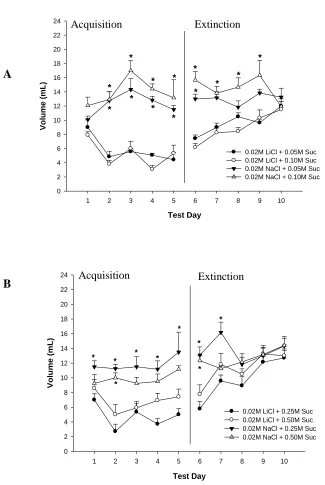
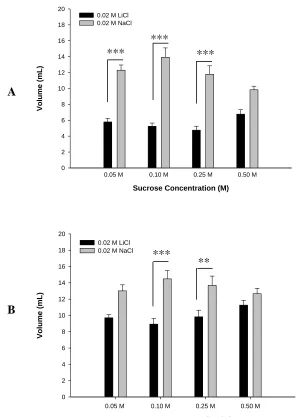
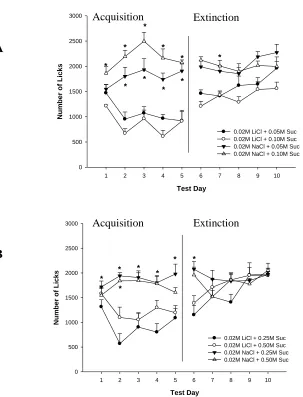
Figure 3.1 - Group volume intake for (A) 0.05 and 0.10 M Sucrose, and
(B) 0.25 and 0.50 M Sucrose ……….….34
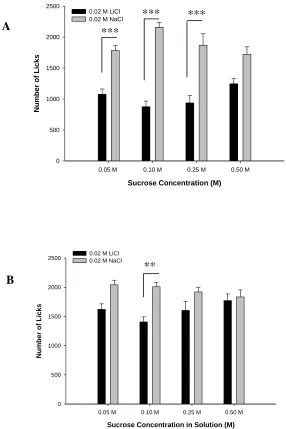
Figure 3.2 - Total intake during (A) acquisition, (B) extinction phase….……….…………35
Figure 3.3 - Group number of licks for (A) 0.05 and 0.10 M Sucrose, and
(B) 0.25 and 0.50 M Sucrose………..…….36
Figure 3.4 - Total number of licks during (A) acquisition and (B) extinction phase ……....37
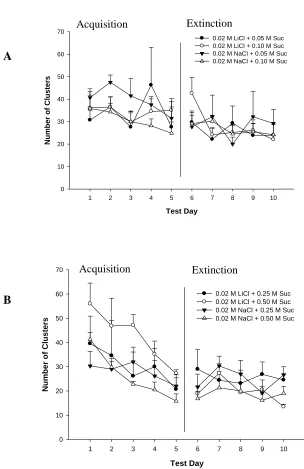
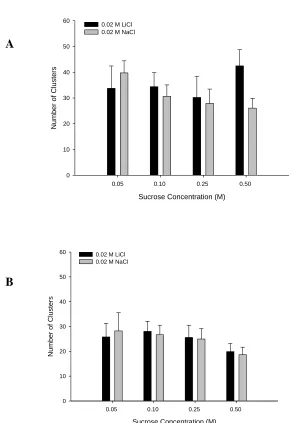
Figure 3.5 - Group number of clusters for (A) 0.05 and 0.10 M Sucrose, and
(B) 0.25 and 0.50 M Sucrose………..….39
Figure 3.6 - Total number of clusters during (A) acquisition and (B) extinction phase…....40
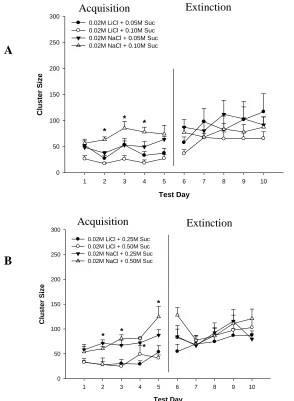
Figure 3.7 - Group size of clusters for (A) 0.05 and 0.10 M Sucrose, and
(B) 0.25 and 0.50 M Sucrose………..…….41
Figure 3.8 - Total size of clusters during (A) acquisition and (B) extinction phase….…..….42
Figure 4.1 - Daily group volume intake………..……….……59
Figure 4.2 - Volume intake by (A) acquisition phase and (B) extinction phase………..60
Figure 4.3 - Daily group number of licks………61
Figure 4.4 - Number of licks by (A) acquisition phase and (B) extinction phase………..….63
Figure 4.5 - Daily group number of clusters……….………...64
Figure 4.6- Number of clusters by (A) acquisition phase and (B) extinction phase……..…..65
Figure 4.7 - Daily group size of clusters……….…….66
Chapter 1
1.1 Introduction
Organisms are in a continuous battle to maintain a state of equilibrium with their
internal and external environments. Foraging animals are often faced with the task of
learning which foods in their environment will meet their nutritional and energetic needs,
and which will have harmful effects when ingested. However, this task is not a simple
choice of “one or the other”. Foraging animals are generally presented with a wide
variety of food options, each with different nutrients and toxins that are combined in one
food source. Homeostatic state can be upset by a diet with nutritional deficits or
potentially toxic metabolites (Glenndinning, 2007; Provenza et al., 1998). It is this
integration of nutrients and chemical contents into one food source that drives foraging
behavior (see Forbey, et al., 2009). The goal is to learn which foods, and how much of
those foods, are safe to consume for homeostatic purposes, without overdosing on any
one toxin. To accomplish this, animals must learn to associate the tastes/flavours of food
with their accompanying post-ingestive effects (Yearsley et al., 2006). These associations
can develop into food preferences or aversions, depending on the beneficial or
detrimental post-ingestive consequences of these foods (Yearsley et al., 2006).
Thus, a key step in learning which foods, or how much of a food, can be safely
consumed, depends on the visceral feedback an animal receives after consumption. With
the presentation of a new food or flavour, animals will exhibit neophobic behavior and
limit their intake until post-ingestive feedback has been experienced (Corey, 1978; Lin,
Amodeo, Arthurs, & Reilly, 2012). With no subsequent negative gastrointestinal or
systemic effects, the food is deemed as safe and familiar, so intake will increase (Lin et
al., 2012). On the other hand, if a novel taste is followed by negative post-ingestive
effects, such as nausea or other gastrointestinal malaise and distress, the animal will
acquire an aversion to or avoidance of that food (e.g., Bures et al., 1998; Cross-Mellor et
al., 2004; Garcia et al., 1955; Garcia et al., 1985; Garcia and Koelling, 1967; Nachman
and Ashe, 1973; Ossenkopp & Eckel, 1995).
A conditioned avoidance occurs when an animal ingests a novel food/flavour and
then becomes ill, minutes to hours later. It may take only minutes for animals to learn the
association between the novel food and negative post-ingestive effects, such as
al., 1998; Garcia et al., 1985; Garcia et al., 1955; Garcia & Koelling, 1967). Upon
subsequent presentations of the food/flavour alone, animals will avoid consumption
(Cross-Mellor et al., 2004; Garcia et al., 1985; Nachman & Ashe, 1973). If the reaction
to the novel food is strong enough, it will only take one pairing for the animal to make
the associations, which can last for long time periods (Bures et al., 1998; Garcia et al.,
1955).
Most taste avoidance research has used high concentrations of toxins, such as
lithium chloride (Cross-Mellor et al., 2004; Garcia & Koelling, 1967; Nachman & Ashe,
1973; Ossenkopp & Eckel, 1995). These high concentrations can result in complete
future avoidance and are infrequently found in natural foraging situations. In nature,
foraging herbivores or omnivores encounter plant secondary metabolites, which act as the
plants defense mechanisms and produce negative systemic effects for the animals
ingesting them. The effects of these metabolites may include weight loss, gastrointestinal
distress, altered metabolic rates, or reduced digestibility of nutrients, all depending on the
type and amount of toxin consumed (Dearing, Foley, & McLean, 2005; Sorenson,
McLister, & Dearing, 2005). One plant may contain many of these toxins at low doses,
but also many different nutrients, so the most successful foraging behavior involves a
successful balance between the different nutrients and toxins, each at low doses (Villalba
& Provenza, 2009). Behavioral strategies do not often include complete avoidance due to
ubiquity and diversity of secondary metabolites (Forbey et al., 2009). For example,
herbivores select a diet from an array of plants containing different nutrients and plant
secondary metabolites, in order to avoid over consuming any one toxin (Freeland and
Janzen, 1974; Launchbaugh, Burritt & Provenza, 1993; Provenza, 1996).
Avoidances and aversions to certain foods explain why animals limit or stop their
intake, but taste-feedback interactions provide a mechanism for the association (Garcia et
al., 1985; Ossenkopp & Eckel, 1995; Provenza, 1996). Animals use these conditioned
associations to discriminate between the mixture of nutrients and toxins within a food,
and can remember the associated olfactory cues across time, due to post-ingestive
feedback (Provenza, 1995). Post-ingestive feedback is a neurally mediated interaction
between the senses and viscera, which enables animals, such as ruminants, to sense the
and preference according to the negative or positive feedback (Provenza, 1995).
Post-ingestive feedback lets animals associate a food's’ taste with its homeostatic utility and
create automatic changes in perceived palatability for that food (Garcia et al., 1985;
Provenza, 1995). Foods with adequate nutrients will increase in preference or hedonic
value, whereas foods with excess toxins or inadequate nutrients will decrease in
preference and these changes can occur within a meal or across meals (Garcia et al.,
1985; Provenza, 1995). Toxins, such as LiCl, induce upper-gastrointestinal distress and
are associated with negative shifts in the hedonic value of a food (cf. Ossenkopp & Eckel,
1995; Loy & Hall, 2002; Provenza et al., 1994).
Toxins can cause a decrease in preference for a food, but they do not necessarily
prevent animals from consuming the food entirely, especially if the food contains needed
nutrients (Wang & Provenza, 1996; 1997). Previous research studying the foraging
behavior of ruminants has shown that the degree to which animals make associations
between a food/flavor and its post-ingestive properties will depend on the impact of
nutrients or toxins, as well as the state of the animal (Yearsley et al., 2006). For example,
lambs offered different foods containing the toxin LiCl will continue to eat only the most
nutritious ones (Wang & Provenza, 1997).
Animals have developed physiological and behavioral mechanisms for dealing
with toxin-containing foods. Glendinning (2007) suggested three possible behavioral
mechanisms that animals use for increasing their tolerance for toxin defended foods.
These mechanisms have been demonstrated in many mammals such as voles, possums,
and ruminants (Duncan et al., 2006; Provenza, 1996; Roy and Bergeron, 1990; Wiggins,
McArthur, Davies, & McLean,2006). One mechanism involves “processing” foods in
order to reduce their toxin concentration (Glendinning, 2007). Voles were observed
cutting branches off young conifers and returning to them days later to consume the
branches, when concentrations of phenols and tannins were reduced (Roy & Bergeron,
1990). Similarly, a species of white-throated hoodrat utilized a food caching strategy to
reduce the concentration of turpenes in plants (Torregrossa & Dearing, 2009). These
hoodrats continuously added to their cache, but used the oldest store first, containing the
lowest amount of toxin (Torregrossa & Dearing, 2009). Humans have also been shown to
require extended root soaking time before it can be consumed
(Chiwona-Karltun et al., 2000).
A second behavioral tolerance mechanism, seen most often in ruminants and other
roaming foragers, is to switch frequently between food sources (Freeland & Janzen,
1974; Glendinning, 2007). Different plants often contain different types or concentrations
of toxins. This strategy of eating a varied diet helps to avoid toxicosis with any one toxin,
but increases the acquisition of different toxins (Provenza, 1996). For example, when
presented with two food options, each containing a different concentration of LiCl, lambs
will consume both in small amounts to avoid overloading on either one (Burritt &
Provenza, 2000).
The third mechanism by which organisms can regulate their toxin consumption is
based on a threshold point. This behaviorally regulated tolerance mechanism has been
observed in rats, birds, and marsupials. When post-ingestive aversive effects (illness
and/or gastrointestinal malaise) reach a certain level, organisms will stop food
consumption (Glendinning, 2007).
However, when animals have only one food source and it contains toxins, they
must be able to regulate their intake to avoid toxicosis, yet maximize their caloric intake.
Previous research has often employed a ‘forced exposure’ to toxin paradigm to
investigate the resulting effects on behavior. There has been much less research on the
voluntary intake of toxin containing foods. By presenting the toxin mixed into solution,
rats are forced to control their own intake and regulate what toxin amount they are
willing to consume.
The main objective of this thesis was to develop a possible model of foraging
behavior, but using voluntary intake and regulation of toxin containing food, rather than
forced toxin exposure. First, I wanted to examine the ability of rodents to process low
levels of the toxin LiCl, and monitor how their behavior is regulated with a single toxic
food source. In the first experiment (Chapter 2), rats were tested in a conditioned taste
avoidance paradigm by means of oral ingestion of a sucrose solution containing various
low levels of LiCl. Behavior was monitored by intake and lick number. After
conditioning, rats were presented with corresponding sucrose solutions containing NaCl
rats regulate their behavior in a dose-dependent manner with the LiCl concentration
present in solution.
The second aim of this thesis was to examine putative toxin-nutrient trade-off by
rodents. Foraging animals often use an integrated representation of their foods’ to decide
how much to consume (i.e. caloric value, nutritional value, and toxic contents). Trade-off
strategy here refers to the willingness of the rat to increase its toxin load, by consuming a
greater amount of solution in to maximize its caloric intake. To determine which aspect
of food contributed to trade-off behavior rodents were again tested using a paradigm that
resembled that used in the first experiment by using the conditioned taste avoidance
paradigm, this time using sucrose (Chapter 3) or saccharin (Chapter 4) and a single toxin
concentration. After conditioning, rats were presented with the corresponding sweetener
solution containing NaCl. Behavior in both phases was measured by intake, number of
licks, and microstructural licking variables (cluster number and cluster size). Chapter 3
found a pronounced trade-off effect between calories and toxin, when the amount of
calories available was high. Chapter 4 supported the idea of a toxin-nutrient trade-off
strategy used by rats when consuming a toxin containing food, as no trade-off behavior
1.2 Reference List
Bures, J., Bermúdez-Rattoni, F., & Yamamoto, T. (1998). Conditioned taste
aversion: A special kind of memory. USA: Oxford University Press.
Burritt, E.A. & Provenza, F.D. (2000). Role of toxins in intake of varied diets by
sheep. Journal of Chemical Ecology, 26, 1991-2005.
Corey, D.T. (1978). The determinants of exploration and neophibia. Neuroscience
and Biobehavioral Reviews, 2, 235-253.
Chiwona-Karltun, L., Tylleskar, T., Mkumbria, J., Medhin, G., & Rosling, H.
(2000). Low dietary cyanogen exposure from frequent consumption of potentially toxic
cassava in Malawi. International Journal of Food Sciences and Nutrition, 51, 33-43.
Cross-Mellor, S., Clarke, S.N. & Ossenkopp K.-P. (2004). Rapid toxin-induced
gustatory conditioning in rats: separate and combined effects of systemic injection or
intraoral infusion of lithium chloride. Behavioral Brain Research, 154, 423-430.
Dearing, M.D., Foley, W.J., McLean, S. (2005). The influence of plant secondary
metabolites on the nutritional ecology of herbivorous terrestrial vertebrates. Annual
Review of Ecology, Evolution, and Systematics, 36, 169-189.
Eckel, L.A. & Ossenkopp, K.-P. (1996). Area postrema mediates the formation of
rapid, conditioned palatability shifts in lithium treated rats. Behavioral Neuroscience,
110, 202–212.
Forbey, J.S., Harvey, A.L., Huffman, M.A., Provenza, F.D., Sullivan, R., &
Tasdemir, D. (2009). Exploitation of secondary metabolites by animals: A response to
homeostatic challenges. Integrative and Comparative Biology, 49, 314-328.
Freeland W.J. & Janzen, D.H. (1974). Strategies in herbivory by mammals – role
of plant secondary compounds. American Naturalist, 108, 269-289.
Garcia, J., Kimeldorf, D.J., & Koelling, R.A. (1955). Conditioned aversion to
saccharin resulting from exposure to gamma radiation. Science, 122, 157 – 158.
Garcia, J. & Koelling, R.A. (1967). A comparison of aversions induced by
X-rays, toxins, and drugs in the rat. Radiation Research Supplement, 7, 439-450.
Garcia, J., Lasiter, P.S., Bermúdez-Rattoni, F., & Deems, D.F. (1985). A general
theory of aversion learning. Annals of the New York Academy of Sciences, 443, 8 – 21.
Glendinning, J.I. (2007). How do predators cope with chemically defended foods?
Biological Bulletin, 213, 252-266.
Lin, J.Y., Amodeo, L.R., Arthurs, J. & Reilly, S. (2012). Taste neophobia and
palatability: The pleasure of drinking. Physiology and Behavior, 106, 515-519.
Launchbaugh, K.L., Burrit, E.A. & Provenza, F.D. (1993). How herbivores track
variable environments: Response to variability to phytotoxins. Journal of Chemical
Ecology, 19, 1047-1056.
Loy, I. & Hall, G. (2002). Taste aversion after ingestion of lithium chloride: An
associative analysis. Quarterly Journal of Experimental Psychology Section B, 55,
365-380.
Nachman, M. & Ashe, J.H. (1973). Learned aversion in rats as a function of
dosage, concentration, and route of administration of LiCl. Physiology & Behavior, 10,
73 – 78.
Ossenkopp, K-P., & Eckel, L.A. (1995). Toxin-induced conditioned changes in
taste reactivity and the role of the chemosensitive area postrema. Neuroscience and
Biobehavioral Reviews, 19, 99-108.
Provenza. F.D., Lynch, J. Burritt, E. & Scott, C. (1994). How goats learn to
distinguish between novel foods that differ in postingestive consequences. Journal of
Chemical Ecology, 20, 609-624.
Provenza, F.D. (1995). Postingestive feedback as an elementary determinant of
food preference and intake in ruminants. Journal of Range Management, 48, 2 – 17.
Provenza, F.D. (1996). Acquired aversions as the basis for varied diets of
ruminants foraging on rangelands. Journal of Animal Science, 74, 2010-2020.
Provenza, F.D., Villalba, J.J., Cheney, C.D., & Werner, S.J. (1998).
Self-organization of foraging behavior; from simplicity to complexity without goals. Nutrition
Research Reviews, 11, 199 – 222.
Roy, J. & Bergeron, J.M. (1990). Branch cutting behavior by vole (Microtus
pennsylvanicus): a mechanism to decrease toxicity of secondary metabolites in conifers.
Journal of Chemical Ecology, 16, 735-741.
Sorensen, J.S., McLister, J.D. & Dearing, M.D. (2005). Plant secondary
metabolites compromise the energy budgets of specialist and generalist mammalian
herbivores. Ecology, 86, 125-139.
Torregrossa, A.M. & Dearing, M.D. (2009). Caching as a behavioral mechanism
to reduce toxin intake. Journal of Mammalogy, 90, 803-810.
Villalba, J.J. & Provenza, F.D. (2009). Learning and dietary choices in
herbivores. Rangeland and Ecology Management, 62, 399-406.
Wang, J. & Provenza, F.D. (1996). Food deprivation affects preference of sheep
for foods varying in nutrients and a toxin. Journal of Chemical Ecology, 22, 2011-2021.
Wang, J.& Provenza, F.D. (1997). Dynamics of preference by sheep offered
foods varying in flavors, nutrients, and a toxin. Journal of Chemical Ecology, 23,
275–288.
Wiggins, N.L., McArthur, C., Davies, N.W. & McLean, S. (2006). Behavioral
responses of a generalist mammalian folivore to the physiological constraints of a
chemically defended diet. Journal of Chemical Ecology, 32, 1133-1147.
Yearsley, J.M., Villalba, J.J., Gordon, I.J., Kryiazakis, I., Speakman, J.R. et al.,
(2006). A theory of associating food types with their post-ingestive consequences. The
Chapter 2
MODELLING THE EFFECTS OF LOW TOXIN LEVELS IN FOOD
ON FEEDING: DOSE-DEPENDENT REDUCTION OF FLUID
INTAKE BY LOW LEVELS OF LITHIUM CHLORIDE.
A version of this chapter has been published. (A.N. Good, M. Kavaliers, & K.-P.
Ossenkopp. Modelling the effects of low toxin levels in food on feeding: Dose-dependent
reduction of fluid intake by low levels of lithium chloride. Toxicology Letters, (2013),
2.1 Introduction
Organisms must be able to determine which foods available in their environment
will meet both their energetic and nutritional needs. Foraging strategies and behaviors
that underlie food selection have evolved so that organisms can learn to maximize
nutrients and minimize toxins ingested in order to keep a balanced internal environment
(e.g., Glendinning, 2007; Provenza et al., 1998). Foraging behavior is reinforced through
feedback loops, from sensory input to motor output (Villalba & Provenza, 2007). The
first inputs come from the visual, olfactory, and taste receptor systems, which allow for
food discrimination and assessment. Visceral receptors then signal to the central nervous
system information about nutrient value and toxin load, and whether or not consumption
should continue (Janssen & Depoortere, 2013; Provenza et al., 1998; Villalba &
Provenza, 2007). This feedback also helps to determine how certain foods will be limited
in subsequent encounters and may alter the hedonic value of food (Pfister et al., 2010).
An important, behaviorally adaptive learning mechanism that helps animals avoid
consuming potentially harmful foods is conditioned taste avoidance. This learning
process allows organisms to make associations between illness and recently ingested
novel flavors (Bures et al., 1998; Garcia et al., 1955; Garcia et al., 1985). If an organism
becomes ill, within minutes to hours after ingesting a novel food or flavor, it will learn to
associate the visual or oral sensory input of the food with the induced illness. If the
reaction to the toxin is strong enough, an association between the sensory cues and the
induced illness can be made with one pairing that will last for long time periods (Bures et
al., 1998; Garcia et al., 1955, 1985).
Lithium chloride (LiCl) is a toxin frequently used to induce aversions or
avoidances of novel tastes or places in rats and other animals (c.f. O’Donnell & Gould,
2007; Riley & Freeman, 2004; Tenk et al., 2005, 2006). When LiCl is paired with a
highly palatable food or flavour, such as sucrose, the hedonic value of the flavour can
become diminished as it becomes associated with the toxic effects of LiCl (Cross-Mellor
et al., 2004; Ossenkopp & Eckel, 1995). In rodents, the toxic effects and illness
associated with LiCl can manifest within 15 - 20 min of ingestion or systemic treatment
(Garcia et al., 1985; Provenza, 1996). Nachman and Ashe (1973) first observed that the
a food, is proportional to the dose administered with higher doses of LiCl resulting in a
stronger avoidance. Effects of the route of administration on taste avoidance learning
were also examined by comparing intraperitoneal (i.p.) injections, subcutaneous
injections, and direct stomach infusion. As all of the animals tested learned the
lithium-induced avoidance, it was concluded that route of administration had little effect on the
strength of avoidance learning (Nachman & Ashe, 1973). Even with relatively low levels
of ingested toxin, a rat can establish a conditioned taste avoidance that might otherwise
not affect other behaviors, such as locomotor activity or fear responses (Nachman &
Ashe, 1973). This suggests that the formation of a taste avoidance is an automatic
response, and that gustatory conditioning is a useful paradigm in studying the
phenomenon. Orally ingested LiCl can produce robust conditioned taste avoidance
(Ladowsky & Ossenkopp, 1986; Loy & Hall, 2002) and even small quantities are able to
decrease ingestive responses to the toxin-containing flavor (Cross-Mellor et al., 2004).
Glenndinning (2007) proposed three possible behavioral mechanisms that
organisms can use to decrease toxin load and increase calories consumed. The first
mechanism involves “processing” foods in ways that will reduce the toxin content. For
example, some meadow voles will chew off small branches from plants containing a high
concentration of phenolics and tannins and then return to them at a later time for
consumption, as the toxins decay substantially across days (Roy & Bergeron, 1990).
Humans have also been shown to use this processing mechanism for plants such as
cassava, which are cyanogenic and require extended root soaking time before it can be
consumed (Chiwona-Karltun et al., 2000). The second proposed mechanism involves
switching between different foods sources having different chemical defenses. By doing
this the organism can minimize the specific toxin load from each plant, and maximize
nutrients available from the different plants. For example, ruminants will alternate food
sources in one meal and eat from each source until a threshold level of toxin from each
plant is reached (Provenza, 1996). The third mechanism by which organisms can
regulate their toxin load is based on a threshold point. This behaviorally regulated
tolerance mechanism has been observed in rats, birds, and marsupials. When
post-ingestive aversive effects (illness and/or gastrointestinal malaise) reach a certain level,
The behaviorally regulated tolerance mechanism was investigated in the current
study by presenting rats with a highly palatable food (a solution of 0.3 M sucrose plus
0.12 M salt) containing differing low doses of the toxin LiCl. As food selection involves
the interaction of sensory assessment (vision, taste and smell) and postingestive feedback,
both positive and negative (Garcia, 1989; Glendinning, 2007; Janssen & Depoortere,
2013; Provenza 1995) the present study examined the dose relationship between the oral
ingestion of different concentrations of LiCl in a standard sucrose solution on food
consumption (drinking behavior). At equimolar concentrations the smell and taste of LiCl
and NaCl solutions are indistinguishable to naïve rats (Keifer, 1978; Loy & Hall, 2002;
Nachman, 1963; Strom et al., 1970; Ossenkopp et al., 1997) and upon initial presentation
rats will consume equivalent amounts. With repeated presentation rats can eventually
learn to discriminate between the effects of equimolar NaCl and LiCl solutions. Rats
conditioned with a high dose of LiCl will also exhibit an extended extinction period when
subsequently presented with a solution of NaCl (Kiefer, 1978; Loy & Hall, 2002;
Nachman, 1963; Strom et al., 1970). This inability of rats to easily discriminate between
the smell and taste of equimolar NaCl and LiCl solutions allowed for the present
experimental design.
A highly palatable fluid (sucrose plus salt) can easily be manipulated in terms of
toxin load. In a 0.3 M sucrose solution mixed with a standard salt concentration of 0.12M
the salt component can be varied between 0.12 M NaCl to 0.12 M LiCl, as well as
mixtures of these salts, to obtain low levels of toxin load in the fluids (e.g., 0.01 M LiCl
plus 0.11 M NaCl). Note that for all solutions the total salt concentration is kept constant
at 0.12 M. As the tastes of the solutions are highly similar, the effects of drinking these
solutions on behavior relate to the post-ingestive effects of the differing levels of LiCl.
In the present experimental design the negative control solution (no toxin)
consisted of 0.3 M sucrose plus 0.12 M NaCl. A positive control solution (high toxin) of
sucrose plus 0.12 M LiCl, previously shown to condition a robust taste avoidance
(Cross-Mellor et al., 2004; Loy & Hall, 2002; Nachman & Ashe, 1973), was used to verify the
toxin induced taste avoidance effect. Of particular interest was the effect of ingesting low
levels of toxin, and these were represented by sucrose solutions that contained low
rats, maintained on a water deprivation schedule, were tested with these different fluid
solutions. Amount of fluid consumed and licking behavior were recorded for each rat and
subsequently analyzed and compared. On the basis of the behaviorally regulated
tolerance mechanism hypothesis (Glendinning, 2007) a LiCl dose-related reduction in
fluid intake and lick frequency was hypothesized to occur over days of testing in the
groups of rats drinking the various sucrose plus salt solutions.
2.2 Methods
2.2.1 Animals
Fifty-eight naïve adult male Long-Evans rats (Charles River, Quebec, Canada),
weighing 250-300 g at the start of the experiment were used. Rats were individually
housed in polypropylene cages, in a temperature controlled colony room maintained at 21
± 1º C, with a 12-h light: 12-hr dark schedule (lights on at 07:00 h). Food (Prolab rat
chow) and water was available ad libitum unless otherwise noted. The experimental
methodology was carried out according to the Canadian Council on Animal Care
guidelines and was approved by the Institutional Animal Care Committee.
2.2.2 Apparatus
An automated lickometer was used during testing (Contact 108 lick analysis
system, Dilog Instruments, Tallahassee, Fl). Eight clear Plexiglas chambers (31cm X
31cm X 40 cm) with Plexiglas lids containing air holes were used. Each chamber had a
100 mL graduated drinking tube mounted and centered on the front, with the spout being
8 cm above chamber floor. The drinking tube was accessible through an oval opening, in
which only the rats tongue could make contact, and would not alter the tongue and jaws
natural movements. Each time the rat’s tongue came into contact with drinking spout, a
non-detectable current (~60 nA) passed through the spout to complete an electric circuit,
registering one lick. Signals were amplified before being stored on a desktop computer
for compilation of licking measures (QLick, version 4.0).
2.2.3 Procedure
2.2.3.1 Water Restriction and Habituation.Over a period of five days, a split
water deprivation schedule was established. After 24h with no access to water, animals
had access to water for 30 minutes, twice daily. For the first five days water access
h–1600 h. Over the next 3 days, animals were habituated to the general testing procedure
and lickometer testing chambers. For 20 minutes a day, access to water was given in
these boxes (between 0900 h – 1100 h). After each test session chambers were cleaned
and deodorized using Alconox and baking soda. The habituation phase lasted until
drinking levels were stable (approximately 7 mL/session) for all animals. Baseline
drinking levels were recorded to ensure groups did not differ in their initial drinking
levels. The additional 30 minutes of water access was given in the home cages between
14:00 – 16:00 h.
2.2.3.2 Acquisition Phase. Once habituated, all animals were randomly assigned
to one of the six different groups drinking 0.3 M sucrose solutions with differing levels of
LiCl. On 5 days of acquisition training rats were presented with a 0.3 M sucrose plus
0.12 M salt solution for 20 min in the lickometer chambers with one of the following salt
combinations: 0.12 M NaCl (negative control; n = 10); 0.005 M LiCl + 0.115 NaCl (n =
10); 0.01 M LiCl + 0.11 NaCl (n = 10); 0.015 M LiCl + 0.105 M NaCl (n = 10); 0.02 M
LiCl + 0.10 M NaCl (n = 10); and 0.12 M LiCl (positive control; n = 8). “Intake volume”
and “number oflicks” were the dependent variables. An additional 30 minutes of water
access was again given in the home cages between 14:00 – 16:00 h.
2.2.3.3 Extinction Phase.Over the subsequent five days of testing all rats were
given 20 minutes of access to a 0.3 M sucrose + 0.12 M NaCl solution in the lickometer
chambers. Intake volume and number of licks were again recorded. 30 minutes of water
access was again provided at the usual time in the home cages.
2.2.4 Data Analysis
The lickometer system recorded and stored number of licks. Intake volume was
recorded by noting the starting and finishing volumes in the graduated tubes, recorded to
the nearest half mL. Data were analyzed with a mixed design analysis of variance
(ANOVA) procedure. In all analyses the between subjects factor was LiCl concentration
(at 6 levels; 0, 0.005, 0.01, 0.015, 0.02, 0.12 M) and the within subjects factor was Day
(at five levels; 1, 2 …5; for each phase). Significant interactions were subsequently investigated with Tukey’s HSD test of pairwise comparisons, and α = 0.05 was used as
criterion for significance. Dose-response relationships of mean fluid “intake volume”
(0.005 to 0.02 M LiCl) were examined with best fit polynomial curves and the associated
formulae were then used to calculate the ID50 (infective dose). This isused to examine
the dose of an infectious agent required to produce infection in 50 percent of the
experimental subjects. For our purpose the ID50 is the molar dose of LiCl at which 50%
reductions in the dependent variables were observed.
2.3 Results
The pattern of results was very similar for the “volume intake” data and the
“number of licks” data. As well, large positive Pearson product moment correlations were
obtained between number of licks and volume intake across all groups (correlation range
of r = 0.79 to 0.87). Thus, only the “number of licks” data are presented in Fig. 1A and
1B.
2.3.1 Acquisition Phase
2.3.1.1 Intake Volume (mL). Inspection of group mean volume consumption of a
solution containing sucrose and varying levels of LiCl indicates that the animals in the
negative control group (sucrose plus NaCl only) drank consistently high levels of fluid
across acquisition days, attesting to the high level of palatability for this solution (data
not shown). The ANOVA revealed a significant Day x LiCl concentration interaction,
F(17,175) = 4.27, p < 0.001 and post-hoc pairwise comparisons indicated that rats
drinking solutions with a LiCl concentration greater than 0.01 M were drinking
significantly less than animals in the NaCl only control group. As expected the positive
control group (0.12M LiCl) consumed significantly less than all other groups, on all
testing days. The 0.02 M LiCl group drank significantly less than NaCl control group on
days 2-5 and rats drinking 0.015 M LiCl drank less than the NaCl control group on days
2-4. A main effect of LiCl concentration was also obtained, F(5,52) = 61.75, p < 0.001,
but no main effect of Day, F(4,175) <1.
The dose related effect of low LiCl concentrations on drinking behavior was
examined using mean intake volumes on days 2 – 5 (data not shown). A significant
relationship between mean intake volume and LiCl concentration was found, F(4,45) =
29.53, p< 0.001, with the best fit polynomial curve (Y = 13.19 – 110.95X – 785.71 X2 –
633333.33 X3; R2 = 0.998) for these dose-response data indicating that ID50 = 0.0188 M
days 2 – 5 revealed that the 0.12 M LiCl group consumed a mean of 3.815 mg of LiCl.
Similarly, the 0.02, 0.015 and 0.01 M LiCl groups consumed a mean of 4.756, 5.818, and
4.866 mg of LiCl, respectively. Group 0.005 LiCl only consumed a mean of 2.645 mg/kg.
Taking body weights into account, groups 0.02, 0.015 and 0.01 M LiCl were thus
exposed to an overall mean dose of 16.90 mg/kg and group 0.005 M LiCl to a mean dose
8.55 mg/kg. Thus, these data suggest that rats drinking solutions containing low levels of
LiCl regulated their mean intake levels to no more than 16.0 to 18.0 mg/kg per day.
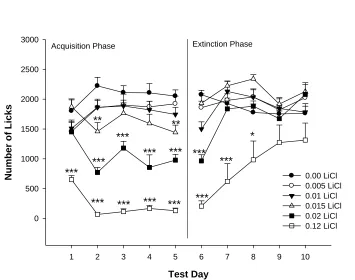
2.3.1.2 Number of Licks. Analysis of the group mean number of licks is shown in
Figure 2.1A. Inspection of this figure indicates that the animals in the negative control
group (sucrose plus NaCl only) exhibited consistently high levels of licking across
acquisition days, again attesting to the high level of palatability for this solution. A
significant Day x LiCl concentration interaction was found, F(17,173) = 3.63, p < 0.001
and post-hoc pairwise analyses showed that rats drinking 0.02 M, and 0.015 M LiCl
differed from NaCl on days 2-5, and 2 and 5, respectively. Also, rats drinking 0.02 M
LiCl displayed lower levels of licking than rats drinking 0.015 M, 0.01 M and 0.005 M
LiCl on days 2 – 5. As expected the positive control group drinking 0.12 M LiCl
displayed significantly lower levels of licking than all the other groups on all days. A
significant main effect of LiCl concentration was also obtained, F(5,52) = 51.9, p <
0.001, but no main effect of Day, F(4,173) <1.
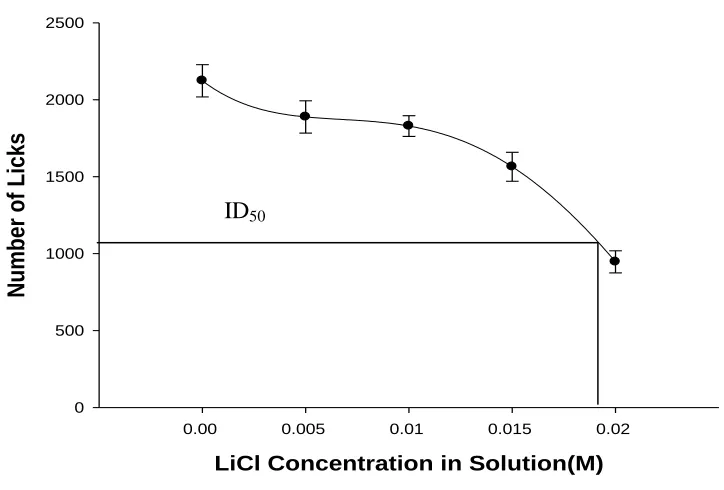
The dose related effect of low LiCl concentration on licking behavior was also
examined using mean number of licks on days 2 – 5 (Figure 2.1B). A significant
relationship between mean number of licks and LiCl concentration solution was found,
F(4,45) = 25.01, p< 0.001, with the best fit polynomial curve (Y = 2119,93 – 73830.24 X
+ 7798928.57 X2 – 352433333.33 X3; R2 = 0.996) for these dose-response data indicating
that ID50 = 0.0194 M LiCl for the number of licks.
2.3.2 Extinction Phase
2.3.2.1 Intake volume (mL). Group mean volume intake during the extinction
phase (all groups drinking sucrose plus NaCl only) was also investigated (data not
shown). A significant Day x LiCl concentration interaction was found, F(18,187) = 8.87,
p < 0.001. Post-hoc analyses revealed that on days 1-3 of extinction, the positive control
Test Day
1 2 3 4 5 6 7 8 9 10
Nu mber of Li cks 0 500 1000 1500 2000 2500 3000 0.00 LiCl 0.005 LiCl 0.01 LiCl 0.015 LiCl 0.02 LiCl 0.12 LiCl *** *** *** *** *** *** *** *** *** ** ** *** *** *** *
Acquisition Phase Extinction Phase
LiCl Concentration in Solution(M)
0.00 0.005 0.01 0.015 0.02
N
um
ber
of Lick
s
0 500 1000 1500 2000 2500
Figure 2.1(B) Dose response relationship for number of licks and LiCl concentration. Data points represent group mean number of licks for days 2 – 5, for each solution. The best fit polynomial curve (see text) for this dose-response relationship reveals that ID50 = 0.0194 M LiCl for number of licks. Error bars represent S.E.M.
the NaCl group. Rats drinking 0.015 M and 0.02 M LiCl drank significantly less than
those drinking NaCl on day 1 only. By day 3, all rats were drinking similar amounts of
sucrose plus NaCl solution. A significant main effect of Day was also obtained, F(4,187)
= 30.58, p < 0.001. The increase in fluid intake across days differed among groups (main
effect of LiCl concentration), dependent on the concentration of LiCl encountered during
the acquisition phase, F(5,52) = 13.66, p < 0.001.
2.3.2.2 Number of Licks.Group mean number of licks during the extinction phase
is depicted in Figure 2.1A (right hand panel). The ANOVA for these data revealed a
significant Day x LiCl concnetration interaction, F(17,177) = 6.05, p < 0.001. Post-hoc
analyses indicated that, in comparison to rats in the negative control group (sucrose plus
NaCl in acquisition), rats drinking 0.12 M LiCl in acquisition exhibited significantly
lower mean number of licks on days 1 – 3 of extinction. Those drinking 0.015 M and
0.02 M LiCl in the acquisition phase, licked significantly less frequently only on day 1 of
extinction, in comparison to the NaCl only control group. Both a significant main effect
of LiCl concentration, F(5,52) = 12.61, p < 0.001, anda significant main effect of Day
were also obtained, F(4,177) = 17.34, p < 0.001.
2.4 Discussion
The negative control group, drinking a 0.3 M sucrose plus 0.12 M NaCl solution,
exhibited high and consistent levels of fluid intake and number of licks, both in the
acquisition and extinction phases, indicating that this mixture had no obvious negative
post-ingestive effects. In contrast, the positive control group, drinking a 0.3 M sucrose
plus 0.12 M LiCl (toxin) solution during the acquisition phase, quickly reduced both fluid
intake levels and number of licks to very low levels, indicative of a strong taste avoidance
that already developed on the first acquisition day. The strong conditioned taste
avoidance was further evidenced by the relatively slow return to baseline levels of both
intake levels and lick number by this group during the extinction phase when drinking a
toxin free solution. These findings are consistent with previous demonstrations of strong
taste avoidance conditioning in rats drinking solutions with 0.12 M or higher levels of
Of particular interest in the present study were the groups drinking low levels of
LiCl, as these groups modeled feeding on foods with low levels of toxin. Dose dependent
effects of LiCl on ingestion were evidenced by the dose related reductions in both volume
intake and number of licks during the acquisition phase. During the extinction phase, all
rats were presented with a solution of sucrose plus NaCl, allowing the animals,
previously given LiCl, to learn that the sucrose/taste was no longer associated with toxic
effects. During the extinction phase the low toxin level groups exhibited a rapid return to
control values after the first day. These finding are consistent with the threshold
hypothesis, which suggests that rats will regulate toxin intake, even at low levels
(Glendinning, 2007). As the rats drinking the solution with 0.02 M LiCl drank
significantly less than the NaCl negative control group on days 2 -5, this concentration of
LiCl could represent a toxin threshold level to which the rats were regulating their
behavior. Indeed, the ID50 values for both the intake volume and number of licks data are
very close to this molarity of LiCl (0.0188 and 0.01935, respectively).
It is also interesting to note that the rats in the present experiment voluntarily
regulated their intake of LiCl to no more than about 18 mg/kg per day. This value is
comparable to the lowest dose (0.3 mEq/kg; 12.72 mg/kg) of LiCl which was shown to
induce a significant conditioned avoidance in a more traditional taste avoidance learning
paradigm, with rats first drinking a sucrose solution (10 min) followed by an injection
(i.p.) with 0.15 M LiCl solution (Nachman and Ashe (1973). Clearly there are major
differences in methodology between the present study and the Nachman and Ashe (1973)
study; nevertheless, the levels of LiCl which the rats are willing to tolerate in the present
experiment are similar to levels which have been shown to effectively induce conditioned
avoidances of palatable tastes. The present rat model is thus useful for examining the
regulated feeding mechanism, as it shows a clear toxin dose related, regulated feeding
process. Quantification of consumption, by using orally presented solutions is simple,
and it is easy to manipulate the toxin load in the drinking solutions.
The pattern of regulating feeding behavior observed in the present study is often
seen in natural foraging conditions. Ruminants, such as sheep, have been found to alter
their diet and limit intake of particular plants in order to minimize toxins and maximize
When presented with different plant species, each containing a different toxin, sheep will
consume one plant until a threshold for the toxin in that plant is reach and then move on
to the next plant (Pfister et al., 2010). This behavioral mechanism allows the animal to
get the benefit of the food source, yet limit toxin effects.
Cross-Mellor et al. (2004) suggested that animals may have two different
processes for regulating intake of toxic substances. If ingesting foods containing high
toxin levels, animals develop a robust, long term rejection and avoidance of these foods.
At high concentrations, LiCl and other toxins act on the chemosensitive area postrema
(AP) in the brainstem to induce conditioned taste avoidances and aversions (Borison,
1989; Eckel & Ossenkopp, 1996; Ladowsky & Ossenkopp, 1986; Ossenkopp & Eckel,
1994, 1995; Ritter et al., 1980). As well, high doses of lithium have been shown to
induce conditioned palatability shifts when paired with highly palatable tastes. These
conditioned palatability shifts are likely mediated by the chemosensitive area postrema
(Eckel & Ossenkopp, 1996; Ossenkopp & Eckel, 1995). By lesioning this structure in the
brainstem conditioned taste and place avoidances can be blocked (Ladowsky &
Ossenkopp, 1986; Ossenkopp et al., 1997; Ritter, McGlone, & Kelley, 1980). However,
when animals are ingesting foods containing low toxin levels, they may be using a
short-term transient mechanism to regulate feeding behavior within a meal and on a day to day
basis. Evidence for this mechanism comes from rats learning to discriminate between an
equimolar LiCl and NaCl solution, as these animals can develop a discrimination in the
absence of an area postrema (Ossenkopp et al., 1997), suggesting that post-ingestive
aversive cues from the gut are likely involved in the formation of this discrimination. It is
likely that the behavioral regulatory process observed in the present study also depends
on feedback of post-ingestive aversive cues from the gut. What the role of the area
postrema chemosensor might be in such behavioral regulation remains to be determined.
In conclusion, it is evident that with oral ingestion of LiCl, rats will learn taste
avoidances in a dose-dependent manner, and regulate their drinking behavior to
correspond to a toxin threshold. The strength of the avoidance is a function of the
concentration of the toxin in the food, and higher toxin concentrations result in faster
2.5 Reference List
Borison, H.L. (1989). Area postrema: chemoreceptor circumventricular organ of
the medulla oblongata. Progress in Neurobiology, 32, 351-390.
Bures, J., Bermúdez-Rattoni, F., & Yamamoto, T. (1998). Conditioned taste
aversion: A special kind of memory. USA: Oxford University Press.
Chiwona-Karltun, L., Tylleskar, T., Mkumbria, J., Medhin, G., & Rosling, H.
(2000). Low dietary cyanogen exposure from frequent consumption of potentially toxic
cassava in Malawi. International Journal of Food Sciences and Nutrition, 51, 33-43.
Cross-Mellor, S., Clarke, S.N. & Ossenkopp K.-P. (2004). Rapid toxin-induced
gustatory conditioning in rats: separate and combined effects of systemic injection or
intraoral infusion of lithium chloride. Behavioral Brain Research, 154, 423-430.
Eckel, L.A. & Ossenkopp, K.-P. (1996). Area postrema mediates the formation of
rapid, conditioned palatability shifts in lithium treated rats. Behavioral Neuroscience,
110, 202–212.
Garcia, J., Kimeldorf, D.J., & Koelling, R.A. (1955). Conditioned aversion to
saccharin resulting from exposure to gamma radiation. Science, 122, 157 – 158.
Garcia, J., Lasiter, P.S., Bermúdez-Rattoni, F., & Deems, D.F. (1985). A general
theory of aversion learning. Annals of the New York Academy of Sciences, 443, 8 – 21.
Glendinning, J.I. (2007). How do predators cope with chemically defended foods?
Biological Bulletin, 213, 252-266.
Janssen, S. & Depoortere, I. (2013). Nutrient sensing in the gut: new roads to
therapeutics? Trends in Endocrinology and Metabolism, 24, 92 - 100.
Kiefer, S.W. (1978). 2-Bottle discrimination of equimolar NaCl and LiCl
solutions by rats. Physiological Psychology, 2, 191-198.
Ladowsky, R. L. & Ossenkopp, K.-P. (1986). Conditioned taste aversions and
changes in motor activity in lithium-treated rats: Mediating role of the area postrema.
Neuropharmacology, 25, 71-77.
Loy, I. & Hall, G. (2002). Taste aversion after ingestion of lithium chloride: An
associative analysis. Quarterly Journal of Experimental Psychology Section B, 55,
Nachman, M. (1963). Learned aversion to the taste of lithium chloride and
generalization to other salts. Journal of Comparative and Physiological Psychology, 56,
343-349.
Nachman, M. & Ashe, J.H. (1973). Learned aversion in rats as a function of
dosage, concentration, and route of administration of LiCl. Physiology & Behavior, 10,
73 – 78.
O’Donnell, K.C. & Gould, T.D. (2007). The behavioral actions of lithium in
rodent models: Leads to develop novel therapeutics. Neuroscience and Behavioral
Reviews, 31, 932-962.
Ossenkopp K-P. & Eckel LA. (1994). Area postrema as a brainstem chemosensor
in defense against ingested toxins. Advances in the Biosciences, 93,485-490.
Ossenkopp, K-P., & Eckel, L.A. (1995). Toxin-induced conditioned changes in
taste reactivity and the role of the chemosensitive area postrema. Neuroscience and
Biobehavioral Reviews, 19, 99-108.
Ossenkopp, K-P., Ladowsky, R.L. & Eckel, L.A. (1997). Forced-choice
discrimination of equimolar NaCl and LiCl solutions in rats: effects of ablating the
chemosensitive area postrema on acquisition and retention. Behavioral Brain Research,
87, 15-24.
Pfister, J.A., Gardner, D.R., Cheney, C.C., Panter, K.E. & Hall, J.O. (2010). The
capability of several toxic plants to condition taste aversions in sheep. Small Ruminant
Research, 90, 114-119.
Provenza, F.D. (1995). Postingestive feedback as an elementary determinant of
food preference and intake in ruminants. Journal of Range Management, 48, 2 – 17.
Provenza, F.D. (1996). Acquired aversions as the basis for varied diets of
ruminants foraging on rangelands. Journal of Animal Science, 74, 2010-2020.
Provenza, F.D., Villalba, J.J., Cheney, C.D., & Werner, S.J. (1998).
Self-organization of foraging behavior; from simplicity to complexity without goals. Nutrition
Research Reviews, 11, 199 – 222.
Riley, A.L. & Freeman, K.B. (2004). Conditioned taste aversion: A database.
Ritter, S., McGlone, J.J., Kelley, K.W. (1980). Absence of lithium induced taste
aversion after area postrema lesion. Brain Research, 201, 501-506.
Roy, J. & Bergeron, J.M. (1990). Branch cutting behavior by vole (Microtus
pennsylvanicus): a mechanism to decrease toxicity of secondary metabolites in conifers.
Journal of Chemical Ecology, 16, 735-741.
Strom, C., Lingenfelter, A., Brody, J.F. (1970). Discrimination of lithium and
sodium chloride solutions by rats. Psychonomic Science, 18, 290 – 291.
Tenk, C.M., Kavaliers, M., & Ossenkopp, K.-P. (2005). Dose response effects of
lithium chloride on conditioned place aversions and locomotor activity in rats. European
Journal of Pharmacology, 515, 117-127.
Tenk, C.M., Kavaliers, M., & Ossenkopp, K.-P. (2006). The effect of acute
corticosterone on lithium chloride-induced conditioned place aversion and locomotor
activity in rats. Life Sciences, 11, 1069-1080.
Villalba, J.J. & Provenza, F.D. (2007). Self-medication and homeostatic behavior
Chapter 3
EXAMINING POSSIBLE BEHAVIORAL TOXIN-NUTRIENT
TRADE-OFFS IN RATS PRESENTED WITH LOW DOSE LITHIUM
3.1 Introduction
Foraging animals are faced with the task of determining which foods in their
environment are safe to consume, and which are harmful. In nature animals are often
presented with multiple food sources that offer a variety of nutrients. However, these
food sources may also be defended by a variety of toxins such as plant secondary
metabolites (c.f. Forbey et al., 2009). When consumed in large amounts, these
metabolites may cause a number of adverse side effects, such as gastrointestinal malaise
(Pfister et al., 2010; Provenza, 1996). Animals can learn to use the integration of sensory
input from the foods’ characteristics and postingestive feedback to determine how much
of one food can be ingested safely (e.g. Provenza, 1995; Provenza et al., 1999; Villalba &
Provenza, 2007). An automatic and adaptive mechanism to help guide food choice or
food preference is conditioned taste avoidance. When an animal ingests a novel
food/flavour, and then becomes ill within minutes to hours later, it will learn to associate
the sensory cues of that food with the illness and avoid it upon future encounters (Bures
et al., 1998; Garcia, Kimeldorf, & Koelling, 1955; Garcia, Lasiter, & Bermudez-Rattoni,
1985).
Lithium chloride (LiCl) is a commonly used toxin, in laboratory investigations, to
induce gastrointestinal malaise and mild nausea, and has been used frequently to
investigate conditioned taste avoidances or aversions when paired with novel flavours
(Garcia & Koelling, 1967, see Riley & Freeman, 2004). In rats, the effects of LiCl are
manifested within 15-20 minutes, but the mildly adverse effects are short lived (Garcia et
al., 1985; Loy & Hall, 2002; Provenza, 1996). Work by Nachman and Ashe (1973)
showed that the route of administration does not significantly influence the toxic effects
of LiCl. When presented orally, LiCl has been found to induce robust avoidances in a
dose-dependent manner (Ladowsky & Ossenkopp, 1986; Loy & Hall, 2002), and even
when tested at very low concentrations (Cross-Mellor et al., 2004; Good, et al., 2013).
Many previous studies with LiCl used relatively high toxin concentrations (~95 – 128
mg/kg) to establish avoidances (c.f. Riley & Freeman, 2004; Nachman & Ashe, 1973).
The mechanisms for avoidance learning at high LiCl concentrations may be different
compared to low LiCl concentrations (Cross-Mellor et al., 2004). Typically, a palatable
intake of the conditioned food.
Foraging animals are generally exposed to very low concentrations of toxins in
any one food source. When toxins are presented in food sources at low concentrations
for oral consumption, animals are willing to voluntarily manipulate their intake to
maximize nutrients, but minimize toxin intake (Good et al., 2013; Provenza, 1995;
Provenza et al., 1999). Most species use physiological and behavioral adaptations to
ensure a homeostatic balance between nutrient intake and toxin level (e.g. Barnett,
Skelhorn, Bateson, & Rowe, 2011; Bevolsky, 1978; Chiwona-Karltun, et al., 2000;
Dearing, Foley, & McLean, 2005; Duncan, Ginane, Elston, Kunaver, & Gordon, 2006;
Glendinning, 2007). In a recent study, water-deprived rats were presented with a
palatable sucrose solution containing various low concentrations of LiCl for oral
consumption (Good et al., 2013), thus allowing rats to control toxin consumption levels.
It was found that these rats used a threshold regulation strategy (suggested by
Glendinning, 2007), in which they limited the intake of the toxic solution in a
dose-dependent manner, and stopped consumption when post-ingestive feedback indicated that
a certain toxin level had been reached, in order to minimize more serious toxic effects
(Good et al., 2013). Duncan et al. (2006) showed that natural browsing ruminants show a
similar dose-dependent decline in food preference when paired with a negative stimulus.
They also suggested that the positive (i.e. nutrients) and negative effects (i.e. secondary
metabolites) associated with a food seem to act independently, and it is the integration of
both of these aspects that is responsible for the overall amount ingested.
Depending on the state of the animal, the positive post-ingestive effects from a
food may include its caloric value. Rats’ show distinct differential liking of sugars, and
the hedonic value and palatability of a sugar changes with its concentration (Ackroff,
Manza, & Sclafani, 1993; Richter & Campbell, 1940; Sclafani & Nissenbaum, 1987).
Sclafani & Nissenbaum (1987) used a two-bottle preference test to determine a
preference threshold for sucrose over water. The preference threshold was indicated at
0.0026M, but intake showed an inverted ‘U’ shape preference curve as concentration of
sucrose was increased. Rats showed increased preference for sucrose at ~ 0.05 M - 0.10
M, and then preference leveled off until ~0.25 M sucrose, and decreased at 0.50 M
present study were based on this preference curve.
The difference in taste/palatability of sucrose solutions can be further analyzed by
examining the licking behavior of the rat, especially when broken down into
microstructural components. When ingesting a liquid food source, rats lick in rapidly
occurring rhythmic tongue movements that occur in bursts (Davis, 1973). The intake and
licking behavior system is under the control of a variety of influences, including sensory,
gustatory, and post-ingestional variables (Davis & Perez, 1993). When a food source has
an attractive smell and is accompanied by a “pleasant” taste, it is rated as having high
palatability. Palatability and hedonic value of a solution can be inferred from both
consumption and the microstructural analyses of licking patterns (Baird, St. John, &
Nguyen, 2005; Dwyer, 2009; Weijnen, 1998). Microstructural analysis of licking patterns
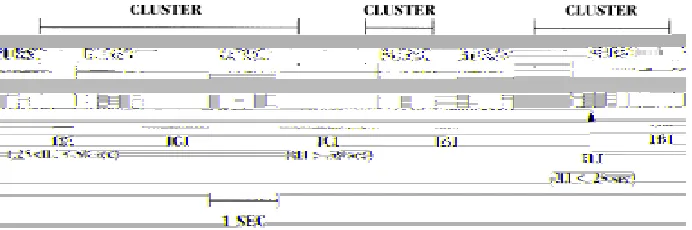
includes number of bursts, and number of clusters, and the size of bursts and clusters.
Bursts and clusters of licks are defined by the pauses between lickings. By incorporating
the toxin directly into a palatable solution, the microstructure of licking can offer
information related to the animals’ reaction to the palatability of the solution in ways that
are not possible with other techniques such as taste-reactivity tests (Dwyer, 2012; Dwyer,
Pincham, Thein, & Harris, 2009). Previous research has also shown that cluster size is
independent of consumption and that the mean number of licks in a cluster shows a
positive monotonic relationship with the concentration of a palatable fluid (Davis &
Smith, 1992; Dwyer et al., 2009), such as a sucrose solution.
The purpose of the current study was to investigate the possible use of a
toxin-nutrient trade-off strategy in rats. I was interested in examining changes in feeding
behavior when a constant LiCl concentration is used, but the sucrose concentration is
varied. Of particular interest was at what concentration the positive effects of sucrose
would outweigh the negative effects of the LiCl. Trade-off strategy here refers to the
willingness of the rat to increase its toxin load, by consuming a greater amount of
solution in to maximize its caloric intake. Previous work from our laboratory suggested
that rats regulate their intake to a possible LiCl threshold dose of 0.02 M (Good et al.,
2013), a concentration that was used in the current study. By keeping the toxin
concentration constant, it was possible to examine how much LiCl rats are willing to
Previous demonstrations that the taste and smell of equimolar concentrations of
LiCl and NaCl are indistinguishable to naive rats (Keifer, 1978; Loy & Hall, 2002;
Nachman, 1963; Ossenkopp et al., 1997; Strom et al., 1970), allowed for the use of
control solutions containing 0.02 M NaCl, in various sucrose solutions, as each
comparable LiCl and NaCl group would initially be experiencing the same taste, until
post-ingestive feedback relays the effects of LiCl. Rats that are presented with LiCl
during the acquisition phase of avoidance learning, will also generalize their avoidance to
NaCl when presented with a NaCl solution during the extinction phase. How long this
generalization lasts is also an indication of the strength of the avoidance.
When water-deprived rats are presented with a toxic solution for oral
consumption, with each group containing a different sucrose concentration, the amount
consumed could be affected by both the palatability of the solution, and the available
calories of each. It was hypothesized that when presented with a toxic sucrose solution,
the amount consumed would vary according to the concentration of sucrose. That is, with
a constant LiCl concentration, the benefits of sucrose would outweigh the toxic effects of
LiCl only at higher sucrose concentrations, and rats would consume more of the test
solution when compared to rats drinking solutions with low sucrose concentrations.
3.2 Methods
3.2.1 Animals
Fifty naïve adult male Long-Evans rats (Charles River, Quebec, Canada),
weighing 175 - 200 g at the start of the experiment were used. Rats were individually
housed in polypropylene cages, in a temperature controlled colony room maintained at 21
± 1º C, with a 12-h light: 12-hr dark schedule (lights on at 07:00 h). Food (Prolab rat
chow) and tap water were available ad libitum unless otherwise noted. The experimental
methodology was carried out according to the Canadian Council on Animal Care
guidelines and was approved by the Institutional Animal Care Committee.
3.2.2 Apparatus
An automated lickometer was used during testing (Contact 108 lick analysis
system, Dilog Instruments, Tallahassee, Fl). Eight clear Plexiglas chambers (31cm X
31cm X 40 cm) with Plexiglas lids containing air holes were used. Each chamber had a
![4,13 Diacetyl [2 2]paracyclophane](data:image/gif;base64,R0lGODlhAQABAIAAAP///wAAACH5BAEAAAAALAAAAAABAAEAAAICRAEAOw==)